
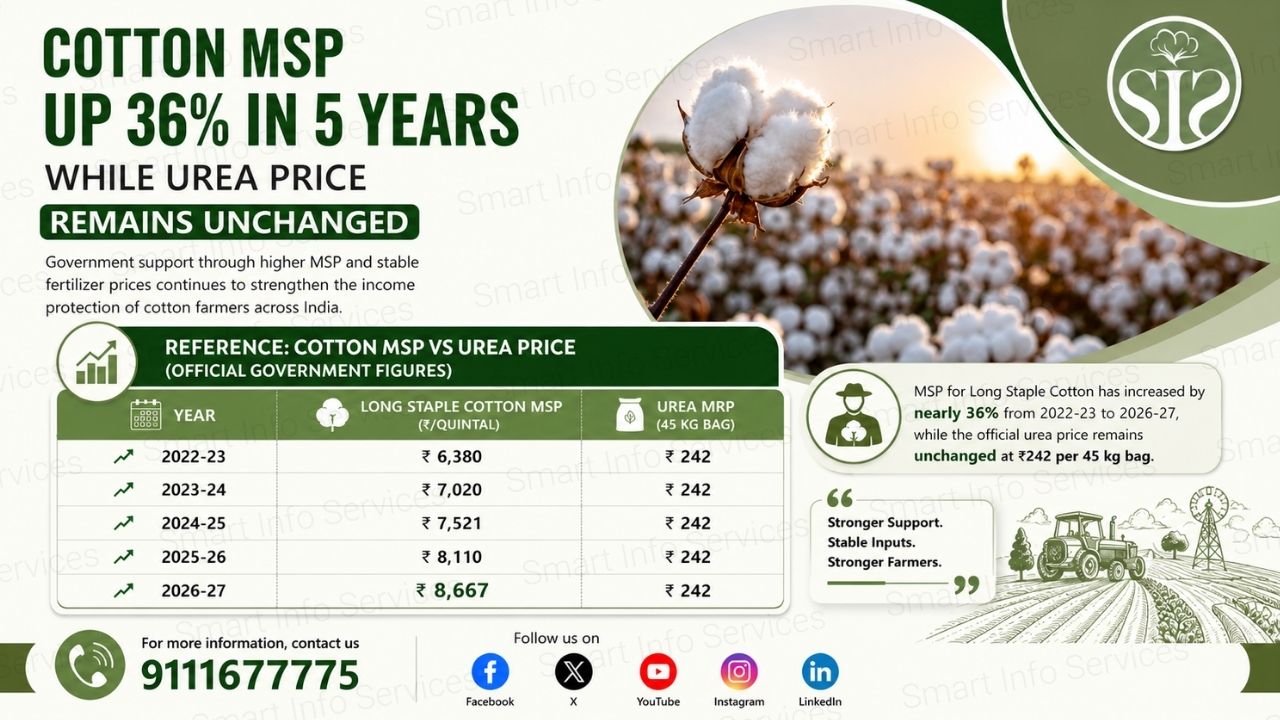
कपास का MSP 36% बढ़ा, जबकि यूरिया ₹242 पर स्थिर: क्या किसानों को आखिरकार फायदा हो रहा है?नई दिल्ली: पिछले पांच सालों में सरकारी सपोर्ट प्राइस (MSP) में भारी बढ़ोतरी से भारत के कपास किसानों को फायदा हुआ है, जबकि लगातार सब्सिडी मिलने के कारण यूरिया की सरकारी कीमत में कोई बदलाव नहीं हुआ है। इस घटनाक्रम ने इस बहस को फिर से हवा दी है कि क्या बढ़ता हुआ MSP किसानों की आय में बढ़ोतरी का कारण बन रहा है।सरकारी आंकड़ों के अनुसार, लंबे रेशे वाले कपास (Long Staple Cotton) का MSP 2022-23 में ₹6,380 प्रति क्विंटल से बढ़कर 2026-27 सीज़न के लिए ₹8,667 प्रति क्विंटल हो गया है। यह पांच सालों में ₹2,287 प्रति क्विंटल या लगभग 36 प्रतिशत की बढ़ोतरी है। 2026-27 के लिए ₹557 प्रति क्विंटल की हालिया बढ़ोतरी, प्रमुख खरीफ फसलों के लिए घोषित सबसे बड़ी बढ़ोतरी में से एक है।MSP लगातार बढ़ा है: 2022-23 में ₹6,380 से बढ़कर 2023-24 में ₹7,020, 2024-25 में ₹7,521, 2025-26 में ₹8,110 और 2026-27 में ₹8,667 हो गया है। 20 क्विंटल कपास पैदा करने वाले किसान के लिए, फसल का MSP-आधारित मूल्य ₹1.27 लाख से बढ़कर ₹1.73 लाख हो गया है, जिससे ₹45,000 से अधिक का संभावित लाभ हुआ है।इसके विपरीत, नीम-कोटेड यूरिया के 45 किलोग्राम के बैग की अधिकतम खुदरा कीमत (MRP) ₹242 पर ही बनी हुई है। रसायन और उर्वरक मंत्रालय ने स्पष्ट किया है कि अभी यूरिया की कीमतें बढ़ाने का कोई प्रस्ताव नहीं है, और सरकार किसानों के लिए उर्वरक को किफायती बनाए रखने के लिए सब्सिडी देना जारी रखेगी।यह तुलना एक महत्वपूर्ण ट्रेंड को उजागर करती है: जहां 2022-23 के बाद से लंबे रेशे वाले कपास के MSP में लगभग 36 प्रतिशत की बढ़ोतरी हुई है, वहीं यूरिया की सरकारी कीमत में कोई बदलाव नहीं हुआ है। इससे कपास की कीमतों और खेती में सबसे ज्यादा इस्तेमाल होने वाले इनपुट (यूरिया) के बीच का अनुपात बेहतर हुआ है। हालांकि, कृषि विशेषज्ञों का कहना है कि सिर्फ़ MSP और खाद की कीमतों से ही मुनाफ़ा तय नहीं होता। किसानों को मज़दूरी, कीटनाशकों, डीज़ल, सिंचाई और मशीनरी पर ज़्यादा खर्च करना पड़ रहा है। खेती की बढ़ती लागत ने ज़्यादा MSP से होने वाले फ़ायदे का कुछ हिस्सा खत्म कर दिया है, जिसका मतलब है कि असल आमदनी में बढ़ोतरी MSP में बढ़ोतरी से कम है।फिर भी, सरकार की MSP बढ़ाने और साथ ही खाद पर सब्सिडी बनाए रखने की दोहरी रणनीति ने कपास उगाने वाले किसानों की आमदनी को बेहतर सुरक्षा दी है। खरीफ़ की फ़सलों में कपास के MSP में सबसे ज़्यादा बढ़ोतरी हुई है और यूरिया की कीमतें स्थिर रही हैं, इसलिए किसान आम तौर पर पाँच साल पहले की तुलना में बेहतर स्थिति में हैं।विशेषज्ञों का कहना है कि आगे चुनौती यह पक्का करने की है कि ज़्यादा सपोर्ट प्राइस के साथ-साथ बेहतर उत्पादकता, सही तरीके से खरीद और खेती की कम लागत भी हो, ताकि फ़ायदे का एक बड़ा हिस्सा आखिरकार किसानों की जेब तक पहुँचे।और पढ़ें :- गुजरात में कपास बुवाई में तेजी, एक सप्ताह में 78,000 हेक्टेयर का इजाफा
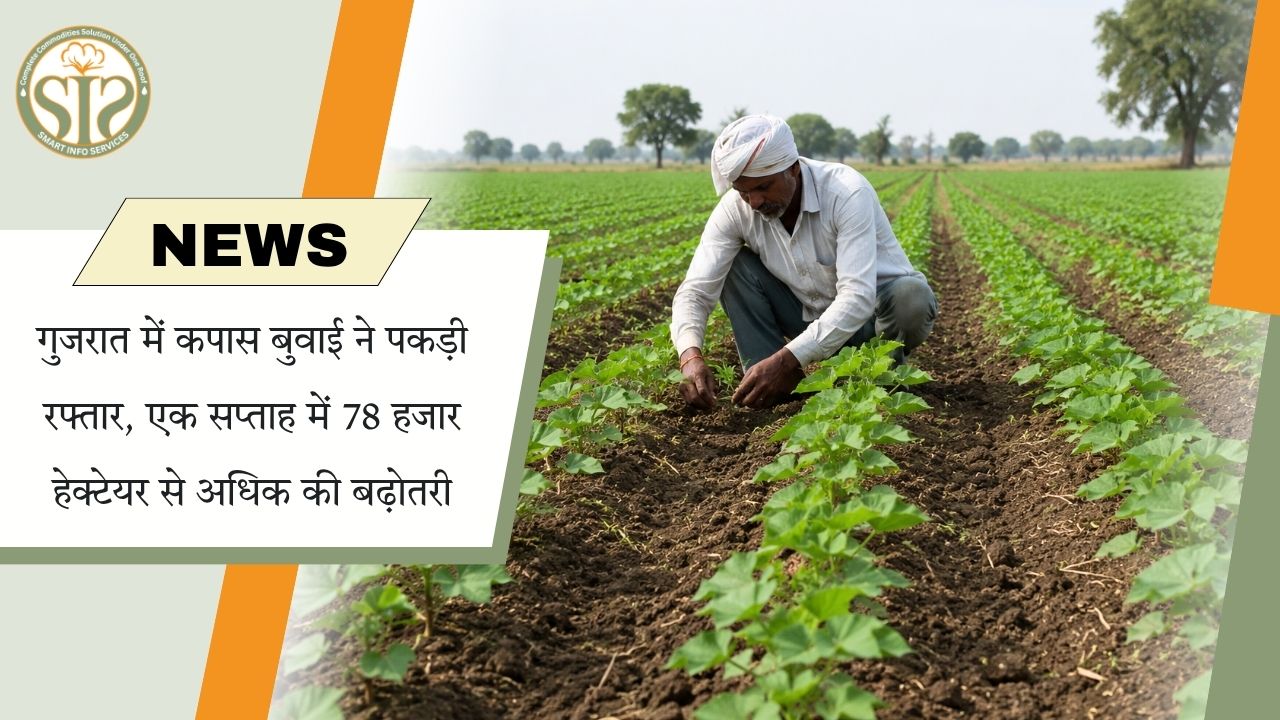
गुजरात में कपास बुवाई ने पकड़ी रफ्तार, एक सप्ताह में 78 हजार हेक्टेयर से अधिक की बढ़ोतरीअहमदाबाद, 08 जून 2026: गुजरात में कपास बुवाई का कार्य तेजी से आगे बढ़ रहा है। गुजरात कृषि, किसान कल्याण एवं सहकारिता विभाग द्वारा जारी साप्ताहिक बुवाई आंकड़ों के अनुसार, राज्य में 01 जून से 08 जून के बीच कपास बुवाई क्षेत्र में उल्लेखनीय वृद्धि दर्ज की गई है।आंकड़ों के मुताबिक, राज्य में कुल कपास बुवाई 01 जून को 14,996 हेक्टेयर थी, जो 08 जून तक बढ़कर 93,449 हेक्टेयर पहुंच गई। इस प्रकार एक सप्ताह में 78,453 हेक्टेयर की अतिरिक्त बुवाई दर्ज की गई।सौराष्ट्र क्षेत्र कपास बुवाई में सबसे आगे बना हुआ है। यहां बुवाई 12,500 हेक्टेयर से बढ़कर 60,700 हेक्टेयर हो गई। सुरेंद्रनगर (18,900 हेक्टेयर), मोरबी (16,800 हेक्टेयर), अमरेली (7,500 हेक्टेयर), भावनगर (6,500 हेक्टेयर) तथा बोटाद (6,100 हेक्टेयर) प्रमुख बुवाई वाले जिले रहे।कच्छ जिले में भी किसानों ने तेजी से कपास की बुवाई की है। जिले में बुवाई क्षेत्र 1,900 हेक्टेयर से बढ़कर 10,300 हेक्टेयर पहुंच गया। वहीं उत्तर गुजरात में कपास बुवाई 500 हेक्टेयर से बढ़कर 14,800 हेक्टेयर हो गई, जिसमें मेहसाणा, पाटन और साबरकांठा प्रमुख योगदानकर्ता रहे।मध्य गुजरात में बुवाई 100 हेक्टेयर से बढ़कर 4,700 हेक्टेयर दर्ज की गई, जबकि दक्षिण गुजरात में 3,100 हेक्टेयर क्षेत्र में कपास की बुवाई हो चुकी है। भरूच और तापी जिले इस क्षेत्र में प्रमुख रहे।विशेषज्ञों का मानना है कि मानसून की प्रगति और अनुकूल मौसम परिस्थितियों के कारण किसानों ने कपास बुवाई में तेजी दिखाई है। आगामी दिनों में अच्छी वर्षा होने पर राज्य में कपास बुवाई का रकबा और बढ़ने की संभावना है।स्रोत: गुजरात कृषि, किसान कल्याण एवं सहकारिता विभाग (Gujarat Agriculture, Farmers Welfare and Co-operation Department)और पढ़ें :- पाचोरा में 43°C गर्मी के बीच 60% कपास बुवाई पूरी

मंगलवार को सुबह के कारोबार में 95.48 पर खुलने के बाद, भारतीय रुपया अमेरिकी डॉलर के मुकाबले 13 पैसे बढ़कर 95.35 पर बंद हुआ।कारोबार बंद होने पर सेंसेक्स 394.50 अंक या 0.54 प्रतिशत बढ़कर 73,918.76 पर और निफ्टी 119.10 अंक या 0.52 प्रतिशत बढ़कर 23,242.10 पर बंद हुआ। लगभग 2694 शेयरों में बढ़त हुई, 1343 शेयरों में गिरावट आई और 175 शेयरों में कोई बदलाव नहीं हुआ।
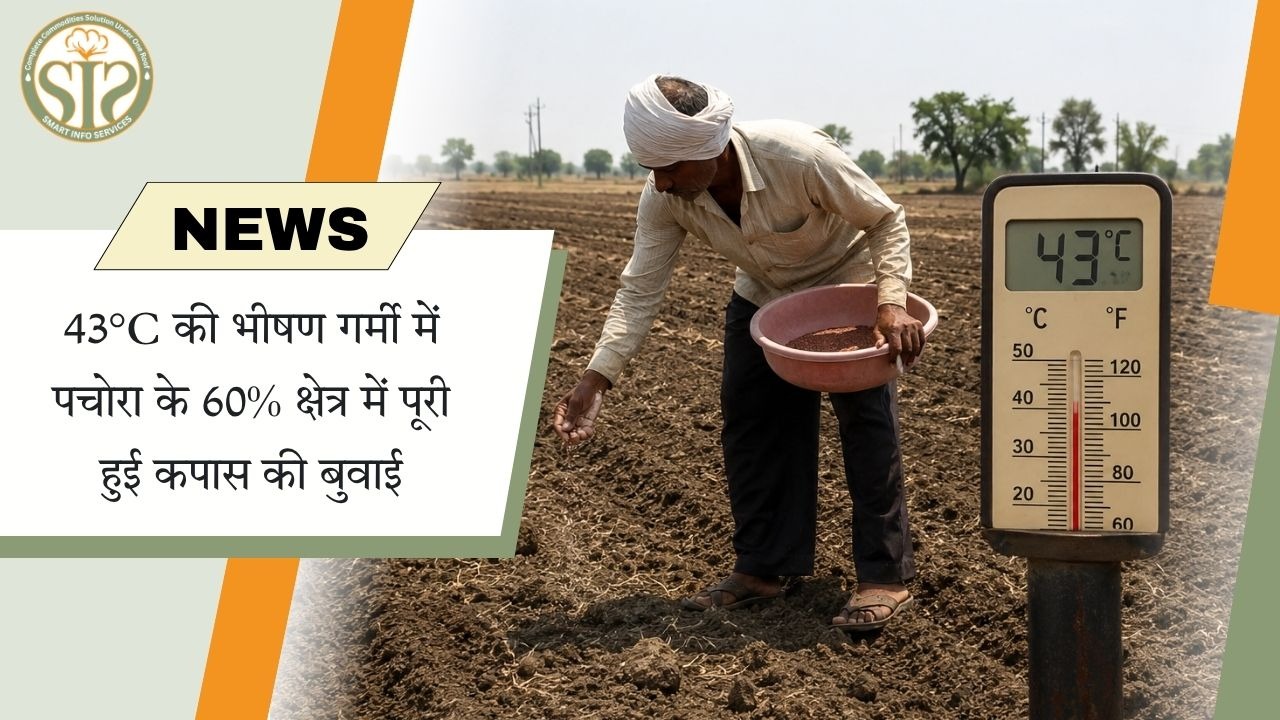
43°C की भीषण गर्मी में पचोरा के 60% क्षेत्र में पूरी हुई कपास की बुवाईजलगांव जिले का पचोरा तालुका कपास उत्पादन के लिए प्रसिद्ध है, लेकिन पिछले कुछ वर्षों से किसानों को लाल रोग, बॉलवर्म, अनियमित वर्षा और फसल के कम दाम जैसी समस्याओं का सामना करना पड़ रहा है। इस वर्ष भी मौसम विभाग और कृषि विशेषज्ञों ने ‘अल नीनो’ के प्रभाव के कारण कम बारिश की आशंका जताई है। इसके बावजूद किसानों ने जोखिम उठाते हुए समय से पहले कपास की बुवाई शुरू कर दी है।कृषि विभाग ने किसानों को सलाह दी थी कि वे 15 जून के बाद ही कपास की बुवाई करें, क्योंकि क्षेत्र में अत्यधिक गर्मी और शुष्क हवाओं का प्रभाव बना हुआ है। वर्तमान में वातावरण का तापमान लगभग 40°C है, जबकि मिट्टी का तापमान 43°C से अधिक दर्ज किया जा रहा है। ऐसी परिस्थितियों में बीजों के अंकुरण पर प्रतिकूल असर पड़ सकता है और पौधों में बाद में लाल रोग जैसी समस्याएं बढ़ सकती हैं।इसके बावजूद पचोरा तालुका के लगभग 60 प्रतिशत किसानों ने प्री-सीजन बुवाई पूरी कर ली है। किसानों का मानना है कि बुवाई में देरी होने से उत्पादन और आय प्रभावित हो सकती है, इसलिए उन्होंने उपलब्ध सिंचाई सुविधाओं के आधार पर खेती शुरू कर दी है। जिन किसानों के कुओं में पानी उपलब्ध है, उन्होंने 20 मई से ही खेतों में बीज डालना शुरू कर दिया था।पचोरा तालुका का कुल भौगोलिक क्षेत्र 82,507 हेक्टेयर है, जिसमें से 58,202 हेक्टेयर खेती योग्य भूमि है। इस वर्ष लगभग 42,950 हेक्टेयर क्षेत्र में कपास की खेती की योजना बनाई गई है।वहीं, लगातार नुकसान के कारण किसानों का रुझान मक्का की खेती की ओर भी बढ़ रहा है। पिछले वर्ष 9,822 हेक्टेयर क्षेत्र में मक्का बोया गया था, जो इस वर्ष बढ़कर 11,220 हेक्टेयर हो गया है। अब किसानों की नजर मानसून पर टिकी है, क्योंकि समय पर और पर्याप्त बारिश ही उनकी इस जोखिम भरी खेती की सफलता तय करेगी।और पढ़ें :- हरियाणा में कपास रकबा घटा, किसान सभा ने सरकार की नीतियों पर उठाए सवाल
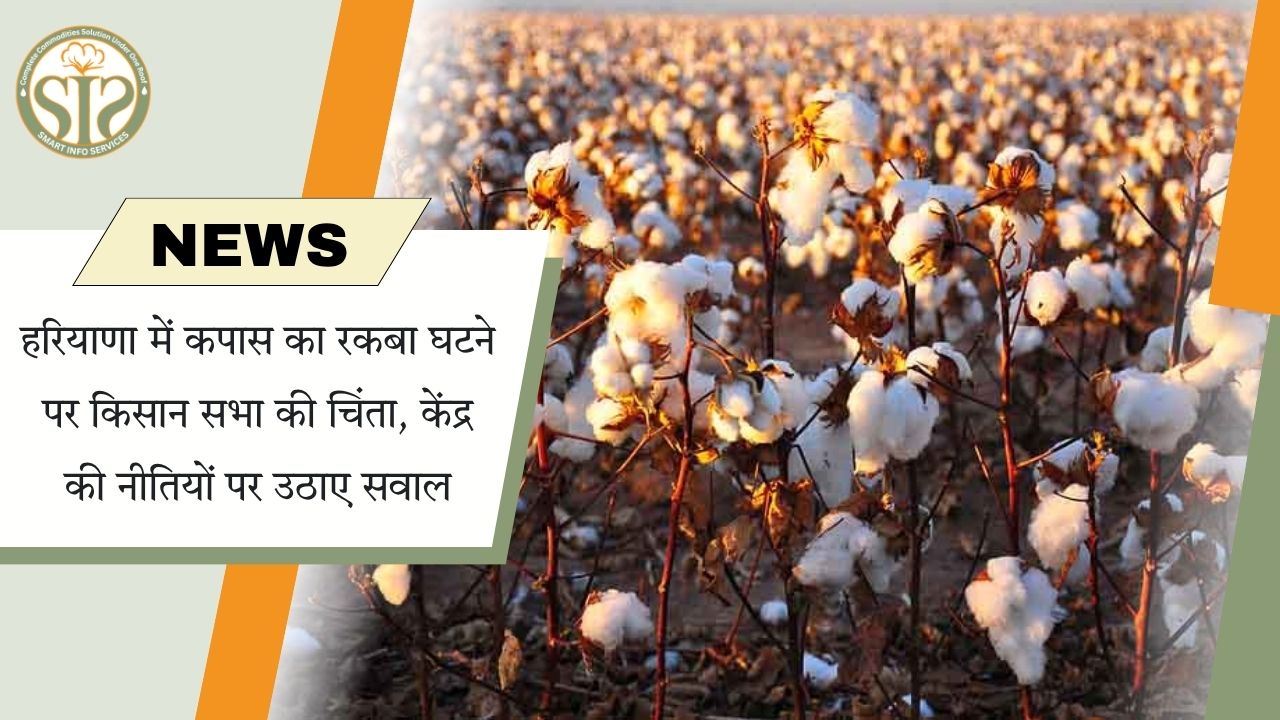
हरियाणा में कपास का रकबा घटने पर किसान सभा की चिंता, केंद्र की नीतियों पर उठाए सवालऑल इंडिया किसान सभा (AIKS) की हरियाणा इकाई ने राज्य में कपास की खेती के लगातार घटते रकबे पर गंभीर चिंता जताई है। संगठन का कहना है कि कपास उत्पादन में आ रही यह गिरावट किसानों की आय, ग्रामीण अर्थव्यवस्था और देश के कपास क्षेत्र पर व्यापक प्रभाव डाल सकती है। इस मुद्दे पर सोमवार को रोहतक में आयोजित AIKS की राज्य स्तरीय समिति की बैठक में विस्तार से चर्चा की गई।बैठक में बताया गया कि हरियाणा के प्रमुख कपास उत्पादक जिले—सिरसा, फतेहाबाद, हिसार, भिवानी, रेवाड़ी और महेंद्रगढ़—में कपास की खेती का क्षेत्र लगातार कम हो रहा है। किसान सभा के नेताओं ने इसके लिए केंद्र सरकार की नीतियों को जिम्मेदार ठहराते हुए कहा कि किसानों को लाभकारी मूल्य और पर्याप्त संरक्षण नहीं मिलने के कारण वे कपास की खेती से दूरी बना रहे हैं।बैठक की अध्यक्षता AIKS के राज्य अध्यक्ष मास्टर बलबीर सिंह ने की। उन्होंने केंद्र सरकार द्वारा कपास पर 11 प्रतिशत आयात शुल्क हटाने के फैसले की आलोचना करते हुए कहा कि इससे सस्ते आयातित कपास का दबाव बढ़ेगा और घरेलू उत्पादकों को नुकसान उठाना पड़ेगा। उनके अनुसार, यह निर्णय पहले से आर्थिक चुनौतियों का सामना कर रहे कपास किसानों की स्थिति को और कमजोर कर सकता है।बैठक में हाल ही में घोषित खरीफ फसलों के न्यूनतम समर्थन मूल्य (MSP) पर भी असंतोष व्यक्त किया गया। किसान नेताओं का कहना था कि खेती की बढ़ती लागत को देखते हुए MSP में की गई वृद्धि पर्याप्त नहीं है और इससे किसानों को अपेक्षित राहत मिलने की संभावना कम है।और पढ़ें :- ट्रंप बोले: इज़रायल और ईरान तत्काल युद्धविराम की ओर बढ़ रहे

अमेरिकी राष्ट्रपति डोनाल्ड ट्रंप का कहना है कि इज़राइल और ईरान तुरंत युद्धविराम चाहते हैं; शांति वार्ता जारी हैअमेरिकी राष्ट्रपति डोनाल्ड ट्रंप ने 8 जून (IST) को कहा कि इज़राइल और ईरान तुरंत युद्धविराम चाहते हैं। उन्होंने यह भी कहा कि एक व्यापक शांति समझौते तक पहुँचने के लिए अंतिम बातचीत अभी चल रही है।अपने 'ट्रुथ सोशल' प्लेटफॉर्म पर एक पोस्ट में, ट्रंप ने कहा कि दोनों देश दुश्मनी खत्म करने और बातचीत के ज़रिए किसी समझौते की ओर बढ़ने की कोशिश कर रहे हैं। हालाँकि, उन्होंने यह भी कहा कि जब तक कोई व्यापक समझौता नहीं हो जाता, तब तक मौजूदा प्रतिबंध लागू रहेंगे। (sis)ट्रंप ने लिखा, "दोनों पक्ष - इज़राइल और ईरान - तुरंत युद्धविराम करना चाहते हैं! 'शांति' पर अंतिम बातचीत चल रही है।" उन्होंने यह भी चेतावनी दी कि "अज्ञानता या बेवकूफी" के कारण इस प्रक्रिया में कोई रुकावट नहीं आनी चाहिए।ट्रंप ने आगे कहा कि जब तक कोई "अंतिम समझौता" नहीं हो जाता, तब तक नाकेबंदी "पूरी तरह से लागू" रहेगी। इससे संकेत मिलता है कि शांति वार्ता के सफल समापन तक मौजूदा उपाय लागू रहेंगे।और पढ़ें :- ओडिशा वस्त्र क्षेत्र में 40 मिलियन डॉलर निवेश, 12,500 नौकरियों की उम्मीद
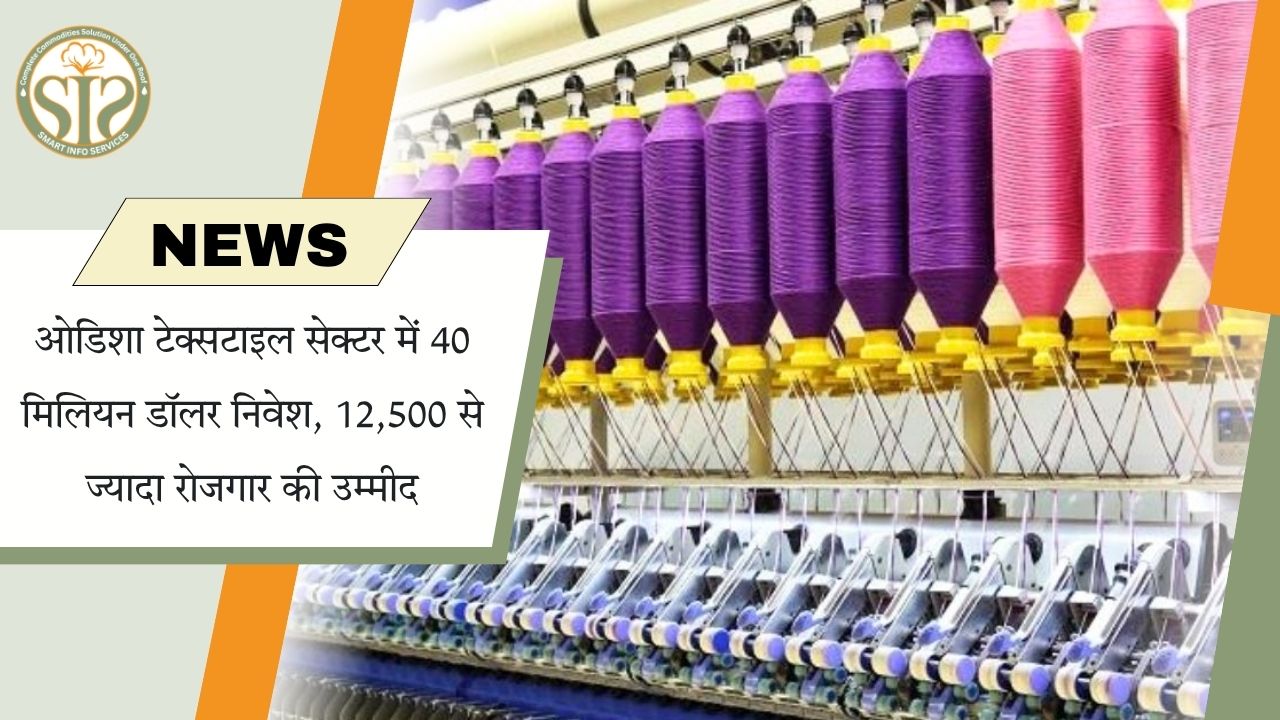
ओडिशा टेक्सटाइल सेक्टर में 40 मिलियन डॉलर निवेश, 12,500 से ज्यादा रोजगार की उम्मीदओडिशा को हाल ही में टेक्सटाइल और अपैरल सेक्टर में 40 मिलियन अमेरिकी डॉलर (लगभग 300 करोड़ रुपये से अधिक) के नए निवेश मिले हैं। इन परियोजनाओं से राज्य में करीब 12,500 नए रोजगार सृजित होने की संभावना है, जिससे यह सेक्टर सबसे बड़े रोजगार देने वाले क्षेत्रों में उभर रहा है।सबसे बड़ा रोजगार सृजन प्रोजेक्ट खुर्दा जिले में नंडराज टेक्सटाइल्स प्राइवेट लिमिटेड का अपैरल मैन्युफैक्चरिंग यूनिट है। कंपनी इस परियोजना में 168.64 करोड़ रुपये (लगभग 17.70 मिलियन डॉलर) का निवेश करेगी, जिससे 10,306 लोगों को रोजगार मिलने की उम्मीद है। यह राज्य के हाल के वर्षों के सबसे बड़े रोजगार-सृजन निवेशों में से एक माना जा रहा है।इसके अलावा, संबलपुर में शाही एक्सपोर्ट्स प्राइवेट लिमिटेड को 145.5 करोड़ रुपये (15.27 मिलियन डॉलर) के निवेश से निटेड गारमेंट्स मैन्युफैक्चरिंग यूनिट स्थापित करने की मंजूरी मिली है। इस परियोजना से लगभग 1,840 रोजगार पैदा होने की संभावना है और राज्य के अपैरल मैन्युफैक्चरिंग इकोसिस्टम को मजबूती मिलेगी।गंजाम जिले में माँ तारातारिणी टेक्सटाइल पार्क प्राइवेट लिमिटेड 70 करोड़ रुपये (7.34 मिलियन डॉलर) के निवेश से एक इंटीग्रेटेड टेक्सटाइल प्रोजेक्ट विकसित करेगी, जिससे करीब 350 रोजगार सृजित होंगे।इन सभी परियोजनाओं को स्टेट लेवल सिंगल विंडो क्लीयरेंस अथॉरिटी (SLSWCA) ने मंजूरी दी है। सरकार का उद्देश्य औद्योगिक विकास को केवल कुछ चुनिंदा क्षेत्रों तक सीमित न रखकर राज्य के विभिन्न जिलों में फैलाना है।खुर्दा के अलावा कोरापुट, संबलपुर, जाजपुर, झारसुगुड़ा, ढेंकनाल, बलांगीर, क्योंझर और मयूरभंज जैसे जिलों में भी निवेश प्रस्तावों को मंजूरी मिली है, जिससे पूरे ओडिशा में संतुलित औद्योगिक विकास और रोजगार सृजन को बढ़ावा मिलने की उम्मीद है।और पढ़ें :-कॉटन यार्न महंगा, करूर का टेक्सटाइल उद्योग संकट में

कॉटन यार्न की कीमतों में उछाल से करूर का टेक्सटाइल उद्योग दबाव मेंकरूर: पश्चिम एशिया में जारी भू-राजनीतिक तनाव और वैश्विक आपूर्ति श्रृंखला में व्यवधान के बीच कॉटन यार्न की कीमतों में आई तेज बढ़ोतरी ने तमिलनाडु के प्रमुख टेक्सटाइल केंद्र करूर के उद्योग को दबाव में ला दिया है। उद्योग प्रतिनिधियों का कहना है कि कच्चे माल की बढ़ती लागत से उत्पादन और निर्यात गतिविधियां प्रभावित हो रही हैं।उद्योग सूत्रों के अनुसार, करूर के टेक्सटाइल निर्माता अपनी यार्न जरूरतों के लिए मुख्य रूप से कोयंबटूर, डिंडीगुल, विरुधुनगर और वेल्लाकोइल की स्पिनिंग मिलों पर निर्भर हैं। पिछले छह सप्ताह के दौरान मोटे काउंट वाले कॉटन यार्न की मांग और आपूर्ति के बीच असंतुलन के कारण इसकी कीमतों में 30 से 40 प्रतिशत तक की बढ़ोतरी हुई है। हाई-काउंट यार्न का भाव करीब 300 रुपये प्रति किलोग्राम से बढ़कर 400 रुपये प्रति किलोग्राम तक पहुंच गया है, जिसे उद्योग असामान्य वृद्धि मान रहा है।हालांकि केंद्र सरकार ने टेक्सटाइल उद्योग की मांग पर कॉटन आयात पर शुल्क में राहत दी है, लेकिन करूर के कारोबारियों का कहना है कि इसका लाभ मुख्य रूप से तिरुपुर के गारमेंट निर्माताओं को मिला है। गारमेंट क्षेत्र में इस्तेमाल होने वाले यार्न की कीमतों में 3 से 4 प्रतिशत की गिरावट आई है, जबकि करूर में उपयोग होने वाले मोटे यार्न की कीमतों पर इसका कोई खास असर नहीं पड़ा है।करूर टेक्सटाइल मैन्युफैक्चरर्स एंड एक्सपोर्टर्स एसोसिएशन के अध्यक्ष पी. गोपालकृष्णन ने कहा कि कॉटन यार्न की कीमतों में मौजूदा बढ़ोतरी अभूतपूर्व है और इससे उद्योग की लागत संरचना पर गंभीर असर पड़ा है। उन्होंने कहा कि यार्न की कीमतों में स्थिरता उद्योग के सुचारू संचालन के लिए आवश्यक है।उद्योग संगठनों ने केंद्र और राज्य सरकारों से हस्तक्षेप की मांग की है। कारोबारियों के अनुसार, अमेरिका और ईरान के बीच बढ़ते तनाव का असर वैश्विक व्यापार और शिपिंग पर पड़ा है, जिससे पॉलिएस्टर, डाइंग केमिकल्स, पॉलीथीन और पैकेजिंग सामग्री जैसी आवश्यक वस्तुओं की कीमतें भी बढ़ गई हैं। निर्यातकों का मानना है कि यदि यह स्थिति बनी रहती है, तो करूर के टेक्सटाइल उद्योग की प्रतिस्पर्धात्मकता, निर्यात वृद्धि और रोजगार के अवसरों पर नकारात्मक प्रभाव पड़ सकता है।और पढ़ें :- डॉलर के मुकाबले रुपया 23 पैसे मजबूत होकर 95.48 पर खुला

रुपया 23 पैसे मजबूत 95.48 USD पर खुला.मंगलवार को भारतीय रुपया डॉलर के मुकाबले 23 पैसे मजबूत 95.48 पर खुला. जबकि सोमवार को यह 95.71 पर बंद हुआ था।और पढ़ें :- रुपया डॉलर के मुकाबले 40 पैसे गिरकर 95.71 पर बंद हुआ।

सोमवार को सुबह के कारोबार में 95.31 पर खुलने के बाद, भारतीय रुपया अमेरिकी डॉलर के मुकाबले 40 पैसे गिरकर 95.71 पर बंद हुआ।कारोबार के अंत में, सेंसेक्स 719.08 अंक या 0.97 प्रतिशत गिरकर 73,524.26 पर और निफ्टी 243.70 अंक या 1.04 प्रतिशत गिरकर 23,123.00 पर बंद हुआ। लगभग 1172 शेयरों में बढ़त हुई, 3007 शेयरों में गिरावट आई और 154 शेयरों में कोई बदलाव नहीं हुआ।और पढ़ें :- कपास आयात शुल्क छूट से गुजरात के टेक्सटाइल उद्योग को राहत
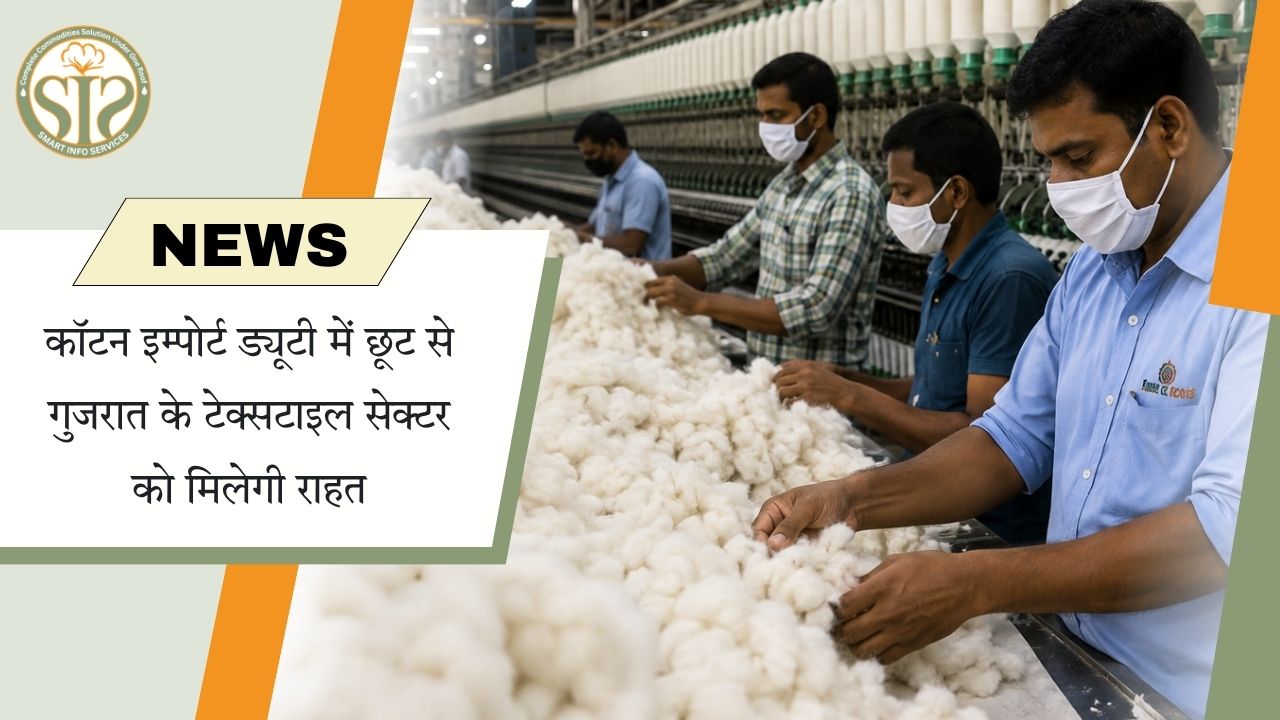
कॉटन इम्पोर्ट ड्यूटी में छूट से गुजरात के टेक्सटाइल सेक्टर को मिलेगी राहतअहमदाबाद: केंद्र सरकार द्वारा 30 अक्टूबर तक कॉटन पर लगने वाली 11 प्रतिशत आयात शुल्क (इम्पोर्ट ड्यूटी) को निलंबित किए जाने के फैसले का गुजरात के टेक्सटाइल उद्योग ने स्वागत किया है। उद्योग जगत का मानना है कि इस कदम से कच्चे माल की लागत में कमी आएगी और भारतीय टेक्सटाइल उत्पादों की वैश्विक बाजार में प्रतिस्पर्धात्मकता बढ़ेगी।पिछले कुछ महीनों में घरेलू बाजार में कॉटन की कीमतें बढ़कर 68,500 रुपये प्रति कैंडी तक पहुंच गई थीं, जिससे स्पिनिंग मिलों, फैब्रिक निर्माताओं और गारमेंट निर्यातकों की लागत बढ़ गई थी। उद्योग का कहना है कि ड्यूटी में छूट मिलने से कॉटन की उपलब्धता बेहतर होगी और कीमतों को नियंत्रित रखने में मदद मिलेगी।एसोचैम गुजरात स्टेट काउंसिल के चेयरमैन चिंतन ठाकर ने कहा कि आयात मुख्य रूप से एक्स्ट्रा-लॉन्ग स्टेपल (ELS) कॉटन तक सीमित है, जो भारतीय कॉटन का विकल्प नहीं है। उनके अनुसार, यह फैसला टेक्सटाइल निर्माताओं और निर्यातकों की उत्पादन लागत कम करने में मदद करेगा। साथ ही, बेहतर गुणवत्ता वाले फाइबर की उपलब्धता से उत्पादों की गुणवत्ता सुधरेगी और वैश्विक ब्रांड्स की जरूरतों को पूरा करना आसान होगा।गुजरात चैंबर ऑफ कॉमर्स एंड इंडस्ट्री (GCCI) की टेक्सटाइल कमेटी के सह-अध्यक्ष राहुल शाह ने बताया कि ड्यूटी में छूट की घोषणा के बाद कच्चे कॉटन की कीमतों में करीब 4,000 रुपये प्रति कैंडी की गिरावट दर्ज की गई है। इससे मिलों की इनपुट लागत कम होगी और विशेष रूप से निर्यात-उन्मुख कंपनियों के परिचालन मार्जिन में सुधार होगा।स्पिनर्स एसोसिएशन गुजरात (SAG) के वरिष्ठ उपाध्यक्ष जयेश पटेल ने कहा कि भारतीय स्पिनिंग मिलों को चीन और बांग्लादेश से अच्छे निर्यात ऑर्डर मिल रहे हैं, लेकिन घरेलू कॉटन की ऊंची कीमतें चुनौती बनी हुई थीं। उनका मानना है कि आयात शुल्क में छूट से कॉटन और यार्न की कीमतों पर दबाव कम होगा तथा भारतीय टेक्सटाइल उद्योग वैश्विक स्तर पर अधिक प्रतिस्पर्धी बन सकेगा।और पढ़ें :- महाराष्ट्र में कपास रकबा 10–15% बढ़ने की संभावना

महाराष्ट्र में खरीफ 2026-27 में कपास का रकबा बढ़ने की उम्मीदमहाराष्ट्र में खरीफ 2026-27 सीजन के दौरान कपास की खेती का रकबा 10-15 प्रतिशत बढ़ने की संभावना है। कृषि विभाग के अधिकारियों के अनुसार, घरेलू और अंतरराष्ट्रीय बाजारों में कपास की कीमतों में हुई तेज बढ़ोतरी के कारण किसान, विशेषकर विदर्भ और मराठवाड़ा क्षेत्र में, सोयाबीन के बजाय कपास की खेती को प्राथमिकता दे रहे हैं।अधिकारियों का कहना है कि बेहतर बाजार मांग और अधिक लाभ की संभावना किसानों को कपास की ओर आकर्षित कर रही है। पिछले सीजन में सोयाबीन उत्पादकों को भारी नुकसान उठाना पड़ा था। 5,328 रुपये प्रति क्विंटल के MSP के मुकाबले कई किसानों को सोयाबीन 4,000-4,500 रुपये प्रति क्विंटल की दर से बेचनी पड़ी। इसके विपरीत, अप्रैल और मई में कपास की कीमतें 9,000 से 9,500 रुपये प्रति क्विंटल तक पहुंच गईं, जो MSP से काफी अधिक थीं।यवतमाल के किसान अशोक भुताडा ने बताया कि उन्होंने पिछले वर्ष 16 एकड़ में कपास बोई थी, जबकि इस बार वे 20-21 एकड़ में कपास की खेती करने की योजना बना रहे हैं। उनके अनुसार, बदलते मौसम और अनिश्चित वर्षा के बीच सोयाबीन की तुलना में कपास अपेक्षाकृत सुरक्षित विकल्प बनकर उभरी है।कृषि विभाग का मानना है कि यह रुझान विदर्भ और मराठवाड़ा के कई जिलों में देखने को मिल रहा है। हालांकि, विशेषज्ञों ने किसानों को केवल मौजूदा ऊंची कीमतों के आधार पर निर्णय लेने से सावधान किया है। किसान नेता Vijay Jawandhia का कहना है कि कपास की कीमतों में मौजूदा तेजी अंतरराष्ट्रीय बाजार की परिस्थितियों से जुड़ी है और यह जरूरी नहीं कि फसल बाजार में आने तक कीमतें इसी स्तर पर बनी रहें।कपास की बढ़ती लोकप्रियता के बावजूद इससे जुड़े जोखिम भी बने हुए हैं। 2025-26 में राज्य में कपास का उत्पादन लगभग 47 प्रतिशत घटकर 51 लाख मीट्रिक टन रह गया था। इसका प्रमुख कारण अत्यधिक और बेमौसम बारिश तथा ओलावृष्टि रहा। आगामी सीजन के लिए भी कई जिलों में कम वर्षा की आशंका जताई जा रही है।विशेषज्ञों का मानना है कि किसानों की आय सुनिश्चित करने के लिए केवल ऊंची बाजार कीमतें पर्याप्त नहीं हैं। प्रभावी खरीद व्यवस्था, उचित मूल्य और बेहतर कृषि मार्गदर्शन ही किसानों को वास्तविक आर्थिक सुरक्षा प्रदान कर सकते हैं।और पढ़ें :- केरल में अगले 7 दिन भारी बारिश का अलर्ट

केरल में मानसून सक्रिय, अगले 7 दिनों तक भारी बारिश की चेतावनीकेरल में दक्षिण-पश्चिम मानसून ने 4 जून 2026 को दस्तक दे दी है, जिसके बाद राज्य में बारिश की गतिविधियां तेज हो गई हैं। मानसून से पहले जारी प्री-मानसून बारिश के चलते पहले से ही कई क्षेत्रों में नमी बनी हुई थी, और अब मध्यम से भारी बारिश का दौर शुरू हो गया है। मौसम विभाग के अनुसार, अगले एक सप्ताह तक केरल में तेज बारिश जारी रहने की संभावना है।जून और जुलाई के महीने केरल में सबसे अधिक वर्षा वाले माने जाते हैं। इस अवधि में औसतन करीब 650 मिमी बारिश दर्ज होती है, और पूरे मानसूनी सीजन की लगभग 70 प्रतिशत वर्षा इन्हीं दो महीनों में हो जाती है। यही कारण है कि यह समय राज्य के लिए बेहद महत्वपूर्ण और संवेदनशील माना जाता है।अरब सागर में सक्रिय सिस्टम का प्रभावपूर्व-मध्य अरब सागर में गोवा और उत्तर कर्नाटक के तट के पास मध्य स्तरों पर एक चक्रवाती परिसंचरण विकसित हुआ है, जो लगभग 10 से 15 हजार फीट की ऊंचाई पर सक्रिय है। इस सिस्टम के कारण मानसूनी पश्चिमी हवाओं की ताकत बढ़ गई है, जिससे वे पश्चिमी घाट से अधिक टकरा रही हैं और लगातार बारिश हो रही है।पिछले 24 घंटों में कोच्चि, कोझिकोड, कोट्टायम और कन्नूर सहित कई जिलों में भारी वर्षा दर्ज की गई है। इसी सिस्टम का असर कर्नाटक के तटीय क्षेत्रों जैसे होन्नावर और कारवार तक भी देखा गया है।अगले कुछ दिनों में बढ़ सकता है असरमौसम विभाग का अनुमान है कि यह चक्रवाती परिसंचरण अगले कुछ दिनों तक सक्रिय रहेगा। हालांकि इसके बड़े और शक्तिशाली तूफानी सिस्टम में बदलने की संभावना कम है, लेकिन यह मानसूनी हवाओं को लगातार सक्रिय रखेगा।तिरुवनंतपुरम से कोझिकोड तक पूरे तटीय केरल में भारी से बहुत भारी बारिश का खतरा बना हुआ है। 7 जून से 11 जून 2026 के बीच बारिश की तीव्रता और फैलाव और अधिक बढ़ सकता है।बाढ़ और भूस्खलन का खतरालगातार बारिश से कई क्षेत्रों में जलभराव, नदी जलस्तर में वृद्धि और पहाड़ी इलाकों में भूस्खलन की संभावना बढ़ गई है। प्रशासन ने लोगों से अपील की है कि वे सतर्क रहें और अनावश्यक यात्रा से बचें।और पढ़ें :- राज्यवार CCI कपास बिक्री का विवरण
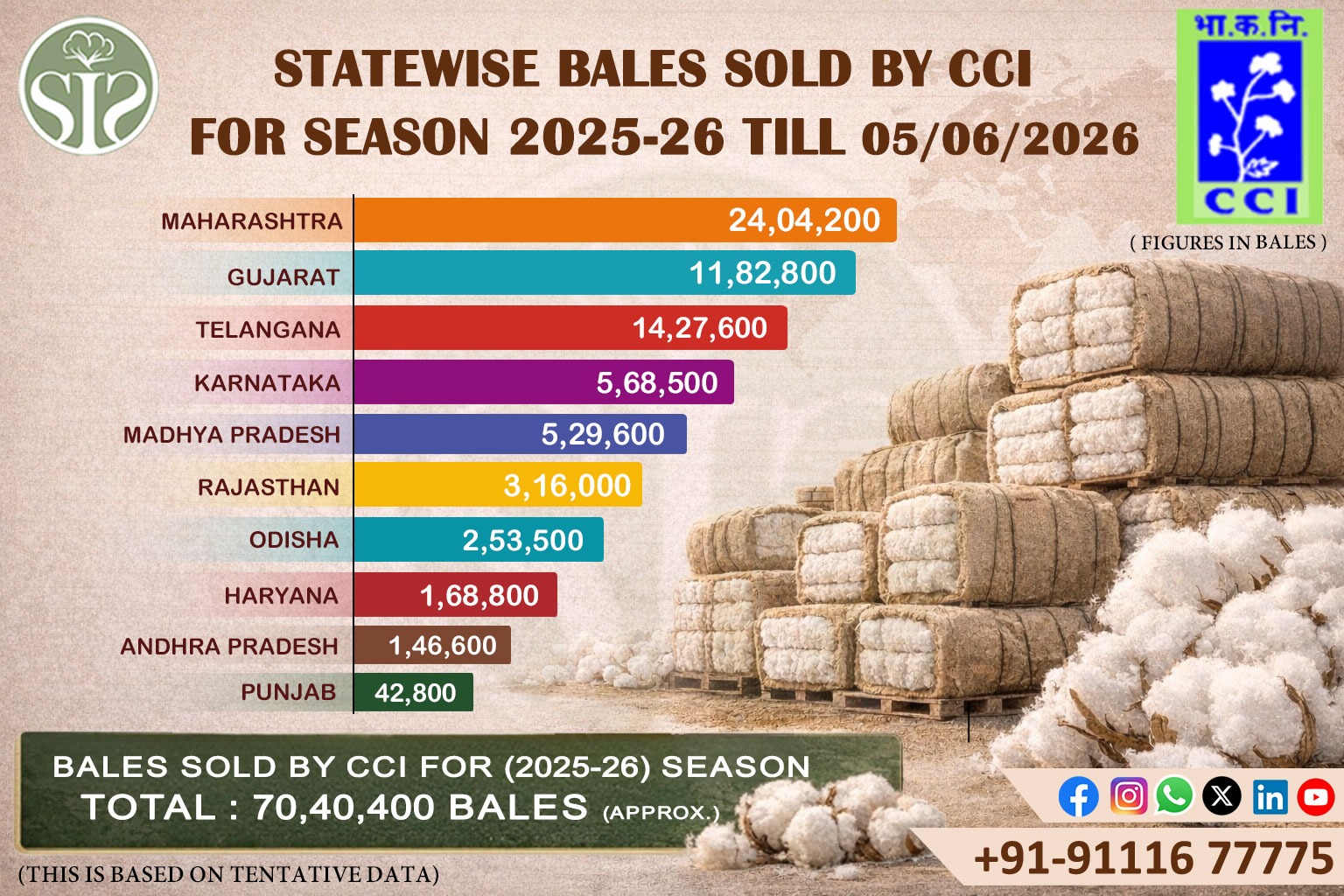
राज्य-वार CCI कपास बिक्री विवरण – 2025-26 सीज़नकॉटन कॉर्पोरेशन ऑफ़ इंडिया (CCI) ने 2025-26 सीज़न के लिए इस सप्ताह अपनी कॉटन कैंडी की कीमतों में ₹700 प्रति कैंडी तक की कमी की । अब तक CCI द्वारा सीजन 2025-26 की लगभग कुल 70,40,400 कपास गांठें (बेल्स) बेची जा चुकी हैं। बिक्री कुछ प्रमुख कपास उत्पादक राज्यों में केंद्रित है, जिसमें महाराष्ट्र, तेलंगाना और गुजरात सबसे आगे हैं।

रुपया 37 पैसे गिरकर 95.31 USD पर खुला.सोमवार को भारतीय रुपया डॉलर के मुकाबले 37 पैसे गिरकर 95.31 पर खुला. जबकि शुक्रवार को यह 94.94 पर बंद हुआ था।और पढ़ें :- CCI ने कपास कीमत में ₹700 प्रति कैंडी की कटौती की
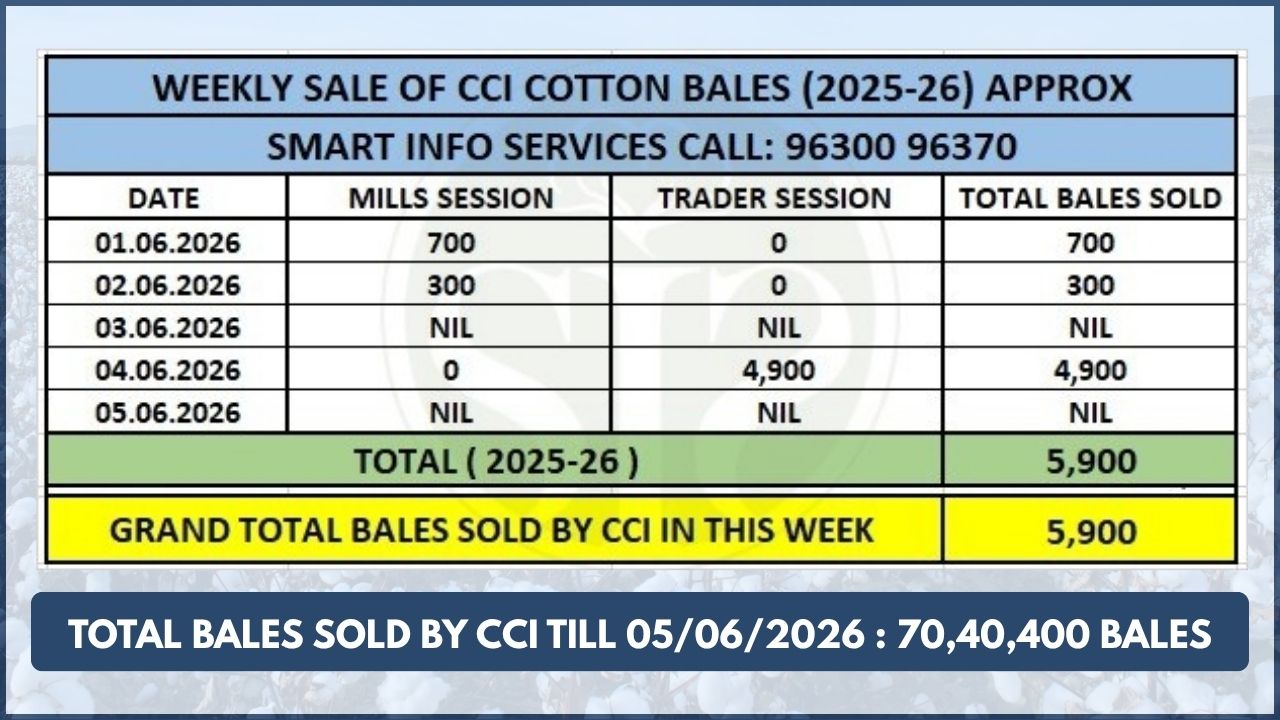
CCI ने कॉटन की कीमतें ₹700 प्रति कैंडी कम कीं; सीज़न की बिक्री 70.4 लाख बेल्स के पारकॉटन कॉर्पोरेशन ऑफ़ इंडिया (CCI) ने 1 जून से 5 जून, 2026 के सप्ताह के दौरान अपनी कॉटन कैंडी की कीमतों में ₹700 प्रति कैंडी की कटौती की। कीमतें कम होने के बावजूद, नीलामी में गतिविधि सामान्य रही, जिसमें मिलों और व्यापारियों दोनों ने हिस्सा लिया। इस सप्ताह के दौरान 2025–26 कॉटन सीज़न से कुल बिक्री लगभग 5,900 बेल्स रही।*साप्ताहिक बिक्री रिपोर्ट* 1 जून, 2026 (सोमवार)सप्ताह की शुरुआत 700 गठानों की बिक्री के साथ हुई, जिन्हें पूरी तरह से टेक्सटाइल मिलों ने खरीदा।2 जून, 2026 (मंगलवार)CCI ने 300 गठानों की बिक्री दर्ज की, जिसमें खरीद में मिलों का दबदबा बना रहा।4 जून, 2026 (गुरुवार)सप्ताह की सबसे ज़्यादा गतिविधि गुरुवार को देखी गई, जब 4,900 गठाने बेचीं गई । पूरी मात्रा कॉटन व्यापारियों द्वारा खरीदी गई।3 जून और 5 जून, 2026बुधवार या शुक्रवार को कपास गठानों की कोई बिक्री नहीं हुई।*कुल बिक्री का अपडेट*CCI की कुल बिक्री इस स्तर पर पहुँच गई है:2025–26 सीज़न: 70,40,400 गठानें

मक्का से कपास और सोयाबीन की ओर बढ़ सकता है किसानों का रुझानसंभावित अल-नीनो प्रभाव और सामान्य से कम मानसून के पूर्वानुमान के बीच खरीफ सीजन में किसानों की फसल चयन रणनीति में बदलाव देखने को मिल सकता है। क्रिसिल की एक रिसर्च रिपोर्ट के अनुसार, विभिन्न राज्यों में किसान मौसम, लाभप्रदता और बाजार की स्थितियों को ध्यान में रखते हुए फसलों का चयन कर सकते हैं।रिपोर्ट के मुताबिक, राजस्थान में मक्का उत्पादक किसानों का रुझान सोयाबीन की ओर बढ़ सकता है। वहीं, देश के सबसे बड़े सोयाबीन उत्पादक राज्य मध्य प्रदेश में मक्का और सोयाबीन के कुछ रकबे के कपास की ओर स्थानांतरित होने की संभावना जताई गई है, जिससे राज्य में कपास का रकबा बढ़ सकता है।रिपोर्ट के मुख्य लेखक पुशन शर्मा के अनुसार, मक्का के कुल रकबे में कमी आने की संभावना है, लेकिन फसल परिवर्तन का स्वरूप राज्यों के अनुसार अलग-अलग रहेगा। किसान केवल वर्षा के पूर्वानुमान पर ही नहीं, बल्कि फसलों की सापेक्ष लाभप्रदता, खरीद सहायता और मौजूदा बाजार परिस्थितियों को भी ध्यान में रखेंगे।रिपोर्ट में कहा गया है कि मौसम के शुरुआती चरण में अधिक तापमान और असमान वर्षा के कारण कपास और सोयाबीन जैसी फसलों में कीट एवं रोगों का प्रकोप बढ़ सकता है। इससे उत्पादन प्रभावित होने का जोखिम बना रहेगा।हालांकि, देश के जलाशयों में पानी का स्तर सामान्य से बेहतर बना हुआ है, जिससे प्रमुख कृषि क्षेत्रों में समय पर खेतों की तैयारी और बुवाई कार्य को सहायता मिलने की उम्मीद है। इसके बावजूद खरीफ फसलों की पैदावार काफी हद तक मानसून के वितरण, कीट एवं रोग प्रबंधन तथा उर्वरकों की उपलब्धता पर निर्भर करेगी।रिपोर्ट के अनुसार, सामान्य से कम बारिश की आशंका के बीच किसान जोखिम और संभावित लाभ को ध्यान में रखते हुए फसल चयन करेंगे, जिसके चलते कुछ क्षेत्रों में मक्का के स्थान पर कपास और सोयाबीन का रकबा बढ़ सकता है।

शुक्रवार को सुबह के कारोबार में 95.72 पर खुलने के बाद, भारतीय रुपया अमेरिकी डॉलर के मुकाबले 78 पैसे मजबूत होकर 94.94 पर बंद हुआ।कारोबार के अंत में, सेंसेक्स 116.67 अंक या 0.16 प्रतिशत गिरकर 74,243.34 पर और निफ्टी 49.85 अंक या 0.21 प्रतिशत गिरकर 23,366.70 पर बंद हुआ। लगभग 1966 शेयरों में बढ़त हुई, 2049 शेयरों में गिरावट आई और 197 शेयरों में कोई बदलाव नहीं हुआ।और पढ़ें :- नवीकरणीय ऊर्जा अपनाकर तमिलनाडु का टेक्सटाइल उद्योग सालाना ₹3,250 करोड़ बचा सकता है: रिपोर्ट

रिपोर्ट: रिन्यूएबल एनर्जी अपनाने से तमिलनाडु के टेक्सटाइल उद्योग को सालाना ₹3,250 करोड़ तक की बचत संभवबेंगलुरु स्थित थिंक टैंक Climate Risk Horizons की एक नई रिपोर्ट के अनुसार, तमिलनाडु का टेक्सटाइल उद्योग स्वच्छ ऊर्जा की ओर संक्रमण कर हर वर्ष ₹1,560 करोड़ से ₹3,250 करोड़ तक की लागत बचा सकता है। अध्ययन में पिछले एक दशक के ‘एनुअल सर्वे ऑफ इंडस्ट्रीज़’ (ASI) के आंकड़ों के आधार पर उद्योग के डीकार्बोनाइजेशन की स्थिति और संभावनाओं का आकलन किया गया है।रिपोर्ट के मुताबिक, यदि उद्योग पूरी तरह रिन्यूएबल बिजली का उपयोग करे तो उसे सालाना ₹2,320 करोड़ से ₹3,250 करोड़ तक की बचत हो सकती है। अध्ययन में कहा गया है कि ऊर्जा और ईंधन पर बढ़ता खर्च राज्य में टेक्सटाइल उत्पादन की लागत बढ़ाने वाला प्रमुख कारक बन गया है।रिपोर्ट के सह-लेखक Rakesh Ranjan के अनुसार, बढ़ती ईंधन लागत तमिलनाडु के टेक्सटाइल उद्योग की प्रतिस्पर्धात्मकता को प्रभावित कर रही है। उन्होंने बताया कि राज्य का टेक्सटाइल निर्यात 2017 से लगभग 7.4 अरब डॉलर के स्तर पर स्थिर बना हुआ है। उनके अनुसार, रिन्यूएबल ऊर्जा अपनाने से उद्योग की लागत घटेगी और उसकी वैश्विक प्रतिस्पर्धात्मक क्षमता मजबूत होगी।रिपोर्ट में यह भी उल्लेख किया गया है कि पिछले चार वर्षों में राज्य के टेक्सटाइल क्षेत्र का कुल ऊर्जा व्यय लगभग दोगुना हो गया है। साथ ही, ईंधन लागत और उत्पादन के अनुपात में भी वृद्धि दर्ज की गई है। अध्ययन के अनुसार, प्रमुख निर्यातक देशों की तुलना में भारत के टेक्सटाइल उद्योग का कार्बन फुटप्रिंट सबसे अधिक है, जो प्रति किलोग्राम टेक्सटाइल पर 12.5 किलोग्राम CO₂e से अधिक है।रिपोर्ट में सुझाव दिया गया है कि रिन्यूएबल ऊर्जा आधारित इलेक्ट्रिक हीटिंग को अपनाकर उद्योग उत्पादन लागत और कार्बन उत्सर्जन दोनों में कमी ला सकता है। साथ ही, राज्य सरकार और बिजली नियामक संस्थाओं से विशेषकर MSME इकाइयों के लिए रिन्यूएबल ऊर्जा तक पहुंच आसान बनाने की सिफारिश की गई है।और पढ़ें :- हरियाणा में कपास खेती से किसानों का मोहभंग, रकबा 65% घटा
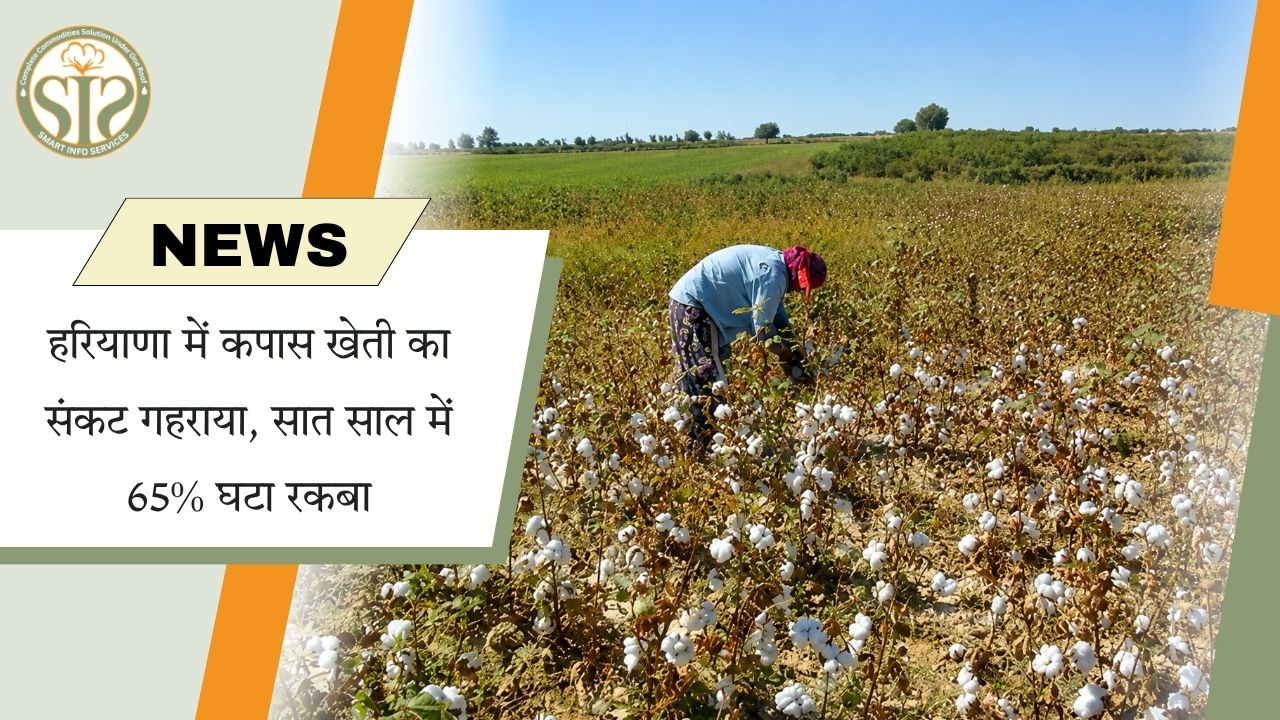
हरियाणा में कपास खेती का संकट गहराया, सात साल में 65% घटा रकबाहिसार -हरियाणा में कभी किसानों की प्रमुख नकदी फसल मानी जाने वाली कपास अब संकट के दौर से गुजर रही है। लगातार आर्थिक नुकसान, गुलाबी सुंडी के बढ़ते प्रकोप और बारिश से फसल को होने वाले भारी नुकसान के कारण किसान कपास की खेती से दूरी बना रहे हैं। इसका असर प्रदेश में कपास के रकबे पर साफ दिखाई दे रहा है।वर्ष 2019-20 में हरियाणा में कपास की खेती 8.01 लाख एकड़ क्षेत्र में की गई थी, जो 2025-26 में घटकर केवल 2.84 लाख एकड़ रह गई है। यानी सात वर्षों में कपास का रकबा करीब 65 फीसदी कम हो चुका है। पिछले तीन वर्षों में ही इसका क्षेत्रफल लगभग आधा रह गया है। इस बार भी कपास की बिजाई का क्षेत्रफल पिछले आठ वर्षों के सबसे निचले स्तर पर दर्ज किया गया है।कपास की खेती को बढ़ावा देने के लिए कृषि विभाग ने कई प्रयास किए हैं। ‘प्रमोशन फॉर कॉटन कल्टीवेशन इन हरियाणा’ अभियान के तहत प्रमुख कपास उत्पादक जिलों में जागरूकता कार्यक्रम चलाए गए। किसानों को सूक्ष्म पोषक तत्वों के लिए दो हजार रुपये प्रति एकड़ तथा देसी कपास की खेती पर चार हजार रुपये प्रति एकड़ की सहायता भी दी जा रही है। इसके बावजूद किसान कपास की ओर लौटने को तैयार नहीं हैं।संयुक्त निदेशक (कपास) डॉ. आत्मा राम गोदारा के अनुसार, पिछले कुछ वर्षों से किसानों को कपास की खेती में लगातार नुकसान उठाना पड़ रहा है। अगस्त-सितंबर में होने वाली बारिश फसल को सबसे अधिक प्रभावित करती है, जबकि गुलाबी सुंडी का प्रकोप भी बड़ी चुनौती बना हुआ है।हरियाणा कृषि विश्वविद्यालय के कृषि वैज्ञानिक डॉ. विनय महला की रिपोर्ट के अनुसार, कपास की खेती पर किसानों की प्रति एकड़ औसत लागत 40,024 रुपये रही, जबकि बिक्री और उप-उत्पादों से कुल आय केवल 24,882 रुपये हुई। इससे किसानों को औसतन 15,142 रुपये प्रति एकड़ का नुकसान उठाना पड़ा। विशेषज्ञों का मानना है कि यदि बेहतर और कीट-प्रतिरोधी किस्में विकसित नहीं की गईं तो आने वाले वर्षों में प्रदेश में कपास की खेती का दायरा और सिमट सकता है।और पढ़ें :- अमेरिकी डॉलर के मुकाबले रुपया 7 पैसे मजबूत होकर 95.72 पर खुला
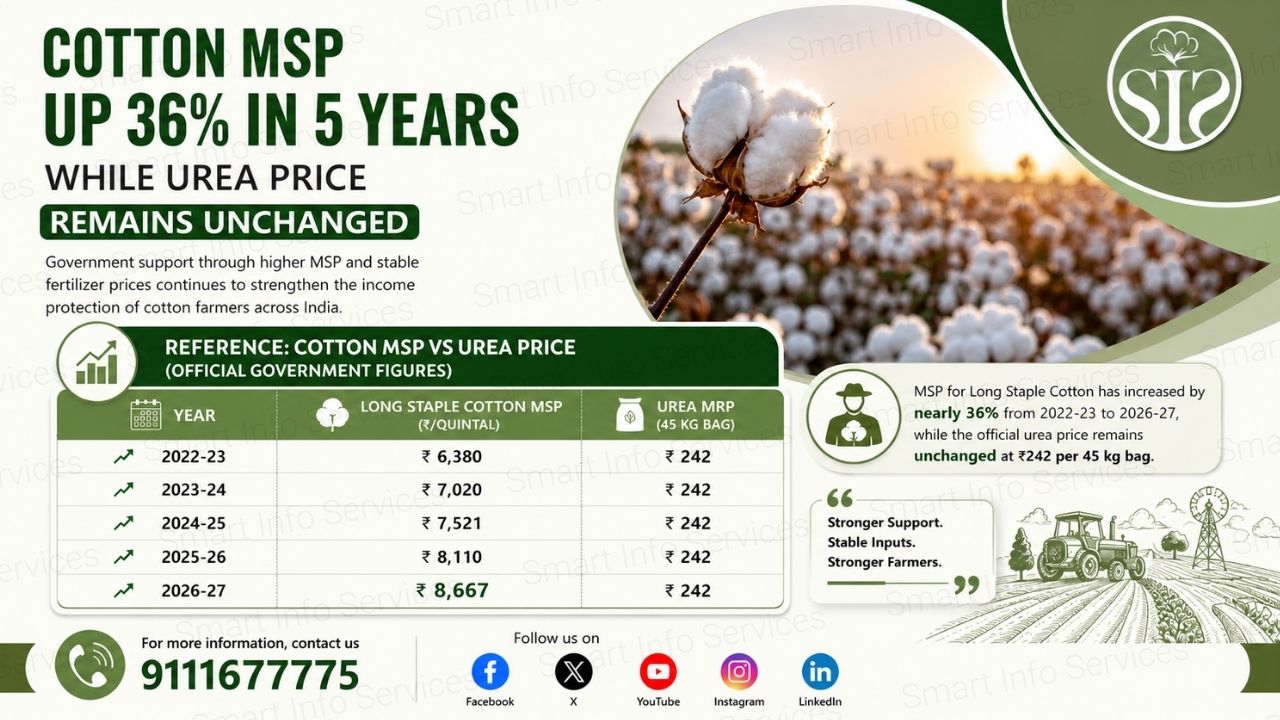
Cotton MSP Climbs 36% While Urea Remains at ₹242: Are Farmers Finally Gaining?New Delhi: India's cotton farmers have benefited from a sharp increase in government support prices over the past five years, while the official price of urea has remained unchanged due to continued subsidy support. The development has renewed debate over whether rising Minimum Support Prices (MSP) are translating into higher farm incomes.According to official government figures, the MSP for Long Staple Cotton has increased from ₹6,380 per quintal in 2022-23 to ₹8,667 per quintal for the 2026-27 season. This represents an increase of ₹2,287 per quintal, or nearly 36 percent in five years. The latest hike of ₹557 per quintal for 2026-27 is among the highest absolute increases announced for major kharif crops.The MSP has risen steadily from ₹6,380 in 2022-23 to ₹7,020 in 2023-24, ₹7,521 in 2024-25, ₹8,110 in 2025-26 and ₹8,667 in 2026-27. For a farmer producing 20 quintals of cotton, the MSP-linked value of the crop has increased from ₹1.27 lakh to ₹1.73 lakh, resulting in a potential gain of more than ₹45,000.In contrast, the Maximum Retail Price (MRP) of a 45-kg bag of neem-coated urea continues to remain at ₹242. The Ministry of Chemicals and Fertilizers has clarified that there is currently no proposal to increase urea prices, with the government continuing subsidy support to keep the fertilizer affordable for farmers.The comparison highlights a significant trend: while the MSP of Long Staple Cotton has increased by nearly 36 percent since 2022-23, the official price of urea has remained unchanged. This has improved the relationship between cotton prices and one of the most widely used farm inputs.However, agricultural experts caution that MSP and fertilizer prices alone do not determine profitability. Farmers continue to face higher expenses on labour, pesticides, diesel, irrigation and machinery. Rising cultivation costs have absorbed part of the gains generated by higher MSPs, meaning actual income growth is lower than MSP growth.Even so, the government's twin strategy of increasing MSPs while maintaining fertilizer subsidies has provided stronger income protection for cotton growers. With cotton receiving one of the largest MSP increases among kharif crops and urea prices remaining stable, farmers are generally in a better position than they were five years ago.The challenge ahead, experts say, is ensuring that higher support prices are accompanied by better productivity, efficient procurement and lower cultivation costs so that a larger share of the benefits ultimately reaches farmers' pockets.read more :- Gujarat Cotton Sowing Surges by 78,000 Hectares in One Week

Cotton Sowing Gains Momentum in Gujarat; Increase of Over 78,000 Hectares in a WeekAhmedabad, June 08, 2026: Cotton sowing operations are progressing rapidly in Gujarat. According to weekly sowing data released by the Gujarat Department of Agriculture, Farmers' Welfare, and Cooperation, a significant increase in the cotton sowing area has been recorded in the state between June 1 and June 8.The data indicates that the total cotton sowing area in the state stood at 14,996 hectares on June 1 and rose to 93,449 hectares by June 8. Thus, an additional 78,453 hectares of sowing was recorded within a single week.The Saurashtra region continues to lead in cotton sowing. Here, the sown area increased from 12,500 hectares to 60,700 hectares. Surendranagar (18,900 hectares), Morbi (16,800 hectares), Amreli (7,500 hectares), Bhavnagar (6,500 hectares), and Botad (6,100 hectares) were the key districts for sowing.Farmers in Kutch district have also actively engaged in cotton sowing; the sown area in the district rose from 1,900 hectares to 10,300 hectares. Meanwhile, in North Gujarat, cotton sowing increased from 500 hectares to 14,800 hectares, with Mehsana, Patan, and Sabarkantha being the major contributors.In Central Gujarat, sowing increased from 100 hectares to 4,700 hectares, while in South Gujarat, cotton has been sown across 3,100 hectares. Bharuch and Tapi districts were prominent in this region.Experts believe that the progress of the monsoon and favorable weather conditions have prompted farmers to accelerate cotton sowing. The cotton sowing acreage in the state is likely to increase further if good rainfall occurs in the coming days. Source: Gujarat Agriculture, Farmers Welfare and Co-operation DepartmentREAD MORE :- 60% Cotton Sowing Completed in Pachora Despite 43°C Heat

On Tuesday the Indian Rupee higher by 13 paise to close at 95.35 against the US dollar, after opening at 95.48 in morning trade.At close, the Sensex was up 394.50 points or 0.54 percent at 73,918.76, and the Nifty was up 119.10 points or 0.52 percent at 23,242.10. About 2694 shares advanced, 1343 shares declined, and 175 shares unchanged.
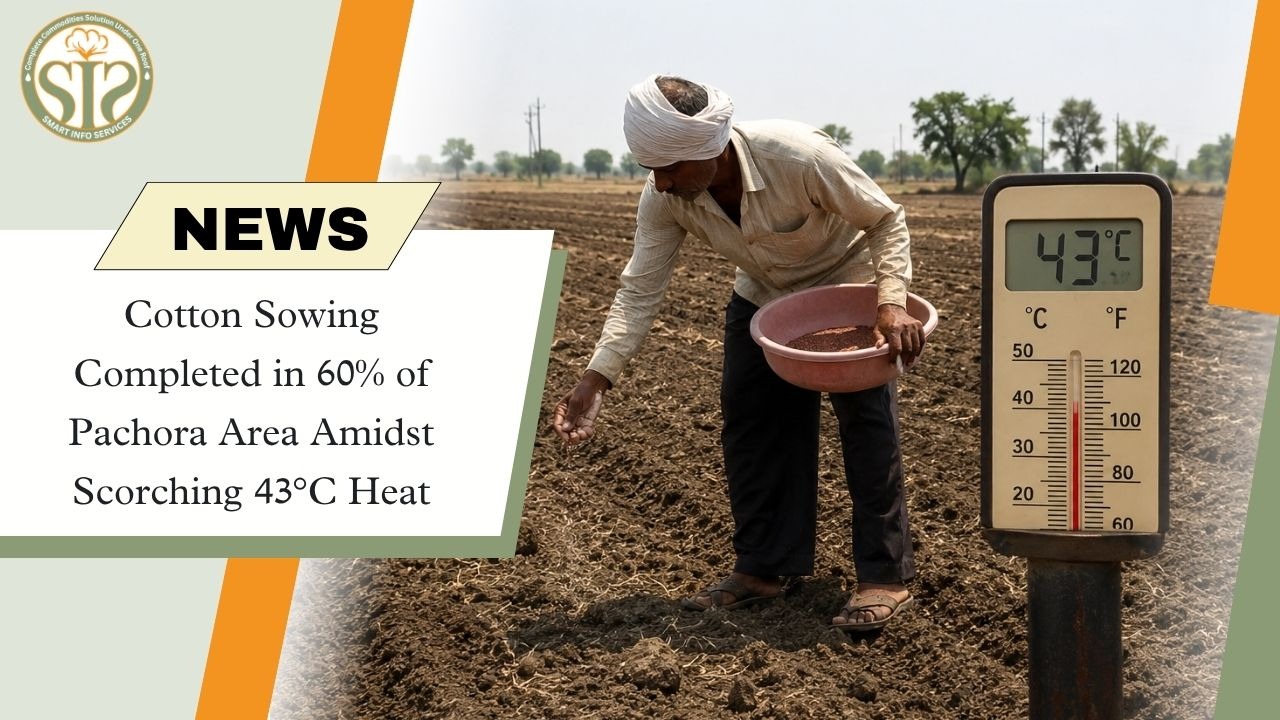
Cotton Sowing Completed in 60% of Pachora Area Amidst Scorching 43°C HeatPachora Taluka in Jalgaon district is renowned for cotton production; however, in recent years, farmers have grappled with issues such as 'red disease' (reddening of leaves), bollworm infestations, erratic rainfall, and low crop prices. This year too, the Meteorological Department and agricultural experts have predicted deficient rainfall due to the 'El Niño' effect. Despite this, farmers have taken the risk and commenced cotton sowing ahead of schedule.The Agriculture Department had advised farmers to sow cotton only after June 15, given the prevailing extreme heat and dry winds in the region. Currently, the ambient temperature hovers around 40°C, while soil temperatures exceeding 43°C are being recorded. Such conditions can adversely affect seed germination and increase the likelihood of issues like 'red disease' in the plants later on.Nevertheless, approximately 60 percent of farmers in Pachora Taluka have completed pre-season sowing. Believing that a delay could impact both yield and income, they have initiated farming operations based on available irrigation facilities. Farmers with access to well water began sowing seeds as early as May 20.Pachora Taluka has a total geographical area of 82,507 hectares, of which 58,202 hectares is cultivable land. Plans are in place to cultivate cotton across approximately 42,950 hectares this year.Meanwhile, due to recurring losses, farmers are also showing an increasing inclination towards maize cultivation. Last year, maize was sown across 9,822 hectares; this figure has risen to 11,220 hectares this year. Farmers are now pinning their hopes on the monsoon, as timely and adequate rainfall will determine the success of this high-risk farming venture. READ MORE :- Kisan Sabha Flags Decline in Haryana Cotton Acreage, Criticises Govt Policies
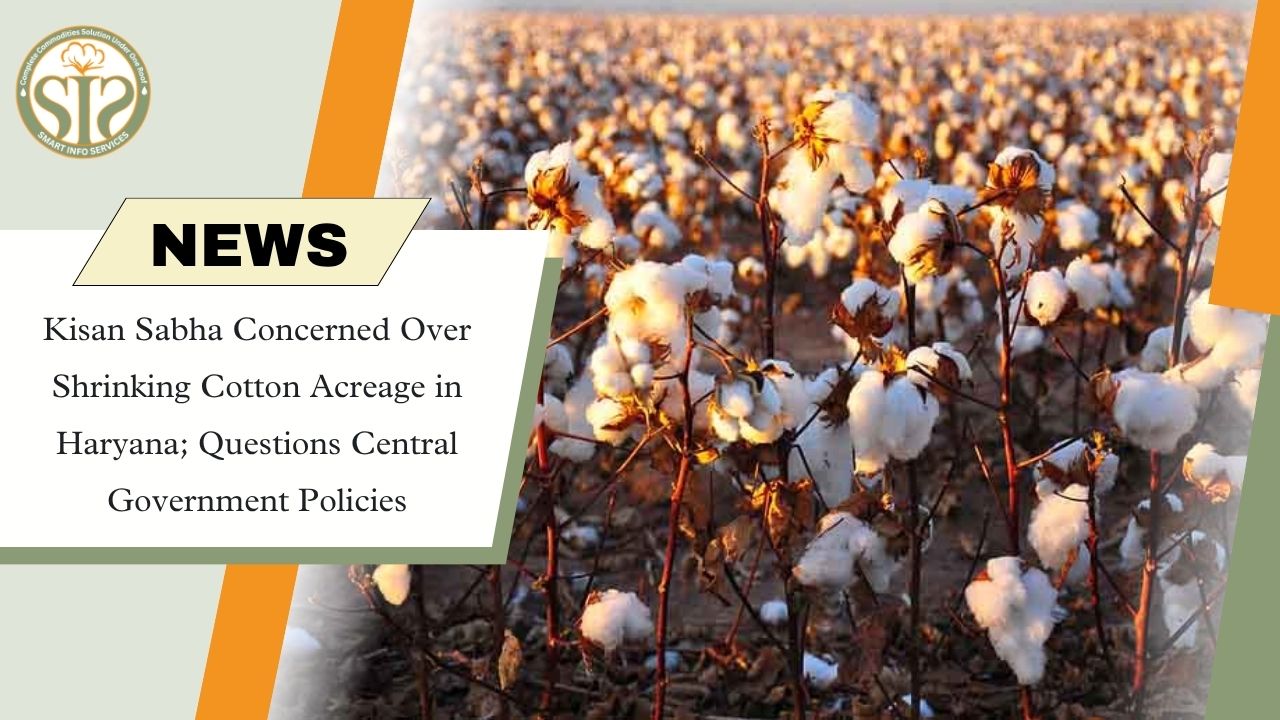
Kisan Sabha Concerned Over Shrinking Cotton Acreage in Haryana; Questions Central Government PoliciesThe Haryana unit of the All India Kisan Sabha (AIKS) has expressed serious concern over the continuously declining acreage of cotton cultivation in the state. The organization states that this drop in cotton production could have a far-reaching impact on farmers' incomes, the rural economy, and the country's cotton sector. This issue was discussed in detail during a meeting of the AIKS state-level committee held in Rohtak on Monday.It was noted during the meeting that the area under cotton cultivation is steadily shrinking in Haryana's major cotton-producing districts—Sirsa, Fatehabad, Hisar, Bhiwani, Rewari, and Mahendragarh. Blaming the central government's policies for this trend, Kisan Sabha leaders stated that farmers are moving away from cotton cultivation because they are not receiving remunerative prices or adequate protection.The meeting was presided over by AIKS State President Master Balbir Singh. Criticizing the central government's decision to remove the 11 percent import duty on cotton, he argued that this would increase pressure from cheap imported cotton and cause losses to domestic producers. According to him, this decision could further weaken the position of cotton farmers who are already grappling with economic challenges.Highlighting the struggle of farmers in Bhiwani and Dadri, AIKS National Vice President Inderjit Singh noted that farmers had agitated for nearly ten months to secure insurance claims for Kharif crops damaged in 2023. Following sustained pressure, the government approved compensation of ₹375 crore for crop loss, yet several issues regarding its disbursement persist. He demanded that the approved compensation amount be transferred to the farmers' accounts without delay.Dissatisfaction was also expressed regarding the recently announced Minimum Support Price (MSP) for Kharif crops. Farmer leaders argued that the hike in MSP is insufficient given the rising costs of cultivation and is unlikely to provide the expected relief to farmers. READ MORE :- Trump Says Israel and Iran Seek Immediate Ceasefire, Peace Talks Underway

US President Donald Trump Says Israel and Iran Seeking Immediate Ceasefire; Peace Negotiations OngoingUS President Donald Trump on June 8 (IST) said that Israel and Iran are seeking an immediate ceasefire, adding that final negotiations aimed at reaching a broader peace agreement are currently underway.In a post on his Truth Social platform, Trump stated that both countries are looking to halt hostilities and move toward a negotiated settlement. He noted, however, that existing restrictions would remain in place until a comprehensive agreement is finalised.“Both sides, Israel and Iran, are looking to do an immediate CEASEFIRE! Final negotiations on ‘Peace’ are proceeding,” Trump wrote. He also cautioned that progress should not be hindered by “ignorance or stupidity.”Trump further said that the blockade would remain “in full force and effect” until a “Final Deal” is reached, indicating that current measures would stay in place pending the successful conclusion of peace talks.

$40 Million Investment in Odisha's Textile Sector; 12,500 Jobs ExpectedOdisha has recently secured new investments worth US$40 million (over ₹300 crore) in the textile and apparel sector. These projects are expected to generate approximately 12,500 new jobs in the state, positioning the sector as a major source of employment.The largest employment-generating project is an apparel manufacturing unit by Nandraj Textiles Private Limited in Khurda district. The company will invest ₹168.64 crore (approximately $17.70 million) in this project, which is expected to provide employment to 10,306 people. This is considered one of the state's most significant job-creating investments in recent years.Additionally, Shahi Exports Private Limited has received approval to set up a knitted garment manufacturing unit in Sambalpur with an investment of ₹145.5 crore ($15.27 million). This project is likely to create around 1,840 jobs and strengthen the state's apparel manufacturing ecosystem.Maa Taratarini Textile Park Private Limited will develop an integrated textile project in Ganjam district with an investment of ₹70 crore ($7.34 million), creating approximately 350 jobs.All these projects have been approved by the State Level Single Window Clearance Authority (SLSWCA). The government aims to spread industrial development across various districts of the state rather than limiting it to a few select areas.Apart from Khurda, investment proposals have also been approved for districts such as Koraput, Sambalpur, Jajpur, Jharsuguda, Dhenkanal, Balangir, Keonjhar, and Mayurbhanj, fostering balanced industrial growth and job creation across Odisha.READ MORE :- Karur Textile Industry Hit by Cotton Yarn Price Surge

Karur’s Textile Industry Under Pressure Due to Surge in Cotton Yarn PricesKarur: A sharp rise in cotton yarn prices—driven by ongoing geopolitical tensions in West Asia and disruptions in global supply chains—has placed the textile industry in Karur, a major textile hub in Tamil Nadu, under significant pressure. Industry representatives state that rising raw material costs are impacting both production and export activities.According to industry sources, textile manufacturers in Karur rely primarily on spinning mills in Coimbatore, Dindigul, Virudhunagar, and Vellakoil for their yarn requirements. Over the past six weeks, an imbalance between supply and demand has caused the price of coarse-count cotton yarn to surge by 30 to 40 percent. Prices for high-count yarn have risen from approximately ₹300 per kilogram to ₹400 per kilogram—an increase the industry considers extraordinary.Although the central government granted relief on cotton import duties in response to demands from the textile industry, traders in Karur argue that the benefits have primarily accrued to garment manufacturers in Tiruppur. While prices for yarn used in the garment sector have dropped by 3 to 4 percent, there has been no significant impact on the prices of the coarse yarn used in Karur.P. Gopalakrishnan, President of the Karur Textile Manufacturers and Exporters Association, stated that the current surge in cotton yarn prices is unprecedented and has severely impacted the industry's cost structure. He emphasized that price stability is essential for the smooth operation of the industry.Industry bodies have urged both the central and state governments to intervene. According to traders, escalating tensions between the US and Iran have affected global trade and shipping, leading to price hikes for essential items such as polyester, dyeing chemicals, polyethylene, and packaging materials. Exporters believe that if this situation persists, it could have a negative impact on the competitiveness, export growth, and employment opportunities of Karur's textile industry.read more :- Rupee Opens 23 Paise Stronger at 95.48 Against Dollar

The rupee opened 23 paise stronger at 95.48 against the USD.On Tuesday, the Indian rupee opened 23 paise stronger against the dollar at 95.48, whereas it had closed at 95.71 on Monday. READ MORE :- The rupee ended 40 paise lower at 95.71 against the dollar.

On Monday the Indian Rupee lower by 40 paise to close at 95.71 against the US dollar, after opening at 95.31 in morning trade.At close, the Sensex was down 719.08 points or 0.97 percent at 73,524.26, and the Nifty was down 243.70 points or 1.04 percent at 23,123.00. About 1172 shares advanced, 3007 shares declined, and 154 shares unchanged.read more :- Cotton Duty Waiver Boosts Gujarat Textile Sector

Relief for Gujarat's Textile Sector from Cotton Import Duty WaiverAhmedabad: Gujarat's textile industry has welcomed the Central Government's decision to suspend the 11% import duty on cotton until October 30. Industry stakeholders believe this move will reduce raw material costs and enhance the competitiveness of Indian textile products in the global market.In recent months, domestic cotton prices had surged to ₹68,500 per candy, driving up costs for spinning mills, fabric manufacturers, and garment exporters. The industry states that the duty waiver will improve cotton availability and help keep prices in check.Chintan Thaker, Chairman of the ASSOCHAM Gujarat State Council, noted that imports are primarily limited to Extra-Long Staple (ELS) cotton, which is not a substitute for Indian cotton. According to him, this decision will help reduce production costs for textile manufacturers and exporters. Furthermore, the availability of superior quality fiber will improve product quality and make it easier to meet the requirements of global brands.Rahul Shah, Co-Chairman of the Textile Committee at the Gujarat Chamber of Commerce and Industry (GCCI), stated that raw cotton prices have dropped by approximately ₹4,000 per candy following the announcement of the duty waiver. This will lower input costs for mills and improve operating margins, particularly for export-oriented companies.Jayesh Patel, Senior Vice President of the Spinners Association Gujarat (SAG), mentioned that while Indian spinning mills are receiving strong export orders from China and Bangladesh, high domestic cotton prices had posed a challenge. He believes the import duty waiver will ease pressure on cotton and yarn prices, enabling the Indian textile industry to become more competitive globally.read more :- Maharashtra Cotton Acreage Set to Rise

Cotton Acreage Expected to Rise in Maharashtra for Kharif 2026-27Cotton cultivation acreage in Maharashtra is likely to increase by 10–15% during the Kharif 2026-27 season. According to Agriculture Department officials, farmers—particularly in the Vidarbha and Marathwada regions—are prioritizing cotton over soybean due to the sharp rise in cotton prices in both domestic and international markets.Officials state that better market demand and the prospect of higher profits are attracting farmers to cotton. Soybean growers suffered heavy losses last season; many had to sell their produce at ₹4,000–4,500 per quintal, well below the Minimum Support Price (MSP) of ₹5,328 per quintal. In contrast, cotton prices reached ₹9,000–9,500 per quintal in April and May, significantly exceeding the MSP.Ashok Bhutada, a farmer from Yavatmal, mentioned that he cultivated cotton on 16 acres last year and plans to expand this to 20–21 acres this time. He believes that amidst changing weather patterns and erratic rainfall, cotton has emerged as a relatively safer option compared to soybean.The Agriculture Department observes that this trend is visible across several districts in Vidarbha and Marathwada. However, experts have cautioned farmers against making decisions based solely on current high prices. Farmer leader Vijay Jawandhia notes that the current surge in cotton prices is linked to international market conditions, and there is no guarantee that prices will remain at this level by the time the crop hits the market.Despite cotton's growing popularity, associated risks remain. In 2025-26, cotton production in the state dropped by approximately 47% to 51 lakh metric tonnes, primarily due to excessive, unseasonal rainfall and hailstorms. Concerns regarding deficient rainfall in several districts persist for the upcoming season as well. Experts believe that high market prices alone are not sufficient to ensure farmers' income. Only an effective procurement system, fair prices, and better agricultural guidance can provide farmers with genuine economic security.read more :- Heavy Rain Alert in Kerala

Monsoon Active in Kerala; Heavy Rain Warning for Next 7 DaysThe Southwest Monsoon arrived in Kerala on June 4, 2026, leading to an intensification of rainfall across the state. Several regions were already saturated due to pre-monsoon showers, and a spell of moderate to heavy rain has now commenced. According to the Meteorological Department, heavy rainfall is likely to continue in Kerala for the next week.June and July are considered the wettest months for Kerala. On average, the state receives around 650 mm of rainfall during this period, accounting for approximately 70 percent of the total monsoon season's rainfall. Consequently, this time of year is regarded as crucial and sensitive for the state.Impact of the Active System in the Arabian SeaA cyclonic circulation has developed in the mid-levels of the atmosphere—at an altitude of approximately 10,000 to 15,000 feet—over the east-central Arabian Sea, near the coasts of Goa and North Karnataka. This system has strengthened the monsoon's westerly winds, causing them to strike the Western Ghats with greater force and resulting in continuous rainfall.Heavy rainfall has been recorded over the past 24 hours in several districts, including Kochi, Kozhikode, Kottayam, and Kannur. The impact of this system has also been observed in the coastal regions of Karnataka, such as Honnavar and Karwar.Impact Likely to Intensify in the Coming DaysThe Meteorological Department forecasts that this cyclonic circulation will remain active for the next few days. While it is unlikely to evolve into a major, powerful storm system, it will keep the monsoon winds consistently active.There is a risk of heavy to very heavy rainfall across the entire Kerala coast, stretching from Thiruvananthapuram to Kozhikode. The intensity and spread of the rainfall are expected to increase further between June 7 and June 11, 2026. Risk of Floods and LandslidesContinuous rainfall has led to waterlogging in several areas and a rise in river water levels, while also increasing the likelihood of landslides in hilly regions. The administration has urged people to remain vigilant and avoid unnecessary travel.read more :- State-wise CCI Cotton Sales Update
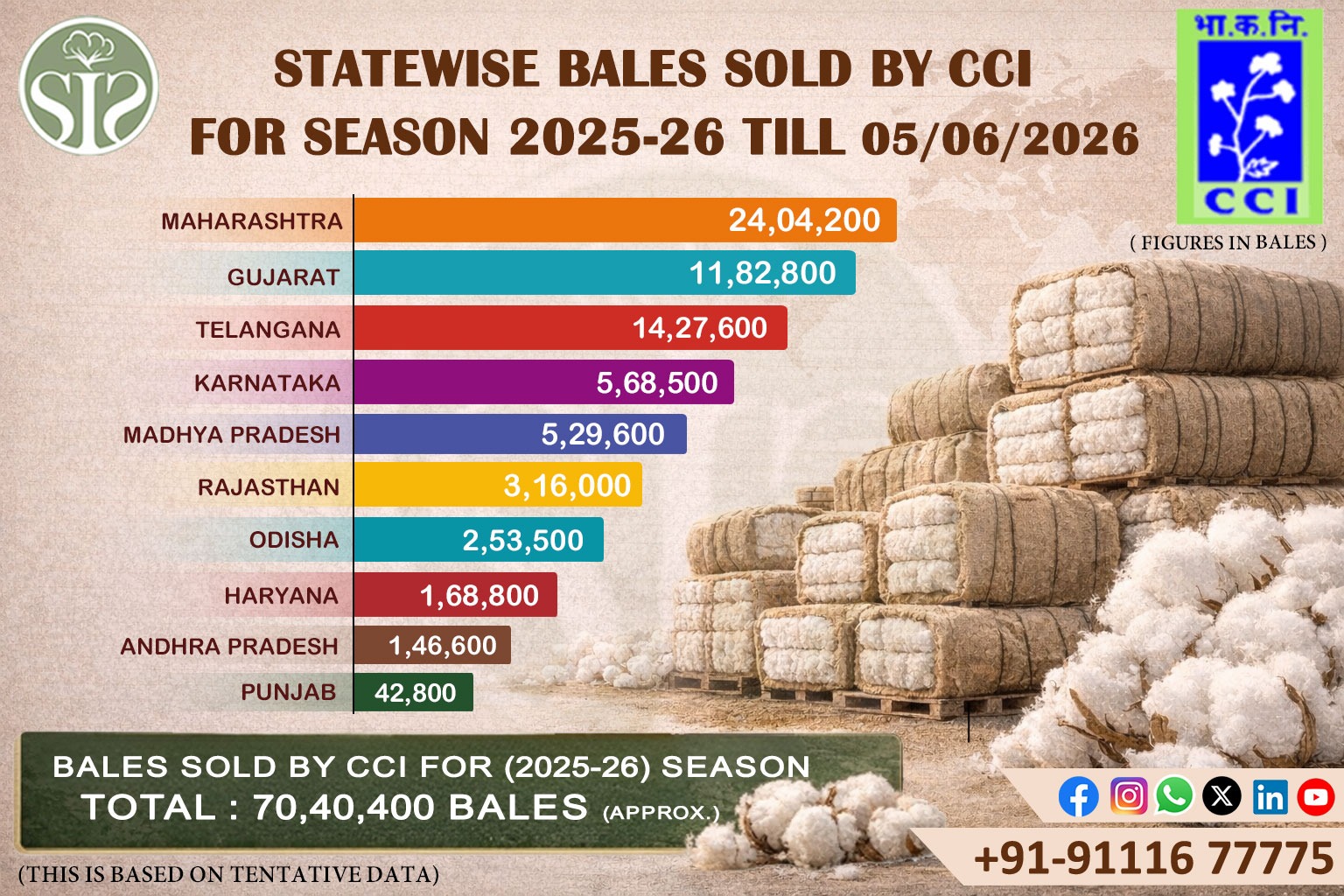
State-wise CCI Cotton Sales Details – 2025-26 SeasonThe Cotton Corporation of India (CCI) reduced its cotton candy prices by upto ₹700 per candy during this week . CCI has sold approximately 70,40,400 cotton bales for the 2025-26 season. Sales are highly concentrated in a few major cotton-producing states, Maharashtra, Telangana and Gujarat emerging as the leading contributors.

The rupee opened 37 paise lower at 95.31 against the USD.On Monday, the Indian rupee opened 37 paise lower against the dollar at 95.31, whereas it had closed at 94.94 on Friday.READ MORE :- CCI Cuts Cotton Prices by ₹700 per Candy
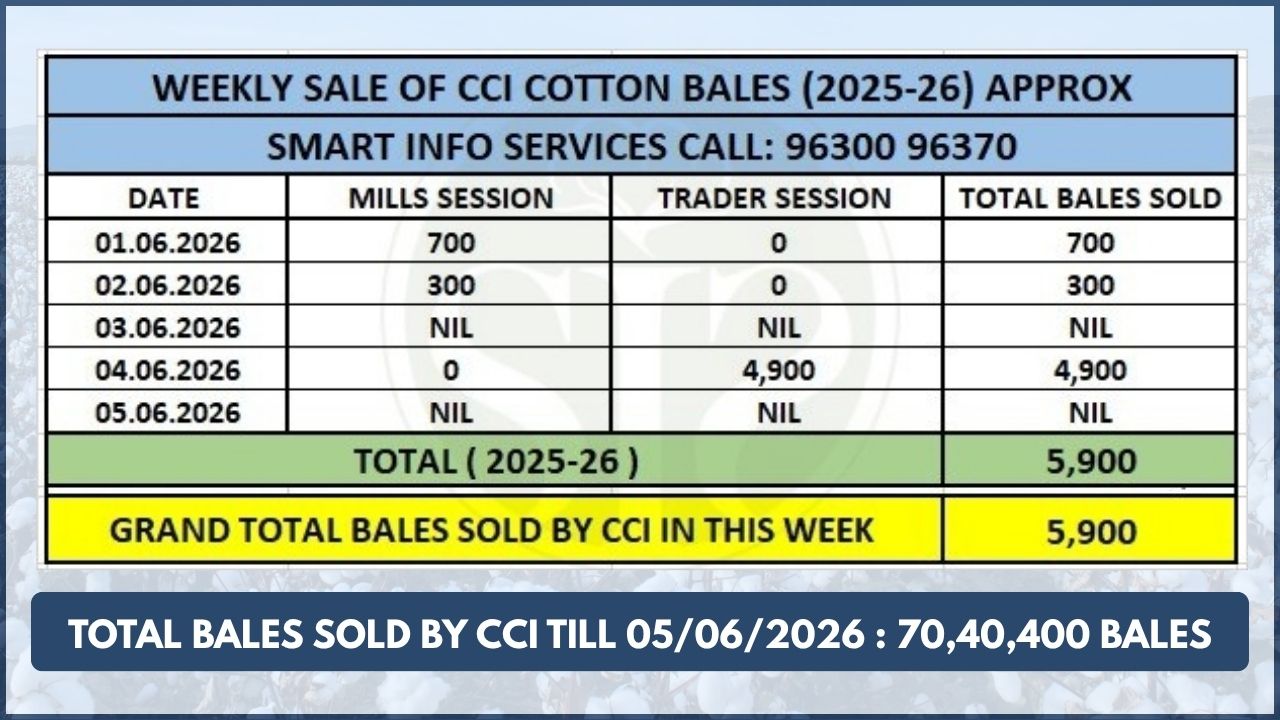
CCI Cuts Cotton Prices by ₹700 per Candy; Season Sales Cross 70.4 Lakh BalesThe Cotton Corporation of India (CCI) reduced its Cotton Candy prices by ₹700 per candy during the week of June 1–June 5, 2026. Despite the price reduction, auction activity remained moderate, with participation from both mills and traders. Total sales during the week stood at approximately 5,900 bales from the 2025–26 cotton season.Day-wise Auction PerformanceJune 1, 2026 (Monday)The week began with the sale of 700 bales, all purchased by textile mills.June 2, 2026 (Tuesday)CCI recorded sales of 300 bales, with mills continuing to dominate purchases.June 4, 2026 (Thursday)The highest activity of the week was witnessed on Thursday, when 4,900 bales were sold. The entire quantity was purchased by cotton traders.June 3 & June 5, 2026No cotton sales were reported on either Wednesday or Friday.Cumulative Sales Update CCI’s total sales have reached: 2025–26 season: 70,40,400 bales

Farmers May Shift from Maize to Cotton and SoybeanAmidst the potential El Niño effect and forecasts of a below-normal monsoon, farmers' crop selection strategies for the Kharif season may undergo changes. According to a research report by CRISIL, farmers across various states are likely to select crops based on weather conditions, profitability, and market dynamics.The report indicates that maize-growing farmers in Rajasthan might shift towards soybean cultivation. Meanwhile, in Madhya Pradesh—the country's largest soybean-producing state—there is a possibility of some acreage currently dedicated to maize and soybean shifting to cotton, potentially increasing the state's total cotton area.Pushan Sharma, the lead author of the report, notes that while the total area under maize is expected to decline, the pattern of crop switching will vary by state. Farmers will consider factors beyond just rainfall forecasts, such as the relative profitability of crops, procurement support, and prevailing market conditions.The report highlights that higher temperatures and uneven rainfall during the early stages of the season could lead to increased pest and disease infestations in crops like cotton and soybean, posing a risk to production.However, water levels in the country's reservoirs remain above normal, which is expected to facilitate timely field preparation and sowing operations in key agricultural regions. Nevertheless, Kharif crop yields will largely depend on the distribution of monsoon rainfall, pest and disease management, and the availability of fertilizers.According to the report, faced with the prospect of below-normal rainfall, farmers will weigh risks against potential returns when selecting crops; consequently, the acreage for cotton and soybean may increase at the expense of maize in certain regions.read more :- The rupee ended 78 paise higher at 94.94 against the dollar.

On Friday the Indian Rupee higher by 78 paise to close at 94.94 against the US dollar, after opening at 95.72 in morning trade.At close, the Sensex was down 116.67 points or 0.16 percent at 74,243.34, and the Nifty was down 49.85 points or 0.21 percent at 23,366.70. About 1966 shares advanced, 2049 shares declined, and 197 shares unchanged.read more :- Tamil Nadu Textile Industry Could Save ₹3,250 Crore Annually Through Renewable Energy: Report

Report: Tamil Nadu’s textile industry could save up to ₹3,250 crore annually by adopting renewable energyAccording to a new report by the Bengaluru-based think tank Climate Risk Horizons, Tamil Nadu’s textile industry could save between ₹1,560 crore and ₹3,250 crore annually by transitioning to clean energy. The study assesses the status and potential of the industry's decarbonization based on data from the 'Annual Survey of Industries' (ASI) over the past decade.The report states that if the industry were to switch entirely to renewable electricity, annual savings could range from ₹2,320 crore to ₹3,250 crore. The study notes that rising energy and fuel costs have become a primary factor driving up textile production costs in the state.Rakesh Ranjan, a co-author of the report, stated that escalating fuel costs are impacting the competitiveness of Tamil Nadu’s textile industry. He pointed out that the state's textile exports have remained stagnant at around $7.4 billion since 2017. According to him, adopting renewable energy would lower costs and strengthen the industry's global competitiveness.The report also highlights that the total energy expenditure of the state's textile sector has nearly doubled over the last four years. Additionally, there has been an increase in the ratio of fuel costs to production output. The study reveals that India's textile industry has the highest carbon footprint compared to major exporting nations, exceeding 12.5 kg of CO₂e per kilogram of textile produced.The report suggests that the industry could reduce both production costs and carbon emissions by adopting renewable energy-based electric heating. It also recommends that the state government and electricity regulatory bodies facilitate easier access to renewable energy, particularly for MSME units. This version is more streamlined and edited in the formal style of news writing.read more :- Haryana Farmers Abandon Cotton Cultivation as Acreage Falls 65% in Seven Years
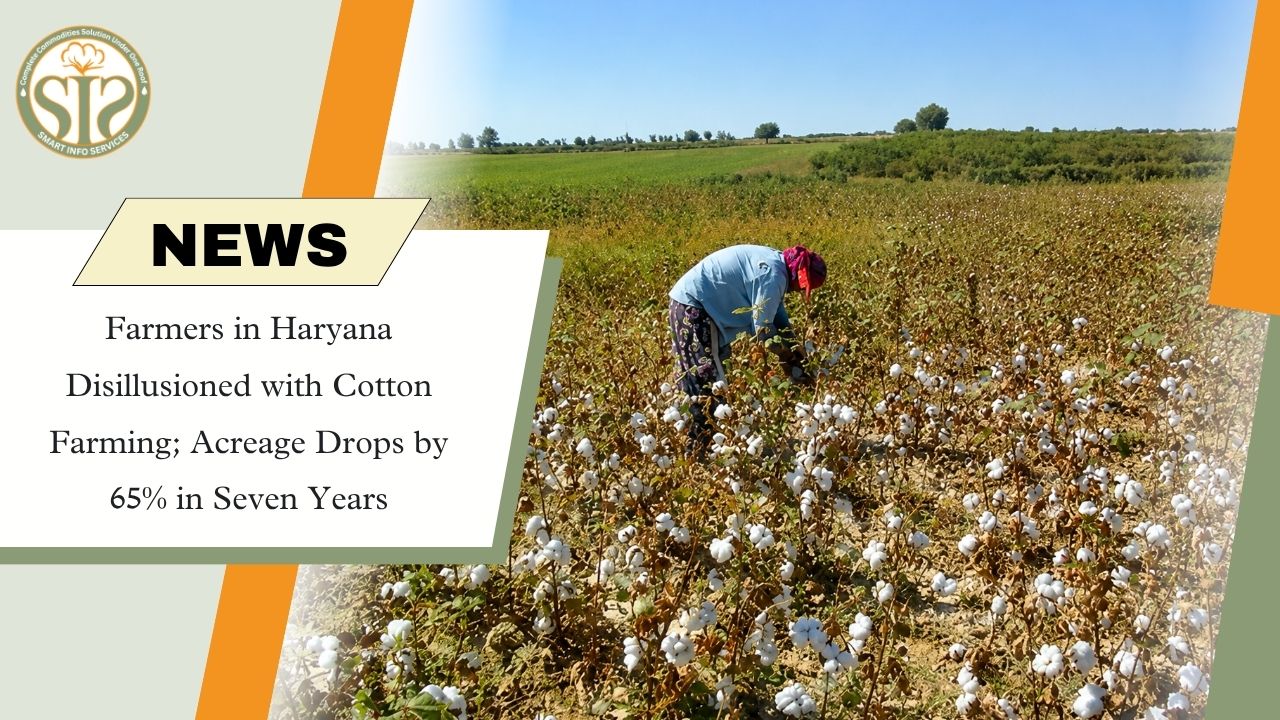
Farmers in Haryana Disillusioned with Cotton Farming; Acreage Drops by 65% in Seven YearsHisar – Cotton, once considered a major cash crop for farmers in Haryana, is currently facing a crisis. Farmers are turning away from cotton cultivation due to persistent financial losses, the growing menace of the pink bollworm, and heavy crop damage caused by rainfall. The impact of this shift is clearly visible in the state's cotton acreage.In the 2019-20 season, cotton was cultivated across 8.01 lakh acres in Haryana; by 2025-26, this figure had dropped to just 2.84 lakh acres. In other words, the area under cotton cultivation has shrunk by approximately 65 percent over seven years. The cultivated area has nearly halved in the last three years alone. This season, the area sown with cotton has hit its lowest level in eight years.The Agriculture Department has made several efforts to promote cotton cultivation. Awareness programs were conducted in major cotton-producing districts under the 'Promotion for Cotton Cultivation in Haryana' campaign. Financial assistance of ₹2,000 per acre for micronutrients and ₹4,000 per acre for cultivating indigenous cotton varieties is also being provided to farmers. Despite these measures, farmers remain reluctant to return to cotton farming.According to Dr. Atma Ram Godara, Joint Director (Cotton), farmers have been incurring consistent losses in cotton cultivation over the past few years. Rainfall during August and September causes the most significant damage to the crop, while the infestation of the pink bollworm remains a major challenge.A report by Dr. Vinay Mahla, an agricultural scientist at Haryana Agricultural University, indicates that the average cost of cotton cultivation for farmers was ₹40,024 per acre, whereas the total income from sales and by-products was only ₹24,882. Consequently, farmers suffered an average loss of ₹15,142 per acre. Experts believe that if better and pest-resistant varieties are not developed, the scope of cotton cultivation in the state could shrink further in the coming years.read more :- Rupee Opens 7 Paise Higher Against US Dollar at 95.72
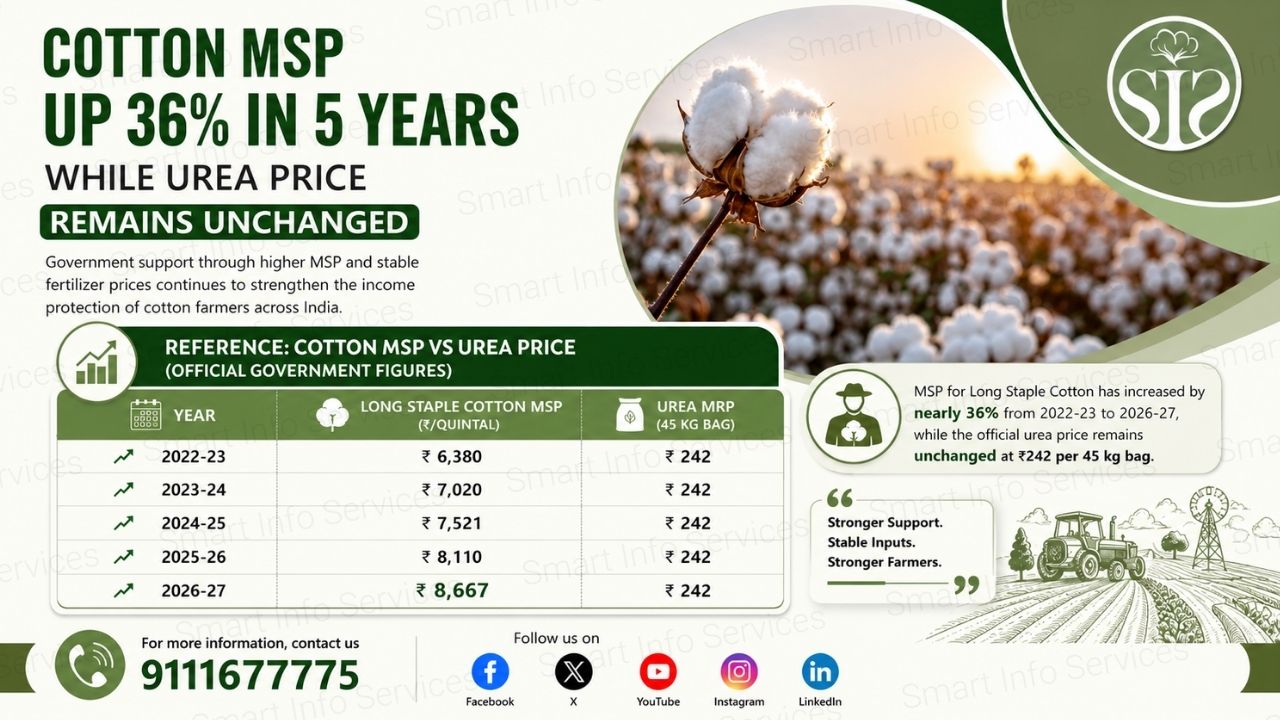
કપાસની MSP ૩૬% વધી છે જ્યારે યુરિયા ₹૨૪૨ પર સ્થિર છે: શું ખેડૂતોને આખરે ફાયદો મળી રહ્યો છે?નવી દિલ્હી: છેલ્લા પાંચ વર્ષમાં લઘુત્તમ ટેકાના ભાવ (MSP) માં નોંધપાત્ર વધારાથી ભારતના કપાસના ખેડૂતોને ફાયદો થયો છે, જ્યારે સતત સબસિડીને કારણે સરકાર દ્વારા નક્કી કરાયેલ યુરિયાના ભાવ યથાવત રહ્યા છે. આ વલણે ફરી ચર્ચા જગાવી છે કે શું MSPમાં વધારો ખેડૂતોની આવકમાં વધારો કરી રહ્યો છે.સરકારી આંકડા અનુસાર, લાંબા ગાળાના કપાસ માટે MSP ૨૦૨૨-૨૩માં પ્રતિ ક્વિન્ટલ ₹૬,૩૮૦ થી વધીને ૨૦૨૬-૨૭ સીઝન માટે પ્રતિ ક્વિન્ટલ ₹૮,૬૬૭ થયો છે. આ પાંચ વર્ષમાં પ્રતિ ક્વિન્ટલ ₹૨,૨૮૭ - અથવા આશરે ૩૬ ટકા - નો વધારો દર્શાવે છે. ૨૦૨૬-૨૭ માટે પ્રતિ ક્વિન્ટલ ₹૫૫૭ નો તાજેતરનો વધારો મુખ્ય ખરીફ પાક માટે જાહેર કરાયેલા સૌથી મોટા વધારામાંનો એક છે.MSPમાં સતત વધારો જોવા મળ્યો છે: 2022-23માં ₹6,380 થી 2023-24માં ₹7,020, 2024-25માં ₹7,521, 2025-26માં ₹8,110 અને 2026-27માં ₹8,667. 20 ક્વિન્ટલ કપાસનું ઉત્પાદન કરતા ખેડૂત માટે, પાકનું MSP-આધારિત મૂલ્ય ₹1.27 લાખથી વધીને ₹1.73 લાખ થયું છે, જેના પરિણામે ₹45,000 થી વધુનો સંભવિત ફાયદો થયો છે.તેનાથી વિપરીત, લીમડાથી કોટેડ યુરિયાની 45 કિલોની થેલીનો મહત્તમ છૂટક ભાવ (MRP) ₹242 પર યથાવત રહ્યો છે. રસાયણ અને ખાતર મંત્રાલયે સ્પષ્ટતા કરી છે કે યુરિયાના ભાવમાં વધારો કરવાનો હાલમાં કોઈ પ્રસ્તાવ નથી, અને સરકાર ખેડૂતો માટે ખાતરોને પોસાય તે માટે સબસિડી આપવાનું ચાલુ રાખશે. આ સરખામણી એક નોંધપાત્ર વલણ દર્શાવે છે: જ્યારે લાંબા ગાળાના કપાસ માટે લઘુત્તમ ટેકાના ભાવ (MSP) 2022-23 થી આશરે 36 ટકા વધ્યા છે, ત્યારે યુરિયાના સરકાર દ્વારા નિર્ધારિત ભાવ યથાવત રહ્યા છે. આનાથી કપાસના ભાવ અને યુરિયા - સૌથી વધુ ઉપયોગમાં લેવાતા કૃષિ ઇનપુટ - ની કિંમત વચ્ચેનો ગુણોત્તર સુધર્યો છે. જોકે, કૃષિ નિષ્ણાતો નિર્દેશ કરે છે કે નફાકારકતા ફક્ત MSP અને ખાતરના ભાવ દ્વારા નક્કી થતી નથી; ખેડૂતોને મજૂરી, જંતુનાશકો, ડીઝલ, સિંચાઈ અને મશીનરી માટે વધુ ખર્ચનો સામનો કરવો પડી રહ્યો છે. વધતા ખેતી ખર્ચે ઊંચા MSP થી કેટલાક લાભોને ઘટાડ્યા છે, જેનો અર્થ એ થાય કે વાસ્તવિક આવકમાં વધારો MSP માં વધારા કરતા ઓછો છે.તેમ છતાં, ખાતર સબસિડી જાળવી રાખીને MSP વધારવાની સરકારની બેવડી વ્યૂહરચનાએ કપાસના ખેડૂતોને વધુ સારી આવક સુરક્ષા પૂરી પાડી છે. ખરીફ પાકોમાં કપાસમાં સૌથી મોટો MSP વધારો અને યુરિયાના ભાવ સ્થિર રહેવાને કારણે, ખેડૂતો સામાન્ય રીતે પાંચ વર્ષ પહેલા કરતા સારી સ્થિતિમાં છે.નિષ્ણાતો જણાવે છે કે આગળનો પડકાર એ સુનિશ્ચિત કરવાનો છે કે ઊંચા ટેકાના ભાવ સાથે ઉત્પાદકતામાં સુધારો, કાર્યક્ષમ ખરીદી અને ખેતી ખર્ચમાં ઘટાડો થાય, જેથી લાભનો નોંધપાત્ર હિસ્સો આખરે ખેડૂતોના ખિસ્સા સુધી પહોંચે.વધુ વાંચો :- ગુજરાતમાં કપાસ વાવણીમાં તેજી, એક સપ્તાહમાં 78,000 હેક્ટરનો વધારો
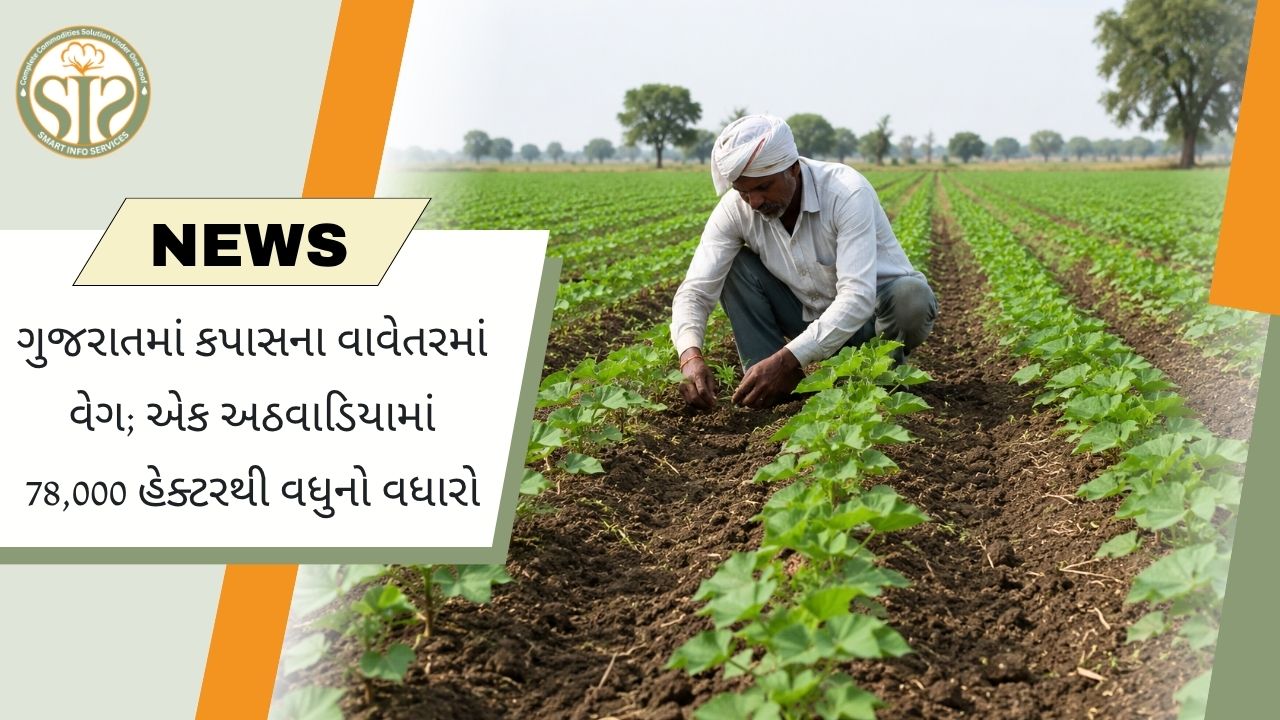
ગુજરાતમાં કપાસના વાવેતરમાં વેગ; એક અઠવાડિયામાં 78,000 હેક્ટરથી વધુનો વધારોઅમદાવાદ, 08 જૂન, 2026: ગુજરાતમાં કપાસની વાવણી ઝડપથી ચાલી રહી છે. ગુજરાત કૃષિ, ખેડૂત કલ્યાણ અને સહકાર વિભાગ દ્વારા જાહેર કરાયેલા સાપ્તાહિક વાવણીના આંકડા અનુસાર, 1 જૂનથી 8 જૂન દરમિયાન રાજ્યમાં કપાસના વાવેતર વિસ્તારમાં નોંધપાત્ર વધારો નોંધાયો છે.આ આંકડા દર્શાવે છે કે રાજ્યમાં કપાસનો કુલ વાવેતર વિસ્તાર 1 જૂનના રોજ 14,996 હેક્ટર હતો અને 8 જૂન સુધીમાં તે વધીને 93,449 હેક્ટર થયો છે. આમ, એક જ અઠવાડિયામાં 78,453 હેક્ટરમાં વધારાનું વાવેતર નોંધાયું છે.સૌરાષ્ટ્ર પ્રદેશ કપાસના વાવેતરમાં આગળ છે. અહીં, વાવણી વિસ્તાર 12,500 હેક્ટરથી વધીને 60,700 હેક્ટર થયો છે. સુરેન્દ્રનગર (૧૮,૯૦૦ હેક્ટર), મોરબી (૧૬,૮૦૦ હેક્ટર), અમરેલી (૭,૫૦૦ હેક્ટર), ભાવનગર (૬,૫૦૦ હેક્ટર) અને બોટાદ (૬,૧૦૦ હેક્ટર) વાવણી માટે મુખ્ય જિલ્લાઓ હતા.કચ્છ જિલ્લાના ખેડૂતો પણ કપાસના વાવેતરમાં સક્રિયપણે જોડાયા છે; જિલ્લામાં વાવણી વિસ્તાર ૧,૯૦૦ હેક્ટરથી વધીને ૧૦,૩૦૦ હેક્ટર થયો છે. દરમિયાન, ઉત્તર ગુજરાતમાં કપાસનું વાવેતર ૫૦૦ હેક્ટરથી વધીને ૧૪,૮૦૦ હેક્ટર થયું છે, જેમાં મહેસાણા, પાટણ અને સાબરકાંઠા મુખ્ય ફાળો આપે છે.મધ્ય ગુજરાતમાં, વાવણી ૧૦૦ હેક્ટરથી વધીને ૪,૭૦૦ હેક્ટર થઈ છે, જ્યારે દક્ષિણ ગુજરાતમાં, ૩,૧૦૦ હેક્ટરમાં કપાસનું વાવેતર થયું છે. આ ક્ષેત્રમાં ભરૂચ અને તાપી જિલ્લાઓ અગ્રણી હતા.નિષ્ણાતો માને છે કે ચોમાસાની પ્રગતિ અને અનુકૂળ હવામાન પરિસ્થિતિઓને કારણે ખેડૂતો કપાસની વાવણીને વેગ આપવા માટે પ્રેરિત થયા છે. આગામી દિવસોમાં સારો વરસાદ પડે તો રાજ્યમાં કપાસનું વાવેતર વધુ વધવાની શક્યતા છે. સ્ત્રોત: ગુજરાત કૃષિ, ખેડૂત કલ્યાણ અને સહકાર વિભાગવધુ વાંચો :- પાચોરામાં 43°C ગરમી વચ્ચે 60% કપાસ વાવણી પૂર્ણ

મંગળવાર સવારના કારોબારમાં 95.48 પર ખુલ્યા પછી, ભારતીય રૂપિયો અમેરિકન ડોલર સામે 13 પૈસા વધીને 95.35 પર બંધ થયો.કારોબારના અંતે, સેન્સેક્સ 394.50 પોઈન્ટ (0.54 ટકા) વધીને 73,918.76 પર બંધ થયો, જ્યારે નિફ્ટી 119.10 પોઈન્ટ (0.52 ટકા) વધીને 23,242.10 પર બંધ થયો. આશરે 2,694 શેર વધ્યા, 1,343 ઘટ્યા અને 175 શેર યથાવત રહ્યા.
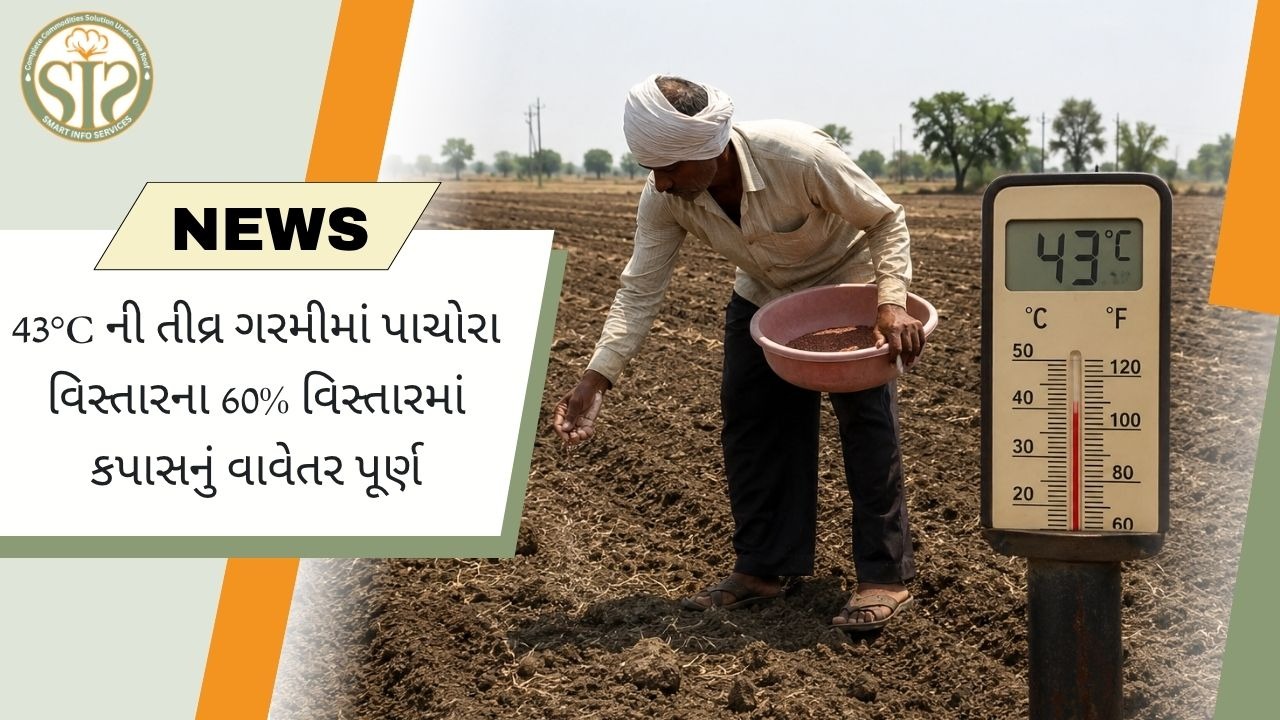
43°C ની તીવ્ર ગરમીમાં પાચોરા વિસ્તારના 60% વિસ્તારમાં કપાસનું વાવેતર પૂર્ણજલગાંવ જિલ્લાનો પાચોરા તાલુકો કપાસના ઉત્પાદન માટે પ્રખ્યાત છે, પરંતુ છેલ્લા કેટલાક વર્ષોથી ખેડૂતોને લાલ સડો, ઈયળ, અનિયમિત વરસાદ અને પાકના ઓછા ભાવ જેવી સમસ્યાઓનો સામનો કરવો પડી રહ્યો છે. આ વર્ષે પણ હવામાન વિભાગ અને કૃષિ નિષ્ણાતોએ અલ નીનોની અસરને કારણે ઓછા વરસાદની આગાહી કરી છે. તેમ છતાં, ખેડૂતોએ જોખમ લીધું છે અને સમય પહેલા કપાસની વાવણી શરૂ કરી છે.કૃષિ વિભાગે ખેડૂતોને ૧૫ જૂન પછી જ કપાસની વાવણી કરવાની સલાહ આપી હતી, કારણ કે આ પ્રદેશમાં ભારે ગરમી અને સૂકા પવનો ચાલી રહ્યા છે. હાલમાં, વાતાવરણનું તાપમાન ૪૦°C ની આસપાસ છે, જ્યારે માટીનું તાપમાન ૪૩°C થી વધુ છે. આવી પરિસ્થિતિઓ બીજ અંકુરણ પર પ્રતિકૂળ અસર કરી શકે છે અને પાછળથી છોડમાં લાલ સડો જેવી સમસ્યાઓનું જોખમ વધારી શકે છે.આમ છતાં, પાચોરા તાલુકાના આશરે ૬૦% ખેડૂતોએ પૂર્વ-મોસમ વાવણી પૂર્ણ કરી છે. ખેડૂતો માને છે કે વાવણીમાં વિલંબ કરવાથી ઉત્પાદન અને આવક પર અસર પડી શકે છે, તેથી તેઓએ ઉપલબ્ધ સિંચાઈ સુવિધાઓના આધારે ખેતી શરૂ કરી છે. 20 મેથી જ પાણી ધરાવતા ખેડૂતોએ પોતાના ખેતરોમાં બીજ વાવવાનું શરૂ કરી દીધું હતું.પાચોરા તાલુકાનો કુલ ભૌગોલિક વિસ્તાર 82,507 હેક્ટર છે, જેમાંથી 58,202 હેક્ટર ખેતીલાયક જમીન છે. આ વર્ષે અંદાજે 42,950 હેક્ટરમાં કપાસનું વાવેતર કરવાનું આયોજન છે.તે જ સમયે, સતત નુકસાનને કારણે, ખેડૂતો મકાઈની ખેતી તરફ પણ વળી રહ્યા છે. ગયા વર્ષે 9,822 હેક્ટરમાં મકાઈનું વાવેતર થયું હતું, જે આ વર્ષે વધીને 11,220 હેક્ટર થયું છે. ખેડૂતો હવે ચોમાસા પર નજર રાખી રહ્યા છે, કારણ કે સમયસર અને પૂરતો વરસાદ આ જોખમી પાકની સફળતા નક્કી કરશે.વધુ વાંચો :- હરિયાણામાં કપાસ રકબામાં ઘટાડો, કિસાન સભાએ સરકારની નીતિઓ પર ઉઠાવ્યા પ્રશ્નો

હરિયાણામાં કપાસના વાવેતરમાં ઘટાડા અંગે કિસાન સભા ચિંતિત; કેન્દ્ર સરકારની નીતિઓ પર સવાલ ઉઠાવે છેઅખિલ ભારતીય કિસાન સભા (AIKS) ના હરિયાણા એકમે રાજ્યમાં કપાસના વાવેતરમાં સતત ઘટાડા અંગે ગંભીર ચિંતા વ્યક્ત કરી છે. સંગઠનનું કહેવું છે કે કપાસના ઉત્પાદનમાં આ ઘટાડો ખેડૂતોની આવક, ગ્રામીણ અર્થતંત્ર અને દેશના કપાસ ક્ષેત્ર પર દૂરગામી અસર કરી શકે છે. સોમવારે રોહતકમાં યોજાયેલી AIKS રાજ્ય-સ્તરીય સમિતિની બેઠક દરમિયાન આ મુદ્દા પર વિગતવાર ચર્ચા કરવામાં આવી હતી.બેઠક દરમિયાન એ નોંધવામાં આવ્યું હતું કે હરિયાણાના મુખ્ય કપાસ ઉત્પાદક જિલ્લાઓ - સિરસા, ફતેહાબાદ, હિસાર, ભિવાની, રેવારી અને મહેન્દ્રગઢમાં કપાસના વાવેતર હેઠળનો વિસ્તાર સતત ઘટી રહ્યો છે. આ વલણ માટે કેન્દ્ર સરકારની નીતિઓને દોષી ઠેરવતા, કિસાન સભાના નેતાઓએ જણાવ્યું હતું કે ખેડૂતો કપાસની ખેતીથી દૂર જઈ રહ્યા છે કારણ કે તેમને નફાકારક ભાવ કે પૂરતું રક્ષણ મળી રહ્યું નથી.બેઠકની અધ્યક્ષતા AIKS રાજ્ય પ્રમુખ માસ્ટર બલબીર સિંહે કરી હતી. કેન્દ્ર સરકારના કપાસ પરના ૧૧ ટકા આયાત ડ્યુટી દૂર કરવાના નિર્ણયની ટીકા કરતા તેમણે દલીલ કરી હતી કે આનાથી સસ્તા આયાતી કપાસ પર દબાણ વધશે અને સ્થાનિક ઉત્પાદકોને નુકસાન થશે. તેમના મતે, આ નિર્ણય કપાસના ખેડૂતોની સ્થિતિને વધુ નબળી બનાવી શકે છે જેઓ પહેલાથી જ આર્થિક પડકારોનો સામનો કરી રહ્યા છે.ભિવાની અને દાદરીમાં ખેડૂતોના સંઘર્ષ પર પ્રકાશ પાડતા, AIKS ના રાષ્ટ્રીય ઉપાધ્યક્ષ ઇન્દ્રજીત સિંહે નોંધ્યું હતું કે ખેડૂતોએ ૨૦૨૩માં નુકસાન પામેલા ખરીફ પાક માટે વીમાના દાવા મેળવવા માટે લગભગ દસ મહિના સુધી આંદોલન કર્યું હતું. સતત દબાણને પગલે, સરકારે પાકના નુકસાન માટે ૩૭૫ કરોડ રૂપિયાનું વળતર મંજૂર કર્યું, છતાં તેના વિતરણ અંગે અનેક મુદ્દાઓ યથાવત છે. તેમણે માંગ કરી હતી કે મંજૂર વળતરની રકમ વિલંબ વિના ખેડૂતોના ખાતામાં ટ્રાન્સફર કરવામાં આવે.ખરીફ પાક માટે તાજેતરમાં જાહેર કરાયેલ લઘુત્તમ ટેકાના ભાવ (MSP) અંગે પણ અસંતોષ વ્યક્ત કરવામાં આવ્યો હતો. ખેડૂત નેતાઓએ દલીલ કરી હતી કે ખેતીના વધતા ખર્ચને ધ્યાનમાં રાખીને MSPમાં વધારો અપૂરતો છે અને તેનાથી ખેડૂતોને અપેક્ષિત રાહત મળવાની શક્યતા ઓછી છે.વધુ વાંચો :- ટ્રમ્પ: ઇઝરાયેલ અને ઇરાન તાત્કાલિક યુદ્ધવિરામ તરફ

યુએસ પ્રમુખ ડોનાલ્ડ ટ્રમ્પે કહ્યું કે ઇઝરાયલ અને ઈરાન તાત્કાલિક યુદ્ધવિરામ માંગે છે; શાંતિ વાટાઘાટો ચાલુ છેયુએસ પ્રમુખ ડોનાલ્ડ ટ્રમ્પે 8 જૂન (IST) ના રોજ કહ્યું કે ઇઝરાયલ અને ઈરાન તાત્કાલિક યુદ્ધવિરામ માંગે છે, અને ઉમેર્યું કે વ્યાપક શાંતિ કરાર પર પહોંચવા માટે અંતિમ વાટાઘાટો હાલમાં ચાલી રહી છે.તેમના ટ્રુથ સોશિયલ પ્લેટફોર્મ પર એક પોસ્ટમાં, ટ્રમ્પે જણાવ્યું હતું કે બંને દેશો દુશ્મનાવટ બંધ કરવા અને વાટાઘાટો દ્વારા સમાધાન તરફ આગળ વધવા માંગે છે. જોકે, તેમણે નોંધ્યું હતું કે વ્યાપક કરારને અંતિમ સ્વરૂપ ન મળે ત્યાં સુધી હાલના પ્રતિબંધો યથાવત રહેશે."બંને પક્ષો, ઇઝરાયલ અને ઈરાન, તાત્કાલિક યુદ્ધવિરામ કરવા માંગે છે! 'શાંતિ' પર અંતિમ વાટાઘાટો આગળ વધી રહી છે," ટ્રમ્પે લખ્યું. તેમણે ચેતવણી પણ આપી હતી કે "અજ્ઞાનતા અથવા મૂર્ખતા" દ્વારા પ્રગતિને અવરોધવી જોઈએ નહીં.ટ્રમ્પે વધુમાં કહ્યું કે "અંતિમ સોદો" થાય ત્યાં સુધી નાકાબંધી "સંપૂર્ણ બળ અને અસરમાં" રહેશે, જે દર્શાવે છે કે શાંતિ વાટાઘાટોના સફળ નિષ્કર્ષ સુધી વર્તમાન પગલાં યથાવત રહેશે.વધુ વાંચો :- ઓડિશા ટેક્સટાઇલ ક્ષેત્રમાં 40 મિલિયન ડોલરનું રોકાણ, 12,500 નોકરીઓની શક્યતા
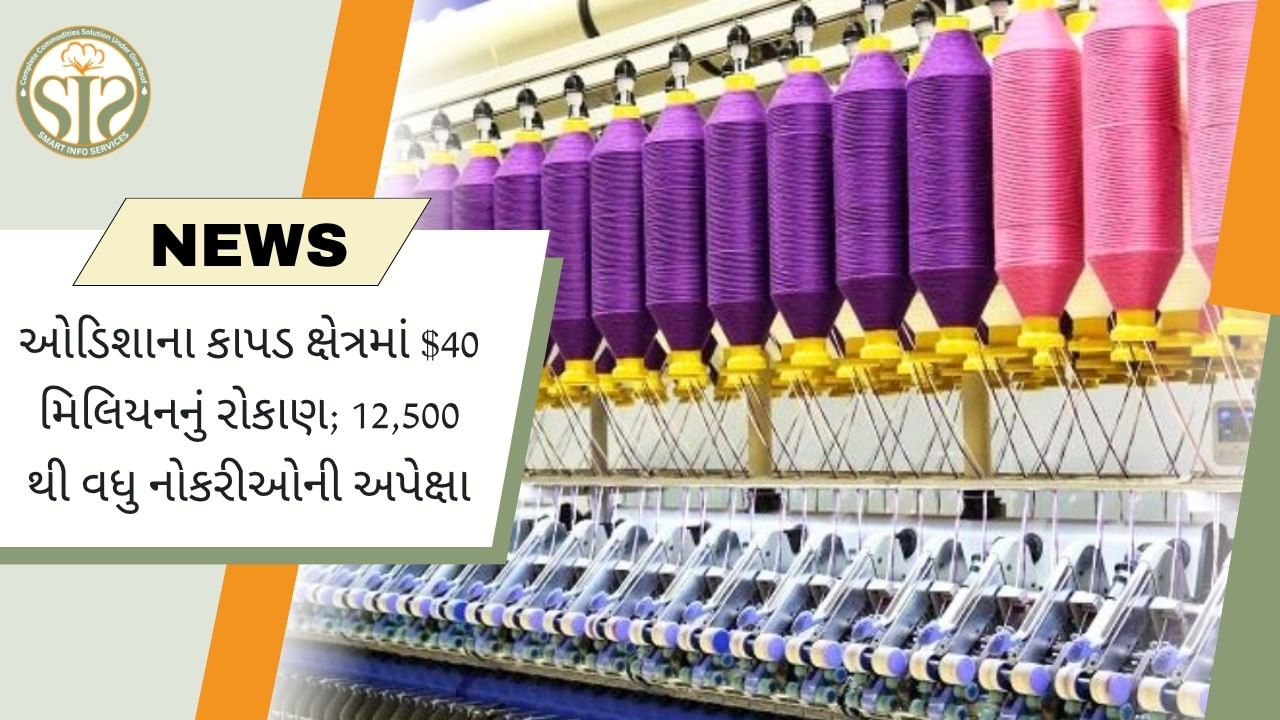
ઓડિશાના કાપડ ક્ષેત્રમાં $40 મિલિયનનું રોકાણ; 12,500 થી વધુ નોકરીઓની અપેક્ષાઓડિશાએ તાજેતરમાં કાપડ અને વસ્ત્ર ક્ષેત્રમાં US$40 મિલિયન (₹300 કરોડથી વધુ) ના નવા રોકાણો મેળવ્યા છે. આ પ્રોજેક્ટ્સ રાજ્યમાં આશરે 12,500 નવી નોકરીઓનું સર્જન કરવાની અપેક્ષા રાખે છે, જે આ ક્ષેત્રને રોજગારના મુખ્ય સ્ત્રોત તરીકે સ્થાન આપે છે.સૌથી મોટો રોજગાર ઉત્પન્ન કરનાર પ્રોજેક્ટ નંદરાજ ટેક્સટાઇલ્સ પ્રાઇવેટ લિમિટેડ દ્વારા ખુર્દા જિલ્લામાં એક વસ્ત્ર ઉત્પાદન એકમ છે. કંપની આ પ્રોજેક્ટમાં ₹168.64 કરોડ (આશરે $17.70 મિલિયન)નું રોકાણ કરશે, જે 10,306 લોકોને રોજગાર પ્રદાન કરશે તેવી અપેક્ષા છે. આ તાજેતરના વર્ષોમાં રાજ્યના સૌથી મહત્વપૂર્ણ રોજગાર સર્જન કરનારા રોકાણોમાંનું એક માનવામાં આવે છે.વધુમાં, શાહી એક્સપોર્ટ્સ પ્રાઇવેટ લિમિટેડને સંબલપુરમાં ₹145.5 કરોડ ($15.27 મિલિયન) ના રોકાણ સાથે નીટેડ ગાર્મેન્ટ ઉત્પાદન એકમ સ્થાપવાની મંજૂરી મળી છે. આ પ્રોજેક્ટથી લગભગ 1,840 નોકરીઓનું સર્જન થવાની અને રાજ્યના વસ્ત્ર ઉત્પાદન ઇકોસિસ્ટમને મજબૂત બનાવવાની સંભાવના છે.મા તારાતારિની ટેક્સટાઇલ પાર્ક પ્રાઇવેટ લિમિટેડ ગંજમ જિલ્લામાં ₹70 કરોડ ($7.34 મિલિયન) ના રોકાણ સાથે એક સંકલિત ટેક્સટાઇલ પ્રોજેક્ટ વિકસાવશે, જેનાથી આશરે 350 નોકરીઓનું સર્જન થશે.આ બધા પ્રોજેક્ટ્સને રાજ્ય સ્તરીય સિંગલ વિન્ડો ક્લિયરન્સ ઓથોરિટી (SLSWCA) દ્વારા મંજૂરી આપવામાં આવી છે. સરકારનો ઉદ્દેશ્ય રાજ્યના વિવિધ જિલ્લાઓમાં ઔદ્યોગિક વિકાસને માત્ર થોડા પસંદગીના ક્ષેત્રો સુધી મર્યાદિત રાખવાને બદલે ફેલાવવાનો છે.ખુર્દા ઉપરાંત, કોરાપુટ, સંબલપુર, જાજપુર, ઝારસુગુડા, ધેંકનાલ, બલાંગીર, કેઓંઝર અને મયુરભંજ જેવા જિલ્લાઓ માટે પણ રોકાણ દરખાસ્તોને મંજૂરી આપવામાં આવી છે, જેનાથી સમગ્ર ઓડિશામાં સંતુલિત ઔદ્યોગિક વિકાસ અને રોજગાર સર્જનને પ્રોત્સાહન મળશે.વધુ વાંચો :- કપાસ યાર્નના ભાવ વધતા કરૂરનું ટેક્સટાઇલ ઉદ્યોગ દબાણમાં

કપાસના યાર્નના ભાવમાં વધારાને કારણે કરુરનો કાપડ ઉદ્યોગ દબાણ હેઠળકરુર: પશ્ચિમ એશિયામાં ચાલી રહેલા ભૂ-રાજકીય તણાવ અને વૈશ્વિક પુરવઠા શૃંખલાઓમાં વિક્ષેપોને કારણે કપાસના યાર્નના ભાવમાં તીવ્ર વધારો થયો છે, જેના કારણે તમિલનાડુના મુખ્ય કાપડ કેન્દ્ર કરુરમાં કાપડ ઉદ્યોગ નોંધપાત્ર દબાણ હેઠળ છે. ઉદ્યોગના પ્રતિનિધિઓ જણાવે છે કે કાચા માલના વધતા ખર્ચ ઉત્પાદન અને નિકાસ પ્રવૃત્તિઓ બંનેને અસર કરી રહ્યો છે.ઉદ્યોગ સૂત્રોના જણાવ્યા અનુસાર, કરુરમાં કાપડ ઉત્પાદકો તેમની યાર્નની જરૂરિયાતો માટે મુખ્યત્વે કોઈમ્બતુર, ડિંડીગુલ, વિરુધુનગર અને વેલ્લાકોઇલમાં સ્પિનિંગ મિલો પર આધાર રાખે છે. છેલ્લા છ અઠવાડિયામાં, પુરવઠા અને માંગ વચ્ચે અસંતુલનને કારણે બરછટ-કાઉન્ટ કપાસના યાર્નના ભાવમાં 30 થી 40 ટકાનો વધારો થયો છે. ઉચ્ચ-કાઉન્ટ યાર્નના ભાવ આશરે ₹300 પ્રતિ કિલોગ્રામથી વધીને ₹400 પ્રતિ કિલોગ્રામ થયા છે - જે ઉદ્યોગ અસાધારણ માને છે.કાપડ ઉદ્યોગની માંગણીઓના જવાબમાં કેન્દ્ર સરકારે કપાસની આયાત જકાતમાં રાહત આપી હોવા છતાં, કરુરના વેપારીઓ દલીલ કરે છે કે તેનો ફાયદો મુખ્યત્વે તિરુપુરના કપડા ઉત્પાદકોને થયો છે. જ્યારે કપડા ક્ષેત્રમાં વપરાતા યાર્નના ભાવમાં 3 થી 4 ટકાનો ઘટાડો થયો છે, ત્યારે કરુરમાં વપરાતા બરછટ યાર્નના ભાવ પર કોઈ ખાસ અસર થઈ નથી.કરુર ટેક્સટાઇલ મેન્યુફેક્ચરર્સ એન્ડ એક્સપોર્ટર્સ એસોસિએશનના પ્રમુખ પી. ગોપાલકૃષ્ણને જણાવ્યું હતું કે કોટન યાર્નના ભાવમાં હાલનો વધારો અભૂતપૂર્વ છે અને ઉદ્યોગના ખર્ચ માળખા પર ગંભીર અસર પડી છે. તેમણે ભાર મૂક્યો હતો કે ઉદ્યોગના સુગમ સંચાલન માટે ભાવ સ્થિરતા જરૂરી છે.ઉદ્યોગ સંસ્થાઓએ કેન્દ્ર અને રાજ્ય સરકાર બંનેને હસ્તક્ષેપ કરવા વિનંતી કરી છે. વેપારીઓના મતે, અમેરિકા અને ઈરાન વચ્ચે વધતા તણાવથી વૈશ્વિક વેપાર અને શિપિંગ પર અસર પડી છે, જેના કારણે પોલિએસ્ટર, ડાઇંગ કેમિકલ્સ, પોલિઇથિલિન અને પેકેજિંગ મટિરિયલ્સ જેવી આવશ્યક વસ્તુઓના ભાવમાં વધારો થયો છે. નિકાસકારો માને છે કે જો આ પરિસ્થિતિ ચાલુ રહે તો કરુરના કાપડ ઉદ્યોગની સ્પર્ધાત્મકતા, નિકાસ વૃદ્ધિ અને રોજગારીની તકો પર નકારાત્મક અસર પડી શકે છે.

રૂપિયો ૨૩ પૈસા મજબૂત થઈને ૯૫.૪૮ USD પર ખુલ્યો.મંગળવારે, ભારતીય રૂપિયો ડોલર સામે ૨૩ પૈસા મજબૂત થઈને ૯૫.૪૮ પર ખુલ્યો, જ્યારે સોમવારે તે ૯૫.૭૧ પર બંધ થયો.વધુ વાંચો :- ડોલર સામે રૂપિયો 40 પૈસા ઘટીને 95.71 પર બંધ થયો.

સોમવારે ભારતીય રૂપિયો 40 પૈસા ઘટીને 95.71 પર બંધ થયો, જે સવારના વેપારમાં 95.31 પર ખુલ્યો હતો.બંધ સમયે, સેન્સેક્સ 719.08 પોઈન્ટ અથવા 0.97 ટકા ઘટીને 73,524.26 પર બંધ થયો હતો, અને નિફ્ટી 243.70 પોઈન્ટ અથવા 1.04 ટકા ઘટીને 23,123.00 પર બંધ થયો હતો. લગભગ 1172 શેર વધ્યા, 3007 શેર ઘટ્યા અને 154 શેર યથાવત રહ્યા.વધુ વાંચો :-

ગુજરાતના કાપડ ક્ષેત્રને કપાસ આયાત ડ્યુટી માફીમાંથી રાહતઅમદાવાદ: ગુજરાતના કાપડ ઉદ્યોગે 30 ઓક્ટોબર સુધી કપાસ પર 11% આયાત ડ્યુટી સ્થગિત કરવાના કેન્દ્ર સરકારના નિર્ણયનું સ્વાગત કર્યું છે. ઉદ્યોગના હિસ્સેદારો માને છે કે આ પગલાથી કાચા માલના ખર્ચમાં ઘટાડો થશે અને વૈશ્વિક બજારમાં ભારતીય કાપડ ઉત્પાદનોની સ્પર્ધાત્મકતા વધશે.તાજેતરના મહિનાઓમાં, સ્થાનિક કપાસના ભાવ પ્રતિ કેન્ડી ₹68,500 સુધી વધી ગયા હતા, જેના કારણે સ્પિનિંગ મિલો, ફેબ્રિક ઉત્પાદકો અને ગાર્મેન્ટ નિકાસકારો માટે ખર્ચમાં વધારો થયો હતો. ઉદ્યોગ જણાવે છે કે ડ્યુટી માફી કપાસની ઉપલબ્ધતામાં સુધારો કરશે અને ભાવને નિયંત્રણમાં રાખવામાં મદદ કરશે.એસોચેમ ગુજરાત સ્ટેટ કાઉન્સિલના ચેરમેન ચિંતન ઠાકરએ નોંધ્યું હતું કે આયાત મુખ્યત્વે એક્સ્ટ્રા-લોંગ સ્ટેપલ (ELS) કપાસ સુધી મર્યાદિત છે, જે ભારતીય કપાસનો વિકલ્પ નથી. તેમના મતે, આ નિર્ણય કાપડ ઉત્પાદકો અને નિકાસકારો માટે ઉત્પાદન ખર્ચ ઘટાડવામાં મદદ કરશે. વધુમાં, શ્રેષ્ઠ ગુણવત્તાવાળા ફાઇબરની ઉપલબ્ધતા ઉત્પાદનની ગુણવત્તામાં સુધારો કરશે અને વૈશ્વિક બ્રાન્ડ્સની જરૂરિયાતોને પૂર્ણ કરવાનું સરળ બનાવશે.ગુજરાત ચેમ્બર ઓફ કોમર્સ એન્ડ ઇન્ડસ્ટ્રી (GCCI) ખાતે ટેક્સટાઇલ કમિટીના સહ-અધ્યક્ષ રાહુલ શાહે જણાવ્યું હતું કે ડ્યુટી માફીની જાહેરાત બાદ કાચા કપાસના ભાવમાં પ્રતિ કેન્ડી આશરે ₹4,000નો ઘટાડો થયો છે. આનાથી મિલોનો ઇનપુટ ખર્ચ ઘટશે અને ઓપરેટિંગ માર્જિનમાં સુધારો થશે, ખાસ કરીને નિકાસલક્ષી કંપનીઓ માટે.સ્પિનર્સ એસોસિએશન ગુજરાત (SAG) ના સિનિયર વાઇસ પ્રેસિડેન્ટ જયેશ પટેલે ઉલ્લેખ કર્યો હતો કે જ્યારે ભારતીય સ્પિનિંગ મિલોને ચીન અને બાંગ્લાદેશ તરફથી મજબૂત નિકાસ ઓર્ડર મળી રહ્યા છે, ત્યારે સ્થાનિક કપાસના ઊંચા ભાવે એક પડકાર ઉભો કર્યો છે. તેમનું માનવું છે કે આયાત ડ્યુટી માફી કપાસ અને યાર્નના ભાવ પર દબાણ ઘટાડશે, જેનાથી ભારતીય કાપડ ઉદ્યોગ વૈશ્વિક સ્તરે વધુ સ્પર્ધાત્મક બનશે.વધુ વાંચો :- મહારાષ્ટ્રમાં કપાસનો વિસ્તાર વધવાની શક્યતા

મહારાષ્ટ્રમાં ખરીફ ૨૦૨૬-૨૭ માટે કપાસનો વાવેતર વિસ્તાર વધવાની ધારણામહારાષ્ટ્રમાં ૨૦૨૬-૨૭ ખરીફ સિઝન દરમિયાન કપાસના વાવેતર વિસ્તારમાં ૧૦-૧૫%નો વધારો થવાની શક્યતા છે. કૃષિ વિભાગના અધિકારીઓના જણાવ્યા અનુસાર, સ્થાનિક અને આંતરરાષ્ટ્રીય બજારોમાં કપાસના ભાવમાં તીવ્ર વધારાને કારણે ખેડૂતો - ખાસ કરીને વિદર્ભ અને મરાઠવાડા પ્રદેશોમાં - સોયાબીન કરતાં કપાસને પ્રાથમિકતા આપી રહ્યા છે.અધિકારીઓ જણાવે છે કે સારી બજાર માંગ અને વધુ નફાની સંભાવના ખેડૂતોને કપાસ તરફ આકર્ષિત કરી રહી છે. ગયા સિઝનમાં સોયાબીન ઉત્પાદકોને ભારે નુકસાન થયું હતું; ઘણા લોકોએ તેમનો પાક પ્રતિ ક્વિન્ટલ ₹૪,૦૦૦-૪,૫૦૦ ના ભાવે વેચવો પડ્યો હતો, જે લઘુત્તમ ટેકાના ભાવ (MSP) ₹૫,૩૨૮ પ્રતિ ક્વિન્ટલ કરતાં ઘણો ઓછો હતો. તેનાથી વિપરીત, એપ્રિલ અને મે મહિનામાં કપાસના ભાવ પ્રતિ ક્વિન્ટલ ₹૯,૦૦૦-૯,૫૦૦ સુધી પહોંચી ગયા હતા, જે MSP કરતાં નોંધપાત્ર રીતે વધુ હતા.યવતમાળના ખેડૂત અશોક ભુતાડાએ ઉલ્લેખ કર્યો છે કે તેમણે ગયા વર્ષે ૧૬ એકર જમીન પર કપાસનું વાવેતર કર્યું હતું અને આ વખતે તેને ૨૦-૨૧ એકર સુધી વિસ્તારવાની યોજના છે. તેમનું માનવું છે કે બદલાતા હવામાન અને અનિયમિત વરસાદ વચ્ચે, કપાસ સોયાબીનની તુલનામાં પ્રમાણમાં સલામત વિકલ્પ તરીકે ઉભરી આવ્યો છે.કૃષિ વિભાગનું અવલોકન છે કે વિદર્ભ અને મરાઠવાડાના ઘણા જિલ્લાઓમાં આ વલણ જોવા મળી રહ્યું છે. જોકે, નિષ્ણાતોએ ખેડૂતોને ફક્ત વર્તમાન ઊંચા ભાવોના આધારે નિર્ણયો લેવા સામે ચેતવણી આપી છે. ખેડૂત નેતા વિજય જાવંધિયા નોંધે છે કે કપાસના ભાવમાં હાલનો ઉછાળો આંતરરાષ્ટ્રીય બજારની સ્થિતિ સાથે જોડાયેલો છે, અને પાક બજારમાં આવે ત્યાં સુધી ભાવ આ સ્તરે રહેશે તેની કોઈ ગેરંટી નથી.કપાસની વધતી જતી લોકપ્રિયતા છતાં, સંકળાયેલા જોખમો હજુ પણ છે. ૨૦૨૫-૨૬માં, રાજ્યમાં કપાસનું ઉત્પાદન આશરે ૪૭% ઘટીને ૫૧ લાખ મેટ્રિક ટન થયું, જે મુખ્યત્વે અતિશય, કમોસમી વરસાદ અને કરા પડવાને કારણે થયું હતું. આગામી સિઝન માટે પણ ઘણા જિલ્લાઓમાં ઓછા વરસાદ અંગે ચિંતાઓ યથાવત છે. નિષ્ણાતો માને છે કે માત્ર ઊંચા બજાર ભાવ ખેડૂતોની આવક સુનિશ્ચિત કરવા માટે પૂરતા નથી. માત્ર એક અસરકારક ખરીદી વ્યવસ્થા, વાજબી ભાવ અને વધુ સારું કૃષિ માર્ગદર્શન જ ખેડૂતોને વાસ્તવિક આર્થિક સુરક્ષા પૂરી પાડી શકે છે.વધુ વાંચો :- કેરળમાં આગામી 7 દિવસ ભારે વરસાદની ચેતવણી

કેરળમાં ચોમાસુ સક્રિય; આગામી 7 દિવસ માટે ભારે વરસાદની ચેતવણી4 જૂન, 2026 ના રોજ કેરળમાં દક્ષિણ-પશ્ચિમ ચોમાસુનું આગમન થયું, જેના કારણે રાજ્યભરમાં વરસાદનું પ્રમાણ વધ્યું. ચોમાસા પહેલાના વરસાદને કારણે ઘણા પ્રદેશો પહેલાથી જ ભરાઈ ગયા હતા, અને હવે મધ્યમથી ભારે વરસાદ શરૂ થઈ ગયો છે. હવામાન વિભાગ અનુસાર, આગામી અઠવાડિયા સુધી કેરળમાં ભારે વરસાદ ચાલુ રહેવાની સંભાવના છે.જૂન અને જુલાઈને કેરળ માટે સૌથી ભીના મહિના માનવામાં આવે છે. આ સમયગાળા દરમિયાન રાજ્યમાં સરેરાશ 650 મીમી વરસાદ પડે છે, જે કુલ ચોમાસાની ઋતુના વરસાદના આશરે 70 ટકા જેટલો છે. પરિણામે, વર્ષના આ સમયને રાજ્ય માટે મહત્વપૂર્ણ અને સંવેદનશીલ માનવામાં આવે છે.અરબી સમુદ્રમાં સક્રિય સિસ્ટમની અસરગોવા અને ઉત્તર કર્ણાટકના દરિયાકાંઠાની નજીક, પૂર્વ-મધ્ય અરબી સમુદ્ર પર વાતાવરણના મધ્ય-સ્તરમાં - આશરે 10,000 થી 15,000 ફૂટની ઊંચાઈએ - ચક્રવાતી પરિભ્રમણ વિકસિત થયું છે. આ સિસ્ટમથી ચોમાસાના પશ્ચિમી પવનો વધુ મજબૂત બન્યા છે, જેના કારણે તે પશ્ચિમ ઘાટ પર વધુ જોરથી ત્રાટક્યા છે અને સતત વરસાદ પડી રહ્યો છે.છેલ્લા 24 કલાકમાં કોચી, કોઝિકોડ, કોટ્ટાયમ અને કન્નુર સહિત અનેક જિલ્લાઓમાં ભારે વરસાદ નોંધાયો છે. આ સિસ્ટમની અસર કર્ણાટકના દરિયાકાંઠાના પ્રદેશો, જેમ કે હોન્નાવર અને કારવારમાં પણ જોવા મળી છે.આગામી દિવસોમાં અસર વધુ તીવ્ર બનવાની શક્યતાહવામાન વિભાગે આગાહી કરી છે કે આ ચક્રવાતી પરિભ્રમણ આગામી થોડા દિવસો સુધી સક્રિય રહેશે. જ્યારે તે એક મોટી, શક્તિશાળી વાવાઝોડાની સિસ્ટમમાં વિકસિત થવાની શક્યતા નથી, તે ચોમાસાના પવનોને સતત સક્રિય રાખશે.તિરુવનંતપુરમથી કોઝિકોડ સુધીના સમગ્ર કેરળ દરિયાકાંઠે ભારેથી અતિ ભારે વરસાદનું જોખમ છે. ૭ જૂનથી ૧૧ જૂન, ૨૦૨૬ દરમિયાન વરસાદની તીવ્રતા અને ફેલાવો વધુ વધવાની ધારણા છે. પૂર અને ભૂસ્ખલનનું જોખમસતત વરસાદને કારણે અનેક વિસ્તારોમાં પાણી ભરાઈ ગયા છે અને નદીના પાણીના સ્તરમાં વધારો થયો છે, જ્યારે પહાડી વિસ્તારોમાં ભૂસ્ખલનની શક્યતા પણ વધી છે. વહીવટીતંત્રે લોકોને સતર્ક રહેવા અને બિનજરૂરી મુસાફરી ટાળવા વિનંતી કરી છે.વધુ વાંચો :- રાજ્યવાર CCI કપાસ વેચાણની વિગતો
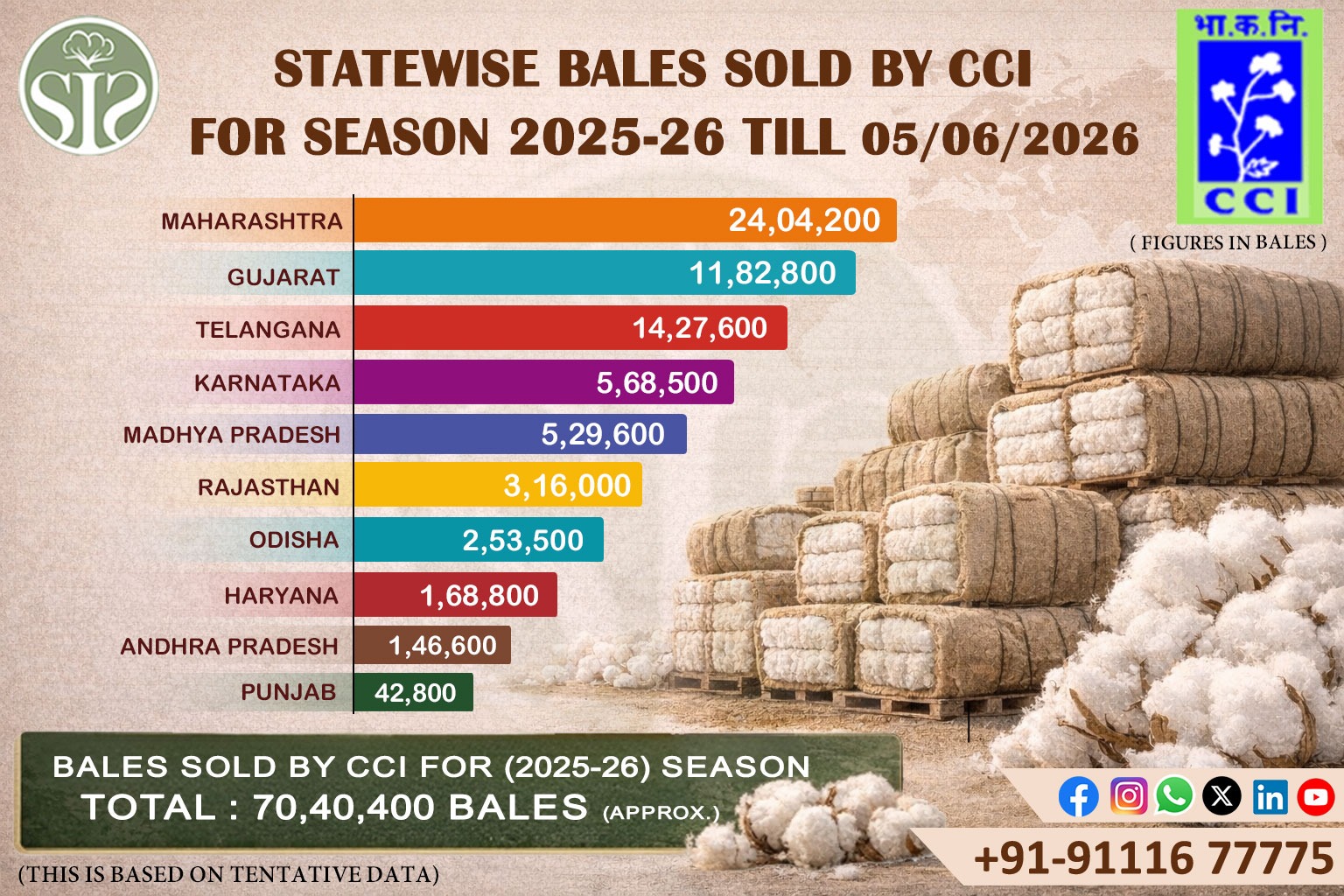
રાજ્યવાર CCI કપાસ વેચાણ વિગતો - 2025-26 સીઝનકોટન કોર્પોરેશન ઓફ ઇન્ડિયા (CCI) એ આ અઠવાડિયે 2025-26 સીઝન માટે તેના કપાસ કેન્ડીના ભાવમાં પ્રતિ કેન્ડી ₹700 સુધીનો ઘટાડો કર્યો છે. અત્યાર સુધીમાં, CCI એ 2025-26 સીઝન માટે કુલ આશરે 7,040,400 કપાસ ગાંસડી વેચી છે. વેચાણ મુખ્ય કપાસ ઉત્પાદક રાજ્યોમાં કેન્દ્રિત છે, જેમાં મહારાષ્ટ્ર, તેલંગાણા અને ગુજરાત યાદીમાં આગળ છે.

રૂપિયો ૩૭ પૈસા ઘટીને ૯૫.૩૧ USD પર ખુલ્યો.સોમવારે, ભારતીય રૂપિયો ૩૭ પૈસા ઘટીને ૯૫.૩૧ પર ખુલ્યો. શુક્રવારે તે ૯૪.૯૪ પર બંધ થયો હતો.વધુ વાંચો :- CCIએ કપાસના ભાવમાં ₹700 પ્રતિ કેન્ડી ઘટાડો કર્યો
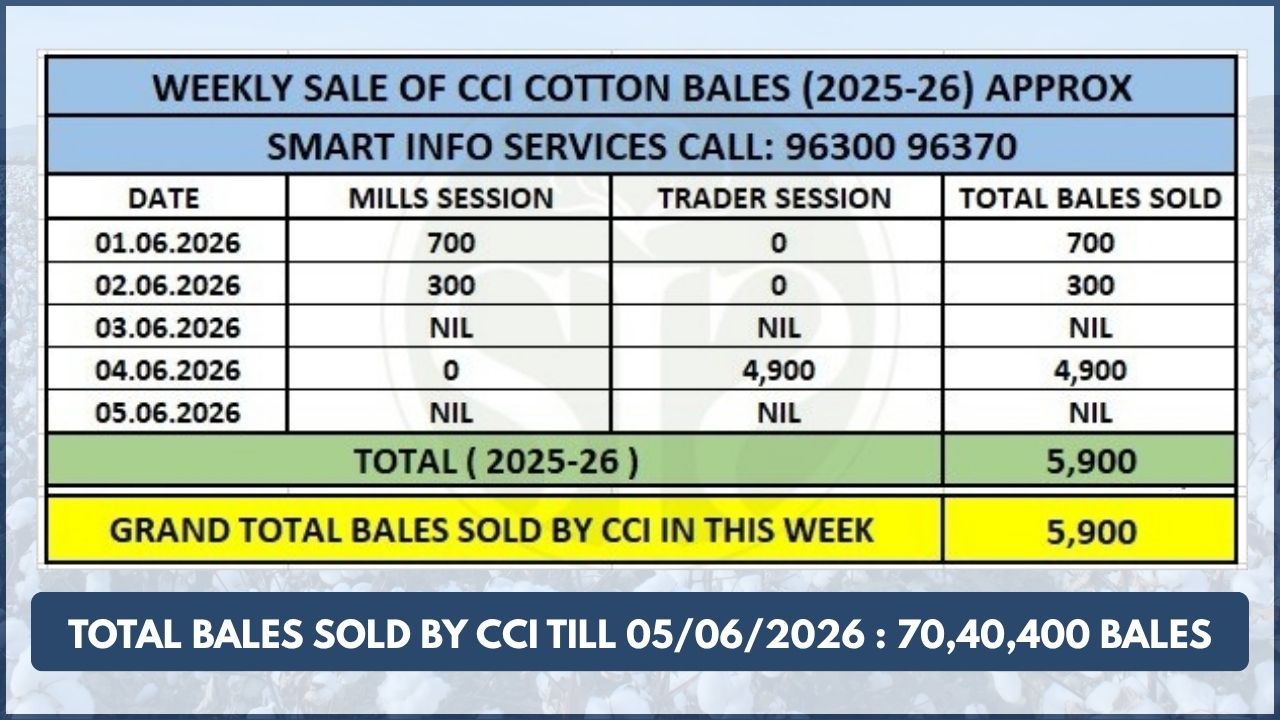
CCI એ કપાસના ભાવમાં પ્રતિ કેન્ડી ₹700નો ઘટાડો કર્યો; મોસમી વેચાણ 70.4 લાખ ગાંસડીને પાર કર્યુંકોટન કોર્પોરેશન ઓફ ઇન્ડિયા (CCI) એ 1 જૂન થી 5 જૂન, 2026 ના અઠવાડિયા દરમિયાન તેના કપાસના ભાવમાં પ્રતિ કેન્ડી ₹700નો ઘટાડો કર્યો. ભાવ ઘટાડા છતાં, હરાજીની પ્રવૃત્તિ સામાન્ય રહી, જેમાં મિલો અને વેપારીઓ બંનેની ભાગીદારી હતી. આ અઠવાડિયા દરમિયાન 2025-26 કપાસની સિઝન માટે કુલ વેચાણ આશરે 5,900 ગાંસડી હતું.*સાપ્તાહિક વેચાણ અહેવાલ*1 જૂન, 2026 (સોમવાર)સપ્તાહની શરૂઆત 700 ગાંસડીના વેચાણથી થઈ હતી, જે બધી કાપડ મિલો દ્વારા ખરીદવામાં આવી હતી.2 જૂન, 2026 (મંગળવાર)CCI એ 300 ગાંસડીનું વેચાણ નોંધાવ્યું, જેમાં મિલોએ ખરીદીમાં પ્રભુત્વ જાળવી રાખ્યું.૪ જૂન, ૨૦૨૬ (ગુરુવાર)ગુરુવારે અઠવાડિયાની સૌથી વધુ પ્રવૃત્તિ જોવા મળી હતી, જ્યારે ૪,૯૦૦ ગાંસડી વેચાઈ હતી. કપાસના વેપારીઓ દ્વારા સમગ્ર જથ્થાની ખરીદી કરવામાં આવી હતી.૩ જૂન અને ૫ જૂન, ૨૦૨૬બુધવાર કે શુક્રવારે કપાસની કોઈ ગાંસડી વેચાઈ ન હતી.*કુલ વેચાણ અપડેટ*CCIનું કુલ વેચાણ નીચેના સ્તરે પહોંચ્યું છે:૨૦૨૫–૨૬ સીઝન: ૭,૦૪૦,૪૦૦ ગાંસડી

કેરળમાં ચોમાસુ સક્રિય; આગામી 7 દિવસ માટે ભારે વરસાદની ચેતવણી4 જૂન, 2026 ના રોજ કેરળમાં દક્ષિણ-પશ્ચિમ ચોમાસુનું આગમન થયું, જેના કારણે રાજ્યભરમાં વરસાદનું પ્રમાણ વધ્યું. ચોમાસા પહેલાના વરસાદને કારણે ઘણા પ્રદેશો પહેલાથી જ ભરાઈ ગયા હતા, અને હવે મધ્યમથી ભારે વરસાદ શરૂ થઈ ગયો છે. હવામાન વિભાગ અનુસાર, આગામી અઠવાડિયા સુધી કેરળમાં ભારે વરસાદ ચાલુ રહેવાની સંભાવના છે.જૂન અને જુલાઈને કેરળ માટે સૌથી ભીના મહિના માનવામાં આવે છે. આ સમયગાળા દરમિયાન રાજ્યમાં સરેરાશ 650 મીમી વરસાદ પડે છે, જે કુલ ચોમાસાની ઋતુના વરસાદના આશરે 70 ટકા જેટલો છે. પરિણામે, વર્ષના આ સમયને રાજ્ય માટે મહત્વપૂર્ણ અને સંવેદનશીલ માનવામાં આવે છે.અરબી સમુદ્રમાં સક્રિય સિસ્ટમની અસરગોવા અને ઉત્તર કર્ણાટકના દરિયાકાંઠાની નજીક, પૂર્વ-મધ્ય અરબી સમુદ્ર પર વાતાવરણના મધ્ય-સ્તરમાં - આશરે 10,000 થી 15,000 ફૂટની ઊંચાઈએ - ચક્રવાતી પરિભ્રમણ વિકસિત થયું છે. આ સિસ્ટમથી ચોમાસાના પશ્ચિમી પવનો વધુ મજબૂત બન્યા છે, જેના કારણે તે પશ્ચિમ ઘાટ પર વધુ જોરથી ત્રાટક્યા છે અને સતત વરસાદ પડી રહ્યો છે.છેલ્લા 24 કલાકમાં કોચી, કોઝિકોડ, કોટ્ટાયમ અને કન્નુર સહિત અનેક જિલ્લાઓમાં ભારે વરસાદ નોંધાયો છે. આ સિસ્ટમની અસર કર્ણાટકના દરિયાકાંઠાના પ્રદેશો, જેમ કે હોન્નાવર અને કારવારમાં પણ જોવા મળી છે.આગામી દિવસોમાં અસર વધુ તીવ્ર બનવાની શક્યતાહવામાન વિભાગે આગાહી કરી છે કે આ ચક્રવાતી પરિભ્રમણ આગામી થોડા દિવસો સુધી સક્રિય રહેશે. જ્યારે તે એક મોટી, શક્તિશાળી વાવાઝોડાની સિસ્ટમમાં વિકસિત થવાની શક્યતા નથી, તે ચોમાસાના પવનોને સતત સક્રિય રાખશે.તિરુવનંતપુરમથી કોઝિકોડ સુધીના સમગ્ર કેરળ દરિયાકાંઠે ભારેથી અતિ ભારે વરસાદનું જોખમ છે. ૭ જૂનથી ૧૧ જૂન, ૨૦૨૬ દરમિયાન વરસાદની તીવ્રતા અને ફેલાવો વધુ વધવાની ધારણા છે. પૂર અને ભૂસ્ખલનનું જોખમસતત વરસાદને કારણે અનેક વિસ્તારોમાં પાણી ભરાઈ ગયા છે અને નદીના પાણીના સ્તરમાં વધારો થયો છે, જ્યારે પહાડી વિસ્તારોમાં ભૂસ્ખલનની શક્યતા પણ વધી છે. વહીવટીતંત્રે લોકોને સતર્ક રહેવા અને બિનજરૂરી મુસાફરી ટાળવા વિનંતી કરી છે.વધુ વાંચો :- ડોલર સામે રૂપિયો 78 પૈસા વધીને 94.94 પર બંધ થયો.

શુક્રવારે ભારતીય રૂપિયો 78 પૈસા વધીને 94.94 પર બંધ થયો, જે સવારના કારોબારમાં 95.72 પર ખુલ્યો હતો.બંધ સમયે, સેન્સેક્સ 116.67 પોઈન્ટ અથવા 0.16 ટકા ઘટીને 74,243.34 પર બંધ થયો હતો, અને નિફ્ટી 49.85 પોઈન્ટ અથવા 0.21 ટકા ઘટીને 23,366.70 પર બંધ થયો હતો. લગભગ 1966 શેર વધ્યા, 2049 શેર ઘટ્યા, અને 197 શેર યથાવત રહ્યા.વધુ વાંચો :- નવનીકરણીય ઊર્જાથી તમિલનાડુનો ટેક્સટાઇલ ઉદ્યોગ દર વર્ષે ₹3,250 કરોડ બચાવી શકે: અહેવાલ

રિપોર્ટ: તમિલનાડુનો કાપડ ઉદ્યોગ નવીનીકરણીય ઉર્જા અપનાવીને વાર્ષિક ₹3,250 કરોડ સુધીની બચત કરી શકે છેબેંગલુરુ સ્થિત થિંક ટેન્ક ક્લાઇમેટ રિસ્ક હોરાઇઝન્સના નવા રિપોર્ટ મુજબ, તમિલનાડુનો કાપડ ઉદ્યોગ સ્વચ્છ ઉર્જા તરફ સંક્રમણ કરીને વાર્ષિક ₹1,560 કરોડથી ₹3,250 કરોડ સુધીની બચત કરી શકે છે. આ અભ્યાસ છેલ્લા દાયકામાં 'વાર્ષિક સર્વે ઓફ ઇન્ડસ્ટ્રીઝ' (ASI) ના ડેટાના આધારે ઉદ્યોગના ડીકાર્બનાઇઝેશનની સ્થિતિ અને સંભાવનાનું મૂલ્યાંકન કરે છે.રિપોર્ટમાં જણાવાયું છે કે જો ઉદ્યોગ સંપૂર્ણપણે નવીનીકરણીય વીજળી તરફ સ્વિચ કરે છે, તો વાર્ષિક બચત ₹2,320 કરોડથી ₹3,250 કરોડ સુધીની થઈ શકે છે. અભ્યાસમાં નોંધાયું છે કે રાજ્યમાં કાપડ ઉત્પાદન ખર્ચમાં વધારો કરવા માટે વધતી જતી ઊર્જા અને બળતણ ખર્ચ એક પ્રાથમિક પરિબળ બની ગયા છે.રિપોર્ટના સહ-લેખક રાકેશ રંજને જણાવ્યું હતું કે બળતણ ખર્ચમાં વધારો તમિલનાડુના કાપડ ઉદ્યોગની સ્પર્ધાત્મકતાને અસર કરી રહ્યો છે. તેમણે ધ્યાન દોર્યું કે 2017 થી રાજ્યની કાપડ નિકાસ આશરે $7.4 બિલિયન પર સ્થિર રહી છે. તેમના મતે, નવીનીકરણીય ઊર્જા અપનાવવાથી ખર્ચમાં ઘટાડો થશે અને ઉદ્યોગની વૈશ્વિક સ્પર્ધાત્મકતા મજબૂત થશે.અહેવાલમાં એ પણ ભાર મૂકવામાં આવ્યો છે કે છેલ્લા ચાર વર્ષમાં રાજ્યના કાપડ ક્ષેત્રનો કુલ ઊર્જા ખર્ચ લગભગ બમણો થયો છે. વધુમાં, ઉત્પાદન ઉત્પાદનમાં બળતણ ખર્ચના ગુણોત્તરમાં વધારો થયો છે. અભ્યાસ દર્શાવે છે કે ભારતના કાપડ ઉદ્યોગમાં મુખ્ય નિકાસકાર દેશોની તુલનામાં સૌથી વધુ કાર્બન ફૂટપ્રિન્ટ છે, જે ઉત્પાદિત કાપડના કિલોગ્રામ દીઠ 12.5 કિલો CO₂e થી વધુ છે.અહેવાલ સૂચવે છે કે ઉદ્યોગ નવીનીકરણીય ઊર્જા આધારિત ઇલેક્ટ્રિક હીટિંગ અપનાવીને ઉત્પાદન ખર્ચ અને કાર્બન ઉત્સર્જન બંને ઘટાડી શકે છે. તે એવી પણ ભલામણ કરે છે કે રાજ્ય સરકાર અને વીજળી નિયમનકારી સંસ્થાઓ નવીનીકરણીય ઊર્જાની સરળ ઍક્સેસને સરળ બનાવે, ખાસ કરીને MSME એકમો માટે.વધુ વાંચો :- હરિયાણામાં કપાસ ખેતીથી ખેડૂતોનો મોહભંગ, વિસ્તાર 65% ઘટ્યો
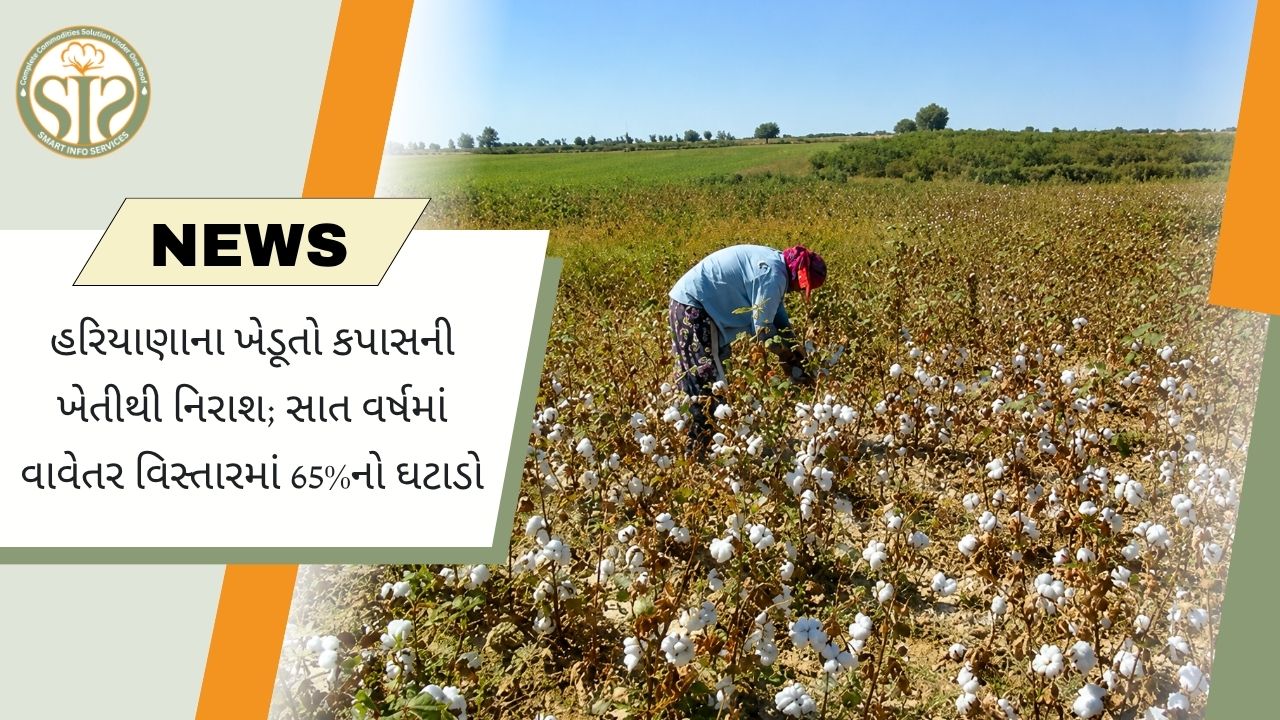
હરિયાણાના ખેડૂતો કપાસની ખેતીથી નિરાશ; સાત વર્ષમાં વાવેતર વિસ્તારમાં 65%નો ઘટાડોહિસાર - હરિયાણાના ખેડૂતો માટે એક સમયે મુખ્ય રોકડિયો પાક ગણાતો કપાસ હાલમાં સંકટનો સામનો કરી રહ્યો છે. સતત નાણાકીય નુકસાન, ગુલાબી ઈયળનો વધતો ભય અને વરસાદને કારણે પાકને ભારે નુકસાનને કારણે ખેડૂતો કપાસની ખેતીથી દૂર થઈ રહ્યા છે. આ પરિવર્તનની અસર રાજ્યના કપાસના વાવેતરમાં સ્પષ્ટપણે દેખાય છે.2019-20 સીઝનમાં, હરિયાણામાં 8.01 લાખ એકરમાં કપાસનું વાવેતર થયું હતું; 2025-26 સુધીમાં, આ આંકડો ઘટીને માત્ર 2.84 લાખ એકર થઈ ગયો હતો. બીજા શબ્દોમાં કહીએ તો, સાત વર્ષમાં કપાસના વાવેતર હેઠળનો વિસ્તાર આશરે 65 ટકા ઘટી ગયો છે. છેલ્લા ત્રણ વર્ષમાં જ વાવેતર વિસ્તાર લગભગ અડધો થઈ ગયો છે. આ સિઝનમાં, કપાસનું વાવેતર વિસ્તાર આઠ વર્ષમાં સૌથી નીચા સ્તરે પહોંચી ગયો છે.કૃષિ વિભાગે કપાસના વાવેતરને પ્રોત્સાહન આપવા માટે ઘણા પ્રયાસો કર્યા છે. 'હરિયાણામાં કપાસની ખેતીને પ્રોત્સાહન' અભિયાન હેઠળ કપાસ ઉત્પાદક મુખ્ય જિલ્લાઓમાં જાગૃતિ કાર્યક્રમો હાથ ધરવામાં આવ્યા હતા. ખેડૂતોને સૂક્ષ્મ પોષકતત્ત્વો માટે પ્રતિ એકર ₹2,000 અને સ્વદેશી કપાસની જાતોના વાવેતર માટે પ્રતિ એકર ₹4,000 ની નાણાકીય સહાય પણ આપવામાં આવી રહી છે. આ પગલાં છતાં, ખેડૂતો કપાસની ખેતી તરફ પાછા ફરવા માટે અનિચ્છા રાખે છે.ડૉ. આત્મા રામ ગોદારાના સંયુક્ત નિયામક (કપાસ) ના જણાવ્યા અનુસાર, છેલ્લા કેટલાક વર્ષોમાં ખેડૂતો કપાસની ખેતીમાં સતત નુકસાન સહન કરી રહ્યા છે. ઓગસ્ટ અને સપ્ટેમ્બર દરમિયાન વરસાદ પાકને સૌથી વધુ નુકસાન પહોંચાડે છે, જ્યારે ગુલાબી ઈયળનો ઉપદ્રવ એક મોટો પડકાર રહે છે.હરિયાણા કૃષિ યુનિવર્સિટીના કૃષિ વૈજ્ઞાનિક ડૉ. વિનય મહલાના અહેવાલ મુજબ, ખેડૂતો માટે કપાસની ખેતીનો સરેરાશ ખર્ચ પ્રતિ એકર ₹40,024 હતો, જ્યારે વેચાણ અને ઉપ-ઉત્પાદનમાંથી કુલ આવક માત્ર ₹24,882 હતી. પરિણામે, ખેડૂતોને પ્રતિ એકર સરેરાશ ₹15,142 નું નુકસાન થયું. નિષ્ણાતો માને છે કે જો વધુ સારી અને જીવાત પ્રતિરોધક જાતો વિકસાવવામાં નહીં આવે તો આગામી વર્ષોમાં રાજ્યમાં કપાસની ખેતીનો વ્યાપ વધુ સંકોચાઈ શકે છે.વધુ વાંચો :- અમેરિકી ડોલર સામે રૂપિયા 7 પૈસા મજબૂત થઈ 95.72 પર ખુલ્યો