STAY UPDATED WITH COTTON UPDATES ON WHATSAPP AT AS LOW AS 6/- PER DAY
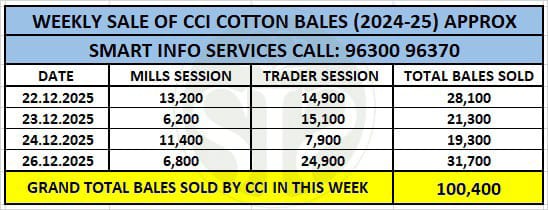
Start Your 7 Days Free Trial TodayState-wise CCI Cotton Sales Details – 2024-25 SeasonThe Cotton Corporation of India (CCI) increase its cotton prices by up to ₹1000- ₹1300 per candy this week and sold approximately 98,700,800 bales for the season 2024-25. This represents around 98.70% of the total cotton procured so far this season.A state-wise breakdown of sales indicates strong activity from Maharashtra, Telangana, and Gujarat, which together account for over 83.84% of the total sales to date.This data underscores CCI’s proactive efforts in stabilizing the cotton market and ensuring steady supply across key cotton-producing states.
India's textile and apparel exports grew for the second consecutive month in DecemberDespite a weak global trade environment and 50 per cent tariffs imposed by the US, the country's largest export market for the sector, India's textile and apparel exports have demonstrated resilience in December, growing for the second consecutive month on a year-on-year basis.The textile ministry said textile and apparel exports grew by 0.40 per cent to US$3.27 billion in December 2025 for the second consecutive month after strong growth in November compared to the previous year, reflecting the sector's "adaptability, diversified market presence and strength in value-added and labour-intensive sectors", the textile ministry said.segment wise growthDuring December 2025, export growth was broad-based across key sectors led by handicrafts (7.2 per cent), ready-made apparel (2.89 per cent), and MMF yarn, fabrics and made-ups (3.99 per cent).The ministry said these trends underline India's competitive advantage in value-added manufacturing, traditional crafts and employment-intensive production even amid volatile global demand conditions.calendar year performanceOn calendar year basis (January-December 2025), textile and apparel exports remained stable at US$ 37.54 billion, with significant cumulative growth in handicrafts (17.5 percent), ready-made garments (3.5 percent), and jute products (3.5 percent).The textile ministry said stability at this scale, despite geopolitical tensions and inflationary pressures in key markets, reflects the structural strength of the sector and diverse export basket.promote market diversificationThe highlight of 2025 has been significant market diversification.During January-November 2025, India's textile sector recorded export growth to 118 countries and export destinations compared to the same period in 2024, reflecting a broad improvement in market performance.Strong expansion was seen in both emerging and traditional markets, including the United Arab Emirates (9.5 percent), Egypt (29.1 percent), Poland (19.3 percent), Sudan (182.9 percent), Japan (14.6 percent), Nigeria (20.5 percent), Argentina (77.8 percent), Cameroon (152.9 percent), and Uganda (75.7 percent), as well as key European markets such as Spain (7.9 percent) There was a continuous increase. percent), France, Italy, the Netherlands, Germany and the United Kingdom.global sourcing powerThe ministry said this diverse growth pattern underlines the resilience of India's textile export sector and strengthening India's global market presence across various destinations.Overall, the sustained export momentum, wide market presence, and strong performance of value-added segments reaffirm India's position as a reliable and resilient global sourcing hub for textiles and apparel.With continued emphasis on diversification, competitiveness and MSME participation, the sector is well positioned to increase exports and deepen its integration with global value chains in times to come.read more :- Trump's tariff threat on Greenland issue
Trump threatens to impose tariffs on countries that oppose US claim on Greenland. United States President Donald Trump on Friday threatened to impose tariffs on countries that do not support US control of Greenland.The US president did not elaborate on the details, but has said in the past that the United States needs Greenland from a "national security" perspective."If they don't go along with Greenland I could put tariffs on them, because we need Greenland for national security," Bloomberg quoted Trump as saying at a White House event on health care.Trump has insisted for months that the US should take control of Greenland, a self-governing territory that is part of the Kingdom of Denmark.However, while the White House has confirmed that "all options are on the table" regarding the US annexing the region, this is the first time that Trump has threatened tariffs on countries that do not support the proposal.It came a day after European countries sent a small number of troops to Greenland, while Denmark said it was pressing ahead with plans to establish a "larger and more permanent" NATO presence to protect the island, according to Reuters news agency.The show of support for the region was also to help Denmark prepare military exercises, and was followed by a meeting of officials from the US, Denmark and Greenland.On Friday, a group of US senators and representatives met with lawmakers in the Danish parliament, according to Bloomberg, with protests against Trump's plans scheduled to take place across Denmark on Saturday.Danish Foreign Minister Lars Lokke Rasmussen has also been attending meetings with members of the US Congress in Washington over the past week, following talks with US Vice President JD Vance and Secretary of State Marco Rubio.After talks with Vance and Rubio, Rasmussen said there remain "fundamental disagreements" with Trump over Greenland. According to the AP, during the meetings both sides agreed to form a working group to discuss ways to resolve differences.read more :- CCI to start cotton sales for 2025-26 season next week
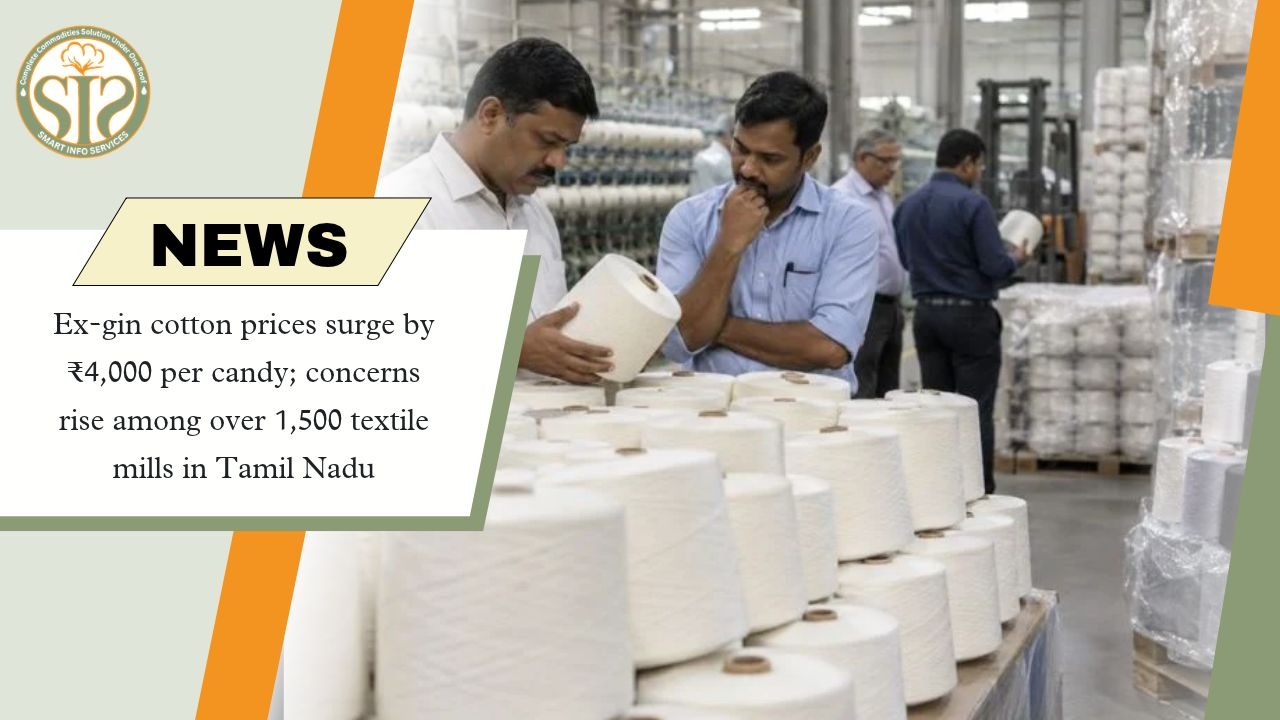
India's CCI to start selling cotton for 2025-26 season next weekThe Cotton Corporation of India (CCI) is set to begin selling cotton procured during the 2025-26 crop season starting January 19. The government agency has announced the terms and conditions for the sale of fully pressed cotton bales on its website. According to trade sources, the CCI has so far procured approximately 8 million bales (170 kg each), and procurement is still ongoing in various states, including Telangana and Maharashtra.Market rebounds, prices rise above MSPCotton prices have seen a significant increase in recent weeks, rising above the Minimum Support Price (MSP) level. This is mainly due to the strengthening of cottonseed prices and the government's decision to end the import duty exemption from December 31. According to Ramanuja Das Bub, a sourcing agent from Raichur, "In the last month, the price of cottonseed has increased by approximately ₹700 per quintal, rising from ₹3,600-3,700 to a high of ₹4,300, and is now at ₹4,100. Similarly, cotton prices have also increased by about ₹4,000 per candy, reaching ₹55,000-56,000. The price of raw cotton has also increased from ₹7,700 to approximately ₹8,200-8,300." He added that now that the CCI (Cotton Corporation of India) has announced its sales plan starting next week, buyers are waiting for their prices.Production Estimates Increased, But Imports Break RecordsWhile production has increased, imports are also at record levels. The trade body Cotton Association of India (CAI) recently increased its cotton production estimate for 2025-26 by 7.5 lakh bales to 317 lakh bales. This increase is due to better-than-expected production in Maharashtra and Telangana.The association has projected record imports of 50 lakh bales this season, higher than the 41 lakh bales imported last year. By December 31st, 31 lakh bales had already been imported. Due to record imports, the CAI has projected a massive surplus of 122.59 lakh bales at the end of the season, a 56% increase compared to last year.read more :- CCI increased cotton prices, weekly sales 17,500 bales
CCI Raises Cotton Prices by ₹1,000–₹1,300 per Candy; Weekly Sales Touch 17,500 BalesThe Cotton Corporation of India (CCI) increased cotton prices by 1000-₹1300 per candy this week. CCI has now sold 98.70% of the cotton procured during the 2024-25 season through e-auctions.During the week of January 12, 2026 to January 16, 2026, CCI conducted regular online auctions for mills and traders at various centers. These auctions resulted in total weekly sales of approximately 17,500 bales.Weekly Sales ReportJanuary 12, 2026The highest sales of the week were recorded at 9,800 bales, with mills purchasing 6,100 bales and traders purchasing 3,700 bales.January 13, 2026CCI sold 3,100 bales on this day, with mills purchasing 2,600 bales and traders purchasing 500 bales.January 14, 2026Total sales were 4,600 bales. Mills purchased 3,900 bales, while traders purchased 700 bales.January 16, 2026The week ended with no bales sold in both the session on this day.With this week's sales, CCI's total cotton sales for the current season have reached approximately 98,70,800 bales, representing 98.70% of its total procurement under the 2024-25 season.read more :- Textile industry expects duty free cotton from Budget 2026-27
Indian textile industry seeks duty-free cotton in Budget 2026-27 India’s textile and apparel industry has highlighted concerns over the security of raw material availability at global quality standards and competitive prices in its wish list ahead of the Union Budget 2026–27. The budget will be presented by Finance Minister Nirmala Sitharaman on February 01, 2026, in Parliament.The Southern India Mills Association (SIMA) has demanded duty-free cotton imports without any time rider. It has also urged a separate classification for recycled and sustainable textile products, import duty exemptions for speciality fibres, and the removal of anti-dumping duties on key inputs such as PTA and MEG.SIMA said in its representation that cotton productivity has slipped sharply in recent seasons, cutting output well below industry demand and leaving mills exposed to supply gaps from late 2025 onwards. Industry estimates indicate that retaining import duties would restrict cotton inflows and worsen shortages, while a permanent duty-free regime would allow higher imports, stabilise prices, and support a significant rise in textile exports and employment. With competing countries holding far larger stocks, Indian mills risk losing orders to rivals such as Bangladesh, Vietnam and Cambodia if fibre supply remains uncertain.The industry body has also sought the removal of import duty on cotton waste, which is widely used by handloom and power loom clusters in centres such as Karur, Erode, Salem and Madurai to produce towels, kitchen linen, carpets and furnishing fabrics. The levy is hurting the competitiveness of Indian exporters against Pakistan in recycled and waste-based home textile products and has pushed many open-end spinning units into financial stress.In the man-made fibre segment, manufacturers have called for a separate classification for recycled and sustainable textile products to enable international buyers to identify them easily. They have also urged the government to remove anti-dumping duties on key inputs such as PTA and MEG, and to grant import duty exemptions for speciality fibres not produced in India, to help the industry move into technical textiles and higher-value exports.MSME textile units have sought compliance relief by aligning audit and company secretary requirements with the revised MSME definition, and banking support to ensure smooth discounting of export bills, especially for shipments to Bangladesh, which remains a major market for Indian cotton yarn and fabrics. They have warned that any disruption in export finance could quickly squeeze working capital for small manufacturers.To reduce logistics costs and emissions, exporters have proposed allowing trucks delivering import cargo to carry export consignments on their return journey, particularly along routes linking ports with textile hubs such as Tiruppur, Erode and Karur. This would help cut empty runs, lower freight costs and improve turnaround times for MSME exporters.The industry has also pushed for the fast-tracking of pending technology upgradation subsidies, the continuous operation of export incentive schemes in cash form, and the extension of interest-subvention support to cotton yarn exports. With cotton yarn seen as a major growth driver towards India’s long-term textile export targets, manufacturers say stronger credit support is essential to sustain investment and job creation.Finally, the sector has urged stronger measures to curb under-invoiced imports of garments and made-ups through fabric- or yarn-forward rules, along with a broader credit-guarantee framework and interest support to prevent textile manufacturing from turning into a stressed sector as global competition intensifies.read more :- Cotton sector hopes for new seed technology
Indian Cotton Sector Hopes for New Seed Technology from the Budget: Atul GanatraAtul Ganatra, Chairman* of the SRCPL Group, said in an interview with CNBC Bajar that cotton productivity in India is extremely low, and the biggest reason for this is outdated seed technology.He stated that the average cotton production in India is 450 kilograms per hectare, while in Brazil and Australia it is several times higher. Atul Ganatra urged the government to allocate a special fund of Rs. 15,000 crore in the upcoming budget for the development of new seed technology.He clarified that simply increasing the Minimum Support Price (MSP) will not increase farmers' income. Farmers will only truly benefit when their yield per hectare increases.Atul Ganatra also suggested that the purchase of cotton at MSP should be stopped and a "Price Difference Scheme" (Bhavantar Yojana) should be implemented, allowing the government to directly transfer assistance to farmers' bank accounts. This would benefit all cotton farmers and strengthen the entire textile industry value chain.Regarding the increase in cotton imports, he said that allowing duty-free imports and high domestic cotton prices are the main reasons. Since Indian prices are significantly higher than global market prices, cotton exports from India are currently not feasible.read more :- Rupee fell 50 paise to close at 90.87 per dollar
On Friday, the Indian rupee fell 50 paise to close at 90.87 per dollar, compared to its opening price of 90.37 in the morning.BSE Sensex closed at 83,570.35, up 187.64 points or 0.23 per cent. The index recorded an intra-day high at 84,134.97 and low at 83,456.50. read more :- EU-India trade agreement, boost to apparel-textile sector
EU to Seal Trade Deal With India, Boosting Apparel, Textile Prospects | The European Union is set to formalise its largest trade agreement to date with India on 27 January, in a move expected to significantly deepen economic ties between Brussels and New Delhi and reshape trade flows across multiple sectors, including apparel and textiles.According to a report by European news outlet Euractiv, European Commission President Ursula von der Leyen informed Members of the European Parliament during a closed-door briefing that the agreement would be concluded later this month. Von der Leyen and European Council President António Costa are scheduled to sign the agreement alongside Indian Prime Minister Narendra Modi during their visit to New Delhi.Von der Leyen described the agreement as a major signal of the European Union’s trade policy ambitions. The deal would be the bloc’s largest free trade agreement to date, granting enhanced access to a market representing roughly a quarter of the world’s population.The agreement is expected to have particular significance for the apparel and textile sector. The European Union is currently India’s second-largest export destination for apparel, accounting for nearly 27% of India’s total garment exports. Annual apparel shipments from India to the EU are valued at more than US $ 7.5 billion, while total textile and clothing exports to the bloc—including yarn, fabrics and home textiles—are estimated to exceed US $ 11 billion annually.At present, Indian apparel exports to the EU face import duties ranging from 8% to 12%, reducing price competitiveness compared with suppliers such as Bangladesh, Vietnam and Turkey, which benefit from preferential or duty-free access under existing trade arrangements. Industry stakeholders expect an FTA to significantly lower or eliminate these tariffs, improving India’s position in the European sourcing market.UK and European apparel brands, including Marks & Spencer, Primark and Next, have already begun preliminary negotiations with Indian suppliers as the agreement moves closer to ratification. Buyers have increased factory audits and supplier assessments in major manufacturing hubs such as Tirupur in Tamil Nadu, indicating plans to initiate or expand sourcing from India once the agreement comes into force.Industry analysts say the deal could accelerate a shift in European sourcing strategies, particularly as brands seek to diversify supply chains amid rising costs and regulatory pressures in other manufacturing regions.read more :- US market slow, India's hold in China strong
India's exports to China jumped , exports to America stalled due to Trump tariffsIndia's exports to China increased by 67% to $2 billion in December, while exports to the US declined by 1.8% to $6.8 billion.Main reasons:* 50% tariffs imposed by the US on India — the highest on any country.* Due to this India turned towards alternative markets.Key figures:* Trade with China to $110.2 billion in April-December 2025, more than US.* $26 billion surplus with the US, while $81.7 billion deficit with China.* Total trade deficit increased 21.4% to $25 billion in December.On the diplomatic front:* Recent improvements in India-China relations; Dialogue and trade increased between the two countries.* Trade agreement between India and America is still in limbo.* India objected to the statement given by the American side regarding “Modi-Trump phone call”.Further strategy:* India is now moving towards trade agreements with countries like EU, UK, Oman, New Zealand.* According to exporters, India's “diverse and flexible export network” is providing strength in the changing geopolitical environment.read more :- Rupee open Falls 07 Paise to 90.37/USD
Rupee opens 07 paise down at 90.37 against dollarIndian rupee opened lower at 90.37 per dollar on Friday versus Wednesday's close of 90.30.read more :- Cotton Market Situation Report – As on 31/12/2025
A SUMMARISE REPORT ON PRESENT COTTON SCENARIO (POSITION AS ON 31/12/2025) (Each bale170 kgs.)▪️Total pressing estimate during crop year 2025-2026 is estimated as 317.00 lakh bales & upto 31-12-2025 total 155.19 lakh bales have been pressed. Considering above till Dec-2025 end total availability of cotton may be assesed as 246.78 lakh bales including import of 31.00 lakh bales and Opening stock of 60.59 lakh bales.▪️Cotton consumption in this cotton season may touch 305 lakh bales and upto 31-12-2025 about 76.25 lakh bales reported as consumed. (SIS)▪️Export upto Dec 2025 end is found total 4.50 lakh bales against estimation for this season year of 15.00 lakh bales.▪️It is revealed that during current crop end total 50.00 lakh bales may be imported. Upto 31 Dec 2025 about 31 lakh bales have been arrived at different indian ports. (SIS)▪️Kepping in view the above , total available stock as on 30.12.2025 is calculated to the tune 246.78 lakh bales, consisting of opening stock, total pressing & import. (SIS)▪️As on 31 Dec 2025 stock with the mills is found to the tune of 66.00 lakh bales where as with CCI/MFED MNCS, Ginner , Treaders and Exporters it comes around 100.03 lakh bales.
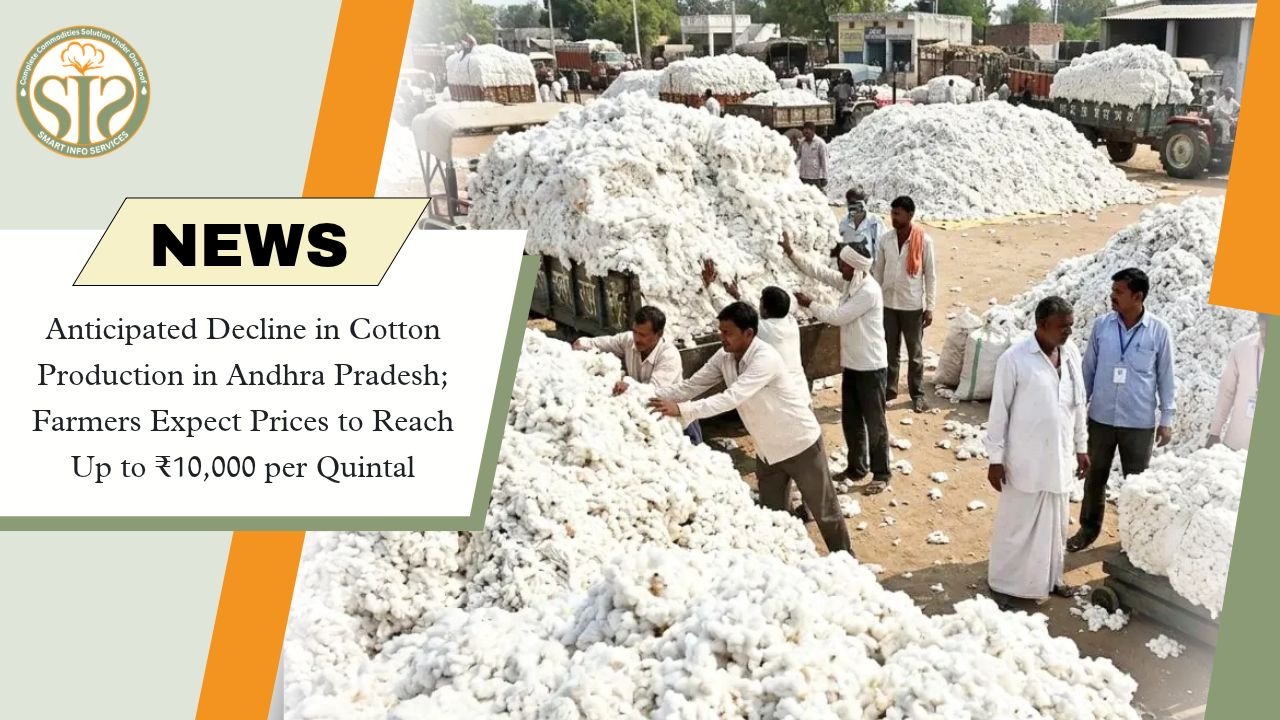
Guaranteed Rates Fall; Farmers Upset by Lower Grading: Cotton Prices Surge in Open Market, Reaching Eight Thousand; a Rs. 600 Increase RecordedWhile the price of cotton has decreased at the guaranteed purchase centers, it has surged in the open market of the district. The implementation of a second grade by the Cotton Corporation of India (CCI) has lowered the guaranteed price, but the open market has seen an increase of Rs. 500 per quintal.The Cotton Corporation of India (CCI) has introduced a second grade for cotton at its guaranteed purchase centers. This has reduced the guaranteed price by Rs. 100 per quintal. As a result, the price of cotton at the procurement center has fallen from Rs. 8110 to Rs. 8010 per quintal. On the other hand, the price of cotton in the open market of Yavatmal district has increased significantly. Cotton, which was previously priced between Rs. 7,200 and Rs. 7,500 per quintal, has now increased by Rs. 500 to Rs. 600, with prices reaching as high as Rs. 8,100 per quintal. This has created a sense of enthusiasm among farmers, and there is a rush to sell in the open market.However, farmers are complaining that despite having good quality cotton, they are being given a lower grade at the guaranteed centers. Farmers are demanding that the previous grading system be reinstated. However, since no new notification has been issued by the central government in this regard, procurement at the guaranteed centers is currently being done according to the second grade.Discussion on Import Duty: The central government had given an 11 percent exemption on import duty on cotton. There are discussions that these charges have now been reversed. However, an official notification in this regard has not yet been issued. Agricultural experts believe that even if the import duty is reversed, it will not have much impact on market prices.read more :- Cotton imports increase in December quarter due to duty-free incentives
India's Dec quarter cotton imports soar amid duty-free import pushMUMBAI, Jan 14 - India's cotton imports rose 158% year on year to a record 3.1 million bales in the December quarter after New Delhi allowed duty-free imports, boosting overseas purchases, a leading industry body said on Wednesday.Higher imports by the world's second-largest cotton producer are expected to support global prices , but they could weigh on local prices, which had been rising due to crop damage.New Delhi exempted cotton imports from the 11% duty during the December quarter.India's cotton imports in the 2025/26 marketing year, which began on Oct. 1, are likely to jump 22% from a year earlier to a record 5 million bales, the Mumbai-based Cotton Association of India (CAI) estimated.India's imports reached a record 4.1 million bales last year from the U.S., Brazil, Australia and Africa.The industry body raised its estimate for the current season's cotton crop to 31.7 million bales, up from the previous forecast of 30.95 million bales, mainly due to higher output in the western state of Maharashtra and the southern state of Telangana.The textile industry is one of the largest employers in India, directly employing over 45 million people.The CAI forecasts cotton consumption will decline 2.9% to 30.5 million bales in 2025/26, amid weak overseas demand for Indian fabric and apparel.The U.S., which takes nearly 29% of India's $38 billion annual textile exports, doubled tariffs on imports from India to as high as 50%, effective August.read more :- INR Drops 05 Paise, Closes at 90.30 per Dollar
The Indian rupee on Wednsesday lower 05 paise to close at 90.30 per dollar, while it opened at 90.25 in the morning.At close, the Sensex was down 244.98 points or 0.29 percent at 83,382.71, and the Nifty was down 66.70 points or 0.26 percent at 25,665.60. About 1887 shares advanced, 1918 shares declined, and 150 shares unchanged.read more :- FY 2026: World Bank estimates India's growth rate at 7.2%
World Bank raises India's growth forecast to 7.2% for FY2026, sees limited impact from US tariffsThe upgraded outlook is also driven by robust domestic consumption, recent tax cuts, and higher real rural incomes.The World Bank has revised India's FY2026 growth forecast to 7.2 percent, citing resilient domestic demand despite higher US tariffs. This marks a significant increase from the 6.3 percent estimate made in June 2025.However, according to the World Bank's latest Global Economic Prospects report, assuming the 50 percent tariffs imposed by the Trump administration remain in place throughout the forecast period, growth is expected to moderate to 6.5 percent in FY27.The agency said that stronger-than-expected domestic demand and improved consumption patterns would mitigate the impact of higher US tariffs on India. The upgraded outlook is also driven by robust domestic consumption, recent tax cuts, and higher real rural incomes.The World Bank report stated: "In SAR, the projected slowdown in 2026 primarily reflects the impact of increased US tariffs on India’s goods exports. Growth in the South Asia region (SAR) is poised to rebound in 2027, as exports recover and domestic demand firms, supported by strong services activity as the effects of political uncertainty in several economies dissipate."However, it cautioned that despite the strong performance of services exports, the US tariffs could dampen India's goods exports and impact overall growth. Expressing concerns over large fiscal deficits and spending pressures, the World Bank said it expects India's fiscal deficit to gradually decline through consolidation measures.The agency added that the continued rapid growth, led by India, is expected to support further economic convergence along with a significant reduction in poverty rates. In 2026, growth in South Asia is projected to slow to 6.2 percent, primarily due to the impact of increased US tariffs on India."This year's forecast has been revised down by 0.2 percentage points compared to the June estimates. The revision reflects higher US import tariffs than previously anticipated and updated assumptions about the timing of tariff effects—from 2025 to early-to-mid 2026—and the subsequent recovery."The report further notes that, excluding India, growth in the region is expected to strengthen to 5 percent in 2026 and 5.6 percent in 2027.read more :- The rupee opened 07 paisa lower against the dollar at 90.25
Indian rupee opens 07 paise lower at 90.25 against US dollarIndian rupee opened with marginal losses at 90.25 per dollar on Wednesday versus previous close of 90.18.read more :- Rupee rise 07 paisa to close at 90.18 per dollar
The Indian rupee on Tuesday rise 07 paise to close at 90.18 per dollar, compared to its opening price of 90.25 in the morning.At close, the Sensex was down 250.48 points or 0.30 percent at 83,627.69, and the Nifty was down 57.95 points or 0.22 percent at 25,732.30. About 1870 shares advanced, 1942 shares declined, and 158 shares unchanged.read more :- Gujarat's textile industry: engine of employment and sustainable development
Gujarat's textile industry has emerged as a key driver of development through job creation and sustainable growth.The second day of the Vibrant Gujarat Regional Conference (VGRC) in Rajkot focused specifically on the textile industry. The state's textile sector is a crucial source of development as it generates new employment opportunities and is a sustainable industry.Experts discussed this topic in detail and shared their views during a seminar, the Chief Minister's Office said in a press release.The textile industry is not just a sector producing textile products, but a driving force behind Gujarat's economic transformation. Through new technologies, job creation, and sustainable development, this industry is making a significant contribution to the development of the state and the country.At the VGRC, experts shared their insights on new aspects of this industry, technologies, and how to increase textile exports globally.Prominent figures present at the seminar included Updeep Singh, Resident Director of Welspun Group; Prashant Agarwal, Joint Managing Director of Wazir Group; D.S. Patel, Scientist at the Cotton Research Center, Navsari University; Ashwin Chandra, Chairman of CITI; and Vinay Kotak, President of the Cotton Association of India.Speaking at the event, these prominent individuals stated that the textile industry in Gujarat has witnessed remarkable development.The release stated, "This industry has carved a niche for itself in the global market. To remain globally competitive in the textile industry, it has become crucial to develop capabilities in innovative technologies and new designs. Today, fashion plays a very important role in the textile industry, but to keep pace with the ever-changing fashion trends, the use of innovative technologies is essential."Globally, the textile industry is estimated to be worth approximately USD 900 billion. To meet the growing demand for textiles over time, it will be necessary to adopt innovative technologies, while also prioritizing design and quality. Cotton is produced in 11 states of India, with Gujarat, Maharashtra, Rajasthan, Punjab, and Haryana leading in production. Gujarat, in particular, produces a significant amount of cotton.The release further states that today, farmers in Gujarat have been able to significantly increase their production through the use of BT cotton. This high-quality cotton also fetches them better prices. The development of the textile sector cannot be achieved by the government alone; farmers, companies, and the government must work together for the development of this sector. Only then will cotton production increase, and we will succeed in doubling farmers' incomes.The industry is moving forward today through innovative technology, innovation-driven production methods, and eco-friendly manufacturing. The textile industry makes a significant contribution to the state's GDP and export sector. It also promotes small and medium enterprises, thereby increasing employment. The industry has strengthened the employment structure in both the handicraft and machinery sectors. Training and skill development programs have also been implemented for workers and artisans.Sustainable development and innovative technology have encouraged the sector to adopt environmentally friendly practices. New technologies such as recycling, water conservation, and energy saving are being used. Global competition, raw material prices, and changing market demands are challenges for the industry; however, new production methods, digitalization, and new marketing strategies will further strengthen the industry, the release added.read more :-Budget 2026: Demand to remove cotton import duty
| title | Created At | Action |
|---|---|---|
| CCI Cotton Sales Report 2024-25 | 17-01-2026 15:33:10 | view |
| Increase in textile-garment exports for the second month | 17-01-2026 12:11:48 | view |
| Trump's tariff threat on Greenland issue | 17-01-2026 12:01:25 | view |
| CCI to start cotton sales for 2025-26 season next week | 17-01-2026 11:45:17 | view |
| CCI increased cotton prices, weekly sales 17,500 bales | 16-01-2026 18:09:42 | view |
| Textile industry expects duty free cotton from Budget 2026-27 | 16-01-2026 16:54:17 | view |
| Cotton sector hopes for new seed technology | 16-01-2026 16:42:13 | view |
| Rupee fell 50 paise to close at 90.87 per dollar | 16-01-2026 15:49:18 | view |
| EU-India trade agreement, boost to apparel-textile sector | 16-01-2026 12:51:03 | view |
| US market slow, India's hold in China strong | 16-01-2026 12:19:18 | view |
| Rupee open Falls 07 Paise to 90.37/USD | 16-01-2026 10:32:41 | view |
| Cotton Market Situation Report – As on 31/12/2025 | 15-01-2026 18:24:46 | view |
| Farmers worried about fluctuations in cotton prices | 15-01-2026 11:04:42 | view |
| Cotton imports increase in December quarter due to duty-free incentives | 14-01-2026 18:10:12 | view |
| INR Drops 05 Paise, Closes at 90.30 per Dollar | 14-01-2026 15:43:40 | view |
| FY 2026: World Bank estimates India's growth rate at 7.2% | 14-01-2026 11:29:25 | view |
| The rupee opened 07 paisa lower against the dollar at 90.25 | 14-01-2026 10:31:17 | view |
| Rupee rise 07 paisa to close at 90.18 per dollar | 13-01-2026 15:50:24 | view |
| Rupee rises 07 paisa to close at 90.18 per dollar | 13-01-2026 15:45:58 | view |
| Gujarat's textile industry: engine of employment and sustainable development | 13-01-2026 12:08:42 | view |