STAY UPDATED WITH COTTON UPDATES ON WHATSAPP AT AS LOW AS 6/- PER DAY
Start Your 7 Days Free Trial TodayThe Indian rupee on monday lower 27 paise to close at 85.75 per dollar, while it opened at 85.48 in the morning. The BSE Sensex shed 452.44 points or 0.54 per cent to settle at 83,606.46 levels, after trading in the range of 84,099.53 - 83,482.13.read more :- "Indian Cotton Crisis Demands Policy Action"
Plagued By Challenges, Indian Cotton Cries For Policy AttentionPolicymakers and industry representatives must be equally concerned over the lack of growthin the country’s cotton economy. In recent years, our domestic cotton crop has been grappling with several challenges, including land constraints, water shortage and climate change.Acreage for cotton crops has stagnated at around 125-130 lakh hectares, and yields have actually declined from the peak of 500 kilograms per hectare to the present, around 425 kg/ha.Cotton output has turned uncertain in terms of quantity and quality. Production has steadily fallen from 360 lakh bales in 2019-20 to 294 lakh bales in 2024-25. Our raw cotton export has been on a declining trend for the last three years. In 2024-25, India has moved from being a net exporter to a net importer of cotton.At the same time, the demand for the natural fibre has been rising, boosted by the addition of a new processing capacity (spindles).The view that the supply and demand fundamentals of cotton are tightening steadily is unmistakable. Import volumes are gathering pace. This raises a serious question. Can India produce enough cotton in the future to remain self-reliant?The answer is not easy, but surely not out of reach. We must abandon the ‘business-as-usual’ approach and adopt a holistic policy for the cotton sector. The cotton economy is a composite economy. It is labour-intensive and export-intensive.Cotton is not just fibre but much more—including the seed and its by-products like oil and meal. Indeed, cotton represents 5Fs—fibre, food, feed, fuel and fertiliser.Its composite nature warrants an ecosystem approach. It involves designing an optimal pathway that balances the economic interests of all stakeholders and, at the same time, advances sustainability principles and practices.As the planted area is stagnating and possibly nearing a saturation point, the only way to boost cotton production is through vertical growth, that is, by raising yields. To achieve this, intervention at multiple levels is necessary.As someone closely tracking agriculture for decades, this author proposes the following four big-ticket ideas: technological intervention, boosting genetic research, replicating high-yield area experience in other areas, and promoting contract farming by large user units.The emphasis should be on research. It is important to remember, “Yesterday’s research is today’s science, and today’s science is tomorrow’s technology.”Technology: Bt cottonseed is facing a technology fatigue. Pink bollworm has probably acquired resistance, as evidenced by the incidence of pest attacks. We need a conducive policy environment to support tech seeds. Sucking pests are taking a toll. New generation seeds (with stacked genes) are available. Indian seed companies should be encouraged to adopt new tech seeds. Tech seeds by themselves will not raise yields, but they will surely help prevent or reduce yield losses. The crop saved is the crop produced. In cotton promotion, ‘stewardship’ is missing. Industry bodies should work with agricultural universities and Krishi Vigyan Kendras (KVKs) to educate growers about farming practices like high-density planting.Genetic research: Cotton needs to fight climate change. The answer is climate-smart agriculture, including climate-resilient inputs and scientific agronomy. For the purpose, a conducive long-term policy to encourage firms to spend on R&D is the only alternative. Currently, many private seed firms have reduced their research expenditure because of non-supportive policy or an uncertain policy environment. Seed research is a long-term play. Reduction in the R&D spend is not good for the country and must be reversed.Replication: While the all-India cotton yield averages around 450 kg/ha, several districts enjoy yields twice the national average. There is something for stakeholders to learn from the experience of high-yield areas—input management, agronomy and so on. Replicating the experience and practices of high-yield areas in low-yield areas will pay dividends.Contract farming: To reduce dependence on cotton imports and generate a genuine export surplus, large user industries have a moral duty to produce the raw material they need. Contract farming is the way forward. Farmer Producer Organisations, or FPOs, can be good partners for contract farming. It will be a win-win for growers and industrial users. Scientific, well-tested and transparent methodologies to price the output in advance are available.Strengthening the cotton ecosystem demands ‘political will’ and active participation of the user industry in its own self-interest.read more :- Cost Push Drives Illegal HTBt Cotton in Maharashtra
Stark difference in labour costs pushes Maharashtra farmers to grow illegal HTBt cotton varietyOver the past few years, Laxmint Kauthankar has eschewed using genetically modified cotton variety, commonly known as Bt cotton, and started using completely unauthorised herbicide tolerant Bt (HTBT) cotton. This farmer from Adgaon Budruk village in Akola’s Akot taluka knows that such cultivation is illegal, but claims that simple economics forces him to do so.“Weed control alone in Bt cotton would cost me over Rs 20,000 per acre. In case of HTBT, the same expense would be Rs 2,000. So why shouldn’t I adopt it?” Kauthankar says that Bt cotton is hardly sold in his village’s input shop – most farmers have moved to HTBT for the same reasons. Like him, other cotton growers in Maharashtra have adopted the cultivation of unauthorised transgenic cotton, fully aware of the illegality of their act.Central government rules call for fines and jail terms for cultivating unauthorised GM crops. India has so far allowed the commercial release of Bt cotton. Bt stands for Bacillus thuringiensis – the name of the bacterium whose gene has been inserted into cotton seeds. HtBT is the next generation of GM cotton and allows plants to resist spraying of glyphosate, a herbicide commonly used for weed control. But the sale, production and storage of this variety is illegal in the country.But for farmers like Kauthankar, the ground conditions matter. “Consider this: For one acre of land, I will need about four cycles of weeding during the entire 6-7 month cycle of the cotton crop. For one weeding, I will need about 15 labourers and thus the total labour requirement will be around 60. At a daily wage of Rs 300 per day, the total labour expenditure for weeding comes to Rs 18,000. Even if I arrange the money, where are the labourers?,” said the farmer who cultivates cotton and soybean in over 40 acres of his holding. On the other hand, HTBT cotton requires herbicide spraying, and the total cost of this operation comes to Rs 2,000 per acre in the entire cotton crop cycle.read more :- Rupee open Strength 01 Paise to 85.48 per Dollar
INR higher 01 Paise, Opens at 85.48per USDIndian rupee opened higher by 01 paise at 85.48 per dollar on Monday versus Friday's close of 85.49.read more :- CCI Cotton Sales report Update for Season 2024-25
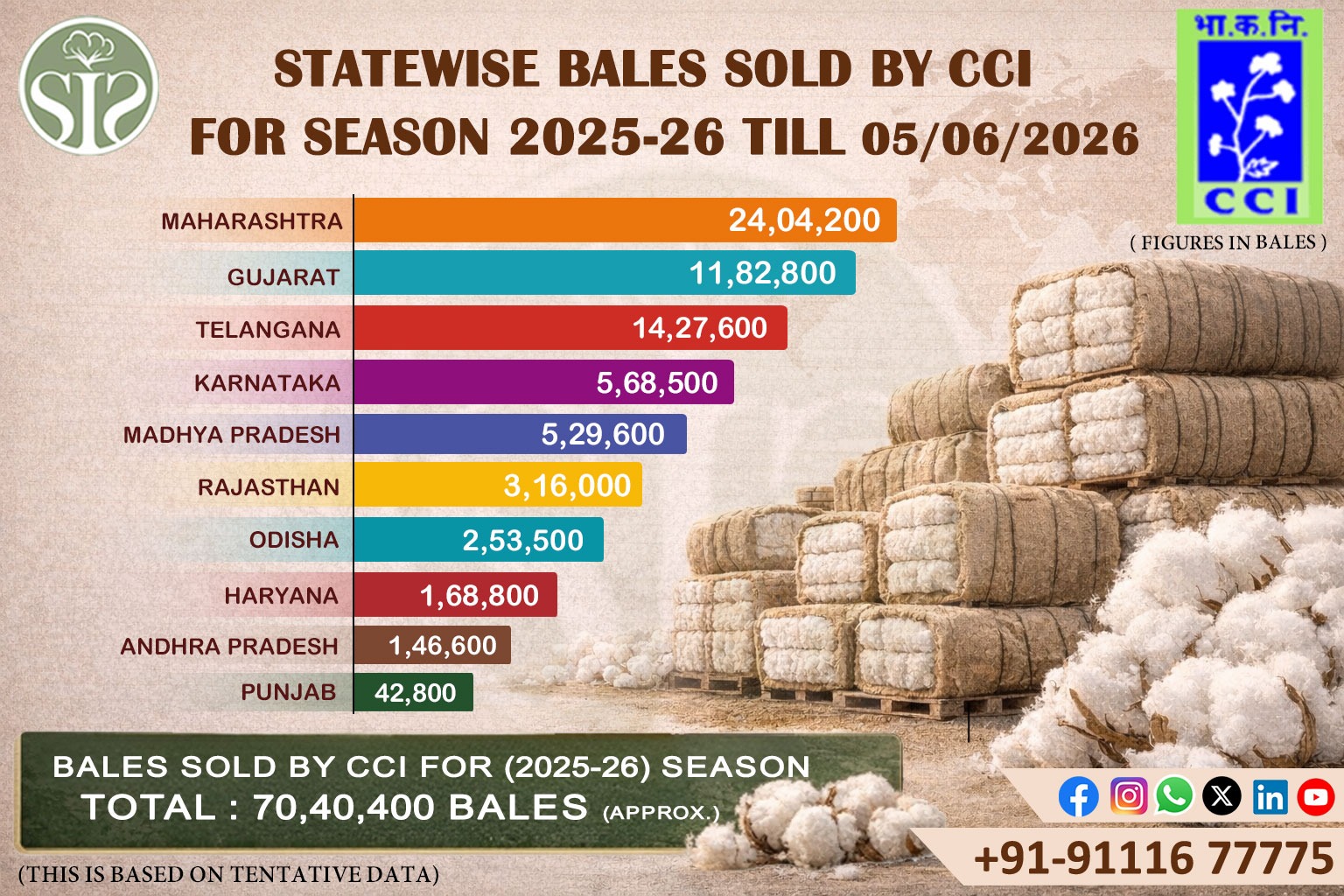
CCI Cotton Sales Report 2024-25The Cotton Corporation of India (CCI) has sold approx. 47,44,600 bales of cotton so far in the current season 2024-25. This accounts for 47.44% (approx.) of the total cotton procured this year.The state-wise breakdown of bales sold by CCI mentioned in the above postThis data reflects significant movement in cotton sales, particularly from Maharashtra, Telangana, and Gujarat, which together account for over 85.54% of total sales so far.This data showcases CCI’s active role in stabilizing the cotton market across major producing states.read more :- CCI Weekly Report on Cotton Bales Sales
India bans import of jute, other items via land routes amid strained Bangladesh ties: India on Friday tightened trade restrictions on Bangladesh, announcing a ban on imports of certain jute products and woven fabrics through all land routes, citing strained relations between the two countries.These measures were announced in the context of the controversial statements made by Muhammad Yunus, the head of Bangladesh's interim government, in China.Land route ban on Bangladeshi productsUnder the new directive from the Directorate General of Foreign Trade (DGFT), imports will be allowed only through the Nhava Sheva seaport in Maharashtra, PTI reported.The goods under these curbs include jute products, flax tow and waste, jute and other bast fibres, jute, single flax yarn, single yarn of jute, multiple folded, woven fabrics or flex, and unbleached woven fabrics of jute.This effectively closes all land border crossings for these specific goods, a significant disruption for cross-border trade.Such port restrictions will not apply to Bangladeshi goods transiting through India to Nepal and Bhutan, it added.Re-exports not allowedThe DGFT further said re-exports of these products from Bangladesh to India through Nepal and Bhutan will not be allowed."Import from Bangladesh shall not be allowed from any land port on the India-Bangladesh border. However, it is allowed only through the Nhava Sheva seaport," the DGFT said, adding that "imports of certain goods from Bangladesh to India are regulated with immediate effect". On May 17, India imposed port restrictions on the import of certain goods like readymade garments and processed food items, from the neighbouring country.On April 9, India withdrew the transhipment facility it had granted to Bangladesh for exporting various items to the Middle East, Europe and various other countries except Nepal and Bhutan, the news agency reported.Strained cross-border relationsThe new measures were announced after Yunus' comments that irked New Delhi. They also drew sharp reactions from political leaders across party lines in India.India-Bangladesh relations have deteriorated after Yunus failed to contain attacks on minorities, especially HindusEconomic impactBangladesh is a big competitor of India in the textile sector. The India-Bangladesh trade stood at $12.9 billion in 2023-24.In 2024-25, India's exports stood at $11.46 billion, while imports were $2 billion.Bangladesh's perceived growing closeness with Pakistan and China and the implications of India's strained ties with its eastern neighbour were also discussed at a parliamentary committee meeting on Friday, according to the news agency.read more :- CCI Weekly Report on Cotton Bales Sales
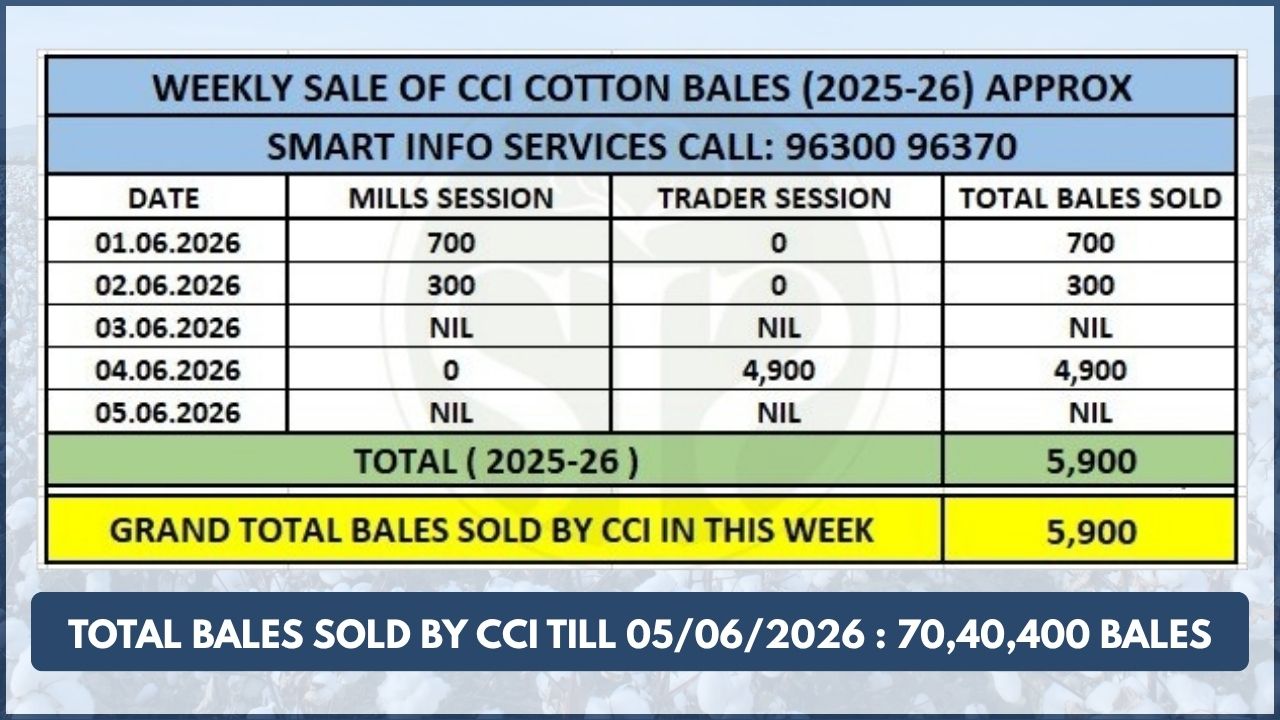
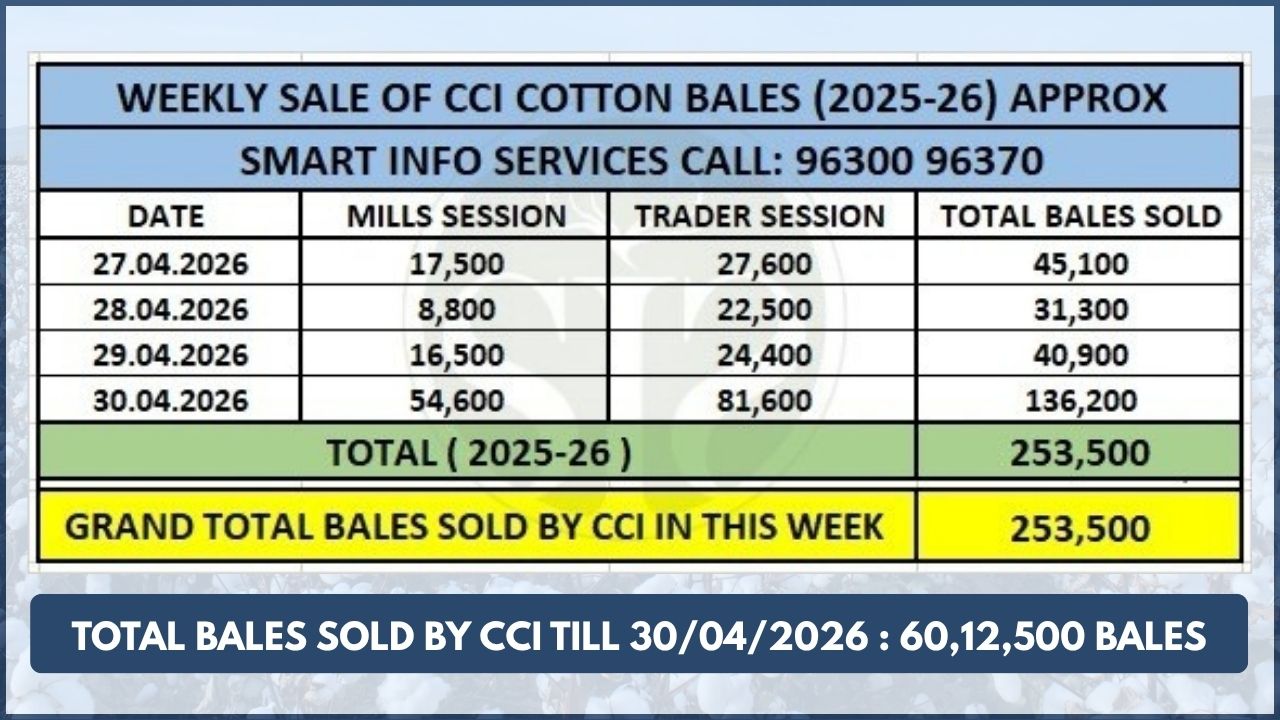
CCI Weekly Cotton Bale Sales ReportCotton Corporation of India (CCI) conducted online bidding for cotton bales throughout the week, with the summary of daily sales being as follows:23 JUNE 2025 : Daily sales were recorded at 1,00,400 bales (2024-25) and 1,800 bales (2023-24), comprising 21,300 bales (2024-25) in the Mills session and 79,100 bales (2024-25) and 1,800 bales (2023-24) in the Traders session.24 JUNE 2025 : Total 2,24,400 bales recorded, including 2,24,200 bales (2024-25) and 200 bales (2023-24), comprising 98,000 bales (2024-25) and 200 bales (2023-24) in Mills session and 1,26,200 bales (2024-25) in Traders session.25 JUNE 2025 : Highest sales of the week were 4,34,500 bales (2024-25) , including 1,88,000 bales (2024-25) in Mills session and 2,46,500 bales (2024-25) in Traders session.26 JUNE 2025 : Total 4,14,400 bales (2024-25) were recorded, including 1,53,800 bales (2024-25) in Mills session and 2,60,600 bales (2023-24) in Traders session.27 JUNE 2025: Week closed at 3,19,700 bales (2024-25 season), including 77,900 bales sold during Mills session, and 2,41,800 bales sold during Traders session.Weekly Total: During the week, CCI sold 47,44,600 (approx.) cotton bales, successfully using its online bidding platform to streamline transactions and support trading.SiS is committed to updating you in real time on all textile related newsread more :- Tamilnadu Plans Fair Pricing for Cotton Yield
Steps being taken to ensure cotton farmers get appropriate price for their produce, says T.N. government.The Tamil Nadu Agriculture Department has called upon cotton farmers to bring their produce to regulated markets. It also appealed to them to dry their produce and categorise them to meet norms on moisture, staple length, and micronaire, among others.An official release from the Secretary of the Agriculture Department said the Tamil Nadu government was taking steps to ensure cotton farmers get an appropriate price for their produce. It has also deputed officials to visit the districts.Cotton was cultivated in about 3.66 lakh acres across Tamil Nadu and the production was about 52,700 MT. As per the third estimates, the cotton production was about 36,000 MT during 2024-25. Of this, the production of cotton from the Cauvery delta districts such as Thanjavur, Nagapattinam, Mayiladuthurai and Tiruvarur districts, was about 7,700 MT, it said.read more :- Hedging desk started for farmers in Maharashtra
Maharashtra government launches hedging desk for cotton, turmeric and maize to help farmers(PTI) To ensure fair market prices and increased income for farmers, the Maharashtra government has launched a hedging desk in Pune under the first phase of the Balasaheb Thackeray Agribusiness and Rural Transformation (SMART) project.The desk will initially focus on cotton, turmeric and maize crops. Over time, the initiative will be expanded to cover more crops, a statement from the Chief Minister's Office (CMO) said.In collaboration with the National Commodity and Derivatives Exchange (NCDEX) and its research wing NCDEX Institute of Commodity Markets and Research (NICR), the initiative aims to protect farmers from losses due to market price fluctuations.Chief Minister Devendra Fadnavis called it a major step for the development of the agriculture sector.Hedging, like a fence protecting the farm, protects farmers from risks caused by price fluctuations in the market. Its main objective is to mitigate risks arising from potential price declines in the future. Farmers can also benefit from options trading, which allows them to lock in favourable prices, the statement said.Based on World Bank recommendations and the project implementation framework, the hedging desk has been set up to provide training and guidance to farmers and farmer producer organisations (FPOs) to participate in the commodity futures market.Agriculture contributes 12 per cent to Maharashtra's gross state domestic product (GSDP), yet crop production is still heavily dependent on nature.Despite successful crops, farmers often lack price control over their produce. To tackle this uncertainty, the government has supported them through policies, modern agricultural practices and crop insurance schemes.Recognising the limited resources and market knowledge of individual farmers, the government has now set up a dedicated, centralised agricultural hedging desk in Pune, it said.The hedging desk will work with FPOs and cluster-based business organisations (CBBOs) to provide technical information on commodity contracts and risk management strategies.This desk will provide real-time market information on trends, supply-demand changes and global prices. It will also promote setting up of storage centres near farms through FPOs.A risk management cell will analyse various types of risks and prepare mitigation strategies. It will publish annual commodity price risk assessment reports for cotton, maize and turmeric, offering current insights, forecasts and policy recommendations. Awareness and training programmes on commodity derivatives will also be organised.Additionally, at least 50 FPOs involved in the production and marketing of cotton, maize and turmeric will be registered and facilitated to trade in the futures market.A formal agreement was signed between NCDEX and Smart Project on April 8, 2025 for setting up this hedging desk. Special focus will be given to FPOs and farmers in cotton, turmeric and maize growing areas, especially in Hingoli, Washim, Sangli, Yavatmal, Akola, Nanded, Amravati, Chhatrapati Sambhajinagar and Beed.The project is headquartered in Pune and has started operating across the state.Hedging and options trading in select agricultural commodities are expected to bring huge benefits to farmers in Maharashtra. For example, a farmer unsure about future market prices at the time of sowing can lock in the price using options trading. This guarantees a minimum selling price, protecting them from market volatility, the statement said.Ultimately, this helps farmers get a stable income, plan financially better and feel more confident about investing in agriculture.read more :- Karnataka: 40% of kharif sowing has been completed in Yadgir district.
Yadgir Farmers Complete 40% Kharif SowingAfter three weeks of southwest monsoon and good rains before that, farmers who had already prepared the land in the district have started sowing. And, 40% sowing has been recorded till the beginning of this week.According to data provided by the agriculture department, 40.77% sowing has been recorded in Yadgir district. The department has set a target of 4,16,474 hectares for 2025-26 and out of this, 1,69,181 hectares, i.e. 40.77%, has been brought under cultivation so far.Farmers prefer moong, red moong, cotton and paddy for the kharif season, which is widely covered in the area irrigated under the Upper Krishna Project network, especially in Hunsgi and parts of Shahapur and Shorapur taluks.Meanwhile, paddy sowing is to be done in 1,07,856 hectares, while sowing is yet to begin.The taluk-wise sowing target and actual sowing is as follows: Shahapur 75,627 hectares (23,610 hectares), Wadagera 57,284 hectares (20,075 hectares), Shorapur 94,952 hectares (28,569 hectares), Hunsagi 66,134 hectares (19,682 hectares), Yadgir 69,505 hectares (42,979 hectares) and Gurmitkal 52,968 hectares (34,795 hectares).The highest sowing of 65.54% was recorded in Gurmitkal taluk, while the lowest sowing of 30.03% was recorded in Hunsagi taluk, where the area is largely irrigated and farmers sow paddy."Farmers can sow all crops except green gram by the end of July. We hope to cover more than 90% of the targeted area in the remaining period," said Rathendranath Sugur, joint director of the agriculture department. The district has received sporadic rainfall since sowing began this season. And, the weather has been dry despite cloudy weather across the district. Currently, mainly the green gram crop, considered a short-term cash crop, is about 10-15 days old. So, farmers have started ploughing to remove weeds between the crop rows to help them grow beautifully."The crops will need rain water in the next few days if not immediately as the soil is drying up slowly after ploughing," said Mahadevappa, a farmer ploughing his green gram field. Many farmers have said that the district has received good rainfall even before the onset of monsoon, which is even above the normal figures. "More importantly, if the crops get the required rainfall and fertilisers, they will give a good yield now," said Basavaraj Patil, another farmer.read more :- Maharashtra Cotton Sowing Hits 47% Mark
Maharashtra: So far only 47 percent sowing has been done in the district; this year cotton cultivation has been half .Jalgaon: Despite the month of Ashadh starting, sowing of Kharif is getting delayed in the district. Till 25th June only 47.6 percent sowing has been done. There has been rain at some places in the district. Due to this, the rate of sowing is more or less low everywhere in the taluka. Due to good initial rains this year, the maximum sowing has been done in Bodwad taluka in 90 percent area. Whereas Dharangaon taluka has the lowest sowing of 8 percent and Jalgaon taluka has only 10 percent sowing. Cotton cultivation starts from the first week of June, but this year cotton cultivation has been done in only 49 percent area. Still 51 percent cotton sowing is yet to be done.So far only 47 percent sowing has been done in the district; This year cotton cultivation was only half: 49 percent cotton cultivation, 64 percent maize sowingDespite the beginning of the month of Ashadh, sowing of Kharipa is still delayed in the district. Only 47.6 percent sowing has been completed till June 25. There has been rain at some places in the district. Due to this, the sowing rate is also more or less low everywhere in the taluka. Due to good initial rains this year, the highest sowing has been done in Bodwad taluka in 90 percent area. Whereas the lowest sowing has been done in Dharangaon taluka at only 8 percent and the lowest sowing has been done in Jalgaon taluka at only 10 percent. Cotton cultivation starts from the first week of June, but this year cotton cultivation has been completed in only 49 percent area. Still 51 percent cotton sowing is yet to be done.Kharif cultivation is done in 7 lakh 40 thousand 536 hectares in Jalgaon district. Out of this, the largest area of 5 lakh 46 thousand 933 hectares is of cotton alone. Although this year it rained in May, but the rain was delayed in June, due to which Kharif sowing could be completed in only 3 lakh 48 thousand hectares. Cotton has been cultivated in 2 lakh 68 thousand hectares. It is estimated that this year the area of cotton will decrease and the area of maize and soybean will increase. Despite less rain, the maximum 64 percent of maize sowing has been completed in the district. Maize sowing has been done in 59 thousand hectares.88 mm rainfall in the district Jalgaon district has recorded 88.7 mm rainfall till Wednesday. An average of 107.2 mm rainfall is expected in the district till June 26. In fact, 82.7 mm rainfall has been recorded. The highest rainfall of more than 100 mm was recorded in Jalgaon, Bhusaval, Erandol, Parola and Pachora talukas. The lowest rainfall was recorded in Raver, Muktainagar and Amalner talukas.read more :- Indian cotton acreage likely to increase despite setbacks in some pockets
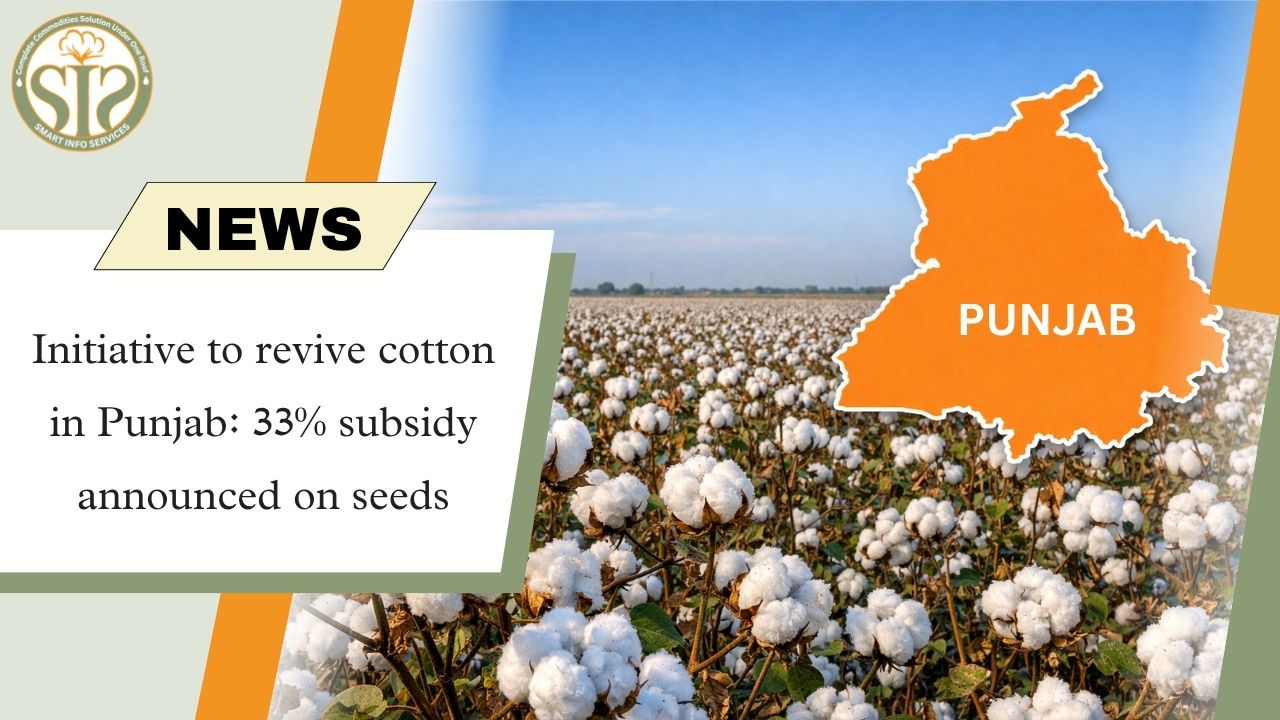
"Cotton Cultivation Expands in India Despite Setbacks"The country’s area under cotton has witnessed an uptick despite setbacks in Telangana and Andhra Pradesh where a dry spell threatens to hit the first sowing. The cotton acreage is expected to increase by 7 per cent over 113.60. lakh hectares (lh) last year. As of June 20, the area under cotton was 31.25 lh.Though the area is trailing in States such as Telangana, the trade expects the acreage to improve in Telangana and Andhra Pradesh following an increase in minimum support price (MSP) for the fibre crop. In Karnataka, the area was up by about 40 per cent till June 20 at 3.35 lh compared with 2.40 lh a year ago. The area in Gujarat, however, could decline by 5 per cent as farmers in Saurashtra are shifting from cotton to groundnut.A long dry spell after early rains in the last week of May has dampened the hopes of cotton farmers in Telangana. Two-thirds of 33 districts in the State reported deficit rainfall. According to the India Meteorological Department, the State has received 23 per cent deficient rain during the current monsoon. With the prospects of losing the first sowing looming large, the State government is taking measures to make seeds available.Lukewarm enthusiasm“There is likely to be an increase of 8-10 per cent in the coverage of cotton in the country this season,” said Ramanuj Das Boob, Vice-President of the All-India Cotton Brokers Association and a sourcing agent in Raichur. In Karnataka, the acreage will be more by around 10 per cent, while Telangana and Andhra may also see an improvement, he said.Also, in northern States such as Rajasthan and Punjab, the acreage is seen improving, he said.Bhagirath Chaudhary, Director of Jodhpur-based South Asia Biotechnology Centre, said across North India, the 2025 cotton season has been marked by lukewarm enthusiasm driven by persistent concerns over profitability, recurring pink bollworm infestations and increasing disease concerns.Despite the Punjab government’s subsidy on Bt cotton hybrid seeds, farmer response this season has remained largely indifferent. The support, though well-intentioned, has failed to translate into any significant expansion of the cotton-growing area on the ground, Chaudhary said.Major setback“A major setback has been the unavailability of canal water during the crucial May sowing window, which has further discouraged farmers from planting cotton. This critical lapse has turned the tide in favour of paddy, a crop perceived by farmers as more stable, remunerative, and less risky,” Chaudhary said“To arrest the continuing decline, North Indian states must collaborate with the Central government on a comprehensive revival strategy to implement TMC 2.0 by incentivising drip irrigation system ensuring timely sowing of cotton and fast tracking approval and adoption of pink bollworm-resistant Bt cotton varieties with herbicide-tolerant traits,” he said.According to Anand Popat, Rajkot-based cotton, yarn and cotton waste trader, it will take another fortnight for the actual picture on cotton sowing to emerge across the country. However, the area in Gujarat could decline by 5 per cent as farmers in Saurashtra are shifting from cotton to groundnut. On the other hand, soyabean farmers are switching over to cotton. “In Maharashtra, the acreage could be plus or minus 2 per cent compared with last year. In the North, there could be a 10 per cent increase, and in the South, the area could rise by 15-25 per cent,” said Popat.Telangana farmers in distress.The early monsoon brought cheers to farmers in Telangana last month and they went for early sowings of cotton and paddy. Their hopes, however, are short-lived as the south-west monsoon played spoilsport. A long dry spell after the initial showers in the last week of May is causing concern among cotton farmers.“We are on the verge of losing the investments that we made in sowings. After initial rains in the last week, there have been no rains. If it doesn’t rain in the next few days, we may have to go for second sowing,” Ram Reddy (name changed), a cotton farmer in Narayanpet, told.read more :- INR rises 01 Paise, Closes at 85.49 per Dollar
The Indian rupee on friday higher 01 paise to close at 85.49 per dollar, while it opened at 85.50 in the morning.At close, the Sensex was up 303.03 points or 0.36 percent at 84,058.90, and the Nifty was up 88.80 points or 0.35 percent at 25,637.80. About 2135 shares advanced, 1727 shares declined, and 140 shares unchanged.read more :- Tamil Nadu: Business Traditions: Why cotton-rich Tirupur is turning to synthetics
Tirupur’s Shift from Cotton to SyntheticsTirupur : As the world increasingly embraces fast fashion, the demand for man-made fibres (MMFs) is on the rise. With this in mind, over 70% of people across the world currently wear clothes made from MMFs. “It is still early days,” says Siva Subramaniam, a second-generation manufacturer and exporter of innerwear, T-shirts and sweaters, sitting in his factory office in Tirupur. However, he firmly believes that “this is the way of the future for the industry”.“We should think about the global market and the growth of demand,” says Subramaniam, founder and CEO of Raft Garments.It has been two years since Raft Garments started using polyester spandex fabric to manufacture underwear, previously using only cotton spandex. The reason: “It resists sweat and is more durable,” he says, displaying some of the new polyester pieces now being produced at his manufacturing unit in Tirupur.The exporter currently has 85% cotton-based garments and 15% MMF, while the earlier portfolio was entirely cotton-based (100%). In the coming years, Subramaniam intends to increase the share of MMF to 50% as he is betting big on MMF.He says the domestic market is increasingly favouring synthetics, while also noting that the growth is happening at a steady rate. “Especially in the sports sector, cotton is almost disappearing, and everyone is showing an inclination towards polyester. We cannot always depend on cotton alone and we have to explore new avenues as well. Though it is a small percentage right now, there can be a gradual change with adequate support from the government to develop the sector,” he says.For those who don’t know, MMF is usually made by chemical processes or by modifying natural fibres, resulting in materials such as polyester, nylon and rayon. With benefits such as durability, ease of care and resistance to wear and tear, these materials are suitable for a variety of applications. Currently, China is the leader in MMF production, with an estimated global market share of 72%. A recent report by the Ministry of Textiles on MMF shows that India’s per capita fibre consumption is 5.5 kg; of this, MMF’s share is 3.1 kg, which is the lowest globally, even lower than Africa. This shows that India has a huge potential to increase its per capita MMF fibre consumption.The textile industry estimates that India’s MMF textile exports will grow by 75% to reach $11.4 billion in 2030 from around $6.5 billion in 2021-22. However, this is easier said than done. Factors such as raw material cost, quality, capacity and technological advancement make it difficult for Indian exporters to compete with their global counterparts. Tirupur, the knitwear capital of India, is also facing similar challenges as a cluster as it is slowly moving towards the uncharted territories of MMF apparel.Keeping pace with global demandTirupur holds a prominent position globally as a knitwear exporter, catering to the demand of major markets including Europe and the USA. It exports cotton and cotton-blend T-shirts, dresses, sweatshirts and other knitted garments to global markets. Tirupur’s proximity to the major textile hub Coimbatore has also helped it emerge as a globally recognised apparel manufacturing hub.ChallengesSo, what exactly is stopping us from going full throttle in this sector, especially in clusters like Tirupur, which has a bustling textile industry at its core?ET Digital's interactions with exporters in Tirupur revealed that India has not been able to match China's potential in this sector. While some firms have started manufacturing products on MMF, buoyed by the surge in global demand, most continue to be dominated by cotton-based products.Preparing for the futureMeanwhile, Tirupur exporters are striving to take themselves a notch higher in this sector. Smaller exporters are investing Rs 2-3 crore to gradually make the shift towards MMF. "We have invested Rs 3-4 crore in MMF production. Globally, the market is showing a clear preference for MMF. We want to compete for that share," says Subramanian.The industry and the government collectively need to step in to make this possible and bring innovation for a cluster that has the capacity and capability to take MMF production to the next level.read more :- Rupee Rises 20 Paise to 85.50 Against Dollar
Indian rupee opens 20 paise higher at 85.50 against US dollarThe rupee opened 20 paise up on June 27 as the dollar index continues to trade lower. The rupee opened at 85.50 against the dollar after ending the previous session at 85.70.read more :- India's monsoon set to cover entire country over a week early
Monsoon Makes Fast Advance Over IndiaIndia's annual monsoon rains are set to cover the entire country within the next three to four days, over a week ahead of their typical schedule, two senior weather officials said on Thursday, accelerating planting of summer-sown crops.The monsoon, the lifeblood of India's nearly $4 trillion economy, delivers almost 70% of the rainfall needed to water farms and replenish aquifers and reservoirs.Nearly half of India's farmland, which is not irrigated, depends on the annual June-September rains for crop growth.In a typical year, rains lash the southwestern coastal state of Kerala around June 1 and move northwards to cover the entire country by July 8.After stalling for two weeks, the monsoon regained momentum last week and rapidly covered central India and most northern states, the India Meteorological Department said.Rains had reached all parts of India except some areas in the northwestern state of Rajasthan, neighbouring Haryana, Delhi and Uttar Pradesh, an IMD chart released on Thursday showed.The monsoon has continued its expansion over some parts of northwestern states, said R. K. Jenamani, head of the national weather forecasting centre, and conditions are favourable for it to reach the remaining untouched areas over the next three to four days.Despite receiving rainfall 31% below average in the first half of June, the monsoon's revival has turned the deficit into a 9% surplus so far this month.Central and northern states are likely to receive above-average rainfall this week and next week, which will help farmers accelerate sowing of summer-sown crops, another weather official said.Farmers usually start planting summer-sown crops such as rice, corn, cotton, soybeans, and sugarcane after the arrival of monsoon rains.India is likely to see above-average monsoon rains for the second straight year in 2025, according to an IMD forecast released last month.read more :- Cotton Sowing Up 7% Ahead of 2025-26 Season
Cotton Sowing Gains Momentum: All-India Area Rises 7% Ahead of 2025-26 SeasonCotton sowing for the upcoming 2025-26 season has shown a positive trend across several states, with total sowing across India reaching 31.25 lakh hectares, a 7.3% increase compared to 29.12 lakh hectares recorded during the same period last year.State-wise Performance:Rajasthan has witnessed a robust increase, with cotton sowing covering 550.29 thousand hectares, up from 444.79 thousand hectares last year — a significant 23.7% jump.Gujarat, another key cotton-growing state, reported a rise in coverage, with 7.58 lakh hectares (757,842 ha) sown so far compared to 5.80 lakh hectares (580,128 ha) last year — marking a 30.6% surge.Maharashtra has also registered a moderate increase. Sowing has reached 11.53 lakh hectares (1,153,486 ha), up from 11.30 lakh hectares (1,129,892 ha), a 2.1% rise.However, not all states have seen a positive trend:Karnataka reported a decline, with sowing dropping to 3.36 lakh hectares compared to 5.19 lakh hectares in the previous year — a sharp 35.3% fall.Telangana has also seen reduced sowing activity, with the area under cotton falling to 22.84 lakh hectares (2,284,474 ha) from 26.42 lakh hectares (2,641,595 ha) — a 13.5% decrease.Outlook: Experts attribute the increase in sowing in Rajasthan and Gujarat to favorable early monsoon conditions and improved market sentiment. On the other hand, delayed rains and shifting crop preferences may have impacted sowing in Karnataka and Telangana.The Ministry of Agriculture is monitoring sowing trends closely as monsoon patterns evolve. The overall positive start indicates a potentially strong kharif season for cotton if favorable weather persists in the coming weeks.read more :- Rupee higher 18 Paise Against USD, Closes at 85.70
The Indian rupee on thursday higher 18 paise to close at 85.70 per dollar, while it opened at 85.88 in the morning.At close, the Sensex was up 1,000.36 points or 1.21 percent at 83,755.87, and the Nifty was up 304.25 points or 1.21 percent at 25,549. About 1983 shares advanced, 1855 shares declined, and 151 shares unchanged.read more :- Lower US tariffs on textile goods could make India competitive: Crisil
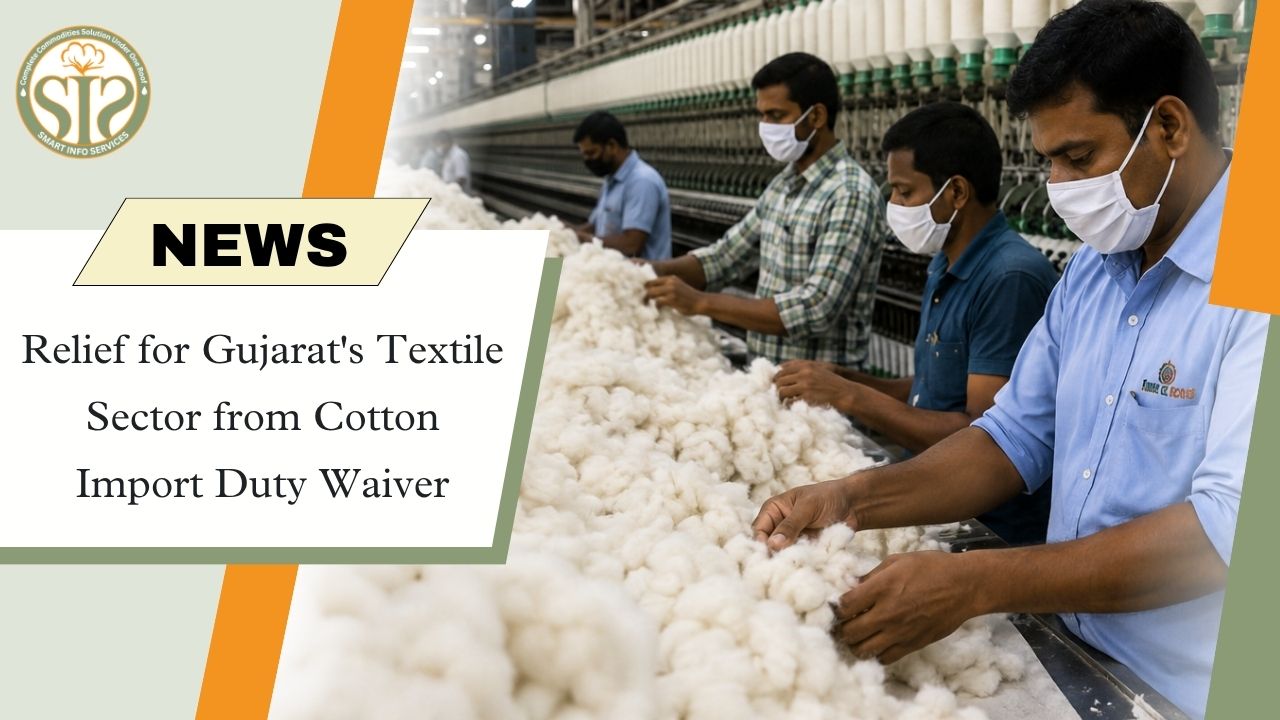
US Tariff Cut May Boost Indian TextilesAccording to Crisil, the US-India bilateral trade agreement (BTA) under negotiation is likely to reduce India's goods trade surplus with the United States, and India will be able to import more energy products, certain agricultural products and defence equipment, among others, from the US.Although the United States is India's largest export partner, there is scope to further increase exports in sectors such as smartphones, certain pharma products and labour-intensive exports such as textiles and gems and jewellery, S&P Global said in a note.As the first tranche of the proposed BTA is targeted to be completed by autumn 2025, India should be prepared to see more imports from the United States as India's tariffs are much higher than those of the United States and reducing them would be beneficial for US exporters.Crisil feels there is some scope for India to increase its exports to the United States.Textile products are among the major products exported to the US that attract duty. Lower duty under the BTA could help India compete with other major textile exporters such as Bangladesh, China and Vietnam.While some textile products such as toilet linen, kitchen linen and bed linen already have significant market share (which should get a boost from the duty reduction), Crisil said the market penetration for products in the readymade garment (RMG) sector is low and would benefit from the duty reduction."India's imposition of zero or lower duty on cotton imports from the US could enhance synergies in textile trade, especially when India's cotton production is declining. This could help meet the growing demand for RMG from the US, provided duty on such imports is reduced," it said.read more :- Gujarat: Farmers sowed crops in 12,950 hectares, most of them were cotton
Gujarat Begins Kharif Sowing, Cotton on TopVadodara : India is an agricultural country, so it is natural to have good rains in the agricultural sector. The sons of the soil are eagerly waiting for the rain. There is an atmosphere of happiness among the farmers of Vadodara district due to rain from the sky this year. In the current Kharif season, sowing has been completed in 12,950 hectares of agricultural area in the district so far.Out of the total 12,950 hectares of Kharif crop sown in Vadodara district, cotton has been sown in 8,891 hectares of land, which is the highest. Apart from this, fodder has been sown in 2,042 hectares of land. Vegetables have been planted in 1,781 hectares, soybean in 125 hectares and pigeon pea crop in 60 hectares. While banana and papaya have been planted in 1 hectare each.If we look at the area of Kharif crops taluka wise, then crops have been sown on 4,201 hectares in Dabhoi, 49 in Desar, 1,363 in Karjan, 4,399 in Padra, 552 in Savli and 2,386 hectares in Shinor. After the solid planning of the state and central government, farmers have not faced any problem in getting fertilizers. On the other hand, the sons of the soil, who are facing the demon-like rain from the sky, have taken up the task of converting every grain of food into a grain with full enthusiasm.read more :- Cotton sowing slows down, decline continues in northern region
| title | Created At | Action |
|---|---|---|
| Rupee falls 27 paise to close at 85.75 | 30-06-2025 22:51:09 | view |
| "Indian Cotton Crisis Demands Policy Action" | 30-06-2025 18:46:45 | view |
| Cost Push Drives Illegal HTBt Cotton in Maharashtra | 30-06-2025 18:08:47 | view |
| Rupee open Strength 01 Paise to 85.48 per Dollar | 30-06-2025 17:33:20 | view |
| CCI Cotton Sales report Update for Season 2024-25 | 28-06-2025 22:29:28 | view |
| India Shuts Land Trade for Jute, Goods | 28-06-2025 22:28:40 | view |
| CCI Weekly Report on Cotton Bales Sales | 28-06-2025 21:08:14 | view |
| Tamilnadu Plans Fair Pricing for Cotton Yield | 28-06-2025 19:50:45 | view |
| Hedging desk started for farmers in Maharashtra | 28-06-2025 18:54:57 | view |
| Karnataka: 40% of kharif sowing has been completed in Yadgir district. | 28-06-2025 00:25:44 | view |
| Maharashtra Cotton Sowing Hits 47% Mark | 27-06-2025 23:50:23 | view |
| Indian cotton acreage likely to increase despite setbacks in some pockets | 27-06-2025 23:18:27 | view |
| INR rises 01 Paise, Closes at 85.49 per Dollar | 27-06-2025 22:48:43 | view |
| Tamil Nadu: Business Traditions: Why cotton-rich Tirupur is turning to synthetics | 27-06-2025 19:06:20 | view |
| Rupee Rises 20 Paise to 85.50 Against Dollar | 27-06-2025 17:24:15 | view |
| India's monsoon set to cover entire country over a week early | 27-06-2025 00:46:00 | view |
| Cotton Sowing Up 7% Ahead of 2025-26 Season | 27-06-2025 00:27:10 | view |
| Rupee higher 18 Paise Against USD, Closes at 85.70 | 26-06-2025 22:44:06 | view |
| Lower US tariffs on textile goods could make India competitive: Crisil | 26-06-2025 20:08:06 | view |
| Gujarat: Farmers sowed crops in 12,950 hectares, most of them were cotton | 26-06-2025 19:17:25 | view |