Filter

Recent News

India Budget 2025: Textile budget may rise 15 per cent to $578 mn

India's 2025 budget for textiles could increase by 15% to $578 million. India may increase the budget allocation by 15 per cent for the Ministry of Textiles for the next financial year 2025-26 in the upcoming Union Budget. Union Finance Minister Nirmala Sitharaman will present the Union Budget on February 1 for the next fiscal year. There are expectations that budget allocations for the Ministry will exceed ₹5,000 crore ($578 million) for the next fiscal year.A close analysis of previous years’ budgets reveals patchy allocations and utilisation of funds. The government allocated ₹4,417 crore ($510 million) for the current fianancial year 2024-25, which was a 28 per cent higher allocation compared to the revised budget of ₹3,443 crore ($397 million) for the fiscal year 2023-24. The budget allocation was quite higher at ₹4,389 crore ($507 million) for fiscal year 2023-24. However, the ministry could utilise only ₹3,443 crore ($397 million) during the fiscal year. This reveals that the budget allocation for fiscal year 2024-25 was just 0.63 per cent higher than the budget allocation for fiscal year 2023-24.Interestingly, the budget allocation for fiscal year 2023-24 was 32.6 per cent higher than the actual budget of ₹3,309 crore ($382 million) in fiscal year 2022-23. The India budget portal has not released the revised/actual budget for the current fiscal year 2024-25, which may be lower than the budget allocation. The ministry’s revised/actual budget remained very low at ₹3,309 crore ($382 million) in 2022-23 and ₹3,443 crore ($397 million) in 2023-24.The finance minister is likely to increase the budget allocation by 33 per cent for the Production Linked Incentive (PLI) scheme for textiles, with its allocation expected to rise from ₹45 crore ($5.20 million) to ₹60 crore ($6.93 million). The PLI scheme for textiles was launched in 2021 to promote the production of man-made fibre (MMF) apparel, MMF fabrics, and technical textile products. It was aimed at helping the textiles industry scale up and compete globally.According to an official, the government has ambitious targets for the textiles sector and is exploring measures to encourage domestic manufacturing. The finance minister may announce other initiatives for the textile industry.read more :-  Cotton prices stable: Farmers are getting loss-making prices

Cotton prices stable: Farmers are getting loss-making prices

Cotton prices are steady, and farmers are receiving prices that are losing money.There is still no increase in the price of cotton; farmers have to sell at low prices.Jalgaon News: Farmers in the Bhusaval taluka of Jalgaon district are in a lot of trouble due to unseasonal rains. The unseasonal rains have affected the crops of cotton, soybean and maize, resulting in a drop in production.Bhusaval (Jalgaon): The wait for a hike in the price of cotton is still on. Farmers have stored cotton in the hope of a price hike. However, there is no sign of any initiative from the government regarding the price hike. This has put the farmers in trouble and wondering how long they will be able to keep the cotton in their homes, some farmers are reluctantly selling cotton to traders at low prices.Farmers in the Bhusaval taluka of Jalgaon district are in a lot of trouble due to unseasonal rains. Crops like cotton, soybean and maize have been affected by the unseasonal rains. This has led to a drop in production and it is seen that farmers are not getting good prices. Sooner or later cotton will get a good price; Anticipating this, farmers had stored cotton at home.Farmers have lamented that they are not getting the desired price, as the government has not yet taken any decision on the price increase of cotton. The math of farmers has gone wrong as the stored cotton is not getting a good price in anticipation of a fall in market price and price increase. Farmers have been storing cotton at home since Diwali. Since cotton prices have remained between Rs 6,500 to Rs 7,000 since the beginning, farmers are storing cotton at home.read more :- Indian rupee opens almost flat at 86.56 against US dollar
KHAGA appeals to Nirmala Sitharaman to reject GST hike for textile industry

KHAGA urges Nirmala Sitharaman to oppose the textile industry's GST hike. The Karnataka Household and Garment Association (KHAGA) has written to Union Finance Minister Nirmala Sitharaman to urge her to abandon the idea in response to news that the Goods and Services Tax (GST) rates for the apparel and textile industry may be revised.The local apparel and textile industry’s trade group, KHAGA, emphasised the revision’s potential economic and social effects on pricing, manufacturing, and consumer demand.The association expressed worries about the possible loss of jobs in the industry in the event that GST rates are hiked. According to KHAGA, any tax increase would increase the financial strain currently experienced by the garment and textile sector, which employs a sizable number of unskilled and semi-skilled workers, many of whom are women, endangering many livelihoods.KHAGA president Prakash Bhojani stated that if ethnic garments, typically bought for weddings and celebrations, are categorised under luxury tax, they will become unaffordable for many. He added that this could reduce consumption during cultural and festive occasions, ultimately slowing down the economy.Additionally, the group said that changing the GST rates would drive firms and consumers to unofficial marketplaces. While illegitimate merchants would profit from this change, respectable retailers would suffer.read more :- Cotton prices fall as WASDE forecasts higher production and ending stocks for 2024/25 crop year

Cotton prices fall as WASDE forecasts higher production and ending stocks for 2024/25 crop year

As WASDE projects increased production and ending stocks for the 2024–2025 crop year, cotton prices decline.Cotton candy prices fell 0.45% to close at ₹53,670 on bearish sentiment following a WASDE report that forecast higher production and ending stocks for the 2024/25 crop year. Global cotton production is estimated to rise by 1.2 million bales to 117.4 million due to large crops in India and Argentina. However, north Indian states reported a sharp 43% drop in cotton arrivals till November 30, leading to a shortage of raw material for ginners and spinners. The Cotton Association of India (CAI) estimates cotton consumption for 2024/25 at 313 lakh bales, while the pressing estimate remains unchanged at 302.25 lakh bales.Cotton imports are expected to rise by 9.8 lakh bales to 25 lakh bales compared to last year. Nearly 9 lakh bales had arrived at Indian ports till November 30. Ending stocks for 2024/25 are estimated at 26.44 lakh bales, down from 30.19 lakh bales in the previous year. Globally, US cotton production forecast rose to 14.3 million bales in December, while world production rose to 117.4 million bales. World consumption rose by 570,000 bales, led by India, Pakistan and Vietnam, offsetting a shortfall in China. Meanwhile, exports are slightly higher, with notable growth in Brazil, Benin and Cameroon.Technically, the market is witnessing long liquidation as open interest fell 19.29% to 297. Prices are supported at ₹53,490, with potential downside to ₹53,300. Resistance is seen at ₹53,940, and break above this level could test ₹54,200.read more :- Rupee rises 17 paise to 86.28 against US dollar in early trade
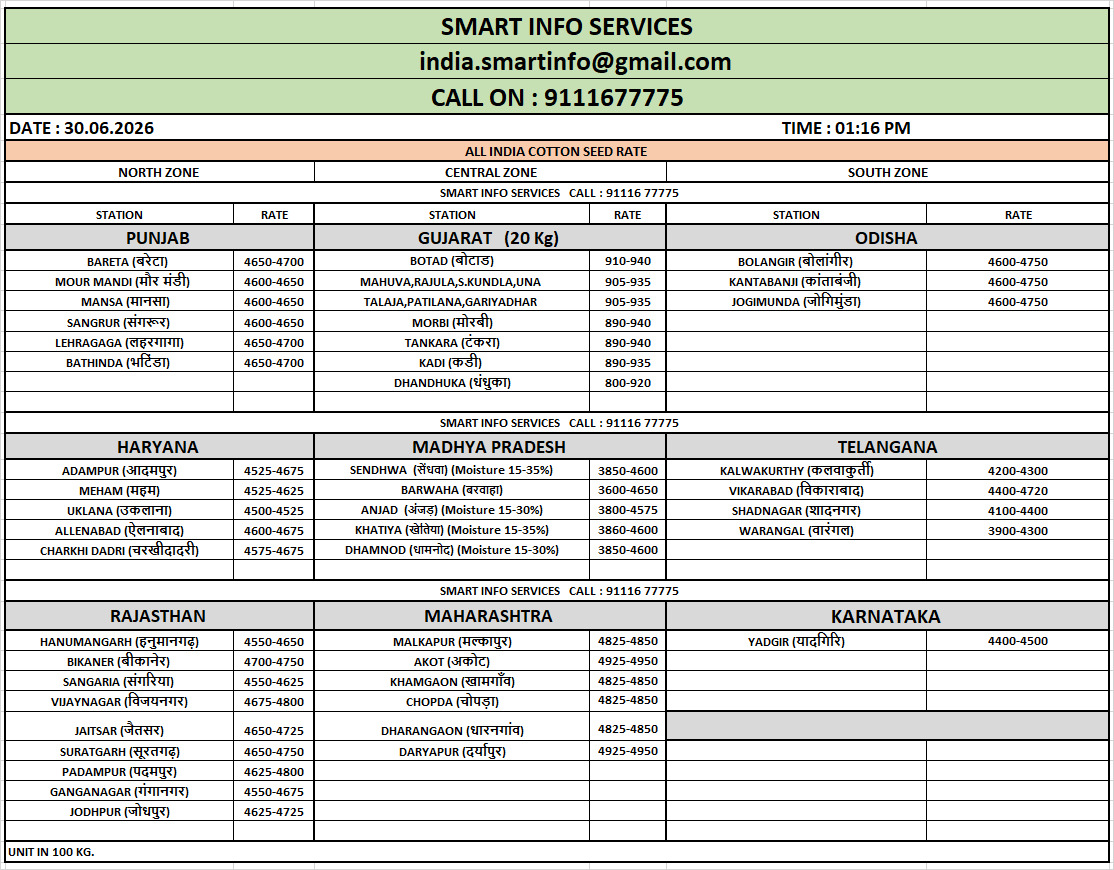
“Madhya Pradesh Cotton Procurement Hits 12 Lakh Quintals: CCI”

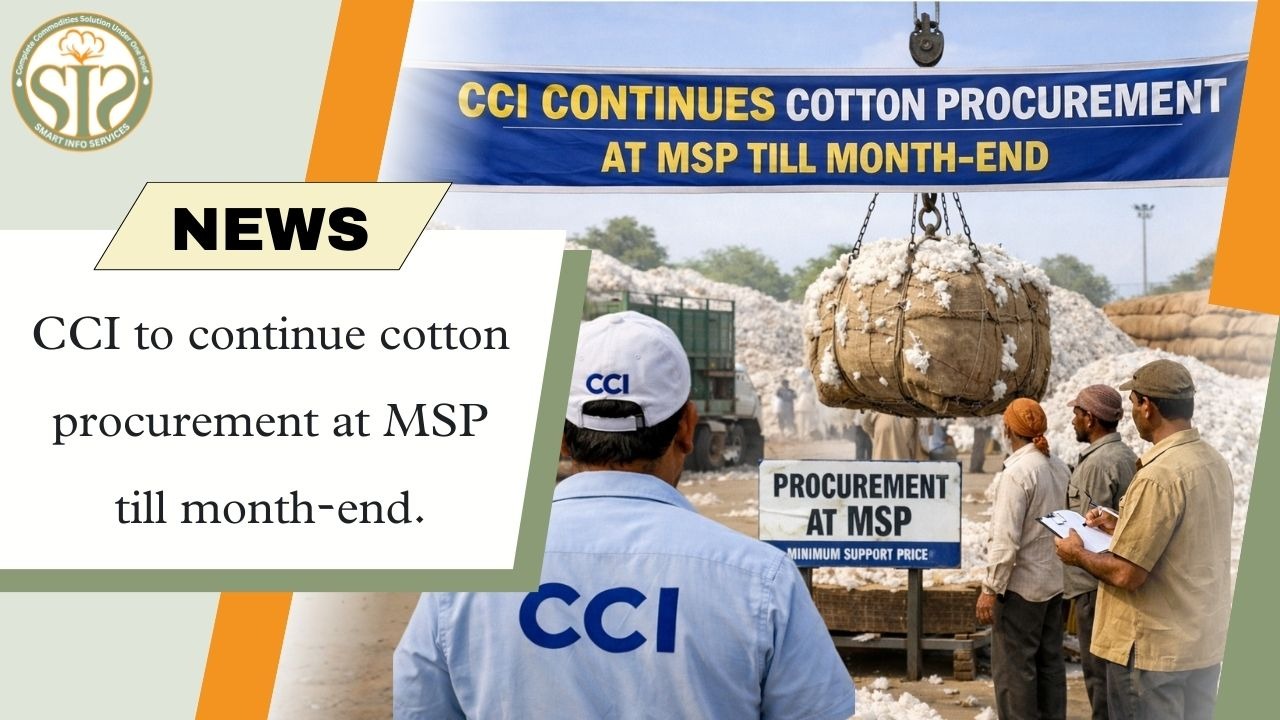
CCI’s Cotton Procurement in Madhya Pradesh Touches 12 Lakh QuintalsIndore: The Cotton Corporation of India (CCI), the nodal agency under the Ministry of Textiles, has procured around 12 lakh quintals of cotton in Madhya Pradesh so far this season—nearly double last year’s procurement of 6.35 lakh quintals.Procurement operations began in October 2024 at the Minimum Support Price (MSP), with 21 centres established across the state to facilitate farmer participation.“Approximately 12 lakh quintals have been procured so far. Most centres are fully operational, especially since arrivals were strong in the early months. While initial produce had higher moisture levels, the quality has steadily improved, and current stock levels are satisfactory,” a CCI official said on condition of anonymity.For the 2024–25 season, the MSP has been fixed at ₹7,121 per quintal for general cotton and ₹7,521 per quintal for medium and long-staple varieties.Key procurement centres are located in major cotton-growing regions such as Khargone, Dhamnod, Bikangaon, Badwah, and Khandwa. In the Indore division, prominent cotton belts include Khargone, Khandwa, Barwani, Manawar, Dhar, Ratlam, and Dewas.According to Kailash Agrawal, a local trader and farmer, higher procurement this season has been driven by improved production and better per-hectare yields. “Unlike previous years, many farmers chose to sell early to secure assured returns, resulting in strong arrivals at the start of the season,” he said.Traders estimate that nearly 80% of cotton arriving in mandis this season has been purchased by CCI, as open market prices have remained below the MSP.Another trader, Hari Kishore, noted that cotton prices have not crossed ₹8,000 per quintal in the past three years. “Given past trends, farmers prefer to clear their stocks early at MSP, which is seen as a safer option,” he said.Daily arrivals at the Khargone market are currently estimated at 10,000–15,000 quintals, compared to 8,000–10,000 quintals during the same period last year.Read More :- Global cotton faces 2025 challenges amid supply-demand gap

Global cotton faces 2025 challenges amid supply-demand gap

The supply-demand mismatch will provide issues for global cotton in 2025.The global cotton sector may face notable challenges in 2025, as production continues to rise faster than demand. Economic forecasts suggest growth will match last year’s pace, while oil prices are trading lower, and cotton futures indicate stability for the year ahead, as per the Centre for Advanced Studies on Applied Economics (CEPEA).Brazil concluded 2024 as the world’s major cotton exporter, shipping 2.77 million tons, overtaking the United States, which exported 2.37 million tons. A significant factor behind Brazil’s record exports was China, which imported 924.7 thousand tons.Cotton prices in Brazil are likely to face downward pressure due to high ending stocks, limited global demand, and marginal global economic growth. However, the Brazilian real’s devaluation against the US dollar could enhance export competitiveness, potentially stabilizing prices.Conab estimates that Brazil’s 2024/25 cotton crop planted area may grow by 3 per cent, reaching 2 million hectares. Productivity is projected to decline by 3.1 per cent compared to the previous season, to 1,845 kilos per hectare. Total production for the 2024/25 crop is anticipated at 3.695 million tons, a slight decrease of 0.2 per cent from the prior season.Globally, USDA data indicates a 3.9 per cent rise in supply for the 2024/25 season, totalling 25.558 million tons. World cotton consumption is projected to increase by 1.3 per cent in the same period, reaching 25.211 million tons.read More :-   Rupee rises 14 paise to 86.46 against US dollar in early trade today 
Copyright© 2023 | Smart Info Service
Application Download