STAY UPDATED WITH COTTON UPDATES ON WHATSAPP AT AS LOW AS 6/- PER DAY
Start Your 7 Days Free Trial TodayPM MITRA Park Tamil Nadu Allocates 190 Acres of Land to 23 Textile InvestorsThe Board of Directors of PM MITRA Park Tamil Nadu has allocated 190.44 acres of industrial land to 23 investors, unlocking committed investments of approximately ₹2,192.21 crore (~$264 million) and creating the potential for approximately 15,000 jobs. Approved proposals include integrated plants, yarn manufacturing, fabric production, processing and finishing, apparel manufacturing, and technical textiles.The allocations indicate the industry's strong confidence in the park's governance structure and long-term competitiveness. According to a press release issued by the Indian Ministry of Textiles, the PM MITRA Park in Virudhunagar is expected to accelerate the development of an integrated yarn-to-garment value chain in a region already known for textile and apparel manufacturing and exports.The park, one of seven mega textile parks under the PM MITRA scheme, is being developed at a cost of ₹1,894 crore ($228 million). It will include a 15 MLD CETP with ZLD, a 20 MLD ZLD facility, a 20 MW solar power plant, a centralized steam boiler, and approximately 1.3 million square feet of plug-and-play units. Located on NH 44 and 106 km from Tuticorin Port, it offers strong logistics connectivity. Infrastructure work worth approximately ₹550 crore ($60 million) is underway, targeted for completion by December 2027.The 9th Board meeting, held on February 27, 2026, was chaired by Neelam Shami Rao, Secretary, Ministry of Textiles. Among those present were Rohit Kansal, Additional Secretary, Ministry of Textiles; Arun Roy Vijayakrishnan, Secretary, Department of Industries, Investment Promotion and Commerce, Government of Tamil Nadu; Senthil Raj Krishnan, MD, SIPCOT; With representatives from NICDC, Ministry of Textiles and SIPCOT.

India introduces deferred customs duty payments for some importersThe Central Board of Indirect Taxes and Customs (CBIC) of India has recently introduced a new facility for credible manufacturers by enabling the facility of deferred payment of customs duty for a new category of importers called 'Eligible Manufacturer Importers' (EMIs).This facility will be available from April 1 and will be applicable till March 31, 2028.The decision was taken after the announcement by Finance and Corporate Affairs Minister Nirmala Sitharaman in the budget for the financial year 2026-27.The reforms are expected to improve ease of doing business, strengthen compliance, promote wider participation in the Authorized Economic Operator (AEO) program and boost domestic manufacturing, a Finance Ministry release said.CBIC has issued detailed eligibility conditions, application process and operational guidelines in this regard.Under the initiative, EMI can be paid for imported goods without paying customs duty at the time of clearance. Instead, the applicable duty can be paid on a monthly basis, as prescribed under the Deferred Payment of Import Duty Rules, 2016, thereby helping manufacturers better manage cash flow and working capital.The deferred payment facility will be available for EMIs meeting the prescribed criteria related to Customs and Goods and Services Tax (GST) compliance, turnover, financial position and past track record. Existing entities including Micro, Small and Medium Enterprises under AEO Tier 1 (T1), who satisfy the eligibility conditions, are also eligible to participate.The release said the EMI scheme has been designed as a confidence-based convenience measure to encourage compliant manufacturers to benefit from the simplified processes and motivate them towards higher levels of compliance.During the validity period of the scheme, approved EMIs are expected to progressively attain AEO-T2 or AEO-T3 status, thereby enabling access to enhanced convenience, faster approvals and priority treatment under the AEO programme.read more :- Iran-Israel war: The price may prove costly for India
Oil, Textiles & More: The Cost India May Pay for the Iran–Israel WarThe escalating conflict between Israel and Iran is beginning to impact India’s economy, with rising household prices and growing pressure on exporters. Disruptions in shipping lanes and air routes across West Asia are pushing up logistics costs, delaying deliveries, and unsettling commodity markets.Prices of staples such as pulses and onions have started climbing as supply chains face uncertainty. Exporters of rice, textiles, gems, electronics, and IT services are also reporting higher freight rates and longer transit times.In 2025, India exported goods worth $1.2 billion to Iran, including rice ($747 million), bananas ($61 million), and tea ($51 million). Imports from Iran comprised petroleum coke ($135.7 million), apples ($71.5 million), and dates ($33.3 million).Textile exports hit by shipping delays :-India’s garment and textile sector is among the first to feel the heat, as vessels avoid the Strait of Hormuz — a key route for trade between Asia and the West. Ships headed to Europe and the US may now take the longer route around the Cape of Good Hope, extending delivery times by up to 25 days.“We will face delays in shipments going to Europe and the USA as the shipping routes would now avoid the Gulf region,” said Vijay Agarwal, chairman of the Cotton Textiles Export Promotion Council. “It’s going to hurt us as we are in the fashion business, which is very time-sensitive.”In Tiruppur, which accounts for over 40% of India’s knitted garment exports, manufacturers fear missed deadlines and tighter cash flows. “Some April orders have been shipped, while others are still being produced. Any delay has financial implications,” said Raja M. Shanmugham, former president of the Tiruppur Exporters’ Association.“Even Dubai is an important transit hub,” added K. M. Subramaniam, current president of the association. “If airspace there closes, exports could be severely disrupted.”Oil shock raises fiscal concerns :-Crude oil prices surged after US–Israeli strikes killed Iran’s Supreme Leader, with Brent crude hitting $82.37 per barrel on Monday — the highest since January 2025. Nearly 20% of global oil trade and 40% of India’s crude imports move through the Strait of Hormuz.“For India, each $1 increase in crude adds roughly $2 billion to the annual import bill,” said JM Financial in a note. Sustained high oil prices could raise petrol, diesel, and LPG costs, strain public finances, and widen the fiscal deficit.HDFC Bank warned that higher oil prices may also weaken the rupee and expand the current account deficit. India’s strategic oil reserves cover around 74 days of demand, but analysts caution that if tensions persist, Brent could rise to between $90 and $110 per barrel.Broader impact :-The Iran–Israel conflict underscores India’s vulnerability to instability in West Asia — a region critical for both energy and exports. From household groceries to high-value shipments, the economic shock could deepen if the crisis escalates further.read more :- Rupee fell 22 paise to close at 91.47 per dollar
The Indian rupee on Monday lower 22 paise to close at 91.47 per dollar, while it opened at 91.25 in the morning.At close, the Sensex was down 1,048.34 points or 1.29 percent at 80,238.85, and the Nifty was down 312.95 points or 1.24 percent at 24,865.70. About 820 shares advanced, 3386 shares declined, and 130 shares unchanged.read more :- Cotton yarn prices fall 2% due to RoDTEP cut in India
Cotton yarn prices in India fell by 2% after RoDTEP cut.India’s cotton yarn market has weakened after the recent reduction in benefits under the Remission of Duties and Taxes on Exported Products scheme. Export rebates for cotton yarn have been reduced from around 3.4% of FOB value to 1.7%. The 50% cut has immediately narrowed exporter margins.India cotton yarn prices fall up to 2% after RoDTEP cut squeezes export marginsSouth India, which accounts for nearly 60% of India’s spinning capacity, has seen slower trade over the past week. In key hubs such as Coimbatore and Tiruppur, traders report that yarn prices have declined by ₹2 to ₹5 per kilogram across several commonly traded counts.In Mumbai, prices of 30 count carded cotton yarn fell by about ₹3 per kilogram,while 40 count combed yarn dropped by around ₹4 per kilogram compared with the previous week of February 2026. Overall, spot yarn prices corrected by 1% to 2% in the short term.India’s cotton yarn exports reached about $3.77 billion in FY2023–24, according to Texprocil trade statistics. A 1.7% reduction in export rebates could cut about $60 million from industry earnings each year. Since most mills work with profit margins of only 3% to 5%, this loss is very significant.Domestic demand has also remained cautious. Fabric and garment units have adequate inventory and are not placing aggressive fresh orders. Capacity utilization in several spinning units has reportedly slipped to 75% to 80%, compared with over 85% during stronger export cycles.The competitiveness gap is a growing concern. Competing producers in Bangladesh and Vietnam continue to benefit from stable export support structures and trade advantages. Even a 1% pricing difference can influence sourcing decisions in large volume contracts.Industry associations have appealed to the Government of India to review the revised rates. They argue that the spinning sector supports more than 50 million jobs across the textile value chain and contributes substantially to rural employment and cotton procurement.In the near term, price recovery will depend on three variables. These include clarity on export incentives, stability in domestic cotton prices, and improvement in global apparel demand. Until then, Indian yarn markets are expected to remain soft with limited upward momentum.read more :- US cotton acreage at lowest level in decade in 2026: CoBank
US cotton acreage seen falling to a decade low in 2026: CoBankU.S. cotton planting area is projected to decline for the second consecutive year in 2026, with acreage expected to fall by 9 million acres, down 3 percent year over year and the lowest level in more than a decade, according to CoBank analysis. This approach reflects lower price competitiveness compared to alternative crops and changes in grower economics ahead of spring planting decisions.Sectoral changes are expected to fuel the contraction. Cotton acreage in the southern United States is expected to shift toward soybeans amid improved profitability prospects, while irrigated cotton areas in the Plains are likely to shift toward corn production as producers rebalance crop rotations and manage input cost pressures, Cobank said in an article by Tanner Ehmke and Emmy Noyes.The slowing pace of U.S. cotton exports to China, increased competition from Brazil and Australia in global markets, and continued replacement by man-made fibers have collectively hindered price recovery, limiting producers' willingness to expand cotton acreage.Despite the projected decline, some degree of support is expected from the policy mechanism. Adjustments to base acreage payments under agricultural support programs are likely to moderate, helping to stabilize cotton plantings and prevent a sharp contraction in the 2026 season.read more :- India-EU FTA: 5-year MFN agreement
EU, India agree on 5-year MFN status under proposed FTA The European Union (EU) and India have agreed to grant each other the ‘most favoured nation’ (MFN) status for five years from the date their planned free trade agreement (FTA) comes into force, according to a draft of the deal released recently by the Indian commerce ministry.This implies neither side can give more favourable tariff terms to other trading partners for five years.Both sides announced on January 27 that talks on the FTA had concluded. The pact will allow 93 per cent of Indian exports to enter the EU duty free.The agreement also contains an annexure that provides for mediation, allowing disputes to be resolved through a fast-track process with the help of a mutually agreed mediator.The two sides have agreed not to introduce new import or export curbs beyond what is allowed under World Trade Organisation (WTO) rules. They agreed to step up cooperation in digital trade, agreeing to reduce unjustified barriers and supporting an open and secure online space..The draft text sets out plans for closer customs cooperation and quicker clearance of goods. These commitments will become binding after ratification.The two sides will start sharing annual import data one year after the deal takes effect. They have also agreed to provide fair and accessible appeal processes for customs decisions related to imports, exports or goods in transit.read more :- The rupee fell 28 paise to open at 91.25.
The rupee fell 28 paise to open at 91.25/USD.The Indian rupee opened 28 paise lower at 91.25 against the US dollar on Monday, compared to its closing level of 90.97 on Friday.READ MORE :- State-wise Cotton Corporation of India Cotton Sales – 2025-26
💥State-wise CCI Cotton Sales Details – 2025-26 Season💥The Cotton Corporation of India (CCI) reduced its cotton prices for the 2025-26 season by ₹700–₹1,100 per candy this week, significantly boosting CCI's sales volume. However, on February 26, CCI increased its cotton sales prices by ₹100 per candy. To date, CCI has sold approximately 12,58,100 cotton bales for the 2025-26 season.
Madhya Pradesh invites investment in textile sector from Rajasthan Chief Minister of India’s Madhya Pradesh (MP) state Mohan Yadav recently invited investors from neighbouring Rajasthan state to further develop the former’s textile industry.He was addressing local investors, business leaders, industrialists and representatives of various industrial organisations at a session on investment opportunities in MP held in the textile city of Bhilwara in Rajasthan.Drawing inspiration from Bhilwara’s rich textile heritage, Madhya Pradesh seeks to explore multiple opportunities and build a long-term partnership with a progressing Rajasthan, an official release from the MP government said.Yadav, who has personally taken charge of the state’s industries department, said incentives are being provided to investors, and significant concessions are being offered for major investment proposals.The foundation stone for the country’s first and largest PM MITRA Park in the textile sector has already been laid in MP.Secretary of the Mewar Chamber of Commerce RK Jain urged Yadav to establish a technical textile park in the bordering Neemuch district.read more:- Cotton arrivals in Morbi break records
Record breaking cotton revenue in Morbi (Gujarat) yard: 10 lakh maunds of cotton received in 5 monthsCompared to last year, revenue increased by 1.50 lakh maunds due to higher sowing, although the price decreased by Rs 30 to 35 per maund.Morbi: Due to higher sowing of cotton than groundnut in Morbi district in the last Kharif season, the marketing yard received 10 lakh maunds of cotton in the last 5 months. Which, according to the official data of Marketing Yard, is 1.50 lakh maunds more than last year. It is important to note that despite record sowing of cotton in the Kharif season, farmers got an average price of Rs 30 to 35 per maund lower than last year.According to the information received, maximum cotton was planted in Morbi district in the Kharif season of 2025-26. Due to timely rains in the Kharif season, farmers had a very good cotton crop. But, due to unseasonal rains after Diwali, farmers' cotton crop got spoiled. Despite this, the hard work of the farmers paid off and this year the farmers produced 1.50 lakh maunds more cotton than last year.In the year 2024-25, the total cotton production in the district was 1,68,321 maunds. In contrast, in the Kharif season of 2025-26, farmers had sold 2,03,511 maunds of cotton for sale in the marketing yard. It is noteworthy that last year farmers got an average price of Rs 1416 for cotton. In comparison, this year farmers got an average price of Rs 1385, down by Rs 30 to 35.read more:- CCI records cotton purchase in Sankheda
Record Cotton Procurement in Gujarat’s Sankheda: CCI Buys Produce Worth ₹685 CroreSankheda (Gujarat): A major milestone has been achieved in the agriculture sector of Sankheda taluka, where the Cotton Corporation of India (CCI) recorded a significant cotton procurement during the 2025–26 season. Despite challenges such as unseasonal rains and adverse weather, cotton worth nearly ₹685 crore was directly purchased from farmers.The procurement drive, which started in December at Handod and Kalediya centres, concluded on February 27. This season, CCI offered a higher Minimum Support Price (MSP) of ₹8,060 per quintal, attracting a large number of farmers not only from Chhota Udaipur district but also from neighbouring Narmada and Vadodara districts.As per official figures, around 8.50 lakh quintals of cotton were procured at these two centres, marking a notable increase from last year’s 7.81 lakh quintals—an addition of nearly 70,000 quintals.While farmers welcomed the higher MSP, concerns were raised regarding crop losses due to untimely rainfall and initial difficulties with the newly introduced digital registration system. For the first time, CCI implemented a mobile app-based registration process aimed at improving transparency and efficiency.Although farmers initially found the system challenging due to document uploads and digital procedures, it ensured direct payment transfers into bank accounts, minimizing delays and eliminating middlemen.Despite weather-related setbacks affecting crop quality and yield, overall procurement has surpassed last year’s levels. The infusion of ₹685 crore into the rural economy is expected to boost local trade, liquidity, and employment in the region.read more:- Relief to farmers: Procurement till March 15
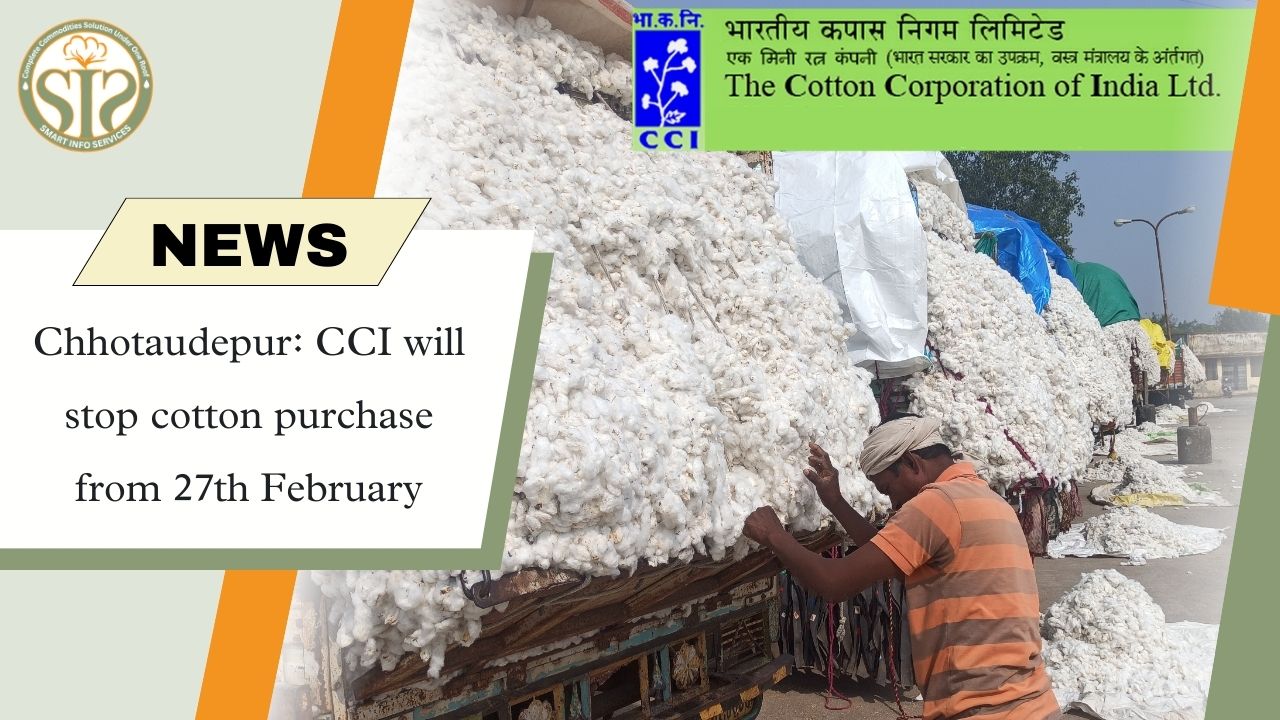
Cotton procurement date extended: Cotton procurement date extended till March 15; Important decision of CCI for farmersPune News: CCI has finally extended 15 days for the purchase of cotton under guarantee. Cotton procurement in the state will now be done with guaranteed price till March 15. Therefore, CCI has appealed to the cotton producers to book their slots and sell cotton at a guaranteed price.Cotton Corporation of India i.e. CCI had decided to stop purchasing cotton with guarantee from Friday (27th). But farmers were still demanding extension of time as there was still a large amount of cotton left. State Chief Minister Devendra Fadnavis had also written a letter to Union Textiles Minister Giriraj Singh demanding extension of time till April 30.But till the evening of 27 February, no decision was taken regarding cotton expansion. Therefore, various types of discussions continued in the market throughout the day. There was confusion among the farmers also. Farmers in many areas are saying that they still have up to 30 percent cotton left. There was a fear that these farmers would face problems due to this. But this evening a decision was taken to extend the deadline. So farmers will get relief.CCI President Lalit Kumar Gupta said Maharashtra Chief Minister Devendra Fadnavis had requested Union Textiles Minister Giriraj Singh to extend the deadline for cotton procurement. Farmers were also demanding extension. Accordingly, Textiles Minister Singh, keeping in mind the demand of the Chief Minister, has extended the deadline for cotton procurement in the interest of farmers.guarantee requiredCotton prices in the domestic market have declined since CCI started selling them. The price has come down from Rs 8,500 and at present the average price of cotton in the market is between Rs 7,300 to Rs 7,700. So the guaranteed price of cotton is Rs 8 thousand 110. The price has been reduced by Rs 800 from the guaranteed price. On one hand CCI is reducing the price by selling cotton at lower prices. Therefore the basis of guarantee is necessary. Farmers need the option to sell cotton at a minimum guaranteed price.25 lakh bales purchased in the stateSince the price of cotton was low from the beginning, this year also CCI's purchase got a good response from the farmers. CCI has so far purchased 102 lakh bales of cotton in the country. Out of this, 25 lakh 50 thousand bales of cotton were purchased in Maharashtra. CCI has informed that 31 lakh bales have been purchased in Telangana. There is a possibility that as time progresses, purchases in the state will increase.Maharashtra Chief Minister Devendra Fadnavis had requested Union Textiles Minister Giriraj Singh to extend the deadline for cotton procurement. Keeping in mind the demand of the Chief Minister and the interest of the farmers, the Union Minister has extended the deadline for cotton purchase till March 15.Lalit Kumar Gupta, Chairman, CCIread more:- Cotton target raised despite labour shortage
Punjab increases cotton target amid fear of pests, shortage of labourAs soon as the cotton sowing season starts in April, there is an atmosphere of uncertainty in the cotton sector of Punjab. Farmers and agricultural experts are concerned about the threat of pest-prone hybrid seeds, especially pink bollworm, and a severe shortage of farm workers. Despite these challenges, the state agriculture department has set a target of sowing cotton in 1.5 lakh hectares for the kharif season of 2025-26, which is about 30,000 hectares more than the previous season. It is noteworthy that in the year 2021, cotton was sown in 2.5 lakh hectare area in the state, after which there has been a continuous decline in the area.In the semi-arid southern districts of Punjab, cotton picking is mainly done by women. However, declining crop production and persistent losses have led to reduced work in the fields, causing a large number of agricultural workers to turn to other employment. Many workers now find working in non-agricultural activities or under rural employment schemes as a more secure and stable option.Baldev Singh, a farmer from Bajak village in Bathinda district, says that since 2021, crops are continuously failing due to pest attacks and adverse weather. In such a situation, the availability of agricultural workers called 'Siri' has decreased. Workers are preferring jobs that are less labor-intensive and have relatively stable income, increasing the difficulties for cotton growers.According to Gurjit Singh Romana, a farmer from Fazilka district, after five consecutive seasons of poor crops, farmers are not ready to take the risk again. He says BT-2 cotton seeds are sensitive to pink bollworm and till now farmers have not been assured that the new crop will be safe. Despite limited options in semi-arid areas, farmers are skeptical and reluctant to increase cotton acreage.State Agriculture Director Gurjit Singh Brar admitted that the labor shortage in the cotton belt has become acute in the last two-three years. He said that the department is taking steps like promoting mechanization and cleaning the fields before sowing. According to Brar, the root of the problem is the seeds being susceptible to pests. The new generation of pink bollworm-resistant seeds are still in the testing phase and their acceptance will take time. At present, the teams of the department are busy in motivating the farmers for cotton cultivation as per the advice of experts.read more:- CCI weekly sales: 8.65 lakh bales sold, prices fluctuate
CCI's Weekly Sales Update: 8.65 Lakh Bales Sold as Prices Fluctuate Between ₹700–1100 Drop and ₹100 Hike During the week from 23rd February 2026 to 27th February 2026, CCI conducted regular online auctions for mills and traders of various centers. These auctions resulted in total weekly sales of approximately 8.64 Lakh bales for 2025-26 and 800 bales for 2024-25 season, reflecting strong demand from both segments.Cotton prices fell by ₹700– ₹1100 per candy on the 23rd Feb, leading to a significant rise in CCI’s sales volume. However, on 26th Feb, CCI increased its cotton sale price by ₹100 per candy.Day-wise Sales PerformanceFebruary 23, 2026:CCI began the week with strong sales, disposing of 86,000 bales from 2025–26 season.Mills session accounted for 32,300 bales and Traders purchased 53,700 balesFebruary 24, 2026:The total volumes reaching 2,17,100 bales, comprising 2,16,900 bales from 2025–26 and 200 bales from the previous season.Mills bought 87,900 bales, all from current season and Traders purchased 1,29,200 bales, including 200 bales from the older season.February 25, 2026:The highest sales volume of the week was recorded on Wednesday, with 2,77,800 bales sold. This included 2,77,200 bales from the 2025–26 crop and 600 bales from 2024–25.Mills bought 1,02,800 bales, including 100 bales from the older season and Traders emerged as aggressive buyers with 1,75,000 bales, including 500 bales from 2024–25.February 26, 2026:CCI sold 1,84,200 bales, all belonging to the current season.Mills purchased 73,200 bales and Traders accounted for 1,11,000 bales.February 27, 2026:The week concluded with sales of 1,00,500 bales, all from the current season.Mills bought 45,500 bales and Traders purchased 55,000 bales.Cumulative sales :Following the latest auctions, CCI’s total sales reached:12,58,100 bales for the 2025–26 season, and 98,83,000 bales for the 2024–25 season.read more :- PM Mitra Park in MP: New center of industry and employment
MP's PM Mitra Park leading in investment and employment generationIndore: PM Mega Integrated Textile Region and Apparel (PM MITRA) Park located in Dhar district of Madhya Pradesh has emerged as the leader among the seven textile mega parks of India. The park has shown high pace in investment commitments and land allocation, while many other states are still in the early implementation stage. It will encourage integrated manufacturing and technological upgradation in line with the 5F vision of the Central Government – from farm to fiber to factory to fashion and overseas market.In the recently concluded second phase, 320 acres of land was allotted to 13 companies, which will generate investment of about Rs 7,500 crore and over 16,000 jobs. About 1,130 acres of land had been allotted in the first phase, and the process of lease execution and plot possession is being expedited ahead of the third phase.Rajkumar Ramasamy, managing director of the Tamil Nadu-based textile company, said they are setting up an integrated unit to supply fiber to their plants. He described the favorable industrial environment of Madhya Pradesh and the success of the pilot project in Ujjain as attractive opportunities. Bhilosa Industries, a major anchor investor, plans to invest about Rs 4,500 crore in 200 acres of land and create 3,500 jobs.Industry experts are appreciating MP's rapid development, quick approval process and integrated planning of social infrastructure such as housing, health, education and recreation around the park. Madhya Pradesh has also provided competitive power tariffs, increasing the cost efficiency and long-term feasibility of the project.Sanjay Aggarwal, Managing Director, NASA's Fiber to Fashion, said that they are developing an integrated weaving, dyeing and apparel project in 30 acres inside the park. With EU tariff benefits and state incentives for European markets, the project will be cost effective and in line with global standards.MPIDC Managing Director Chandramouli Shukla said so far 38 companies have submitted investment proposals worth more than Rs 21,500 crore, which is expected to create about 55,000 jobs. Seven PM Mitra Parks of India have been approved in the budget of Rs 4,445 crore under the Union Textiles Ministry, with the aim of promoting large-scale investment and employment generation.read more :- 106 lakh quintals of cotton purchased on MSP in Maharashtra: Minister
| title | Created At | Action |
|---|---|---|
| Land to 23 textile investors in PM Mitra Park | 03-03-2026 14:57:13 | view |
| Relief in customs duty payment to some importers in India | 03-03-2026 11:23:49 | view |
| Iran-Israel war: The price may prove costly for India | 02-03-2026 16:02:34 | view |
| Rupee fell 22 paise to close at 91.47 per dollar | 02-03-2026 15:41:14 | view |
| Cotton yarn prices fall 2% due to RoDTEP cut in India | 02-03-2026 13:43:41 | view |
| US cotton acreage at lowest level in decade in 2026: CoBank | 02-03-2026 12:11:48 | view |
| India-EU FTA: 5-year MFN agreement | 02-03-2026 11:56:58 | view |
| The rupee fell 28 paise to open at 91.25. | 02-03-2026 09:49:46 | view |
| State-wise Cotton Corporation of India Cotton Sales – 2025-26 | 28-02-2026 15:28:52 | view |
| MP leads in investment in textiles | 28-02-2026 13:05:28 | view |
| Cotton arrivals in Morbi break records | 28-02-2026 12:54:39 | view |
| Sankheda Sets Record: CCI Procures Cotton Worth ₹685 Crore | 28-02-2026 12:43:47 | view |
| Relief to farmers: Procurement till March 15 | 28-02-2026 12:32:50 | view |
| Cotton target raised despite labour shortage | 28-02-2026 12:21:41 | view |
| CCI weekly sales: 8.65 lakh bales sold, prices fluctuate | 27-02-2026 17:50:52 | view |
| PM Mitra Park in MP: New center of industry and employment | 27-02-2026 17:10:51 | view |