Filter

Recent News

Rain Washouts Whitefly Threat in South Malwa; Agri Experts Warn Cotton Growers of Bollworm Attack

Experts in agriculture warn cotton growers of the threat posed by boltworm attacks in South Malwa due to rain washouts.Agricultural experts from the Punjab Agricultural University (PAU) and the state agriculture department have announced that recent showers will mitigate the threat of whitefly infestation on the cotton crop. The initial spell of rain on the first day of August ended a month-long dry spell in the kharif season, providing much-needed relief to farmers.According to the PAU’s observatory at the Bathinda-based regional research centre, 63.2 mm of rainfall was recorded on Thursday. This weather shift also caused a significant drop in temperature, with the maximum falling to 27.2 degrees Celsius, a decline of 10 degrees since July 31. The meteorological department predicts more rain later this week, which is seen as beneficial for both rice and cotton cultivation in this semi-arid region.PAU principal entomologist Vijay Kumar reported that field inputs from farm scientists at Krishi Vigyan Kendras (KVKs) indicate that the immediate threat of whitefly has been alleviated as the rain has washed away the adult pest population. However, Kumar emphasized the importance of continued vigilance, as future whitefly growth will depend on the upcoming climatic conditions.“This kharif season, the Malwa belt experienced scant rainfall. The dry and humid conditions over the past month were conducive to whitefly population growth, posing a significant threat to the cotton crop,” said Kumar. “As cotton reaches the flowering stage next week, farmers must stay alert to handle potential pink bollworm attacks.”Fazilka Chief Agriculture Officer (CAO) Sandeep Rinwa noted that while whitefly populations were detected in several villages, they remained below alarming levels and were managed with insecticides. “In the last week of June, pink bollworm was reported in a few areas, but it was controlled. Post-rainfall, farmers will add nutrients to their fields, promoting rapid plant growth and healthy crops,” Rinwa explained. Another survey will ensure that cotton sticks, often used as firewood and potential carriers of pink bollworm larvae, are removed from fields.Vinay Pathania, assistant professor (plant protection) at Bathinda KVK, confirmed that no pest infestations had exceeded the economic threshold limit (ETL) in the district. Extension teams have advised cotton-growers to continue monitoring their fields for any signs of pests.Rain Inundates Low-Lying AreasHeavy rain since Thursday morning has led to waterlogging in the low-lying areas of Bathinda and surrounding districts. In Bathinda’s Prajapat Colony, a house roof collapsed, damaging household items. Fortunately, the family was not home at the time. The Power House Road locality in Bathinda was severely affected, with water levels reaching up to 3 feet on the streets. Commercial and residential areas of Mall Road, Vir Colony, and Paramram Nagar also experienced significant waterlogging.Read More :>Whitefly attack looms large in cotton belt in Malwa area

India's monsoon seen bringing above average rain in August, September

August and September had above-average rainfall due to India's monsoonIndia is set to receive monsoon rainfall that is above the average as a La Nina weather pattern forms in August and September, a top weather official said on Thursday, promising to boost farm output and growth in Asia's third-biggest economy.The lifeblood of a nearly $3.5-trillion economy, the annual monsoon brings almost 70% of the rain India needs to water farms and replenish reservoirs and aquifers.Without irrigation, nearly half the farmland in the world's second-biggest producer of rice, wheat and sugar depends on the rains that usually run from June to September.A La Nina weather pattern is likely to develop by the end of August or early September, bringing higher rainfall, said Mrutyunjay Mohapatra, director-general of the India Meteorological Department (IMD)."We are moving towards a La Nina weather condition and its impact is becoming visible," he told an online press conference. "La Nina will play a role in increased rainfall activity in September." In August, he added, India is likely to receive average rainfall, ranging between 94% and 106% of a figure weathermen describe as the long-period average.However, rainfall could be below average in August in a few areas in eastern, northeastern, central, and southern regions, he said.Areas growing cotton, soybean, pulses and sugarcane in the western state of Maharashtra and neighbouring Gujarat are likely to get less rainfall than average in August, he said.India received 9% more rainfall than average in July as the monsoon covered the entire country ahead of schedule.Torrential rain in the north killed at least 10 people, officials said on Thursday, after landslides following heavy rain killed at least 178 in the southern state of Kerala this week.Summer rains usually begin in the south around June 1 before spreading nationwide by July 8, allowing farmers to plant crops such as rice, cotton, soybeans and sugarcane.Farmers have expanded the area under most crops since July's abundant rainfall everywhere except in some eastern rice-growing states, a Mumbai-based dealer with a global trading house said."Eastern states desperately need good rains in the next few weeks, or their paddy output will decline," he said.The world's biggest exporter of rice, India put curbs on overseas shipments in 2023 to rein in domestic prices of the staple.Reda more :- Expanded Cotton Acreage in South May Compensate for Northern Decline

Whitefly attack looms large in cotton belt in Malwa area

In the cotton belt of the Malwa area, whitefly attacks are a major concern.After nine years, the fear of whitefly attacks on cotton crops is back to haunt farmers of the cotton belt in the Malwa area, as the presence of sulking pests has been reported in some parts of Mansa, Bathinda, and Fazilka districts.State Agriculture Department teams have visited various villages and held meetings with officials, asking the field officers to be vigilant. The teams have been directed to visit farmers in the fields to check the crop and recommend spray as per the situation.The department has also been making announcements in villages through gurdwara loudspeakers, urging farmers to spray their crops as recommended by experts as whitefly attacks were on the rise.Experts claimed hot and humid weather conditions were leading to pest infestations. They said against the state’s recommendations a large number of farmers grew moong crops during summer. They said it was another reason behind the pest infestation in the region.Farmers said the area under cotton had reduced drastically to an all-time low of about 97,000 hectares. They said the reason behind it was that farmers have shifted to paddy, pulses, and maize as successive governments have failed to contain pest attacks on cotton.Dejected by the whitefly attack on his cotton crop, Kulwinder Singh of Bhagi Bander village in the district reportedly destroyed his crop on two acres.In August–September 2015, nearly 60 per cent of the cotton crop sown on 4.21 hectares of land was damaged. Unable to bear the losses, some farmers ended their lives.Bathinda Chief Agriculture Officer (CAO) Jagseer Singh said, “Whitefly is quite rampant in the district, and it is due to the prolonged dry spell. Teams are visiting the fields and are recommending farmers spray the crop, which is quite effective in the early stages.”Read More :>Expanded Cotton Acreage in South May Compensate for Northern Decline

Expanded Cotton Acreage in South May Compensate for Northern Decline

Increased Cotton Acreage in South May Make Up for Decline in the NorthThe natural fibre’s acreage is up in Karnataka, Telangana, Andhra pradesh, and Maharashtra due to favorable rains.Cotton acreage has increased in southern India as farmers in Karnataka, Telangana, and Andhra Pradesh have planted more of the crop. Industry stakeholders believe this growth in the South will help offset the decline in northern states like Punjab, Haryana, and Rajasthan, where farmers have significantly reduced cotton planting due to pest issues, especially the pink bollworm. A similar reduction in cotton area is expected in Gujarat.As of July 22, cotton had been planted on 102.05 lakh hectares across the country, down from 105.66 lh during the same period last year. The normal area under cotton is 129 lh. The acreage decrease is mainly due to lower plantings in Gujarat, Rajasthan, Haryana, and Punjab.In Gujarat, the largest cotton-producing state, the acreage is down to 20.98 lh from 25.39 lh last year. Rajasthan's cotton area has decreased to 4.94 lh from 7.73 lh, while in Punjab, pest issues have halved the area to 1 lh from 2.14 lh. Haryana's cotton acreage is down to 4.76 lh from 6.65 lh.In the South, Karnataka's cotton area has risen to 6.09 lh as of July 22, up from 2.44 lh last year, thanks to a timely and widespread monsoon. Telangana's acreage has increased to 15.22 lh from 14.13 lh, and Andhra Pradesh's area has grown to 1.60 lh from 1.32 lh. Maharashtra, which has the largest cotton area, saw an increase to 39.69 lh from 38.33 lh last year."The decline in North Indian cotton area is being compensated in the South," said Ashish Dobhal, CEO of UPL Sustainable Agri Solutions Ltd. UPL, which previously focused on North India for its spraying services, is now shifting its strategies to the South in response to the reduced acreages in Punjab and Haryana."The sowing season has been good, with increased area in the South and positive crop prospects in Karnataka, Telangana, and Maharashtra," said Ramanuj Das Boob, a sourcing agent in Raichur. However, he noted that while rainfall has supported the crop, market prices remain bearish due to global trends and subdued demand.Bhagirath Chowdhary, Founder Director of the Jodhpur-based South Asia Biotechnology Centre, warned that the significant reduction in cotton area in the North is a wake-up call for the textile industry, particularly in Punjab and Rajasthan. "Except in Vidarbha, Telangana, and Karnataka, cotton crops in other regions like Andhra Pradesh, Marathwada, and Gujarat are under severe moisture stress and vulnerable to pests and diseases. Overall, cotton production next season is expected to decline, widening the demand-supply gap and negatively impacting the textile industry and raw cotton exports," Chowdhary said.Read More:>India gets 9% more monsoon rain in July after weak June

India gets 9% more monsoon rain in July after weak June

After a lackluster June monsoon, India receives 9% more rain in JulyIndia received 9% more rainfall than average in July as the monsoon covered the entire country ahead of schedule, delivering heavy rain in central and southern states, weather department data showed on Wednesday.The lifeblood of the nearly $3.5 trillion economy, the monsoon brings nearly 70% of the rain India needs to water farms and refill reservoirs and aquifers.Without irrigation, nearly half of the farmland in the world's second-biggest producer of rice, wheat and sugar depends on the annual rains that usually run from June to September.In July, southern and central regions of the country received nearly a third more rainfall than the average, while east and north-eastern regions received 23.3% less rainfall, according to the India Meteorological Department (IMD).The north-western part of the country got 14.3% less rainfall than average.The surplus rainfall in July helped erase June's rainfall deficit of 10.9%, and the country has received 1.8% more rainfall since the start of the monsoon season on June 1.Summer rains, critical for economic growth in Asia's third-largest economy, usually begin in the south around June 1 before spreading nationwide by July 8, allowing farmers to plant crops such as rice, cotton, soybeans and sugarcane.This year monsoon covered the entire country six days ahead of the usual time of arrival, helping farmers to accelerate planting of summer-sown crops.Read more :- Cottonseed Oil Market Outlook: Stability Amidst Shifting Sowing Patterns

State Government Announces Financial Aid for Soybean and Cotton Farmers

The State Government Offers Financial Assistance to Cotton and Soybean GrowersNagpur: In a significant move to support the agriculture sector, the state government has sanctioned substantial financial aid for cotton and soybean farmers affected by last year's price declines.To mitigate the impact of these losses, the government unveiled a relief package aimed at helping cotton and soybean cultivators during the kharif marketing season 2023-24. This package includes a grant of ₹5,000 per hectare, capped at two hectares per farmer.The government has structured the financial assistance into two categories: ₹1,000 per hectare for areas under 0.2 hectares and ₹5,000 per hectare for areas exceeding 0.2 hectares, up to a maximum of two hectares.As the Government Resolution (GR) was issued on July 29, the exact amount to be allocated to farmers in Vidarbha remains to be determined, according to officials. "However, the process has already started at district levels across both divisions in Vidarbha. We will need to begin by compiling a list of eligible farmers and completing other preliminary tasks," an official explained.The government has allocated a total expenditure of ₹4,194.68 crore for this financial assistance scheme. Of this, ₹1,548.34 crore is designated for cotton farmers, while ₹2,646.34 crore is earmarked for soybean growers. The funding will be released as part of the additional budget presented on July 5, supporting a special action plan designed to enhance the productivity and value chain of cotton, soybean, and other oilseed crops.Eligibility for this financial support is clearly defined: Cotton and soybean farmers who cultivated their crops during the 2023 kharif season are eligible to receive ₹1,000 per hectare for areas under 0.2 hectares and ₹5,000 per hectare for areas up to two hectares. This scheme is expected to bolster the agricultural sector, reflecting the government's commitment to addressing the needs of the farming community.Read More :> Cotton Prices Dip Below ₹60,000/Candy Amid Weak Yarn and Garment Demand

Related News

Youtube Videos

कपास बाज़ार साप्ताहिक रिपोर्ट 🔥 | तेजी या मंदी? | CCI Update | Cotton Market Today
कपास बाज़ार साप्ताहिक रिपोर्ट 🔥 | तेजी या मंदी? | CCI Updat...
कैसा रहा आज का कपास बाज़ार? 😱 | Cotton Market Rate Today | 26 June 2026
कैसा रहा आज का कपास बाज़ार? 😱 | Cotton Market Rate Today |...
जानिए आज का कपास बाज़ार 🔥 | तेलंगाना कपास बुआई | Cotton Market Rate Today
जानिए आज का कपास बाज़ार 🔥 | तेलंगाना कपास बुआई | Cotton Mar...
राजस्थान कपास बुआई + रुई बाजार भाव 🔥 | Cotton Market Rate Today | 24 June 2026
राजस्थान कपास बुआई + रुई बाजार भाव 🔥 | Cotton Market Rate T...
कपास बाज़ार में आज क्या हुआ? 😱 Cotton Market Rate 23 June 2026
कपास बाज़ार में आज क्या हुआ? 😱 Cotton Market Rate 23 June 2...
ऐसा रहा आज कपास बाज़ार😱🔥Cotton market rate today #youtube
रुई बाजार में तेजी! 🚨 CCI की रिकॉर्ड बिक्री | पूरे भारत की कपास बुवाई रिपोर्ट | Cotton Market Update
रुई बाजार में तेजी! 🚨 CCI की रिकॉर्ड बिक्री | पूरे भारत की...
CCI Update: आज कितनी रुई गठानें बिकीं? 😱 | Cotton market price today  #youtube
CCI Update: आज कितनी रुई गठानें बिकीं? 😱 | Cotton market pr...
आज का कपास बाजार भाव LIVE 🤔| CCI बिक्री अपडेट, राज्यवार मंडी भाव और Cotton Rate Today #kapas #rates
आज का कपास बाजार भाव LIVE 🤔| CCI बिक्री अपडेट, राज्यवार मंड...
ऐसा रहा आज का कपास बाज़ार || cotton market price update #youtube #cottonmarket #kapas
ऐसा रहा आज का कपास बाज़ार || cotton market price update #yout...
🚨 सम्पूर्ण भारत की बुआई रिपोर्ट 2026-27😱आज का कपास बाज़ार #youtube
🚨 सम्पूर्ण भारत की बुआई रिपोर्ट 2026-27😱आज का कपास बाज़ार #...
गुजरात में कपास बुवाई ने पकड़ी रफ्तार! 😱 Cotton market rate today #youtube
गुजरात में कपास बुवाई ने पकड़ी रफ्तार! 😱 Cotton market rate...
कपास बाज़ार में गिरावट का सिलसिला जारी 😱Weekly Cotton Market #youtube
कपास बाज़ार में गिरावट का सिलसिला जारी 😱Weekly Cotton Market...
जानिए आज का कपास बाज़ार 😨 Cotton market rate today #youtube
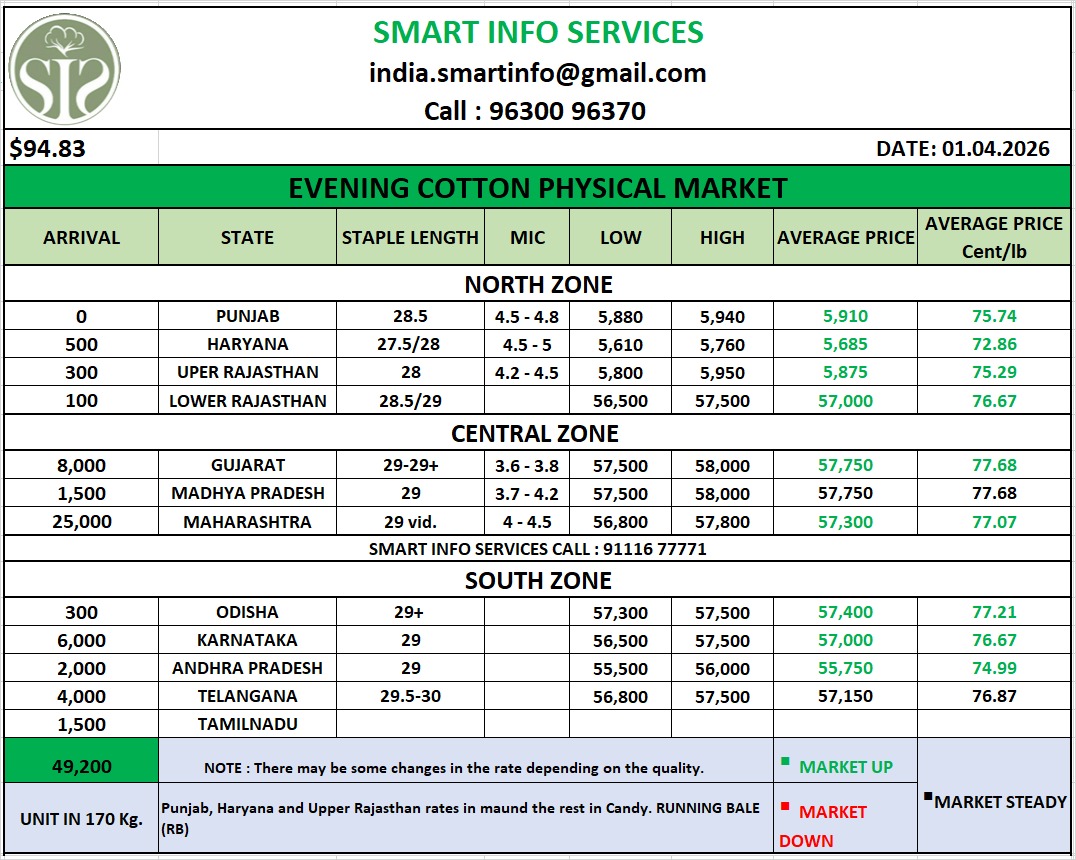
All India cotton market rate
Copyright© 2023 | Smart Info Service
Application Download