STAY UPDATED WITH COTTON UPDATES ON WHATSAPP AT AS LOW AS 6/- PER DAY
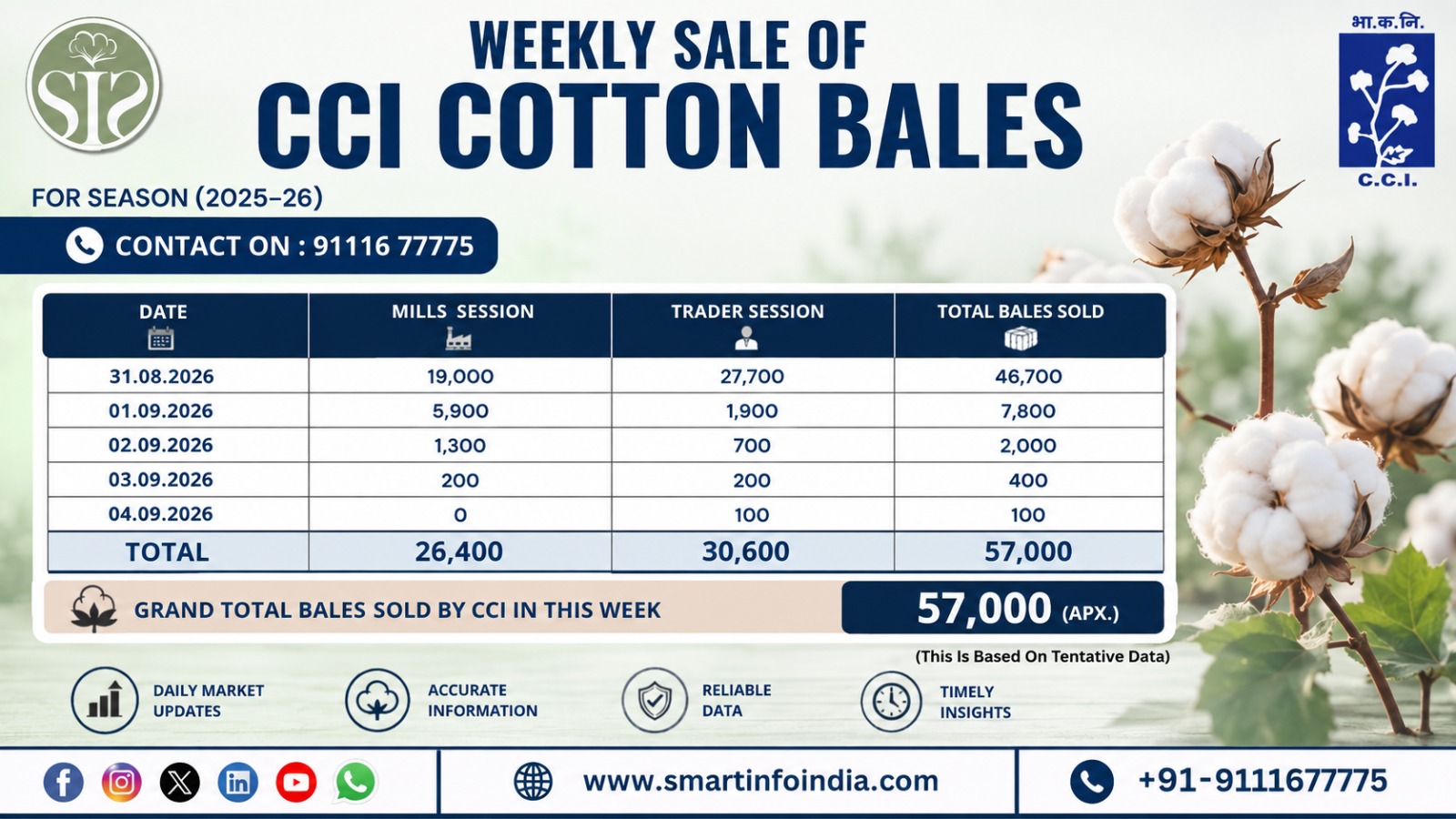
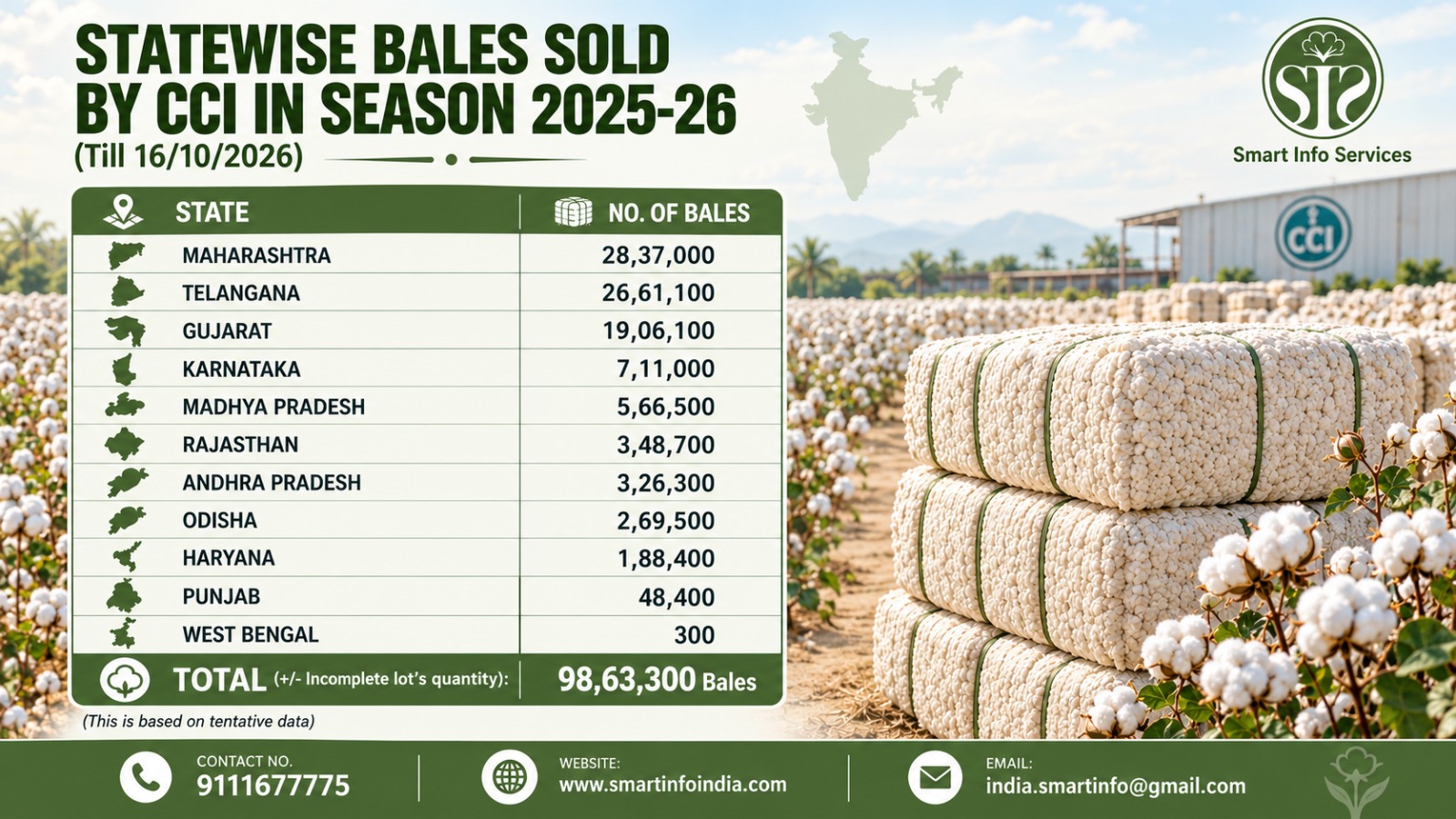
Start Your 7 Days Free Trial TodayCCI Raises Cotton Prices by ₹1,800- ₹2,000 per Candy; Weekly Auction Sales Cross 6.76 Lakh BalesThe Cotton Corporation of India (CCI) raised its cotton prices by ₹1,800- ₹2,000 per candy during the week from March 30 to April 03 2026, the auctions witnessed strong participation from mills and cotton traders, resulting weekly sales of about 6,76,200 bales from the 2025–26 season.Day-wise Auction PerformanceMarch 30, 2026 (Monday):The week began on a strong note with the highest single-day sales of 2,88,700 bales. Mills purchased 1,13,700 bales, while traders accounted for a larger share with 1,75,000 bales.April 01, 2026 (Wednesday):Sales saw a slight dip, with 2,44,300 bales sold during the day. Mills bought 1,13,000 bales, while traders purchased 1,31,300 bales.April 02, 2026 (Thursday):The week concluded with the sale of 1,43,200 bales. Mills purchased 74,000 bales, while traders dominated with 69,200 bales.Cumulative Sales UpdateCCI’s total sales have reached:2025–26 season: 45,34,200 bales2024–25 season: 98,85,100 bales
Telangana to become textile capital of South Asia, says Revanth ReddyHyderabad: Chief Minister A. Revanth Reddy on Friday reiterated the State’s ambition to transform Telangana into the Textile Capital of South Asia, with a strong emphasis on developing eco-friendly textile hubs.Speaking at the Asian Textile Conference (ATEXCON 2026) in Hyderabad, he outlined a long-term vision to position the State as a leading global textile destination by 2047. He assured investors of comprehensive support, including world-class infrastructure, land availability, reliable power, water supply, and attractive incentives.Highlighting the region’s rich textile heritage, the Chief Minister referred to renowned traditional weaves such as Pochampally Ikat, Gadwal sarees, Warangal durries, and Narayanpet sarees. He noted that textiles are not merely an industry but a vital source of livelihood for thousands of weaving communities across the State.Emphasizing Telangana’s strengths, he pointed out that it is among India’s largest cotton-producing regions, with globally recognized quality. He added that the State combines both skilled manpower and strong policy intent to emerge as a top textile hub.Reddy also highlighted key initiatives such as the Kakatiya Mega Textile Park, along with multiple apparel parks, as part of efforts to strengthen the textile ecosystem. He further noted Telangana’s leadership across diverse sectors, including technology, pharmaceuticals, aerospace, defence, manufacturing, and energy.read more :- Brazil cotton prices see sharpest rise since August 2022
Brazil cotton prices post sharpest rise since August 2022 in MarchBrazil’s cotton prices climbed sharply in March 2026, marking the strongest monthly increase since August 2022. The CEPEA/ESALQ Index surpassed BRL 3.91 per pound, driven by firm demand, sellers holding back from lower price offers, and supportive global market trends.The index rose 11.2% percent the month, closing at BRL 3.9173 per pound on March 31. Domestic prices were further boosted by rising international oil prices and higher freight costs, which added upward pressure, according to the Center for Advanced Studies on Applied Economics (CEPEA). On average, the index reached BRL 3.6463 per pound in March, up 3.58% from February. Despite the recent gains, inflation-adjusted prices were still 11.35% lower than in March 2025.Looking ahead, global cotton production for the 2026–27 season is projected at 25.11 million tonnes—slightly higher than earlier estimates but still below the 2025–26 level. Meanwhile, global consumption is expected to increase to 25.405 million tonnes, pointing to modest growth in demand.In Brazil, cotton output is forecast at 3.75 million tonnes for 2026–27. Production for the current 2025–26 season has been slightly revised downward to 3.795 million tonnes, according to CEPEA’s latest outlook.read more :- The rupee closed 15 paisa higher against the dollar at 93.10
On Thursday the Indian rupee opened at 93.25 against the dollar and closed 15 paisa higher at 93.10At close, the Sensex was up 185.23 points or 0.25 percent at 73,319.55, and the Nifty was up 33.70 points or 0.15 percent at 22,713.10. About 2548 shares advanced, 1505 shares declined, and 147 shares unchanged.read more :- Cotton Crosses 8,500—No Benefit to Farmers
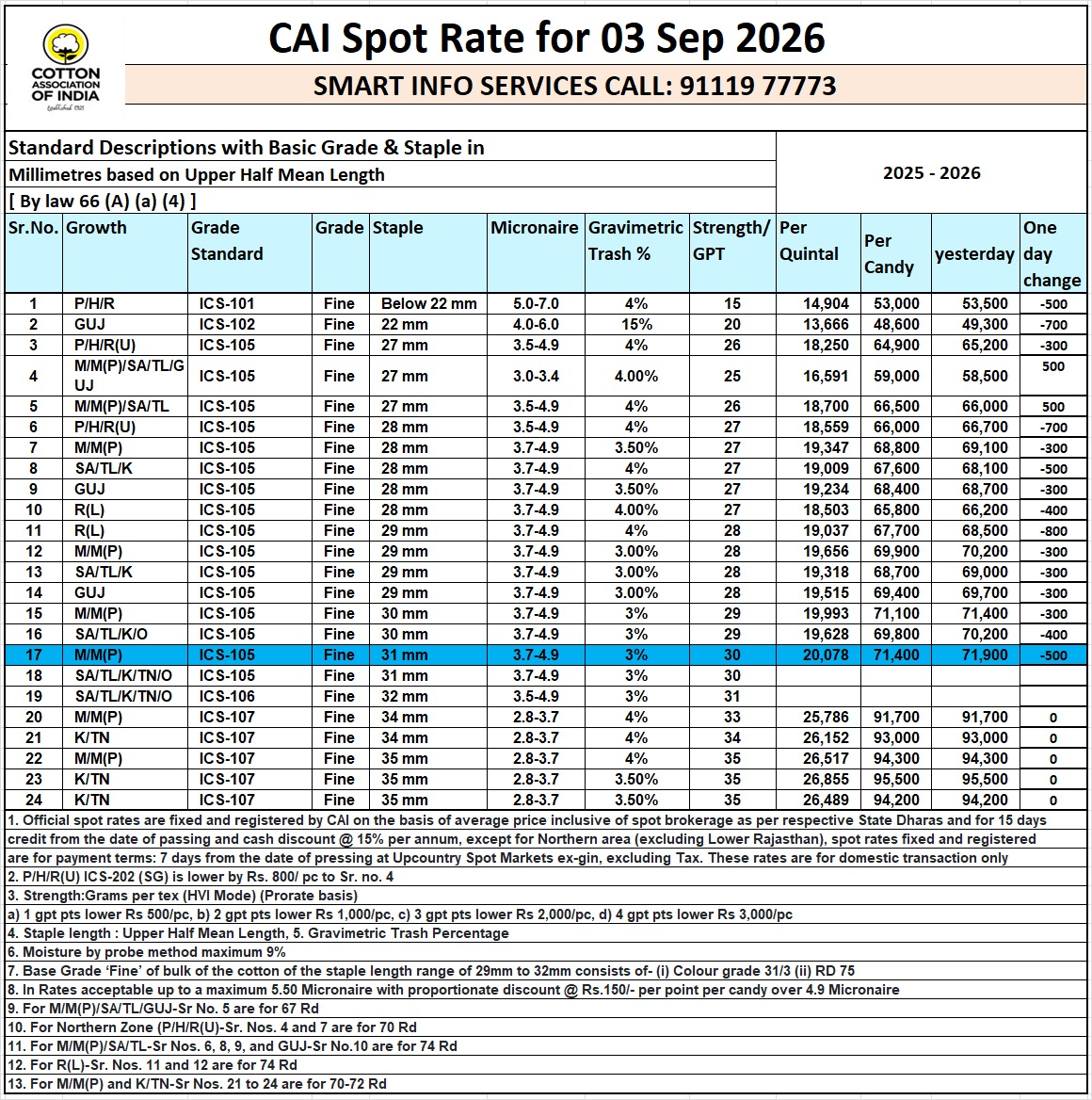
Cotton prices increased beyond 8,500 due to war, but farmers are not getting benefitsMaharashtra (Selu): Due to the US-Iran war, the demand for cotton has increased globally, due to which its prices have increased. The price of one Khandi (two bales) has increased from Rs 53 thousand to Rs 58 thousand. On Wednesday, private traders in the Agricultural Produce Market Committee premises gave prices ranging from Rs 8,400 to Rs 8,500 per quintal for cotton.However, farmers are not getting much benefit from this increased price, because at the district and taluka level, farmers have almost run out of cotton to sell. This year, due to heavy rains in the Kharif season, production reduced and due to low prices in the initial phase, farmers sold only limited quantities of cotton. The arrival of cotton in the market has stopped for the last one month, due to which the season is almost over.Earlier, the price of cotton by private traders was up to Rs 7,200 per quintal, while the Cotton Corporation of India (CCI) had also stopped its purchases. Due to shortage of cotton in the market, production in ginning mills has also come to a standstill for the last one month.According to Ritesh Toshniwal of Tirupati Cotton Industries and Oil Mill, Valur, "Due to the war, the supply of crude oil has been affected and the prices have increased. This has increased the demand for cotton as an alternative to synthetic thread. Now the price of cotton has reached eight and a half thousand rupees, but the farmers do not have the goods to sell. The little that is coming, the traders are immediately buying it."This year, under the policy of the Central Government, 40 lakh bales of cotton were imported into the country, whereas normally this figure is 10 lakh bales. Before the increase in imports, the price of cotton was Rs 55-56 thousand per khandi, which came down to Rs 52-53 thousand. Now due to the US-Iran war, there has been a surge in demand and prices have started rising again.Procurement was done by CCI at a support price of Rs 8,100 per quintal, but cotton with higher moisture content was taken at a lower price. Traders had given prices ranging from Rs 7,200 to Rs 7,700 depending on the quality. Now mainly traders are getting the benefit of increased prices, because farmers have no stock left.read more :- Yarn prices rise by ₹12/kg, Tiruppur exporters under pressure
Yarn Prices Jump by ₹12/kg, Tiruppur Exporters Under Pressure Amid Global UncertaintyCotton yarn prices used in Tiruppur’s knitwear industry rose by ₹10–₹12 per kilogram on Wednesday, marking the start of the new fiscal year with fresh cost pressures. The increase follows earlier hikes of ₹7/kg in late February and another ₹7/kg in mid-March, according to industry sources.The surge is linked to rising global cotton prices, driven by ongoing geopolitical tensions in the Middle East. As a result, domestic cotton rates in India have also climbed.Manufacturers estimate that the latest increase could push up the production cost of a single knitwear garment by as much as ₹6.Exporters are particularly concerned about the impact. KM Subramanian, President of the Tiruppur Exporters’ Association (TEA), noted that the sharp rise in cotton prices has added to existing challenges, including higher raw material costs, overseas tariffs, and shipping difficulties.He pointed out that exporters are unable to pass on the increased costs to international buyers, as prices for current orders have already been locked in through contracts—effectively squeezing margins further.On Wednesday, all major varieties of cotton yarn saw price increases. For instance, 20s combed yarn rose from ₹265 to ₹277 per kilogram.Despite the price surge, industry representatives maintain that there is no shortage of cotton in India, even as the current cotton season nears its end.read more :- Expensive BT cotton seeds, farmers' worries increase
Rising prices of BT cotton seeds and farmers' worriesThe rising prices of BT (Bacillus thuringiensis) cotton seeds is becoming a big problem for the cotton producing farmers. The price of Bollgard-2 variety seeds has been continuously increased by the Union Ministry of Agriculture and Farmers Welfare in the last few years, due to which the production cost of farmers has increased. At the same time, farmers are still waiting for an improved and more effective version of this technology, due to which their resentment is increasing.The most cultivated variety in the country is Bolgard-2, while the use of Bolgard-1 is relatively less. But due to increasing costs and decreasing profits, cotton cultivation is now becoming a loss-making deal. This year, farmers did not even get fair price for cotton, due to which the economic pressure increased further.Farmers faced many problems during farming—like shortage of labour, rising prices of fertilizers and black marketing of seeds. Despite all this, farmers sowed cotton, but the crop defied expectations.Farmers have been waiting for a long time for a new cotton variety resistant to pests like pink bollworm. However, even this year no such advanced and effective variety has been available in the market. On the contrary, the prices of Bt cotton seeds are continuously increasing, leading to increasing dissatisfaction in cotton growing areas.Farmers say that the government decides the price of seeds, but does not ensure that the same price is implemented in the market. Due to lack of control over black marketing of seeds and selling at higher prices, farmers are being financially exploited.Details of increase in seed prices:* 2023-24 season: Bt (Bolgard-2) seeds – ₹853 per bag* 2024-25 season: ₹864 per bag* 2025-26 season: ₹901 per bag* Bollgard-1 seeds in 2025-26: ₹635 per bagThere is no visible progress towards genetic improvement in cotton seeds. Farmers are now waiting for a variety that has effective resistance to pink bollworm. Cotton was once a major cash crop, but now the crop is becoming more profitable for seed, pesticide and herbicide companies rather than for farmers.read more :- The rupee opened 158 paise higher at 93.25.
The rupee opened 158 paise higher at 93.25/USD.The Indian rupee opened 158 paise higher at 93.25 per dollar on Thursday, whereas it had closed at 94.83 on Monday.READ MORE :- India's $174 billion textile industry hit by West Asia conflict
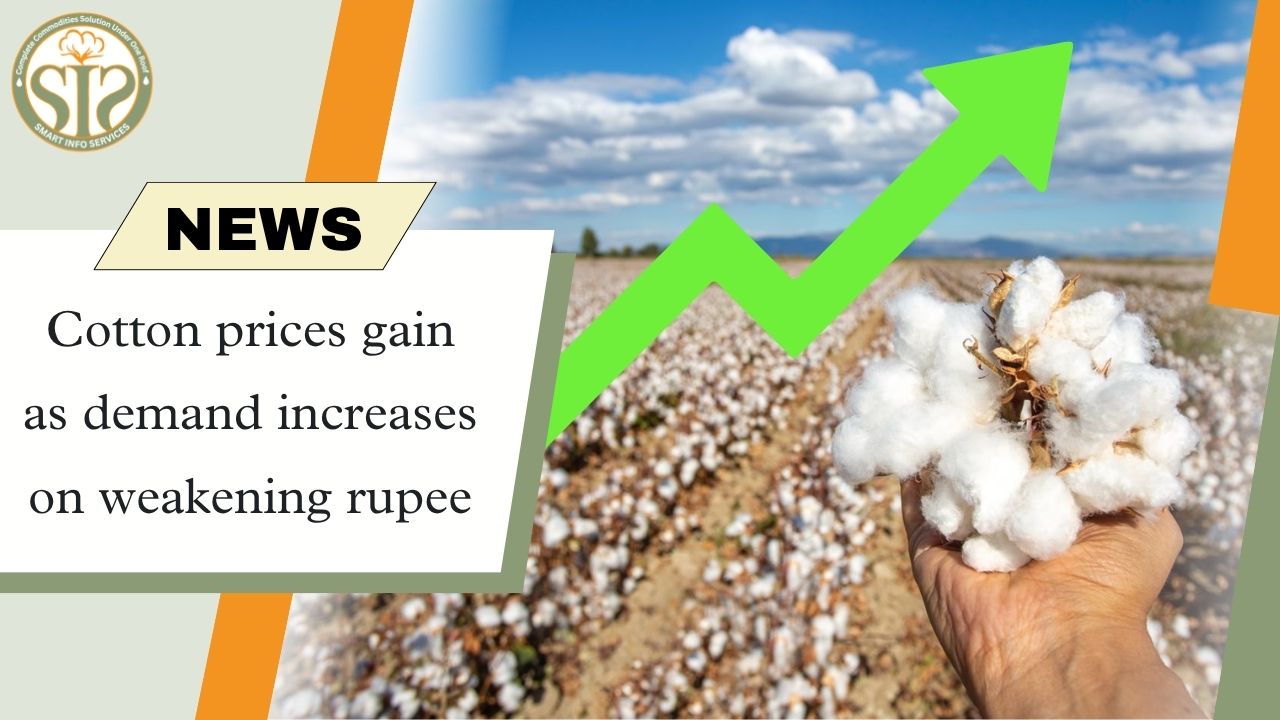
India’s $174 Billion Textile Industry Faces Crisis Amid West Asia ConflictIndia’s $174-billion textile industry, one of the world’s largest, is grappling with a crisis triggered by the ongoing West Asia conflict involving the US, Israel, and Iran. Rising crude oil prices, higher raw material costs, labor migration, and weakened demand are intensifying challenges reminiscent of the COVID-19 disruption.Exporters are still reeling from earlier US tariff uncertainties, which squeezed margins and created prolonged instability. For an industry projected to reach $350 billion by 2030 and employing over 45 million people, the impact is substantial.Clusters like Surat, known as India’s “Silk City,” have seen voluntary production cuts of around 40%, while Tiruppur, the “Knitwear Capital of India,” faces soaring operational costs—logistics up 400%, coal 80%, and chemicals 20%. Labor welfare is also a concern, as rising fuel costs threaten basic living conditions for hundreds of thousands of workers housed in hostels dependent on LPG.Compared with competitors such as China, Bangladesh, and Vietnam, India suffers from longer shipping times, creating higher inventory burdens for buyers. Experts urge measures like loan deferment, restructuring stressed accounts, enhanced working capital, and lower interest rates to sustain the sector.Industry leaders stress market diversification as a key strategy. Expanding into domestic markets, technical textiles, and free-trade agreement (FTA) countries can mitigate risks from geopolitical volatility. While short-term challenges loom, India’s textile sector remains poised for long-term growth, with a $100-billion export target by 2030. The immediate priority is preserving the industry ecosystem until global stability returns.read more :- Double crisis on Ludhiana textile industry
Ludhiana's textile industry in double crisis of rising costs and falling demandLudhiana: Ludhiana, known as the major textile production center of the country, is facing serious challenges these days. Rising raw material prices, disrupted supply chains, weak domestic and international demand, and rising logistics costs have put pressure on the industry.According to industry experts, the prices of synthetic fibers made from crude oil—such as polyester, nylon and spandex—have increased by a sharp 20% to 30% in recent weeks. Simranjit Singh, a textile manufacturer from Bahadarke Road, said it was becoming difficult to continue production due to rising costs. According to him, the price of polyester has increased from Rs 115 per kg to Rs 165–170, while the price of nylon fabric has increased from Rs 175 per meter to around Rs 210. Spandex prices have also increased by about 20%.The problem is not limited to synthetic fibres. Natural fibers like cotton have also become expensive. The price of cotton yarn has increased from Rs 260 per kg to around Rs 292 per kg. Industry organizations say that prices of almost all types of fiber have increased significantly.Packaging costs have also seen a sharp rise. Prices of polybags and other plastic-based packing materials, which are essential for logistics and exports, have increased by up to 40%. For example, the price of a polybag has increased from Rs 2 to Rs 3.15 to Rs 3.5.People associated with the industry consider fluctuating crude oil prices, disruption in the global supply chain and rising freight expenses as the main reasons behind this rising cost. Due to geopolitical tensions, international transportation has become expensive, further increasing production costs.Amidst all these challenges, the industry is also facing declining orders and labor shortage. Industry representatives say that if the situation does not improve soon and the supply chain is not stabilized, the situation may become more serious in the coming months.Experts believe that timely policy intervention, cost control measures and strengthening the supply chain are essential to overcome this crisis.read more :- “Double Western Disturbance: Heavy rain and hail from April 3-9”
Double attack of Western Disturbance: Danger of heavy rain and hailstorm across the country from 3 to 9 April.The weather has taken a turn across the country and widespread rains will be seen in the coming days. According to the latest update of Skymet Weather, due to Western Disturbances becoming active one after the other, the weather pattern will change from North India to Central and South India. Rain alert in North and Central IndiaThere is a possibility of good rain over North-West India as well as Central India on 3rd and 4th April. Due to its effect, intermittent rainfall will continue in many parts of Rajasthan, Madhya Pradesh, Punjab, Haryana, Delhi and Uttar Pradesh. 6 to 9 April: Heavy rain across the countryAccording to the Meteorological Department, there may be heavy rain in most of the states of the country between April 6 and 9. This period will be widespread and effective, due to which a drop in temperature will be seen. Farmers suffer loss due to hailstormThe effect of rain has reached the southern districts of Haryana including Bhatinda, Abohar, Fazilka, Muktsar and Mansa of Punjab and western Uttar Pradesh (Bulandshahr, Hathras, Mathura, Aligarh, Meerut). Farmers have suffered huge losses due to hailstorm at many places.Hisar, Bhiwani, Mahendragarh and Hanumangarh of Haryana have also recorded rain along with hailstorm, due to which crops have been damaged. Delhi-NCR next targetNow the weather system is moving towards Delhi-NCR. In the coming time, Delhi, Noida, Gurugram and Faridabad may also experience heavy rain and possibly hailstorm. There will be entry in South India alsoThere is a possibility of rain activities starting in South India from 4th or 5th April, due to which the weather there will also change.read more :- Cotton prices in Ralegaon rose even after CCI procurement ceased.
Increase in cotton prices: Cotton prices increased even after CCI purchase stopped in RalegaonRelief to farmers: Farmers and traders were worried that cotton prices would fall after the Cotton Corporation of India (CCI) stopped procurement. However, the reality is the opposite and cotton prices are currently increasing. In Ralegaon Agricultural Produce Market Committee, the price of good quality cotton is currently around Rs 8,200 per quintal, which had reached Rs 8,240 a few days ago.Earlier, good quality cotton was being purchased from CCI at the rate of around Rs 8,010 per quintal. However, in the last phase of procurement, many farmers did not get slots and their cotton was not purchased by CBI. Therefore, the expectation was that prices would fall after the purchases were closed.However, at present, due to increase in demand in the market, cotton prices have gone above the guaranteed price.Experts believe that the increase in prices is due to international development. Due to the situation of tension in the Gulf region, demand in yarn and textile industry is likely to increase, which is impacting cotton prices. Apart from this, the increase in the prices of bales (cotton bales) and silk is also supporting the cotton market.At present, 200 to 250 carts are coming to Ralegaon Market Committee every day to sell cotton, and it is estimated that 7 to 8 thousand quintals of cotton is being traded. Of this, about 70 percent is from the previous season (old) and the remaining 30 percent is new arrivals. It is expected that this situation will continue for the entire month of April.In the current season, a total of 8 lakh 76 thousand quintals of cotton has been sold through Ralegaon Market Committee.Out of this, 3 lakh 12 thousand quintals of cotton was purchased by CCI, while the remaining 5 lakh 64 thousand quintals of cotton was purchased from private traders. Right now, the news is that about 30 percent of the farmers still have good quality cotton left. relief for farmersEven after CCI procurement has stopped, market demand, international conditions and rise in by-products are supporting cotton prices, which is a matter of relief for farmers.read more :- Cotton prices above MSP due to strong demand
Cotton prices rise above MSP levels on strong demand Cotton prices have been firming up globally and futures on the ICE market have gained by around 15 per cent since the first week of MarchCotton Corporation of India (CCI) has hiked the floor price for the 2025-26 crop by ₹1,300 per candy on Monday, inline with the global prices and strong domestic demand.Including Monday’s revision, the total price increase carried out by CCI is ₹3,200 per candy of 356 kg since early March for the 2025-26 crop.Cotton prices have been firming up globally and futures on the ICE market have gained by around 15 per cent since the first week of March. Cotton futures for May delivery crossed 70.12 cents per pound, while the July’ delivery hovered around 73.28 cents.More rise likelyPrices of raw cotton have firmed up, though most of the 2025-26 crop has already arrived into the market. Raw cotton (kapas) prices traded above the minimum support price (MSP) of ₹8,110 per quintal in the range of ₹8,400-8,700l in some markets such as Raichur and Adoni, and also in parts of Maharashtra and Gujarat.In Raichur, the raw cotton prices ranged around ₹8,500-8,600, while in Adoni it was ₹8,500-8,700. “Kapas prices have finally moved above the MSP levels after ruling below the support price for most part of the marketing season. After today’s price increase, the kapas prices may go up further to ₹8,800 levels encouraging farmers to plant more in the upcoming kharif season,” said Ramanuj Das Boob, a sourcing agent in Raichur.Despite the price increase, CCI cotton has been attracting buying interest from traders and millers. On Monday CCI sold close to 3 lakh bales. For some good quality cotton, buyers have even paid premium, sources said.read more :- Cotton sowing intensifies due to favorable weather, heat wave alert in Rajasthan
Favorable Weather Boosts Cotton Sowing Across India; Heatwave Alert in RajasthanAccording to the latest 24-hour forecast issued by the India Meteorological Department (IMD), weather conditions across India’s major cotton-growing belts are expected to remain largely favorable for sowing and field preparation, with dry weather dominating central and northwestern regions.Central India (Madhya Pradesh, Vidarbha, Chhattisgarh): Predominantly dry weather with rising temperatures will support land preparation and early sowing activities. Soil conditions remain workable and favorable.Northwest India (Rajasthan, Punjab, Haryana): Dry conditions will continue across the region. However, heatwave conditions in parts of Rajasthan may accelerate soil moisture loss, making irrigation management important.South India (Telangana, Andhra Pradesh, Karnataka, Tamil Nadu): Isolated light rainfall and thunderstorms are expected. While not widespread, these may cause short-term, localized disruptions to fieldwork.East & Northeast India (Assam, Meghalaya, West Bengal, Odisha): Light to moderate rainfall is likely, with occasional heavier spells in the Northeast. These areas are less significant for cotton but indicate active moisture conditions.Overall: Weather remains largely favorable for cotton sowing across key regions, with dry conditions aiding progress. Localized rain in the south and heat stress in Rajasthan are the main factors to watch.read more :- Cotton acreage is likely to increase in 2026 due to inflation and El Niño.
Rising Prices and El Niño Forecast Likely to Lift India’s Cotton Acreage in 2026India’s cotton acreage is expected to expand significantly in the 2026 kharif season, driven by a recovery in domestic prices, improving global demand, and the likelihood of an El Niño-induced weak monsoon. Industry stakeholders estimate that the area under cotton cultivation could rise by 10–20%, reversing last year’s decline when farmers shifted to alternative crops like pulses and maize.Sowing preparations have already begun in the northern states of Punjab, Haryana, and Rajasthan, with planting expected to commence shortly. According to industry experts, better price realization—well above the Minimum Support Price (MSP) of ₹8,100 per quintal—has encouraged farmers. If the MSP increases further to around ₹8,600, cotton could become even more attractive. Additionally, cotton’s relatively low water requirement makes it a preferred choice during years of deficient rainfall, a likely scenario under El Niño conditions.Farmers in Maharashtra have also reported improved yields after adopting HTBT seeds, with production projected to rise sharply. This combination of higher yields and better prices is expected to further boost farmer confidence.Despite the positive outlook, overall cotton output in 2025–26 declined slightly, reflecting reduced acreage. However, 2026 may mark a turning point. Rising crude oil prices are increasing the cost of synthetic fibres, potentially restoring cotton’s competitiveness in the textile sector. This shift could benefit millions of cotton farmers and revive the broader cotton value chain.Globally, the trend contrasts with India’s outlook. Major producers such as the US and Australia are expected to reduce cotton acreage due to rising cultivation costs and lower profitability. Estimates suggest a modest decline in US acreage and reduced output in Australia due to water constraints.While favourable prices and weather dynamics support expansion, experts stress that policy reforms and technological advancements will be crucial to sustaining long-term growth in India’s cotton sector.read more :- The Rupee fell by 1.36 paise to close at 94.83 per dollar.
On Monday, the Indian Rupee fell by 1.36 paise to close at 94.83 per dollar, while it had opened at 93.47 in the morning.At market close, the Sensex dropped 1,635.67 points, or 2.22 percent, to settle at 71,947.55, and the Nifty fell 488.20 points, or 2.14 percent, to close at 22,331.40. Gains were recorded in approximately 837 stocks, 3,419 stocks declined, and 138 stocks remained unchanged.READ MORE :- Shrimp and Textile Exports Hit by Sluggish US Demand and Policy Uncertainty
| title | Created At | Action |
|---|---|---|
| CCI hikes cotton prices by ₹2,000, weekly sales cross 6.76 lakh bales | 03-04-2026 17:51:40 | view |
| Telangana will become textile capital of South Asia: Revanth Reddy | 03-04-2026 17:13:51 | view |
| Brazil cotton prices see sharpest rise since August 2022 | 03-04-2026 14:50:36 | view |
| The rupee closed 15 paisa higher against the dollar at 93.10 | 02-04-2026 15:45:12 | view |
| Cotton Crosses 8,500—No Benefit to Farmers | 02-04-2026 13:23:16 | view |
| Yarn prices rise by ₹12/kg, Tiruppur exporters under pressure | 02-04-2026 12:40:26 | view |
| Expensive BT cotton seeds, farmers' worries increase | 02-04-2026 12:19:44 | view |
| The rupee opened 158 paise higher at 93.25. | 02-04-2026 09:24:16 | view |
| India's $174 billion textile industry hit by West Asia conflict | 01-04-2026 15:01:58 | view |
| Double crisis on Ludhiana textile industry | 01-04-2026 11:48:54 | view |
| “Double Western Disturbance: Heavy rain and hail from April 3-9” | 01-04-2026 11:32:37 | view |
| Cotton prices in Ralegaon rose even after CCI procurement ceased. | 31-03-2026 15:13:50 | view |
| Cotton prices above MSP due to strong demand | 31-03-2026 11:37:06 | view |
| Cotton sowing intensifies due to favorable weather, heat wave alert in Rajasthan | 31-03-2026 11:21:20 | view |
| Cotton acreage is likely to increase in 2026 due to inflation and El Niño. | 31-03-2026 10:59:12 | view |
| The Rupee fell by 1.36 paise to close at 94.83 per dollar. | 30-03-2026 15:55:32 | view |