
पाकिस्तान के कपास बाजार में छाई सुस्तीस्थानीय कपास बाजार में बुधवार को मंदी का रुख रहा और कारोबार की मात्रा कम रही। कॉटन एनालिस्ट नसीम उस्मान ने बताया कि सिंध में कपास की कीमत 17,500 रुपये से 19,500 रुपये प्रति मन है। पंजाब में कपास की दर 18,000 रुपये से 19,500 रुपये प्रति मन है। सिंध में फूटी की दर 7,000 रुपये से 8,300 रुपये प्रति 40 किलोग्राम के बीच है। पंजाब में फूटी का रेट 7,000 रुपये से 9,200 रुपये प्रति 40 किलो है। स्पॉट रेट 19,800 रुपये प्रति मन पर अपरिवर्तित रहा। पॉलिएस्टर फाइबर 355 रुपये प्रति किलो पर उपलब्ध था।
बंजर खेत, घटती पैदावार: बीटी कपास ने मध्य प्रदेश के किसानों को दिया धोखामहाराष्ट्र, गुजरात और मध्य प्रदेश में 2010 और 2017 के बीच पिंक बॉलवर्म का प्रकोप 5.17 प्रतिशत से बढ़कर 73.82 प्रतिशत हो गया था। बीटी कपास को अपनाना 2007 में 81 प्रतिशत और 2011 में 93 प्रतिशत तक बढ़ गया क्योंकि किसानों ने सोचा कि कीट-प्रतिरोधी किस्में उनकी सबसे अच्छी शर्त थीं। अन्य फसलों के विपरीत, जीएम किस्म की खेती के लिए हर बार बाजार से नए बीज खरीदने पड़ते हैं। ... बीटी कपास के बारे में किए गए सभी दावे गलत साबित हुए हैं। जहां तक उपज में वृद्धि का सवाल है, अगर आप सिंचाई के आंकड़ों की जांच करें तो यह स्पष्ट हो जाएगा कि केवल उत्पादन नहीं बढ़ा है।"ऐसे समय में जब बहुचर्चित बीटी कपास की फसल किसानों को परेशान कर रही है, केंद्र सरकार धीरे-धीरे आनुवंशिक रूप से संशोधित सरसों के रोलआउट के लिए मंच तैयार कर रही है। पिछले अक्टूबर में पर्यावरण, वन और जलवायु परिवर्तन मंत्रालय ने दिल्ली विश्वविद्यालय के पूर्व कुलपति दीपक पेंटल द्वारा विकसित धारा मस्टर्ड हाइब्रिड-11 के फील्ड ट्रायल को मंजूरी दी थी। जबकि सरकार का तर्क है कि आनुवंशिक रूप से संशोधित किस्म से सरसों का उत्पादन बढ़ेगा और खाद्य तेल के आयात पर देश की निर्भरता कम होगी, आनुवंशिक रूप से संशोधित विरोधी कार्यकर्ता सावधान हैं। उनके सामने देश में पहली आनुवंशिक रूप से संशोधित फसल बीटी कपास का खराब प्रदर्शन है। उन्होंने देखा है कि कैसे बेहतर उपज की गारंटी और कीटनाशकों और रासायनिक उर्वरकों की कम आवश्यकता के दावे हवा के साथ उड़ गए हैं। जाहिर तौर पर, बीटी कपास के किसानों को जो कुछ चीजें मिलीं, वे थीं बंजर खेत और बढ़ी हुई लागत। मध्य प्रदेश, जहां देश में उत्पादित कुल 352 लाख गांठों (1,18.81 लाख हेक्टेयर में) में से 18.69 लाख कपास गांठें (5.47 लाख हेक्टेयर में) हैं। खरगोन, बड़वानी, खंडवा और बुरहानपुर यहाँ के प्रमुख कपास उत्पादक जिले हैं।किसान कल्याण और कृषि विकास विभाग के आंकड़ों के मुताबिक खरगोन में कुल 2,11,450 हेक्टेयर में कपास की फसल होती है। मोगरगांव निवासी छगन चौहान (50) खरगोन की कपास मंडी में 2.6 क्विंटल कपास बेचने आया है। यह साल उनके लिए बेहतर साबित हुआ है। "आज, मुझे 8,500 रुपये प्रति क्विंटल मिला। यह कीमत मेरे लिए अच्छी है," वह मुस्कराते हुए कहते हैं।पिछले साल लगातार बारिश और कीटों के हमलों ने उनकी आधी फसल को नष्ट कर दिया था। "आदर्श रूप से, बीटी कपास के बीज के 10 पैकेट जो मैंने खेत में छिड़के थे, मुझे लगभग 40 क्विंटल कपास मिलनी चाहिए थी। लेकिन मुझे केवल 16 किलो फसल मिली। शुक्र है कि इस बार कीटों ने मुझे बख्श दिया।टेमला के रहने वाले श्याम (24) पिछले दो सालों से अपने पिता अनिल धनगर (55) की सात एकड़ में बीटी कपास की खेती में मदद कर रहे हैं। उनके सामने आने वाली चुनौतियों के बारे में पूछने पर अनिल कहते हैं, "उपज और कृमि संक्रमण के लिए अच्छी कीमत मिलना हमारी सबसे बड़ी चिंता है।" वह कहते हैं "देखो, गुलाबी रंग के कीट (पेक्टिनोफोरा गॉसिपिएला) ने बीज की गिरी को नुकसान पहुँचाते हुए यहाँ घर बना लिया है। अब, यह कपास का फल फल देने के लिए फूल नहीं बनेगा। केवल एक चीज बची है कि इसे हटा दिया जाए जितनी जल्दी हो सके क्षेत्र में, " वह कहते हैं, पिछले वर्ष की तुलना में इस वर्ष देर से कीट के हमले शुरू हुए, जब लगभग 40 प्रतिशत फसल प्रभावित हुई थी। कपास में चार प्रकार के कैटरपिलर - पिंक बॉलवर्म, स्पॉटेड बॉलवर्म, अमेरिकन बॉलवर्म और टोबैको कटवर्म पाए जाते हैं। उनमें से पिंक और अमेरिकन बॉलवर्म के हमले भारत में आम हैं। सेंट्रल इंस्टीट्यूट ऑफ कॉटन रिसर्च द्वारा किए गए 2018 के एक सर्वेक्षण में पाया गया कि महाराष्ट्र, गुजरात और मध्य प्रदेश में 2010 और 2017 के बीच पिंक बॉलवर्म का प्रकोप 5.17 प्रतिशत से बढ़कर 73.82 प्रतिशत हो गया था। विडंबना यह है कि सरकार ने कीटों के हमलों को रोकने के लिए 2002 में पहली पीढ़ी के बीटी कपास (बीटी-1 कपास) की व्यावसायिक खेती की अनुमति दी थी, जबकि इसकी दूसरी पीढ़ी (बीटी-द्वितीय) को 2006 में दो बीटी (बैसिलस थुरिंगिएन्सिस) के संयोजन से लॉन्च किया गया था। ) प्रोटीन (Cry1Ac+Cry2Ab) विशेष रूप से गुलाबी बॉलवॉर्म को लक्षित करने के वादे के साथ। बीटी कपास को अपनाना 2007 में 81 प्रतिशत और 2011 में 93 प्रतिशत तक बढ़ गया क्योंकि किसानों ने सोचा कि कीट-प्रतिरोधी किस्में उनकी सबसे अच्छी शर्त थीं।

पाकिस्तान के कपास बाजार पर एक नजरस्थानीय कपास बाजार में मंगलवार को मंदी का रुख रहा और कारोबार की मात्रा कम रही। कॉटन एनालिस्ट नसीम उस्मान ने बताया कि सिंध में कपास की कीमत 17,500 रुपये से 21,000 रुपये प्रति मन है। पंजाब में कपास की दर 18,000 रुपये से 20,000 रुपये प्रति मन है।सिंध में फूटी की दर 7,000 रुपये से 8,300 रुपये प्रति 40 किलोग्राम के बीच है। पंजाब में फूटी का रेट 7,000 रुपये से 9,200 रुपये प्रति 40 किलो है। स्पॉट रेट 19,800 रुपये प्रति मन पर अपरिवर्तित रहा। पॉलिएस्टर फाइबर 355 रुपये प्रति किलो पर उपलब्ध था।प्रधान मंत्री शहबाज शरीफ ने इस वर्ष के लिए कपास की कीमत 8500 रुपये प्रति 40 किलोग्राम निर्धारित करने के लिए सैद्धांतिक मंजूरी दे दी है। प्रधानमंत्री मुहम्मद शहबाज शरीफ की अध्यक्षता में सोमवार को लाहौर में आयोजित कृषि कार्य बल की समीक्षा बैठक के दौरान यह मंजूरी दी गई। बैठक के दौरान बताया गया कि पिछले साल बाढ़, बारिश, नहर में पानी की कमी और उर्वरक संकट के कारण कपास के उत्पादन में भारी कमी आई थी। इस वर्ष कपास का कुल उत्पादन 12.77 मिलियन गांठ होने का अनुमान है, जबकि न केवल कपास की खेती के तहत क्षेत्र बल्कि प्रति एकड़ उपज में भी काफी वृद्धि होने की उम्मीद है। प्रधानमंत्री ने कहा कि प्रांतीय सरकारों को किसानों को कपास के निर्धारित मूल्य का प्रावधान सुनिश्चित करना चाहिए। उन्होंने केंद्र सरकार को भी निर्देश दिया कि वह निर्धारित समर्थन मूल्य को लागू करने के लिए प्रांतीय सरकारों को हर संभव सहायता प्रदान करे।

पंजाब में कपास का बुरा हाल, पिछले साल की तुलना में 25 प्रतिशत कम रही फसल की बिक्री ICAL के अनुसार, उत्तर भारत के तीन राज्यों में सामूहिक रूप से कपास का उत्पादन पिछले वर्ष के 48.37 लाख गांठों की तुलना में 42.09 लाख गांठ होने का अनुमान लगाया गया है।किसानों को विविधीकरण की ओर ले जाने की पंजाब सरकार की कोशिशों को एक बड़ा झटका लगा है, इस साल राज्य में कपास का उत्पादन वर्षों में सबसे निचले स्तर पर पहुंचने का अनुमान है। पंजाब राज्य कृषि विपणन बोर्ड के आंकड़ों के अनुसार, 9 मार्च तक राज्य में केवल 7 लाख क्विंटल की आवक के मुकाबले, पिछले वर्ष की आवक 28.89 लाख क्विंटल थी। PSAMB द्वारा दर्ज की गई कपास की फसल की बिक्री के अनुसार, यह पिछले वर्ष की तुलना में 9 मार्च तक एक चौथाई से भी कम है।कीट के हमले का असर PSAMB के अलावा, कपास व्यापार निकाय इंडियन कॉटन एसोसिएशन लिमिटेड (ICAL) द्वारा राज्य की मंडियों में फसल की आवक के बारे में संशोधित अनुमान भी अत्यधिक निराशाजनक हैं। संशोधित अनुमानों ने पिछले साल 7.20 लाख गांठों की आवक की तुलना में लगभग 2.50 लाख गांठें (1 गांठ = 170 किग्रा) फसल की आवक रखी है। पिछले दो वर्षों में लगातार कीट के हमले को फसल के बहुत कम उत्पादन के पीछे बताया गया है। मौजूदा मौसम में, कीट के हमले के अलावा, शुरुआत में बुवाई के मौसम में नहर के पानी की अनुपलब्धता और फिर लगातार बारिश को फसल के खराब प्रदर्शन के कारण कहा जाता है। ऐसा कहा जा रहा है कि उत्पादन के रुझान को देखते हुए, किसानों का फसल पर से विश्वास उठ गया है और इस प्रकार, आगामी बुवाई के मौसम में फसल के क्षेत्रफल में ज्यादा बदलाव की उम्मीद नहीं है। उत्तर भारत में कपास का उत्पादन कमहालांकि, फसल अभी भी 27.5-28.5 एमएम लंबे स्टेपल के लिए 6,280 रुपये प्रति क्विंटल के एमएसपी के मुकाबले 8,000 रुपये प्रति क्विंटल प्राप्त कर रही है। पंजाब की तरह, पड़ोसी राज्य हरियाणा में भी उत्पादन कम है और आईसीएएल के संशोधित अनुमानों के अनुसार पिछले साल मंडियों में 15 लाख गांठों की आवक से 12 लाख गांठ होने का अनुमान लगाया गया है। हालांकि, राजस्थान में कपास का उत्पादन पिछले वर्ष के 26.12 लाख गांठ से बढ़कर 27.60 लाख गांठ होने की उम्मीद है। ICAL के अनुसार, उत्तर भारत के तीन राज्यों में सामूहिक रूप से कपास का उत्पादन पिछले वर्ष के 48.37 लाख गांठों की तुलना में 42.09 लाख गांठ होने का अनुमान लगाया गया है।आवक काफी कमपंजाब के कपास समन्वयक रजनीश गोयल ने कहा, 'पिछले साल की तुलना में कपास की आवक काफी कम है। रुझानों के अनुसार, मंडियों में कुल आवक पिछले वर्षों की तुलना में काफी कम रही है। ICAL द्वारा 28 फरवरी तक दर्ज की गई आवक के अनुसार, पंजाब में 1.69 लाख गांठ की आवक हुई है, जबकि हरियाणा में 6.86 लाख गांठ और राजस्थान में 22.53 लाख गांठ की आवक दर्ज की गई है। तीनों राज्यों में 28 फरवरी तक कुल 31.08 लाख गांठ की आवक हो चुकी है।

चीन का जनवरी-फरवरी सोयाबीन का आयात साल दर साल 16% बढ़ादुनिया के शीर्ष तिलहन खरीदार चीन ने जनवरी और फरवरी में 16.17 मिलियन टन सोयाबीन का आयात किया, सीमा शुल्क डेटा ने मंगलवार को दिखाया, एक साल पहले इसी अवधि में 16.1% की वृद्धि हुई, क्योंकि खरीदारों ने तंग आपूर्ति के बीच स्टॉक किया।2022 के अधिकांश समय में कम आयात के बाद आवक में उछाल आया, हालांकि दिसंबर में आयात पहले ही बढ़ चुका था।जनवरी के अंत में शुरू होने वाले सप्ताह भर के चंद्र नव वर्ष की छुट्टी के समय के कारण चीन के सीमा शुल्क का सामान्य प्रशासन वर्ष के पहले दो महीनों के लिए डेटा जोड़ता है।मांस की चीनी मांग के रूप में बड़ी आवक आती है और इसलिए बीजिंग द्वारा 2022 के अंत में सख्त शून्य-कोविड उपायों को छोड़ने के बाद इस वर्ष पशु आहार घटक, सोयामील में वृद्धि होने की उम्मीद है।हालांकि, दुनिया के शीर्ष उत्पादक ब्राजील में फसल की धीमी शुरुआत के बाद मार्च में आवक में कमी आना तय है।
China's January-February soybean imports up 16% year-on-yearChina, the world's top oilseed buyer, imported 16.17 million tonnes of soybeans in January and February, customs data showed on Tuesday, a 16.1% increase on the same period a year earlier, as buyers stocked up amid tight supplies.The jump in arrivals came after low imports for most of 2022, although imports had already increased in December.China's General Administration of Customs adds data for the first two months of the year in time for the week-long Lunar New Year holiday that begins in late January.Large inflows come as Chinese demand for meat and soymeal, an animal feed ingredient, is expected to rise this year after Beijing abandons strict zero-Covid measures at the end of 2022.However, arrivals are set to decline in March after a slow start to harvest in Brazil, the world's top producer.
कम कीमतों से भारत का पाम तेल आयात 4 साल के उच्च स्तर पर पहुंच सकता है- उद्योग अधिकारीउद्योग के एक वरिष्ठ अधिकारी ने मंगलवार को रायटर को बताया कि भारत का ताड़ के तेल का आयात 2022/23 में 16% बढ़कर 9.17 मिलियन टन के चार साल के उच्च स्तर पर पहुंच सकता है, क्योंकि खपत दो साल के संकुचन के बाद उछलने के लिए तैयार है।दुनिया के सबसे बड़े वनस्पति तेलों के आयातक द्वारा अधिक खरीद से पॉम ऑयल वायदा को और समर्थन मिल सकता है, जो चार महीनों में अपने उच्चतम स्तर के करीब कारोबार कर रहा है।इंडियन वेजिटेबल ऑयल प्रोड्यूसर्स एसोसिएशन के अध्यक्ष सुधाकर देसाई ने कहा, "महामारी के कारण खपत में लगातार दो साल तक गिरावट आई है। इस साल, इसमें लगभग 5% की गिरावट आएगी, क्योंकि प्रतिबंधों में ढील दी गई है और कीमतें गिर गई हैं।"उन्होंने कहा कि खपत वृद्धि पाम ऑयल के अधिक आयात से पूरी होगी, जो प्रतिद्वंद्वी सोया तेल और सूरजमुखी के तेल के मुकाबले डिस्काउंट पर कारोबार कर रहा है।व्यापारियों का अनुमान है कि 2022/23 विपणन वर्ष के पहले चार महीनों में भारत का पाम तेल आयात, जो 1 नवंबर को शुरू हुआ था, एक साल पहले के मुकाबले 74% बढ़कर 3.67 मिलियन टन हो गया।भारत मुख्य रूप से इंडोनेशिया, मलेशिया और थाईलैंड से ताड़ का तेल खरीदता है। यह अर्जेंटीना, ब्राजील, रूस और यूक्रेन से सोयाबीन और सूरजमुखी तेल का आयात करता है।देसाई ने कहा कि देश का कुल वनस्पति तेल आयात एक साल पहले के 14.07 मिलियन टन से बढ़कर चालू वर्ष में 14.38 मिलियन टन हो सकता है।उन्होंने कहा कि सोयाबीन तेल का आयात 4.05 मिलियन टन से गिरकर 3.16 मिलियन टन हो सकता है, जबकि सूरजमुखी तेल का आयात 1.93 मिलियन टन से बढ़कर 2 मिलियन टन हो सकता है।

गुस्साए किसान, घबराएं नेता महाराष्ट के नेताओं पर फूटा किसानों का गुस्सा, प्याज और कपास की कीमतों पर जताई असंतुष्टिगिरती कीमतों से संकट में फंसे किसानों में, मदद करने में विफल केंद्र सरकार के प्रति, राज्य में प्याज और कपास उत्पादकों के बीच असंतोष बढ़ रहा है। इस असंतोष का सामना बीजेपी मंत्रियों को किसानों के गुस्से के रूप में करना पड़ा। रविवार को गुस्साए किसानों ने महाराष्ट्र के उपमुख्यमंत्री देवेंद्र फडणवीस के वाहन पर प्याज फेंक दिया। केंद्रीय राज्य मंत्री और भाजपा लोकसभा सांसद भारती पवार और राज्य के कृषि मंत्री अब्दुल सत्तार को भी किसानों के गुस्से का सामना करना पड़ा।सोशल मीडिया पर वायरल हुए एक वीडियो में गुस्साए किसानों को भारती पवार के आसपास देखा जा सकता है, जबकि मंत्री ने यह कहकर उनके गुस्से को शांत करने की कोशिश की कि केंद्र NAFED (भारतीय राष्ट्रीय कृषि सहकारी विपणन संघ) के माध्यम से प्याज खरीद रहा है और यह सुनिश्चित कर रहा है। कि प्याज के निर्यात पर भी कोई रोक नहीं है। उन्होंने कहा कि अंतरराष्ट्रीय बाजार में प्याज की कीमतें कम हैं और इसलिए घरेलू बाजार में कीमतों में गिरावट आई है। इसके अलावा बाजार में प्याज की आवक काफी अधिक है।अमरावती में कृषि प्रदर्शनी में महाराष्ट्र के कृषि मंत्री अब्दुल सत्तार को भी किसानों के गुस्से का सामना करना पड़ा। किसानों ने उन्हें बताया कि प्याज के दाम पुराने अखबारों के दाम से भी नीचे चले गए हैं. किसानों का तर्क है कि पिछले साल उन्होंने एक क्विंटल कपास 14,000 रुपये में बेचा था, लेकिन वर्तमान में उन्हें केवल 8,000 रुपये प्रति क्विंटल मिलता है। “हम इनपुट लागत भी वसूल नहीं कर पा रहे हैं। अगर सरकार हमारी मदद करने में विफल रहती है तो हमारे पास आत्महत्या करने के अलावा कोई विकल्प नहीं बचा है।हालांकि, वीडियो में किसानों को अपनी दुर्दशा के लिए केंद्र की गलत निर्यात-आयात नीतियों को जिम्मेदार ठहराते हुए देखा जा सकता है। आक्रोशित किसानों का तर्क था कि केंद्र लगातार अपनी नीतियों में बदलाव करता रहता है और इसका खामियाजा किसानों को भुगतना पड़ रहा है। किसानों ने जोर देकर कहा, "केंद्र को हमारे प्याज को अंतरराष्ट्रीय बाजार दर पर खरीदकर हमें मुआवजा देना चाहिए और हमें हर संभव मदद भी देनी चाहिए।" इस बीच, देवेंद्र फडणवीस को अमरावती में किसानों के गुस्से का सामना करना पड़ा, जहां बाद में पुलिस के कार्रवाई करने और प्रदर्शनकारियों को हिरासत में लेने से पहले उन्होंने अपने वाहन पर प्याज फेंका।

पाकिस्तान के कपास कारोबार की साप्ताहिक समीक्षादेश की अर्थव्यवस्था, निर्यात और रोजगार में अहम भूमिका निभाने वाला कपड़ा क्षेत्र चरमराने के कगार पर है। ऑल पाकिस्तान टेक्सटाइल मिल्स एसोसिएशन (APTMA) ने सरकार से ऊर्जा रियायतों को बहाल करने का अनुरोध किया है क्योंकि उद्योग जीवित रहने में असमर्थ है क्योंकि क्षेत्रीय देशों में ऊर्जा की कीमतें अपेक्षाकृत कम हैं, जिससे पाकिस्तानी कपड़ा क्षेत्र के लिए उनसे प्रतिस्पर्धा करना असंभव हो गया है।सरकार ने आईएमएफ की शर्तों को पूरा करने के लिए कपड़ा क्षेत्र सहित पांच निर्यात उद्योगों को दी जाने वाली ऊर्जा पर दी जाने वाली सब्सिडी को वापस ले लिया है, जिससे बिजली की कीमत 19 रुपये प्रति यूनिट से बढ़कर 40 रुपये प्रति यूनिट हो गई है।ब्याज भी 3% बढ़ाकर 17% से 20% कर दिया गया, और डॉलर की अंतर बैंक दर 19 रुपये की वृद्धि के बाद 286 रुपये पर पहुंच गई। खुले बाजार में यह 300 रुपए तक पहुंच गया था लेकिन बाद में इसमें कुछ कमी आई।स्थानीय कपास बाजार में पिछले सप्ताह कपास के भाव स्थिर रहे। सप्ताह की शुरुआत में कपड़ा मिलों के कुछ समूहों ने कपास खरीदने में दिलचस्पी दिखाई। बाद में बुधवार को डॉलर की दर अचानक बढ़ने लगी जिसके बाद जिनर सतर्क हो गए और अधिक कीमतों की मांग करने लगे, जबकि स्पिनर अधिक कीमतों के कारण चुप रहे।सिंध प्रांत में कपास की कीमत गुणवत्ता के आधार पर 19,000 से 20,500 रुपये प्रति मन के बीच थी, जो कम मात्रा में उपलब्ध है। सिंध में फूटी की कीमत 6500 रुपये से 8500 रुपये प्रति 49 किलोग्राम के बीच रही। पंजाब में कपास की दर 19,000 रुपये से 20,000 रुपये प्रति मन के बीच थी जबकि फूटी की दर 7,000 रुपये से 9,500 रुपये प्रति 40 किलोग्राम थी। बनौला खल और तेल की कीमतें अपेक्षाकृत स्थिर रहीं। कराची कॉटन एसोसिएशन की स्पॉट रेट कमेटी ने स्पॉट रेट में 2,00 रुपये प्रति मन की वृद्धि की और इसे 20,000 रुपये प्रति मन पर बंद कर दिया। घरेलू कपास बाजार में कपास की मांग और कीमतें बढ़ने की उम्मीद है, लेकिन घरेलू बाजार में कपास का स्टॉक बहुत कम है जबकि एल/सी मुद्दों और डॉलर की कीमतों में तेज वृद्धि के कारण आयातित कपास की डिलीवरी में देरी हो रही है। इससे आयातित कपास की कीमत बढ़ेगी।कराची कॉटन ब्रोकर्स फोरम के अध्यक्ष नसीम उस्मान ने कहा है कि अंतरराष्ट्रीय कपास बाजारों में कपास की दर स्थिर रही। यूएसडीए की साप्ताहिक निर्यात रिपोर्ट के अनुसार वर्ष 2022-23 के लिए एक लाख सत्तर हजार छह सौ गांठें बेची गईं। 81 हजार 600 गांठ खरीदकर चीन शीर्ष पर रहा। वियतनाम चीन से 900 गांठ और जापान से 100 गांठ समेत 78,900 गांठ खरीदने के बाद दूसरे स्थान पर रहा। भारत ने 18,400 गांठें खरीदीं और तीसरे स्थान पर रहा।
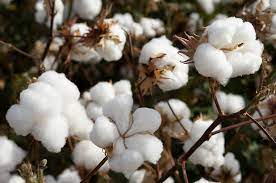
होली के माहौल में दक्षिण भारत में सूती धागे के बाजार में स्थिरता का रूख होली का त्यौहार करीब आने के साथ ही दक्षिण भारत में सूती धागे की घरेलू मांग में कमी आई है। नतीजा, तिरूपुर में सूती धागे की कीमतों ने स्थिरता का रूख ले लिया है। दरअसल, त्यौहार पास आने के अलावा कारखानों में मजदूरों की छुट्टी भी इसका एक प्रमुख कारण रहा है। कारोबारियों के मुताबिक मार्च में मजदूरों की गैरमौजूदगी और वित्तीय बंदी ने उत्पादन गतिविधियों को धीमा कर दिया. निर्यात मांग की तुलना में घरेलू मांग कमजोर थी, लेकिन मुंबई और तिरुपुर में कीमतें स्थिर रहीं।मुंबई में, बाजार ने डाउनस्ट्रीम उद्योग से कमजोर मांग का अनुभव किया। हालांकि, निर्यात खरीदारी थोड़ी बेहतर रही और सूती धागे की कीमतें स्थिर रहीं। मुंबई के एक व्यापारी जय किशन ने बताया, "श्रमिक होली के त्योहार के लिए छुट्टी पर जा रहे थे, और मार्च में वित्तीय समापन ने भी उत्पादन गतिविधियों को कम कर दिया। इसलिए, स्थानीय मांग धीमी थी। हालांकि, कीमतों में कोई गिरावट नहीं आई।"मुंबई में, ताने और बाने की किस्मों के 60 काउंट वाले सूती धागे का कारोबार क्रमशः 1,525-1,540 रुपये और 1,450-1,490 रुपये प्रति 5 किलोग्राम (जीएसटी अतिरिक्त) पर हुआ। 80 कार्ड वाले (बाने) सूती धागे की कीमत 1,440-1,480 रुपये प्रति 4.5 किलोग्राम थी। 44/46 काउंट कार्डेड कॉटन यार्न (वार्प) की कीमत 280-285 रुपये प्रति किलोग्राम थी। 40/41 काउंट कार्डेड कॉटन यार्न (ताना) 260-268 रुपये प्रति किलोग्राम और 40/41 काउंट कॉम्बेड यार्न (वार्प) की कीमत 290-303 रुपये प्रति किलोग्राम थी।इस बीच, तिरुपुर बाजार में भी कीमतें स्थिर रहीं। व्यापार सूत्रों ने कहा कि मांग औसत थी, जो मौजूदा मूल्य स्तर को सहारा दे सकती है। तमिलनाडु में स्थित मिलें 70-80 प्रतिशत उत्पादन क्षमता पर चल रही थीं। बाजार को अगले महीने समर्थन मिल सकता है जब उद्योग अगले वित्तीय वर्ष में अपने उत्पादन का नवीनीकरण करेगा। तिरुपुर बाजार में, 30 काउंट कॉम्बेड कॉटन यार्न का कारोबार ₹280-285 प्रति किलोग्राम (जीएसटी अतिरिक्त), 34 काउंट कॉम्बेड का ₹292-297 प्रति किग्रा और 40 काउंट कॉम्बेड कॉटन यार्न 308-312 प्रति किग्रा पर कारोबार कर रहा था। गुजरात में, पिछले सत्र में मामूली बढ़त के बाद कपास की कीमतों में फिर से गिरावट आई। कारोबारी सूत्रों ने कहा कि सूत कातने वाले कपास खरीद रहे थे, लेकिन वे कीमतों को लेकर काफी सतर्क थे। मिलें सस्ते सौदे हड़पने की कोशिश कर रही थीं। भारत में कपास की प्रति दिन आवक लगभग 1.58 लाख गांठ (170 किलोग्राम) होने का अनुमान लगाया गया था, जबकि गुजरात के बाजार में 37,000 गांठ की आवक दर्ज की गई थी। कीमतें 62,500 रुपये से 63,000 रुपये प्रति कैंडी 356 किलोग्राम के बीच मँडरा रही थीं।

If import duty is not removed, it will be difficult to run spinning mill after June: CAI President In its recently released report, CAI has once again reduced the estimate of cotton crop to 313 lakh bales. Important excerpts of CAI Chairman Atul Ganatraji's interview with a channel on reduction in crop estimate and current condition of cotton industry-Question- Is the reason for the reduction in cotton crop by CAI is the low yield of cotton? Are cotton yields a cause for concern?Answer- In yesterday's meeting, about 25 members from all the 10 cotton producing states participated in this meeting. The idea was that definitely the yield is the main factor in the reduction in the size of the crop. Since last 5 years our production and yield is going down. Also this year, another important factor is that 90% farmers are already in cotton. Have uprooted the plants and are not doing 3rd and 4th picking as the rate of cotton is very less at 7000-8000 as compared to last year's 12000-15000. This top picking (forward) cotton comes to around 3 million bales. And this 30 lakh bales will not be available this year also this reduction in our yield is a matter of concern for the entire textile industry.Question- Why is our cotton production falling?Answer- Our seed technology is very old, we have not changed the seed since 2003. Countries like America, Brazil and Australia are using new technology, so their yield is double than ours. We have recommended the government to change the technology otherwise our spinning industries will suffer. Our cotton consumption is increasing and in the last 15 months 2 million new spindles have been added in India. And in coming 7 months 8-10 lakh new spindles will be erected so our Indian consumption is very high and our production is decreasing year by year so it is very important to bring new seeds and new technology. Till now we could survive even with less crop as we had opening stock of cotton from 125 lakh bales and 75 lakh bales from 2020 (due to corona) but now our opening stock is negligible.Question- How is the situation of arrival and how much cotton is with the farmers?Answer- Till February 20, 1,55,000 bales have arrived in India. According to our crop, 313 lakh bales means, 50% has arrived and 50% is in the hands of the farmers. In North India 20-25% crop, in Central India 40-50% crop, in South India 30-40% crop is in the hands of farmers.Question- If farmers do not sell cotton, it will be carried forward to the next year, then in the CAI meeting next month, there will be further reduction in crop numbers?Ans- Actually it is very difficult to understand the mind of farmers last year farmers saw rate of cotton 12000 to 15,000 per quintal and this year the prices are very low at 7-7500 so big farmers can move their whole cotton higher Farmers can carry forward a minimum of 15 lakh bales for the next season and a maximum of 25 lakh bales for the next season for rate expectation. If this happens, there is a possibility of further reduction in the number (harvest) of CAI in the coming months. We are advising Indian mills to buy cotton.Question- How is the demand for spinning mills?Answer- Spinning mills are running at 95% average capacity in India and monthly consumption is at peak. The monthly consumption of cotton is 28-30 lakh bales. The demand from Indian mills is very good, mills are buying 1-1.10 lakh bales for daily consumption. cotton export is 10-15,000 per day now indian mills have no problem getting cotton but in month of april but in april when arrival will reduce then it may be difficult for spinning mills to cover cotton Lets do it. Since our consumption is high and production is low, the government should remove 11 per cent import duty on cotton. Indian spinning mills will have a tough time after June-July if the import duty is not removed. And we will see the repeat of last season 2022.

The spot price of cotton in Pakistan declined by Rs 300 per maund The spot rate committee of the Karachi Cotton Association (KCA) on Thursday reduced the spot rate by Rs 3,00 per head and closed it at Rs 19,500 per head. The local cotton market remained bearish and the trading volume was very low. Cotton analyst Naseem Usman said that the price of cotton in Sindh is Rs 17,500 to Rs 19,500 per head. The rate of cotton in Punjab is Rs 18,000 to Rs 19,500 per head. The rate of footi in Sindh ranges from Rs 7,000 to Rs 8,300 per 40 kg.The rate of footi in Punjab ranges from Rs 7,000 to Rs 9,200 per 40 kg. The spot rate committee of the Karachi Cotton Association (KCA) reduced the spot rate by Rs 3,00 per head and closed it at Rs 19,500 per head. Polyester fiber was available at Rs 355 per kg.
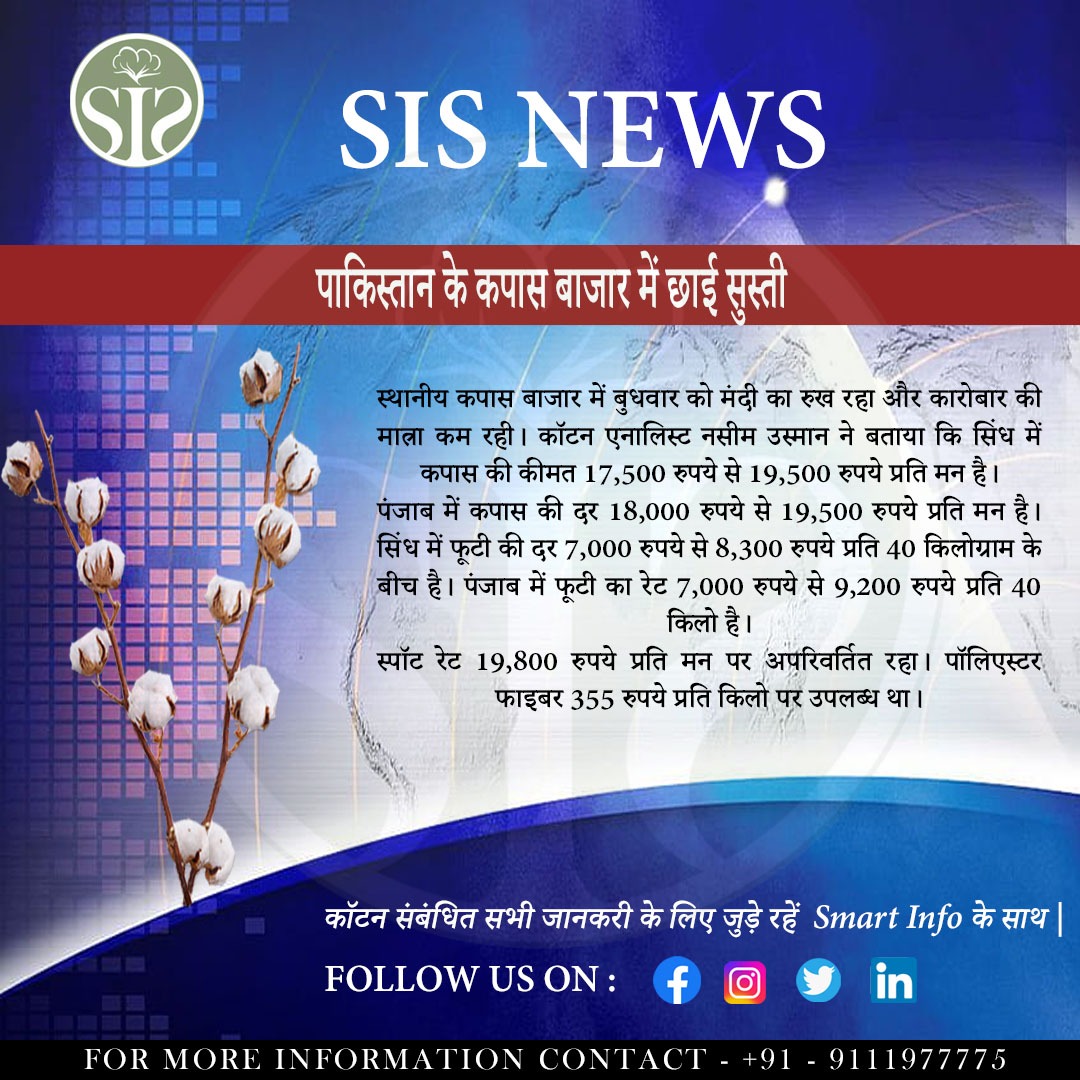
Pakistan's cotton market remains sluggishThe local cotton market turned bearish on Wednesday with thin trading volumes. Cotton analyst Naseem Usman said that the price of cotton in Sindh is Rs 17,500 to Rs 19,500 per head.The rate of cotton in Punjab is Rs 18,000 to Rs 19,500 per head. The rate of footi in Sindh ranges from Rs 7,000 to Rs 8,300 per 40 kg. The rate of footi in Punjab ranges from Rs 7,000 to Rs 9,200 per 40 kg.The spot rate remained unchanged at Rs 19,800 per head. Polyester fiber was available at Rs 355 per kg.

Barren fields, dwindling yields: Bt cotton betrays Madhya Pradesh farmersPink bollworm incidence increased from 5.17 per cent to 73.82 per cent between 2010 and 2017 in Maharashtra, Gujarat and Madhya Pradesh. Adoption of Bt cotton rose to 81 percent in 2007 and 93 percent in 2011 as farmers thought pest-resistant varieties were their best bet. Unlike other crops, new seeds have to be bought from the market every time for the cultivation of GM varieties. ... All the claims made about Bt cotton have been proven wrong. As far as increase in yield is concerned, if you check the irrigation data, it will become clear that only production has not increased."At a time when the much-hyped Bt cotton crop is troubling farmers, the central government is slowly setting the stage for the rollout of genetically modified mustard. Last October, the Ministry of Environment, Forest and Climate Change approved field trials of Dhara Mustard Hybrid-11, developed by Deepak Pantal, former vice-chancellor of Delhi University. While the government argues that the genetically modified variety will increase mustard production and reduce the country's dependence on edible oil imports, anti-GMO activists are wary. In front of them is the poor performance of Bt cotton, the first genetically modified crop in the country.He has seen how claims of better yield guarantees and less need for pesticides and chemical fertilizers have blown away with the wind. Apparently, the only things Bt cotton farmers found were barren fields and increased input costs.Madhya Pradesh, which accounts for 18.69 lakh bales of cotton (5.47 lakh hectare) out of the total 352 lakh bales (in 1,18.81 lakh hectare) produced in the country. Khargone, Barwani, Khandwa and Burhanpur are the major cotton producing districts here.According to the statistics of the Farmers Welfare and Agriculture Development Department, cotton is grown in a total of 2,11,450 hectares in Khargone. Chhagan Chauhan (50), a resident of Mogargaon, has come to Khargone's cotton market to sell 2.6 quintals of cotton. This year has proved to be better for him. "Today, I got Rs 8,500 per quintal. This price is good for me," he says with a smile. Last year, incessant rains and pest attacks destroyed half of his crop. “Ideally, the 10 packets of Bt cotton seeds that I sprinkled in the field should have yielded me around 40 quintals of cotton. But I got only 16 kg. Thankfully, the pests spared me this time.Shyam (24), a resident of Temla, has been helping his father Anil Dhangar (55) cultivate Bt cotton on seven acres for the last two years. When asked about the challenges they face, Anil says, “Getting a good price for the produce and deworming are our biggest concerns.” He says, “Look, the pink colored moth (Pectinophora gossypiella) has made a home here by damaging the seed kernel. Now, this cotton boll will not become a flower to bear fruit. The only thing left is to remove it. be given to the field as soon as possible," he says, adding that the pest attack started late this year compared to last year, when about 40 per cent of the crop was affected.There are four types of caterpillars found in cotton – pink bollworm, spotted bollworm, American bollworm and tobacco cutworm. Among them, attacks of pink and American bollworms are common in India. A 2018 survey conducted by the Central Institute of Cotton Research found that pink bollworm outbreaks had increased from 5.17 per cent to 73.82 per cent between 2010 and 2017 in Maharashtra, Gujarat and Madhya Pradesh.Ironically, the government allowed commercial cultivation of the first generation Bt cotton (Bt-1 cotton) in 2002 to prevent pest attacks, while its second generation (Bt-II) was introduced in 2006 using two Bt (Bacillus thuringiensis) was launched in combination. ) protein (Cry1Ac+Cry2Ab) with promise for specifically targeting the pink bollworm. Adoption of Bt cotton rose to 81 percent in 2007 and 93 percent in 2011 as farmers thought pest-resistant varieties were their best bet.
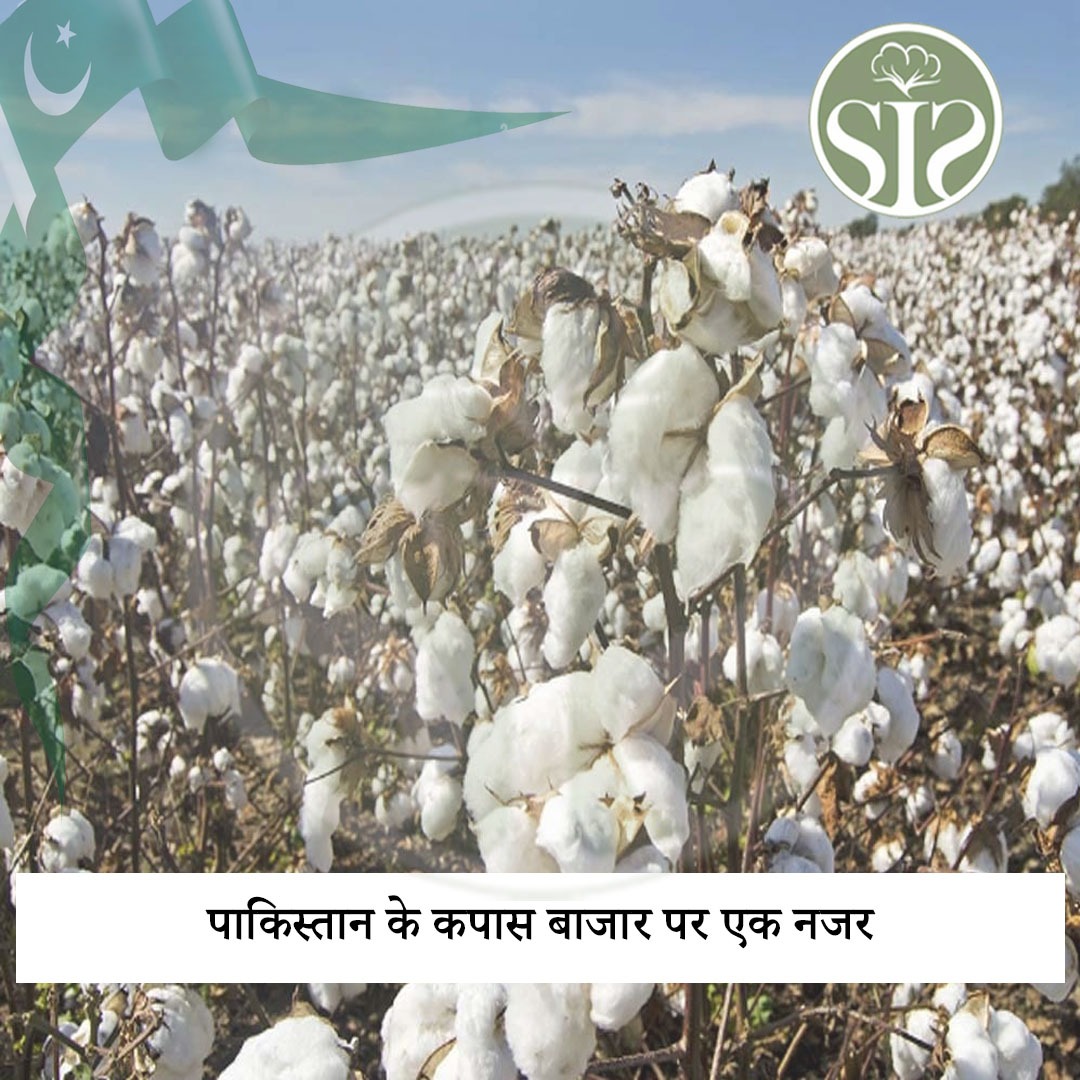
A look at Pakistan's cotton marketThe local cotton market turned bearish on Tuesday with thin trading volumes. Cotton analyst Naseem Usman told that the price of cotton in Sindh is Rs 17,500 to Rs 21,000 per head. The rate of cotton in Punjab is Rs 18,000 to Rs 20,000 per head.The rate of footi in Sindh ranges from Rs 7,000 to Rs 8,300 per 40 kg. The rate of footi in Punjab ranges from Rs 7,000 to Rs 9,200 per 40 kg. The spot rate remained unchanged at Rs 19,800 per head. Polyester fiber was available at Rs 355 per kg.Prime Minister Shehbaz Sharif has given in-principle approval to fix the price of cotton at Rs 8500 per 40 kg for this year. The approval was given during a review meeting of the Agriculture Task Force chaired by Prime Minister Muhammad Shahbaz Sharif in Lahore on Monday. It was informed during the meeting that last year there was a drastic reduction in cotton production due to floods, rains, shortage of water in the canal and fertilizer crisis.The total production of cotton this year is estimated at 12.77 million bales, while not only the area under cotton cultivation but also the yield per acre is expected to increase substantially. The Prime Minister said that the provincial governments should ensure provision of fixed price for cotton to the farmers. He also directed the central government to provide all possible assistance to the provincial governments in implementing the fixed support prices.

Bad condition of cotton in Punjab, crop sales 25 percent less than last year According to ICAL, the collective production of cotton in the three states of North India is estimated at 42.09 lakh bales as compared to 48.37 lakh bales in the previous year.In a major setback to the Punjab government's efforts to diversify farmers, cotton production in the state is estimated to be at its lowest in years this year. As of March 9, the state's arrival stood at 28.89 lakh quintals, against last year's arrival of only 7 lakh quintals, according to data from the Punjab State Agricultural Marketing Board. According to the sales of the cotton crop recorded by PSAMB, it is less than a quarter as of March 9 compared to the previous year.effect of pest attackBesides PSAMB, the revised estimates by cotton trade body Indian Cotton Association Limited (ICAL) about the arrival of the crop in the state mandis are also highly dismal. The revised estimates put the arrival of the crop at around 2.50 lakh bales (1 bale = 170 kg) as against last year's arrival of 7.20 lakh bales. Frequent pest attack in the last two years is said to be behind the very low production of the crop. In the current season, apart from pest attack, non-availability of canal water initially in the sowing season and then incessant rains are said to be the reasons for the poor performance of the crop. It is being said that looking at the production trends, farmers have lost confidence in the crop and thus, not much change in crop area is expected in the upcoming sowing season.Cotton production less in North IndiaHowever, the crop is still fetching Rs 8,000 per quintal against the MSP of Rs 6,280 per quintal for the 27.5-28.5 mm long staple. Like Punjab, production in neighboring Haryana is also low and according to ICAL's revised estimates, arrivals in mandis are estimated at 1.2 million bales from 1.5 million bales last year. However, cotton production in Rajasthan is expected to increase to 27.60 lakh bales from last year's 26.12 lakh bales. According to ICAL, the collective production of cotton in the three states of North India is estimated at 42.09 lakh bales as compared to 48.37 lakh bales in the previous year.very little inputPunjab's cotton coordinator Rajneesh Goyal said, "The arrival of cotton is very less as compared to last year. As per the trends, the total arrivals in the mandis have been much less as compared to previous years. As per the arrivals recorded by ICAL till February 28, Punjab has received 1.69 lakh bales, while Haryana has recorded 6.86 lakh bales and Rajasthan 22.53 lakh bales. Till February 28, a total of 31.08 lakh bales have arrived in the three states.
Lower prices may push India's palm oil imports to 4-year high: Industry officialIndia's palm oil imports could rise 16% to a four-year high of 9.17 million tonnes in 2022/23, a senior industry official told Reuters on Tuesday, as consumption looks to bounce back after two years of contraction. ready for.Higher buying by the world's biggest importer of vegetable oils could provide further support to palm oil futures, which were trading near their highest levels in four months.Sudhakar Desai, president of the Indian Vegetable Oil Producers Association, said, “Consumption has declined for two consecutive years due to the pandemic. This year, it will decline by around 5% as restrictions have been eased and prices have fallen. "He said consumption growth would be met by higher imports of palm oil, which is trading at a discount to rivals soya oil and sunflower oil.Traders estimate India's palm oil imports in the first four months of the 2022/23 marketing year, which began on November 1, jumped 74% from a year earlier to 3.67 million tonnes.India mainly buys palm oil from Indonesia, Malaysia and Thailand. It imports soybean and sunflower oil from Argentina, Brazil, Russia and Ukraine.Desai said the country's total vegetable oil imports are likely to increase to 14.38 million tonnes in the current year from 14.07 million tonnes a year ago.Soybean oil imports could fall to 3.16 million tonnes from 4.05 million tonnes, while sunflower oil imports could rise to 2 million tonnes from 1.93 million tonnes, he said.
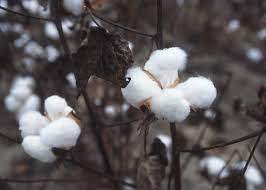
Angry farmers, nervous leadersFarmers anger erupted on Maharashtra leaders, expressed dissatisfaction over prices of onion and cottonResentment is growing among onion and cotton growers in the state against the central government's failure to help farmers distressed by falling prices. The BJP ministers had to face this discontent in the form of farmers' anger.On Sunday, angry farmers threw onions at the vehicle of Maharashtra Deputy Chief Minister Devendra Fadnavis. Union Minister of State and BJP Lok Sabha MP Bharti Pawar and state Agriculture Minister Abdul Sattar also faced the wrath of the farmers.In a video that has gone viral on social media, angry farmers can be seen surrounding Bharti Pawar while the minister tries to pacify their anger by saying that the Center is procuring onions through NAFED (National Agricultural Cooperative Marketing Federation of India) Is and is making sure. That there is no restriction on the export of onions as well. He said that onion prices are low in the international market and hence the prices have come down in the domestic market. Apart from this, the arrival of onion in the market is very high.Maharashtra's Agriculture Minister Abdul Sattar also faced the wrath of farmers at an agricultural exhibition in Amravati. The farmers told him that the prices of onions have gone down even below the prices of old newspapers. Farmers argue that last year they sold a quintal of cotton for Rs 14,000, but currently they get only Rs 8,000 per quintal. “We are not even able to recover the input cost. If the government fails to help us, we are left with no option but to commit suicide.However, in the video the farmers can be seen blaming the Centre's wrong export-import policies for their plight. The angry farmers argued that the Center keeps on changing its policies continuously and the farmers are facing the brunt of it."The Center should compensate us by buying our onions at the international market rate and also give us all possible help," the farmers insisted. Meanwhile, Devendra Fadnavis faced the wrath of farmers in Amravati, where the latter threw onions at his vehicle before the police swung into action and detained the protesters.

Weekly review of Pakistan's cotton businessThe textile sector, which plays an important role in the country's economy, exports and employment, is on the verge of collapse. The All Pakistan Textile Mills Association (APTMA) has urged the government to restore energy concessions as the industry is unable to survive as energy prices in regional countries are relatively low, making it impossible for the Pakistani textile sector to compete with them Is.The government has withdrawn power subsidies given to five export industries, including the textile sector, to meet IMF conditions, increasing the cost of electricity from Rs 19 per unit to Rs 40 per unit. Interest was also raised by 3% from 17% to 20%, and the dollar interbank rate rose by Rs 19 to Rs 286. It had reached up to Rs 300 in the open market but later declined somewhat.Cotton prices remained stable in the local cotton market last week. In the beginning of the week, some groups of textile mills showed interest in buying cotton. Later on Wednesday, there was a sudden rise in the dollar rate after which the ginners became cautious and started demanding higher prices, while the spinners remained silent due to higher prices.Cotton prices in Sindh province ranged between Rs 19,000 and Rs 20,500 per head, depending on the quality, which is available in small quantities. The price of footi in Sindh ranged from Rs 6500 to Rs 8500 per 49 kg. Cotton rates in Punjab ranged from Rs 19,000 to Rs 20,000 per head, while cotton rates ranged from Rs 7,000 to Rs 9,500 per 40 kg. Cottonseed cake and oil prices remained relatively stable.The spot rate committee of the Karachi Cotton Association increased the spot rate by Rs 2,00 per head and capped it at Rs 20,000 per head. Cotton demand and prices are expected to increase in the domestic cotton market, but cotton stocks are very low in the domestic market while deliveries of imported cotton are getting delayed due to L/C issues and sharp rise in dollar prices. This will increase the price of imported cotton.Karachi Cotton Brokers Forum President Naseem Usman has said that cotton rates remained stable in the international cotton markets. According to the USDA's weekly export report, one lakh seventy thousand six hundred bales were sold for the year 2022-23. China remained on top by purchasing 81 thousand 600 bales. Vietnam finished second after buying 78,900 bales, including 900 bales from China and 100 from Japan. India bought 18,400 bales and stood third.
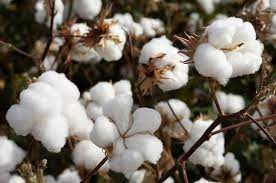
Stable trend in cotton yarn market in South India amid Holi With the Holi festival round the corner, domestic demand for cotton yarn has come down in South India. As a result, cotton yarn prices in Tiruppur have taken a stable trend. Actually, apart from the coming of the festival, the holiday of the workers in the factories has also been a major reason for this. According to traders, the absence of laborers and the financial closure slowed down production activities in March. Domestic demand was weak as compared to export demand, but prices held steady at Mumbai and Tiruppur.In Mumbai, the market experienced weak demand from the downstream industry. However, export buying turned marginally better and cotton yarn prices held steady. Jai Kishan, a Mumbai-based trader, said, "Workers were going on leave for the Holi festival, and the financial closure in March also curtailed production activities. Hence, local demand was slow. However, there was no drop in prices." I."In Mumbai, cotton yarn of 60 count of warp and weft varieties traded at Rs 1,525-1,540 and Rs 1,450-1,490 per 5 kg (GST extra), respectively. Cotton yarn of 80 cards (weft) was priced at Rs 1,440-1,480 per 4.5 kg. The price of 44/46 count carded cotton yarn (warp) was ruling at Rs 280-285 per kg. 40/41 count carded cotton yarn (warp) was trading at Rs 260-268 per kg and 40/41 count combed yarn (warp) was trading at Rs 290-303 per kg.Meanwhile, prices remained stable in Tirupur market as well. Trade sources said demand was moderate, which may support the current price level. Mills located in Tamil Nadu were running at 70-80 per cent production capacity. The market may get support next month when the industry renews its production in the next financial year. In the Tiruppur market, 30 count combed cotton yarn was trading at ₹280-285 per kg (GST extra), 34 count combed at ₹292-297 per kg and 40 count combed cotton yarn at ₹308-312 per kg.In Gujarat, cotton prices declined again after a marginal gain in the previous session. Trade sources said spinners were buying cotton, but they were cautious about prices. The mills were trying to grab cheap deals. Cotton arrivals in India were estimated to be around 1.58 lakh bales (170 kg) per day, while 37,000 bales were recorded in the Gujarat market. The prices were hovering between Rs 62,500 to Rs 63,000 per candy of 356 kg.

Slow trading in Pakistan's cotton marketThe local cotton market remained stable on Monday with thin trading volumes. Cotton analyst Naseem Usman told that the price of cotton in Sindh is Rs 18,000 to Rs 20,500 per head. The price of cotton in Punjab is Rs 18,500 to Rs 20,000 per head.The rate of footi in Sindh ranges from Rs 7,000 to Rs 8,300 per 40 kg. The rate of footi in Punjab ranges from Rs 7,000 to Rs 9,200 per 40 kg. The spot rate remained unchanged at Rs 20,000 per head. Polyester fiber was available at Rs 355 per kg.

डॉलर के मुकाबले रुपया 3 पैसे कमजोरआज शाम को डॉलर के मुकाबले रुपया 3 पैसे की कमजोरी के साथ 79.63 रुपये के स्तर पर बंद हुआ।सेंसेक्स में गिरावट 372 अंक टूटकर बंदआज शेयर बाजार में गिरावट के साथ क्लोजिंग हुई।आज जहां सेंसेक्स करीब 372.46 अंक की गिरावट के साथ 53514.15 अंक के स्तर पर बंद हुआ।वहीं निफ्टी 91.60 अंक की गिरावट के साथ 15966.70 अंक के स्तर पर बंद हुआ। Rupee weakens by 3 paise against dollarToday evening, the rupee closed at Rs 79.63 with a weakness of 3 paise against the dollar.Sensex closed down by breaking 372 pointsToday the stock market closed with a fall.Today, where the Sensex closed at a level of 53514.15 points down by about 372.46 points.On the other hand, Nifty closed at 15966.70 points down by 91.60 points.
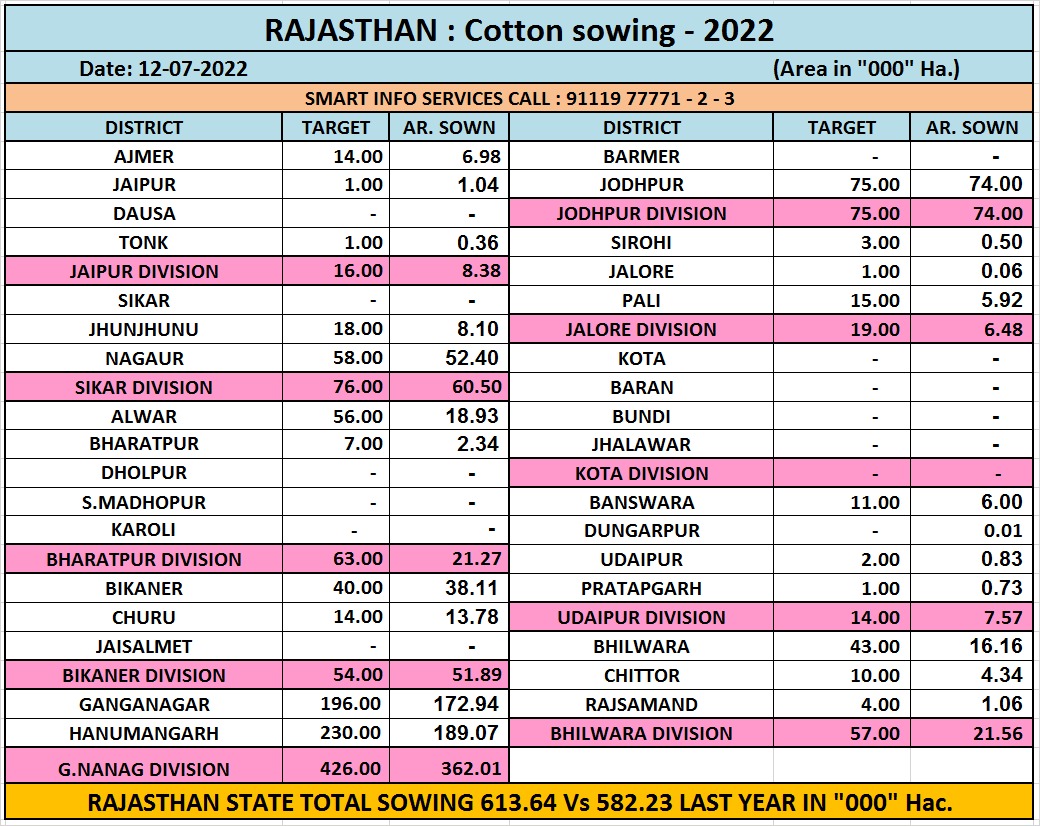
RAJASTHAN COTTON SOWING

Sensex rises further, opens up 246 pointsToday the stock market opened with great momentum. Today the BSE Sensex rose by about 246.05 points to open at the level of 54132.66 points. On the other hand, the Nifty of NSE opened with a gain of 71.40 points at the level of 16129.70 points.Rupee opens 5 paise stronger against dollarRupee opened strongly against the dollar in the foreign exchange market today. Today the rupee opened with a strength of 5 paise at Rs 79.55 against the dollar. At the same time, on Tuesday, the rupee closed at Rs 79.60 with a weakness of 16 paise against the dollar.

सम्पूर्ण भारत का जुलाई 13, 2022 का मौसम पूर्वानुमानदेश भर में बने मौसमी सिस्टमकम दबाव का क्षेत्र दक्षिण ओडिशा तट और दक्षिण आंध्र प्रदेश तट पर बना हुआ है।मॉनसून ट्रफ अब बीकानेर, कोटा, सागर, रायपुर, दक्षिण ओडिशा और उत्तरी आंध्र प्रदेश के तटीय क्षेत्रों के ऊपर कम दबाव के क्षेत्र के केंद्र और फिर दक्षिण पूर्व की ओर बंगाल की पूर्वी मध्य खाड़ी से गुजर रही है।अपतटीय ट्रफ रेखा गुजरात तट से उत्तरी केरल तट तक फैली हुई है।पूर्व पश्चिम कतरनी क्षेत्र लगभग 20 डिग्री उत्तर अक्षांश के साथ चल रहा है।पिछले 24 घंटों के दौरान देश भर में हुई मौसमी हलचलपिछले 24 घंटों के दौरान, दक्षिण मध्य प्रदेश, विदर्भ के कुछ हिस्सों, तेलंगाना, गुजरात और उत्तरी मध्य महाराष्ट्र में मध्यम से भारी बारिश हुई।कोंकण और गोवा, तटीय कर्नाटक, केरल, अंडमान और निकोबार द्वीप समूह, दक्षिण छत्तीसगढ़ और हिमाचल प्रदेश और राजस्थान में एक या दो स्थानों पर हल्की से मध्यम बारिश हुई।गंगीय पश्चिम बंगाल, झारखंड के कुछ हिस्सों, असम, लक्षद्वीप, मराठवाड़ा, तटीय आंध्र प्रदेश, छत्तीसगढ़, मध्य प्रदेश के शेष हिस्सों, पूर्वी राजस्थान, हरियाणा, पंजाब, उत्तराखंड और जम्मू कश्मीर के कुछ स्थानों पर हल्की से मध्यम बारिश हुई।उप-हिमालयी पश्चिम बंगाल, सिक्किम, आंतरिक कर्नाटक, तमिलनाडु और दिल्ली और पूर्वी उत्तर प्रदेश में एक या दो स्थानों पर हल्की बारिश हुई।अगले 24 घंटों के दौरान मौसम की संभावित गतिविधिअगले 24 घंटों के दौरान, दक्षिण मध्य प्रदेश, विदर्भ के कुछ हिस्सों, उत्तरी मध्य महाराष्ट्र, कोंकण और गोवा और दक्षिण गुजरात में मध्यम से भारी बारिश संभव है।गुजरात के शेष हिस्सों, तटीय कर्नाटक, केरल, अंडमान और निकोबार द्वीप समूह, ओडिशा, तेलंगाना के कुछ हिस्सों, छत्तीसगढ़ के कुछ हिस्सों और दक्षिणपूर्व राजस्थान, उत्तराखंड और हिमाचल प्रदेश में एक या दो स्थानों पर हल्की से मध्यम बारिश संभव है।सिक्किम, जम्मू कश्मीर, पूर्वोत्तर भारत, उप-हिमालयी पश्चिम बंगाल, ओडिशा, उत्तरी छत्तीसगढ़, दक्षिण झारखंड, आंतरिक कर्नाटक, तेलंगाना के शेष हिस्सों और तटीय आंध्र प्रदेश में हल्की से मध्यम बारिश संभव है।उत्तर प्रदेश, उत्तरी पंजाब, उत्तरी हरियाणा, तमिलनाडु, लक्षद्वीप और रायलसीमा की तलहटी में हल्की बारिश संभव है।
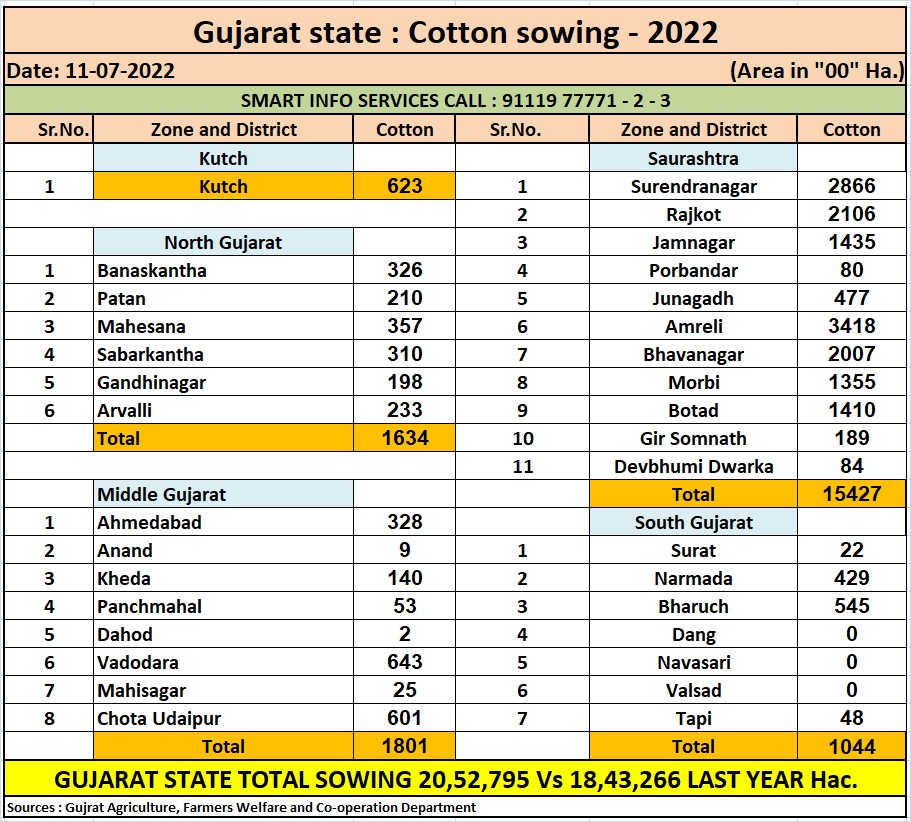
GUJRAT Kharif-2022 Season Sowing Report As On 11 July 2022
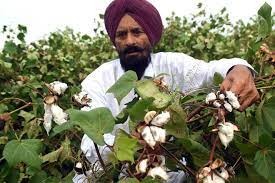
Punjab government engaged in saving cotton crop from pest infestation, formed 37 teams for inspectionPunjab Agriculture Minister constituted 37 teams to inspect the cotton crop in Malwa region. The Agriculture Minister directed the officials to deal with the possible outbreak of the pest on the cotton crop in the sensitive Malwa belt. On Monday, Agriculture Minister Kuldeep Singh Dhaliwal constituted 37 departmental teams to inspect and report on the status of cotton crop in six districts of Malwa amid the menace of pink locust pest.He directed the officials to deal with possible outbreak of pest on cotton crop in the sensitive Malwa belt from tomorrow. The minister announced in a meeting held at the Mandi Board headquarters in Mohali that he would also visit the affected parts. Dhaliwal, who took charge of the department last week, said marketing would be strengthened to make crop diversification a success and take farmers out of the wheat-paddy cycle.He said that emphasis would be laid on marketing of these crops to promote maize and other allied crops. He also asked the officials to check the sale of spurious pesticides, fertilizers and seeds and take strict action against those selling such products. Dhaliwal said that direct sowing of paddy is being encouraged by the Punjab Government and also said that the State Government agencies like Mandi Board, Punjab Agro, Punseed, Godown will be strengthened.

Next 5 years will prove to be a golden year for the giners of GujaratA special conversation with Arif Bhai Shah, the general of Mahua station in Bhavnagar districtThere are ups and downs in the cotton industry, but for the last 3 years, the graph of the ginning industry is moving in the direction of growth. Especially in Gujarat. In Gujarat, many spinning mills units are continuously setting up their plants, due to which the cotton consumption is increasing continuously here. Due to high demand, giners are not reading the need to find buyers. At present 75 lakh cotton bales are being consumed in the state of Gujarat. It is likely to increase further in the coming times. In such a situation, the next 5 years can prove to be golden years for the ginners of Gujarat.Only 10 percent acreage increasedRegarding Bhavnagar district, he told that about 6 lakh cotton bales are produced here, out of which 2 to 2.50 lakh bales are in Mahua district. This year, like the whole country, there has been an increase in sleeping here too. But due to late arrival of rain, only 10 percent of the area has increased more. He said that the price of cotton had increased earlier this year in 2011 as well, but then the price was controlled after March, but this time the prices of cotton have remained in the sky for the whole year.Step into ginning industry since 2005Arif Bhai's father Dawood Bhai Shah used to do cotton tiding work. Arif says that in 2005, when I did anti in business, I saw a lot of profit in the ginning industry. This is the reason why we entered the ginning industry since 2005. Earlier our goods used to go mostly to the south but due to the increase in spinning mills, now good buyers are easily available locally only. Right now we have 1 ginning factory which is managed by my father, me and my brother Siraj Shah together.VisionIt is a dream to start a spinning mill, but the labor cost at our station is very high.want this improvementBorrowing trend in the industry should end and most deals should be closed on cash.

Rupee weakens by 16 paise against dollarToday evening, the rupee closed at Rs 79.60 with a weakness of 16 paise against the dollar.Sensex closed down by breaking 509 pointsToday the stock market closed with a fall.Today, where the Sensex fell by about 508.62 points, closed at the level of 53886.61 points.On the other hand, Nifty closed at a level of 16058.30 points down by 157.70 points.

Sensex collapses as soon as it opens, registers a fall of 295 points Today the stock market opened with a fall. Today the BSE Sensex fell by about 294.85 points and opened at the level of 54100.38 points. On the other hand, the Nifty of NSE opened with a decline of 97.80 points at the level of 16118.20 points.Rupee rumbles against dollar, opened 7 paise weakRupee opened with weakness today against the dollar in the foreign exchange market. Today the rupee opened with a weakness of 7 paise at Rs 79.51 against the dollar. At the same time, on Monday, the rupee closed at Rs 79.44 with a weakness of 19 paise against the dollar.