STAY UPDATED WITH COTTON UPDATES ON WHATSAPP AT AS LOW AS 6/- PER DAY
Start Your 7 Days Free Trial TodayAndhra pradesh:Experts worried over declining cotton cultivation across the countryVijayawada : Experts in cotton solvent and extractors industry are worried about declining cotton cultivation across the country in the past few years. According to the cotton industry report, the cotton crop area has declined by 9.8% in 2024-2025, down to 114.47 lakh hectares. This is expected to result in a dip in production to 307 lakh bales from 325 lakh bales the previous year. Since cottonseed comprises nearly two-thirds of the cotton weight, the production decline has a direct impact on oil and feed production, feel the industry captains.Taking the situation on a serious note, the Solvent Extractors' Association of India (SEA) & All India Cottonseed Crushers' Association (AICOSCA) have decided to explore ways to maximize the potential of cottonseed oil and its by-products to enhance India's edible oil security, livestock feed inustry, and rural economy.According to Sanjeev Asthana, president, SEA, "India produces 12 lakh tonnes of cottonseed oil annually, making it the third-largest edible oil after soybean and rapeseed. It is widely used in Gujarat for cooking due to its superior frying properties, its adoption in other regions remains limited and is mainly consumed by institutional buyers like restaurants and food processors. "We wanted to improve the awareness and encourage adoption of cotton seed oil for domestic consumption for multiple benefits," said Asthana.AICOSCA chairman Sandeep Bajoria said that cottonseed offers a wide range of valuable applications. "Cottonseed oil is one of the most popular cooking oils in kitchens. It is used as a yardstick for measuring the flavour as well as odour qualities in other edible oils. It is also one of the main ingredients in most oriental dishes. Cottonseed meal is an excellent feed meal ingredient," said Bajoria. He said that industry has started focusing on propagating the use and value of cottonseed oil, advancing processing technologies, and promoting cottonseed meal's role in dairy nutrition.SEA executive director Dr. B V Mehta highlighted that the current production of cottonseed oil is about 11.5 to 12 lakh tonnes per annum. However, he observed that its potential is about 18 lakh tonnes, which can be harnessed if the cottonseed is processed by modern scientific methods. This will also help to meet our growing requirement of edible oil and reduce the dependence on import of edible oils.Director of Sri Dhanalakshmi Cotton and Rice Mills Pvt. Ltd (Guntur), P Veera Narayan, said that they will focus on revitalizing cottonseed oil processing and usage in the country at national conclave to be held in Vijayawada on Aug 2, 3. He said that Andhra Pradesh is one of the largest producers of cotton seed and it is appropriate that they host the conference in Vijayawada. More than 300 delegates, including scientists, industry leaders, and traders, are expected to participate in this national platform, fostering collaboration and sustainable growth in the sector.read more:- CCI to sell 70% of cotton through e-bidding in 2024-25
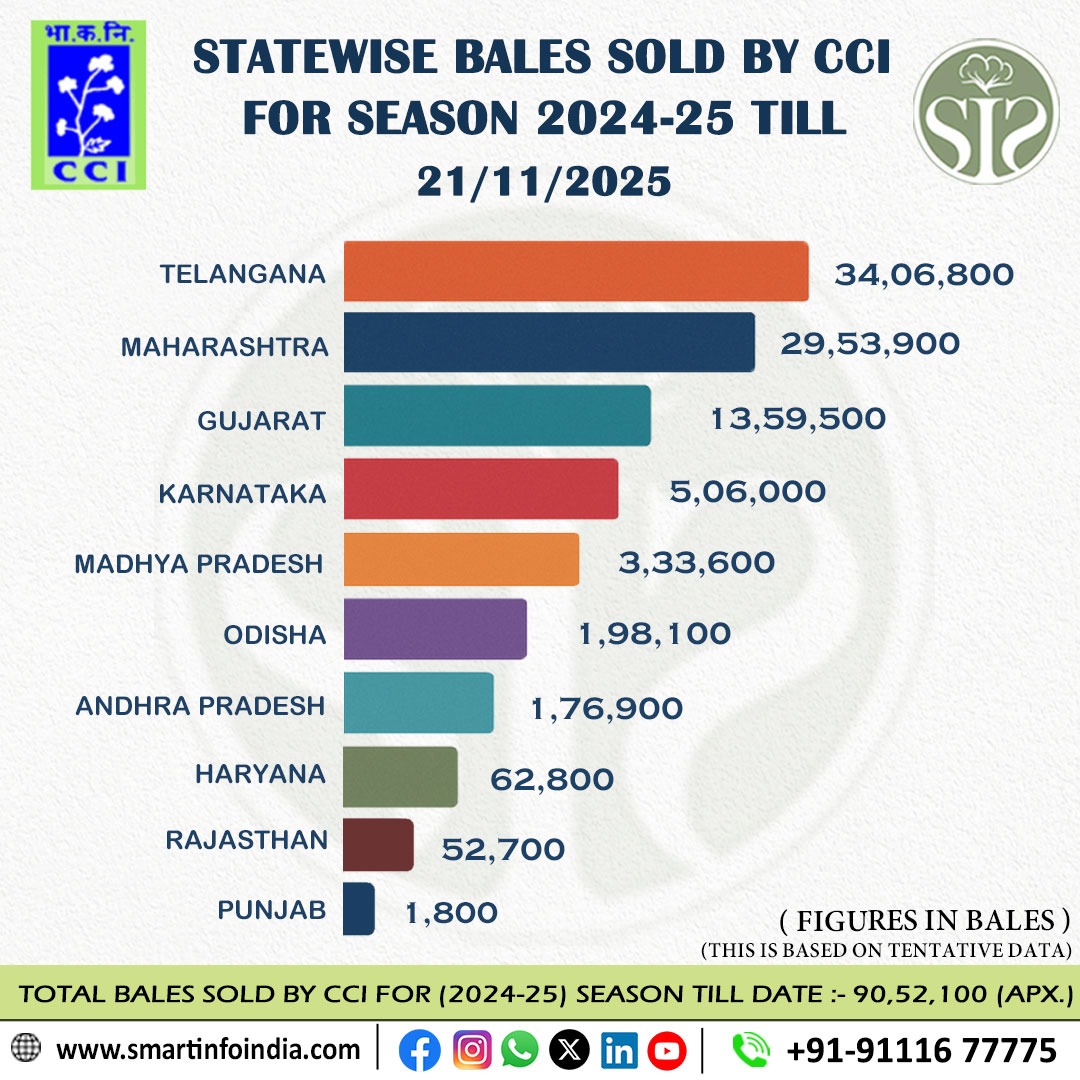
CCI Boosts Cotton Prices, sold 70% of 2024–25 Procurement via E-BiddingThe Cotton Corporation of India (CCI) conducted online bidding for cotton bales throughout the week, with significant trading activity observed across both the Mills and Traders sessions. Over the course of five days, CCI increased its prices by a total of ₹700 per candy.As of now, CCI has sold approximately 70,17,100 cotton bales for the 2024–25 season, representing 70.17% of its total procurement for the season.Date wise weekly Sales Summary :14 July 2025:A total of 1,12,600 bales were sold from the 2024–25 season.Mills session: 45,500 balesTraders session: 67,100 bales15 July 2025:The highest daily sales of the week were recorded on this day, with 1,51,700 bales sold from the 2024–25 season.Mills session: 61,300 balesTraders session: 90,400 bales16 July 2025:Sales amounted to 35,900 bales, all from the 2024–25 season.Mills session: 18,100 balesTraders session: 17,800 bales17 July 2025:A total of 20,600 bales were sold from the 2024–25 season.Mills session: 9,100 balesTraders session: 11,500 bales18 July 2025:The week concluded with sales of 7,100 bales, including 200 bales from 2023–24 season.Mills session: 3,400 balesTraders session: 3,700 bales including 200 bales from 2023–24 season.Weekly Total:CCI achieved total sales of approximately 3,27,900 bales for the week, underscoring its strong market engagement and the growing efficiency of its digital transaction platform.read more :- Rupee fell 16 paise to close at 86.15
The Indian rupee on friday lower 16 paise to close at 86.15 per dollar, while it opened at 85.99 in the morning.At close, the Sensex was down 501.51 points or 0.61 percent at 81,757.73, and the Nifty was down 143.05 points or 0.57 percent at 24,968.40. About 1619 shares advanced, 2265 shares declined, and 153 shares unchanged.read more :- Global cotton prices mixed in July; marginal gains in China and India
Slight increase in cotton prices in China-IndiaGlobal cotton markets witnessed wide volatility last month, with marginal gains in China and India, while prices remained stable in other key markets, including Pakistan and international benchmarks, according to Cotton Incorporated.The December NY/ICE cotton futures contract, the most actively traded, hovered around the upper end of its recent range between 67 and 70 cents per pound, but failed to sustain upward momentum. The contract price is currently near 67 cents per pound, reflecting the continued volatility in global trade.The Cotlook A Index, another key international benchmark, fluctuated in a narrow range of 77 to 80 cents per pound, and came close to 78 cents per pound at the latest count, Cotton Incorporated said in its monthly economic paper - Cotton Market Fundamentals and Price Outlook, July 2025.In China, the cotton index (CC Index 3128B) continued its gradual increase. Internationally, it rose to 97 cents per pound from 92 cents per pound last month, extending a steady upward trend that began in May, when prices bottomed at around 88 cents per pound. Domestically, prices in China rose from 14,600 to 15,100 RMB/ton, while the renminbi remained stable at around 7.17 RMB/USD.Spot prices of Shankar-6 in India also rose; surpassing the May high. Prices rose to around 84 cents per pound (or ₹56,000 per candy) from 80 cents per pound (or ₹54,000 per candy) last month. The Indian rupee remained stable at around ₹86 per USD.In contrast, Pakistan's cotton market remained stable. Spot prices remained stable at around 70 cents per pound, while domestic prices hovered around 16,500 PKR per maund. Pakistani rupee also remained stable and was trading around 283 PKR per dollar.read more :- NBR withdraws advance tax on imports of cotton, man-made fibres
NBR removes advance tax on cotton-fibre importThe National Board of Revenue (NBR) has rolled back the recently imposed 2% advance income tax (AIT) on imports of cotton and man-made fibres used by Bangladesh's garment industry. This reversal comes after intense pressure from industry stakeholders.The exemption, effective immediately, applies specifically to industrial Import Registration Certificate (IRC) holders, as per a gazette issued (17 July). Commercial importers will not benefit from this change.The 2% AIT was introduced in the current budget, effective from 1 July, targeting over 150 imported raw materials, including cotton and man-made fibres. The NBR had projected collecting an additional Tk900 crore from these items in the fiscal year.However, textile mill owners swiftly demanded its withdrawal, arguing that the tax placed undue burden on an already struggling sector. They warned it could lead to the closure of spinning mills and undermine Bangladesh's export competitiveness.Bangladesh imports approximately 99% of the cotton used in its export and domestic garment production. In 2024, the country imported 83.21 lakh bales of cotton, according to the Bangladesh Textile Mills Association (BTMA). Major sources include Africa (43%), India, CIS countries, Australia, and the US, with over 7% of last year's cotton imports coming from the United States. The AIT withdrawal applies to both man-made fibres and their raw materials such as acrylic, synthetic, nylon, polyesters, and acrylic, which are primarily imported from China.Saleudh Zaman Khan, Vice President of BTMA and Managing Director of NZ Textile Mills Limited, welcomed the decision. He highlighted the severe impact the tax would have had, stating, "With 2% AIT, the effective tax rate for my factory would be 64%, though officially it's 27%." He added that Bangladesh imports around $4 billion worth of cotton and man-made fibres annually, making the industry's survival impossible if the tax had remained. "This would mean paying Tk32 crore annually just for cotton import tax. No one makes that much in a year," he explained.The argument over AITNBR officials had defended the AIT, asserting it was adjustable against final profits. NBR Chairman Abdur Rahman Khan told The Business Standard, "Even if the tax is paid upfront at the import stage, firms can later adjust it if they make enough profit." Another NBR official elaborated, "If a textile firm's tax rate is 27% and it earns 10% profit in a year, that's Tk2.7 tax on every Tk100 earned. Since we're collecting Tk2 upfront, they shouldn't face problems."However, mill owners countered that a 10% profit margin is "highly unrealistic" in the current economic climate. They also pointed out the practical difficulties in obtaining refunds or adjustments, fearing the measure would add complexity rather than ease of doing business.Showkat Aziz Russell, President of BTMA, had previously voiced concerns to The Business Standard: "The NBR says the tax can be adjusted at the end of the year, but the process is very complex. At a time when the government is trying to simplify things, there is no logic in making it more difficult." He also highlighted a discrepancy: "There is tax on cotton imports, but no tax on yarn imports. This will increase the costs for our cotton importers."NBR sources confirmed that consultations with representatives from the International Monetary Fund were held before the decision to withdraw the tax was made.read more :- INR Opens Stronger by 08 Paise at 85.99


Rupee opens 8 paise up at 85.99 as dollar index easesThe currency opened at 85.99 against the dollar after ending the previous trading session at 86.07.read more :- INR Drops 18 Paise, Closes at 86.07 per Dollar
The Indian rupee on thursday lower 18 paise to close at 86.07 per dollar, while it opened at 85.89 in the morning.At close, the Sensex was down 375.24 points or 0.45 percent at 82,259.24, and the Nifty was down 100.60 points or 0.40 percent at 25,111.45. About 1931 shares advanced, 1942 shares declined, and 152 shares unchanged.read more :- Trump gives positive signal on tariff issue
Industry optimistic as Trump hints at tariff relief for IndiaEven as US-India trade talks are heating up ahead of the August 1 deadline and a lot is at stake, US President Donald Trump on Tuesday said India is working on a trade deal on the same lines as the one he recently struck with Indonesia."India is basically working on the same lines," Trump said while speaking to reporters in Washington on Tuesday, hinting at the possibility that India could be given similar trade terms as Indonesia.According to Donald Trump, under the new deal with Jakarta, Indonesia will face a 19 per cent tariff on imports to the US, but there will be no tariff on exports from the US to Indonesia.And as news of this announcement spreads in the industry, it highlights what such a deal could mean for India's key export sectors, especially the apparel industry, which considers the United States as its key apparel export destination.“President Trump has hinted at a potential India-US trade deal on the lines of the recent Indonesia deal (where a 19 per cent tariff is applicable on exports), which could ultimately give Indian exporters a more level playing field in the lucrative US apparel market,” underlined Kishan Daga, founder of consulting services provider Concepts N Strategies, speaking to Fibre2Fashion. He also added that a tariff reduction to below 20 per cent could open “more doors” for Indian exporters, especially in the athleisure and MMF-heavy segments where India is ramping up production.Daga claimed that such a change would also support India's vision of becoming a reliable global supplier in technical textiles and functional apparel, while Sabhari Girish, chief sustainability officer, Sulochana Cotton Spinning Mills (Tirupur), on his part said: "If we have to pay a 19 per cent tariff like Indonesia, it is undoubtedly a very positive development; and it also indicates how hard we negotiated the tariff to maintain our competitiveness."Meanwhile, N Thirukkumaran, chairman of Tiruppur-based Essti Exports India Pvt Ltd, said, "India will definitely have a competitive advantage over many of its competitors. However, there will be a caveat to this—the new tariff will be in addition to the existing duties that Indian apparel exporters are already paying on shipments to the US, which may reduce the overall profit to some extent even if the new tariff rate is set at 19 per cent."However, he remained optimistic and said that India could negotiate hard to reduce tariffs below 19 per cent in the interim agreement—a move that, if successful, could be a game-changer for the industry.It is worth mentioning here that with discussions focused on expanding market access and negotiating tariff reductions on goods worth an estimated $150 billion to $200 billion in bilateral trade, it is clear that both countries see the potential to gain even more economic value. This sentiment has also been echoed in several recent media reports that India and the US aim to increase bilateral trade to $500 billion by 2030. This figure would be a significant leap and a transformational moment in their strategic and economic partnership.But this optimistic estimate hinges on the successful conclusion of an equitable and mutually beneficial trade agreement.The mini-trade deal was initiated when Trump first announced his intention to impose additional tariffs on several countries with which the US has a trade deficit. India was prominently included in this list as it has a huge export surplus compared to the US. India exports goods worth around $77 billion to the US annually while imports are only around $42 billion. Thus, this trade surplus has long been a bone of contention for the Trump administration. The Trump administration has repeatedly demanded more equitable terms of trade and better access for US goods and services to the Indian market.If one recalls, in February, Prime Minister Narendra Modi and President Trump had announced during Modi's two-day visit to the US that the 'first tranche' of a major bilateral trade deal would be announced by the autumn of 2025. This had raised hopes in both countries that years of stalled negotiations, misunderstandings and tariff disputes would finally start yielding concrete results.Now, while we await the formal signing and announcement of the deal, which will determine how much tariff India will pay on its exports to the US, there is excitement in the Indian apparel industry in anticipation of a 19 per cent tariff, which is expected to give Indian apparel exporters an edge in the crucial US market.read more:- RMG exports in Tirupur rise against national trends
Tiruppur’s RMG Exports Rise 12% in Q1 FY26, Defying National TrendTIRUPPUR: Tiruppur, widely known as India’s Knitwear Capital, recorded a strong 11.7% growth in ready-made garment (RMG) exports during the first quarter of FY2025-26, reaching ₹12,193 crore.According to official data, the city’s RMG exports grew from ₹10,919 crore in the April–June quarter of the previous fiscal (FY2024-25) to ₹12,193 crore this year, underlining its resilience and growing global demand.This performance stands out against the broader backdrop of India’s textile exports, which declined by 0.94% during the same period. However, apparel exports nationally posted an 8.91% increase, contributing to an overall 3.37% growth in combined textile and apparel exports, as per figures released by the Confederation of Indian Textile Industry (CITI).A. Sakthivel, Vice-Chairman of the Apparel Export Promotion Council (AEPC), welcomed Tiruppur’s performance, calling it a reflection of the sector’s steady recovery and robust momentum.“This is a strong indicator of consistent performance despite global economic uncertainties and fluctuating demand,” he said. “Such growth reaffirms India’s competitiveness in the global apparel market.”He added that sustained efforts in policy advocacy, market intelligence, and capacity building will further support Tiruppur’s export growth in the coming quarters.read more:- Akola is leading in cotton production in the country
Akola gets national recognition for cotton productionAkola : 577 districts across the country had nominated for this award. However, Akola is the only district in Maharashtra to win the award in the non-agricultural sector.Maharashtra has won a gold medal in 'A' category in 'One District, One Product - 2024'..while Akola's cotton products have received national recognition. Akola has received a national award for its cotton processing industry. Let's see this special news about 'white gold' from Akola...Maharashtra has done brilliantly under 'One District One Product 2024'. Under this initiative, the state has received 'A' category gold medals. Akola district has been given the National Award by the Central Government for the development of cotton processing industry. Ratnagiri, Nagpur, Amravati, Nashik and Akola districts of Maharashtra have won gold, silver, bronze and special notable awards for their special products in the agricultural and non-agricultural sectors.The awards were presented at the National Awards Ceremony at Bharat Mandapam in New Delhi in the presence of Union Minister for Commerce and Industry Piyush Goyal. Maharashtra has established its dominance at the national level with the innovation, high quality and distinctive quality of its products. Akola district has received a special notable award for ginning and processing. Akola has about 100 ginning and pressing and 4 spinning mills. Akola has received this award due to its progress and industrial development in the field of cotton production and processing. 577 districts across the country had nominated for this award. However, Akola is the only district in Maharashtra to win the award in the non-agricultural sector. The District Industry Center established a collective service center under the Maharashtra State Industrial Cluster Development Scheme at Borgaon Manju in Akola district and through this, cotton processing industries were provided capital under the Prime Minister's Employment Generation Program and the Chief Minister's Employment Generation Program. Due to this, a 'Sangha Cluster' has been formed in the Borgaon Manju area and it has 103 members. Due to this distinction received by Akola, this only industry that operates from cotton to textile manufacturing will also have export opportunities in the future. Akola district has received a special award for ginning and pressing from the Central Government, which has given national recognition to its cotton products. This will definitely benefit the farmers and local entrepreneurs here.read more:- Chouhan questions Bt cotton efficiency as India’s cotton production dips
Chouhan Questions Bt Cotton as Output FallsAgriculture Minister Shivraj Singh Chouhan on Wednesday questioned the efficacy of Bt cotton, as despite its adoption, the production of the fibre crop has declined due to a slew of issues, including the pink bollworm attack. He also asked the Indian Council of Agricultural Research (ICAR) to introspect why the country’s cotton production has dropped despite the release of several varieties.Speaking at the Foundation Day event of ICAR, Chouhan raised several concerns that farmers have been raising before him and asked officials to address those issues. His views are on the heels of his comments at a Productive Meeting on cotton in Coimbatore on July 11.At the meeting, Chouhan acknowledged the challenges in cotton production in India as India’s productivity lagged compared to other countries. The Bt cotton variety, once developed to increase yields, is now facing a threat from diseases, resulting in declining productivity, he said, adding that the country must take every possible step — just like other nations — to improve cotton productivity using modern technologies and by developing virus-resistant, high-yielding seeds.Taking strong exception to the practice of tagging other products with fertilisers, the minister asked secretary to start a helpline where farmers can directly complain and action can be taken against the retailers. Tagging of nano fertilisers with subsidised urea and DAP has become a common practice in the last few years with little action from the Fertiliser Ministry, except sending letters to States and companies to check the practice. The matter also had reached the Competition Commission.10-point agendaThe Minister asked officials to review and examine if there can be a price control on bio-stimulants, as farmers feel they are getting cheated with very high rates and a promise of a huge jump in yield, without any credible verification of the products.He asked scientists to do research on farm machineries which could be suitable for small land holdings as the country has fragmented land.Speaking at the event, ICAR’s director-general M L Jat outlined 10-point agenda for the future where it would re-orient itself.ICAR would convert vision documents, prepared by its over 100 research institutes, into action this year and also create synergy among all the institutes. Research areas will be prioritised and target oriented while making it demand-driven with state-wide action plan as outlined by the minister, said Jat.Protection, the keyFurther, he said that ICAR will have a special focus on oilseeds and pulses research, where there is a lot need to be done since the country is import dependent. He said protecting the soil is a key issue and as such ICAR will make a National Soil and Resilience Action Plan as well as one National Climate Action Plan. The ICAR will set up a Nodal Centre of Excellence in Technology and Knowledge for the better performance of Krishi Vigyan Kendras (KVKs).Jat said market and value chain research is another area which needs to be promoted because there are many issues related to it.In an innovative plan, he said, ICAR Global has been conceived as it is already working with many international fora like G20. He said ICAR has capacity and ability to make a global foray through it. He also favoured ICAR to work more closely with private companies assessing their CSR funds.On the occasion, the Minister distributed Utkrishta Karm Nishpaka Puraskar by the National Agricultural Science Research Institute to scientists for their outstanding contribution. Awards were distributed in various categories including outstanding woman scientist, young scientist, innovation scientist. The recipients include assistant directors general (ADGs) S K Pradhan and P K Dash, and Director of Ludhiana-based Indian Institute of Maize Research H S Jaat.read more :-Rupee Opens 05 Paise higher at 85.89
Indian rupee opens 05 paise higher at 85.89 against US dollarIndian rupee opened marginally higher at 85.89 per dollar on Thursday versus Wednesday's close of 85.94.read more :- Textile exports grew 3.37% to $9 billion in April-June 2025
India’s textiles and apparel exports grew 3.37% to $9 billion in April-June 2025India’s textiles and apparel (T&A) exports grew 3.37 percent to $9.082 billion during the first quarter of the current financial year 2025-26 (FY26). Out of the total exports, apparel exports grew 8.91 percent to $4.192 billion, while textile exports declined 0.94 percent to $4.889 billion in April-June 2025. This trend continued in June 2025 as well, where apparel and textile exports showed similar trends.According to an analysis by the Confederation of Indian Textile Industry (CITI), India’s T&A exports grew 3.37 percent to $8.785 billion during the first three months of the previous fiscal year 2024-25. Apparel exports grew 8.91 per cent to $4.936 billion from $3.849 billion during the same period, while textile exports declined marginally from $4.936 billion.In June 2025, apparel exports grew 1.23 per cent to $1.309 billion from $1.293 billion in June 2024, while textile exports declined 2.07 per cent to $1.591 billion from $1.625 billion.According to the latest trade data released by the Ministry of Commerce and Industry, the share of T&A in India's total merchandise exports rose to 8.10 per cent during April-June 2025 but declined to 8.26 per cent in June 2025.In the textiles sector, exports of cotton yarn, fabrics, made-ups and handloom products declined by 1.94 per cent to $2.860 billion in the first three months of FY26. Exports of man-made yarn, fabrics and made-ups rose marginally by 0.11 per cent to $1,166.68 million, while carpet exports grew by 2.06 per cent to $370.85 million.In June 2025, exports of cotton yarn, fabrics, made-ups and handloom products declined by 3.07 per cent to $930.30 million, while exports of man-made yarn, fabrics and made-ups fell by 2.56 per cent to $373.41 million. Carpet exports, however, rose by 2.04 per cent to $123.92 million.Imports of raw cotton and waste rose 72.96 per cent to $262.92 million during April-June 2025, as against $152.01 million in the same period of the previous fiscal. Imports of textile yarn, fabric and made-ups rose 11.28 per cent to $619.95 million from $557.10 million. In June 2025, imports of raw cotton and waste rose 5 per cent to $73.73 million from $70.22 million. However, imports of textile yarn, fabric and made-ups declined 1.43 per cent to $206.13 million.In FY 2025, the country's apparel exports grew 10.03 per cent to $15.989 billion, while textile exports rose 3.61 per cent to $20.617 billion. Imports of raw cotton and waste rose 103.67 per cent to $1.219 billion, and imports of textile yarn, fabric and made-ups rose 8.69 per cent to $2.476 billion.In FY24, India's T&A exports stood at $34.430 billion, down 3.24 per cent from $35.581 billion in FY23. Imports of raw cotton and waste stood at $598.63 million in FY24, down 58.39 per cent from $1.439 billion in FY23. Imports of textile yarn, fabric and made-ups also declined 12.98 per cent to $2.277 billion.read more:- INR Gains 05 Paise, Closes at 85.94 per Dollar
The Indian rupee on wednesday higher 05 paise to close at 85.94 per dollar, while it opened at 85.99 in the morning.At close, the Sensex was up 63.57 points or 0.08 percent at 82,634.48, and the Nifty was up 16.25 points or 0.06 percent at 25,212.05. About 2234 shares advanced, 1658 shares declined, and 150 shares unchanged.read more :- Global cotton production, stocks and consumption growth for 2025-26: WASDE
Cotton production, stock and consumption increased in 2025-26: WASDEThe July 2025 World Agricultural Supply and Demand Estimates (WASDE) report by the United States Department of Agriculture (USDA) estimates global cotton production for the 2025-26 marketing season at 118.42 million bales (each weighing 480 pounds or 208.65 kilograms). This is up from 116.99 million bales estimated in the June report.The 1.43 million bale increase is due to a 1 million bale increase in China's crop, a 600,000 bale increase in the US crop and a 100,000 bale increase in Mexico's crop, partly offset by a reduction in Pakistan and Egypt.However, estimates for cotton imports, exports and opening stocks have been lowered.Global consumption increased by 365,000 bales to 118.12 million bales, with increases in Pakistan and Mexico partially offset by decreases in Italy and Germany. Global exports decreased by 100,000 bales to 44.69 million bales. Opening stocks for 2025-26 decreased by 510,000 bales to 76.78 million bales, reflecting lower stock levels in the United States and China and minor adjustments elsewhere.Ending stocks for 2025-26 are estimated at 77.32 million bales, 520,000 bales higher than the previous estimate, as higher production offsets increased consumption and a decrease in opening stocks.The July 2025 WASDE report for 2025-26 for the United States also shows higher production and ending stocks, lower opening stocks, and unchanged consumption and import estimates compared to the June report.According to NASS’s June acreage report, planted area increased to 10.12 million acres. Harvested area increased 6 percent to 8.66 million acres, reflecting both more plantings and less abandonment in the Southwest, partially offset by more abandonment in the Southeast. The national average yield for 2025-26 decreased 1 percent to 809 pounds per harvested acre, as more acres of low-yielding dryland acreage are harvested, driven by a decrease in abandonment in the Southwest.Since the increase in harvested area is greater than the decrease in yield, the production forecast is up 600,000 bales compared to the June estimate to 14.60 million bales – up from 14.41 million bales last year.Beginning stocks for 2025-26 have been reduced by 300,000 bales following a corresponding proportionate increase in projected exports for 2024-25. These revisions result in projected ending stocks for 2025-26 of 4.60 million bales, up 300,000 bales from the previous month, i.e., a stocks-to-use ratio of 32.4 percent. The projected season-average upland price for 2025-26 remains unchanged at 62 cents per pound.read more :- Rajasthan : Cotton crisis Monsoon and pests increased the trouble
Rajasthan: Monsoon causes headaches in cotton crop, pests and diseases increase farmers' worriesAlwar : People have to face a lot of problems due to various types of seasonal diseases during monsoon and rains. In this way, even for the crops, the farmers are also troubled by the diseases that occur in the monsoon. In such a situation, the farmers face a lot of problems due to the diseases affecting the cotton crop. Farmers have sown cotton in Khairthal-Tijara district, which has been sown for about 40 to 45 days. In this case, when the weather changes, the possibility of many diseases in the crop increases.Amar Singh Jangid, a resident of Meerka Basai, a nearby village of Khairthal-Tijara district, said that during the monsoon or continuous rains, the risk of fungal, early blight, late blight and other diseases in crops increases. In such a way, no one is able to spray the crop in this rain.Whenever a farmer goes to see his field, he sees the leaves of the trees (plants) in the cotton crop from above, but if you turn the leaves and look from below, you see Aphids, Jassids and Whitefly, it is an indication that the crop is being attacked by pests. These pests can damage crop growth and yield. Farmers need to pay attention to this immediately.Farmers can protect their cotton crop from diseases like thisIf there is a risk of early blight in the farmers' crops after the rains, then the farmers will have to get pesticides from the authorized fertilizer and seed stores to prevent it. To avoid thrips, farmers use Imidacloprid insecticide, which controls sap-sucking insects like aphids, whiteflies, and jasids.There is danger from these diseases and pestsPink bollworm (Red Lat) outbreak in cotton crop increases in early harvest in the area, which is the biggest threat to cotton crop. The reason for this is that if there is sawdust in the field last year, it should not be cultivated in that field, which increases the germs. Agar Usi Khet mein buwai kar rahein, it is necessary to plow deeply. Farmers consider insecticides like Corazine, Kalex and Ampligo to be effective against Pink Bollworm (Red Lat), but farmers consider 'Corazine' as good. However, farmers say that the cost of corazine is higher than other pesticides, making small farmers reluctant to buy it.But Local 18 appeals to the farmers of the district, if any disease occurs in your crop, consult a specialist. If you use any medicine, use it first with the advice of the Agriculture Department or Agricultural Scientist.read more :- Rupee open Falls 18 Paise to 85.99/USD
Rupee opens 18 paise down at 85.99 as dollar gains amid rise in US inflationThe currency opened at 85.99 against the US dollar after ending the previous session at 85.81.read more :-Giriraj Singh's Japan visit, meeting with textile industry heads
Union Textiles Minister Shri Giriraj Singh began his official visit to Japan and held important meetings with the leaders of the Japanese textile industry.Union Textiles Minister Shri Giriraj Singh began his official visit to Tokyo, Japan on 14th July 2025 by paying floral tribute to the statue of Mahatma Gandhi. On the occasion, he highlighted the enduring relevance of Gandhiji’s ideals of truth, non-violence and compassion.Shri Giriraj Singh visited the Indian Embassy in Tokyo and chaired a briefing hosted by Ambassador Shri Sibi George on India-Japan relations and opportunities in the textile sector.This was followed by a strategic meeting with Shri Tadashi Yanai, Chairman, President and CEO, Fast Retailing Co. Ltd., one of the world’s leading apparel retail companies. The meeting discussed the expansion of Fast Retailing’s sourcing, manufacturing and retail operations in India.Shri Giriraj Singh also met the leadership team of leading textile trading and OEM company Stylam Company Limited and invited them to enhance their engagement with India through PM MITRA parks and other Government initiatives.In a significant event, Shri Giriraj Singh met the Directors of Daiso Industries who announced plans to open 200 stores and manufacture cotton products in India. The Minister encouraged them to take advantage of India’s textile infrastructure and incentives.The day concluded with Shri Giriraj Singh chairing an interactive roundtable with CEOs of leading Japanese textile and apparel companies to encourage investments in technical textiles, fibre production and textile machinery. Ambassador Shri Sibi George delivered the inaugural address and Shri Rohit Kansal, Additional Secretary, Ministry of Textiles made a presentation on key Government policies and emerging opportunities in the sector.Read more :- Indian Rupee higher 16 Paisa, Ends at 85.81 per Dollar
The Indian rupee on tuesday higher 16 paise to close at 85.81 per dollar, while it opened at 85.97 in the morning.At close, the Sensex was up 317.45 points or 0.39 percent at 82,570.91, and the Nifty was up 113.50 points or 0.45 percent at 25,195.80. About 2475 shares advanced, 1422 shares declined, and 148 shares unchanged.read more :- US tariffs may give India a boost in textile exports: SBI
India may gain share in Bangladesh, Cambodia and Indonesia's textile exports amid US tariffs: SBIA report by the State Bank of India suggests that India's apparel exports to the US may increase. This is due to tariff tensions on other Asian exporters. India currently has a 6% share. Gaining an additional 5% share could add 0.1% to India's GDP. Opportunities also exist in agricultural commodities and metal scrap.According to a recent report by the State Bank of India (SBI), India's apparel exports to the US may grow significantly amid the ongoing tariff tensions with major Asian exporters.The report highlights that India, which currently has a 6 per cent share in the US apparel import market, will benefit if it gains an additional 5 per cent share from competing countries. This potential gain could translate into a 0.1 per cent increase in India's GDP.The report said that apart from its strong position in the chemicals sector, India has a clear comparative advantage (RCA) in the textiles industry and exports apparel and accessories to the United States.However, it faces strong competition in this sector from countries such as Bangladesh, Cambodia, Indonesia and Vietnam. Of these, Vietnam currently enjoys a more favourable tariff structure.For the other countries, Bangladesh, Cambodia and Indonesia, the current US tariff structure puts them at a disadvantage compared to India, the report said.It said that "India could capture the apparel export share of Bangladesh, Cambodia and Indonesia".This analysis is supported by US import data for 2024. "Apparel and accessories" is prominent among the top five items imported by the US from Bangladesh, Cambodia and Indonesia, with Bangladesh contributing 88.2 per cent of its US exports, Cambodia 30.8 per cent and Indonesia 15.3 per cent.These countries may now face higher tariffs from the US, opening up opportunities for India to expand its presence.Apart from apparel, the SBI report identifies further export growth opportunities for India in other sectors, especially to countries impacted by US tariff changes.These include agricultural products, livestock and its products, waste and scrap, especially metal scrap, and various processed animal and plant products.The report concludes that India should actively leverage this trade shift and strengthen its export presence, especially in categories where it has a comparative advantage.By taking advantage of emerging opportunities amid changing global trade dynamics, India can not only boost its exports but also drive incremental growth in its economy.read more :- CCI sells over 67 lakh bales of cotton till July 11
| title | Created At | Action |
|---|---|---|
| Andhra Pradesh: Experts worried over decline in cotton cultivation | 19-07-2025 18:40:56 | view |
| CCI to sell 70% of cotton through e-bidding in 2024-25 | 19-07-2025 00:19:49 | view |
| Rupee fell 16 paise to close at 86.15 | 18-07-2025 22:45:43 | view |
| Global cotton prices mixed in July; marginal gains in China and India | 18-07-2025 19:05:40 | view |
| NBR withdraws advance tax on imports of cotton, man-made fibres | 18-07-2025 18:15:18 | view |
| INR Opens Stronger by 08 Paise at 85.99 | 18-07-2025 17:17:41 | view |
| INR Drops 18 Paise, Closes at 86.07 per Dollar | 17-07-2025 22:47:25 | view |
| Trump gives positive signal on tariff issue | 17-07-2025 20:04:15 | view |
| RMG exports in Tirupur rise against national trends | 17-07-2025 19:31:08 | view |
| Akola is leading in cotton production in the country | 17-07-2025 19:00:06 | view |
| Chouhan questions Bt cotton efficiency as India’s cotton production dips | 17-07-2025 17:55:28 | view |
| Rupee Opens 05 Paise higher at 85.89 | 17-07-2025 17:25:55 | view |
| Textile exports grew 3.37% to $9 billion in April-June 2025 | 17-07-2025 00:35:52 | view |
| INR Gains 05 Paise, Closes at 85.94 per Dollar | 16-07-2025 22:42:15 | view |
| Global cotton production, stocks and consumption growth for 2025-26: WASDE | 16-07-2025 19:13:53 | view |
| Rajasthan : Cotton crisis Monsoon and pests increased the trouble | 16-07-2025 18:05:06 | view |
| Rupee open Falls 18 Paise to 85.99/USD | 16-07-2025 17:20:42 | view |
| Giriraj Singh's Japan visit, meeting with textile industry heads | 15-07-2025 23:57:45 | view |
| Indian Rupee higher 16 Paisa, Ends at 85.81 per Dollar | 15-07-2025 22:48:30 | view |
| US tariffs may give India a boost in textile exports: SBI | 15-07-2025 18:29:38 | view |