Filter

Recent News

Cotton Prices Extend Losses Amid Weak Demand

Cotton Market Review: Prices Continue to Decline Amidst Weak Demand and Global PressuresThe bearish trend in the cotton market persisted last week, as support from the demand side appeared to be consistently waning. The impact of the current off-season is clearly evident within the industry, resulting in relatively weak new orders from the downstream textile sector. Concurrently, pressure was also observed in the futures market, with the Zhengzhou cotton futures contract slipping below the critical psychological threshold of 16,000 RMB/ton.In the domestic market, the spot price for Grade 3128B lint cotton stood at approximately 17,480 RMB/ton as of May 25—marking a decline of about 1.31% compared to the previous week. Although the cotton sales rate remains robust and national-level processing is nearing completion, this underlying strength has proven insufficient to prop up prices. While the pace of sales is indeed brisk at present, it is primarily driven by the liquidation of existing stocks rather than by fresh demand.An uptick has also been recorded on the import front. In April 2026, cotton imports surged on a year-on-year basis, while the cumulative imports for the January-to-April period also witnessed a significant increase. This has further intensified domestic supply pressures, thereby exerting additional downward pressure on prices.The situation within the downstream textile sector remains mixed. While large-scale enterprises have managed to maintain a certain degree of stability in their order books, small and medium-sized enterprises (SMEs) are grappling with a dearth of demand and mounting inventory pressures. The accumulation of finished goods inventory has weakened the production-to-sales ratio, consequently curtailing fresh procurement activity.Pressure on cotton prices was also evident on the international stage. Following initial volatility, ICE cotton futures experienced a sharp decline—a movement influenced by broader weakness across global commodity markets and prevailing economic uncertainties.Looking ahead, cotton prices are likely to remain volatile. In the absence of a clear recovery in demand and policy support, the downward trend in the market may persist.read more:- China Extends Cotton Support Policy Through 2028

China Extends Cotton Support Policy Through 2028

China Extends Cotton Target Price Policy Through 2026–28China has extended its cotton target price policy for the Xinjiang region for a period of three years (2026–2028). Under this decision, the target price has been maintained at 18,600 RMB (approximately $2,737 per ton). The objective of this move is to provide long-term support to domestic cotton farmers, stabilize their incomes, and ensure supply security amidst uncertainties prevailing in the global market.Xinjiang is China's largest cotton-producing region, accounting for a significant portion of the country's total output. The extension of this policy is expected to boost the confidence of local farmers, as they will continue to receive guaranteed income in the form of subsidies based on the difference between the market price and the government-set target price. This will help mitigate fluctuations in production and make cotton cultivation more sustainable.Beijing's move is not limited merely to income security; it also aims to make the cotton industry more modern, high-quality, and transparent. The government is promoting supply mechanisms that ensure traceability and minimize the potential for adulteration. This could encourage technological investment and the adoption of advanced agricultural practices within the industry.On a global level, this policy could lend support to international cotton prices in the medium term, as domestic prices within China are likely to remain relatively stable. It may also influence China's import patterns, particularly when global prices are more competitive.Overall, this extension reflects China's strategy to maintain stability within its cotton sector amidst an evolving global trade landscape, climate-related risks, and the imperative of supply chain security.read more :- Brazil Cotton Farmers Benefit as Global Prices Rally

Brazil Cotton Farmers Benefit as Global Prices Rally

Brazilian Cotton Farmers Gain From Global Price Rally Driven by Supply DisruptionsBrazil’s cotton farmers are poised to benefit from a strong rally in global cotton prices, which have risen more than 20% this year and recently reached their highest level since 2024. The surge is being driven by a combination of geopolitical disruption and weather-related supply risks in key producing regions.Tensions in the Middle East have affected shipping routes around the Strait of Hormuz, disrupting flows of naphtha, a petrochemical feedstock used to produce synthetic fibers. As synthetic fiber supply tightens, some demand is shifting back toward natural cotton. At the same time, forecasts of dry weather in major U.S. growing areas have raised concerns about lower output, adding further upward pressure on prices.Brazil, now the world’s largest cotton exporter, is well positioned to take advantage of these conditions. Export estimates show the country is on track to ship a record 3.1 million tons in the season ending in June, about 9% higher than the previous year. Strong demand from China, along with India’s temporary removal of import duties, has supported the increase in shipments.Farmers are quickly responding to higher prices. In Bahia state, producer Sergio Pitt initially pre-sold only about a third of his crop, but after the rally he increased forward sales to around 90%. Many growers are using improved revenues to lock in input costs such as chemicals and fertilizers and strengthen their financial positions after a difficult period marked by high costs and tight credit.Brazil’s rise in global cotton trade reflects structural advantages, including stable weather in its Center-West region and strong trade ties with Asia. Meanwhile, weather stress in the U.S. Cotton Belt, particularly in Texas, has weighed on American production.Analysts suggest that continued supply disruptions could push prices even higher, potentially toward $1 per pound under extreme scenarios. However, Brazil’s efficiency and scale mean it is likely to remain a dominant and expanding force in the global cotton market.read more :- Monsoon Arrival Delayed; Kerala Onset Now Expected in Early June

Monsoon Arrival Delayed; Kerala Onset Now Expected in Early June

India’s Monsoon Delayed: Kerala Onset Now Expected in Early JuneIndia’s southwest monsoon, which was expected to arrive early this year, has missed its anticipated May 26 onset over Kerala, according to the India Meteorological Department (IMD). The revised forecast now places the monsoon’s arrival between June 2 and 4 — slightly later than the usual June 1 onset and nearly a week behind earlier projections.The IMD had initially predicted an early arrival due to favourable atmospheric conditions, raising hopes of relief from the intense heatwave affecting large parts of the country. However, changing ocean temperatures, wind patterns, and atmospheric pressure systems altered the timeline.For the IMD to officially declare the monsoon onset over Kerala, at least 60% of 14 designated weather stations in the state must record a minimum of 2.5 mm rainfall for two consecutive days, along with specific wind and cloud conditions. As of May 25, those requirements had not been met.Despite the delayed declaration, Kerala has already been receiving significant rainfall. The IMD has issued yellow alerts for districts including Thiruvananthapuram, Kollam, Alappuzha, and Ernakulam, warning of heavy rain and thunderstorms. Similar alerts remain in place across Kerala and Lakshadweep through the week.Meteorologists also note that even after the monsoon officially sets in, its early phase may remain weak, with slower-than-usual progress toward northern India and no immediate surge in rainfall.Meanwhile, northern, central, and western parts of the country continue to battle severe heatwave conditions. Regions such as East Uttar Pradesh, Vidarbha, East Madhya Pradesh, and West Rajasthan are among the worst affected. Delhi has repeatedly recorded temperatures above 45°C, while nighttime temperatures have remained close to 30°C, offering little relief.read more :- The Rupee higher by 06 paise to close at 95.69 per dollar.

Dhule Kharif Sowing Target Set at 3.76 Lakh Hectares; Cotton Area Declines

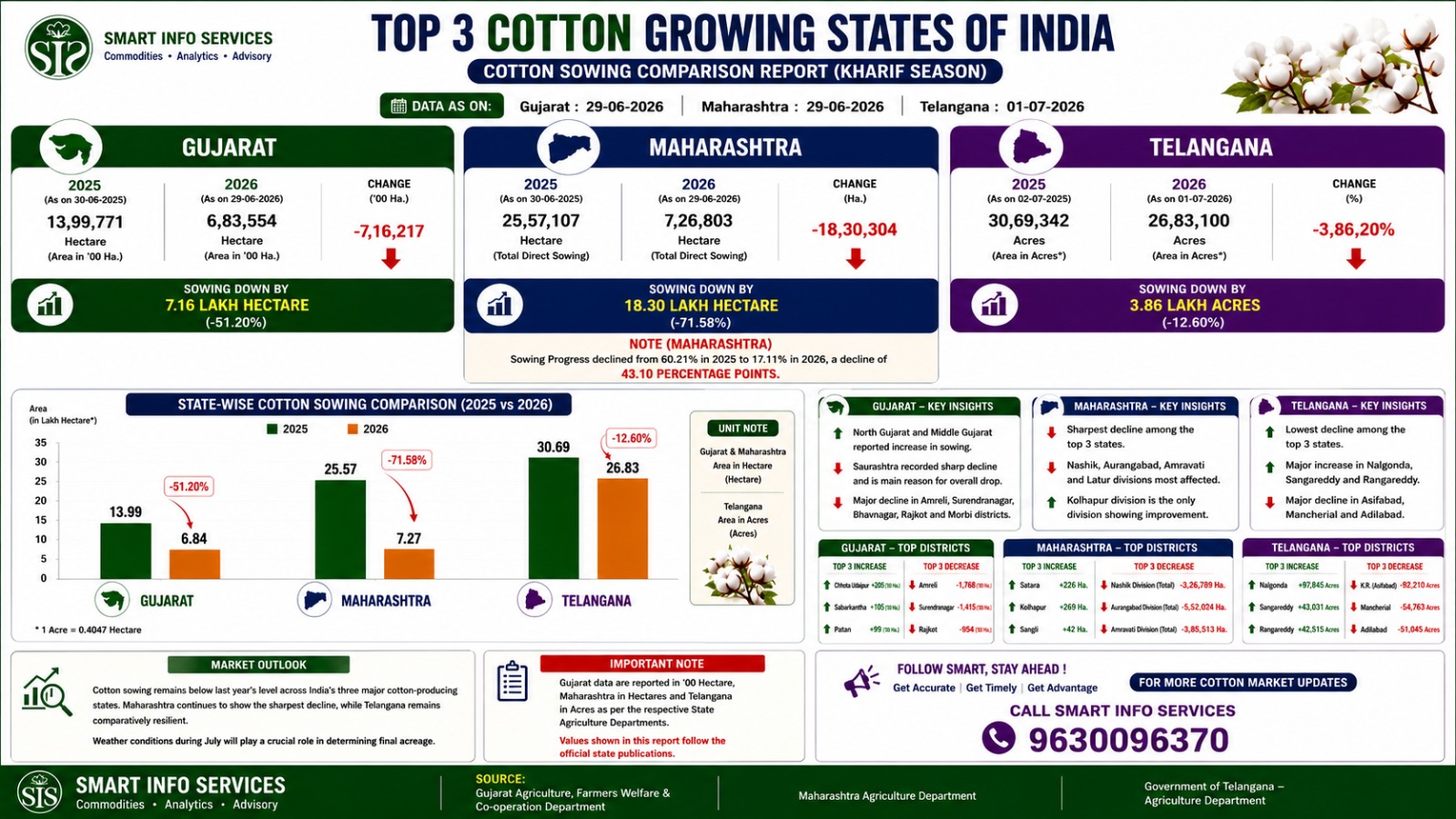
Dhule : Kharif Sowing Target in District Nears 3.75 Lakh Hectares; Cotton Area Shrinks as Trend Shifts Toward Maize and Soybean*The Agriculture Department has set a total sowing target of 376,669 hectares for the Kharif season in the district this year. This target remains roughly consistent with that of the previous year. The district's total cultivable area stands at 378,432 hectares, the majority of which has been designated for the sowing of Kharif crops.The crop basket for this Kharif season includes cereals (rice, sorghum, pearl millet, finger millet, and maize), pulses (pigeon pea, green gram, black gram), and oilseeds (groundnut, sesame, sunflower, and soybean), alongside commercial crops such as cotton and sugarcane. Anticipating rainfall ranging from normal to above-normal—as forecast by the Meteorological Department—the Agriculture Department has already initiated preparations to ensure the availability of seeds and fertilizers.According to agriculture officials, if the rains arrive on schedule, sowing operations are expected to proceed at a rapid pace.*Decline in Cotton Cultivation Area; Shift Toward Alternative Crops*Over the past few years, the district has witnessed a consistent decline in the area dedicated to cotton cultivation. Previously, a significant portion of the Kharif land was utilized for cotton farming; however, a reduction in this area has now been recorded.Key factors cited for the decline in cotton cultivation include pest infestations, rising costs of pesticides, increased labor expenses, and market price volatility. Consequently, farmers are now pivoting toward alternative crops.*Maize and Soybean Emerge as Preferred Alternatives*There has been a rapid surge in farmers' interest toward the cultivation of maize and soybean within the district. Farmers perceive these crops as relatively less expensive and less labor-intensive, as they require fewer pesticides and spraying interventions compared to cotton.For this very reason, the area under maize and soybean cultivation is steadily expanding during the Kharif season, effectively replacing cotton.read more :- Brazil Cotton Exports Jump Despite Softening Prices

Brazil Cotton Exports Jump Despite Softening Prices

Strong Growth in Brazil's Cotton Exports in May 2026; Momentum Sustained Despite Slight Dip in PricesBrazil's raw cotton exports recorded a sharp increase during the first 15 working days of May 2026. According to government statistics, this data is included in a report by the Secretariat of Foreign Trade (SECEX), which operates under the Ministry of Development, Industry, Trade, and Services.The report indicates that the daily average export volume during this period was 67.8% higher compared to May 2025. While the daily average in May 2025 stood at 9,152.6 tons—resulting in a total export of 192,204.3 tons over 21 working days—this average surged to 15,356 tons per day during the initial 15 working days of May 2026. So far this month, a total of 230,339.3 tons of raw cotton have been exported.This rapid surge in exports also had a positive impact on revenue. The average daily export revenue rose to approximately US$23.681 million, representing a 60.7% increase compared to the US$14.738 million recorded in May of the previous year. However, a decline was observed in the average export price per ton. This figure dropped from US$1,610.2 per ton in May 2025 to US$1,542.1 per ton this month—a decrease of 4.2%.Overall, the revenue generated from raw cotton exports during the first 15 working days of May 2026 amounted to approximately US$355.215 million, whereas this figure stood at US$309.489 million for the entire 21-working-day period in May 2025.Pressure was also evident in the global cotton market, as trading remained closed on the New York Stock Exchange due to the Memorial Day holiday. According to market analysts, profit booking, the possibility of rain in U.S. producing regions, and lower crude oil prices have exerted downward pressure on cotton prices. The decline in oil prices has made polyester more competitive, thereby impacting the demand for natural fibers.In Brazil's domestic market as well, the recent surge in cotton lint prices appears to be losing momentum. This is attributed to a decline in global prices and buyers waiting for greater clarity before making new purchases.read more:- India Cotton Stocks Strong as Sowing Area May Rise 7%

India Cotton Stocks Strong as Sowing Area May Rise 7%

A SUMMARISE REPORT ON PRESENT COTTON SCENARIO (POSITION AS ON 30/04/2026) (Each bale170 kgs.)▪️Total pressing estimate during crop year 2025-2026 is estimated as 334.50 lakh bales & upto 30-04-2026 total 310.50 lakh bales have been pressed. Considering above till April-2026 end total availability of cotton may be assesed as 412.89 lakh bales including import of 41.80 lakh bales and Opening stock of 60.59 lakh bales.▪️Cotton consumption in this cotton season may touch 338.00 lakh bales and upto 30-04-2026 about 197.16 lakh bales reported as consumed. (SIS)▪️Export upto April-2026 end is found total 18.00 lakh bales against estimation  for this season year of 15.00 lakh bales.▪️It is revealed that during current crop  end total 47.00 lakh bales may be imported. Upto April-2026 about 41.80 lakh bales have been arrived at different indian ports. (SIS)▪️Kepping in view the above , total available stock as on 30.04.2026 is calculated to the tune 412.89 lakh bales, consisting of opening stock, total pressing & import. (SIS)▪️As on 30-April-2026 stock with the mills is found to the tune of 98.00 lakh bales where as with CCI/MFED MNCS, Ginner , Treaders and Exporters it comes around 108.73 lakh bales.▪️Better cotton prices and higher farmer income may boost India’s cotton sowing area by around 7% in ensuing season.read more:- Indian Rupee Opens 7 Paise Lower Against US Dollar at 95.75

Rising Input Costs Pressure Gujarat Manufacturing Sector

Rising Costs Squeeze Margins in Gujarat's Manufacturing IndustryGujarat's manufacturing industry is currently spending more time grappling with rising input costs than focusing on expansion or securing new orders. Business owners across the textile, chemical, pharmaceutical, and real estate sectors report that a persistent rise in raw material prices, coupled with sluggish demand, has made it increasingly difficult to sustain profit margins.While many companies are attempting to gradually hike prices, a significant portion of the MSME sector is unable to pass the entire burden of these rising costs onto their customers. The repercussions of this situation are manifesting as project delays, reduced production volumes, and inflationary pressures rippling across the entire industrial value chain.The textile industry, in particular, is under severe strain. Soaring prices for cotton yarn and crude-linked chemicals, combined with elevated fuel costs, have rapidly driven up production expenses. Over the past few weeks, a scarcity of yarn availability and rising processing charges have also led to an increase in fabric prices, ranging from approximately ₹10 to ₹25 per meter.According to industry sources, robust export demand from China has pushed cotton yarn prices to a four-year high, while geopolitical tensions in West Asia have further inflated the cost of crude-based inputs essential for dyeing and processing operations. Furthermore, yarn shortages within powerloom units have curtailed production—a factor that has further exacerbated the supply crunch.Although exporters had anticipated benefiting from the depreciation of the Indian Rupee, high shipping costs and persistent demands for price discounts from buyers have largely eroded this potential advantage. Industry representatives state that, owing to the dual pressures of escalating costs and uncertain market demand, many manufacturing units are being compelled to halt production, despite holding existing orders.Meanwhile, calls to abolish the 11% import duty on cotton have intensified, with stakeholders arguing that such a measure is crucial to lower raw material costs and help maintain global competitiveness.read more :- Kharif Sowing Hit by Diesel and Water Crisis in Maharashtra, Gujarat
Related News

Youtube Videos

जानिए आज का कपास बाज़ार? 😱 Cotton Market Rate Today #kapas
साप्ताहिक कपास बाजार में गिरावट 😱 Weekly Cotton Market Rate #kapas
साप्ताहिक कपास बाजार में गिरावट 😱 Weekly Cotton Market Rate...
जन्माष्टमी पर कपास बाजार में गिरावट 😱 आज का कपास भाव  #cotton
जन्माष्टमी पर कपास बाजार में गिरावट 😱 आज का कपास भाव #cott...
Application Download
Whatsapp Contact