STAY UPDATED WITH COTTON UPDATES ON WHATSAPP AT AS LOW AS 6/- PER DAY
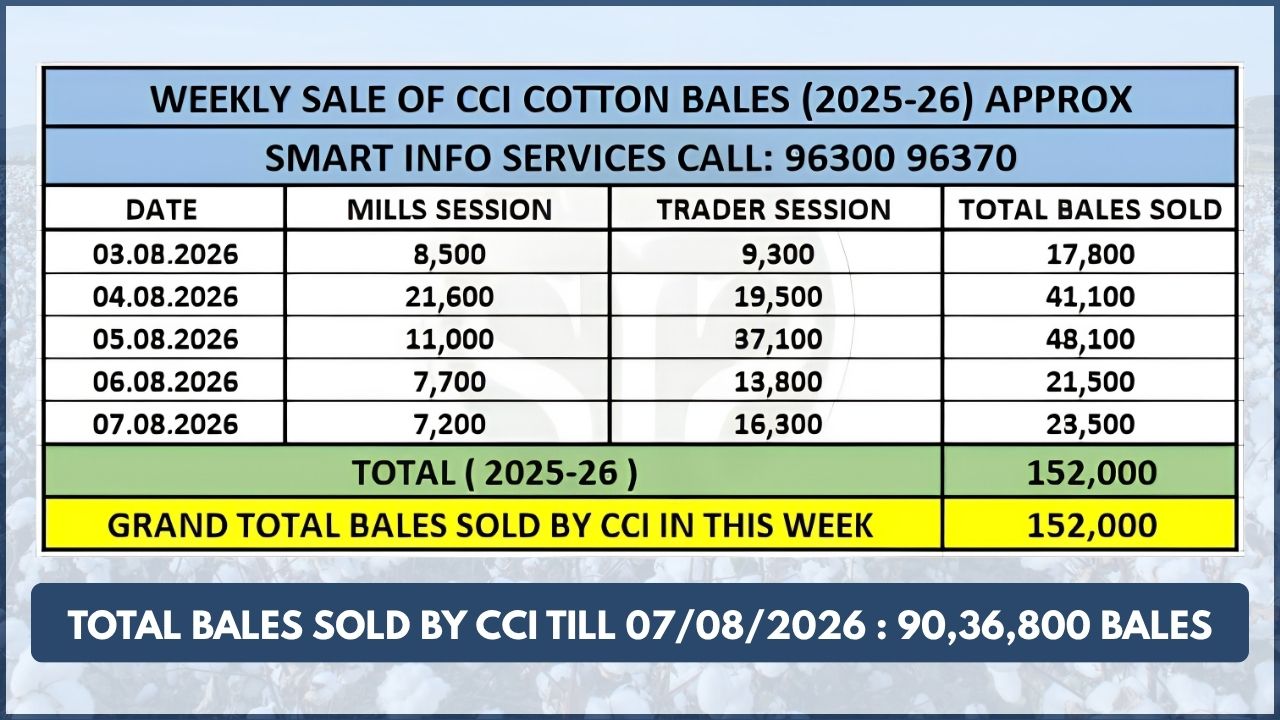
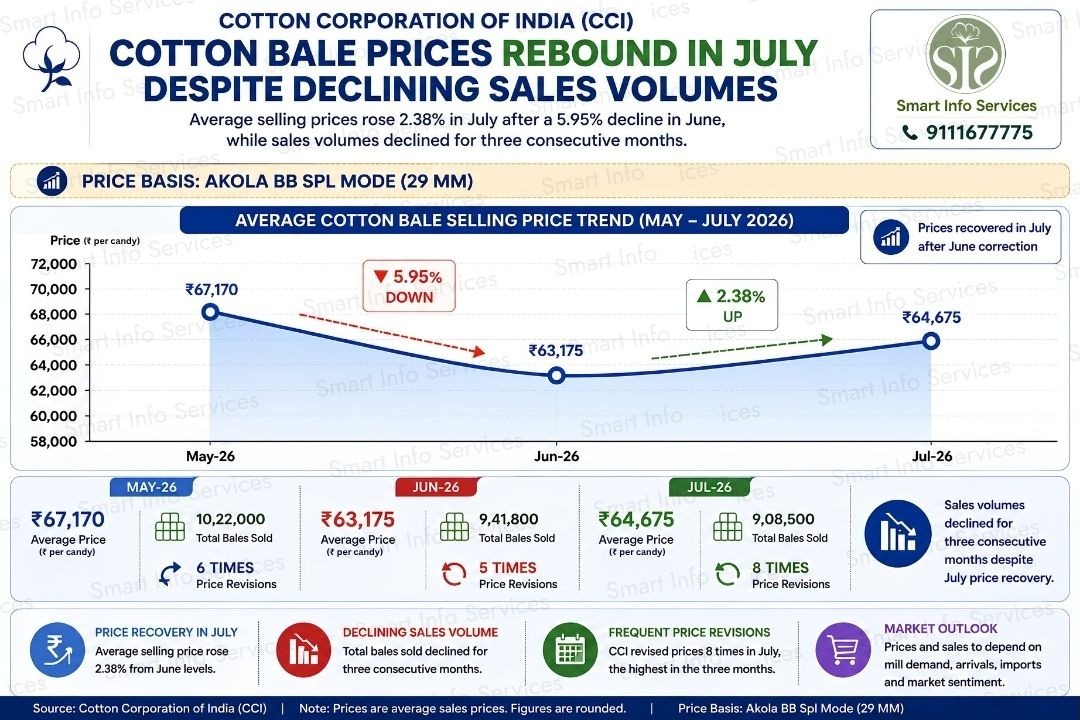
Start Your 7 Days Free Trial TodayState-wise CCI Cotton Sales Details – 2024-25 SeasonThe Cotton Corporation of India (CCI) made no changes in per candy price this week. Following the price revision, CCI sold approximately 2,95,500 bales during the week, bringing the total cotton bales sales for the 2024-25 season to approximately 88,18,100 bales. This represents around 88.18% of the total cotton procured so far this season.A state-wise breakdown of sales indicates strong activity from Maharashtra, Telangana, and Gujarat, which together account for over 85.31% of the total sales to date.This data underscores CCI’s proactive efforts in stabilizing the cotton market and ensuring steady supply across key cotton-producing states.
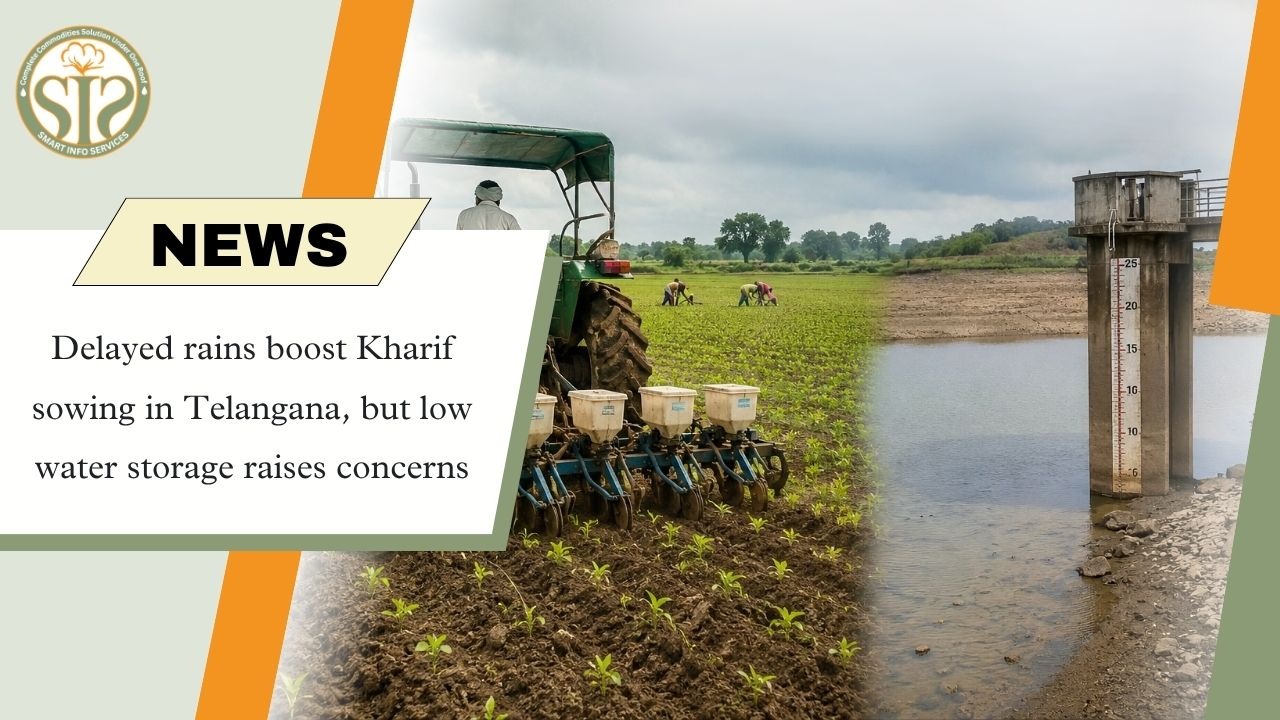
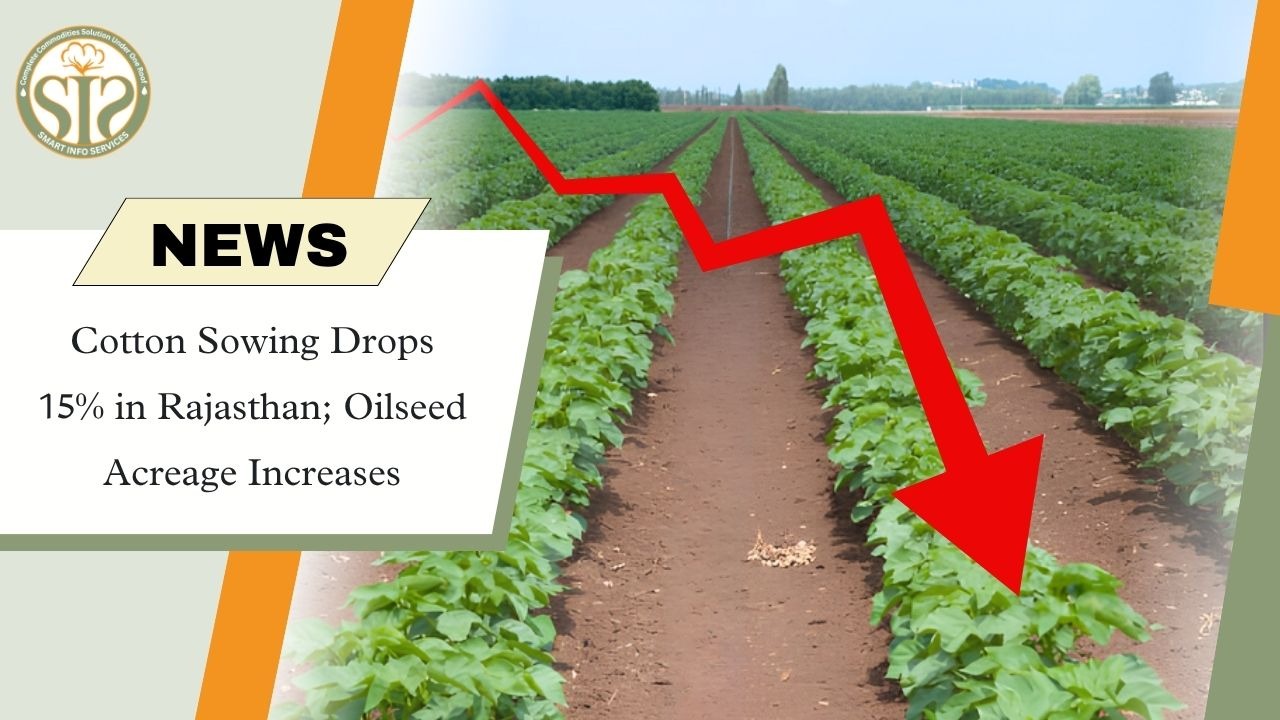
Lack of irrigation water in the canals in April-May delayed cotton and cotton sowing.Upper Rajasthan: Due to a shortage of irrigation water in the Sri Ganganagar canals, farmers were unable to sow cotton and cotton as targeted in April-May this year.Despite the monsoon season, the state's share of water in the Ganga Canal from Punjab is not being fully supplied. The monsoon has retreated, and there is little chance of rain in the region. These days, the maximum temperature is hovering above 38 degrees Celsius. Due to the lack of adequate irrigation water in the canals in April-May, cotton and cotton sowing has been affected and failed to meet targets.The district's target for sowing indigenous cotton was 1,400 hectares, American cotton 5,000 hectares, and Bt cotton 170,000 hectares.Conversely, due to the lack of irrigation water, only 783 hectares of indigenous cotton, 1,013 hectares of American cotton, and 147,000 hectares of Bt cotton were sown. This month, the state's share of water in Ganga Canal till September 20 is 2500 cusecs, but only around 1500 cusecs of water is available in Ganga Canal at Khakhan Head on the Rajasthan border.read more :- Cotton prices remained stable despite market equilibrium.
Cotton prices remain unusually stable amid market equilibriumWhile other commodity prices have seen significant fluctuations throughout the year, cotton has maintained remarkable stability.Since January, cotton prices have consistently traded within a narrow range of 65 to 69 US cents per pound, a stark contrast to the volatility seen in other commodity markets.(SIS)This week, cotton's historical volatility reached multi-year lows, underscoring the current calm.According to Commerzbank AG, the difference between the monthly high and low in September was just 2 US cents.This trend of limited price movement was also seen in July and August.During the first half of the year, the typical monthly trading range was 4-5 US cents, with April being the only exception at 9 US cents.(SIS)The German bank noted in an update on Friday that the brief spike in volatility in April stemmed from a temporary drop in prices to just over 60 US cents following US President Donald Trump's announcement of reciprocal tariffs.“The decline in price volatility began last year, when prices peaked at nearly 100 US cents per pound in the first quarter of 2024,” said Commerzbank commodity analyst Karsten Fritsch in the update.Market balance is a key factorThe current stability in cotton prices can largely be attributed to the near-equilibrium state of the market since last year.For the current 2025-26 crop year, the US Department of Agriculture (USDA) projects a modest supply deficit of 250,000 tons.This is based on an estimated supply of 25.62 million tons and demand of 25.87 million tons.(SIS)The previous crop year saw an even smaller gap between supply and demand, with a modest supply surplus.*This year, the US cotton crop is projected to be 8% smaller... A decline is expected, resulting from significantly reduced acreage and lower yields.(SIS)However, the low abandonment rate (the difference between planted and harvested acreage) has helped to limit the overall reduction in crop volume, Fritsch said.Due to the smaller crop and a modest increase in exports, US cotton stocks at the end of the crop year are expected to be slightly lower than at the beginning.China's Dominance and the Impact of Trade DisputesChina has a significant influence on the global cotton market, ranking first in both supply and demand, ahead of India.Since China consumes more cotton than it produces, it relies on imports.These imports saw a notable decline in the previous crop year, and according to USDA forecasts, no significant increase is expected this year.(SIS)Brazil, which surpassed the US as the largest cotton exporter two years ago, can easily meet China's import needs on its own."This is why the trade dispute will play a smaller role for cotton than for many other agricultural commodities," Fritsch said.It is clear that this stability in cotton prices will not last forever.While the current stability in cotton prices is not expected to last indefinitely, what will ultimately disrupt this equilibrium remains unclear.(SIS)However, it is not entirely clear what could push prices out of their comfortable range.Cotton prices have been unusually stable since January, trading between 65 and 69 US cents per pound.This stability is due to a near-balance in the market, with a slight shortage in supply projected for 2025-26.China's dominant role and Brazil's export capacity suggest that trade disputes will have a limited impact on prices.(SIS)read more:- CCI sells 88% of cotton through e-auction, weekly sales at 2.95 lakh bales

The Cotton Corporation of India (CCI) Sells 88.18% of 2024–25 Cotton Procurement via E-Bidding, Logs Weekly Sales of 2.95 Lakh Bales.Throughout the week from 15 to 20 September 2025, CCI conducted online auctions across its Mills and Traders sessions, with total sales reaching approximately 2,95,500 bales. Importantly, cotton prices remained unchanged during this period, ensuring stability in the market.Weekly Sales Performance15 September 2025: The week’s highest sales volume was recorded at 2,35,800 bales, with Mills buying 49,700 bales and Traders securing 1,86,100 bales.16 September 2025: CCI sold 5,800 bales, including 3,200 bales in the Mills session and 2,600 bales in the Traders session.17 September 2025: Another strong day with 41,100 bales sold, including 7,100 bales to Mills and 34,000 bales to Traders.18 September 2025: Sales surged to 3,600 bales, with Mills purchasing 2,400 bales and Traders accounting for 1,200 bales.19 September 2025: The week concluded with the sales of 9,200 bales, split between 8,400 bales for Mills and 800 bales for Traders.CCI achieved total sales of approximately 2,95,500 bales for the week and for the season CCI’s cumulative saleshave reached 88,18,100 bales, representing 88.18% of its total procurement for 2024–25.read more :- CNBC Markets Interview with CAI President – September 19, 2025
CAI President Interview on CNBC Bazar (Gujarati), Dated 19.09.2025Q1. What is the reason ICE futures are range-bound between 64 to 69 cents?Ans.: Since last year, ICE futures have been range-bound between 64 to 70 cents. The main reasons are :1. Brazil’s bumper crop of about 240 lakh bales (Indian 170 kg standard). Brazil is offering cotton at 4 to 6 cents lower than the U.S.2. China is producing its largest cotton crop in the last 12 years and has stopped importing U.S. cotton.These two factors are exerting pressure on ICE futures and preventing any upward movement. Until ICE futures cross 75 cents, we will not see a significant rise in Indian or global cotton markets.Q2. What is the outlook for Indian cotton and the condition of the new crop?Ans.: Currently, Indian cotton prices are steady, ranging from ₹53,000 to ₹55,000 per candy, depending on quality. These rates are expected to remain stable for some time, and an upward trend is unlikely in the near term.On 30th September 2025, India will have record closing stocks of 60–65 lakh bales — the highest since the COVID year. The new season (starting 1st October) will therefore open with 60–65 lakh bales of old stock, equivalent to around 75 days of mill consumption.For the new crop, state associations estimate a 5–10% higher output compared to last season, mainly due to the widespread adoption of new “4G” technology seeds across major cotton-growing states. According to Gujarat experts, these seeds yield over 700 kg per hectare with 36–40% lint output.* Expected new crop (2025/26): 325–340 lakh bales (vs. 312 lakh last season)* Opening stock: 60–65 lakh bales* Imports expected: 40–50 lakh bales Thus, the total availability will be about 430 lakh bales. This surplus will put downward pressure on the market.Q3. Out of the 60–65 lakh bales carry-forward stock on 30th September, how much will be with CCI, traders, MNCs, and mills?Ans.: Currently, CCI holds 12–15 lakh bales of unsold stock, plus 20–25 lakh bales sold but not yet lifted. Out of this, about 15 lakh bales were sold in the last 15 days alone and remain unlifted. Therefore, by 30th September, CCI’s godowns will hold around 30–35 lakh bales, while mills will have another 30–35 lakh bales — making the total 60–65 lakh bales.This year, mills purchased heavily from CCI and also imported record quantities. By 30th September, mills are expected to have an average of 40–45 days’ stock in their godowns.Since the government has allowed duty-free imports until 31st December, mills have covered imports in large volumes, especially lower-quality cotton at ₹48,000–₹51,000 (Indian port delivery). Around 20 lakh bales are expected to arrive at Indian ports between October and December.Q4. Should the government reconsider the duty-free import decision, as it could harm farmers?Ans.: Farmers are protected by higher MSP rates of ₹8,110 per quintal. Duty-free import was a long-pending demand of the textile industry, and its approval addresses that need.Q5. Why are Indian mills importing such large quantities despite sufficient domestic stock?Ans.: There are two main reasons: 1. Imported cotton, especially Brazilian, is cheaper than Indian cotton.2. CCI procures over 100 lakh bales between October and April but withholds selling immediately, storing it for 8–9 months. Mills requiring continuous supply therefore turn to imports.For the next season, contracts for about 20 lakh bales (October–December shipment) are already in place. Overall, imports could reach 40–50 lakh bales. With this plus higher domestic production and record opening stock, India may see more than 100 lakh bales of carryover stock on 30th September 2026 — the highest ever.Q6. The government recently reduced GST on man-made fibres from 18% to 5%. How much shift do you expect from cotton to man-made fibre?Ans.: This 13% tax advantage will boost demand for man-made fibres. As per Grasim (Birla), sales of viscose and other fibres are expected to rise by 5–7% in the coming year. Consequently, Indian cotton consumption could decline by 15–20 lakh bales.For 2025–26, overall cotton consumption may fall from 315 lakh bales to about 290 lakh bales, mainly due to the GST reduction on man-made fibres and the 50% U.S. tariff.read more :- INR Gains 12 Paise, Closes at 88.10 per Dollar
The Indian rupee on friday higher 12 paise to close at 88.10 per dollar, while it opened at 88.22 in the morning.At close, the Sensex was down 387.73 points or 0.47 percent at 82,626.23, and the Nifty was down 96.55 points or 0.38 percent at 25,327.05. About 1992 shares advanced, 1961 shares declined, and 163 shares unchanged. read more :- Girdawari mandatory: Zero registration on MSP portal in 17 days
The mandatory Girdawari (land survey) requirement for registration to sell cotton at MSP has been achieved to date, but the result is not a single registration on the portal in 17 days.Piles of cotton piled up on the bales at Hanumangarh Junction Mandi. | Hanumangarh: For the first time, the CCI has implemented online registration for cotton purchases at the Minimum Support Price (MSP). The 'Kapas Kisan' app has been launched for this purpose on September 1st.After the Girdawari (land survey) is 100% complete, the report will be certified and uploaded. Only then will farmers be able to obtain the Girdawari report from the Patwari or online. The complete Girdawari is unlikely to be completed before October 15th. Consequently, government cotton procurement will also be delayed. The Agricultural Marketing Department has written to the CCI requesting the removal of the Girdawari requirement at the time of registration. Despite this, the CCI has not issued any orders in this regard. The FCI also purchases wheat at the support price based on online registration, but a survey is not required during registration.When farmers bring their produce to the market, the survey is conducted and the purchase is made.However, the CCI has made it mandatory to upload the survey report at the time of registration. Consequently, registration will be delayed, and procurement will not begin on time. This will result in significant losses for farmers. This year, cotton has been sown on approximately 180,000 hectares in the district. The sown area is approximately 61,000 hectares more than last year. The crop is in good condition so far. Consequently, production is expected to be good. Cotton will arrive in the markets in October.If procurement at the support price does not begin on time, farmers will face difficulties. This time, the Cotton Corporation of India (CCI) will procure at nine centers in the district. The CCI has written to the secretaries of the Agricultural Produce Market Committees of Hanumangarh Town, Junction, Goluwala, Pilibanga, Rawatsar, Bhadra, Nohar, Tibbi, and Sangaria, urging them to educate farmers about registering. However, due to the mandatory uploading of a Girdawari report, farmers are unable to register. CCI officials claim that online registration has been initiated for the convenience of farmers. After registration, farmers will be able to bring their produce to the market according to their slots. The Girdawari requirement is to harass farmers. The government does not want to purchase agricultural commodities at the support price. The government makes new rules every day, but does not consider the interests of farmers. Therefore, various obstacles are imposed. First, online registration was made mandatory for purchasing cotton. Now, Girdawari is being imposed. Farmers will not tolerate this.Surendra Sharma, farmer leader, Hanumangarh Deputy Director, said, "A letter has been written to the General Manager to remove the requirement of Girdawari (land survey) during registration. Girdawari is mandatory during registration on the Cotton App. Due to this, not a single registration has been made. A letter has been written to the General Manager of CCI to remove the requirement of Girdawari during registration." DL Kalwa, Deputy Director, Agricultural Marketing Department, Hanumangarh. The Central Government has increased the MSP of cotton by Rs. 589 per quintal, benefiting farmers. This time, the Central Government has increased the MSP of cotton by Rs. 589 per quintal. This time, the support price for medium-staple cotton has been set at Rs. 7710 per quintal, and the MSP for long-staple cotton has been set at Rs. 8110 per quintal. In recent years, Hanumangarh district has produced common staple cotton, between medium and long. When arrivals begin in the markets, the CCI determines the price by checking the length. Purchases are then made at that rate. Last year, the price of medium staple cotton was fixed at Rs 7121 per quintal and that of long staple at Rs 7521 per quintal. Due to low production last year, procurement could not be done at the support price.Traders only purchased the produce through open auction. The average market price during the season was Rs 6500 to 7000 per quintal. Guidelines from higher level, Girdawari is necessary for registration. Cotton producing farmers can register online on the Kapas Kisan App to sell their produce. Girdawari is necessary at the time of registration. Registration and procurement guidelines for cotton procurement are decided at higher level. Kewalkrishna Sharma, Quality Inspector, CCI
GST 2.0 Boosts Textile and Logistics SectorsNew Delhi : According to an official statement issued on Thursday, the rationalization of the Goods and Services Tax (GST) under GST 2.0 is a significant reform aimed at addressing structural anomalies, reducing costs, and boosting demand in the textile and logistics industries. Both of these are crucial for domestic growth, employment, and export competitiveness.By uniforming tax rates across the value chain, the GST reform ensures affordability for consumers, sustains employment in labor-intensive sectors, and enhances India's ability to compete globally. The statement states that in the textile sector, this rationalization strengthens the entire value chain—from fiber to apparel—by reducing distortions, improving apparel affordability, reviving retail demand, and boosting export competitiveness.The reduction in GST will make apparel more affordable for middle- and lower-income families, boosting domestic demand and having a significant impact in smaller towns and rural areas.The GST on readymade garments up to ₹2,500 is now 5%, making apparel more affordable and boosting domestic demand.Reducing the GST on man-made fibers and yarns from 12% and 18% to 5% removes the inverted duty structure and strengthens small and medium enterprises, while reducing the GST on carpets and other textile floor coverings from 12% to 5% will enhance global competitiveness, the statement said.Similarly, reducing the GST on commercial goods vehicles from 28% to 18% will reduce logistics costs and boost exports.GST reforms also extend to the transportation sector, which plays a key role in reducing logistics costs and promoting industrial growth. Trucks and delivery vans, which carry approximately 65-70% of India's freight traffic, benefit significantly from the tax rationalization. Cheaper freight transportation – Lower costs per tonne-km benefit the transportation of textiles, FMCG, and e-commerce deliveries.The cascading effect of lower logistics costs helps mitigate overall price pressures and reduce inflation. Furthermore, lower logistics costs make the Indian textile industry more competitive abroad.Rationalizing GST in the textile and logistics sectors is a decisive step towards strengthening India's manufacturing base, improving affordability, and boosting exports. By reducing structural imbalances and easing cost pressures, these reforms benefit consumers, small businesses, and exporters alike. The statement further stated that these reforms reinforce the vision of a globally competitive India, driven by resilient supply chains and a thriving textile sector.read more :- Tamil nadu : Mini textile park inaugurated in Karur
Tamil Nadu: Karur gets new textile parkMinister for Textiles and Handlooms R. Gandhi on Thursday inaugurated a mini textile park at Kodangipatti on Thursday.It has been set up under the Tamil Nadu Mini Textile Park Scheme. Under the scheme, the State government will bear 50% of the expenditure on establishing common facilities, infrastructure, and factory buildings. The maximum grant will be ₹2.5 crore for each park. A sum of ₹11.87 crore had been spent on establishing the park. Of the expenditure, the State government had extended ₹2.5 crore as grant. Oasis Texpark Private Ltd. has spent the remaining amount.Minister for Textiles and Handlooms R. Gandhi on Thursday inaugurated a mini textile park at Kodangipatti on Thursday.It has been set up under the Tamil Nadu Mini Textile Park Scheme. Under the scheme, the State government will bear 50% of the expenditure on establishing common facilities, infrastructure, and factory buildings. The maximum grant will be ₹2.5 crore for each park. A sum of ₹11.87 crore had been spent on establishing the park. Of the expenditure, the State government had extended ₹2.5 crore as grant. Oasis Texpark Private Ltd. has spent the remaining amount.A press release said that three companies would function in the textile park. About 400 persons would get employment.Mr. Gandhi said that approval had been given to nine mini textile parks in Karur district. Of them, two parks had started functioning. Other parks were under construction.Earlier, Mr. Gandhi and Mr. Senthilbalaji inaugurated a quilt machine erected at an estimate of ₹35 lakh at Thiyagi Kumaran Handloom Weavers Cooperative Society here.read more :- Rupee open Falls 09 Paise to 88.22/USD
Rupee opens 9 paise weaker at 88.22/USD as dollar strengthensThe Indian rupee opened 9 paise weaker at 88.22 against the US dollar on September 19, tracking the continued rise of the USD index.read more :- India's cotton production expected to increase in 2025-26
India's cotton production expected to increase in 2025-26 despite decline in key statesIndia's cotton production is projected to be higher than last year in the 2025-26 season, starting in October. However, crop acreage has declined in key states like Maharashtra and Gujarat, and heavy rains in August have damaged standing crops in some areas.Key State-wise Situation* Gujarat: Acreage decreased from 23.66 lakh hectares to 20.82 lakh hectares (12% decline).* Maharashtra: Acreage decreased from 40.81 lakh hectares to 38.44 lakh hectares.* Telangana: Acreage increased from 18.11 lakh hectares to 18.51 lakh hectares.* Karnataka: Acreage increased from 7.79 lakh hectares to 8.08 lakh hectares.* Andhra Pradesh: A slight decrease, from 4.13 lakh hectares to 3.77 lakh hectares.Production EstimatesAccording to trade associations, India's cotton production in 2025-26 could reach 32.5–34 million bales (each weighing 170 kg), up from 31.2 million bales in the current season.* Karnataka: Increase from 2.4 to 3 million bales (25% increase).* Andhra Pradesh: Increase from 1.25 to 1.7 million bales.* Telangana: Increase from 5.0 to 5.3–5.5 million bales.Total production in South India could reach 10.5 million bales, up from last year's 8.8 million bales, and offset the shortfall in other regions.Market ImpactCotton arrivals are expected to reach 30–35,000 bales per day by Dussehra, significantly higher than the current 10,000 bales. However, prices are under pressure due to increased production and imports.The government has removed the 11% import duty until the end of the year to support the textile industry. Due to this, imports have reached a record 4.1 million bales in 2024-25 (up from 1.5 million bales last year). Imports are expected to exceed 2 million bales in October-December alone.Raw cotton prices are trading below the MSP (₹5,500–7,000 per quintal). Recent rains in northern states have also affected fiber quality.CCI's RoleThe Cotton Corporation of India (CCI) has prepared for large-scale procurement at MSP. Operations will begin from October 1st through 550 centers in North India. CCI, which purchased 10 million bales last year, has a stock of 1.2 million bales this time.Global OutlookThe USDA estimates that India's production will increase, while imports will decrease to 3.58 million bales and exports will increase to 1.664 million bales.According to the ICAC, global production will decline from 25.9 million tons to 25.5 million tons. Production has been affected due to weather and pests in America, Pakistan and Sudan.read more:- INR Drops 17 Paise, Closes at 88.13 per Dollar
The Indian rupee on thursday lower 17 paise to close at 88.13 per dollar, while it opened at 87.96 in the morning.At close, the Sensex was up 320.25 points or 0.39 percent at 83,013.96, and the Nifty was up 93.35 points or 0.37 percent at 25,423.60. About 2019 shares advanced, 1962 shares declined, and 158 shares unchanged.read more :- PM Mitra Park: Better prices for farmers, employment for youth, investment on 5F model
Farmers said the PM Mitra Park will bring good cotton prices; youth and women hope for employment; investors said the factory will operate on 5F.Prime Minister Narendra Modi laid the foundation stone for the country's largest PM Mitra Park, to be built on approximately 2,158 acres of land in Bhainsala, Dhar, on Wednesday. Production in textile-related industries is expected to begin in this park within two years.Cotton farmers and textile entrepreneurs in Malwa-Nimar have high hopes for this park. Youth across the region are also excited about the potential for employment. Dainik Bhaskar spoke with farmers, youth, women, and industrialists and workers about the project. Find out who has what expectations...First, find out...what farmers expect.Manna Lal Bhuria, a cotton farmer from Chayan village, says, "We grow a large quantity of cotton. Currently, our cotton is small. We believe that cotton will be purchased at good prices in the village itself."Narsingh Bhabar, a farmer from Gandhwani, said, "Setting up factories here will provide employment. Children don't have any work right now, but once this work starts, they will. Women will get good work. We grow cotton, which currently sells for 60-70 rupees a kilo. We believe that once the factories open, our cotton will be bought for at least 100 rupees a kilo."What Women, Youth, and Workers SaidPooja, a couple from Dotriya village, said, "Our wages will increase with the establishment of factories here. We will benefit greatly." Local youth Shobharam Vaskel said, "We are still hoping for government jobs. But even if we don't, we will find jobs here in this park. We won't have to go out looking for jobs."Now read what the industrialists investing in the park said... A zipper industry manufacturing chains for pants and bags will spend 2.70 crore rupees. Aditya Jat, manager of the company that came to PM Mitra Park to obtain an LOI for a zipper manufacturing company, said, "Our company, Chaudhary Infra Project, is based in Badnawar.Our company is going to invest 2 crore 70 lakh rupees here. We have been allotted 10 thousand square feet of land. Our company will manufacture chains for pants, bags, and raincoats. The chain used for designing clothes is called a zipper. Our company will work here to manufacture zippers (chains).An Indore company will work on the park's 5F theme. Sanjay Agarwal, a textile industrialist from Indore, one of the industrialists allotted land in PM Mitra Park, said, "Our company works in the textile sector.We have committed to investing 4 crore 72 lakh rupees here under the name NASA Fiber to Fashion." We have filed a project for dyeing, knitting, and garmenting here. Our company will work on the 5F theme of PM Mitra Park.------------------ These are the 5Fs- ---------* FARM - Cotton-producing farmers will be able to bring cotton directly from their fields and sell it to companies .* Fiber - Cotton will be ginned, i.e., cleaned, and made into yarn .* Factory - Cotton will be spun, woven, and separated from the cotton.* Fashion: Clothing designing, garmenting, etc. will be done, such as buttoning .* Foreign: After packaging the finished garments in the factory, they will be exported directly from here to foreign countries.Industrialist said, "If cotton is purchased at competitive rates, farmers will benefit." Lakshmi Narayan Gupta, Director of TDN Fibers Limited, Kukshi, said, "Our business is cotton fibers. We believe we will receive some more concessions. We are also participating in the park." We are planning production here as well.Setting up plants here will benefit local residents. Cotton farmers will see increased profits. When traders purchase cotton from an average farmer at competitive rates, he will receive more money and his income will increase.read more :- Rupee opens 16 paise down at 87.96
Rupee opens 16 paise down at 87.96 as dollar index surgesThe rupee opened at 87.96 against the dollar after ending the previous session at 87.80.read more :- Brazilian cotton prices near decline (2024-25)
Brazilian cotton prices fall as 2024-25 harvest nears completion Cotton prices in Brazil moved down in early September due to the progress of harvesting and processing activities of the 2024-25 season, which boosted the availability of batches and encouraged sellers to be more flexible about quotations. Decreases in dollar values abroad also reinforced the downward trend in the domestic market, as per the Centre for Advanced Studies on Applied Economics (CEPEA).Due to constant price drops, many sellers stayed away from closing trades in the spot market, preferring to accomplish term contracts, which were closed at more attractive values compared to current ones. Purchasers, in turn, were closing only a few deals.The CEPEA/ESALQ Index (payment in 8 days) decreased 6.05 per cent between August 29 and September 15, closing at BRL 3.6703 (~$0.69) per pound on September 15. On September 12, it closed at BRL 3.6590 per pound, the lowest value since early July 2023, in nominal terms (BRL 3.7047 per pound), CEPEA said in its latest fortnightly report on the Brazilian cotton market.According to data from Brazilian Cotton Growers Association (ABRAPA), 90.83 per cent of 2024-25 crops had been harvested and 30.65 per cent had been processed until September 4.International Cotton Advisory Committee (ICAC) estimates the global area at 30.8 million hectares in 2025-26, for a decrease of 0.76 per cent compared to the previous crop. Productivity is expected to move up 1.4 per cent to 829.18 kilos per hectare, resulting in production at 25.55 million tons, up 0.63 per cent year-on-year. World consumption is likely to reach 25.519 million tons.In Brazil, production may increase 7.19 per cent to the record of 3.92 million tons in 2025-26, sustained by the higher area. Domestic consumption is likely to reach 752 thousand tons, up 0.27 per cent compared to the season before, the highest since 2014-15 (801 thousand tons).read more :- Rupee higher 02 Paise Against USD, Closes at 87.80
The Indian rupee on wednesday higher 02 paise to close at 87.80 per dollar, while it opened at 87.82 in the morning.At close, the Sensex was up 313.02 points or 0.38 percent at 82,693.71, and the Nifty was up 91.15 points or 0.36 percent at 25,330.25. About 2311 shares advanced, 1655 shares declined, and 164 shares unchanged.read more :- Rohtak: Hub of grain-cotton trade, new hub of MSME
MSME for Bharat: A hub for grain and cotton trade, strong connectivity has transformed Rohtak into a hub of industrial activity.Micro, Small, and Medium Enterprises (MSMEs) are considered the backbone of growth in the Indian economy. This sector not only employs millions of people but also plays a major role in fostering innovation and accelerating local and regional development. Amar Ujala is organizing the "MSME for Bharat Conclave" to discuss these opportunities and challenges.MSME for Bharat Conclave InformationThe MSME for Bharat Conclave in Rohtak will be held on September 18th from 11 a.m. to 2 p.m. The venue is Radhakrishnan Auditorium, Maharishi Dayanand University. Several prominent figures from the industry, trade, and development sectors will attend the event. The chief guest will be Mr. Rajesh Nagar, Minister of Food and Supplies, Government of Haryana.Objective of the ConclaveExperts will share their views on key topics such as digital transformation, easy access to finance, supply chain modernization, export expansion, skill development, and policy reforms. Additionally, new funding options, modern branding and marketing techniques, and practical uses of Artificial Intelligence (AI) will be highlighted.The conclave will specifically emphasize promoting women's participation, connecting MSMEs to international markets, and providing global recognition to local products through the One District One Product (ODOP) scheme.Experts believe that such events will prove crucial in connecting the MSME sector with new technology and financial opportunities, preparing them for global competition, and shaping future strategies. This conclave will be a unique opportunity for entrepreneurs across the country, including Rohtak, where industry and business leaders will share their experiences and suggestions.Let's learn about the importance of the MSME sector in Rohtak, Haryana, to the national economy.The Specialty of Rohtak's Light IndustryRohtak in Haryana is known as a major grain and cotton trading center. Light industries are also active here, strengthening the local economy.The city is located on the main Delhi-Ferozepur railway line, making it a vital link in the trade map of North India. Rohtak is also a major hub on the regional road network, offering easy access to Delhi, Bhiwani, Panipat, and other cities.Due to its strong position on both trade and transportation fronts, Rohtak continues to be a hub of industrial and economic activity.Industry ChallengesIndustries here face several challenges. Increasing traffic and expensive logistics put pressure on infrastructure, while the grain and cotton trade remains volatile due to seasonality. Small and medium-sized enterprises face a lack of capital and affordable credit. Furthermore, competition from larger industrial hubs and a reliance on traditional technology are slowing the growth of local industries.read more:- Cotton production to rise despite lower acreage and more rainfall
Cotton output likely to be higher despite drop in area, excess rainIndia’s cotton production during 2025-26, starting in October, is likely to be better than last year, despite a decline in the cropping area in key producing States of Maharashtra and Gujarat, and the excess August rain affecting the standing crop in some States. Timely and widespread rain this year and lower incidence of pest attacks have raised the prospects of higher yields, thereby leading to likely expansion of the overall crop size, according to the trade.Farmers reduced the cotton area this year in Gujarat and Maharashtra, as they found alternatives such as maize, groundnut and pulses to be remunerative. Cotton sowing has ended and the overall acreage is down by 2.53 per cent at 109.64 lakh hectares (lh) during the 2025 kharif season compared with 112.48 lh a year ago. Excellent crop conditionsIn major cotton producing States such as Gujarat, cotton was cultivated in 20.82 lh, a decline of 12 per cent compared with 23.66 lh a year. Similarly in Maharashtra, the area declined to 38.44 lh (40.81 lh last year).Meanwhile, the area under cotton cultivation increased in Southern States. In Telangana, it increased to 18.51 lh (18.11 lh), in Karnataka it is up at 8.08 lh (7.79 lh). In Andhra Pradesh, the area fell slightly to 3.77 lh (4.13 lh).“Crop conditions are excellent this year. Though there was a little damage due to recent rains in North India, the weather has opened again, and they are expecting a good crop in North,” said Atul S Ganatra, President, Cotton Association of India. Based on the recent feedback from all 10 State trade associations, India’s overall cotton crop for 2025-26 is likely to be between 325 lakh bales (170 kg) to 340 lakh bales, against 312 lakh bales this season, Ganatra said.In Karnataka, the crop is likely to increase by around 25 per cent to about 30 lakh bales (24 lakh bales in 2024-25), and in AP the crop size expectation is 17 lakh bales (12.5 lakh bales), he said. “Sowing has also increased in these States and the crop is good.” Ganatra said. In Telangana, the crop will likely be between 53 and 55 lakh bales (50 lakh bales), a 10 per cent increase. South to the rescueIn South India, the 2025-26 crop is likely to be 105 lakh bales (88 lakh bales), which is expected to help offset any decline in other States, Ganatra said. “The crop will be better than last year due to better yields on timely sowing, which was over in almost all states by June 15. The crop condition in central India, mainly Gujarat, Maharashtra and Madhya Pradesh, is excellent,” he added.According to Anand Popat, a cotton broker in Gujarat, the crop has been damaged by heavy rains in Punjab and Haryana, which will have a major impact. In Rajasthan, some damage has occurred, but it’s not very significant. In Central and South India, the crop conditions remain very good, so far. “If the heavy rains do not occur at the end of September, the quality and yield of cotton are expected to improve further,” Popat wrote in his latest weekly newsletter.Heavy rains in Maharashtra last month and again over the past two days has left large parts of Vidarbha’s cotton fields waterlogged. The damage, which was earlier estimated at around 14 lakh hectares, is now expected to rise further as the State Agriculture Department continues its assessment. Alongside weather risks, cotton farmers also face recurring pest attacks and diseases, with pest dynamics shifting over time.Telangana too saw extensive rains over the last few weeks, which has damaged the crop. This could impact the output as farmers expect lower yields. The crop is at the flowering-opening to boll elongation to the boll development stages. Pest incidences in AP“Prevailing weather conditions are congenial for the incidence of Spodoptera (insect) in the crop,” a government report said, advising farmers to use appropriate formulations to prevent any diseases at the crucial stage. In Andhra Pradesh, officials reported incidences of whiteflies, thrips, and jassids in districts like Anantapur, Guntur, and Prakasam. The total affected area is said to be about 11,600 ha.Price pressuresTraders expects arrivals during Dasara festive season (which is ahead by about 20 days this year) to be around 30-35,000 bales per day, from the current arrivals of around 10,000. The removal of import duty is expected to spur the imports during the October-December quarter with the trade pegging the imports upwards of 20 lakh bales during the quarter. As a result, the raw kapas prices have also come down and are hovering below the MSP levels in the range of ₹5,500-7,000 per quintal depending on the moisture content and the quality, which has been impacted in certain regions of North due to the recent rains.Heavy lifting by CCIThe State-run Cotton Corporation of India (CCI) has geared up for a massive market intervention and has opened record 550 procurement centres to launch the MSP operations starting Oct 1 in North India. CCI has been liquidating its stocks through the bulk discount sale scheme in an effort to gear up for the market intervention, where public procurement of the fibre crop is going to a high. Last year, CCI had procured one crore bales of 170 kg each and is currently holding around 12 lakh bales of the 2024-25 crop.Amidst record imports, muted demand, prices are expected to stay bearish and CCI may have do some heavy lifting through major market intervention.Meanwhile, the USDA said in its “Cotton: World Markets and Trade” report that India’s production will likely be higher in the 2025-26 season, leading to a marginal drop in imports to 35.8 lakh bales (170 kg) from 37.14 lakh bales. Exports may increase to 16.64 lakh bales next season from 12.8 lakh bales this season.The International Cotton Advisory Council (ICAC) said cotton production estimates have decreased significantly since August, dropping from 25.9 million tonnes to 25.5 million tonnes. It said there are shifts in trade patterns and demands from retailers, and brands are making cotton’s origin increasingly important.read more :- Rain damages cotton, prices below MSP
As Rain damage to unginned cotton has led to a price drop below MSP in North Indian mandis, causing farmers to lose Rs 500-2,200 per quintal.Nearly 6,000 bales of unginned cotton from the first picking of this season (2025–26), along with some old stock held by farmers, have arrived in various cotton mandis across North India, including Punjab, Haryana, and Rajasthan, in recent days. These three states account for the bulk of the region’s cotton cultivation.Unginned cotton, also known as narma, is cotton which is not separated from its seed.However, the initial rates have come as a shock to farmers, ranging between Rs 5,500 and Rs 7,200 per quintal — nearly Rs 500 to Rs 2,200 below the Minimum Support Price (MSP) in several mandis.For this season, the government has fixed the MSP at Rs 7,710 per quintal for medium staple cotton and Rs 8,110 for long staple cotton. In most of the northern cotton belt — Punjab, Haryana, and Rajasthan — medium staple is the primary crop, while medium-long staple is also grown in some parts, with an MSP of Rs 7,860 per quintal.Vinod Gupta, a commission agent based in Fazilka mandi, said cotton began arriving last week, but the pace is slow as incessant rain delayed the picking and damaged the crop. “Farmers were ready for the first picking by the last week of August, but heavy rain ruined it. Prices are nowhere near MSP. In Fazilka, farmers are getting only Rs 6,600 per quintal, which is a big setback,” he said.Bhagwan Bansal, president of the Punjab Ginners’ Association and the owner of SS Cotgin Pvt Ltd in Bathinda, said arrivals in Haryana and Rajasthan are very limited and nominal in Punjab. “Rates are quite below MSP because the crop has heavy moisture due to rains when the first picking was ready. At the moment, both quality and prices are down. If the weather remains good, rates and quality may improve in the second and third pickings in the coming weeks,” he said.Farmers in Haryana reported that waterlogging damaged crops in Hisar and adjoining areas, while similar damage was seen in Punjab’s Fazilka.According to Sushil Mittal, president of the Haryana Ginners Association and owner of Aditya Agro in Sirsa, rates are hovering between Rs 5,500 and Rs 7,100 per quintal, while the MSP in northern states is Rs 7,860 this year.“Farmers who picked before the rain are getting Rs 7,000–7,200 per quintal, but those who picked after the rain are not getting more than Rs 5,500–6,000 because of the damaged quality of the crop. Huge waterlogging in Hisar damaged crops badly. Experts now predict that only 6 lakh bales (170 kg each) of lint, separated from cotton seed, will arrive in Haryana this year, compared to 28–30 lakh bales just a few years back. Climate change, untimely rain, and pest attacks are reducing cotton acreage every year,” he said.Mittal added that his ginning unit has the capacity to produce 60,000 bales, but last year it could manage only 18,000, and this year the output will fall further. “The decline in area and rain damage has further squeezed the ginning and spinning industry,” he said.Northern cotton belt shrinks furtherDespite a small rebound in Punjab, cotton sowing in Haryana and Rajasthan has remained sluggish this season. Erratic weather, water shortages during sowing, waterlogging during picking, and persistent pink bollworm attacks have discouraged farmers from planting cotton, once a major alternative to paddy.Punjab has covered 1.13 lakh hectares, Haryana 3.80 lakh hectares, and Rajasthan 5.17 lakh hectares — totalling 10.10 lakh hectares. This is 2.35 lakh hectares less than last year (2024–25) and nearly 7.9 lakh hectares short of the 2023–24 level of 17.96 lakh hectares.Punjab, which saw its area collapse to below 1 lakh hectares in 2023–24 from 2.14 lakh hectares in 2022–23, has recorded a 15 per cent increase this year. Officials, however, call it only a partial recovery compared to the early 2000s when over 8 lakh hectares were under cotton. Farmers now prefer paddy due to pest attacks and groundwater depletion in the cotton belt.In Haryana, sowing is far behind the 4.76 lakh hectares reported last year and 5.78 lakh hectares in 2022–23. Rajasthan too has seen sharp shrinkage — from 10.04 lakh hectares in 2023–24 to 6.62 lakh hectares last year.read more:- Cotton and paddy in Punjab markets, prices below MSP
Punjab : On 1st day of paddy procurement, cotton too reaches Punjab mandis, sold below MSPBathinda: The first pickings of cotton and paddy reached grain markets of Punjab on Tuesday, the first day of paddy procurement.With the official purchase of cotton starting from Oct 1, the cash crop is being purchased by private traders. Cotton arrived in the Mansa grain market, while paddy arrived at Barnala grain market and others. Earlier, cotton also reached the Abohar grain market.Cotton brought by Gursewak Singh of Bhupal village in Mansa was purchased at Rs 7,265 per quintal, while the crop brought by Gurpreet Singh of Beerewala village was purchased at Rs 7,135 per quintal. Both brought small quantities of the crop. The MSP for different staples of cotton ranges from Rs 7,710 to Rs 8,110 per quintal. Cotton normally grown in Punjab is of 27.5-28.5mm long staple, with an MSP of Rs 8,010 per quintal. The first purchases, which took place in the presence of Mansa market committee chairman Gurpreet Singh Bhuchar, were made at nearly Rs 750-850 per quintal less than the MSP.Paddy that arrived at Barnala grain market was procured by state procurement agencies at an MSP of Rs 2,389 per quintal. As it was the first day of official procurement, some cleanliness arrangements were still underway in the grain markets.read more :- Rupee opened 23 paisa stronger at 87.82
| title | Created At | Action |
|---|---|---|
| CCI Cotton Sales by State – 2024-25 | 20-09-2025 15:39:00 | view |
| Sowing of cotton and maize is affected due to lack of water in canals. | 20-09-2025 13:43:56 | view |
| Cotton prices remained stable despite market equilibrium. | 19-09-2025 17:38:05 | view |
| CCI sells 88% of cotton through e-auction, weekly sales at 2.95 lakh bales | 19-09-2025 17:35:26 | view |
| CNBC Markets Interview with CAI President – September 19, 2025 | 19-09-2025 16:16:04 | view |
| INR Gains 12 Paise, Closes at 88.10 per Dollar | 19-09-2025 15:42:16 | view |
| Girdawari mandatory: Zero registration on MSP portal in 17 days | 19-09-2025 14:53:48 | view |
| "GST 2.0: New impetus for textiles and logistics" | 19-09-2025 12:26:43 | view |
| Tamil nadu : Mini textile park inaugurated in Karur | 19-09-2025 11:46:41 | view |
| Rupee open Falls 09 Paise to 88.22/USD | 19-09-2025 10:39:42 | view |
| India's cotton production expected to increase in 2025-26 | 18-09-2025 16:11:29 | view |
| INR Drops 17 Paise, Closes at 88.13 per Dollar | 18-09-2025 15:42:13 | view |
| PM Mitra Park: Better prices for farmers, employment for youth, investment on 5F model | 18-09-2025 13:30:11 | view |
| Rupee opens 16 paise down at 87.96 | 18-09-2025 10:51:26 | view |
| Brazilian cotton prices near decline (2024-25) | 17-09-2025 15:59:11 | view |
| Rupee higher 02 Paise Against USD, Closes at 87.80 | 17-09-2025 15:40:26 | view |
| Rohtak: Hub of grain-cotton trade, new hub of MSME | 17-09-2025 15:36:28 | view |
| Cotton production to rise despite lower acreage and more rainfall | 17-09-2025 13:08:30 | view |
| Rain damages cotton, prices below MSP | 17-09-2025 11:32:54 | view |
| Cotton and paddy in Punjab markets, prices below MSP | 17-09-2025 11:18:50 | view |