STAY UPDATED WITH COTTON UPDATES ON WHATSAPP AT AS LOW AS 6/- PER DAY
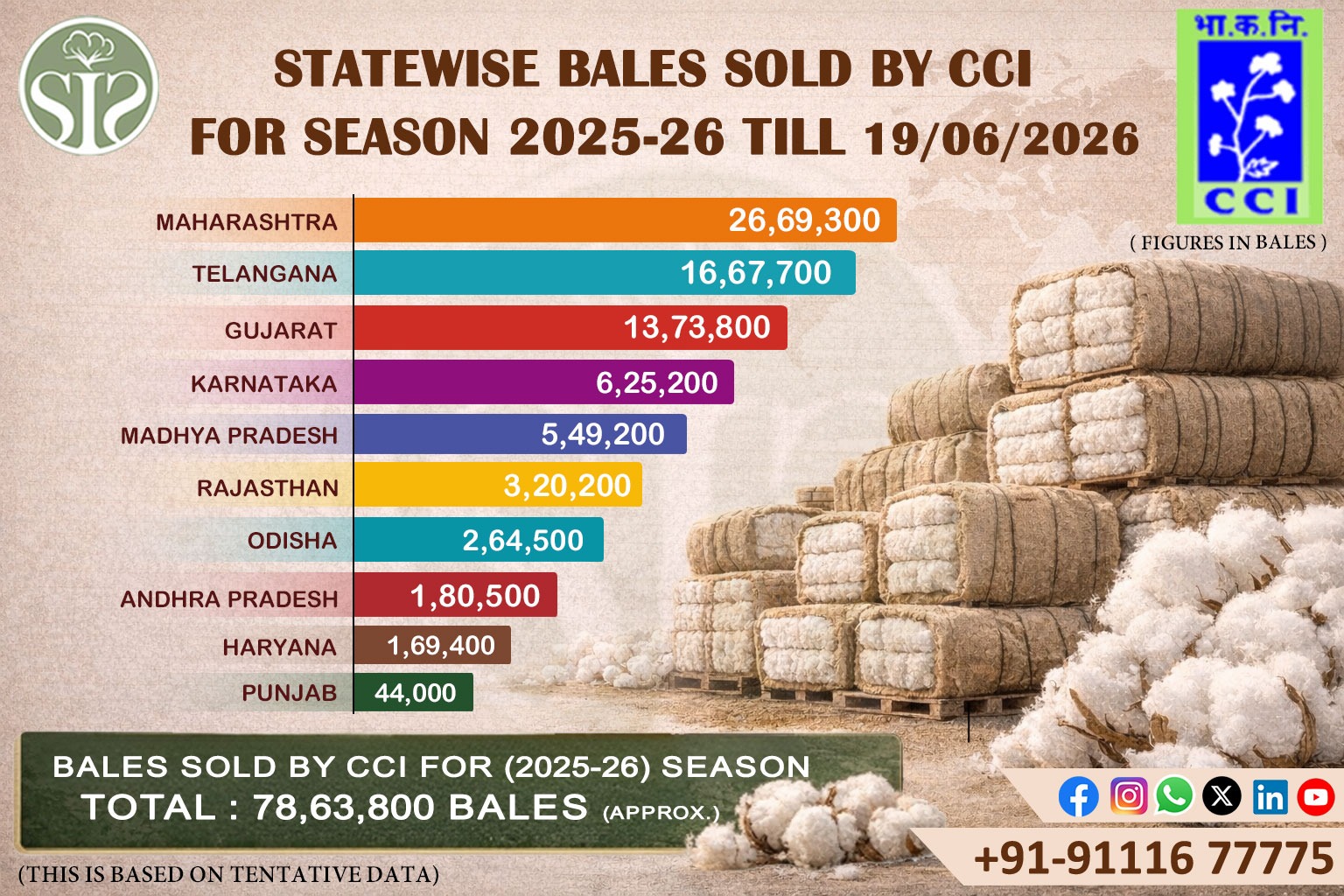
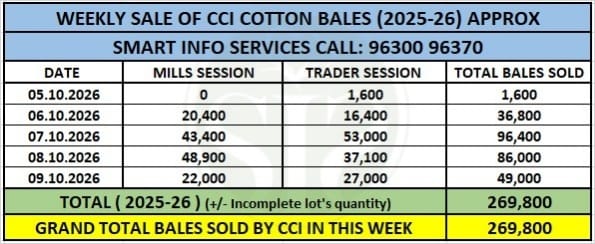
Start Your 7 Days Free Trial TodayIndia's Cotton Corp cuts fiber prices by up to 3% to boost salesAmid a softening trend in international prices, Cotton Corporation of India (CCI) has cut the price of the 2025-26 crop by ₹1,400-1,700 per candy (356 kg) to boost its sales. The state-run unit has also reduced the pickup period for buyaers from 60 days to 30 days."The improvement in prices is in line with international prices," CCI Chairman and Managing Director Lalit Kumar Gupta said. The state-run unit started selling the 2025-26 crop on January 19 and has sold around 4 lakh bales so far, amid a lukewarm response from the industry.Besides, CCI's procurement has so far reached 93 lakh bales of 170 kg each, Gupta said. The procurement will continue till the end of this month. CCI is still carrying out procurement work in states like Telangana, Maharashtra and Gujarat.output estimates unchangedGupta said local inflows are continuing and the industry will continue buying ahead of the market. Daily arrivals are estimated to be between 1.25-1.5 lakh bales. “Our sales generally increase only after March,” Gupta said.Ramanuj Das Boob, sourcing agent in Raichur, said arrivals in Maharashtra, Gujarat and Telangana are good, while arrivals in Karnataka are declining. “Market prices are lower than the CCI price, and traders are getting the cotton of their choice from the market,” Das Bub said.Meanwhile, the Cotton Association of India (CAI), which recently raised the crop estimate for 2025-26 by about 2.5 per cent or 7.5 lakh bales of 170 kg to 317 lakh bales on higher than estimated production in Maharashtra and Telangana, on Tuesday retained the estimate.CAI has pegged total cotton consumption during 2025-26 at 305 lakh bales of 170 kg each by the end of September, compared to 314 lakh bales last year. Cotton consumption by the end of January is estimated at 104 lakh bales, CAI President Vinay N Kotak said in a statement.CAI has projected a year-end surplus of 122.59 lakh bales for the 2025-26 season, up 56 per cent year-on-year on record imports of 50 lakh bales during the year. By the end of January, imports stood at 35 lakh bales and exports at 6 lakh bales.read more :- Cotton arrivals affected due to fall in production in Wardha

Cotton arrivals in Wardha have been affected due to huge decline in production.Wardha: Due to huge decline in production, there has been a sharp decline in the arrival of cotton in Wardha district this season, affecting the farmers as well as the cotton processing industry.During the 2024-25 season, the district recorded arrival of around 1.11 lakh quintals of cotton. However, in the ongoing 2025-26 season, the arrivals so far are limited to only 45,000 quintals, officials said.Currently, the CCI rate for cotton is Rs 8,010/quintal, while private procurement centers are buying cotton at around Rs 7,900/quintal. Farmers are facing difficulties as new CCI registrations have been stopped, although CCI procurement is expected to continue till February 28.Vilash Chandankhede, a farmer from Goji village, said the decline in cotton production is mainly due to poor quality seeds. He said, "Adulterated seeds are available on a large scale in the market, due to which farmers are not able to get the expected yield." He said that many farmers purchased seeds from Andhra Pradesh.Chandankhede said that this year the crop was damaged due to excessive rains, due to which the cotton bolls did not flower. “The arrival of cotton in the market is light, resulting in low weight,” he said, adding that high input costs and non-availability of the expected rate of Rs 10,000/quintal have put farmers in financial crunch.Sameer Pedke, secretary of Wardha Agricultural Produce Market Committee, said that although cotton production exists in the district, fluctuating prices have discouraged farmers from bringing their produce to the market. “About 25% of farmers who have storage facilities have stored cotton at home,” he said.Piyush Thakkar, ginning mill owner of Vaigaon, said cotton does not require extra water, but continuous rains till September and October have caused major damage to the first crop.read more :- Increasing impact of pests on BT cotton
Insect resistance in Bt-cotton increasing: MinisterIf the government's reply in the Lok Sabha is any indication, insect resistance to Bt-cotton is increasing in India.In a written reply in the Lok Sabha on Tuesday, Union Minister of State for Agriculture and Farmers Welfare Ram Nath Thakur said that approximately 95 percent of the area under cotton cultivation is occupied by Bt cotton (Gossypium hirsutum).Although Bt cotton continues to control a major cotton pest [the American bollworm (Helicoverpa armigera)], the pink bollworm has developed resistance to the Bt protein and is becoming a major pest in all cotton-growing regions. He said that sucking pests have also been increasing in the cotton ecosystem over the past few years.Higher expenditure on pesticidesThe minister said that farmers now spend more on pesticides than during the initial phase of Bt-cotton's introduction.Citing studies on the long-term impact of Bt-cotton in India, he said that Bt-cotton technology replaced a large portion of the area under various varieties with Bt-hybrids because the technology was only available in hybrid form in India.Noting that Bt-cotton adoption has been shown to be a poor indicator of yield trends, he said it was a strong indicator of the initial reduction in pesticide use.Asked about the steps taken by the government to protect indigenous cotton varieties, Thakur said that the ICAR-Central Institute for Cotton Research (CICR), Nagpur, is involved in germplasm conservation, documentation, and utilization of wild cotton species, perennial cotton species, and indigenous cotton species.India witnessed a massive surge in cotton imports during the 2024-25 crop year (October-September). Replying to a question on cotton imports in the Lok Sabha, Union Textiles Minister Giriraj Singh said that India imported 41.39 lakh bales worth ₹11989 crore in the crop year 2024-25, while 15.19 lakh bales worth ₹5483 crore were imported in 2023-24.During the crop year 2024-25, India imported 8.56 lakh bales of cotton worth ₹2908 crore from the US. This was followed by 8.54 lakh bales worth ₹2131 crore from Brazil and 8.49 lakh bales worth ₹2367 crore from Australia.read more :- Record cotton imports in 2024-25, US top supplier
Record cotton imports in 2024-25, US biggest supplierBathinda: India's cotton imports hit a record high in 2024–25 (Oct–Sept), surging to 4.13 million bales worth Rs 11,989 crore — nearly three times the previous year's volume. The surge marked the highest import level in five years, with the US emerging as the biggest contributor, Union textiles minister Giriraj Singh said in a written reply in Lok Sabha on Tuesday, while quoting data from the Directorate General of Commercial Intelligence and Statistics.Except for 2023–24, India imported the maximum quantity of cotton from the US in the last five years. In 2024–25, the US exported 8,56,000 bales, followed by 854,000 by Brazil and 849,000 by Australia. In 2023–24, Australia remained the biggest exporter when it exported 358,000 bales, followed by 268,000 bales imported from the US. In 2022–23, the US exported a maximum of 457,000 bales; in 2021–22, it exported 773,000 bales; and in 2020–21, the USA exported a maximum of 430,000 bales to India.Even as the country witnessed a big jump in cotton imports in 2024–25, the Union govt exempted 11% import duty on cotton in 2025–26. This included 5% basic customs duty, 5% agriculture infrastructure and development cess (AIDC), and 1% social welfare surcharge, from August 19, 2025 to December 31, 2025, and it was reinstated from January 1, 2026.Farmers in Punjab said they were already facing precarious conditions, and the exemption from import duty lowered cotton prices in the local market.Due to this, the Cotton Corporation of India (CCI) made certain purchases at the minimum support price.The reply said the govt protects cotton farmers by announcing MSP, based on Commission for Agricultural Cost and Prices (CACP) recommendations, state and central inputs, and production costs, ensuring that farmers receive a minimum of 1.5 times the cost of production (A2+FL) for their produce. The Cotton Corporation of India (CCI) undertakes procurement under MSP whenever market prices fall below MSP. For the 2025–26 cotton season, CCI opened 571 procurement centres across 149 districts in 11 cotton-growing states, and procured over 9,054,000 bales so far.Duty exemptions on cotton imports ensure sufficient availability of quality raw material, supporting value addition, boosting employment, and enhancing exports, thereby generating higher indirect revenue.Lok Sabha member G Kumar Naik asked for details of cotton imported by the country and details of the top 10 importing countries during each of the last 5 years; whether the govt exempted import duties on cotton for the current financial year; whether any assessment or survey was conducted by the govt regarding the impact of cotton import duty exemption on domestic cotton farmers; the measures being proposed by the govt to protect the interest of cotton farmers while simultaneously addressing the requirements of the textile industry; and details of the impact of cotton duty exemption on govt revenue.read more :- Rupee opens 02 paise down at 90.60
Rupee opens 02 paise lower at 90.60/USD Indian rupee opened lower at 90.60 per dollar on Wednesday versus previous close of 90.58.read more :- Atul Ganatra: Impact of US-Bangladesh trade on India's textile
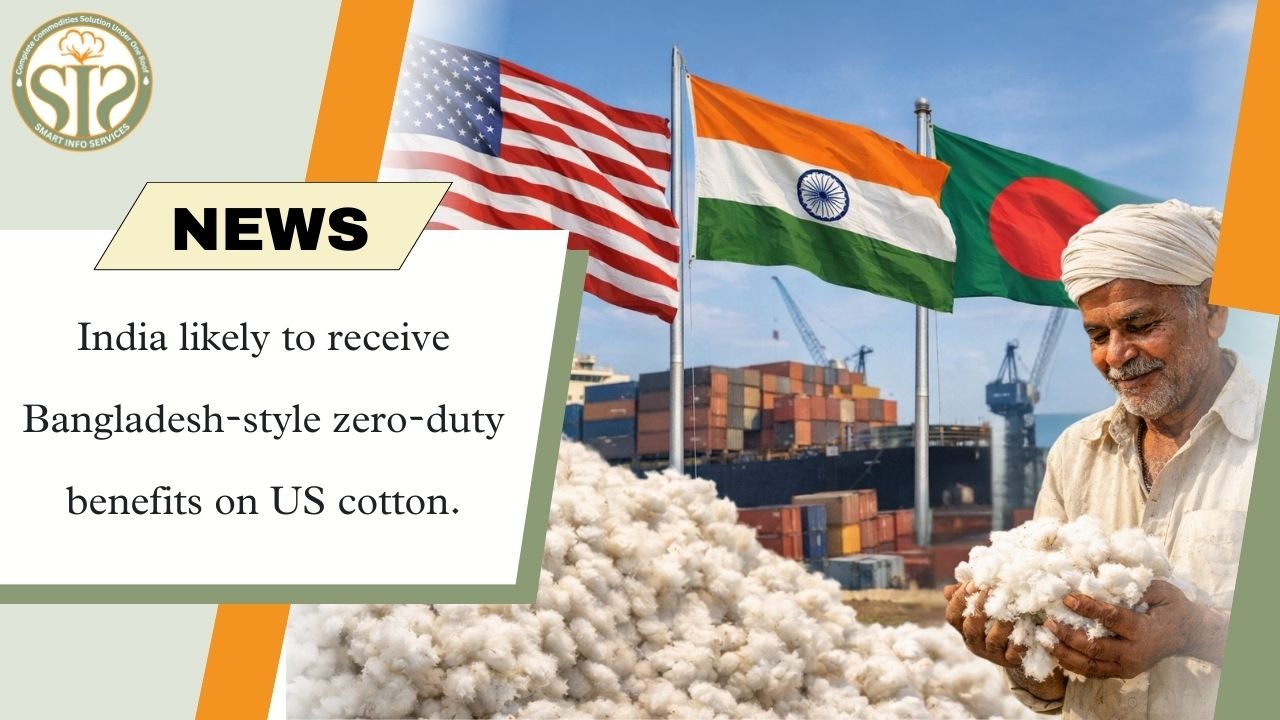
Radha Lakshmi Group CMD Atul Ganatra on CNBC Awaaz: How US–Bangladesh Trade Will effect India’s Textile IndustryDuring an exclusive interview with CNBC Awaaz, Mr. Atul Ganatra, CMD of Radha Lakshmi Group, shared key insights on the recently announced trade developments between Bangladesh and the USA, and their potential effects on the Indian cotton and textile industry.(SMARTINFO)Atul Ganatra highlighted that under the new trade arrangement, Bangladesh can import U.S. cotton and export finished garments to the U.S. at zero duty.This policy won’t significantly impact India’s garment and apparel exports,” he stated, “but it could affect India’s cotton and yarn trade — as Bangladesh is one of our largest buyers.(SMARTINFO)India’s Cotton & Yarn Trade Impact India exports 16–18 lakh bales of cotton to Bangladesh annually.Bangladesh also imports 45–50% of India’s total cotton yarn exports, as local spinning in Bangladesh remains less viable.* If Bangladesh shifts to U.S. cotton for its production, India’s cotton and yarn exports may see a dip.However, Atul Ganatra emphasized that the Indian garment and apparel sector remains strong, thanks to:A robust FTA with the European Union, effective from July onwards.(SMARTINFO)New trade agreements with six Gulf countries, soon to be implemented. These will provide a major boost to India’s textile exports and strengthen its global position.India’s Competitive Edge: Power & ProductionAtul Ganatra dismissed the old notion that Bangladesh enjoys lower power costs.“That’s no longer true. Today, India’s power cost is more competitive due to progressive state policies allowing captive solar and wind power for spinning and weaving mills,” he said. This has significantly reduced energy costs and improved India’s overall textile production competitiveness.(SMARTINFO)The U.S. Cotton FactorIt will take 3–4 months for U.S. cotton shipments to reach Bangladesh — including logistics and manufacturing time — meaning no immediate disruption for Indian exporters. Moreover, the clarity on the percentage of cotton that the U.S. will allow Bangladesh to import is still pending.Atul Ganatra also pointed out that the U.S. is actively seeking new cotton buyers after China reduced its imports due to a 34% tariff imposed last year.(SMARTINFO)“In the near future, India too may explore similar trade arrangements with the U.S.,” he said. “If Indian spinning and garment units source cotton from the U.S., zero-duty access could open up significant export advantages.”Despite short-term challenges in cotton and yarn exports, India’s textile and garment sector stands resilient and future-ready. With supportive trade deals, competitive power policies, and increasing global demand, the Indian textile industry is well-positioned for sustained growth.(SMARTINFO)read more :- Cotton Stock and Market Position – 31 January 2026
A SUMMARISE REPORT ON PRESENT COTTON SCENARIO (POSITION AS ON 31/01/2026) (Each bale170 kgs.)▪️Total pressing estimate during crop year 2025-2026 is estimated as 317.00 lakh bales & upto 31-01-2026 total 220.58 lakh bales have been pressed. Considering above till Jan-2026 end total availability of cotton may be assesed as 316.71 lakh bales including import of 35.00 lakh bales and Opening stock of 60.59 lakh bales.▪️Cotton consumption in this cotton season may touch 305 lakh bales and upto 31-01-2026 about 104.00 lakh bales reported as consumed. (SIS)▪️Export upto Jan 2026 end is found total 6.00 lakh bales against estimation for this season year of 15.00 lakh bales.▪️It is revealed that during current crop end total 50.00 lakh bales may be imported. Upto 31 Jan 2025 about 35 lakh bales have been arrived at different indian ports. (SIS)▪️Kepping in view the above , total available stock as on 31.01.2026 is calculated to the tune 316.17 lakh bales, consisting of opening stock, total pressing & import. (SIS)▪️As on 31 Jan 2026 stock with the mills is found to the tune of 75.00 lakh bales where as with CCI/MFED MNCS, Ginner , Treaders and Exporters it comes around 131.17 lakh bales.read more :- The rupee closed 13 paise higher at 90.58 against the dollar.
On Tuesday, the Indian rupee closed 13 paise higher at 90.58 against the dollar, after opening at 90.71.At close, the Sensex was up 208.17 points or 0.25 percent at 84,273.92, and the Nifty was up 67.85 points or 0.26 percent at 25,935.15. About 2456 shares advanced, 1605 shares declined, and 155 shares unchanged.read more :- Cotton crop affected by natural virus
Disease in cotton crop: Due to natural virus, cotton bolls are rotting and falling off.Ahilyanagar Maharashtra: Cotton bolls were rotting and bolls were falling off during the Kharif season in Ahilyanagar district. Farmers had complained that this was happening due to bad seeds. After this, the District Level Committee of the Agriculture Department, along with a team of scientists from Mahatma Phule Agricultural University, inspected the cotton crops of the complaining farmers and submitted a report. It was told that boll rot and boll shedding of cotton was not caused by bad seeds but due to the spread of a natural virus and the complaints of the farmers have been resolved.Cotton is cultivated in about 1.5 lakh hectare area in Ahilyanagar district. This year, due to continuous rains and heavy rains, Kharif crops have suffered huge losses in many areas. More than 100 farmers from Rahuri, Nevasa and Sangamner talukas had complained to the Agriculture Department that cotton growing companies had sold defective seeds. These include boll rot and cotton boll loss.According to the complaint received by the Agriculture Department, the District Level Committee of the Agriculture Department first irrigated the cotton crop of the complaining farmer and then re-investigated it in collaboration with the scientist of Mahatma Phule Agriculture University. According to information received from Agriculture Department and University scientists, this year certain varieties of cotton were more affected by different viruses.The cotton varieties of that company were more affected by the virus. Because of this, ball rot disease occurred in that variety of cotton and the cotton balls fell, causing huge losses. The scientist has given the investigation report in this regard to the Agriculture Department and more than 100 concerned farmers who complained.Heavy damage to cotton due to heavy rainsCotton crop in 2 lakh hectares has been affected due to heavy and continuous rains in the last monsoon in Ahilyanagar district. In this, rainfall reduces in the month of June. However, it starts increasing from July. In this, 8 hectares of cotton crop has been affected in July, 31.26 hectares in August and 1 lakh 71 thousand hectares in September. Because of this, farmers are saying that production has reduced this year.read more :- Lower duty on American cotton, excitement in Indian textile industry
Indian cotton textiles industry upbeat on cheaper US cotton importsThe Indian cotton textiles industry has expressed optimism over the possibility of importing US cotton at lower tariffs, as expectations rise around new trade agreements with the United States and the European Union. Industry stakeholders believe that easier and cheaper access to imported cotton could help meet growing demand in the coming years and improve competitiveness in global markets.With domestic cotton production stagnating over the past few years and prices remaining higher than global levels, mill owners and trade bodies are urging the government to reduce import duties or adopt a quota-based duty concession system. Currently, cotton imports (excluding extra-long staple varieties) attract around 11% duty, though industry experts suggest this could be reduced or waived for US cotton under a trade arrangement.Industry leaders have proposed several possible policy options, including a 50% reduction in import duty for US cotton, duty-free imports up to a fixed quota, or a model similar to the Australian cotton import arrangement. Some traders estimate that duty-free imports could be allowed for up to 50,000 tonnes, while others expect a broader quota of 5–10 lakh bales.Experts say high domestic prices are making imports attractive. The Cotton Corporation of India (CCI) is currently offering cotton at around ₹56,500 per candy (356 kg), while imported cotton is landing at below ₹54,000 per candy. Brazilian cotton, for instance, is reported to be even cheaper, with landed costs near ₹50,000 per candy.According to industry representatives, US cotton is also preferred for its quality, consistency, and low contamination levels, which are important for export-oriented textile units. They argue that India’s cotton output has remained stagnant due to declining yields, pest attacks such as Pink Bollworm, and delayed adoption of new technologies.Industry bodies such as the Tamil Nadu Spinning Mills Association (TASMA) and the Cotton Association of India (CAI) believe that trade agreements with the US and EU could significantly increase cotton demand and help stabilize supply chains. Some estimates suggest that imports may double in the current cotton season.Experts also note that lower-cost imports could improve yarn production efficiency, as only about 65% of India’s yarn capacity is currently being utilized. Increased availability of raw cotton is expected to boost domestic consumption of yarn and support the textile value chain.While details of the proposed trade mechanism are still awaited, the industry remains hopeful that policy changes will support sustainable growth and reduce raw material costs for mills across the country.read more :- Rupee opened 05 paise stronger at 90.71 per dollar
Rupee opens 05 paise up at 90.71/USD Indian rupee opened higher at 90.71 per dollar on Tuesday versus previous close of 90.76.read more :- CAI demands zero duty on ELS cotton
Zero duty on ELS cotton to boost textiles exports, says CAIThe Indian government’s decision to move extra long staple (ELS) cotton to the First Schedule, effectively reducing customs duty to zero, is expected to boost India’s high-value textile and apparel exports, according to the trade body Cotton Association of India (CAI). The Budget 2026-27 has moved ELS cotton to the First Schedule (zero customs duty).Vinay N Kotak, Chairman, CAI said the Budget is designed as a futuristic, growth-oriented blueprint, aimed at establishing India as a global manufacturing hub and securing its position as the world’s third largest economy.“One of the important changes in the Customs Schedule, which is aimed at providing relief to enable manufacturing is to move Extra Long Staple Cotton to First Schedule (zero Customs Duty). This will boost exports of our finished textile products and increase India’s share in the world textile markets,” Kotak said in a statement. India imports around 5-7 lakh bales of ELS cotton mainly from USA and Egypt, he said.Improving accessCotton with fibre length of 33 mm and above is called ELS cotton, a key input for manufacturing premium yarns, fine fabrics and high-end garments. Since domestic production of ELS cotton is limited, Indian textile manufacturers depend on imports to meet quality requirements for export markets. The removal of import duty is expected to lower raw material costs and improve access to high-quality fibre, enhancing the global competitiveness of Indian exporters.The ELS cotton is grown in approximately 2 lakh hectares, predominantly under the DCH-32 variety in parts of Karnataka such as Dharwad, Haveri and Mysuru districts, also in Coimbatore, Erode and Dindigul in Tamil Nadu and in Ratlam in Madhya Pradesh.read more :- Last date for cotton MSP purchase 10 February
Cotton purchase at support price till 10th FebruaryHanumangarh Cotton will be procured by Cotton Corporation of India (CCI) at support price till February 10. In this regard, Director of Agricultural Marketing Department, Jaipur, Rajesh Kumar Chauhan has issued a letter to the regional joint directors and deputy directors of the department.Instructions have been given in the letter that all the cotton farmers registered on Cotton Kisan Mobile App of Cotton Corporation of India should be made aware to book slots and sell their cotton before the last date of purchase. Also, it has been asked to ensure that farmers can sell their cotton before February 10.
The Indian rupee lower 21 paise to close at 90.76 per dollar on Monday, compared to its opening price of 90.55 in the morning.At close, the Sensex was up 485.35 points or 0.58 percent at 84,065.75, and the Nifty was up 173.60 points or 0.68 percent at 25,867.30. About 3003 shares advanced, 1181 shares declined, and 152 shares unchanged.read more :- CITI welcomes tariff cut, clarity on cotton
CITI welcomes visibility on US tariff reduction, seeks clarity on cottonThe Confederation of Indian Textile Industries (CITI) heartily welcomes the reduction of US tariffs to 18% with effect from February 7, 2026. CITI expresses its heartfelt gratitude to US President Mr. Donald Trump and Indian Prime Minister Mr. Narendra Modi for successfully resolving the tariff issue."The biggest problem for the Indian textile and apparel sector was earlier the 50% tariff imposed by the US on Indian goods, as the US is India's largest foreign market. Now this tariff has been removed, allowing India's textile and apparel exports to compete effectively in the US again. With the 18% tariff, we will also get a slight tariff advantage compared to our nearest competitors, Vietnam and Bangladesh," said Mr. Ashwan Chandran, President, CITI.“This extremely positive development is a major boost to India's target of $100 billion textile and apparel exports by 2030, the 'Make in India' initiative and employment generation in the textile and apparel industry driven by small and medium enterprises (MSMEs). CITI is extremely grateful to Honorable US President Mr. Donald Trump, Honorable Prime Minister Shri Narendra Modi and all the Ministers and senior officials involved in the US and India for this achievement.”China, Vietnam, India, and Bangladesh are the largest exporters of textiles and apparel goods to the US. The US tariff rate on both Vietnam and Bangladesh is set at 20%. An analysis by CITI of US Office of Textiles and Apparel (OTEXA) data showed that US imports of textiles and apparel from India declined by 31.4% in November 2025 compared to November 2024.CITI president said the industry body was waiting for more clarity on cotton. There is extensive coordination between the United States and India on cotton. India's textile and apparel exports are mainly dependent on cotton.The Joint Statement of the United States and India on the Framework for an Interim Agreement on Reciprocating and Mutually Beneficial Trade (Interim Agreement) states: "India will eliminate or reduce tariffs on all U.S. industrial goods and a wide range of U.S. food and agricultural products, including dried distillers grains (DDG), red sorghum for animal feed, nuts, fresh and processed fruits, soybean oil, wine and spirits, and other products."CITI believes that removal of import duty on cotton of all varieties will reduce the gap between domestic and global prices and help restore the competitiveness of India's spinning and textile industries. This step will also ensure that the minimum support price (MSP) and other farmer-support mechanisms can function as intended without any significant price distortion. In the current cotton season, the MSP of the cotton variety has increased by about 8%.read more :- Cotton import increased due to trade deal, farmers in trouble, slight relief in textile sector
Trade deal will increase cotton imports! Farmers in crisis and signs of recovery in textile industryNagpur: Due to India-America 'trade deal', efforts have started to eliminate 11 percent import duty on cotton. Already, cotton imports are continuously increasing, while exports are decreasing. With this deal, import of cotton from America will increase and the price of cotton in the domestic market will come under pressure and farmers will have to suffer financial losses. The Indian textile industry, which exports very little, will benefit from the deal as it will get cotton at cheaper prices.The Indian textile industry requires 315 to 320 lakh bales of cotton every year to meet the export and domestic demand of textiles. Every year 330 to 340 lakh bales of cotton are produced in India. India requires 12 to 15 lakh bales of extra long yarn cotton to produce premium quality textiles.The production of this cotton is 3 to 4 lakh bales and every year 10 to 12 lakh bales have to be imported. India has the largest production of long and medium yarn cotton. Since cotton prices in the global market are lower than in India, Indian textile industries import long yarn cotton in the name of extra long yarn and reduce the price. If the cotton price falls below the MSP, the government purchases 22-27 per cent of the total cotton production at the MSP rate. Farmers will be hit the hardest by duty-free cotton imports due to the 'trade agreement'.India's textile exportsChina ranks first in textile exports in the world market, while India ranks sixth. India's textile export share is only four percent. 25 to 30 percent of this cloth is exported to America. The European Union, Vietnam, Bangladesh and Türkiye are India's major competitors.How does the textile industry benefit?The rate of rupee in the year 2021-22 was Rs 1 lakh 5 thousand. Therefore, the prices of clothes increased in the year 2022-23. Rupee prices declined by 40 per cent in 2022-23 to reach a surplus of Rs 62,000. However, the industries did not reduce the rates of clothes by 40 percent. At present the rates of cotton are between 55 to 57 thousand rupees and the rates of clothes are between 1 lakh rupees.A missed opportunity for India in VietnamThere is huge demand for Bangladeshi clothes in the world. Bangladesh's textile industry is dependent on Indian cotton.Due to political instability, Bangladesh's position in the global textile market faltered and India got an opportunity to gain its customers. Vietnam seized this opportunity as the Indian government ignored it.read more :- New opportunity for textile industry from India-US deal
| title | Created At | Action |
|---|---|---|
| Cotton Corp cuts fiber prices by 3% | 11-02-2026 19:39:50 | view |
| Cotton arrivals affected due to fall in production in Wardha | 11-02-2026 19:08:26 | view |
| Increasing impact of pests on BT cotton | 11-02-2026 18:57:59 | view |
| Record cotton imports in 2024-25, US top supplier | 11-02-2026 18:25:02 | view |
| Rupee opens 02 paise down at 90.60 | 11-02-2026 17:24:33 | view |
| Atul Ganatra: Impact of US-Bangladesh trade on India's textile | 10-02-2026 23:43:38 | view |
| Cotton Stock and Market Position – 31 January 2026 | 10-02-2026 23:30:59 | view |
| The rupee closed 13 paise higher at 90.58 against the dollar. | 10-02-2026 22:40:49 | view |
| Cotton crop affected by natural virus | 10-02-2026 19:24:49 | view |
| Indian textile industry upbeat over cheaper US cotton import prospects | 10-02-2026 18:30:16 | view |
| Rupee opened 05 paise stronger at 90.71 per dollar | 10-02-2026 17:35:18 | view |
| CAI demands zero duty on ELS cotton | 10-02-2026 00:39:11 | view |
| Last date for cotton MSP purchase 10 February | 10-02-2026 00:27:58 | view |
| Rupee fell 21 paise to close at 90.76 per dollar | 09-02-2026 22:42:05 | view |
| CITI welcomes tariff cut, clarity on cotton | 09-02-2026 20:16:12 | view |
| Cotton import increased due to trade deal, farmers in trouble, slight relief in textile sector | 09-02-2026 20:02:51 | view |