Filter

Recent News

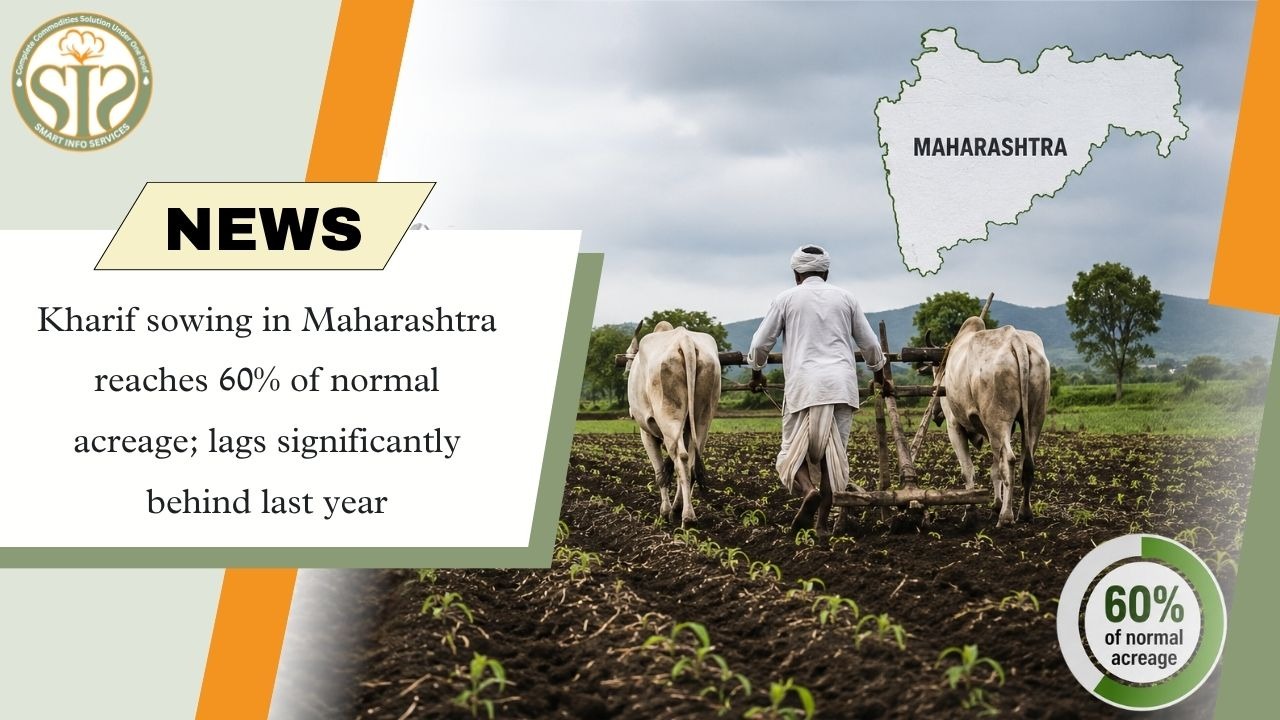
Cotton Cultivation Sees Sharp Rise in Pune District

Sharp jump in cotton production in Pune districtPune: Cotton cultivation in Pune district has seen a remarkable surge this year, with the area under cultivation expanding well beyond the usual average. While cotton is typically sown across 1,122 hectares annually, this year the figure has jumped to 1,955 hectares — marking a significant 74% increase, according to data from the agriculture department.In recent years, the district had witnessed a steady decline in cotton farming. However, the trend appears to be reversing. During the current Kharif season, farmers in Daund, Shirur, Baramati, Indapur and Purandar talukas have opted for cotton over several traditional crops.Agriculture experts attribute this shift to favorable weather conditions, timely early rains, and the expectation of better market prices. Cotton’s lower water requirement has also influenced farmers’ decisions, especially in areas facing water scarcity.To support the farmers, the district agriculture department is ensuring the supply of quality seeds, pest management resources, and on-field guidance. Officials have been visiting farms regularly to monitor crop conditions.Given the expansion in cultivation, cotton output in the district is expected to rise substantially this year. However, farmers remain cautious, pointing out that final yields and profits will hinge on weather patterns, pest and disease management, and price trends in the months ahead.read more :- INR Gains 03 Paise, Closes at 88.10 per Dollar
Confident on Trump-Modi trade talks

Trump, Modi Confident of Positive Outcome in Bilateral Trade DiscussionsPresident Donald Trump on Wednesday took to Twitter to announce progress in ongoing trade negotiations between the United States and India, expressing confidence that the discussions would conclude successfully.“I am pleased to announce that India and the United States of America are continuing negotiations to address the trade barriers between our two nations. I look forward to speaking with my very good friend, Prime Minister Modi, in the upcoming weeks. I feel certain that there will be no difficulty in coming to a successful conclusion for both of our great countries,” Trump said.Responding to Trump’s remarks, Prime Minister Narendra Modi echoed optimism about the future of bilateral ties, emphasizing the natural partnership between the two nations.“India and the US are close friends and natural partners. I am confident that our trade negotiations will pave the way for unlocking the limitless potential of the India–US partnership. Our teams are working to conclude these discussions at the earliest. I am also looking forward to speaking with President Trump. We will work together to secure a brighter, more prosperous future for both our people,” Modi said.The statements signal renewed momentum in bilateral efforts to address trade barriers and strengthen economic cooperation, as both leaders prepare for further dialogue in the coming weeks.read more :-PM Modi will lay the foundation stone of PM Mitra Park in Dhar on September 17

PM Modi will lay the foundation stone of PM Mitra Park in Dhar on September 17

PM Modi will lay the foundation stone of PM Mitra Park in Dhar on September 17, cotton farmers and industry will benefit.The country's first PM Mitra (Prime Minister Mega Integrated Textile Region and Apparel) park is going to be built in Dhar district of Madhya Pradesh. PM Narendra Modi will lay the foundation stone of this mega textile park in Bhaisola village of Badnawar tehsil of the district on September 17. This park will be a cotton-based industrial hub, which will give a new direction to the state's economy and create employment opportunities for lakhs of people. State CM Dr. Mohan Yadav gave this information in a review meeting organized on Monday regarding the preparations for the program.About 3 lakh employment opportunities will be createdChief Minister Mohan Yadav said that PM Mitra Park will provide about 1 lakh direct and more than 2 lakh indirect employment opportunities. Overall, more than 3 lakh people will benefit from it. This opportunity will give new possibilities especially to the farmers and local youth of cotton producing areas.These cotton districts will benefitDistricts like Dhar, Jhabua, Ujjain, Khargone and Barwani are already ahead in cotton production. In such a situation, setting up a large cotton-based industrial park here will prove beneficial for both farmers and industry. With the availability of raw material and better infrastructure for industries, the entire value chain of cotton will develop at one place.Farm to Fashion - All work at one placeThe objective of PM Mitra Park is to give real shape to the concept of 'Farm to Fashion'. In this, the entire process from yarn production, weaving, dyeing and garment manufacturing will be done at one place. This will reduce costs, save time and also increase export capacity. The Indian textile sector will get stronger in competition at the international level.The government estimates that investors' interest in this park will increase. Big entrepreneurs of the textile and garment sector will invest here. This will not only increase employment at the local level, but will also provide opportunities to small entrepreneurs and startups. The youth will get a chance to work with skill development and new avenues of employment will open up for women as well.Approach road and other preparations in full swingCotton and textile sector play an important role in the state's economy. This contribution will be further strengthened with the opening of this park. With the increase in industrial production, the state's exports will increase and farmers will also get better prices. New sources of income will be developed in both rural and urban areas.This project is the first of the seven PM Mitra parks under the Centre's ambitious scheme, whose bhoomi pujan is going to take place. In the coming time, such parks will be established in other states as well. The state government has started extensive preparations for the park. Preparations for transport system and connecting roads are in full swing. At the same time, the layout of the venue has been prepared.read more :-Giriraj Singh's $100 billion export vision

Giriraj Singh's $100 billion export vision

Union Textiles Minister Giriraj Singh Chairs MSME Exporters Meet, Charts Path to $100B ExportsUnion Minister of Textiles Giriraj Singh on Tuesday chaired a consultation with MSME textile exporters, underlining India’s roadmap to scale exports to $100 billion by 2030 despite global headwinds, including the recent 50% US tariff on Indian imports.Singh highlighted India’s resilient performance: textile exports grew 5.37% in July 2025 to $3.1B, with April–July exports up 3.87% year-on-year. Key segments like readymade garments (+7.87%), carpets (+3.57%), and jute products (+15.78%) led the growth. Strong gains were also seen in partner markets such as Japan (+17.9%), UK (+7.39%), and UAE (+9.62%).The Minister stressed the need for strategic diversification into 40 new global markets, which collectively represent nearly $600 billion in textile imports, while deepening domestic demand in line with the PM’s “Vocal for Local” call.GST reforms announced in the 56th GST Council meeting were hailed as a “game-changer,” promising to lower costs, boost demand, and enhance competitiveness across the textile value chain. Singh reiterated the government’s “Farm to Fibre to Factory to Fashion to Foreign” (5F) formula as India’s growth mantra.Exporters welcomed reforms but sought fiscal support, simpler compliance, and stronger global branding of handlooms, handicrafts, and GI-tagged Swadeshi products. Singh urged exporters to build warehouses in key global markets and leverage e-commerce to directly reach international consumers.The government has already rolled out measures to boost competitiveness, including cotton import duty exemption till Dec 2025, extended export obligations, and an expanded PLI scheme window.Reaffirming Vision 2030, Singh said India aims for a $250B domestic textile market alongside $100B in exports, powered by market diversification, innovation, and Swadeshi-driven growth.“India will compete in America and in the $800B global textile market. With MSMEs at the core, we will emerge stronger,” Singh asserted.read more:-  Tariff crisis: Textile orders worth Rs 40 billion cancelled in Tirupur

Tariff crisis: Textile orders worth Rs 40 billion cancelled in Tirupur

Existence of textile exporters in danger due to tariff; Tirupur most affected, orders worth Rs 40 billion cancelledThe 50 per cent tariff imposed by the US has increased the difficulties of the Indian textile industry. Exporters are not able to bear the impact of the tariff. In such a situation, the textile industry needs immediate incentives. According to the report of MK Research, the earlier imposed tariff has led to a decline in the margins of the textile industry. The additional tariff will further reduce the margins of the industry, which is struggling to remain competitive in the global markets.According to the report, the textile industry is not getting new orders from the US due to high tariffs. Old orders are also being cancelled, due to which inventory is increasing. In such a situation, government help is necessary for the industry and especially micro, small and medium enterprises (MSMEs), because their books are not as strong as those of large exporters. The industry needs fiscal incentives to bear the tariff shock and remain relevant in the global supply chain. If necessary steps are not taken immediately, not only will the existence of small companies be in danger, but a large number of jobs will also be lost.Tirupur most affected, orders worth Rs 40 billion cancelledThe Tirupur cluster, which has a 55-60 percent share in the country's knitwear exports, is badly affected by the tariff. Clothes worth about Rs 700 billion are exported from here. Due to the tariff, orders worth about Rs 40 billion that Tirupur used to get from the US have been cancelled.India has about four percent share in the global textile market, which is much less than Bangladesh (13 percent) and Vietnam (9 percent).Pressure due to these reasons tooPayments are getting delayed by US retailers.Rising inventory has created additional pressure on domestic companies.MSMEs are extremely vulnerable to barriers in international trade.Due to implementation challenges in free trade agreements, its full benefit is not being received.Tirupur most affected, orders worth Rs 40 billion cancelledThe Tirupur cluster, which has a 55-60 percent share in the country's knitwear exports, is badly affected by the tariff. Clothes worth about Rs 700 billion are exported from here. Due to tariffs, Tirupur has lost orders worth about Rs 40 billion from the US.India has a share of about four per cent in the global textile market, which is much less than Bangladesh (13 per cent) and Vietnam (9 per cent).There is also pressure due to these reasons* Payments are getting delayed by US retailers.* Rising inventory has created additional pressure on domestic companies.* MSMEs are extremely vulnerable to barriers in international trade.* Full benefits are not being reaped due to implementation challenges in free trade agreements.read more:-  Rupee open Falls 02 Paise to 88.13/USD

*Interview of Sanchit Rajpal, ED of Manjit Cotton, on CNBC Awaaz*

*Interview of Sanchit Rajpal, ED of Manjit Cotton, on CNBC Awaaz**Reduction in cotton sowing** Cotton sowing in 2024-25: 112.13 lakh hectares* Estimated in 2025-26: 109.17 lakh hectaresThat is, there has been a decline of about 3% in sowing.*India's situation and yield*Today, about 50 countries of the world grow cotton.* India is number 1 in area, but in terms of productivity (yield) we come at 35th place.* The average production in India is 600 kg / hectare, whereas in China, Brazil and America it has reached 2500–2800 kg / hectare.The main reason for this is that till now only 3-4 generations of BT seeds are being used in India, whereas the world has reached 6-7 generations today.Therefore, it is very important to bring new seeds and technology to increase production. This will not only increase productivity, but farmers will also be attracted towards cotton cultivation.*Impact on global market and export** Cotton prices have been under pressure for the last few years.* Global demand remained weak and the situation worsened due to tariff war.* India once used to export up to 20% of its production, but today the situation has changed and it has started depending on imports.*Impact of prices and MSP** MSP (minimum support price) in India is a support for farmers, but it affects the industry.* Due to high MSP, the industry has to buy expensive cotton, whereas cotton is available cheaper in the international market.* This is the reason why textile exports slowed down and countries like Bangladesh got a competitive edge.*Cotton vs Man-made fiber** Tensil, bamboo and other man-made fibers are now rapidly emerging as alternatives in the market.* Man-made fibers are more consistent than cotton.* Still, the global trend is towards sustainability and hence cotton is expected to remain important.*Forward Outlook** Given the current conditions—such as tariffs, mill conditions and global demand—cotton prices are likely to remain under pressure in the near future.read more :- INR drop 11 Paise, Closes at 88.11 per Dollar

Copyright© 2023 | Smart Info Service
Application Download