Filter

Recent News

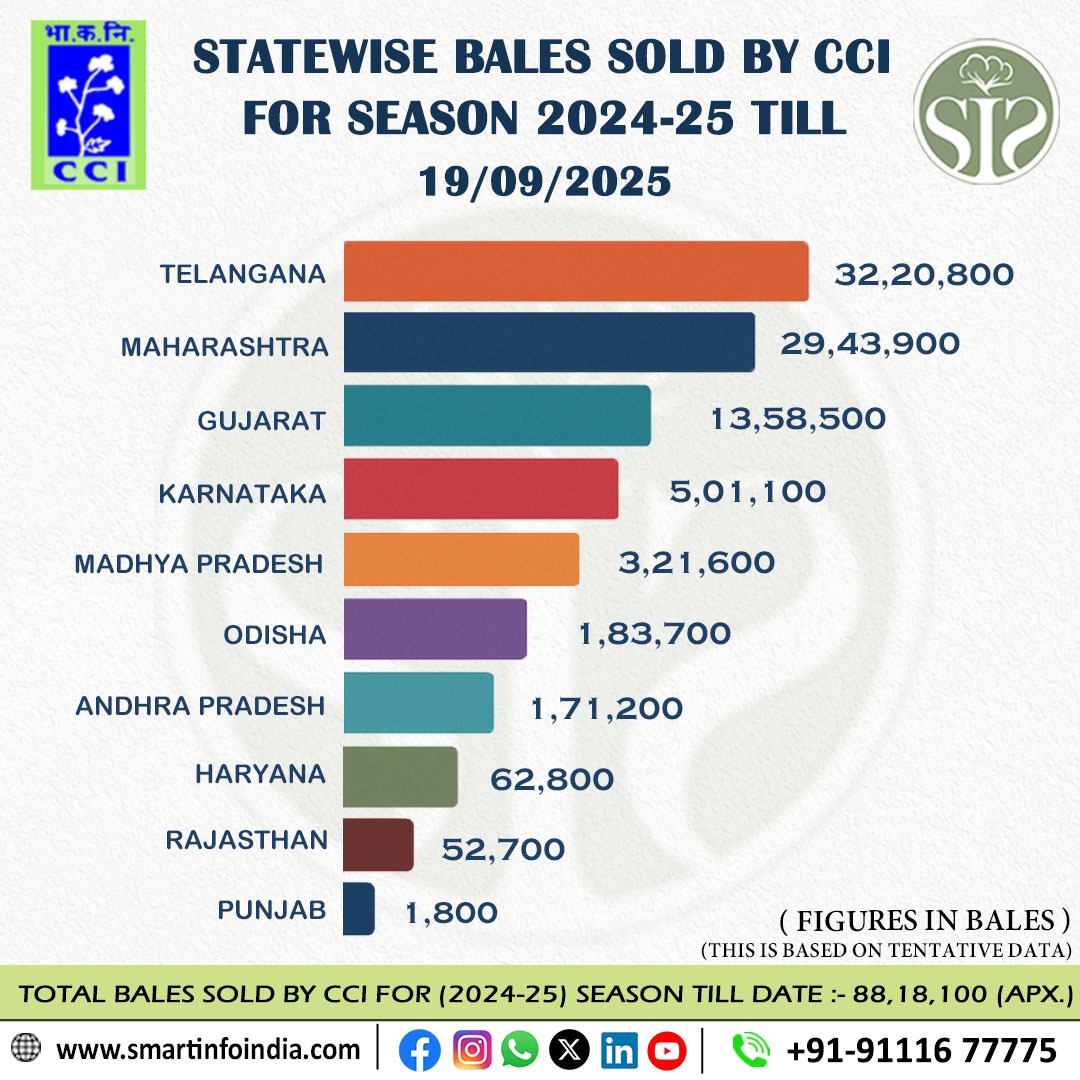
Cotton Corporation sold 15 lakh bales under the wholesale discount scheme

Cotton Corporation sold 15 lakh bales under bulk discount scheme in last fortnightCCI President Lalit Kumar Gupta said, "We have sold 15 lakh bales under this bulk discount scheme. We have a stock of less than 12 lakh bales right now."State-run CCI, which had bought one crore bales at minimum support price (MSP) during the 2024-25 cotton season, reduced its floor price by ₹2,000 per candy (356 kg of ginned cotton) after the government removed 11 per cent import duty on August 19.BengaluruThe Cotton Corporation of India (CCI) has sold 15 lakh bales (each of 170 kg) under the bulk discount scheme in last fortnight. The bulk discount scheme, which began on September 1, ended on Monday. CCI had a stock of 27 lakh bales before the introduction of the scheme.CCI had launched a bulk discount scheme to sell its stock ahead of the new procurement season starting October 1. It offered discounts ranging from ₹400 to ₹600 per candy to bulk buyers of different categories.Purchasing centresFor the Kharif marketing season 2025-26 starting October, CCI has set a record.Harvest bustle. CCI launched a bulk discount scheme to sell its stock ahead of the new procurement season.550 procurement centres across major cotton producing states."Procurement will commence in Haryana, Punjab and Rajasthan from October 1 and in Madhya Pradesh, Gujarat, Maharashtra and Odisha from October 15," Gupta said.He further added that procurement in Telangana, Andhra Pradesh, Karnataka and Tamil Nadu will commence from October 21. The government has announced an MSP of Rs 7,710 per quintal for medium staple cotton and Rs 8,110 per quintal for long staple cotton. As of September 15, farmers across the country have sown cotton in about 109.64 lakh hectares, lower than 112.48 lakh hectares in the same period last year.The Cotton Association of India recently estimated the carry-forward stock for the new season 2025-26 starting October to be at a five-year high of 60.59 lakh bales, up from 39.19 lakh bales earlier.The increase in carry-forward stock is due to a rise in imports as import duty was removed. Imports for 2024-25 are estimated at 41 lakh bales as against 15 lakh bales last year. Traders expect cotton imports to reach around 20 lakh bales during the October-December quarter.read more:-  India's textile-apparel exports declined by 2.7% in August

India's textile-apparel exports declined by 2.7% in August

India’s textile and apparel exports fall 2.73% in August.CHENNAI : India’s textile and apparel exports contracted by 2.73% in August 2025 compared to the same month last year, declining to $2,931.39 million from $3,013.76 million in August 2024, according to data released by the Confederation of Indian Textile Industry (CITI) on Monday.Exports of jute manufactures and carpets registered sharp year-on-year declines of 8.35% and 7.22%, respectively. Carpet exports to the US fell from $128.48 million in August 2024 to $119.21 million this year. Exports of cotton yarn, handloom products and related categories also dropped to $985.18 million in August 2025, compared with $1,008.61 million a year earlier.On the other hand, cumulative exports of textiles and apparel between April and August 2025 grew 2.52% compared with the same period last year. Apparel exports alone rose 5.78% during this five-month period.India also witnessed a 21.32% rise in imports of cotton (raw and waste) in August 2025 compared to August 2024. During April–August 2025, imports of these products surged 48.75% year-on-year.The Indian textile industry has been reeling under steep tariffs by the US, which is its largest market. Tariffs on textile exports to the US stand at nearly 60%.Rohit Sadaka, Director at India Ratings, told TNIE: “Most of the apparel exports are made-to-order for brands. It is difficult to completely absorb the US demand within the domestic market. India can diversify exports to the UK, Europe and other countries, but any meaningful shift may take time.”According to the rating agency, nearly 35% of listed textile SMEs are likely to face stress due to the uncertainty over US tariffs. Sadaka added: “Large players in the sector can absorb the losses because of their huge cash balances. But small players will face the real heat of these tariffs.”Recently, ICRA revised its outlook on the Indian apparel export industry to negative from stable, following the upward revision in US tariff rates and their consequent adverse impact on India’s overall apparel exports.ICRA expects apparel exporters’ revenues to decline by 6–9% in FY26, despite the Free Trade Agreement (FTA) with the UK and efforts to divert supplies to other geographies. Operating profit margins are forecast to compress to around 7.5% in FY26, down from 10% in FY25, due to weaker performance in the second half of FY26, led by lower volumes and reduced operational efficiency. With weaker earnings and higher working capital dependence, credit metrics are also expected to moderate, the agency said in a press release.read more :- INR Opens Stronger by 16 Paise at 88.05

Tamil Nadu: Demand to set up depots of Cotton Corporation in districts

Tamil nadu : Centre urged to set up Cotton Corporation of India depots in TN districtsCOIMBATORE : The South India Spinners Association (SISPA) has urged the Union textiles ministry to establish Cotton Corporation of India (CCI) depots in key districts of Tamil Nadu.At the 34th annual general body meeting of SISPA held in Coimbatore on Sunday, its newly elected president, R Arun Karthik, highlighted the challenges faced by spinning mills. He reiterated SISPA’s demand that CCI sell cotton in the domestic market at prices aligned with international market rates, a move the association believes is critical to enhancing the industry’s competitiveness.“Although certain industries in Tamil Nadu receive power subsidies, the industrial power tariff in the state is Rs 9.04 per unit, which is higher compared to other states such as Karnataka (Rs 7.75) and Maharashtra (Rs 7.38), thereby affecting the competitiveness of energy-intensive industries,” he said.Tamil Nadu: Demand to set up depots of Cotton Corporation in districtsHe urged the Tamil Nadu govt to immediately implement a power incentive scheme on a per-unit consumption basis to create a level playing field with other states and enhance the state’s industrial competitiveness. He called for the permanent abolition of network charges levied on industries generating rooftop solar energyread more:-  INR Opens Stronger by 16 Paise at 88.05

Farmers Demand MSP for Soybean, GST Exemption on Farm Equipment

Farmers Demand MSP for Soybean, GST Exemption on Agricultural EquipmentThe Bharatiya Kisan Sangh staged a demonstration at the Krishi Upaj Mandi premises on Monday, submitting a memorandum addressed to the Prime Minister and the Chief Minister through Naib Tehsildar Krishna Patel.The organisation raised several key demands, including complete exemption of GST on agricultural inputs and equipment. It also called for a farmer-friendly import-export policy, urging that imports should be restricted during crop harvesting and ripening periods to protect domestic farmers.Farmers demanded the reimposition of import duty on cotton and opposed the entry of genetically modified (GM) crops into India. They also sought limits on land acquisition, stating it should be restricted only to development projects and national interest initiatives.Among financial demands, the Sangh called for immediate access to agricultural credit on the lines of Mudra loans and proposed increasing the Kisan Credit Card limit to ₹5 lakh. It also demanded the establishment of agricultural colleges in all districts and installation of rain measurement instruments in every gram panchayat.Highlighting irrigation and input concerns, farmer leader Suryansh Patidar said maize and soybean should be procured at the Minimum Support Price (MSP). He added that farmers have been facing a shortage of chemical fertilizers for the past two months and urged authorities to ensure timely and adequate supply. The group also demanded replacement of burnt transformers within 24 hours.Several farmer leaders, including Bharatiya Kisan Sangh Tehsil President Dinesh Patel, Vishnu Yadav, and Inder Singh Solanki, participated in the protest. They warned that if their demands are not addressed, they would launch a larger agitation.read more:-  INR Gains 05 Paise, Closes at 88.21 per Dollar

Cotton production-usage increased in 2025-26, stock decreased: WASDE

Global cotton output, use & trade raised in 2025-26; stocks cut: WASDEThe world cotton outlook for 2025–26 has been revised to reflect expectations for higher production, consumption, and trade, along with lower beginning and ending stocks, according to the September 2025 World Agricultural Supply and Demand Estimates (WASDE) report released by the US Department of Agriculture (USDA).Global cotton production is projected to exceed the previous estimate by over 1 million bales, as increases for China, India, and Australia more than offset declines in Turkiye, Mexico, and several West African nations. Total global production is now forecast at 117.68 million bales of 480 pounds (217.7 kg) each.The report indicates that world consumption has been raised by nearly 850,000 bales, driven mainly by increases in China and Vietnam, partially offset by a reduction in Turkiye and minor changes in several other countries. Global consumption is now pegged at 118.83 million bales, up from 117.99 million bales in the previous report.World trade is projected to rise by just over 100,000 bales, with increases for India and Australia partly offset by declines in several West African nations. Global exports are now expected at 43.70 million bales, compared to 43.59 million bales earlier.Beginning stocks for 2025–26 have been reduced by nearly 1 million bales to 74.06 million bales, down from 75.05 million last month, largely reflecting higher 2024–25 consumption in China. Consequently, ending stocks for 2025–26 have been lowered by almost 800,000 bales to 73.14 million bales, the lowest level in four years, compared to 73.91 million bales previously.For the US, the September outlook shows slightly higher production compared to last month, with no changes to exports, consumption, imports, or ending stocks. The US crop is projected 10,000 bales higher at 13.2 million bales, supported by unchanged to slightly higher planted and harvested areas across all regions. However, the national average yield has been lowered by 1 pound to 861 pounds per harvested acre.With no revisions to consumption, exports, or ending stocks, the stocks-to-use ratio remains unchanged at just over 26 per cent. The projected season-average upland cotton price for 2025–26 is steady at 64 cents per pound.read more :- CM will connect Madhya Pradesh cotton farmers with the global market

CM will connect Madhya Pradesh cotton farmers with the global market

Cotton farmers of Madhya Pradesh will have access to global markets: Chief Minister Dr. Mohan YadavChief Minister Dr. Mohan Yadav has said that Madhya Pradesh is one of the leading states in organic cotton production in India. The state contributes about 40% of the country's total organic cotton production. With the foundation stone of the first PM Mitra Park to be laid by Prime Minister Shri Narendra Modi in Dhar district, Madhya Pradesh is set to become the cotton capital of India.Cotton farmers will now have direct access to international markets. The PM Mitra Park will prove to be a milestone in giving global recognition to the hard work of farmers. Dr. Yadav described it as the foundation of the state's industrial future and a gateway to new opportunities for farmers. Thanks to the visionary leadership of Prime Minister Modi, farmers' produce will now reach global markets directly from the fields and the cotton producing region of Madhya Pradesh will play an important role in this change.According to Chief Minister Dr. Yadav, PM Mitra Park is an industrial project that will transform the lives of farmers, workers, women and youth. Cotton producers will now be directly connected to cotton-based industries, making cotton more than just a crop and becoming the industrial identity of Madhya Pradesh.Madhya Pradesh is one of the top cotton-producing states in the country. The Malwa region—which includes Indore, Dhar, Jhabua, Alirajpur, Khargone, Barwani, Khandwa and Burhanpur—produces the highest amount of cotton. Madhya Pradesh has already gained fame for organic cotton production, making it an extremely suitable state for the textile industry. This is why Dhar was chosen for the PM Mitra Park.PM Mitra Park will have world-class facilitiesSpread over about 2,158 acres, the park is being developed with world-class infrastructure, including: a 20 MLD common effluent treatment plant, a 10 MVA solar power plant, assured supply of water and electricity, modern roads and 81 plug-and-play units.Amenities such as housing for workers and women employees and social infrastructure will make it not only an industrial area but also an ideal industrial township.Investors show interestInvestors have shown deep faith in PM Mitra Park and investment proposals worth a total of ₹27,109 crore have been received so far. This will lead to setting up of industries and create new employment opportunities for the local people. Leading textile organizations and industry groups have shown interest in investing here. This will benefit the state industrially and boost exports.The textiles and apparels produced in Dhar will soon reach the global markets directly. Madhya Pradesh is fast emerging as a textile hub.Theme of the park in line with Prime Minister Modi's visionIn line with the vision of Prime Minister Modi, this park will establish a complete value chain: "From farm to fiber, from factory to fashion and from fashion to overseas."The raw cotton obtained from the farmers will be converted into yarn, then textiles and apparels and finally exported. The entire value chain will be consolidated at one place, making this park unique and a model for others.Employment and economic growthThe PM Mitra Park is expected to generate around 3 lakh jobs, including 1 lakh direct and 2 lakh indirect jobs. The expansion of cotton-based industries will allow farmers to get double the value of their crops. This opportunity will not only create jobs but also boost economic activity in rural areas, boosting everything from local markets to exports.read more :- Rupee opened 01 paisa stronger at 88.26

Maharashtra Kharif: Cotton dominates despite rain

Maharashtra: Kharif crop cultivation: Despite timely rains, cotton continues to dominate Kharif crops.Kharif crop cultivation: Despite timely rains, cotton continues to dominate in Manora. Although traditional Kharif crops have declined, cotton cultivation has increased by 135 percent. Farmers have set a new record by relying on cotton even in late rains. (Kharif crop cultivation)Kharif crop cultivation: Despite the late onset of monsoon, farmers of Manora taluka have focused on cotton cultivation this year. (Kharif Crop Cultivation)Due to lack of timely rains, the area under traditional Kharif crops like tur, soybean, moong, urad, jowar has decreased, but cotton cultivation has reached new peaks. (Kharif Crop Cultivation)Rainfall and crop statusManora taluka has received 830 mm of rain till September 9, which is 116.4% of the average rainfall of this season.The total area sown for Kharif crops was 52,414 hectares, which is more than the average of 51,630 hectares.The area under traditional crops has decreased; however, the area under cotton has increased to 17,072 hectares.Half of the cotton cultivation in the district takes place in Manora.In Washim district, the area under cotton cultivation has increased much more than expected this year.Estimated area in the district – 26 thousand 438 hectaresActual cultivation – 32 thousand 194 hectaresOf this, almost half of the cultivation has been done in Manora taluka alone, i.e. an increase of 135.23 percent.Strategic steps of farmersFarmers were worried due to less rain till the end of June. However, farmers showed courage and sowed cotton based on the available water.The late but good rains boosted the cotton crop, while other crops were affected due to limited area.The confidence of the farmers of Manora taluka in cotton was once again evident. This year's figures show that despite the uncertainty of the weather, cotton is the mainstay of the taluka.read more :- CCI sells 85% cotton through e-bidding, weekly sales 7.74 lakh bales

Copyright© 2023 | Smart Info Service
Application Download