Recent News

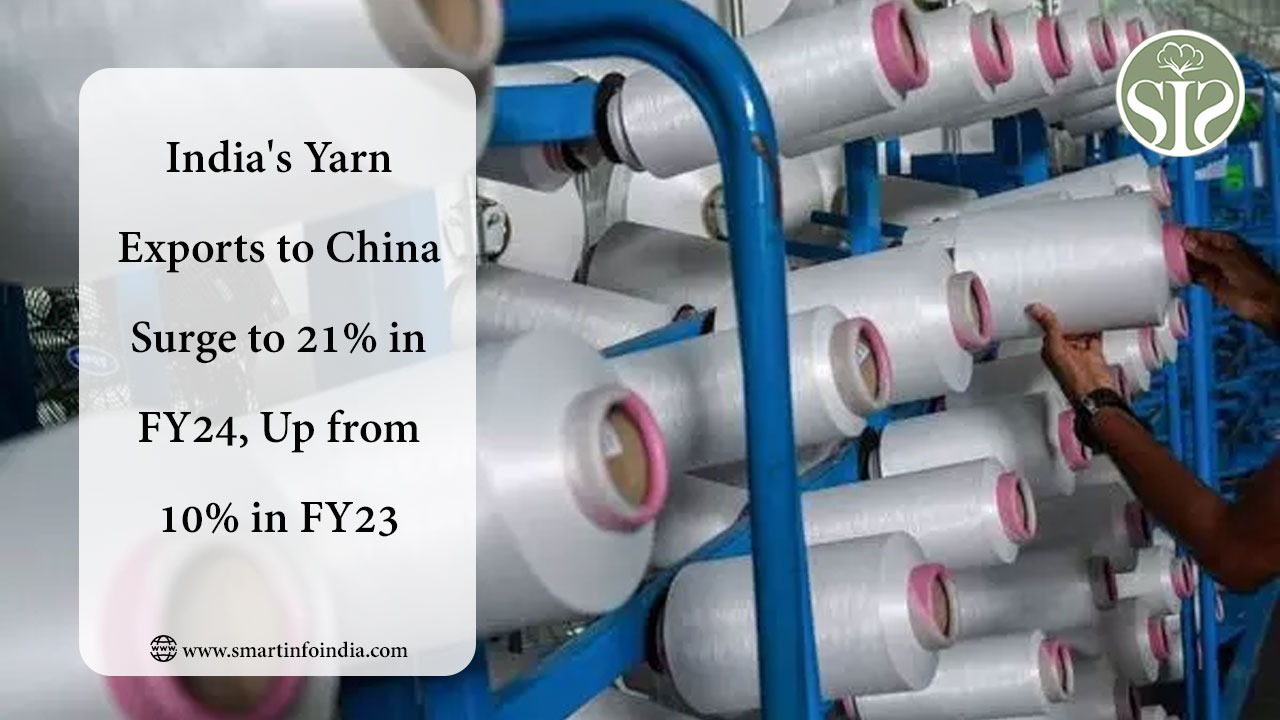
India's Yarn Exports to China Surge to 21% in FY24, Up from 10% in FY23

India's FY24 Yarn Exports to China Increased to 21% from FY23's 10%This increase was fueled by competitive pricing of Indian cotton yarn and global concerns regarding Xinjiang cotton production, prompting markets to turn to India as an alternative supplier. Together, Bangladesh, China, and Vietnam accounted for 60% of India's cotton yarn exports.India’s cotton yarn exports soared by 83% during the fiscal year, raising the share of yarn exports to 32% of the country's total production, up from 19% in FY23. This export growth helped offset domestic market challenges, where demand remained subdued despite a 9% increase in overall cotton yarn production.Domestically, cotton fiber prices, after peaking in the first half of FY23, fell by 25% in FY24 due to weaker demand. Looking ahead, despite an anticipated 6% reduction in cotton fiber production for 2024 due to decreased sown areas, carry-over surplus from previous years is expected to stabilize prices.The ongoing Red Sea conflicts have had minimal impact on cotton yarn exports, as most shipments were directed to stable markets like Bangladesh, China, and Vietnam. However, prolonged conflict could potentially disrupt apparel export volumes, indirectly affecting cotton yarn export volumes and prices.For FY25, domestic spinners expect a modest volume growth of 4-6%, driven by increased exports to Bangladesh and China. This outlook is supported by competitive yarn pricing and a gradual recovery in export demand, while domestic consumption remains subdued.Read more :- Indian Textile Sector Shows Robust Signs of Post-Pandemic Recovery

Indian Textile Sector Shows Robust Signs of Post-Pandemic Recovery

Indian Textile Industry Is Showing Strong Recovery After PandemicThe Indian textile sector is demonstrating signs of recovery, with the latest report from Avendus Spark indicating that the industry's revenue grew by approximately 8% in the last quarter of the fiscal year 2024 (4QFY24) compared to the previous year. Despite a 5% drop in yarn prices, which limited overall growth, stabilising cotton prices are expected to align value growth with volume growth soon.The report also highlighted that Indian cotton prices are currently lower than global prices, aiding cotton spinners in increasing their volumes. This competitive pricing has led to robust margin expansion for cotton spinners due to higher utilisation rates and stable cotton prices.Global retailers and brands have reported that their inventory levels have returned to pre-COVID standards, contributing to the sector's positive outlook. However, the report cautions that demand remains uncertain as garment companies await a boost in order book momentum, suggesting that the order cycle may remain shorter than usual for the foreseeable future.Home textile companies experienced a particularly strong quarter, with a 16% growth in value as Indian exporters gained market share. Garment manufacturers also reported a 4% revenue growth despite the challenges of price fluctuations.The report observed that cotton-related exports increased by 20% sequentially and 18% year-over-year (yoy). Although Indian cotton prices were briefly lower than global prices, boosting demand, they are currently about 13% higher than global prices.In 4QFY24, EBITDA margins for garment manufacturers improved by 177 basis points, primarily due to lower input costs. Vertically integrated players reported better margin growth compared to their peers.Among various textile segments, home textiles continued to excel, with a 15% yoy revenue growth driven by strong demand and increased exports. India's market share in US cotton sheet imports reached an all-time high of 62%, according to Avendus Spark.However, EBITDA margins fell by 80 basis points, indicating a potential slowdown in volume demand. Man-Made Staple Fibers (MMSF) saw a 5% yoy revenue growth, but cheaper imports from countries like China and Bangladesh led to pricing pressures. Capacity constraints also limited volume growth opportunities for MMSF players. Several companies plan to increase capacity in the coming quarters, potentially driving growth. The Production Linked Incentive (PLI) scheme is expected to encourage further investments in MMSF yarn production, the report noted."The top layer of exporters has started getting booked. The next couple of layers of exporters in most of the big hubs are getting many enquiries, and everyone is hopeful that these enquiries will result in an order book that would be better than last year," said Pawan Gupta, CEO and Co-founder of Fashinza, reacting to the report.Read More :> INTERVIEW: CAI President on CNBC (1/7/24)

July Likely to Receive Above-Normal Rainfall

It's Likely to Rain More in July Than UsuallyThe India Meteorological Department (IMD) has forecast above-normal rainfall for most parts of the country in July, except for the northeast and some eastern states like parts of western Bihar, eastern Uttar Pradesh, and Jharkhand. According to the IMD's monthly outlook, rainfall across the country in July is expected to be above normal, exceeding 106% of the long-period average (LPA) of 280.4 mm. The IMD warned of a high likelihood of extreme rainfall in Odisha, Karnataka, Haryana, parts of Uttar Pradesh, Chhattisgarh, and Jharkhand.The monsoon is predicted to intensify in the second half of the season (August-September) as La Niña conditions develop, while El Niño conditions over the equatorial Pacific remain neutral. In India, El Niño is associated with poor monsoons, whereas La Niña typically brings abundant rainfall.Additionally, the IMD forecast that minimum temperatures in July will likely be above normal in many parts of the country, except for some areas in the northwest, central India, and the southeastern peninsula. Maximum temperatures are expected to be normal to below normal in parts of northwest India and southern peninsular India, excluding the west coast.The IMD noted that northwest India experienced its warmest June since 1901, while the east and northeast regions had their fifth warmest June since 1901. This led to the highest number of heatwave days (181) in the last 15 years, surpassing the previous record of 177 days in 2010.This summer, India experienced its second hottest period, with 536 heatwave days across various meteorological subdivisions—the highest in the last 14 years after 2010, which had 578 days.In addition to the extreme heat in June, India also faced a deficit monsoon, receiving 11% less rainfall than normal, marking the seventh lowest rainfall in the past 24 years. The northwest region had the highest deficit, followed by the east, northeast, and central India. However, the southern peninsula received 14.2% above-normal rainfall. The subdued rainfall activity was attributed to a weaker Madden-Julian Oscillation and the lack of low-pressure systems forming over the Bay of Bengal.The IMD observed a trend indicating a higher probability of above-normal rainfall in July if June experienced deficit rainfall.Read more :- INTERVIEW: CAI President on CNBC (1/7/24)

INTERVIEW: CAI President on CNBC (1/7/24)

CNBC interview with the president of CAI (1/7/24).QUESTION:How do you see cotton sowing for the new season in India?ANSWER:About 50-55% of the 60 lakh hectares have been sown so far, which is more than last year at this time. The main reason for this is Maharashtra having sown 20 lakh hectares so far, which is a little earlier than last year. So, we may see more sowing this time. We will have to wait till July 20-25 to know the actual total sowing.Cotton sowing in North India has gone down by about 40% to 50%. There are also reports from Gujarat that cotton sowing is down by 15-20%. Sowing in Khandesh and Vidarbha of Maharashtra may be down by 5-10%, but the sowing area in Marathwada will remain the same.Looking at the trend of farmers in North India and Gujarat, we can say that total cotton sowing in India will go down by 10-15%. The main reason is that the income of farmers in cotton sowing has decreased because the labor cost has increased and the production (yield) is very low. I read a research that in Gujarat if farmers grow peanuts they get Rs 50,000-60,000 per acre, while cotton only gives Rs 20,000.Where there is no water facility, farmers have no option other than cotton. And those who have water facility have many other options other than cotton. Looking at the trend of North India and Gujarat, we can say that there will be a 10-15% reduction in total cotton sowing in India.QUESTION:Which states are included in North India?ANSWER:North India includes Punjab, Haryana and Rajasthan. In Rajasthan, cotton sowing is done in lower Rajasthan and upper Rajasthan. So far this year, sowing has been done in 4.5 lakh hectares in Rajasthan, while last year sowing was done in 10 lakh hectares, so we can say that sowing in Rajasthan is 50-55% less.QUESTION:We have heard that the ministry is going to allow new seed technology. Will the new seed be used for sowing this year, or how long will it take?ANSWER:We have also received news of new seed permission on WhatsApp like you, but we do not have any official confirmation yet. If we get any official confirmation, we will inform the trade. Sowing of new seed is impossible this season as the sowing time will end by the end of July.If the new seed gets permission, it will be tested first, and only after the test is successful, the government will give the new seed to the farmers. Apart from this, the central government will have to take approval from all the states where cotton is grown. New seed will be given to the farmers only after getting approval from all the states. Considering this, it is a long process and it will take time.QUESTION:MSP has increased by 7%, cotton sowing has started. How is the cotton balance sheet of CAI and the demand from mills?ANSWER:This year cotton production and consumption are in similar numbers, around 318 lakh bales. Cotton exports are estimated at 26 lakh bales and imports at 16 lakh bales, so this export-import gap will reduce from last year's closing stock by around 10 lakh bales.The demand from mills is good, the demand from spinning mills is good, and mills are making a profit of Rs 5 to Rs 15 per kg of yarn. Cotton is also readily available and rates are reasonable. Indian mills are currently running at 90-95% capacity. Cotton mills in North India and Central India are running at 100% capacity.QUESTION:Volatility of 2-4% in ICE futures has become normal. What is its impact on the Indian market?ANSWER:Yes, I agree 100%, there is huge speculation going on in ICE futures. 2 months ago ICE futures went up to 103 cents and today it is at 72-73 cents, which is a drop of about 33%. But in India the prices have gone down by only Rs 3,000-4,000 as we have huge consumption of cotton. Also the arrival of cotton is almost over and CCI and ginners have very limited stock, so whatever price the stockers set, mills are buying. Mills will run in this limited stock for the next 3-4 months. This huge fluctuation in ICE is not having a good impact on the entire textile industry as the world market is following ICE futures.Read more :- Chinese Share of Indian Yarn Exports More Than Doubles in FY24

Related News

Youtube Videos

रुई बाज़ार में गिरावट का रुख 😱 Cotton market rate today #youtube
रुई बाज़ार में गिरावट का रुख 😱 Cotton market rate today #you...
जानिए आज का कपास बाज़ार 😱 Cotton market rate today #youtube
Ganesh Chaturthi Celebration at Our Office 🙏✨ | Ganpati Bappa Morya! #shorts
Ganesh Chaturthi Celebration at Our Office 🙏✨ | Ganpati Ba...
Application Download
Whatsapp Contact