Filter

Recent News

India Budget 2025: CITI calls for DBT scheme in cotton procurement

India Budget 2025: CITI Demands DBT Program for Cotton PurchasingThe Cotton Corporation of India (CCI) is expected to acquire approximately 25–35 per cent of the cotton produced this season, as it purchases between 50–70 per cent of the daily cotton arrivals. This surge in procurement is attributed to open market prices falling below the minimum support price (MSP).The Confederation of Indian Textile Industry (CITI), the country’s leading industry body, has urged the government to replace the current procurement system with a Direct Benefit Transfer (DBT) scheme. This demand features prominently in CITI’s recommendations for the Union Budget for the 2025–26 fiscal. Union Finance Minister Nirmala Sitharaman will present the budget on February 1, 2025.CITI noted that the government annually announces an MSP for cotton. When market prices drop below the MSP, the CCI intervenes to purchase cotton directly from farmers at the MSP rate. After procurement, CCI stores the cotton in warehouses and sells it in the open market or through auctions.However, CITI has proposed a DBT scheme where farmers can sell their cotton at prevailing market prices. If the selling price falls below the MSP, the difference would be directly transferred to the farmer’s bank account.This scheme would provide more liquidity to cotton farmers, enabling them to sell their produce without waiting for government procurement. Additionally, it would reduce the financial burden and storage costs for CCI, benefitting all stakeholders.CCI has already purchased around 55 lakh bales of cotton this season, with total procurement expected to reach 100 lakh bales. This would account for over 35 per cent of the estimated output of 302 lakh bales (170 kg each). Mills are facing challenges in sourcing cotton from the open market due to CCI’s aggressive buying and may encounter greater difficulties as arrivals decline, leaving CCI as the largest stockholder.CITI also requested that the government, through CCI, ensure sufficient availability of cotton at globally competitive prices. Currently, domestic cotton prices are higher than international prices. If CCI incurs losses, the government should compensate it through subsidies, similar to those provided for other commodities.CITI has also called for support through a Price Stabilisation Fund Scheme to ensure the industry has access to raw materials at reasonable prices. Currently, textile mills can secure working capital from banks for only three months. Consequently, mills typically procure three months’ worth of cotton stock at the start of the season when prices are generally lower. For the remaining months, mills rely on traders and CCI, whose prices fluctuate based on market conditions. This uncertainty makes it challenging for mills to plan their production schedules effectively.To address the issue of price volatility, the government could consider implementing a Cotton Price Stabilisation Fund Scheme. Under this scheme, mills should receive a 5 per cent interest subvention or loans at NABARD rates, recognising cotton as an agricultural commodity. Additionally, banks should extend the credit limit period for cotton procurement from three months to eight months, with a reduced margin money requirement from 25 per cent to 10 per cent.This scheme would enable the industry to procure raw materials at competitive market rates at the beginning of the season and shield mills from price fluctuations during the off-season, facilitating better production planning and stabilityread more :- On Friday, the Indian rupee closed marginally lower at 85.78 per dollar from its previous close of 85.75.

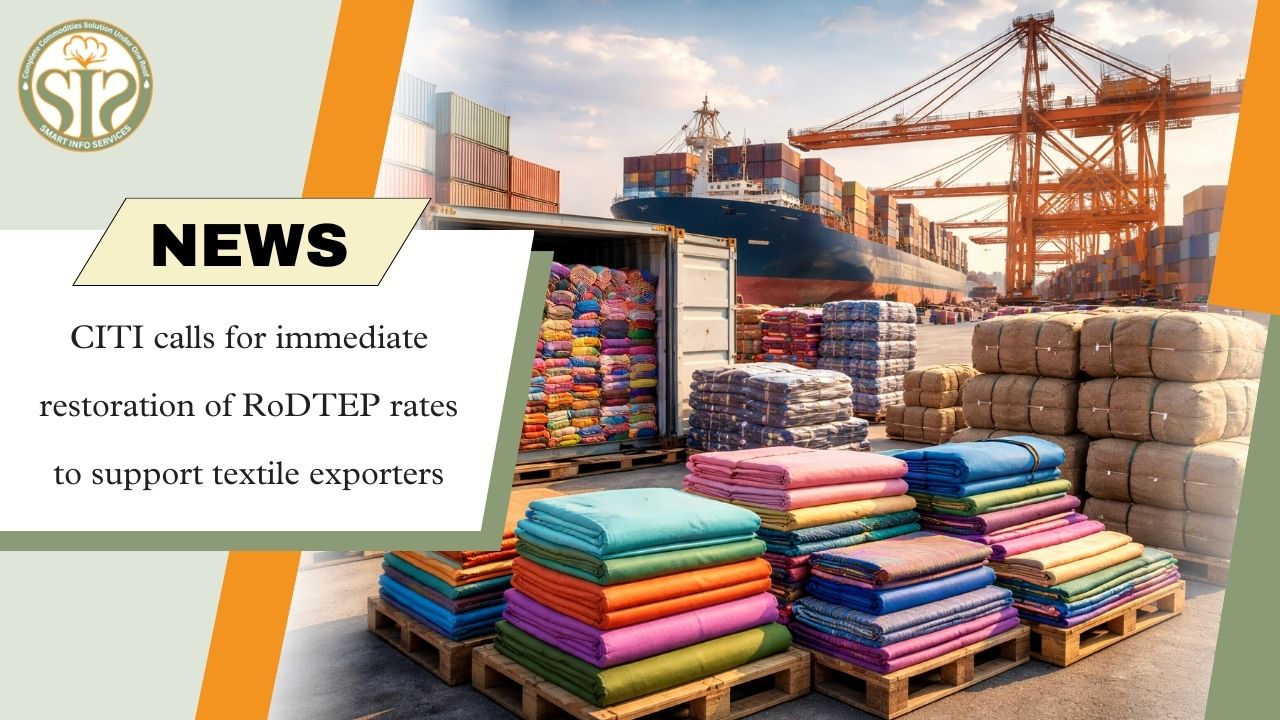
Textile industry seeks cheaper raw materials, cotton duty removal, and price stabilisation in budget

The textile sector wants lower-cost raw materials, the elimination of cotton duties, and budgetary price stability.The availability of raw materials at internationally competitive prices, the removal of import duty from the cotton fibre of all varieties, and the cotton price stabilisation fund scheme are among the major demands of the Indian textile & apparel industry ahead of the Union Budget 2025-26.The Indian Textile & Apparel Industry, in its pre-budget memorandum, demanded ensuring the availability of raw materials at internationally competitive prices.Indian domestic raw material prices are significantly higher than international prices. The industry body stated that while competitors like Bangladesh and Vietnam have free access to such raw materials, India has imposed QCO on MMF fibre/yarn, which is acting as a non-tariff barrier on the imports of such raw materials and thus affecting their free flow. It has resulted in a shortage of some specialised fibre/yarn varieties and also impacted domestic prices, it added.It demanded the removal of import duty from the cotton fibre of all varieties, stating that the Indian cotton industry is importing specialised varieties of cotton, such as contamination-free, organic cotton, sustainable cotton, etc., which are not available domestically.The import duty that was imposed to safeguard the interest of farmers is not serving its intended purpose, rather hurting the domestic cotton textile value chain, it stated. The industry body suggested carrying out cotton purchase operations on Minimum Support Price (MSP) through a Direct Benefit Transfer (DBT) mode.The industry body demanded the Cotton Price Stabilisation Fund Scheme to enable the industry to overcome this issue of price volatility.“At present the textile mills are able to avail working capital only for three months from the banks, due to which mills usually procure 3 months of cotton stock at the start of the season when the cotton prices are usually cheaper. For the remaining months, the mills source cotton from the traders and CCI, whose cotton prices vary according to the market conditions; thus, it becomes difficult for the mills to plan their production schedule effectively. To enable the industry to overcome this issue of price volatility, the government may consider coming up with a Cotton Price Stabilisation Fund Scheme,” the industry body added in the memorandum.The industry body said that the fund should be comprised of 5 per cent interest subvention or loan at the NABARD interest rate (cotton being an agricultural commodity), a credit limit period from three months to eight months, and a reduction in the margin money for cotton working capital from 25 per cent to 10 per cent.read more :- Rupee falls 3 paise to 85.78 against US dollar in early trade

Cotton arrivals in India stood at 12.38 million bales in October-December 2024

Between October and December 2024, 12.38 million bales of cotton were imported into India.India has received 123.80 lakh (or 12.38 million) bales of 170 kg cotton during the first three months of the current season 2024-25 (October-September). The country's apex industry body, the Cotton Association of India (CAI), has estimated cotton arrivals. The organisation has projected a total production of 302 lakh bales for the current season.According to CAI estimates, India recorded 69.22 lakh bales of cotton during the first two months of the current season, October and November. About 52.52 lakh bales of cotton arrived in the mandis during December 2024.State-wise arrival data showed that North India, which includes Punjab, Haryana, Upper Rajasthan and Lower Rajasthan, received 9 lakh bales in October and November and 5.03 lakh bales in December, taking the total for the current season to 14.16 lakh bales.Gujarat and Maharashtra recorded 21.63 lakh bales and 22.93 lakh bales, respectively, this season. Similarly, Madhya Pradesh received 9.52 lakh bales, Telangana 31.95 lakh bales, Andhra Pradesh 6.73 lakh bales, Karnataka 15.18 lakh bales, Tamil Nadu 53,400 bales, Odisha 82,500 bales and others received 30,000 bales of cotton.CAI has estimated cotton production at 302.25 lakh bales. The production is expected to decline by about 7 per cent as against 325.22 lakh bales in the last season. The Government of India has estimated the production of 299.26 lakh bales in the current season.read more :- Rupee falls 11 paise to 85.75 against US dollar during early trade

Cotton up on rising demand from apparel industries and robust export orders

Cotton up on strong export orders and growing demand from the clothing sectorsCotton candy prices rose 0.04% to close at ₹54,160, enabled by rising cotton yarn demand from apparel industries and robust export orders. However, domestic cotton arrivals in the north Indian states of Punjab, Haryana and Rajasthan have declined by 43% year-on-year till November 30, 2024, impacting the supply chain. Farmers are reportedly holding back kapas (un-ginned cotton) in anticipation of better prices, leading to a shortage of raw material for ginners and spinners.India's cotton production for the 2024-25 season is estimated at 302.25 lakh bales of 170 kg each, while imports are expected to rise to 25 lakh bales, a significant increase from the previous season. As of November 30, 9 lakh bales had already arrived at Indian ports. The ending stocks for September 2025 are estimated at 26.44 lakh bales, down from 30.19 lakh bales last year. Globally, cotton production for 2024/25 is estimated at 117.4 million bales, led by higher production in India, Argentina and Brazil. Consumption is estimated to increase by 570,000 bales, with rising demand in India, Pakistan and Vietnam offsetting the decline in China. World ending stocks have increased by 267,000 bales, while opening stocks have decreased by 428,000 bales.Technically, short covering was witnessed in the cotton candy market, with open interest falling 0.27% to 367 contracts. Prices found support at ₹53,260, with a possible decline to ₹52,350. Resistance is likely at Rs 55,540, and a breakout above this level could test Rs 56,910, supported by improving demand and mixed supply dynamicsread more :- Rupee falls 9 paise to 85.61 against US dollar in early trade

Copyright© 2023 | Smart Info Service

Application Download