Filter

Recent News

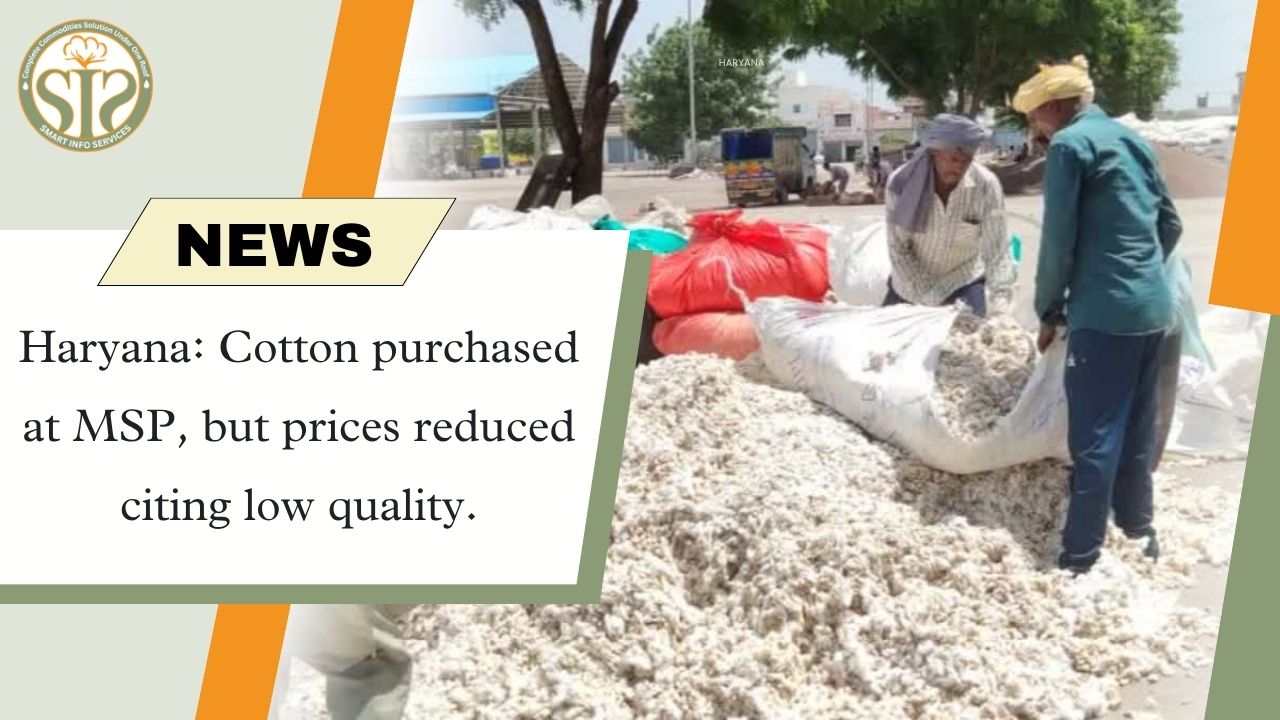
CCI has also reduced the rates for cotton growers.

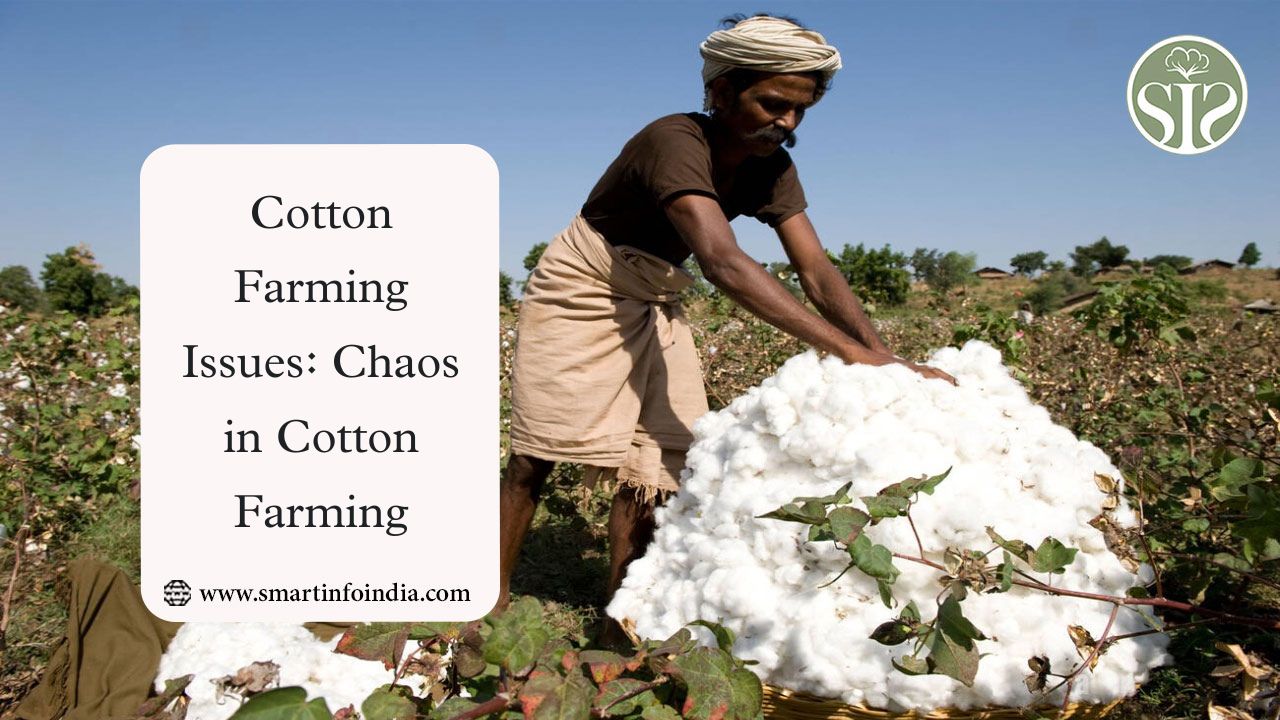
The rates for cotton growers have also been lowered by CCI.Although cotton is being procured at guaranteed rates through the Cotton Corporation of India (CCI) in the state, farmers are still facing difficulties as the rates are given according to the moisture content. After three months of the cotton season, the price of cotton in the market is not as per the expectations of the farmers. At the same time, CCI will reduce the rate and it will affect the market.This year the guaranteed price of cotton is Rs 7,121 per quintal for medium yarn and Rs 7,521 per quintal for long yarn. On Tuesday, 95 quintals of cotton arrived at Amravati Krishi Upaj Bazar Samiti. Cotton got a minimum price of Rs 7,250 and a maximum of Rs 7,550 i.e. an average of Rs 7,400 per quintal.CCI has cut the guaranteed price of cotton by Rs 10. Long yarn cotton is currently available at CCI centers for Rs 7,421. After the collapse of the Cotton Marketing Federation, cotton is now being purchased through CCI. Farmers initially preferred 'CCI' over the private market because cotton was purchased at Hamidara. 'CCI' gave a guarantee for the first picking of cotton. But now these rates have been reduced by a hundred rupees. At present, second picking cotton is coming in the market. The reason given is that the quantity of cotton in this cotton is less than that of the first picking.Since an average of 38 kg of cotton comes out of one quintal of cotton and the price of cotton in the market is high, CCI has given a guaranteed price of Rs 7,512 for long thread cotton and Rs 7,121 for medium thread cotton in the first consignment. Since 34 to 35 kg of cotton comes out of one quintal of cotton in the second picking, the price has been reduced by Rs 20. Therefore, farmers are currently getting a rate of Rs 7,421 per quintal at the CCI center. As soon as CCI reduced the rates, farmers started turning towards the private market. Currently, purchases have started in the private market at guaranteed rates. But, if the arrivals increase, then the rates are likely to decrease. read more :- Cotton procurement at MSP up at 63 lakh bales till early January

Cotton procurement at MSP up at 63 lakh bales till early January

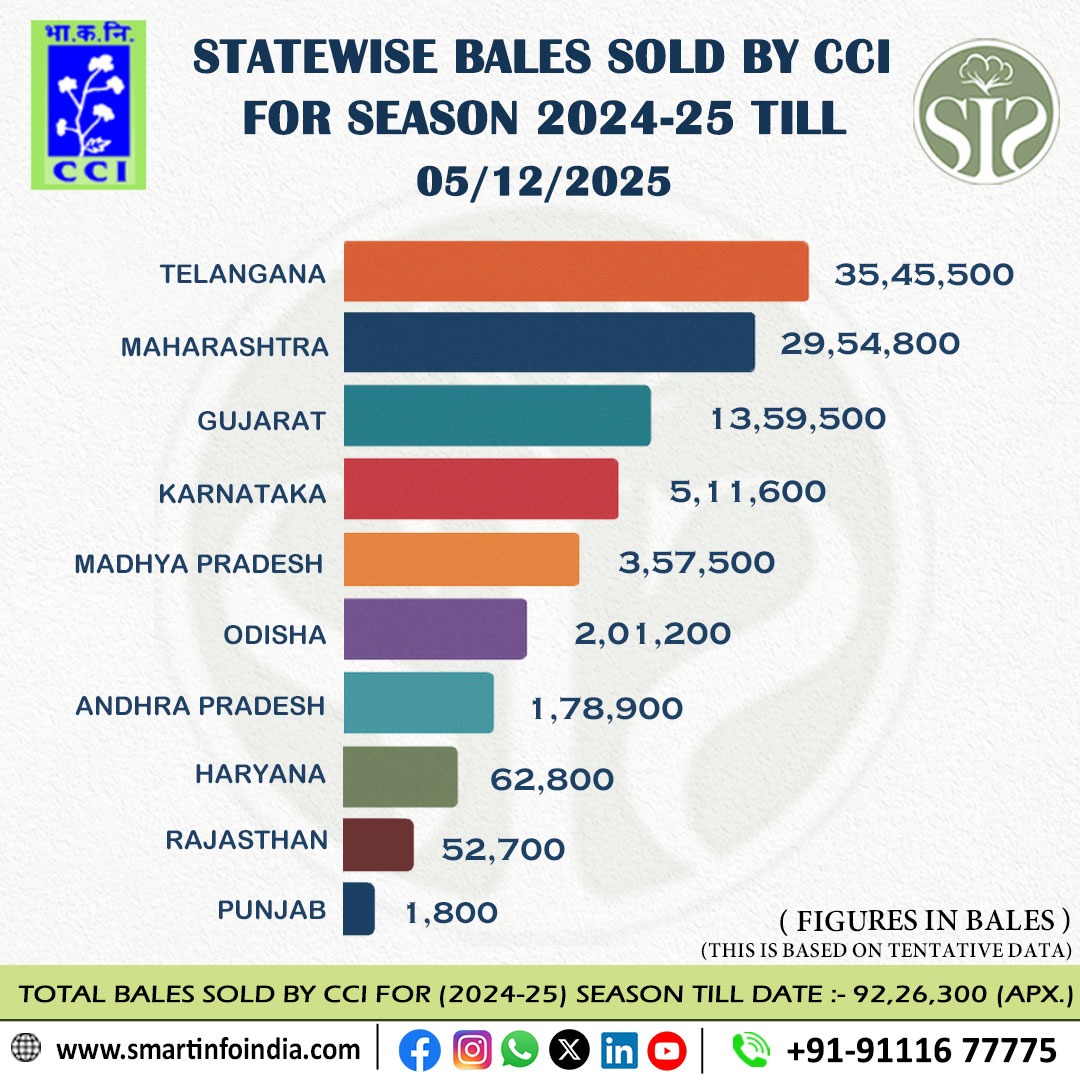
Up to 63 lakh bales of cotton will be purchased at MSP through early January.CCI procured 46% of market arrivals in 2024-25 season; prices remain below MSP levelsThe State-run Cotton Corporation of India (CCI) has procured about 46 per cent of the total market arrivals of the fibre crop in the 2024-25 marketing season till now. As per the latest data, CCI has procured over 63 lakh bales of kapas (raw cotton), which is close to half of the estimated market arrivals of around 136 lakh bales (170 kg each).According to data from the trade body Cotton Association of India (CAI), the market arrivals as of Tuesday reached nearly 136 lakh bales.Regional procurementAccording to Lalit Kumar Gupta, Chairman and Managing director of CCI, about 32 lakh bales have been procured in Telangana and 16 lakh bales in Maharashtra so far. In Gujarat, 5 lakh bales have been procured, while in Andhra and Karnataka, the procurement was at 3 lakh bales each.In Madhya Pradesh, about 2.25 lakh bales have been procured, while in Odisha the cotton purchases stood at 1.25 lakh bales. In Rajasthan, 0.5 lakh bales have been procured, 0.30 lakh bales in Haryana and 0.01 lakh bales in Punjab.CCI’s purchases have been aggressive over the past few weeks. Till mid-December, CCI purchased 31 lakh bales.Pricing concernsDespite the aggressive purchases by CCI, the market prices of raw cotton remain below the minimum support price levels. The kapas prices are in the range of ₹7,100-₹7,200 per quintal in various markets of key producing regions. The Centre had set the MSP of ₹7,121 per quintal for the medium staple and ₹7,521 per quintal for the longer variety for the 2024-25 marketing season.“Prices of pressed cotton have firmed up by about ₹1,000-1,250 per candy (356 kg) in the past one week. Cotton prices are ruling steady and firm in the range of ₹53,500-54,500 per candy,” said Ramanuj Das Boob, a sourcing agent in Raichur. Also, the firming trend in cottonseed prices is providing support to the cotton prices.Cottonseed prices have increased by about 10-15 per cent over the past few days to ₹3,400-3,500 range, Das Boob said. This is mainly due to tight supplies.Das Boob said mills buying of cotton is still slow. “There is no bulk buying from mills,” he said.Daily arrivals top 2 lakh balesAs per CAI data, daily cotton arrivals are exceeding 2 lakh bales, with the majority coming from Maharashtra and Telangana. Arrivals will likely pick up in Maharashtra, where the marketing season was delayed due to a late harvest and the recent assembly elections, sources said.In Telangana, a total of over 34.45 lakh bales have arrived so far, of which CCI has procured over 32 lakh bales. In Maharashtra, of the 26.91 lakh bales that have arrived in the market, CCI has procured 16 lakh bales.Close to half of the estimated crop size of around 300 lakh bales have arrived in the market till the first week of January. The Committee on Cotton Production and Consumption has estimated the 2024-25 crop size to be lower at 299.26 lakh bales of 170 kg each, while the Cotton Association of India has pegged the crop size at 302.25 lakh bales, primarily due to a drop in acreage this kharif season.read more :- Rupee hits record low of 85.83 against US dollar

India Budget 2025: CITI advocates for low import duties on textiles

India Budget 2025: CITI Supports Textile Import Tax CutsAhead of India’s Budget 2025, the textile industry has raised alarms with policymakers about losing its global market share due to severe impacts on cost competitiveness. The Confederation of Textile Industry of India (CITI) has stated in its memorandum to the government before the budget that the prices of raw materials are significantly higher than the global market. Polyester staple fibre (PSF) is 26.64 per cent and viscose staple fibre (VSF) 11.98 per cent more expensive for the domestic industry.CITI has presented its case with facts and figures, noting that PSF was priced at ₹76.82 ($0.915) in the global market in October 2024. Meanwhile, the domestic price of the product was noted at ₹97.3 per kg, which was 26.64 per cent higher than the global price. The price difference was noted to be between 26.64 per cent and 36.31 per cent over the last seven months. VSF was priced at ₹141.10 (~$1.680) per kg in the global market and ₹158 per kg in the domestic market, making local prices 11.98 per cent higher than the global market rate. The price difference varied between 11.98 per cent and 18.42 per cent in the last seven months.CITI has stated that Indian domestic raw material prices are significantly higher than international prices, while competitors like Bangladesh and Vietnam have free access to such raw materials. India has imposed quality control orders (QCO) on man-made fibre (MMF) and yarn, which act as a non-tariff barrier on the imports of such raw materials, thus affecting their free flow. This has resulted in a shortage of some specialised fibres and yarns and also impacted domestic prices.The industry organisation stated that the expensive raw materials are severely affecting the cost competitiveness of downstream textile products. Since the downstream segment has the highest employment elasticity in the entire value chain, it is endangering the livelihoods of the millions of people employed in the sector.The government must consider liberalising import policies and reducing the basic customs duty (BCD) on all MMF fibres, filaments, and essential chemicals like PTA and MEG, which are critical in the production of these raw materials.CITI has renewed its demand to remove the import duty on cotton to ensure the availability of cotton at internationally competitive prices. The government could remove the BCD from all cotton varieties.The government has already excluded cotton of staple length exceeding 32.0 mm from the scope of import duty. However, this accounts for only about 37 per cent of the total cotton imports by India, and the import duty still affects about 63 per cent of the imported cotton. It argued that the duty, which was imposed to safeguard the interests of farmers, is not serving its intended purpose, rather hurting the domestic cotton textile value chain.It noted that the Indian cotton industry is importing specialised varieties of cotton such as contamination-free, organic cotton, and sustainable cotton, which are not available domestically. These are being imported under nominated businesses to meet the quality requirements of foreign clients.In India, cotton is predominantly grown by small and marginal farmers who sell their cotton during the peak season. Due to working capital constraints, the industry can only keep limited inventory and must rely on traders for the supply of cotton during the off-season. These traders, during the off-season, often supply cotton based on import price parity, thus making domestic cotton more expensive than international cotton.During the year, Indian cotton fibre prices were typically 15-20 per cent more expensive than international cotton prices, affecting the cost competitiveness of downstream value-added cotton-based textile productsread more :- Cotton farmers struggle with CCI’s strict moisture cap Andhra Pradesh

Andhra Pradesh Cotton Farmers Struggle Under CCI’s Strict Moisture Norms

Cotton farmers in Andhra Pradesh, particularly in Kurnool district, are facing significant challenges due to strict moisture limits imposed by the Cotton Corporation of India (CCI).Under current norms, CCI offers the full Minimum Support Price (MSP) of ₹7,521 per quintal only for cotton with moisture content of 8% or less. If moisture levels fall between 9% and 12%, the price is reduced proportionately. Any cotton exceeding 12% moisture is rejected outright.This has created serious marketing difficulties for farmers. Of the estimated 4 lakh metric tonnes of cotton produced in the district, only about 3.25 lakh quintals have been procured by CCI so far, leaving a substantial quantity unsold.CCI has initiated procurement through 15 ginning mills across market committees in Mantralayam, Adoni, Yemmiganur, and Kodumur. However, due to low prices in the open market, most farmers prefer selling to CCI. Many, however, are unable to do so because their produce fails to meet the moisture criteria.Farmers are also experiencing long waiting times at procurement centres, adding to their distress.Cotton cultivation in Kurnool covered around 1.97 lakh hectares, with an average yield of 15 quintals per hectare, resulting in an estimated total production of 3.72 lakh metric tonnes. By the end of December, CCI had procured 3.24 lakh quintals from nearly 14,000 farmers, amounting to purchases worth ₹240 crore.Despite this, many farmers remain dissatisfied. Some report that only about 40% of their total produce is being accepted by CCI, forcing them to sell the remaining stock in the open market at significantly lower prices.Farmers are now urging the government to relax the moisture norms or provide additional support measures, so that more of their produce can be procured at the full MSP and their financial burden can be reduced.read more :- Rupee depreciates 7 paise to 85.75 against US dollar in early trade

Textile Ministry aims for $300 billion market and 6 crore jobs by 2030: Textile Minister

By 2030, the Textile Ministry hopes to create 6 crore jobs and a $300 billion market.Meanwhile, textiles exports from India during October were about 11.56 per cent higher at $1,833.95 million, compared to the same month last yearUnion Minister of Textiles Giriraj Singh stated that the textile ministry is committed to helping the industry to reach the market size of $300 billion in year 2030 and provide employment to 6 crore persons in textile value chain, the Ministry stated in a release on Sunday.Textiles Minister Singh inaugurated the new permanent campus of the Indian Institute of Handloom Technology at Fulia, Nadia, West Bengal.The new campus of the institute has been constructed using state-of-the-art technology in a sprawling campus of 5.38 acres of land with the expenditure of ₹75.95 crore.The building is having modern infrastructure consisting smart classes, digital library, and modern and well equipped testing laboratories.The new campus will be a model learning place and will serve as Center of excellence in the field of handloom and textile technology and cater to the educational needs of the students from West Bengal, Bihar, Jharkhand and Sikkim.Talking to ANI on December 7, Singh stated, "The Textile Department has decided that India's textile market will grow to $300 billion from the current $176 billion. Last October, exports of textiles rose by 11 per cent and that of garments by 35 per cent. I hope under the leadership of PM Modi we will touch new heights."Meanwhile, Textiles exports from India during October were about 11.56 per cent higher at $1,833.95 million, compared to the same month last year.At the same time, apparel exports registered a significant growth of 35.06 per cent during the same period October at $1,227.44 million, the Confederation of Indian Textile Industry said in a report, citing government data.Cumulative exports of textiles and apparel in October 2024 increased by 19.93 per cent compared to October 2023.During April-October, Indian textiles exports registered a growth of 4.01 per cent over the previous year while apparel exports registered a growth of 11.60 per cent during the same time, data showed.India's textile industry is on the brink of expansion, with total textile exports projected to reach $65 billion by FY26, according to Invest India, which is the central government's investment promotion and facilitation agency.According to Invest India, the domestic textile market, valued at around $165 billion in 2022, includes $125 billion from domestic sales and $40 billion from exports. Projections indicate that the market will grow at a compound annual growth rate (CAGR) of 10 per cent to reach $350 billion by 2030read more :- On Monday, the Indian rupee fell 4 paise to close at 85.83 per dollar as against 85.78 on Friday.

Copyright© 2023 | Smart Info Service
Application Download