Filter

Recent News

Farmers not getting price for cotton: Gujarat agriculture minister flags dip in acreage.

Cotton Price Crash: Gujarat Minister Raises AlarmCotton farmers in Gujarat are shifting to other crops like groundnuts and soybeans due to low prices for their produce, causing a decline in cotton acreage, state Agriculture Minister Raghavjibhai Patel told.Cotton farmers in Gujarat are shifting to other crops like groundnuts and soybeans due to low prices for their produce, causing a decline in cotton acreage, state Agriculture Minister Raghavjibhai Patel told The New Indian Express.“Gujarat is the hub of cotton production as our Prime Minister Narendra Modi invested a lot in its value chain,” said Patel, who is also Minister of Agriculture, Animal Husbandry, Cow-Breeding, Fisheries, Rural Housing and Rural Development in Gujarat.However, Patel raised concerns that the inadequate price farmers receive is discouraging cotton production in the state. “Cotton farmers in the state are marred by both lower production and lower prices. They do not get the required price for their produce, which discourages them from growing more,” he said, adding that many are shifting to more profitable crops.Gujarat’s cotton acreage has declined from 26.79 lakh hectares last year to 23.62 lakh hectares in the 2024-25 Kharif season. Maharashtra now leads in cotton acreage. Once the largest cotton-producing state, Gujarat has ceded its position to Maharashtra, which now tops the list, followed by Gujarat.Latest estimates from the Cotton Association of India show Gujarat’s cotton pressing at 76 lakh bales (each bale weighing 170 kg), compared to Maharashtra’s 85 lakh bales and Telangana's 48 lakh bales as of May 31, 2025.Meanwhile, India’s overall cotton production has been declining steadily for the past five years. Once a global leader, India’s cotton output is expected to shrink from 39.8 million bales in 2013-14 to 29.5 million bales by 2024-25, with yields falling to less than 450 kg/ha - far behind global leaders like China, which records 1,993 kg/ha.Experts attribute the sharp decline in cotton production to increased pest attacks and erratic weather conditions, including unpredictable rainfall and rising temperatures. The major pest threat remains the pink bollworm (PBW), which has developed resistance to Bt cotton over time. Farmers say pests now infest the crop within two months of flowering, damaging the bolls and flowers.The textiles industry has already expressed concern over the continued dip in cotton production and the projected lower acreage in the current Kharif season.Responding to another question on the rising salinity in coastal areas affecting farming, Patel said the government is taking the issue seriously. “We are building salinity prevention structures to stop seawater intrusion into groundwater and soil,” he said.The minister was speaking on the sidelines of a soluble fertiliser event organised by the Soluble Fertiliser Industry Association.Read More :-Rupee open Falls 7 Paise to 85.39/USD

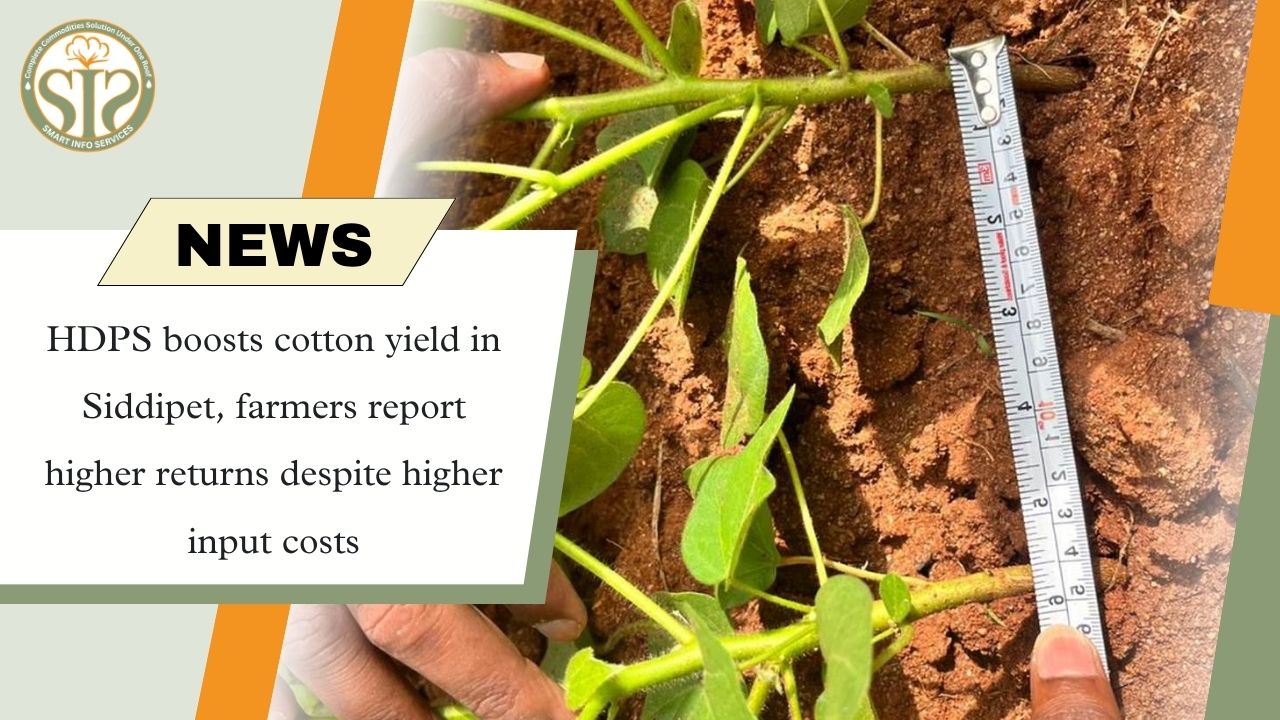
HDPS in Siddipet boosts cotton production

HDPS boosts cotton yield in Siddipet, farmers report higher returns despite higher input costsCotton farmers in Siddipet, one of the major cotton producing districts of Telangana, are witnessing higher yields and better returns with the adoption of High Density Planting System (HDPS), thanks to the special project on cotton by ICAR-Central Institute for Cotton Research (CICR), Nagpur, which is being implemented from 2023.Implemented through Krishi Vigyan Kendra (KVK), Tuniki in Medak district, the project is part of the National Food Security Mission (NFSM) and covers rainfed cotton farmers in five states, including Telangana. In Siddipet, 266 farmers adopted HDPS during the 2024 Kharif season.“Traditionally, farmers in Siddipet cultivate cotton on sandy loam soil under rainfed conditions using the Square Planting System (SPS), maintaining a spacing of 90×90 cm and sowing two seeds per hill, resulting in about 10,000 plants per acre. This greater distance facilitates bullock-drawn two-way hoe, reducing hand weeding,” said Dr Ravi Palitia, Scientist (Plant Protection), ICAR-EGVF (Eklavya Rural Development Foundation), Krishi Vigyan Kendra, Tunis.In contrast, HDPS involves sowing one seed per hill at a reduced spacing of 90×15 cm, increasing the number of plants threefold to 30,000 plants per acre. This denser system, despite requiring more seeds and initial inputs, has shown significant gains in yield and cost-efficiency.“We advise farmers to apply mepiquat chloride, a plant growth regulator (PGR), to manage canopy growth and ensure light and air penetration, thereby reducing pest and disease infestation,” said Ravi Palthia, nodal officer for the special project on cotton. This approach has also facilitated synchronised boll maturation, leading to faster harvesting and timely sowing of rabi crops, he added.The switch to HDPS increased seed cost from ₹1,728 to ₹5,184 per acre and increased labour expenditure for sowing. However, farmers saved on expenses related to row marking and bullock-drawn hoe, reducing the need for traditional two-way inter-farm operations. Overall, HDPS resulted in an additional expenditure of ₹11,256 per acre, according to an ICAR study.Despite the increased costs, there was a significant improvement in yield – from 8 quintals to 12 quintals per acre – leading to an increase in income of ₹30,084 per acre. The reduction in harvesting cycles due to uniform boll maturity also helped reduce labour costs during harvesting. Kunta Kista Reddy of Ahmadipur village in Gajwel mandal, who adopted HDPS on two acres, reported better uniformity in plant growth and a 15-20% increase in yield.“Well-managed canopy and synchronised maturity helped avoid late pest attacks. Though fertiliser and irrigation management required more attention, the system proved to be beneficial,” he said. Chada Sudhakar Reddy of Appalagudem in Markook mandal shared a similar experience. "Initially I was hesitant to use HDPS and machine sowing. But the results were beyond expectations. I used less labour and inputs but harvested more cotton and earned better profits," he said.read more :- INR Up 05 Paise, Opens at 85.66

Tariff and monsoon changed the course of cotton

Cotton Market Sees Mixed Quarter Amid Tariffs, Conflict, CCI and Monsoon ProgressNew York/India – The global cotton market exhibited mixed trends through the second quarter of 2025, influenced by geopolitical tensions, tariff concerns, and seasonal agricultural developments.In the U.S., NY May Futures plunged sharply in early April after tariff announcements rattled market confidence. However, a gradual recovery followed, with the contract ultimately expiring in the 66–67 cents per pound range. NY July Futures, representing the final month of the old crop, remained subdued, confined within a narrow band of 65–69 cents throughout the quarter. Ongoing conflict and weak global demand kept pressure on prices, limiting volatility.Meanwhile, in India, the cotton physical market displayed early resilience in April. However, persistent offloading by the Cotton Corporation of India (CCI) capped prices between ₹53,800 and ₹54,200 through May and June. A shift in sentiment occurred in late June as tensions in the Middle East eased, particularly with the resolution of the Iran-Israel conflict. The improved outlook spurred robust CCI sales, with 21 lakh bales sold over six auctions in a short span, igniting a rally in the domestic market.Agricultural developments also brought optimism. The monsoon arrived early on May 25, and timely rainfall supported a prompt start to kharif sowing. By the end of June, Gujarat had covered 13.99 lakh hectares under cotton, contributing to an all-India total of 50.214 lakh hectares.Market participants remain cautiously optimistic as easing geopolitical tensions and favorable monsoon conditions offer potential support for the upcoming crop season, though global demand and tariff dynamics will continue to be key factors in price direction.read more :- Ministry of Textiles approves PM Mitra Park

Ministry of Textiles approves PM Mitra Park

Textiles Ministry approves Rs 1,894-crore PM MITRA Park project in Tamil NaduIn what can be termed as a significant step towards making Tamil Nadu a national textile region, Union Textiles Minister Giriraj Singh on Tuesday announced the Centre's approval for a Rs 1,894-crore (US$220 million) development scheme for the Pradhan Mantri Mega Integrated Textile Region and Apparel (PM MITRA) Park in Virudhunagar district.Spread over 1,052 acres, the new park will be a next-generation textile cluster with emphasis on technical textiles and integrated manufacturing. It is one of the Centre's premium PM MITRA schemes designed to transform India's textile industry through setting up of world-class infrastructure, efficient regulatory mechanism and sector-specific investment incentives.The approval for the Tamil Nadu project comes after prolonged discussions between the state government headed by Chief Minister M.K. Stalin and the Union Textiles Ministry. State Industry Minister T.R.B. Raja welcomed this approval for the future of Tamil Nadu's textile industry and called it a "result of relentless follow-up and collaborative engagement".The project, targeted to be completed by September 2026, will help attract private investment of Rs 10,000 crore (US$1.16 billion) and create around 100,000 new jobs. Raja also said Tamil Nadu is already India's leading textile exporter - this project will take them to new heights.The key infrastructure to be developed at the site includes a 15 million litres per day (MLD) zero liquid discharge common effluent treatment plant, a 5 MLD sewage treatment plant, housing for 10,000 workers and 1.3 million sq ft of plug-and-play and built-to-suit industrial warehousing.Tamil Nadu joins six other states - Telangana, Karnataka, Maharashtra, Gujarat, Madhya Pradesh and Uttar Pradesh - to host PM MITRA Parks as part of the central government's nationwide programme to revolutionise India's textile production ecosystem.read more :- INR Drops 12 Paise, Closes at 85.71 per Dollar

FTA will give a boost to India's textile sector

India's FTAs with UK, US, EU will open up new opportunities for textiles sector: MargheritaMinister of State for Textiles Pabitra Margherita on Tuesday said that free trade agreements (FTAs) with the US, UK and the European Union (EU) will open up new opportunities for the textiles sector in India.She also said that the country's textile exports have crossed USD 34 billion and the target is to reach USD 100 billion by 2030."On the trade front, the India-UK Free Trade Agreement and our ongoing negotiations with the EU and the US will open up new avenues for growth."These are high-value, quality-conscious markets and we are committed to equipping Indian exporters with the right strategy, standards and compliance to capitalise on these opportunities," he said.Inaugurating the 73rd edition of the India International Apparel Fair (IIGF) at Yashobhoomi, Margherita said the textile and apparel industry contributes 2.3 per cent to India's GDP, 13 per cent to industrial output and 12 per cent to exports."In 2023-24 alone, we exported textile products worth USD 34.4 billion, with apparel accounting for 42 per cent. "Our target now is to take textile exports past the USD 100 billion mark by 2030 and every MSME, every entrepreneur and every exporter has a role to play in achieving this," the Apparel Export Promotion Council (AEPC) quoted the minister as saying in a statement.The AEPC is organising the three-day fair, which is being attended by over 360 exhibitors from across the country and buyers from 80 countries.Margherita also said that it is Asia's largest apparel fair, showcasing not just fabrics and fashion, but also creativity and craftsmanship.This year buyers are coming from various countries and regions, including North America, Latin America, Europe, Asia, Oceania, Africa and Eurasia.The minister said with over 80 per cent of India's textile sector being driven by MSMEs, it is important to focus on increasing productivity, ensuring stable supply of raw materials and reducing import dependency to remain competitive."With the right policy initiatives, innovation and global partnerships, this could be the decade in which India emerges not just as a volume player but also as a value-added powerhouse in global apparel exports," he said.India's apparel exports are expected to reach US$40 billion by 2030. The cumulative growth of 12.8 per cent in apparel exports in the first two months of 2025-26 is a testimony to this progress."This is despite global challenges such as the war in the Middle East, the war between Russia and Ukraine, global logistics challenge, tariff uncertainty by the US and slowdown in many global markets," Sekhri said.read more :- CICR's genetic initiative to increase cotton production

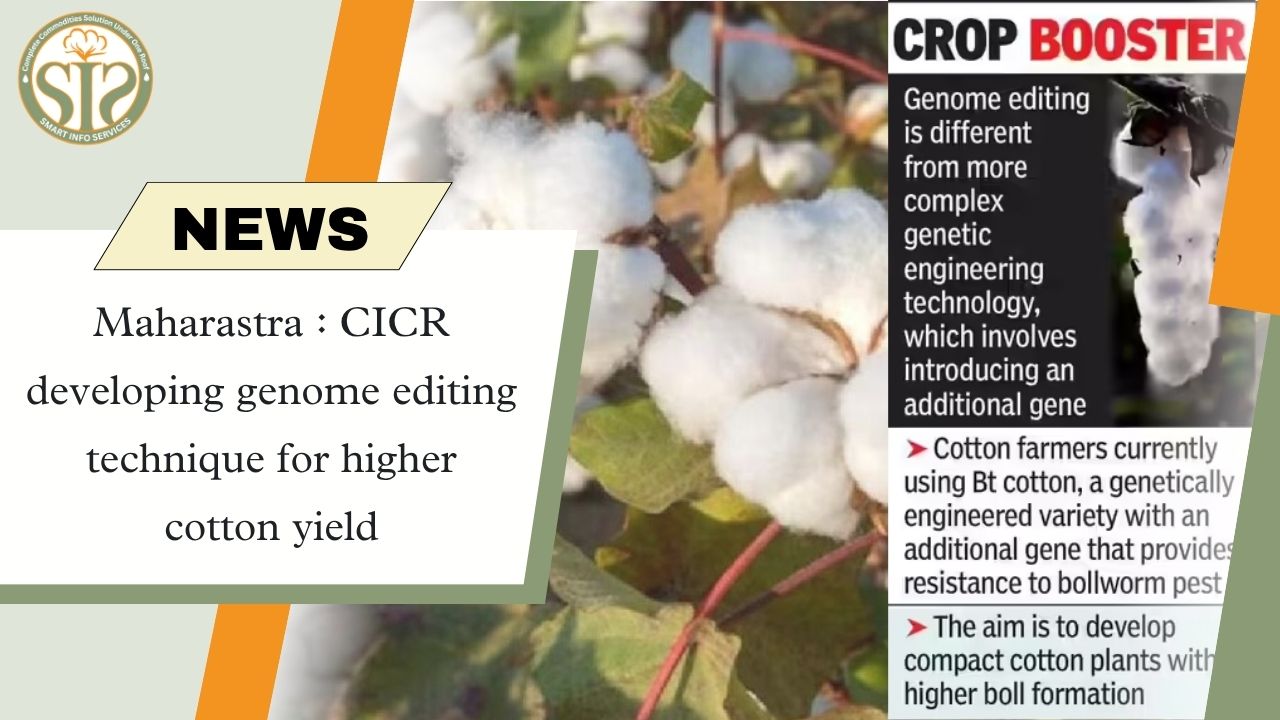
CICR's genetic initiative to increase cotton production

Maharastra : CICR developing genome editing technique for higher cotton yieldNagpur : The Central Institute of Cotton Research (CICR) is now working on a technique to tweak the DNA of cotton plants to ensure higher yield. This method, called genome editing, is among the latest techniques adopted for agricultural research in the country.Genome editing is different from the more complex genetic engineering technology, which involves introducing an additional gene. Cotton farmers are currently using Bt cotton, a genetically engineered variety with an additional gene that provides resistance to the bollworm pest.Speaking to TOI on the sidelines of a seminar on climate-resilient farming, CICR director VN Waghmare said that genetic editing involves changes in DNA sequencing. The aim is to develop compact cotton plants with higher boll formation. It may take another two or three years to achieve the results, he said.Former director of CICR, CD Mayee, said that the Indian Council of Agriculture Research (ICAR) is also encouraging the use of genome editing. Recently, new varieties of paddy were released, which can help in developing varieties suitable for dry conditions.Regarding the reports on rampant use of illegal herbicide-tolerant (HT) seeds in the region, Waghmare said it may not be a prudent idea. This is because farmers here adopt the practice of inter-cropping, where no single crop is grown on a stretch. This means that even if farmers use HT seeds, they won't be able to use weed killers due to the presence of other plants.Waghmare noted that areas in predominantly paddy belts have also started growing cotton. For example, the trend has begun in Gadchiroli too. Farmers are adopting it because of the rugged nature of the crop.read more :- Rupee open Falls 6 Paise to 85.59/USD

Copyright© 2023 | Smart Info Service
Application Download