Filter

Recent News

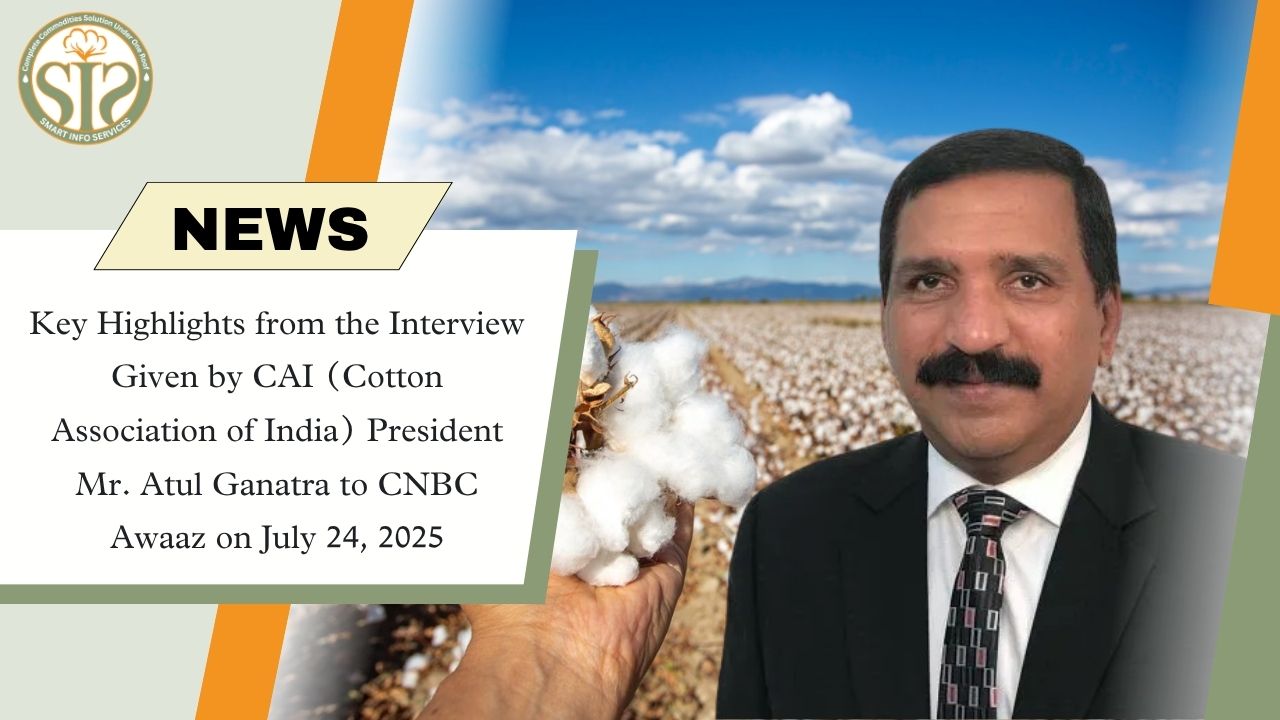
CAI President Atul Ganatra's interview to CNBC Awaaz – Key Points

Key Highlights from the Interview Given by CAI (Cotton Association of India) President Mr. Atul Ganatra to CNBC Awaaz on July 24, 20251. Rising Demand for Alternative Fibers:Mr. Ganatra highlighted that there has been a significant increase in demand for alternative fibers like viscose and polyester over the past four years. In 2021, their daily consumption was around 1,800 tons, which has now risen to 2,600–2,700 tons per day. This upward trend is expected to accelerate further in the coming years.2. Fiber Price Comparison & Yarn Realization Rates:Current Prices:Cotton: ₹170 per kgViscose: ₹155 per kgPolyester: ₹102 per kgYarn Realization (percentage of fiber converted to yarn):Cotton: 86–87%Viscose/Polyester: Approx. 98%3. National vs Global Fiber Usage Ratio:India still uses 70% cotton and 30% synthetic fibers, whereas globally, the trend is reversed—70% manmade fibers and 30% cotton yarn.4. Massive Surge in Cotton Imports:There has been a dramatic rise in cotton imports this year. While only 1.5 million bales were imported last year, this year the number is expected to reach 4 million bales—an increase of over 250%, despite an 11% import duty. This is a concerning development for the Indian economy.5. Competitiveness of Imported Cotton:Currently, November shipment deals from Brazil and African countries are being finalized at ₹50,000–₹51,500 per candy, while domestic cotton prices stand at ₹56,000–₹57,000 per candy, which is 8–10% higher.Imported cotton is considered more competitive due to higher quality, lower contamination, and better yarn recovery compared to Indian cotton.6. Minimum Support Price & Sowing Situation:The MSP for the upcoming season is ₹8,100 per quintal, at which the CCI (Cotton Corporation of India) will procure cotton from farmers. This has boosted farmer confidence.Initially, there were concerns of a 10% decline in sowing area, but recent data shows sowing has already reached 10.1 million hectares, matching last year’s levels. If this trend continues, sowing could see a 3–4% increase this year.Thanks to a timely monsoon, new crop arrivals may begin in North and South India by September 15.7. Impact of Recycled Cotton:Recycled cotton—priced at around 25% of the cost of virgin cotton—is being used in higher volumes, which has also contributed to the reduction in overall cotton demand in the country.read more :- Trump: 15% to 50% tariffs will be imposed on countries

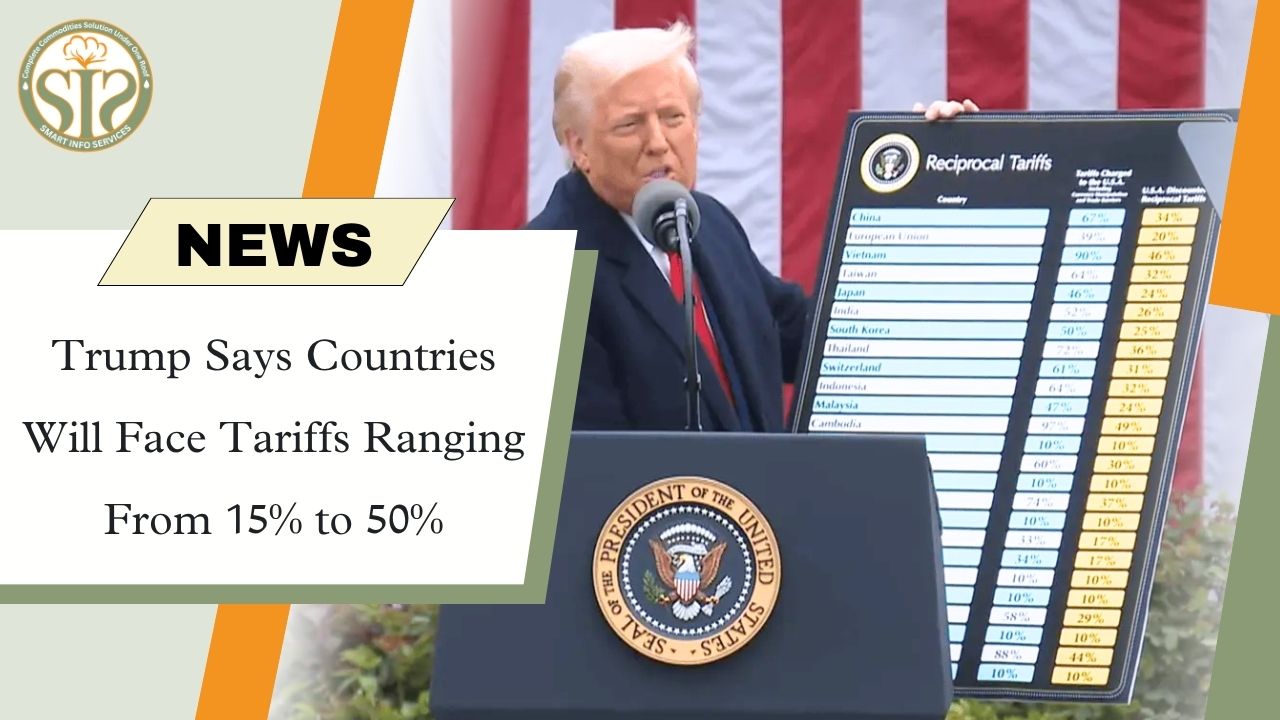
Trump: 15% to 50% tariffs will be imposed on countries

Trump Says Countries Will Face Tariffs Ranging From 15% to 50%US President Donald Trump suggested that he would not go below 15% as he sets so-called reciprocal tariff rates ahead of an Aug. 1 deadline, an indication that the floor for the increased levies was rising.“We’ll have a straight, simple tariff of anywhere between 15% and 50%,” Trump said Wednesday at an AI summit in Washington. “A couple of — we have 50 because we haven’t been getting along with those countries too well.”Trump’s comment declaring that the tariffs would begin at 15% represented the latest twist in his effort to impose duties on nearly every US trading partner, and the latest indication that Trump was looking to more aggressively impose the levies on exports from countries outside the small group that so far has been able to broker trade frameworks with Washington.Trump earlier this month said that more than 150 countries would receive a letter including a tariff rate of “probably 10 or 15%, we haven’t decided yet.” Commerce Secretary Howard Lutnick told CBS News on Sunday that small countries including “the Latin American countries, the Caribbean countries, many countries in Africa” would have a baseline tariff of 10%. And at the first announcement of the tariffs in April, Trump unveiled a universal tariff of 10% on nearly every country.While Trump and his advisers initially expressed hopes of securing multiple deals, the president has been touting the tariff letters themselves as “deals” and suggesting that he is uninterested in back-and-forth negotiations. Still, he has left the door open for countries to make agreements that could lower those rates.On Tuesday, Trump announced he was reducing a threatened 25% tariff on Japan to 15% in exchange for the country removing restrictions on some US products as well as offering to back a $550 billion investment fund.The White House has also discussed a similar fund with South Korea, a nation also focused on reaching a 15% rate including on autos, according to people familiar with the matter. And the Philippines is aiming to bring down its own tariff rate to the 15% level from the current 19% rate, according to the country’s Ambassador to the US Jose Manuel Romualdez.Meantime, officials in Vietnam are weighing the likely cost of their deal. Hanoi estimates its exports to the US could decline by as much as a third if higher tariffs announced by Trump take effect, an internal government assessment shows.Read more: Vietnam Sees Trump Tariffs Cutting Up to a Third of US ExportsOther nations, including India and members of the European Union, are still pushing for an agreements before the heightened tariffs go into effect.On Wednesday, Trump said he would “have a very, very simple tariff for some of the countries” because there were so many nations that “you can’t negotiate deals with everyone.” He said talks with the European Union were “serious.”“If they agree to open up the union to American businesses, then we will let them pay a lower tariff,” Trump said.read more :- India-UK trade agreement: Exemption on Basmati and fruit export, no exemption on dairy and edible oil import

India-UK trade agreement: Exemption on Basmati and fruit export, no exemption on dairy and edible oil import

India-UK FTA: Basmati, fruits, cotton exports exempted from tariff; no relaxation on import of dairy, apples and edible oils.Farmers and food-processing units are set to benefit from the India-UK free trade agreement (FTA) as basmati rice, cotton, groundnut, fruits, vegetables, onion, pickles, spices, tea and coffee, etc, would be exempt from duty when exported to the UK.Also, the FTA allows no tariff concessions on import of dairy products, apples, oats and edible oils. It means apple-growers in Himachal Pradesh and Jammu and Kashmir stand protected. Farmers and politicians from both states had been vocal in seeking ‘no exemption’ on apple imports.Agriculture and food processing will have a 14.8 per cent and 10.6 per cent share, respectively, of the agreed products under the FTA, that is scheduled to be signed in London on Thursday.A duty-free access, streamlined trade protocol, and protection for India's agriculture is part of the FTA and it sets the stage for growth in agri exports and value-added products. It unlocks premium UK markets for Indian farm and food-processing units as tariffs would match, or be lower in some cases, with benefits enjoyed by exporters from Germany, the Netherlands, and other EU nations.Agriculture and food processingOver 95% of ‘tariff lines’ agreed upon in the FTA will attract zero duty on Indian agricultural and processed food. India has calculated that this duty-free access is expected to increase agri exports by over 20% in the next three years, contributing to the goal of $100 billion agri exports by 2030 and putting more money in the hands of rural households.In the food-processing sector, India exports $14.07 billion worth of goods globally, while the UK imports $50.68 billion of goods. So far, Indian products make up just $309.5 million of UK imports.In agriculture, India exports $36.63 billion globally, while the UK imports $37.52 billion, but the UK’s imports from India are just $811 million.India can outcompete major global players in crucial segments. For example, in processed food preparations, India would have to gain ground over the US, China and Thailand. In bakery items, Indian produce would be more competitive than those from the US, China, Thailand and Vietnam. In case of preserved vegetables, fruits, nuts, fresh vegetables and Indian produce would get a lower tariff than that applied to Pakistan, Turkiye, the US, Brazil, Thailand and China.read more :- Rupee fell 07 paise to close at 86.40 per dollar

Cheap fibres put pressure on global cotton

Cheaper alternative fibres put pressure on global cotton growthIndustry experts and research analysts say global cotton growth is under pressure due to the growing trend towards sustainability and environmentally conscious production, as consumers increasingly prefer responsible materials and manufacturing processes."Although natural fibres such as cotton have traditionally been considered sustainable and clean, overall cotton use is gradually declining due to concerns over excessive consumption, water use and climate sensitivity, driven by declining demand for fast-fashion and a shift towards alternative materials," research agency BMI, a unit of Fitch Solutions, said in its study titled "The Future of Cotton in Asia: Slowing Demand, Innovation and Resilience"."The textile sector is looking at alternative fibres such as bamboo, hemp and recycled cotton. These are cheaper than cotton," says Anand Popat, a Rajkot-based trader of cotton, yarn and cotton waste.Blended fibres are gaining popularity"Cotton blended fibres are gaining popularity. Today, pure cotton accounts for less than 30 per cent of the total fibre usage in the textile industry. Manufacturers have many options," said Ramanuj Das Boob, a Raichur-based sourcing agent and vice-president of the All India Cotton Brokers Association.Prabhu Dhamodharan, convener of the Indian Textile Entrepreneurs Federation (ITF), said alternative fibres have made some progress but cotton still remains the preferred choice among premium consumers. "This segment of consumers exhibits high spending power, leading to a sustained demand for cotton-based fashion products," he said.From India's perspective, for the first time this year, its cotton-based apparel exports accounted for 12 per cent of the US market. "With India's established strength in cotton apparels, this momentum is likely to continue," Dhamodharan said.Pointing to various initiatives launched by the EU and the UK to promote eco-friendly products, BMI said the demand for cotton is likely to become volatile due to the growing trend of synthetic fibres and the progress in affordable, high-quality and bio-based alternatives.Recycled cotton"As consumer preferences shift towards more sustainable alternatives, we expect a gradual decline in demand for the cotton crop, impacting prices and hence reducing production in the long term," the research agency said."The low cost of alternatives is impacting cotton. While the lowest price of cotton yarn is ₹220 per kg, blended yarn is priced at around ₹150," Das Bub said."The prices of recycled cotton are one-fourth of the prices of pure cotton products. Even large retailers are considering reducing costs by opting for blended cotton instead of pure cotton," Popat said.BMI said cotton production has faced several challenges in recent years, particularly the development of resistance to Bt cotton by pink bollworm in India, due to incompatibility with local agronomic and climatic conditions. "This underlines the need for cotton producers to continue innovating and adapting to emerging challenges," it said.Social campaignsSocial campaigns against alleged forced labour in China's Xinjiang cotton industry have led to global boycotts by major fashion brands and consumers. "Domestic demand has also weakened, with Chinese garment manufacturers increasingly turning to imported cotton to avoid the adverse effects of import bans and boycotts," the research agency said.Popat said various agencies are now trying to promote cotton. "It all started when cotton prices touched ₹1 lakh per candy (356 kg). Manufacturers tried to reduce costs and alternatives came up," he said."Nothing can beat the feel of pure cotton. This is a cyclical trend. It can change in a few years," Das Boob said.Dhamodaran said inventory levels in the global fashion sector have normalised, with brands and retailers increasingly leveraging AI and digital tools for demand-based, dynamic planning.Almost five-year low"Production is now closely aligned with consumption patterns, especially in developed markets, and EU import and consumption trends remain very stable. We expect even better momentum in the EU going forward," he said.BMI said India and China have initiated measures to address current problems in the cotton sector. These are likely to bear fruits over time.According to the US Department of Agriculture, global cotton production is estimated to be 25.78 million tonnes (MT) in 2025-26, compared to 26.10 million tonnes in 2024-25. Domestic consumption in producing countries is expected to rise to 25.72 million tonnes (25.40 million tonnes in 2024-25), while exports are likely to rise to 9.73 million tonnes (9.36 million tonnes). This will leave ending stocks at 16.83 million tonnes (16.71 million tonnes), a clear sign of a slowdown.Cotton futures on the New York-based Intercontinental Exchange are trading near a five-year low of 66 cents per pound. In India, benchmark Shankar-6 cotton is trading at ₹57,500 per candy in Rajkot, Gujarat.read more :- Farmers moving towards maize: Decline in soybean and cotton cultivation

Farmers moving towards maize: Decline in soybean and cotton cultivation

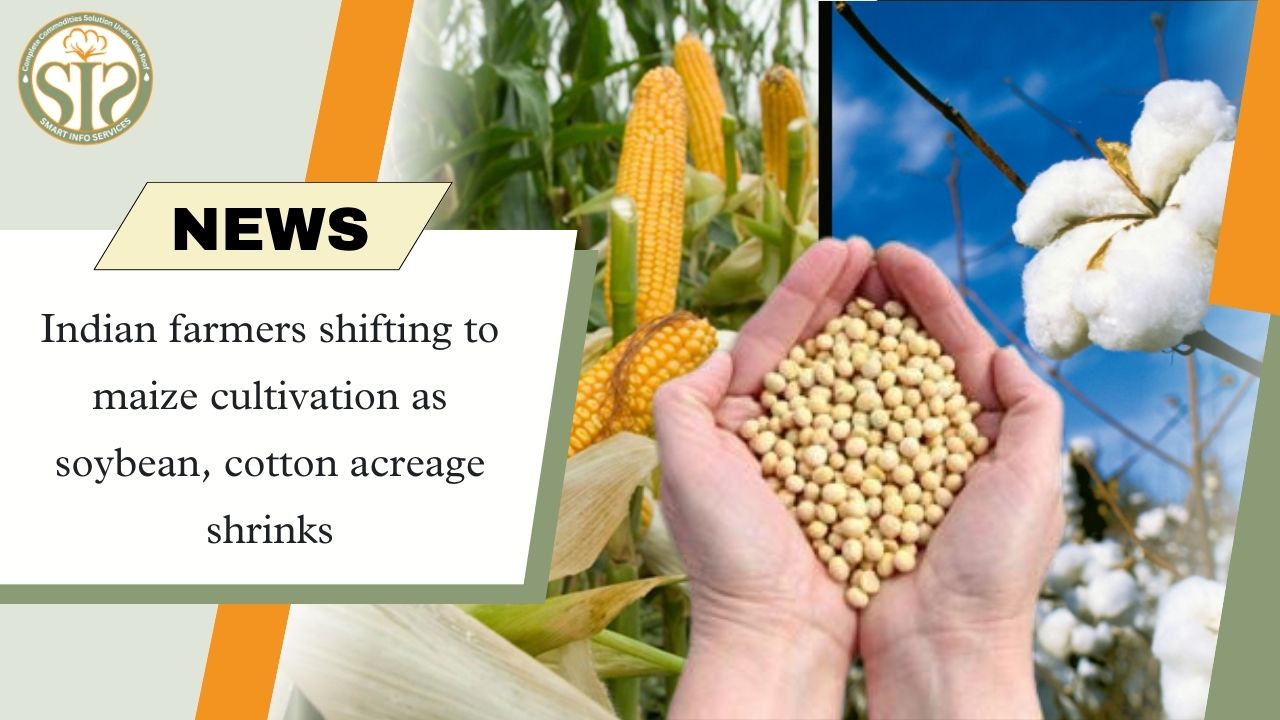
Indian farmers shifting to maize cultivation as soybean, cotton acreage shrinksFarmers across the country have shifted significantly towards maize cultivation while areas dedicated to soybean and cotton farming are declining amid lower-than-expected realisations in the markets.As the country enters the last leg of kharif sowing, India has reported 708.31 lakh hectares of sowing as of July 21, as compared to 680.38 lakh hectares of last year, of which maize recorded the highest jump — from last year’s 61.73 lakh hectares to 71.21 lakh hectares this year.However, oilseeds reported a 6 per cent dip, which is 156.76 lakh hectares as against last year’s 162.80 lakh hectares. Soybean, the main kharif oilseed, was sown over 111.67 lakh hectares this year compared to last year’s 118.96 lakh hectares. Cotton, the major lint crop, has also seen a decrease in the acreage from 102.05 of 202-25 to the present 98.55 lakh hectares of this year.The Solvent and Extractors Association (SEA) – the apex body of edible oil solvent and extractors companies – has expressed concerns about the potential dip in soybean, India’s main summer-sown oilseed crop, acreage nationally.“Soybean acreage has dipped by over 6 per cent compared to the previous year, possibly due to shifting crop preferences and regional weather variability. This trend merits close observation, as soybean remains a crucial pillar in India’s oilseed economy and a major source of oil and meal,” Sanjeeve Asthana, President, SEA, said.Vilas Uphade, a farmer from Latur district of Maharashtra, noted that soybean is currently trading at Rs 4,000 per quintal in the wholesale market.“This is against the government-declared Minimum Support Price (MSP) of Rs 5,328, which is even before the new crop has entered the market. We are expecting a bumper harvest this year, so I worry about what the price conditions will be post the harvest,” he said. With the kharif sowing entering its last phase, prices might see further slide.The demand for maize has increased due to its use as a feedstock for ethanol production.read more :- INR Opens Stronger by 8 Paise at 86.33
Cotton textile exports cross $35.6 billion: Giriraj Singh

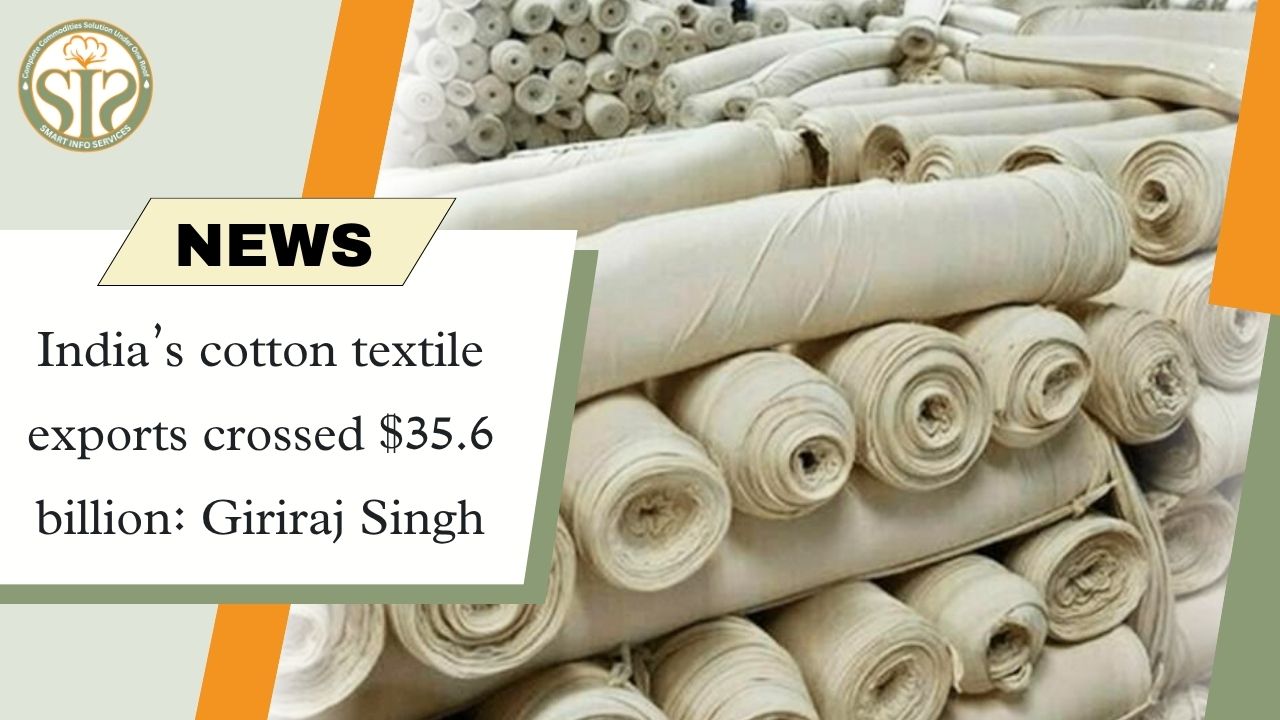
India’s cotton textile exports crossed $35.6 billion: Giriraj SinghIndia’s total exports of cotton textiles, including cotton yarn, cotton fabrics, made-ups, other textile yarn, fabric made-ups and raw cotton, crossed $35.642 billion during the last three years, Union Minister of Textiles Giriraj Singh informed Parliament on Tuesday.The minister also stated that to enhance cotton productivity and quality, promote innovation and strengthen the entire textile value chain in line with the Vision 2030, a five-year ‘Mission for Cotton Productivity’ was announced by the Finance Minister in the Budget for 2025-26.The Department of Agricultural Research and Education (DARE) is the nodal department for implementing the Mission, with the Ministry of Textiles as a partner. The Mission aims to boost cotton production through strategic interventions, including research and extension activities across all cotton-growing states.The Mission also proposes to focus on developing climate-smart, pest-resistant, and high-yielding cotton varieties, including Extra Long Staple (ELS) cotton, using advanced breeding and biotechnology tools.A special project on ‘Targeting technologies to agro-ecological zones-large scale demonstration of best practices to enhance cotton productivity’ has been implemented by ICAR- Central Institute for Cotton Research (CICR), Nagpur, in eight major cotton-growing states. The total outlay of the Special Project is Rs 6,032.35 lakhs, the minister further stated.The ‘Mission for Cotton Productivity’ aims to equip farmers with cutting-edge scientific and technological support, enabling higher productivity, superior fibre quality, and improved resilience against climatic and pest-related challenges. Aligned with the Government’s integrated 5F vision, Farm to Fibre to Factory to Fashion to Foreign, the Mission is expected to boost cotton farmers’ incomes, ensure a steady supply of high-quality cotton, and revitalise India’s traditional textile sector, thereby enhancing its global competitiveness, he added.As part of the steps to boost textile exports, the Ministry has also supported Export Promotion Councils in organizing a global mega textile event Bharat TEX 2025 to showcase the strength of the Indian textiles value chain, highlighting the latest progress innovations in textile & fashion Industry and positioning India as the most preferred destination for sourcing and investment in textile sector, the minister said in reply to another question in the Lok Sabha.These collaborations are governed through MoUs that support student and faculty exchanges, joint research initiatives, dual-degree and twinning programs, collaborative curriculum development, and global academic immersion, the minister said.“These international engagements enhance India’s position in the global textile and fashion sector by fostering academic excellence, promoting innovation, and enabling knowledge transfer. They expose students and faculty to global design sensibilities, technological advancements, and emerging trends. By aligning curricula with international standards, these collaborations equip Indian graduates with the skills and insights needed to compete effectively in global markets and strengthen India’s reputation as a hub for creative and technical expertise in textiles and fashion,” the minister explained.read more :- Cotton Exporting Countries in 2025: India's Ranking


Copyright© 2023 | Smart Info Service
Application Download