Filter

Recent News

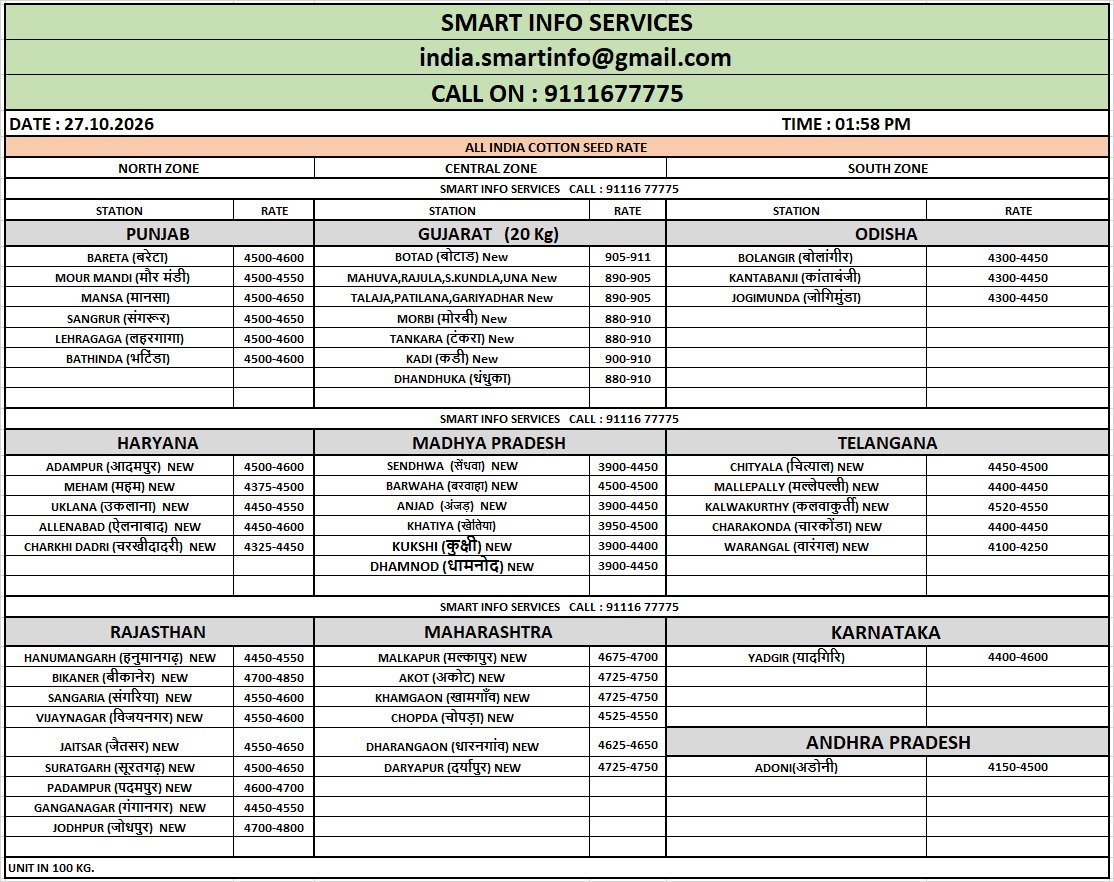
Telangana demands raising the moisture limit in cotton to 20%

Telangana Urges Centre to Raise Cotton Moisture Limit to 20%The Telangana government has urged the central government to raise the permissible upper limit of moisture content in cotton from the current 12% to 20%, citing the state’s prevailing weather conditions during the harvest season.In a letter to Union Textiles Minister Giriraj Singh, Telangana Agriculture Minister Tummala Nageswara Rao said that due to high humidity in October and November, the moisture content in freshly picked cotton naturally ranges between 12% and 20%. However, as per existing norms, the Cotton Corporation of India (CCI) procures cotton only with moisture content between 8% and 12%.“Because of this restriction, farmers are unable to sell their produce at the Minimum Support Price (MSP),” Rao wrote, appealing to the Centre to raise the upper limit to 20% to ensure fair procurement.The minister also noted that although total cotton output in Telangana is likely to decline marginally this year, global cotton prices have also weakened, putting additional pressure on farmers’ incomes. He expressed hope that the CCI would continue procurement at MSP during the ongoing marketing season.Cotton is cultivated on 18.59 lakh hectares across Telangana, with an estimated production of 28.29 lakh tonnes this year. The state ranks third in cotton cultivation nationally—after Maharashtra (38.42 lakh hectares) and Gujarat (20.81 lakh hectares)—followed by Rajasthan (6.28 lakh hectares) and Andhra Pradesh (4.13 lakh hectares).read more :- Rupee fell 38 paise to close at 88.24 per dollar

"Farmers are angry as procurement at MSP has not started in Suratgarh."

Cotton Arrivals at Suratgarh Grain Market: Farmers Dissatisfied With the Non-Start of Procurement at MSPSuratgarh's new grain market is currently witnessing a heavy influx of cotton, but procurement at the Minimum Support Price (MSP) has not yet begun, causing concern among farmers. The price of cotton in the market is currently hovering between ₹7,000 and ₹7,500 per quintal.According to agricultural experts, the MSP for cotton for the 2025-26 Kharif season has been set at ₹7,710 per quintal for medium-staple and ₹8,110 per quintal for long-staple. Farmers believe that if procurement at MSP had begun earlier, the market could have seen a further boom.This year, Bt cotton sowing in the Suratgarh area has increased compared to last year. While canal blockades caused water shortages in most tehsils of the district, farmers in Suratgarh used tube wells to irrigate their fields. Of the 10 cotton factories in the region, 6-7 have begun operations.Assistant Agriculture Officer Mahendra Kuldiya stated,This year, production in the Suratgarh region has increased by one to two quintals per acre. Compared to last year, cotton was sown on 32,240 hectares, an increase of 7,681 hectares.Farmers Netram, Surjaram, and Kashiram say that the CCI is promising to begin procurement on Monday, but if it had been earlier, farmers could have received an additional benefit of 500-600 rupees per quintal. Factory operators Bhanwarlal Sharma and Harish Kumar say that this year's season is likely to be good.The market receives 1,800 to 2,300 quintals of cotton daily, which is going directly to the factory. Meanwhile, CCI Quality Inspector Rakesh Meena said that procurement at the government rate is likely to begin on Monday.read more :- "Sharp decline in cotton production: A new challenge for the agriculture sector"

"The Cotton Revolution: Breaking the Fabric of India"

Threads of Change: Reweaving the Fabric of India's Cotton SectorGlobal warming-induced climate change is exacerbating India's cotton crisis, increasing pest attacks and disease outbreaks, leading to declining yields and productivity. India's cotton production for the 2024-25 marketing year is projected to reach its lowest level in more than a decade and a half at 29.4 million bales. This continues a decade-long decline in production from the peak of 39.8 million bales achieved in 2013-14.Climate change has disrupted weather patterns and altered temperatures. Changing weather and rising temperatures have created conditions where pests, especially cotton's age-old enemy, the pink bollworm, can thrive. This has also weakened the crop's ability to resist such attacks.These factors are increasing the cost of cotton cultivation and reducing yields, creating a storm that is eroding the profits of cotton growers. These factors are pushing farmers toward more profitable alternatives, leading to a decline in cotton acreage, even in top cotton-producing states like Gujarat, and in turn, further fueling the decline of cotton production.Nearly 60 million people depend on the cotton industry as a source of income, so this sector is in dire need of attention. A holistic approach to crop protection that is proven effective, incorporates technology, significantly reduces crop losses, and ultimately brings farmers back to cotton cultivation could be the key to turning the cotton sector around.Integrated pest management can lead such an approach. Integrated pest management (IPM) offers a practical, future-ready, and sustainable solution to address the pest-related challenges facing cotton production. This approach combines multiple pest-management practices, such as biological, cultural, mechanical, and chemical methods, to manage pests in an ecologically balanced and economically viable manner.In contrast to traditional methods that rely heavily on chemical pesticides, IPM takes a more balanced approach, prioritizing sustainable techniques such as crop rotation and the use of natural predators, and using chemicals only when absolutely necessary.The benefits of IPM are proven. For example, rice farmers who adopted an IPM approach have seen yield increases of up to 40%. But IPM can only work to a certain extent. In today's challenging agricultural landscape, technology is crucial to combating pest threats. Artificial intelligence and drones help farmers detect pest and disease outbreaks before they spread to a large crop area.For example, drones can roam the fields and act as farmers' eyes, quickly scanning the cultivated area and accurately detecting any pest attacks or disease outbreaks.On the other hand, manual inspections for pest infestations in crops are both time- and labor-intensive, and the presence of pests is often detected when it's too late.Drones can also be used for spraying pesticides, making the process safer by reducing human exposure.Certainly, the government has recognized the need for a systematic change in the cotton cultivation sector and launched the National Cotton Productivity Mission (NCPM). The NCPM is a five-year mission aimed at halting the decline in cotton production and is designed as a springboard for the entire cotton ecosystem, starting from the farm level to milling operations and even exports.At the farm level, it aims to empower farmers by providing them with technical assistance to adopt a modern, technologically advanced, climate-friendly approach to cotton cultivation and crop protection. Furthermore, it aims to boost the textile sector and ultimately exports.The NCPM is in line with India's 5F vision of "farm to fiber, fiber to factory, factory to fashion, and fashion to foreign."To be successful, it requires private sector support. Private sector participation in the NCPM could revolutionize the cotton sector. It could provide the NCPM with the critical momentum that could take it from policy to reality.Simply put, India needs a cotton revival. A well-thought-out approach to pest management, resilient to today's challenges, combined with private sector participation in an ambitious NCPM, can help make this a reality.read more :- Farmers in Andhra Pradesh are in trouble due to falling cotton prices

Farmers in Andhra Pradesh are in trouble due to falling cotton prices

Farmers in crisis from falling cotton prices in Andhra PradeshGUNTUR : Cotton farmers of the state are in trouble due to chaos in the procurement market. Despite the Centre's hike in the Minimum Support Price (MSP) for the current season, they are struggling to sell their stock.Farmers allege that the move by the Cotton Corporation of India (CCI) to radically change the procurement process through the newly launched Cotton Kisan App, without any training to stakeholders including CCI officials, marketing personnel and ginning mill employees, has further complicated the situation.The price of cotton, which was over ₹12,000 per quintal during 2023-24, has now fallen to ₹6,000, a steep decline of 50 per cent. While the cost of cultivation has increased to ₹10,000 per quintal, the Center has given an MSP of ₹8,100. Farmers who were hoping for better profits due to favorable weather and good yields this season are facing a loss of around ₹ 6,000 per quintal compared to last year.The CCI's experimental change in cotton procurement, which mandates untested cotton app, is pushing open market prices to an all-time low as private traders and middlemen are taking advantage of the disruption to buy stocks at extremely low prices.With CCI's procurement system completely stalled, farmers in cotton-rich districts like Guntur, Palanadu, Prakasam, Kurnool, Bapatla, Ananthapuram and Nandayal are stuck in a vicious cycle of debt.Many took huge loans for seeds, fertilisers, pesticides and labour, but found no buyers at the MSP. Unprecedented rains have also dampened farmers' hopes as stock has been affected due to moisture.The Cotton Kisan app, designed to streamline procurement, has instead become a hindrance. Stakeholders have reported confusion over registration, bidding and payment protocols, and no training sessions have been conducted by the CCI. Ginning mills, critical for processing, are out of order, further disrupting supply chains. As a result, excess stocks of cotton have flooded unregulated markets, causing prices to fall further. What was touted as a digital leap has turned into a policy failure, with farmers suffering the brunt.In fact, the CCI took more than two months to finalize the bids for the selection of ginning mills, while the farmers were in a state of panic. CPM leader Pasam Rama Rao alleged, "Enforce MSP through bulk procurement, compensate verifiable losses, train all stakeholders on cotton app and keep a strict vigil on private buyers. Until CCI corrects its negligence and operational failures, thousands of farmer families will remain on the brink of livelihood."read more :- Rupee open Falls 01 Paise to 87.86/USD

₹3,653 crore assistance to cotton farmers under PMFBY

*Cotton farmers in Maharashtra received ₹3,653 crore in PMFBY claims*Over the past five years, cotton farmers in Maharashtra have received ₹3,653 crore in insurance claims under the Pradhan Mantri Fasal Bima Yojana (PMFBY), protecting them from crop losses due to erratic rainfall and weather challenges.Cotton farmers in Maharashtra have received a total of ₹3,653 crore in insurance claims under the Pradhan Mantri Fasal Bima Yojana (PMFBY) over the past five years. This scheme provides complete coverage against crop losses—from pre-sowing to post-harvest—for crops and areas notified by the state government.Designed to protect farmers from losses due to natural disasters and adverse weather, the PMFBY has proven particularly beneficial for cotton farmers in Vidarbha, helping them overcome recurring crop losses due to erratic rainfall and weather challenges.*Year-over-year claims data shows increasing support.*According to data from the Ministry of Agriculture and Farmers Welfare, cotton farmers in Maharashtra received claims worth ₹55.26 crore in 2020, ₹441.10 crore in 2021, ₹456.84 crore in 2022, ₹1,941.09 crore in 2023, and ₹758.95 crore in 2024.Record Cotton Production in 2024–25During 2024–25, Maharashtra produced 92.32 lakh bales of cotton, an increase from last year's 80.45 lakh bales (each bale weighing 170 kg).*CCI procures 144.55 lakh quintals of cotton, helping farmers*To support cotton growers in key producing districts like Jalgaon and Yavatmal, the Cotton Corporation of India (CCI) has opened 128 procurement centers across 19 districts under its Aurangabad and Akola branches, including 11 in Jalgaon and 15 in Yavatmal. CCI has procured 144.55 lakh quintals of cotton worth ₹10,714 crore through 6.27 lakh transactions with farmers. This includes 21.39 lakh quintals from Yavatmal and 4.79 lakh quintals from Jalgaon districts.read more:-   Heavy rain damages cotton in Shevgaon
Heavy rain damages cotton in Shevgaon

*Maharashtra: Cotton Blight Loss: Heavy Rains Wreak Havoc on Cotton; Shevgaon Farmers Face Double Trouble**Bodhegaon:* Farmers in Shevgaon taluka are facing a natural disaster. Continuous heavy rains have caused significant damage to Kharif crops, and now the cotton crop is facing a severe blight outbreak, causing significant financial losses. There are complaints that traders are fleecing farmers due to the non-functioning of government cotton procurement centers.After the Kharif crops were destroyed by heavy rains, the cotton crop has become increasingly vulnerable to blight. Due to this, cotton production for many farmers in the taluka has halved, leaving no hope of recovering costs. Farmers are frustrated by the failure to control the disease even after spraying pesticides.*Low Prices; Farmers' Anger*The market price of cotton has exhausted farmers' patience. Despite the government's minimum support price of ₹8,200 per quintal, private traders are buying cotton at only ₹5,000 to ₹6,500 per quintal due to the government procurement centers not being operational.Farmers are truly frustrated as they have no other option but to sell their cotton to private traders. Farmers are extremely angry because they are forced to sell their hard-earned produce at low prices. Farmers are demanding that the government immediately establish procurement centers through the CCI and purchase at the minimum support price.Given the increased costs of fertilizers, seeds, labor, and irrigation, the farmers' financial situation has deteriorated significantly, and Baliraja is now facing a double crisis. The question now is who will help them out of this predicament. Farmers are looking to the government for help.*Relief from Compensation*Last month, heavy rains and floods caused huge losses to farmers in Shevgaon taluka. The state government has provided relief to 78,669 farmers in the taluka by approving ₹107 crore 25 lakh for compensation in the first phase. The District Collector had ordered the Revenue Department to deposit the funds into their accounts before Diwali. However, the department's delays caused a slight delay in the process. Currently, the compensation amount has begun to be deposited into farmers' accounts, and crowds of farmers are being seen at various banks. Farmers have expressed their reaction that this assistance is too little, and they hope to receive more from the central government in the next phase.*Double Crisis in Baliraja*Farmers in Shevgaon taluka are facing financial hardship due to excessive rainfall, pest infestation, low prices, and delayed relief. The government is demanded to immediately reopen government procurement centers and announce special assistance for farmers affected by the red leaf disease.read more:-  CCI to procure cotton in Manawar from November

title Created At Action
Rupee opens 08 paise down at 88.32 28-10-2025 17:33:11 view
Telangana demands raising the moisture limit in cotton to 20% 27-10-2025 23:56:10 view
Rupee fell 38 paise to close at 88.24 per dollar 27-10-2025 22:46:18 view
"Farmers are angry as procurement at MSP has not started in Suratgarh." 27-10-2025 20:10:34 view
"Sharp decline in cotton production: A new challenge for the agriculture sector" 27-10-2025 19:47:30 view
"The Cotton Revolution: Breaking the Fabric of India" 27-10-2025 19:24:37 view
Farmers in Andhra Pradesh are in trouble due to falling cotton prices 27-10-2025 19:13:31 view
Rupee open Falls 01 Paise to 87.86/USD 27-10-2025 17:24:21 view
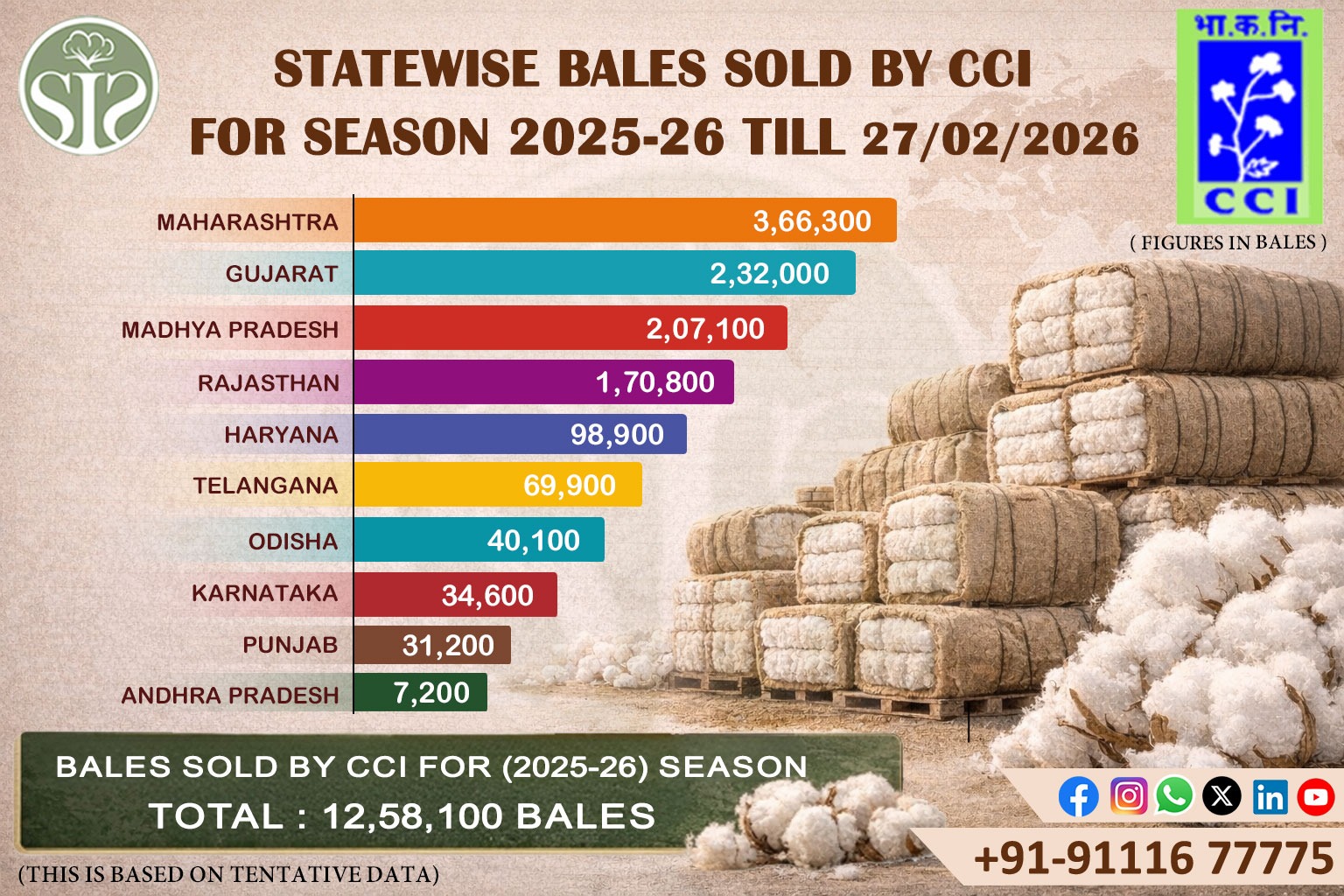
State-wise CCI Cotton Sales 2024–25 25-10-2025 22:19:46 view
₹3,653 crore assistance to cotton farmers under PMFBY 25-10-2025 19:02:58 view
Heavy rain damages cotton in Shevgaon 25-10-2025 18:44:38 view
Copyright© 2023 | Smart Info Service
Application Download