Recent News

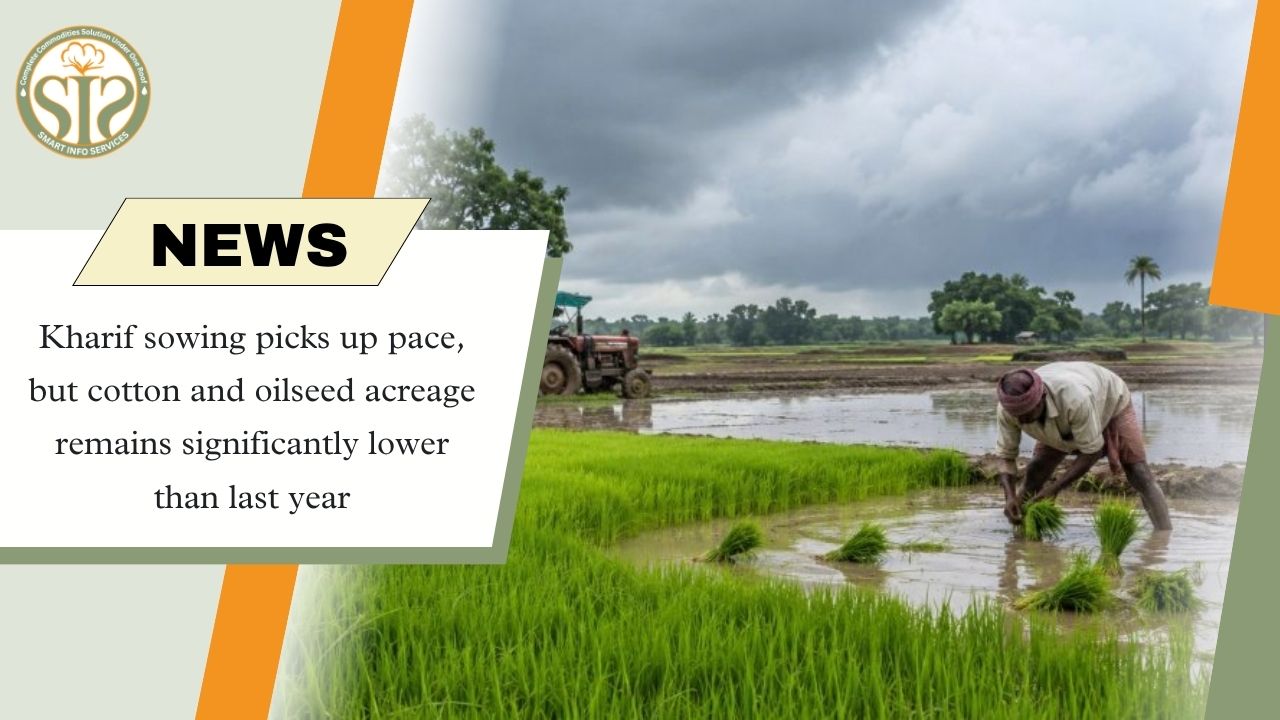
Kharif Sowing Gains Momentum, Cotton and Oilseed Acreage Trails Last Year

Kharif sowing picks up pace, but cotton and oilseed acreage remains significantly lower than last yearThe activation of the southwest monsoon has accelerated Kharif crop sowing across the country; however, the sowing of cotton and oilseeds continues to lag behind last year's figures. According to the latest data released by the Department of Agriculture and Farmers Welfare up to July 10, 2026, while increased rainfall in recent weeks has improved the pace of sowing, the acreage for these two major cash crops has yet to reach last year's levels.Government data indicates that oilseed sowing has covered 117.83 lakh hectares (11.78 million hectares), compared to 149.18 lakh hectares during the same period last year. This represents a decline of 31.35 lakh hectares, or approximately 21 percent, in total oilseed acreage. Among oilseed crops, soybean accounted for the largest share, with sowing recorded at 90.51 lakh hectares; this is down from 107.72 lakh hectares during the same period last year, marking a reduction of 17.21 lakh hectares. Similarly, groundnut acreage has dropped from 35.45 lakh hectares to 23.40 lakh hectares.Cotton sowing has been recorded at 79.54 lakh hectares (7.95 million hectares), down from 93.95 lakh hectares during the same period last year—a decrease of 14.41 lakh hectares, or approximately 15.3 percent. Although recent rains have accelerated sowing in major cotton-producing states like Maharashtra, Gujarat, Madhya Pradesh, and Telangana, the total area remains below last year's figures.According to the India Meteorological Department (IMD), rainfall activity is likely to remain relatively subdued over the next six to seven days across the plains of northwest India, west-central India, and the southern peninsular regions. Consequently, the pace of cotton and oilseed sowing in rain-fed areas could be affected.On the other hand, the water resource situation has improved. Water storage in the 166 major reservoirs monitored by the government rose to 32.38 percent of their live storage capacity by July 9, up from 26 percent a week earlier. Improved water availability is expected to benefit crops in irrigated areas.Experts believe that monsoon activity during the second half of July will be crucial for the sowing and potential output of cotton and oilseeds. If rainfall remains normal, the sowing gap could narrow further, whereas a prolonged weak monsoon could put pressure on the production of these two crops.READ MORE :- Rajasthan Targets 4x Textile Exports by 2030, Unveils Special Export Action Plan

Rajasthan Targets 4x Textile Exports by 2030, Unveils Special Export Action Plan

Target to Quadruple Rajasthan's Textile Exports by 2030; Government Prepares Special Action PlanThe Rajasthan government has launched large-scale initiatives to establish the textile and apparel sector as a key pillar of the state's economy. In line with Chief Minister Bhajan Lal Sharma's vision, the Department of Industries and Commerce has implemented approximately 15 new sector-specific policies. As part of this effort, a dedicated state-level textile cell has been constituted to ensure the effective implementation of the Rajasthan Textile and Apparel Policy-2025 and to boost investment.For the first time in the state, a textile export action plan has been formulated at both the state level and for 11 specific districts to promote exports. This plan encompasses the seven 'Champion Districts' identified by the Government of India—Ajmer, Bhilwara, Jaipur, Banswara, Chittorgarh, Jodhpur, and Kota—along with four 'Aspirational Districts': Sri Ganganagar, Hanumangarh, Nagaur, and Churu.Industries and Commerce Commissioner Nilabh Saxena stated that the textile cell would work to understand the needs of industries in the state and provide them with necessary support. The cell will conduct regular visits to industrial areas to identify bottlenecks related to production and exports. Additionally, solutions will be devised through consultations with industry experts, entrepreneurs, and exporters.He mentioned that the cell would study major textile hubs—both domestic and international—and disseminate information regarding the latest technologies to the industries. Efforts will be made to increase Rajasthan's participation in national and international textile exhibitions, alongside the collection and analysis of sector-related data. A proposal is also in place to organize a two-day textile summit in October of this year.The state government has designated the textile sector as a 'Thrust Sector' under the Rajasthan Investment Promotion Scheme (RIPS), thereby offering additional incentives to industries in this field.According to Saxena, the Government of India has set a target to raise textile and apparel exports to US$ 100 billion by the year 2030. With this in mind, Rajasthan has set a target to increase its textile exports three- to four-fold.In the 2024-25 fiscal year, Rajasthan's total exports exceeded ₹97,171 crore, with the textile and allied sectors contributing approximately ₹13,500 crore. This accounts for more than 13 percent of the state's total exports.Rajasthan ranks first in the country in wool production, contributing nearly 47 percent, while it holds the fifth position in cotton production. Currently, over 1,800 textile and apparel units are operational in the state. Rajasthan's textile industry enjoys a distinct identity in the international market, driven by hand-block printing, traditional techniques, and a diverse range of textile products. The government is now moving towards further strengthening this sector on a global scale through investments, technology, and the expansion of exports.READ MORE :- Rupee opened 3 paise stronger at 96.17 against the US dollar

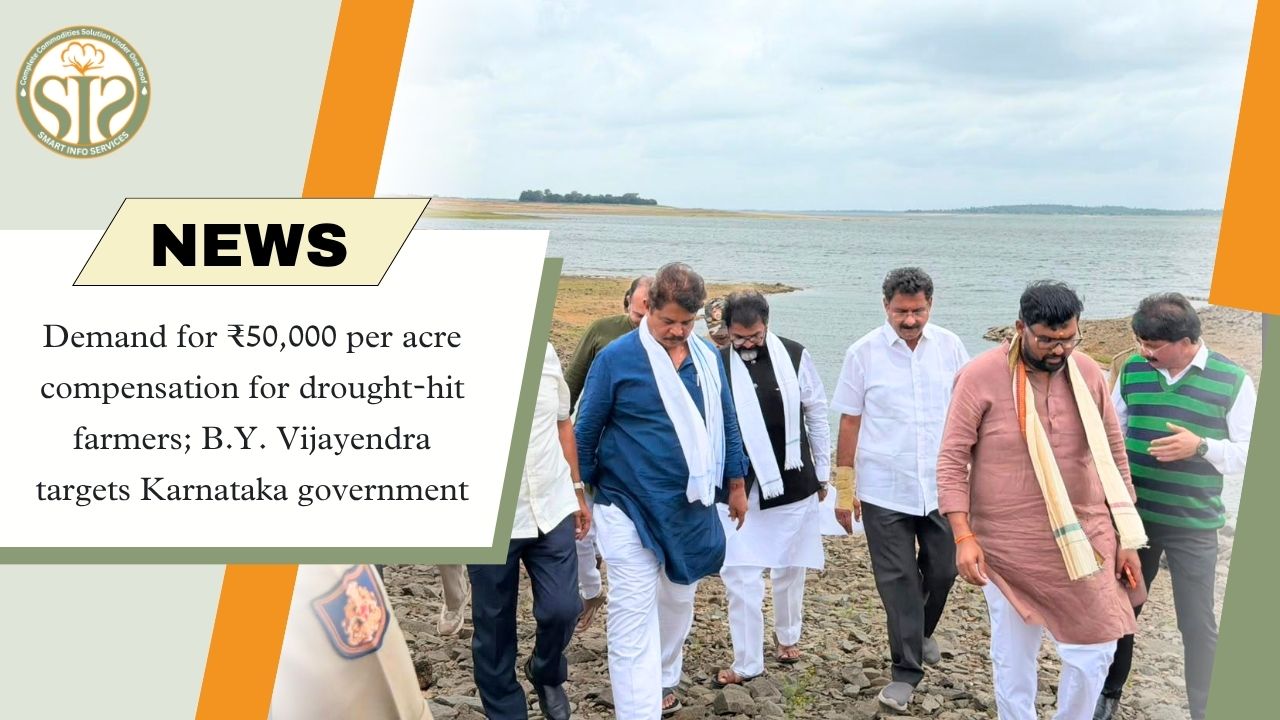
Karnataka BJP Seeks Farmer Relief

Demand for ₹50,000 per acre compensation for drought-hit farmers; B.Y. Vijayendra targets Karnataka governmentKarnataka BJP President B.Y. Vijayendra has launched a scathing attack on the state's Congress government regarding the drought situation in the North Karnataka and Kalyana Karnataka regions. He alleged that the government is not taking the plight of drought-stricken farmers seriously and has failed to provide immediate financial assistance to those affected.During a press briefing held at the airport on July 13, Vijayendra highlighted the dire situation of farmers in several districts, including Bidar, Kalaburagi, and Yadgir. He stated that agricultural activities have been severely impacted due to a significant rainfall deficit in these areas. According to him, rainfall has been far below normal in many regions, preventing farmers from even undertaking sowing operations.Vijayendra claimed that cultivation could not take place on over 30 lakh hectares of agricultural land due to the lack of rain. He noted that major crops such as pigeon pea (tur), sunflower, and cotton have been affected, directly impacting farmers' incomes and leaving many families facing a financial crisis.He demanded that the state government provide compensation of at least ₹50,000 per acre to the drought-affected farmers. Dismissing Chief Minister D.K. Shivakumar's recent visit to Basavakalyan as "merely a photo op," Vijayendra asserted that the government must take concrete steps to assist farmers at the grassroots level.The BJP leader also referred to the initiatives undertaken by the previous BJP government led by former Chief Minister B.S. Yediyurappa. He mentioned that projects worth approximately ₹500 crore were launched for the region's development at that time, with funds of ₹100 crore and ₹200 crore released in phases. Vijayendra alleged that the current Congress government has been neglecting these schemes for the past three years.He urged the Chief Minister to immediately release the pending funds and prioritize development works. Addressing questions about alleged internal rifts within the Bidar district BJP, Vijayendra stated that the party would resolve all local issues through dialogue and mutual consensus. He dismissed allegations of any "adjustment politics" between BJP MLAs and the Congress, asserting that the BJP is playing the role of a strong opposition dedicated to the interests of the public and the farming community.In view of the upcoming Zilla Panchayat and local body elections, Vijayendra emphasized the need to further energize the organization. He stated that strategies regarding election preparations and issues concerning farmers would be formulated through consultations with district leaders, MLAs, and senior office-bearers.read more :-The rupee settled 26 paise lower at 96.20 against the US dollar.

Cotton Acreage Declines in Khandesh as Farmers Shift to Maize and Soybean

Cotton Acreage Shrinks in Maharashtra's Khandesh; Farmers Shift Towards Maize and SoybeanJalgaon/Maharashtra: A significant shift in cropping patterns is being observed in Maharashtra's Khandesh region during this year's Kharif season. While sowing for Kharif crops is nearly 81 percent complete, the area under cotton cultivation is steadily declining. Due to rising cultivation costs, weak market prices, and increasing pest infestations, farmers are now turning towards alternative crops such as maize, soybean, and *arhar* (tur/pigeon pea).Specifically, the cotton cultivation area in Jalgaon district has decreased by approximately 25,000 hectares compared to the previous season. While cotton was cultivated on about 5.11 lakh hectares in the district during 2024-25, this figure has dropped to around 4.55 lakh hectares this year.According to Agriculture Department data, cotton acreage has declined in other districts of Khandesh as well. In Dhule district, cotton is being cultivated on approximately 1.75 lakh hectares this year, down from nearly 2 lakh hectares in the previous season. Meanwhile, in Nandurbar district, the cotton area has shrunk to about 85,000 hectares, compared to over 97,000 hectares last year.Farmers state that while the cost of cotton cultivation keeps rising, market prices are not commensurate with production levels. Escalating costs of labor, fertilizers, seeds, and pesticides have driven up expenses. Additionally, the menace of the pink bollworm and changing weather patterns have further compounded concerns for cotton growers.A delay in monsoon rains has also compelled many farmers to opt for alternative crops. This shift is reflected in the increased acreage for maize and other Kharif crops; in Jalgaon district alone, the area under maize cultivation has expanded by approximately 10,000 hectares. Agricultural experts believe that, given the current circumstances, the total area under cotton cultivation across the Khandesh region could remain below 8 lakh hectares this year. Farmers are now altering their crop choices by taking into account costs, risks, and market prospects.READ MORE :- Rupee Opens 32 Paise Lower at 95.94 Against US Dollar

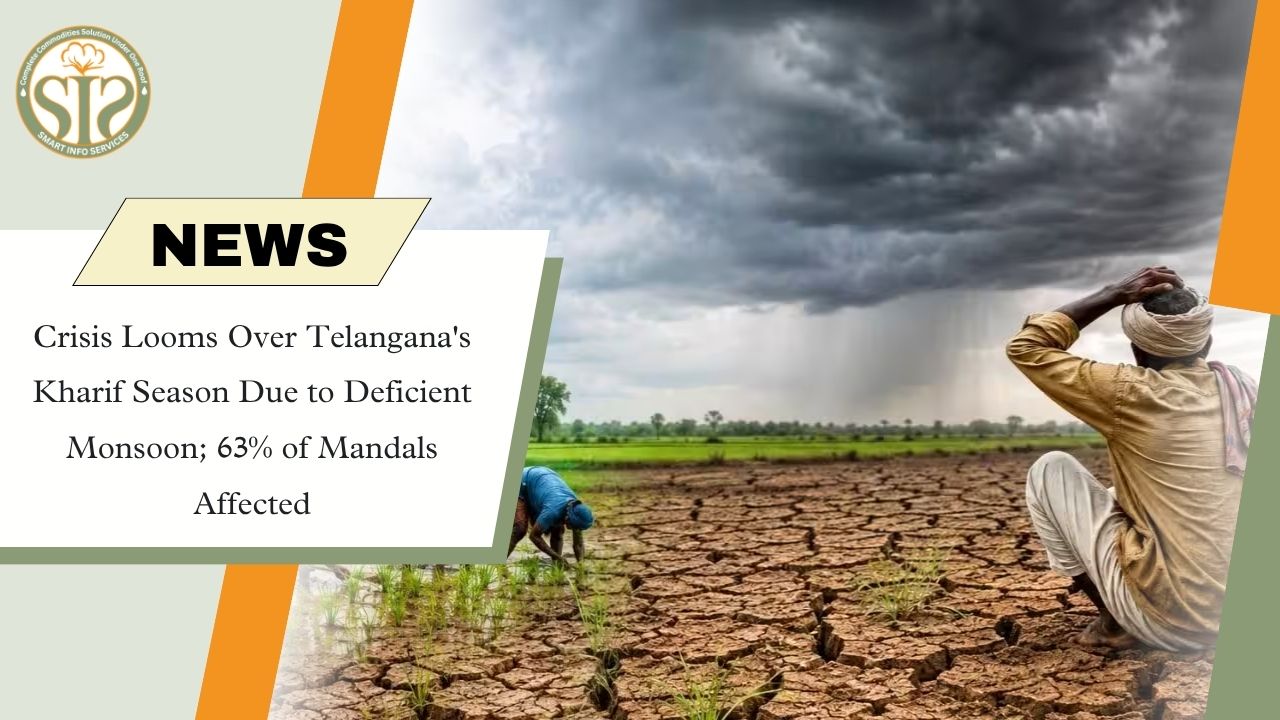
Telangana Kharif Season Faces Crisis as Monsoon Deficit Hits 63% of Mandals

Crisis Looms Over Telangana's Kharif Season Due to Deficient Monsoon; 63% of Mandals AffectedHyderabad: A weak monsoon this year has cast a shadow of uncertainty over Telangana's Kharif season. Despite sowing and transplantation covering a larger area by the end of the first week of July compared to last year, farmers are increasingly concerned due to a severe rainfall deficit across most parts of the state. Agricultural experts believe that a lack of adequate and consistent rainfall in the coming days could severely impact crop growth, yields, and farmers' incomes.Out of the 605 mandals across the state's 32 rural districts, 382 (approximately 63 percent) have been affected by the monsoon's failure. The Meteorological Department has forecast below-normal rainfall for the remainder of July, further deepening the crisis facing Kharif crop prospects. Persistent rainfall deficiency has resulted in insufficient water inflow into major, medium, and minor irrigation reservoirs located in catchment areas, thereby disrupting irrigation systems.According to data from the Agriculture Department, the total area under Kharif cultivation has reached 55.32 lakh acres so far this year, compared to 52.04 lakh acres during the same period last year. A breakdown by crop reveals that cotton accounts for the largest share, with sowing completed on 39.44 lakh acres. Additionally, paddy transplantation has covered 4.22 lakh acres, while soybean, red gram (arhar), and maize have been cultivated on 3.35 lakh acres, 3.19 lakh acres, and 2.84 lakh acres, respectively; green gram (moong) and black gram (urad) have been cultivated on approximately 46,000 acres.Data from the Telangana Development Planning Society indicates that 68 mandals recorded rainfall deficits ranging from 60 to 99 percent below normal, while 327 mandals saw deficits between 20 and 59 percent. Rainfall was recorded in the 'normal' category in only 181 mandals; however, even within these areas, most received up to 19 percent less rainfall than normal. On the other hand, above-normal or excess rainfall was recorded in only 45 mandals. Of these, 11 mandals are located across the districts of Ranga Reddy, Nalgonda, Nagarkurnool, Vikarabad, Sangareddy, Suryapet, and Bhadradri-Kothagudem.Statewide, average rainfall has been 25 percent below normal. The highest deficit was recorded in Hanumakonda district, while 25 districts—including Hyderabad—received less-than-normal rainfall. Nevertheless, groundwater levels remain stable due to good rainfall last year. The average groundwater level in June 2025 stood at 9.46 meters, nearly identical to the 9.47 meters recorded in June of the previous year.In anticipation of a potential crisis, the Agriculture Department has prepared a contingency plan. Officials state that if adequate rainfall does not occur by the end of the second week of July, farmers will be provided with seeds for alternative crops. Additionally, agricultural scientists are advising farmers to adopt low-water-consuming crops and weather-based farming practices to minimize potential losses.READ MORE :- Rainfall Woes Delay Kharif Sowing in Nashik; 45% of Farmland Still Unsown

Rainfall Woes Delay Kharif Sowing in Nashik; 45% of Farmland Still Unsown

Rainfall Woes Hit Sowing in Nashik Division; 45% of Agricultural Land Still UnsownNashik Road: The Kharif season in the Nashik division appears to be affected by a weak and uneven monsoon. While rainfall in some areas last week raised hopes among farmers, the pace of sowing remains sluggish due to the lack of continuous and adequate rain in most regions. Despite about a month and a half having passed since the onset of the monsoon, many farmers are still waiting to sow their crops because the soil lacks sufficient moisture. According to the Agriculture Department, sowing has not yet taken place on approximately 45 percent of the division's total cultivable land.Rising agricultural costs have further compounded farmers' concerns. Expenses related to seeds, fertilizers, land preparation, and labor have increased significantly compared to the past. Consequently, farmers are reluctant to take the risk of sowing in soil with low moisture levels. They argue that sowing without adequate rainfall could lead to seed failure and the need for re-sowing, effectively doubling their costs. This is why most farmers are waiting for good, consistent rainfall.Data from the Agriculture Department indicates that the average area for Kharif crops in the Nashik division is 20.33 lakh hectares. In contrast, sowing has been completed on only 11.23 lakh hectares so far—meaning cultivation has commenced on about 55 percent of the land, while the remaining 45 percent remains unsown. The districts of Nashik and Nandurbar are considered the most severely affected.The department has advised farmers to check weather forecasts before proceeding with sowing. Officials have emphasized that seeds should be sown only when there is adequate soil moisture and that fertilizers should be used in a balanced manner. Should drought-like conditions persist, farmers will be provided with technical guidance and agricultural advice.Meanwhile, Ankush Nivrutti Nikam, a retired teacher from Nagarsul, has set an example by using modern machinery to reduce farming costs. He has purchased a mechanical weeder for inter-cultivation, which allows the weeding of one acre to be completed using just one liter of petrol. According to him, while using bullocks for the same task costs around ₹1,600 per acre, the cost drops to approximately ₹100 when using the machine. The machine can cover three to four acres daily, significantly reducing labor costs as well.Nikam has urged farmers to adopt modern machinery in their farming practices. Meanwhile, Prabhakar Jagannath Kudke of the local society has requested the government to provide subsidies for small tractors and inter-cultivation machines—similar to those offered for large tractors—so that more farmers can leverage modern technology to lower their cultivation costs.READ MORE :- ₹14,000–₹27,000 Assistance for Cotton Farmers: Gujarat Opens Applications Under Cotton Productivity Mission

Related News

Youtube Videos

कपास भाव में उतार-चढ़ाव 😱 जानिए इस हफ्ते का बाजार | CCI नीलामी रिपोर्ट 24 Oct 2026
कपास भाव में उतार-चढ़ाव 😱 जानिए इस हफ्ते का बाजार | CCI नील...
जानिए आज का कपास बाज़ार? 😱कपास, बीज, गठानें, यार्न भाव | Cotton Market Rate Today
जानिए आज का कपास बाज़ार? 😱कपास, बीज, गठानें, यार्न भाव | Co...
आज कपास में तेज़ी या मंदी? 😱 Cotton Market Rate Today | 22 Oct 2026
आज कपास में तेज़ी या मंदी? 😱 Cotton Market Rate Today | 22...
Application Download
Whatsapp Contact