Recent News

Kharif Sowing Insights: Paddy and Pulses Surge, Cotton Declines Amid Monsoon Revival

Kharif Sowing Insights: Cotton Drops During Monsoon Revival, Paddy and Pulses SoarEarly kharif sowing gains have slowed to under 4% as the planting season nears its end, despite recent improvements in the monsoon. Paddy acreage has increased significantly, while cotton planting has dropped for the first time in years. Soybean and oilseed sowing also show positive growth, though nutri-cereals face a decline. Arhar and pulse sowing have surged due to favorable market conditions.Kharif Sowing Progress: Early gains in kharif sowing have narrowed to under 4%, compared to over 10% a week earlier. This shift is attributed to the nearing end of the main planting window.*Monsoon Revival:* The revival of the monsoon, influenced by a low-pressure system in the Bay of Bengal, is expected to enhance sowing activities, particularly in states with previously deficient rainfall.Sowing Statistics: As of July 19, kharif sowing covers 704.04 lakh hectares (64% of the normal area), up by 3.5% from last year. The normal kharif area is 1,096 lakh hectares.Paddy Acreage: The area under paddy has increased to 166.06 lakh hectares, showing a 6.7% rise from 155.65 lakh hectares last year. Key producing states are expected to improve sowing rates with better rainfall.Cotton Sowing Decline: Cotton acreage has decreased to 102.05 lakh hectares, down by 3.4% from 105.66 lakh hectares last year. Declines are noted in Punjab, Haryana, Rajasthan, and Gujarat.Soybean Coverage: Soybean acreage has reached 119.04 lakh hectares, nearing the normal area of 123 lakh hectares. This is a 9.2% increase from 108.97 lakh hectares last year.Oilseed Area: The total area under oilseeds has risen by 8.1% to 163.11 lakh hectares from 150.91 lakh hectares last year, with groundnut showing a 12.6% growth.Read more :- Cotton Purchase Centres by October: Government Assures Court

Gujarat Textile Traders Set 100-Day Payment Limit Amid New Tax Regulations

Gujarat Textile Traders Set 100-Day Payment Limit Amid New Tax RegulationsIn a significant shift for the textile industry, traders in Gujarat are gearing up to implement new payment norms following the introduction of Section 43B(H) of the Income Tax Act. This change has prompted a collective move to reduce credit periods, with most traders agreeing to cap the payment cycle at 100 days, down from the previous 180-day window.The transition, however, is not without its challenges. Many traders express concern over the difficulty of immediately adopting the government-suggested 45-day payment cycle. As a compromise, the industry has opted for a phased approach, starting with the 100-day limit.Gaurang Bhagat, president of Maskati Kapad Market Mahajan, highlighted the rationale behind this move: "We've witnessed an uptick in fraud cases within the textile sector over recent years. The extended payment cycle of up to 180 days has been a significant factor in these fraudulent activities. By reducing the credit period to under 100 days, we aim to mitigate this risk."*The industry is also taking additional steps to safeguard against fraud. Naresh Sharma, secretary of the Maskati Mahajan, revealed that traders have been advised to work exclusively with registered brokers. "This measure will allow us to provide assistance in case of defaults," Sharma explained. He added that traders have been encouraged to ensure their brokers are properly registered.This proactive approach by the textile trading community demonstrates a commitment to adapting to regulatory changes while simultaneously addressing long-standing issues within the industry. As the sector navigates these new norms, the impact on business operations and fraud prevention will be closely watched by industry observers and policymakers alike.READ MORE :> Cotton Purchase Centres by October: Government Assures Court

Textile Exports Affected by Container Shortage

Textile Exports Affected by Container ShortageAhmedabad: Textile deliveries are facing disruptions due to a shortage of containers and increased freight costs, affecting both domestic and export orders.Denim exporters are grappling with a backlog of shipments, with around 500 containers of fabric ready for export but stuck in warehouses due to the shortage. Yarn manufacturers are experiencing similar issues.Industry experts note that the inability to deliver past orders is preventing new ones from coming in. Vinod Mittal, a denim manufacturer in Ahmedabad, stated, “The denim industry saw a revival in the last quarter of FY24, but the situation has been challenging since then. There is steady offshore demand, but we are unable to export due to container issues. Consequently, the demand for godowns to store stock has increased, as have their rents. Until we deliver earlier orders, we cannot secure new ones.”Industry estimates indicate that the denim sector alone has seen a stockpile of around 500 containers (20 tonnes each) in Gujarat. This has reduced capacity utilization of units to 60-70% from around 90% three months ago.“Exporters are unable to ship their manufactured goods due to the unavailability of containers. As a result, godowns available for hire are in high demand, which attracts additional costs at a time when payment cycles are stretched. This is causing a working capital shortage for manufacturers,” explained Kumar Agarwal, another denim manufacturer in Ahmedabad.Jayesh Patel, senior vice president of the Spinners' Association Gujarat (SAG), added, “Exports have become costlier due to the Red Sea crisis. Additionally, shipping companies get better pricing from China, so they prefer taking containers from there. This has reduced the availability of containers here and affected our competitiveness in the global market. We are seeing higher stockpiling with full godowns, and payment rotations have been affected.”Read more :-Area Under Cotton in North India Drops by 6 Lakh Hectares, Punjab’s Dip Sharpest

Cotton Purchase Centres by October: Government Assures Court

October Cotton Purchasing Centers: Government Guarantees CourtNagpur: On Thursday, the central government assured the Nagpur bench of the Bombay High Court that it will open cotton procurement centres for farmers by October and expedite the release of any pending dues.This assurance was given during a hearing in response to a Public Interest Litigation (PIL) filed by Shriram Satpute from Grahak Panchayat Maharashtra Sansthan. Satpute sought directives for the central and state governments to commence cotton procurement before the Diwali festival and ensure payments are deposited into farmers’ accounts within seven days.He argued that delays in opening procurement centres force farmers to sell their produce to traders at prices below the guaranteed minimum support price (MSP), causing financial losses.The High Court had previously instructed both governments to submit data on payments made to cotton-selling farmers within seven days of purchase at government-run procurement centres. Additionally, both were asked to explain any delays in payments.On Wednesday, the central government explained that payment delays occurred because transactions are directly deposited into farmers’ Aadhaar-linked bank accounts. These transactions are routed through the Akola head office of the Cotton Corporation of India (CCI) for the Vidarbha region.The judges then sought a comprehensive reply from the State Textile Department’s principal secretary and the CCI, detailing the number of payments released to farmers after procurement. The central government’s representative informed the court that all efforts were being made to streamline the payment process and ensure timely disbursement.The High Court granted a final opportunity for the Union government’s textile ministry secretary and CCI to file their responses regarding the procurement and payment issues. The petitioner emphasized the importance of timely establishment of procurement centres and prompt payments to safeguard farmers’ interests and prevent exploitation by traders.Read More :> Area Under Cotton in North India Drops by 6 Lakh Hectares, Punjab’s Dip Sharpest

Area Under Cotton in North India Drops by 6 Lakh Hectares, Punjab’s Dip Sharpest

North India's Cotton Area Drops by 6 Lakh Hectares, with Punjab Seeing the Deepest DipFarmers in North India, especially in Punjab, Haryana, and Rajasthan, are increasingly switching from cotton to paddy due to pest attacks and water issues. Harpal Singh, a farmer from Burj Kalan in Mansa district, reduced his cotton cultivation from 5 acres to 2 acres, opting for paddy due to frequent pest problems. Similarly, Satpal Singh from the same village transitioned all 3.5 acres of his land to paddy for a more guaranteed market.In Fazilka district, Talwinder Singh faced a pink bollworm attack on his 5 acres of cotton and has already replanted 1 acre with the PR 126 variety of paddy, which matures quickly. This trend of shifting from cotton to paddy is widespread in the Malwa region of Punjab, driven by pest infestations and unreliable water sources.As of early July, the total area under cotton in Punjab, Haryana, and Rajasthan has dropped to 10.23 lakh hectares from 16 lakh hectares last year. In Punjab, the cotton area fell drastically to 97,000 hectares, a sharp decline from up to 7.58 lakh hectares in the 1980s and 1990s. Similarly, Rajasthan's cotton area reduced from 8.35 lakh hectares last year to 4.75 lakh hectares this year, and Haryana's from 5.75 lakh hectares to 4.50 lakh hectares.Specific districts in Punjab have seen significant reductions: Fazilka's cotton area decreased to 50,341 hectares from 92,000 hectares last year, Muktsar to 9,830 hectares from 19,000 hectares, Bathinda to 13,000 hectares from 28,000 hectares, and Mansa to 22,502 hectares from 40,250 hectares.Pest attacks by pink bollworm and whitefly, coupled with water availability issues, are major factors behind this shift. Pink bollworm damages the cotton lint and seeds, while whiteflies feed on the sap of the leaves. With better water availability, farmers prefer paddy, which has a guaranteed market and is largely free from pest attacks.Bhagirath Choudhary, founder director of the South Asia Biotechnology Centre (SABC), attributes this shift primarily to the pink bollworm infestation. He notes that Punjab's cotton area is now below 1 lakh hectares, and farmers lack awareness and control mechanisms for the pest. The state government's inadequate efforts to educate farmers have also contributed to the decline in cotton cultivation.Harpinder Singh of Jhurarkhera village in Abohar highlighted ongoing pest concerns and insufficient canal water for paddy. Sukhmander Singh, president of BKU Rajewal in Fazilka, criticized the poor quality of BT2 cotton seeds provided by the government. Darshan Singh of Giddranwali village and Ram Singh of Bhainibagha village have also switched to growing paddy and guar (cluster bean) respectively, citing better market prospects and water availability.The reduction in cotton cultivation and the shift to other crops reflect the challenges faced by North Indian farmers, including pest attacks and water scarcityRead more :- Tirupur Textile Hub Rebounds in 2024

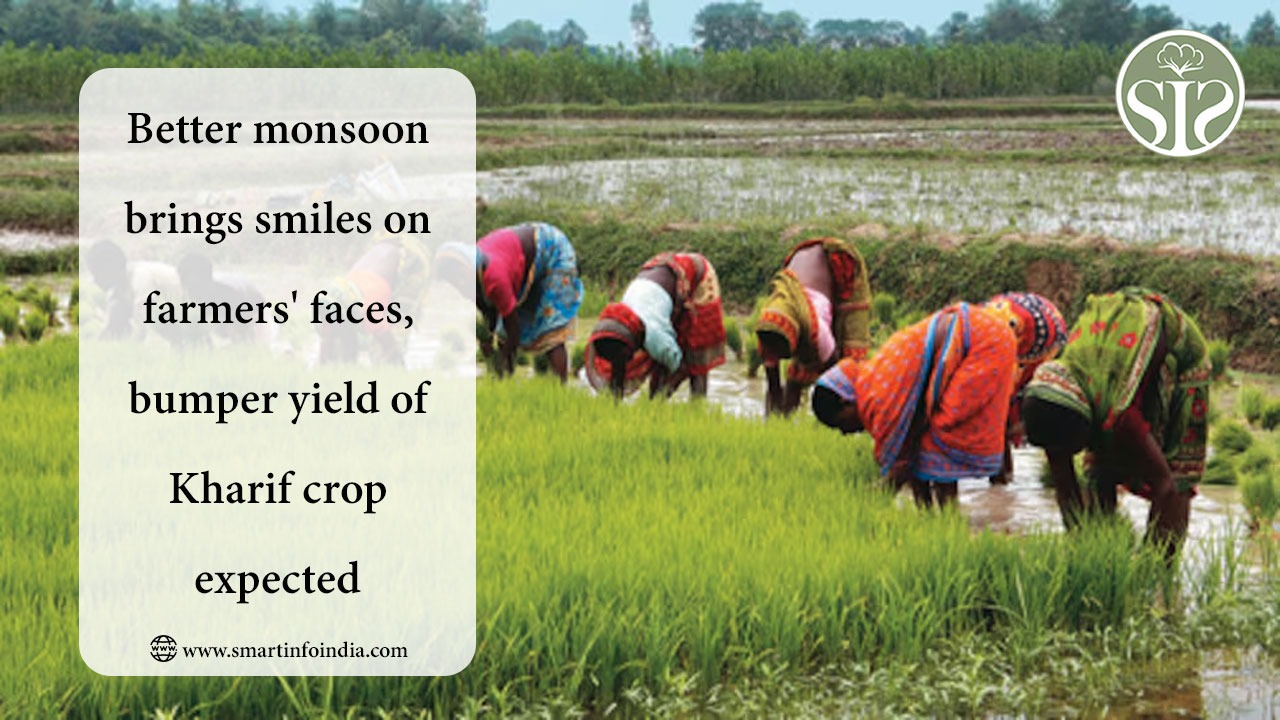
Better monsoon brings smiles on farmers' faces, bumper yield of Kharif crop expected

Farmers are happy with the improved rainfall, and a bumper output of the Kharif crop is anticipated.Better monsoon has brought happiness back on farmers' faces. According to the latest data from the Ministry of Agriculture, due to better monsoon this year, the total area under sowing of Kharif crops has increased by 10.3 percent to 575 lakh hectares, while last year by this time, sowing was done in 521.25 lakh hectares. Some areas remained dry due to irregular rains. This time bumper yield is expected due to increase in sowing area, which will increase the income of farmers and increase demand in rural areas. This is a positive sign for the Indian economy.Increase in cultivation of pulses and oilseedsThis Kharif season, the area under cultivation of pulses has increased to 62.32 lakh hectares, which is 26 percent more than last year. Oilseed cultivation has also increased to 140.43 lakh hectares, while last year it was 115.08 lakh hectares. Increasing the cultivation of pulses and oilseeds is a positive step, as the production of these commodities is often less than the demand, which leads to rising prices.Expectation of reduction in prices and importsIncreasing the area of cultivation of pulses and oilseeds will help in controlling the prices of pulses and oil, which will provide relief to the common people. Currently, to meet the demand of pulses and oil in the country, one has to resort to expensive imports, which leads to expenditure of foreign exchange and there is a risk of weakening of the rupee. Increasing production in the country will reduce the need for imports and pulses and oil will be available at cheaper prices.Read More :> Indian farmers rush to plant summer crops after monsoon revives

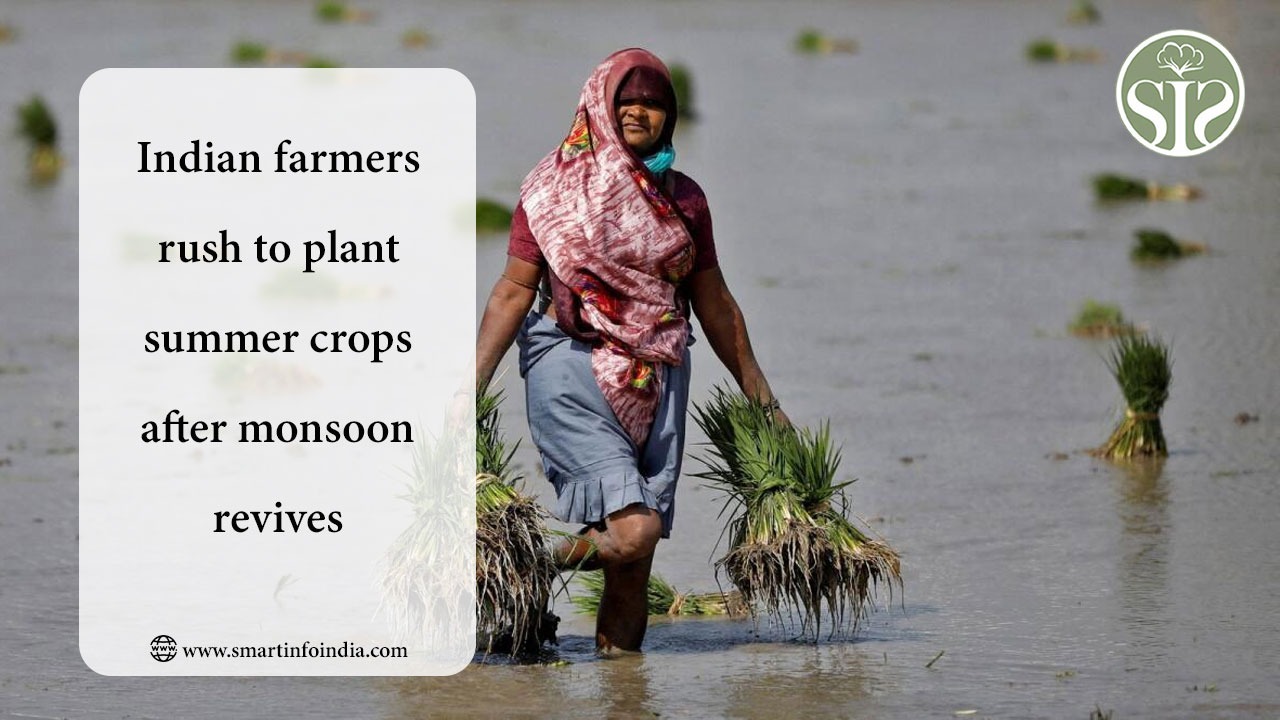
Indian farmers rush to plant summer crops after monsoon revives

As soon as the monsoon returns, Indian farmers hurry to plant summer crops.Indian farmers have rushed to plant summer crops such as paddy, soybean, cotton and maize following above-average monsoon rains in July after a poor June spell, according to government data.Monsoon rains, crucial for India's economic growth, normally begin in southern India around June 1 and spread across the country by July 8, allowing farmers to plant summer crops. However, June received 11% less rain than average, delaying sowing.According to the Ministry of Agriculture and Farmers Welfare, the first fortnight of July received 9% more rain than normal, helping farmers plant summer crops on 57.5 million hectares (142 million acres) by July 12, a tenth more than last year.Farmers have sown paddy on 11.6 million hectares, 20.7% more than the same period last year. Higher rice sowing could ease the country's supply concerns. Higher rice purchases by government agencies from last season's crop and an expansion in paddy acreage could allow the government to ease restrictions on rice exports in October, a New Delhi-based dealer said.Farmers sowed oilseeds, including soybeans, on 14 million hectares of land, compared with 11.5 million hectares a year earlier. Maize sowing was on 5.88 million hectares, up from 4.38 million hectares a year earlier. Cotton acreage rose slightly to 9.6 million hectares, while sowing of pulses rose 26% to 6.23 million hectares from a year earlier.Read more :- Indian Spinning Mills Turn Cautious as Cotton Season Nears End

Related News

Youtube Videos

रुई बाज़ार में गिरावट का रुख 😱 Cotton market rate today #youtube
रुई बाज़ार में गिरावट का रुख 😱 Cotton market rate today #you...
जानिए आज का कपास बाज़ार 😱 Cotton market rate today #youtube
Ganesh Chaturthi Celebration at Our Office 🙏✨ | Ganpati Bappa Morya! #shorts
Ganesh Chaturthi Celebration at Our Office 🙏✨ | Ganpati Ba...
Application Download
Whatsapp Contact