Filter

Recent News

INTERVIEW: CAI President on CNBC (1/7/24)

CNBC interview with the president of CAI (1/7/24).QUESTION:How do you see cotton sowing for the new season in India?ANSWER:About 50-55% of the 60 lakh hectares have been sown so far, which is more than last year at this time. The main reason for this is Maharashtra having sown 20 lakh hectares so far, which is a little earlier than last year. So, we may see more sowing this time. We will have to wait till July 20-25 to know the actual total sowing.Cotton sowing in North India has gone down by about 40% to 50%. There are also reports from Gujarat that cotton sowing is down by 15-20%. Sowing in Khandesh and Vidarbha of Maharashtra may be down by 5-10%, but the sowing area in Marathwada will remain the same.Looking at the trend of farmers in North India and Gujarat, we can say that total cotton sowing in India will go down by 10-15%. The main reason is that the income of farmers in cotton sowing has decreased because the labor cost has increased and the production (yield) is very low. I read a research that in Gujarat if farmers grow peanuts they get Rs 50,000-60,000 per acre, while cotton only gives Rs 20,000.Where there is no water facility, farmers have no option other than cotton. And those who have water facility have many other options other than cotton. Looking at the trend of North India and Gujarat, we can say that there will be a 10-15% reduction in total cotton sowing in India.QUESTION:Which states are included in North India?ANSWER:North India includes Punjab, Haryana and Rajasthan. In Rajasthan, cotton sowing is done in lower Rajasthan and upper Rajasthan. So far this year, sowing has been done in 4.5 lakh hectares in Rajasthan, while last year sowing was done in 10 lakh hectares, so we can say that sowing in Rajasthan is 50-55% less.QUESTION:We have heard that the ministry is going to allow new seed technology. Will the new seed be used for sowing this year, or how long will it take?ANSWER:We have also received news of new seed permission on WhatsApp like you, but we do not have any official confirmation yet. If we get any official confirmation, we will inform the trade. Sowing of new seed is impossible this season as the sowing time will end by the end of July.If the new seed gets permission, it will be tested first, and only after the test is successful, the government will give the new seed to the farmers. Apart from this, the central government will have to take approval from all the states where cotton is grown. New seed will be given to the farmers only after getting approval from all the states. Considering this, it is a long process and it will take time.QUESTION:MSP has increased by 7%, cotton sowing has started. How is the cotton balance sheet of CAI and the demand from mills?ANSWER:This year cotton production and consumption are in similar numbers, around 318 lakh bales. Cotton exports are estimated at 26 lakh bales and imports at 16 lakh bales, so this export-import gap will reduce from last year's closing stock by around 10 lakh bales.The demand from mills is good, the demand from spinning mills is good, and mills are making a profit of Rs 5 to Rs 15 per kg of yarn. Cotton is also readily available and rates are reasonable. Indian mills are currently running at 90-95% capacity. Cotton mills in North India and Central India are running at 100% capacity.QUESTION:Volatility of 2-4% in ICE futures has become normal. What is its impact on the Indian market?ANSWER:Yes, I agree 100%, there is huge speculation going on in ICE futures. 2 months ago ICE futures went up to 103 cents and today it is at 72-73 cents, which is a drop of about 33%. But in India the prices have gone down by only Rs 3,000-4,000 as we have huge consumption of cotton. Also the arrival of cotton is almost over and CCI and ginners have very limited stock, so whatever price the stockers set, mills are buying. Mills will run in this limited stock for the next 3-4 months. This huge fluctuation in ICE is not having a good impact on the entire textile industry as the world market is following ICE futures.Read more :- Chinese Share of Indian Yarn Exports More Than Doubles in FY24


Farming Activities Accelerate in North Maharashtra

Farming In North Maharashtra Is IncreasingKharif crop sowing has gained significant momentum in parts of North Maharashtra's districts following recent rains.According to the agriculture department, as of June 24, sowing has been completed on 6.21 lakh hectares, representing 30% of the total target of 20.64 lakh hectares. This marks a substantial increase from 11% on June 18.Maize, soybean, moong, tur, cotton, bajra, urid, and paddy are the major Kharif crops in the region.Sowing activities have notably accelerated in Dhule and Jalgaon districts, with operations also starting in Nashik and Nandurbar districts.In Jalgaon district, the estimated Kharif acreage is 7.69 lakh hectares, with sowing completed on 2.92 lakh hectares, accounting for 38% of the target. In Dhule district, sowing has been completed on 1.35 lakh hectares out of a total of 3.79 lakh hectares, or 36% of the target.In Nashik district, sowing has been completed on 1.31 lakh hectares out of the projected 6.41 lakh hectares, representing 20% of the target.In Nandurbar, Kharif sowing has been completed on 61,000 hectares out of a total of 2.73 lakh hectares, accounting for 22% of the target. Of the 6.21 lakh hectares sown so far in North Maharashtra’s districts, cotton accounts for the majority, with 4.24 lakh hectares planted.The average area under cotton cultivation in North Maharashtra is approximately 8.72 lakh hectares. Currently, cotton sowing has been completed on 4.24 lakh hectares, which is 49% of the total cotton acreage.Cotton is sown across all four districts of North Maharashtra — Jalgaon, Dhule, Nandurbar, and Nashik. In Nashik, cotton is specifically sown in Malegaon and Yeola talukas.Read More :> Kharif sowing as of 28 June rises 33% year-on-year to 24 million hectares

Kharif sowing as of 28 June rises 33% year-on-year to 24 million hectares

As of June 28, the amount sown in Kharif increased by 33% annually to 24 million hectares.Area under kharif crops in the 2024-25 crop year (July-June) as of 28 June rose 33% year-on-year to 24.1 million hectares (mh), according to data released by the agriculture ministry on Friday.The increase in acreage is largely due to a rise in cultivation of pulses, oilseeds and cotton.Depending upon region, farmers kick off plantation of kharif crops with the first showers of the four-month southwest monsoon season that begins in June. Unlike Rabi or winter crops, Kharif crops such as paddy and maize require plentiful rainfall.The southwest monsoon, crucial for the world's fifth-largest economy, makes the onset over the Kerala coast on 1 June and covers the entire country by 15 July.Importance of monsoonThe timely arrival of the monsoon is crucial, especially for the agricultural sector, as around 56% of the net cultivated area and 44% of food production depend on monsoon rains.Normal precipitation is essential for robust crop production, maintaining stable food prices, especially for vegetables, and bolstering economic growth. Agriculture contributes about 18% to India's gross domestic product, underscoring the importance of a good monsoon.This year's monsoon lost momentum after reaching Mumbai on 9 June—two days ahead of schedule and remained stuck in the eastern region for about three weeks, preventing the agriculture ministry from releasing the acreage data until Friday. With the monsoon's progress over the eastern areas and the India Meteorological Department declaring the arrival of the rain-bearing winds in Delhi, the ministry on Friday released the kharif crop acreage data for the first time this season.Precipitation in the country as of 28 June was 14% deficient since the beginning of the June-September monsoon season, according to IMD.Pulses take the leadWhile the area under paddy or rice, the main kharif crop, was a tad lower year-on-year at 2.2 mh, pulses acreage was 181% higher at 2.2 mh, including 1.3 mh area under tur or arhar and 318,000 hectares area under urad.The government has been trying to encourage farmers to cultivate more area under pulses, especially tur, in view of crop failure in the past two consecutive years and achieve self-sufficiency in pulses and oilseeds by 2027.Consumer affairs secretary Nidhi Khare earlier this month told Mint that food prices, especially those of pulses, which have been skyrocketing for over a year will ease after July as farm output is expected to be good amid normal monsoon.According to the agriculture ministry data, the area under oilseeds rose 18.4% to 4.3 mh, primarily due to a higher coverage under soybean. As of Friday, farmers planted soybean across 3.36 mh, sunflower across 37,000 hectares and sesamum across 43,000 hectares, against 163,000 hectares, 26,000 hectares and 26,000 hectares, respectively in the year-ago period.The area covered under groundnut, however, was lower at 819,000 hectares compared to the previous year’s 1.45 mh.In the case of millets, the area was nearly 15% down year-on-year at 3 mh. Bajra was sown over 409,000 hectares compared to 2.5 mh last year. The maize area was 2.3 mh against 810,000 hectares a year ago.Acreage under cash crops like sugarcane and cotton was 5.68 mh and 5.9 mh, respectively, compared with 5.5 mh and 601,000 hectares a year ago. Farmers planted jute and mesta across 562,000 hectares against 601,000 hectares a year ago.Read More :> Agriculture Department warns cotton farmers: Pink bollworm threat to production

Agriculture Department warns cotton farmers: Pink bollworm threat to production

The Agriculture Department alerts cotton growers to the production threat posed by pink bollworms.Hanumangarh: The Agriculture Department has warned the farmers of the district that the pink bollworm infestation in BT cotton can again affect production this year. Last year too, the district faced a serious problem of this pest, which badly affected the cotton production.The area of sowing of BT cotton has remained around 40 percent this time too, despite the department continuously making farmers aware. In view of the possible outbreak of pink bollworm, the department has given information about management measures since February itself. Measures of management have been suggested to disrupt the life cycle of pink bollworm by destroying its pupa stage. However, some farmers did not pay attention to these measures and did early sowing.In some fields, where early sowing of cotton was done, despite adequate irrigation water and timely irrigation, due to extreme heat, flowers came out in the plants and pink bollworm infestation has been observed.The department has advised farmers to follow pink bollworm management measures in early sown crops. Spray insecticides on fixed days every week and pluck and destroy the flowers and pods affected by pink bollworm. Use neem based pesticides till 60 days of age and do not use synthetic and ready mix insecticides in BT cotton.District Collector made aware of farmers' problemsBhartiya Kisan Union Tikait District Hanumangarh submitted a memorandum to the District Collector on Wednesday under the leadership of District President Resham Singh Manuka. Various demands of farmers were raised in the memorandum, in which compensation of Rs 1125 crore was demanded for the loss caused by pink bollworm last year, but no farmer has received compensation yet.The farmers demanded the state government to start procurement centers in all mandis for the purchase of groundnut and to start government procurement of moong from September 1. Apart from this, there was a demand to start government procurement of paddy by September 15 at any cost and to provide full electricity to the agriculture sector.Read More :> India's monsoon overcomes delay, set to cover country on time

Related News

Youtube Videos

कपास बाज़ार साप्ताहिक रिपोर्ट 🔥 | तेजी या मंदी? | CCI Update | Cotton Market Today
कपास बाज़ार साप्ताहिक रिपोर्ट 🔥 | तेजी या मंदी? | CCI Updat...
कैसा रहा आज का कपास बाज़ार? 😱 | Cotton Market Rate Today | 26 June 2026
कैसा रहा आज का कपास बाज़ार? 😱 | Cotton Market Rate Today |...
जानिए आज का कपास बाज़ार 🔥 | तेलंगाना कपास बुआई | Cotton Market Rate Today
जानिए आज का कपास बाज़ार 🔥 | तेलंगाना कपास बुआई | Cotton Mar...
राजस्थान कपास बुआई + रुई बाजार भाव 🔥 | Cotton Market Rate Today | 24 June 2026
राजस्थान कपास बुआई + रुई बाजार भाव 🔥 | Cotton Market Rate T...
कपास बाज़ार में आज क्या हुआ? 😱 Cotton Market Rate 23 June 2026
कपास बाज़ार में आज क्या हुआ? 😱 Cotton Market Rate 23 June 2...
ऐसा रहा आज कपास बाज़ार😱🔥Cotton market rate today #youtube
रुई बाजार में तेजी! 🚨 CCI की रिकॉर्ड बिक्री | पूरे भारत की कपास बुवाई रिपोर्ट | Cotton Market Update
रुई बाजार में तेजी! 🚨 CCI की रिकॉर्ड बिक्री | पूरे भारत की...
CCI Update: आज कितनी रुई गठानें बिकीं? 😱 | Cotton market price today  #youtube
CCI Update: आज कितनी रुई गठानें बिकीं? 😱 | Cotton market pr...
आज का कपास बाजार भाव LIVE 🤔| CCI बिक्री अपडेट, राज्यवार मंडी भाव और Cotton Rate Today #kapas #rates
आज का कपास बाजार भाव LIVE 🤔| CCI बिक्री अपडेट, राज्यवार मंड...
ऐसा रहा आज का कपास बाज़ार || cotton market price update #youtube #cottonmarket #kapas
ऐसा रहा आज का कपास बाज़ार || cotton market price update #yout...
🚨 सम्पूर्ण भारत की बुआई रिपोर्ट 2026-27😱आज का कपास बाज़ार #youtube
🚨 सम्पूर्ण भारत की बुआई रिपोर्ट 2026-27😱आज का कपास बाज़ार #...
गुजरात में कपास बुवाई ने पकड़ी रफ्तार! 😱 Cotton market rate today #youtube
गुजरात में कपास बुवाई ने पकड़ी रफ्तार! 😱 Cotton market rate...
कपास बाज़ार में गिरावट का सिलसिला जारी 😱Weekly Cotton Market #youtube
कपास बाज़ार में गिरावट का सिलसिला जारी 😱Weekly Cotton Market...
जानिए आज का कपास बाज़ार 😨 Cotton market rate today #youtube
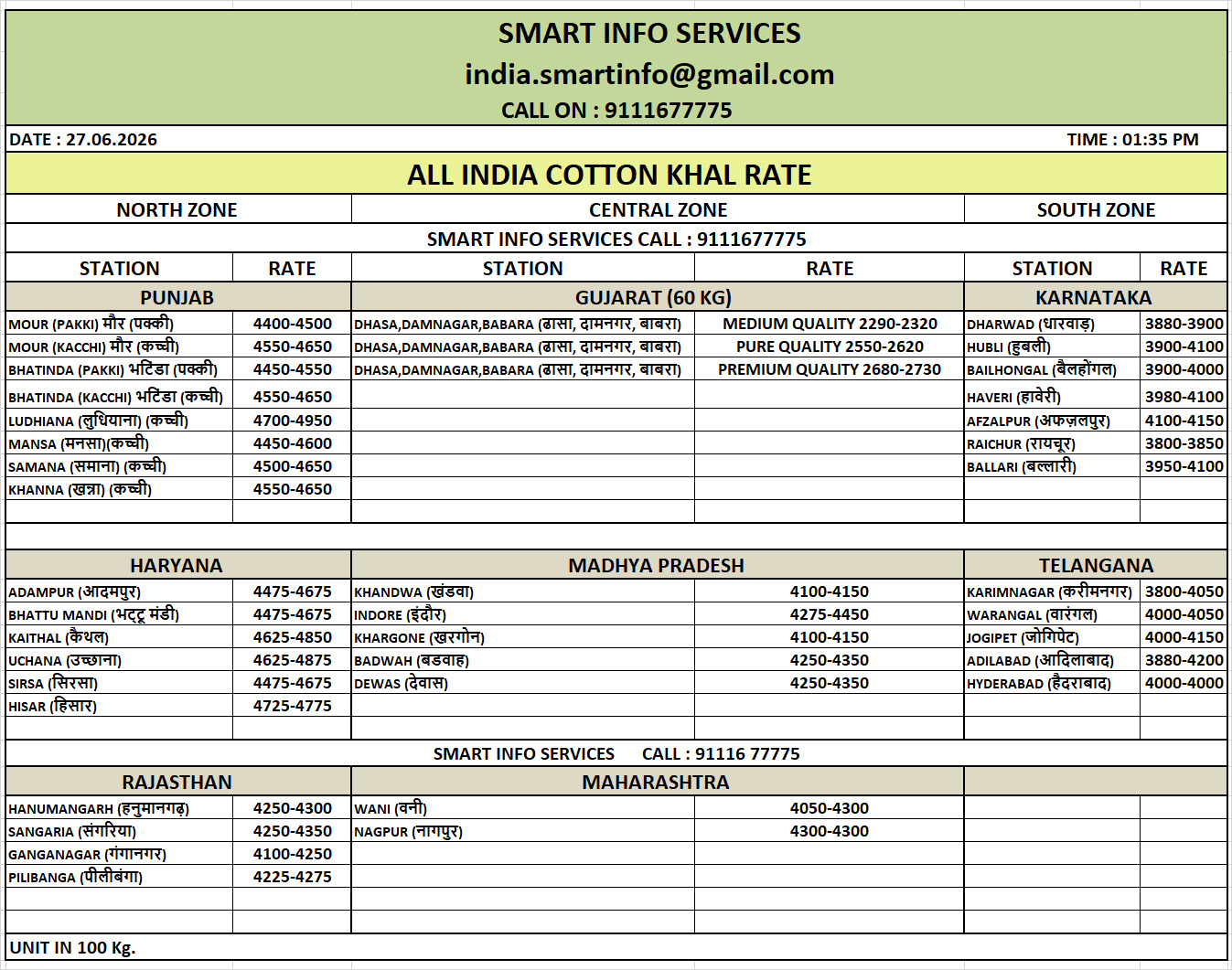
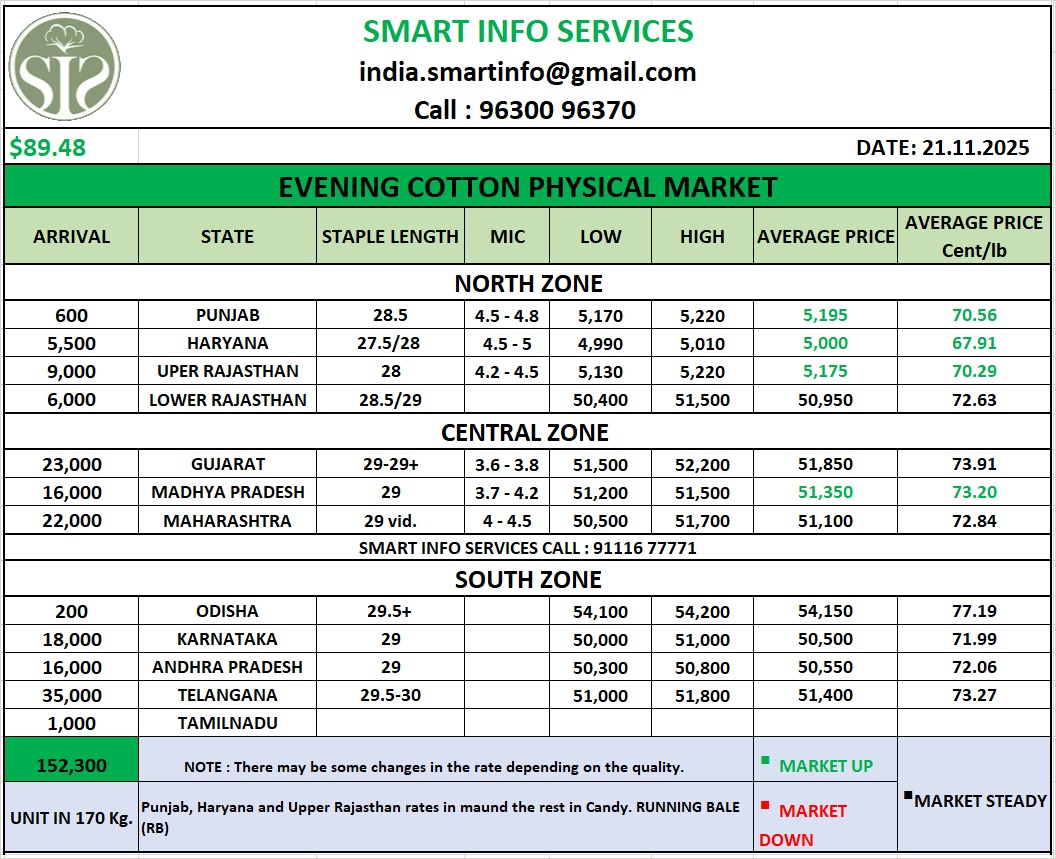
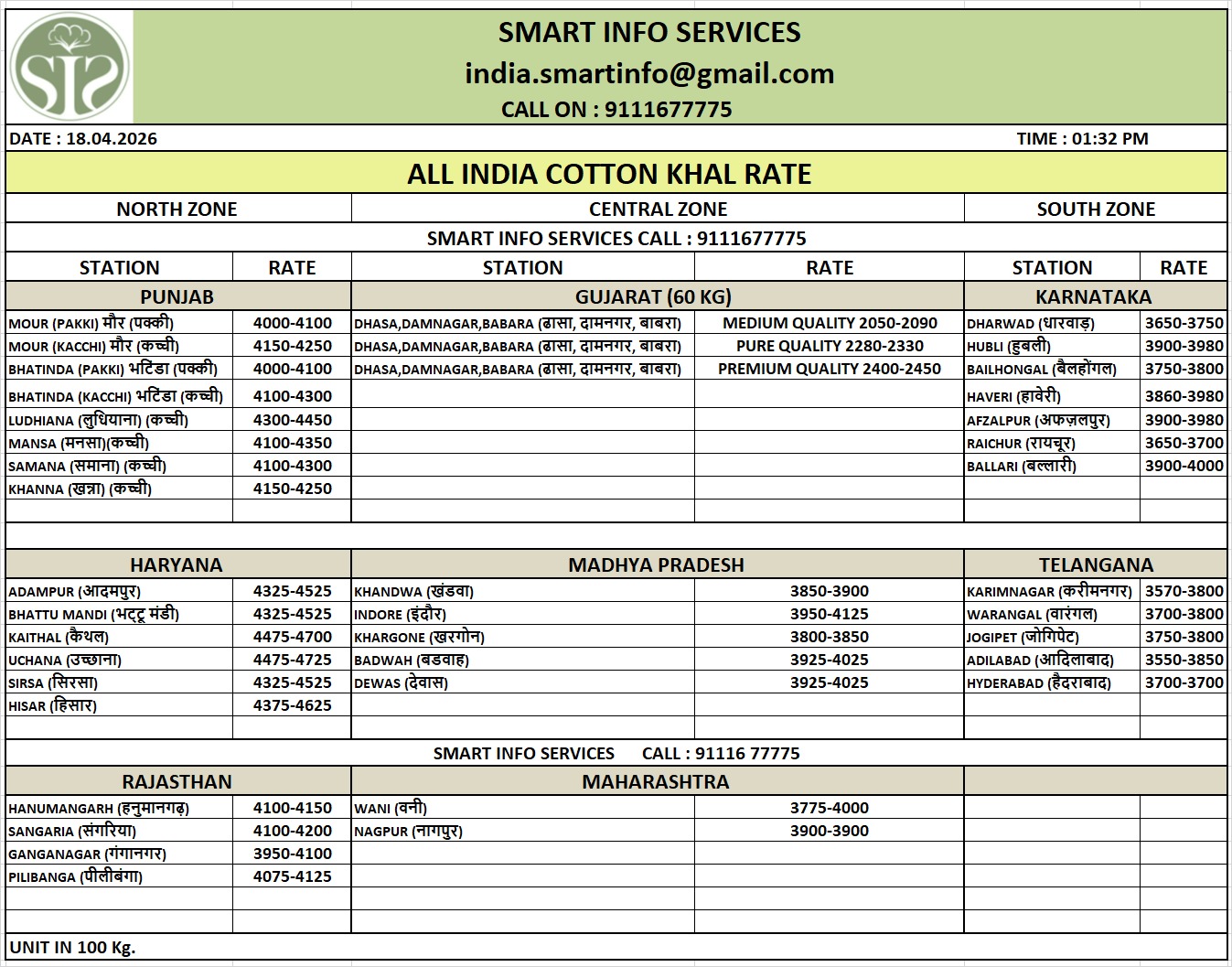
All India cotton market rate
Copyright© 2023 | Smart Info Service
Application Download