Filter

Recent News

Indian Textile Sector Pushes for Reassessment of Quality Control Orders

The Indian Textile Industry Advocates for Reevaluating Quality Control OrdersThe Indian textile industry is calling on the government to reconsider the quality control orders (QCOs) imposed on upstream raw material products in the non-cotton sector. These QCOs, implemented over the last couple of years, were designed to ensure the import of quality raw materials in line with Bureau of Indian Standards (BIS) regulations.However, the downstream industry claims that these QCOs have had a detrimental effect, promoting monopolistic practices by a few producers of polyester and viscose fibers, along with their raw materials and yarn. The industry has appealed to Union Finance Minister Nirmala Sitharaman to reevaluate the QCOs to ensure the availability of raw materials at globally competitive prices and quality.Recently, the Supreme Court stayed the Gujarat High Court's order that reinstated anti-dumping duties on Purified Terephthalic Acid (PTA) imported from South Korea and Thailand.Ashish Gujarati, president of the Surat-based Pandesara Weavers Cooperative Society Limited, expressed in a letter to Finance Minister Sitharaman, “The government showed its sensitivity towards the downstream industry by challenging the Gujarat HC order in the Supreme Court. This court order will directly benefit fiber and yarn manufacturers and indirectly benefit the fabric and garment industry. It demonstrates that the government is very much concerned for the downstream and fabric industries. We are confident the government will take a positive approach if a sunset review begins.”Bharat Gandhi, chairman of the Federation of Indian Art Silk Weaving Industry (FIASWI), stated in a separate letter that QCOs cannot ensure quality. He emphasized that these orders have been disastrous for the industry, granting monopolistic advantages to a few upstream producers. The non-cotton fiber, yarn, and fabric industry is struggling to remain competitive in the global market due to dependency on local suppliers who have raised raw material prices because of restricted global supply through the QCOs. The industry maintains that QCOs fail to ensure a consistent supply of raw materials, rendering the downstream industry uncompetitive in the global textiles and garment market.Read More :Bangladesh Crisis: Textile Orders Likely to Shift to Indian Hubs Like Tiruppur

Cotton Growers Fear Low Yield After Prolonged Rains

Cotton Farmers Are Afraid about Low Yield Following Extended RainsNagpur: Vidarbha cotton growers are increasingly anxious due to prolonged rainfall, which has hindered the growth of their primary agricultural produce.Farmers fear the continuous rain may negatively impact the yield, potentially delaying the harvest and disrupting their cash flow cycle. Typically, the first round of cotton plucking around Dussehra provides crucial funds during the festive season.The persistent rains have also led to an overgrowth of grass in the fields, increasing cultivation costs. According to farmers, the lack of sunny days has created excessive humidity, which is detrimental to cotton growth. Ganesh Nanote, a farmer from Akola district, noted that cotton needs intervals of dry weather and sunlight for optimal growth, conditions that have been lacking this year.In Yavatmal’s Bori village, located on the Maharashtra-Telangana border, farmer Gajanan Singedwar reported that cotton plants should be at waist level and starting boll formation by this time of year. However, the rain has slowed growth, possibly pushing the harvest back to Diwali.Kishore Tiwari, former chairman of the Vasantrao Naik Shetkari Swavalamban Mission, a state government task force on farm crises, confirmed that cotton crops are affected across the state. "There needs to be at least a week's break from the rain for the crops to recover. The cycle is already delayed by twenty days," he said.Agriculture department officials are hopeful that a respite from the rains will help the crops recover. While early-sown cotton is already in the boll stage, late-sown cotton is likely to face more significant impacts from the adverse weather conditions.Read More :>Bangladesh Situation to Impact India's Cotton Exports

BRAZIL: July Cotton Prices Reach Highest Levels Since March 2024

Brazil: July Sees the Highest Levels of Cotton Prices Since March 2024In July, the monthly average of cotton prices in Brazil reached the highest levels since March 2024, in real terms. This upward trend was mainly driven by limited supply in the spot market and firm pricing by many sellers focused on fulfilling contracts.However, there were periods during the month when prices dipped due to some sellers being more flexible, aiming to offload batches of the 2022/23 crop or to generate quick cash.The monthly average of the Index was BRL 4.0793 per pound, marking a 3.76% increase from June 2024 and a 3.1% rise compared to July 2023, in real terms (IGP-DI June 2024). This is the highest level since March 2024, when the price was BRL 4.3019 per pound. From June 28 to July 31, the CEPEA/ESALQ cotton Index (with payment in 8 days) rose by 2.67%, closing at BRL 4.0757 per pound on July 31.Cepea's calculations show that export parities FAS (Free Alongside Ship) fell by 6.6% from June 28 to July 29, reaching BRL 3.8782 per pound (USD 0.6890 per pound) at the port of Santos (SP) and BRL 3.8887 per pound (USD 0.6908 per pound) at the port of Paranaguá (PR) on July 29. The Cotlook A Index (product delivered in the Far East) also decreased by 7.2% in the same period, down to USD 0.7930 per pound on July 29.According to data from Abrapa (Brazilian Cotton Producers Association), 28.39% of the 2023/24 cotton area in Brazil had been harvested by July 25, and 9.96% of the production had been processed.Read More :>CCI Procures 33 Lakh Bales of Cotton at MSP This Season

Bangladesh Extends Curfew, Shuts Down RMG and Textile Mills Amid Unrest

Amid unrest, Bangladesh extends the curfew and closes the RMG and textile mills.Bangladesh’s readymade garment (RMG) factories and textile mills will remain closed as the government has extended the curfew indefinitely and announced a three-day general holiday starting Monday due to the deteriorating law and order situation, according to sector leaders.Production in most RMG factories in Narayanganj and a few units in Gazipur was already suspended on Sunday amid ongoing unrest. The government extended the curfew starting from 6:00 PM on Sunday and declared a three-day public holiday beginning Monday. This decision came after clashes in 14 districts resulted in at least 42 fatalities involving protesters, law enforcement, and ruling party-backed groups.Abdullah Hil Rakib, Vice-President of the Bangladesh Garment Manufacturers and Exporters Association, stated that factories would comply with the government’s announcement of general holidays. “However, we will seek a meeting with the government to request permission to operate the units during the curfew and holidays,” he added.Bangladesh Textile Mills Association (BTMA) Secretary General Zakir Hossain conveyed in a text message that all BTMA member mills would remain closed during the three-day holiday from August 5-7 due to the deteriorated law and order situation. Decisions on reopening the mills will depend on the overall situation and further government declarations.Factory owners in Narayanganj reported that workers began production on Sunday morning but were later incited by outsiders to leave. Consequently, workers from Eurotex Knitwear Limited and IFS Texwear Pvt Limited exited their workplaces and took to the streets. This led to protests in several factories in Narayanganj BSCIC and Fatullah, prompting other factory owners to declare a holiday to protect their establishments, said Fazle Shamim Ehsan, Senior Vice-President of the Bangladesh Knitwear Manufacturers and Exporters Association.In Gazipur, production in some factories ceased after 3:00 PM as workers left their jobs, according to Abdullah Hil Rakib. Additionally, an official from the BTMA reported that the Outpace Spinning mill in Gazipur was set on fire by outsiders on Sunday afternoon.Read More :>Ginning Units in Indore Region Face Challenges with High Mandi Tax

Ginning Units in Indore Region Face Challenges with High Mandi Tax

Indore Region Ginning Units Face Difficulties Due to High Mandi TaxAs the new cotton season approaches, beginning in the last week of September, ginning units in the Indore region are gearing up for operations. However, uncertainty over demand and uncompetitive pricing due to high mandi taxes has dampened industry sentiment.Madhya Pradesh hosts approximately 200 ginning units, with around half of them located in the Nimar region. Shrikrishan Agrawal, owner of a ginning unit in Bhikangaon village, Khargone district, remarked, “Preparations for the new season are underway, but capacity utilization may be impacted. Local units struggle to compete due to higher prices compared to other states.” Ginners argue that the mandi tax levied by the Madhya Pradesh government makes procuring raw cotton and selling finished lint cotton more expensive.Currently, the mandi tax in Madhya Pradesh stands at 1.20 percent. Ginners advocate for a reduction to 0.50 percent to level the playing field with other states. Kailash Agrawal, a cotton farmer and ginner from Khargone, highlighted the issue: “Selling cotton lint to other states is challenging because our prices are higher due to the mandi tax. This affects processing, leading ginning units to reduce operations.”The new cotton season is anticipated to start with arrivals in local markets by late September or October. In the Indore division, key cotton-growing areas include Khargone, Khandwa, Barwani, Manawar, Dhar, Ratlam, and Dewas.The Cotton Association of India, an apex trade body, estimates cotton pressing in Madhya Pradesh for the 2023-24 season at 18 lakh bales (1 bale equals 170 kg).Read More :>Rain Washouts Whitefly Threat in South Malwa; Agri Experts Warn Cotton Growers of Bollworm Attack

Related News

Youtube Videos

कपास बाज़ार साप्ताहिक रिपोर्ट 🔥 | तेजी या मंदी? | CCI Update | Cotton Market Today
कपास बाज़ार साप्ताहिक रिपोर्ट 🔥 | तेजी या मंदी? | CCI Updat...
कैसा रहा आज का कपास बाज़ार? 😱 | Cotton Market Rate Today | 26 June 2026
कैसा रहा आज का कपास बाज़ार? 😱 | Cotton Market Rate Today |...
जानिए आज का कपास बाज़ार 🔥 | तेलंगाना कपास बुआई | Cotton Market Rate Today
जानिए आज का कपास बाज़ार 🔥 | तेलंगाना कपास बुआई | Cotton Mar...
राजस्थान कपास बुआई + रुई बाजार भाव 🔥 | Cotton Market Rate Today | 24 June 2026
राजस्थान कपास बुआई + रुई बाजार भाव 🔥 | Cotton Market Rate T...
कपास बाज़ार में आज क्या हुआ? 😱 Cotton Market Rate 23 June 2026
कपास बाज़ार में आज क्या हुआ? 😱 Cotton Market Rate 23 June 2...
ऐसा रहा आज कपास बाज़ार😱🔥Cotton market rate today #youtube
रुई बाजार में तेजी! 🚨 CCI की रिकॉर्ड बिक्री | पूरे भारत की कपास बुवाई रिपोर्ट | Cotton Market Update
रुई बाजार में तेजी! 🚨 CCI की रिकॉर्ड बिक्री | पूरे भारत की...
CCI Update: आज कितनी रुई गठानें बिकीं? 😱 | Cotton market price today  #youtube
CCI Update: आज कितनी रुई गठानें बिकीं? 😱 | Cotton market pr...
आज का कपास बाजार भाव LIVE 🤔| CCI बिक्री अपडेट, राज्यवार मंडी भाव और Cotton Rate Today #kapas #rates
आज का कपास बाजार भाव LIVE 🤔| CCI बिक्री अपडेट, राज्यवार मंड...
ऐसा रहा आज का कपास बाज़ार || cotton market price update #youtube #cottonmarket #kapas
ऐसा रहा आज का कपास बाज़ार || cotton market price update #yout...
🚨 सम्पूर्ण भारत की बुआई रिपोर्ट 2026-27😱आज का कपास बाज़ार #youtube
🚨 सम्पूर्ण भारत की बुआई रिपोर्ट 2026-27😱आज का कपास बाज़ार #...
गुजरात में कपास बुवाई ने पकड़ी रफ्तार! 😱 Cotton market rate today #youtube
गुजरात में कपास बुवाई ने पकड़ी रफ्तार! 😱 Cotton market rate...
कपास बाज़ार में गिरावट का सिलसिला जारी 😱Weekly Cotton Market #youtube
कपास बाज़ार में गिरावट का सिलसिला जारी 😱Weekly Cotton Market...
जानिए आज का कपास बाज़ार 😨 Cotton market rate today #youtube
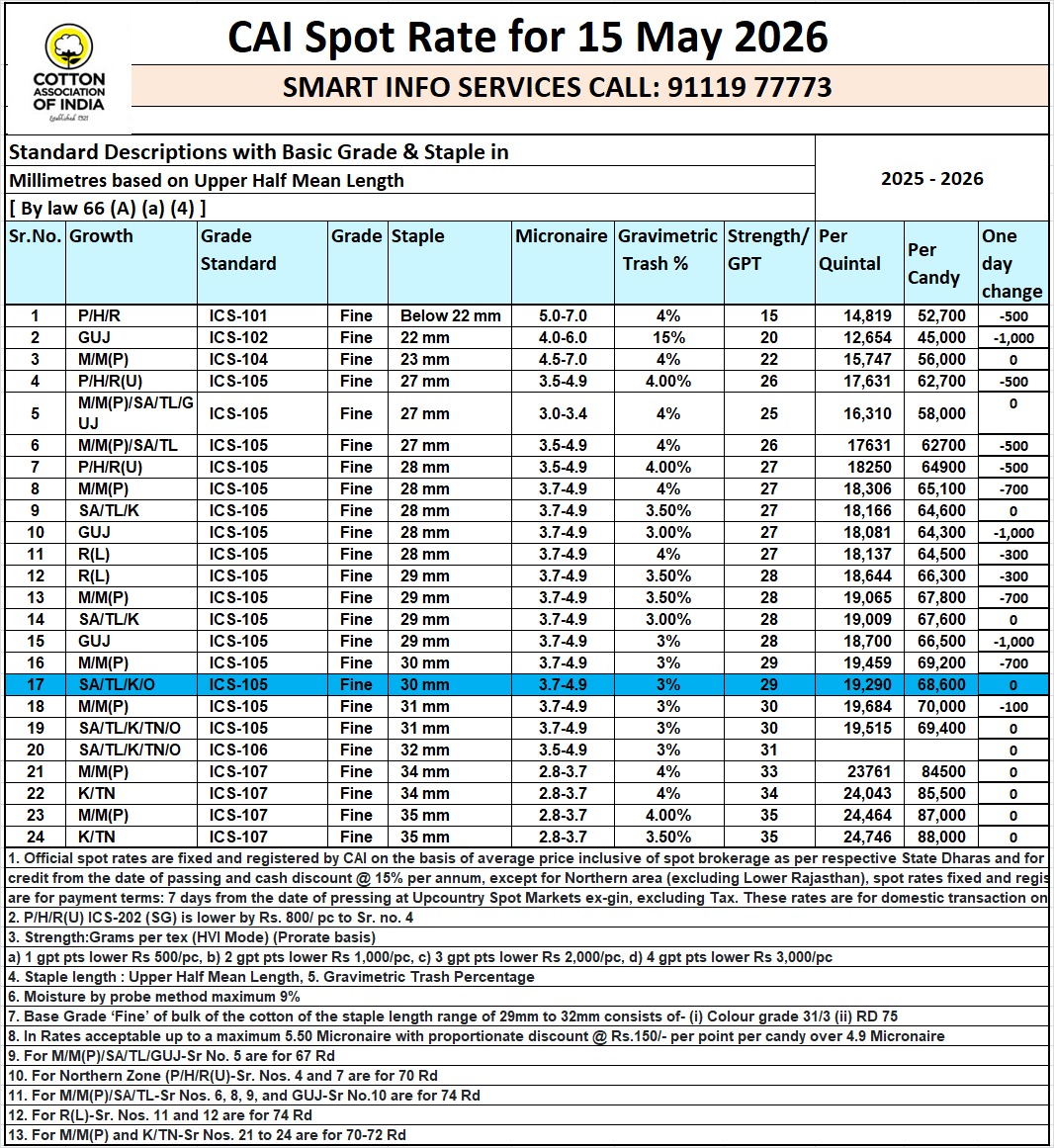
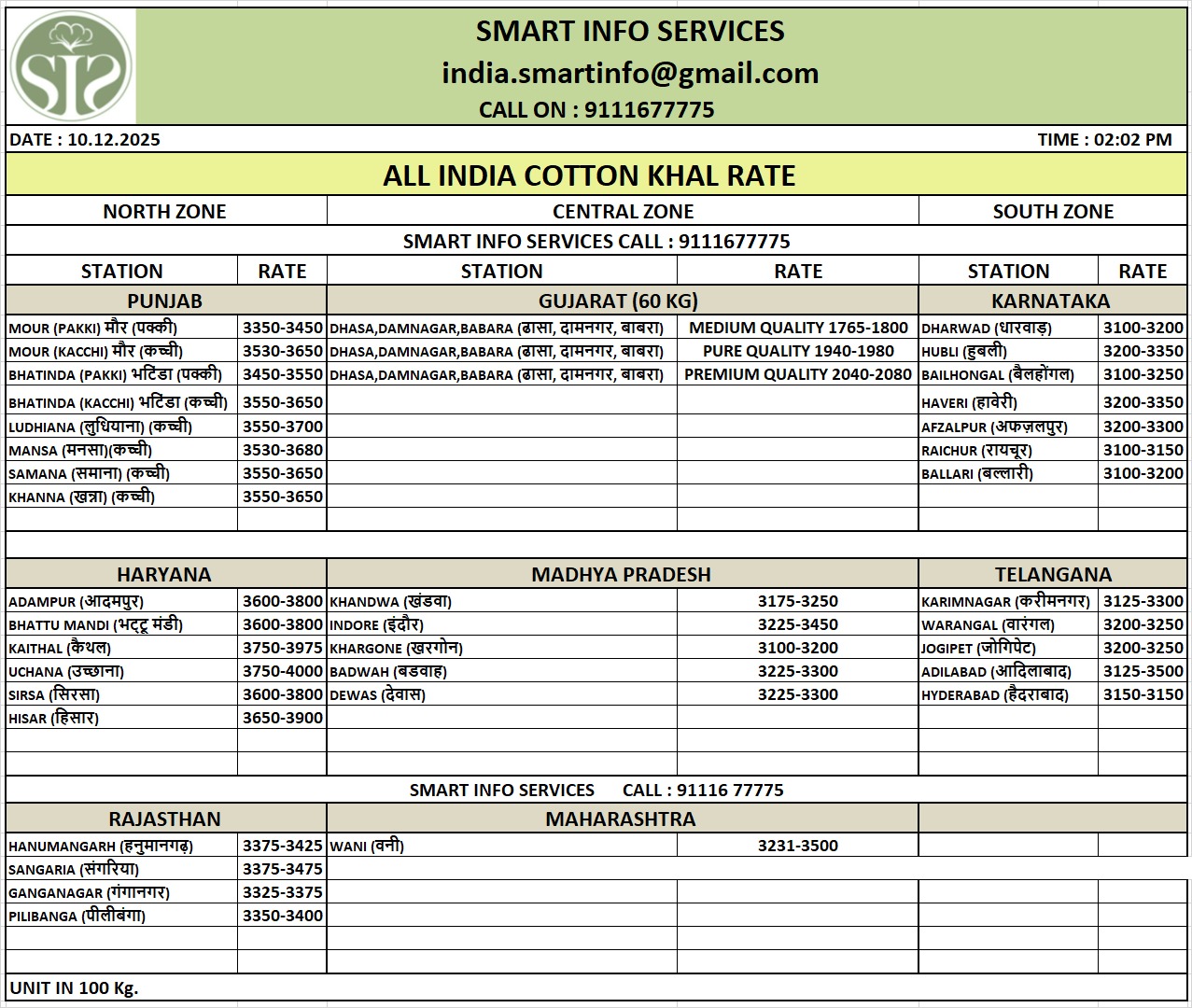
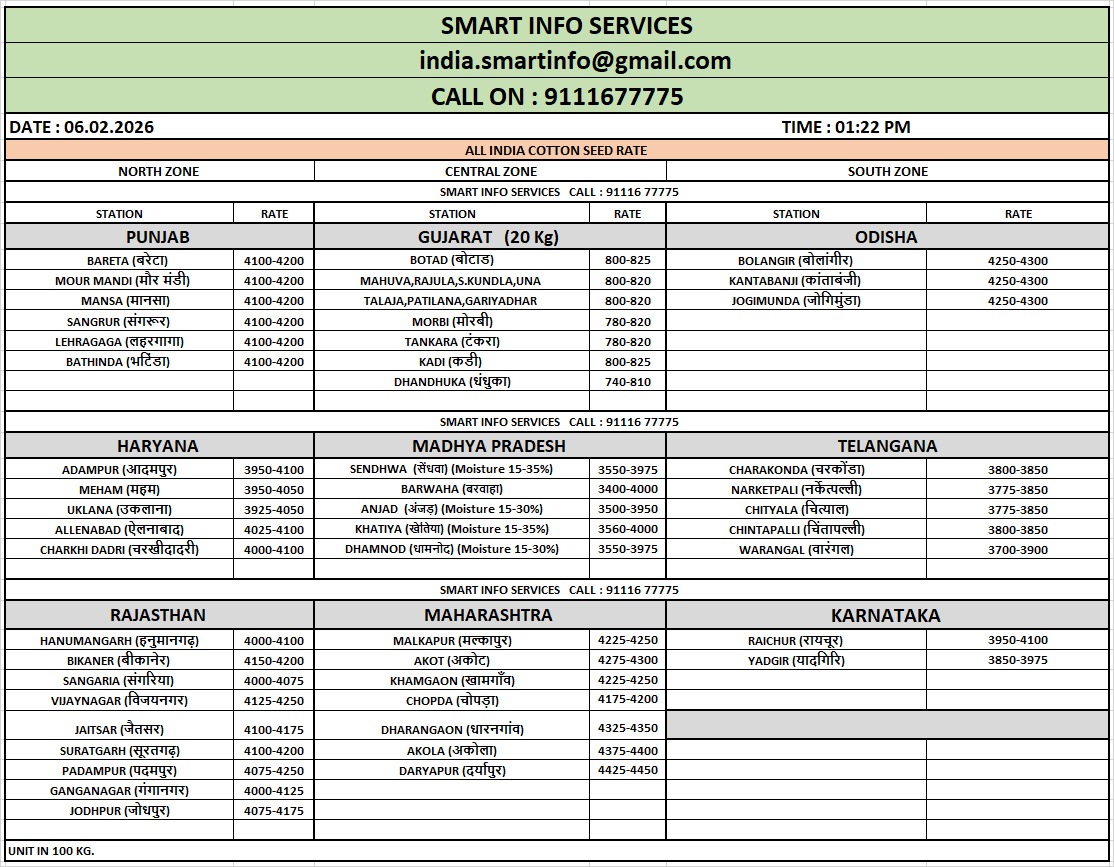
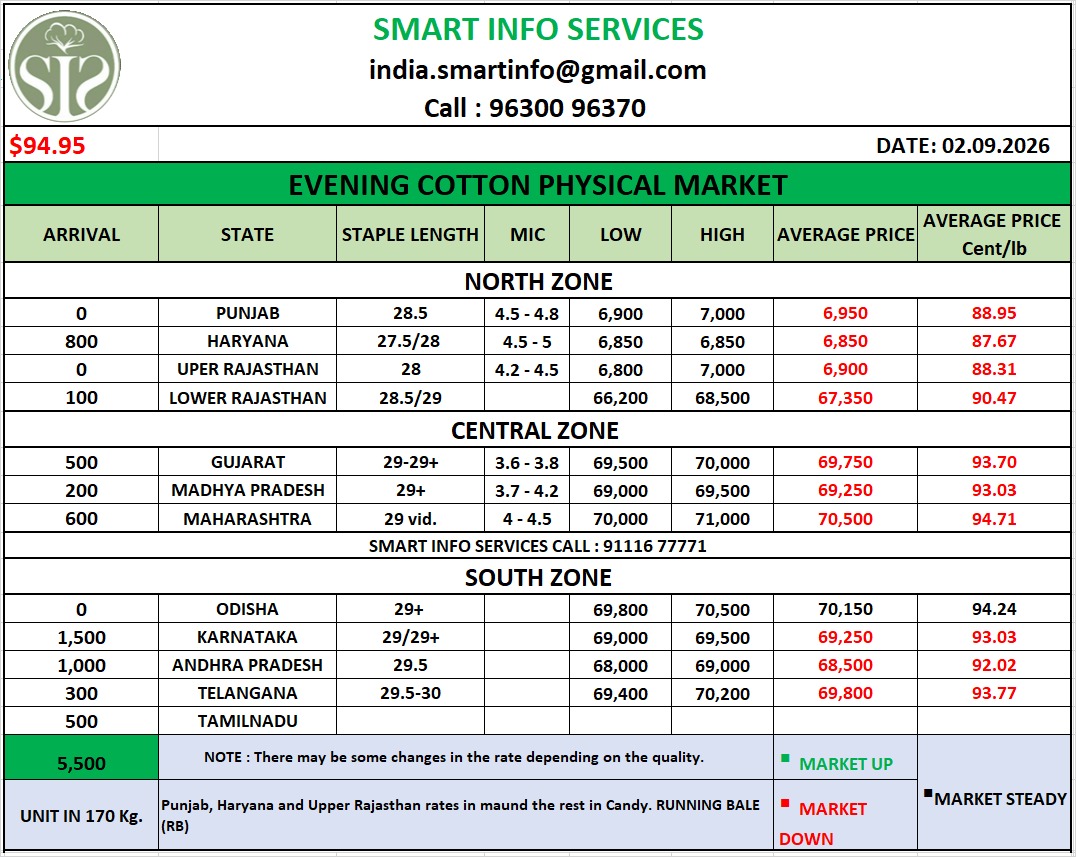
All India cotton market rate
Copyright© 2023 | Smart Info Service
Application Download