Filter

Recent News

Global trade shift demands bold Indian export moves: D&B

Global Trade Shift: D&B Calls for Indian Export PushA major shift in global trade dynamics is underway, driven by recent US tariff actions that impact a wide range of trading partners, including India, according to Dun & Bradstreet (D&B) India, a leading provider of business decisioning data and analytics, which has released a new report titled 'Navigating the Fault Lines of Global Trade: An Indian Perspective', offering a comprehensive analysis of the shifting trade landscape and its implications for Indian exporters.As global trade tensions intensify and the United States recalibrates its economic engagement, the report has revealed that the trade environment has changed significantly. Indian businesses need to be ready to mitigate rising risks while seizing newly emerging export opportunities.Of the 3,934 Indian product lines exported to the US, over 3,100 now face a flat 10 per cent tariff, while 343 are hit with a 25 per cent rate—placing significant pressure on sectors such as textiles, iron & steel, machinery, and chemicals. Despite these challenges, the report highlights 360 high-potential products—particularly in specialty chemicals, pharma inputs, home textiles, and industrial components—where India is well-positioned to grow its US market share. To help exporters navigate this landscape, products are mapped into four strategic zones: sweet spots, high risk–high reward, margin traps, and non-core, allowing businesses to focus where it matters most."This marks an important shift in the global trade landscape," said Arun Singh, global chief economist, Dun & Bradstreet. "India is at a point where thoughtful, strategic steps can help turn current global changes into long-term success. As supply chains diversify and trade policies evolve, Indian exporters have a chance to strengthen their role in key sectors. To fully leverage this shift, India must adopt forward-looking strategies that balance risk management with market expansion, especially in margin-sensitive industries like specialty chemicals, pharmaceuticals, textiles, and advanced manufacturing inputs.read more :-Rupee Opens 3 Paise Stronger at 85.97/USD

NEW DELHI: India Working On US Reciprocal Tariff Exemption, Interim Deal By July 8

India, US May Seal Tariff Pact by July 8India and the US are trying to negotiate an interim deal before July 8 to ensure full exemption from the imposition of 26 per cent "reciprocal tariff" on Indian domestic goods, government sources have said. The 90-day "pause" placed on the reciprocal tariff by the US will be lifted on July 9. The 10 per cent baseline tariff remains in place though.Recently Commerce Minister Piyush Goyal returned from the US after talks with US Commerce Secretary and other senior officials of President Donald Trump's administration and now India's chief negotiator Rajesh Aggarwal is continuing. India wants an interim deal ahead of the finalization of the first tranche of India-US Bilateral Trade Agreement by September-October, to avoid reciprocal tariff on Indian goods.India is engaging the Trump Administration at two levels -- political and the official-level, sources said.  On April 2, the US had imposed an additional 26 per cent reciprocal tariff on Indian goods but suspended it for 90 days till July 9, 2025.President Trump, in his second term, eliminated all country and product-specific exemptions arguing that it would help protect the US domestic industries. He reinstated 25 per cent tariff on all steel and aluminium imports. India, in its retaliatory measure, said it would place tariffs on $7.6 billion worth of imports from the US. On April 2, the US suspended the additional 26 per cent tariffs on India till July 9 and now both sides are working to take advantage of the 90-day tariff pause window to advance the trade talks.India is seeking duty concessions on labour-intensive sectors like textiles, gems and jewellery, leather goods, garments, plastics, chemicals, shrimp, oil seeds, chemicals, grapes, and bananas in the proposed pact with America.The US wants concessions for industrial goods, automobiles (electric vehicles in particular), wines, petrochemical products, dairy, agriculture items such as apples, tree nuts and GM (genetically modified) crops.read more:-Indian Rupee lower 42 Paisa, Ends at 86.00 per Dollar

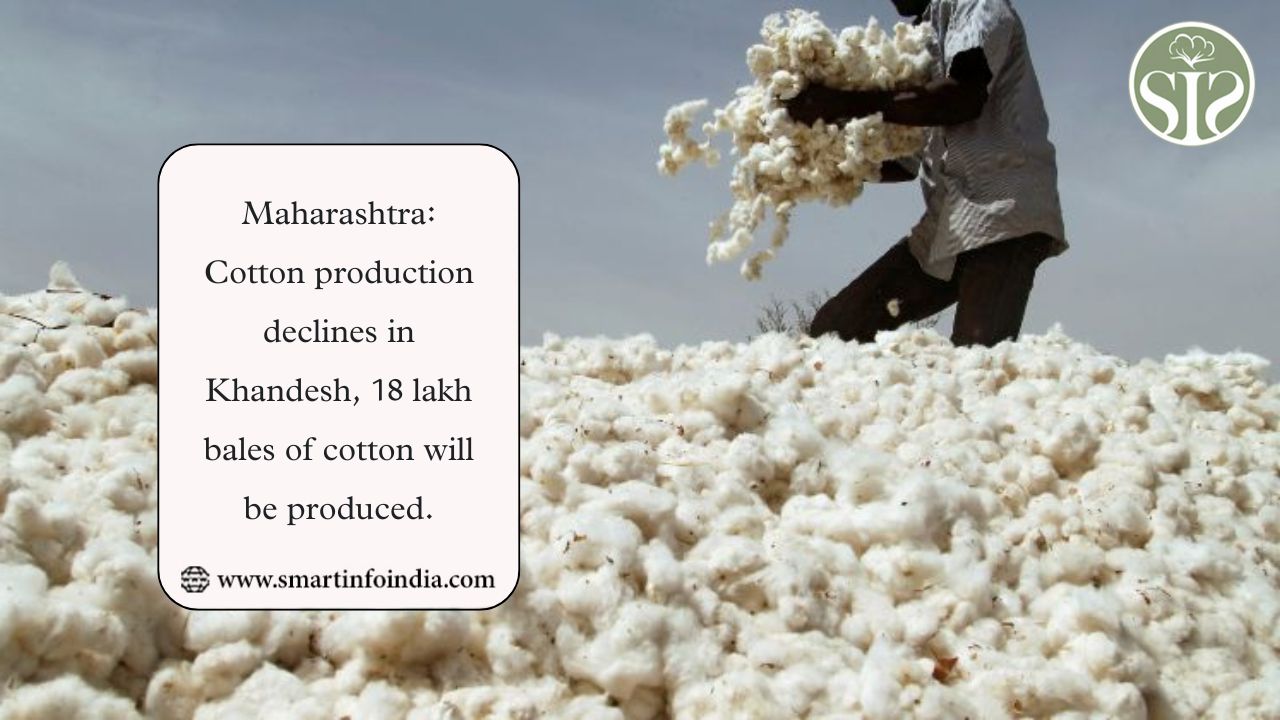
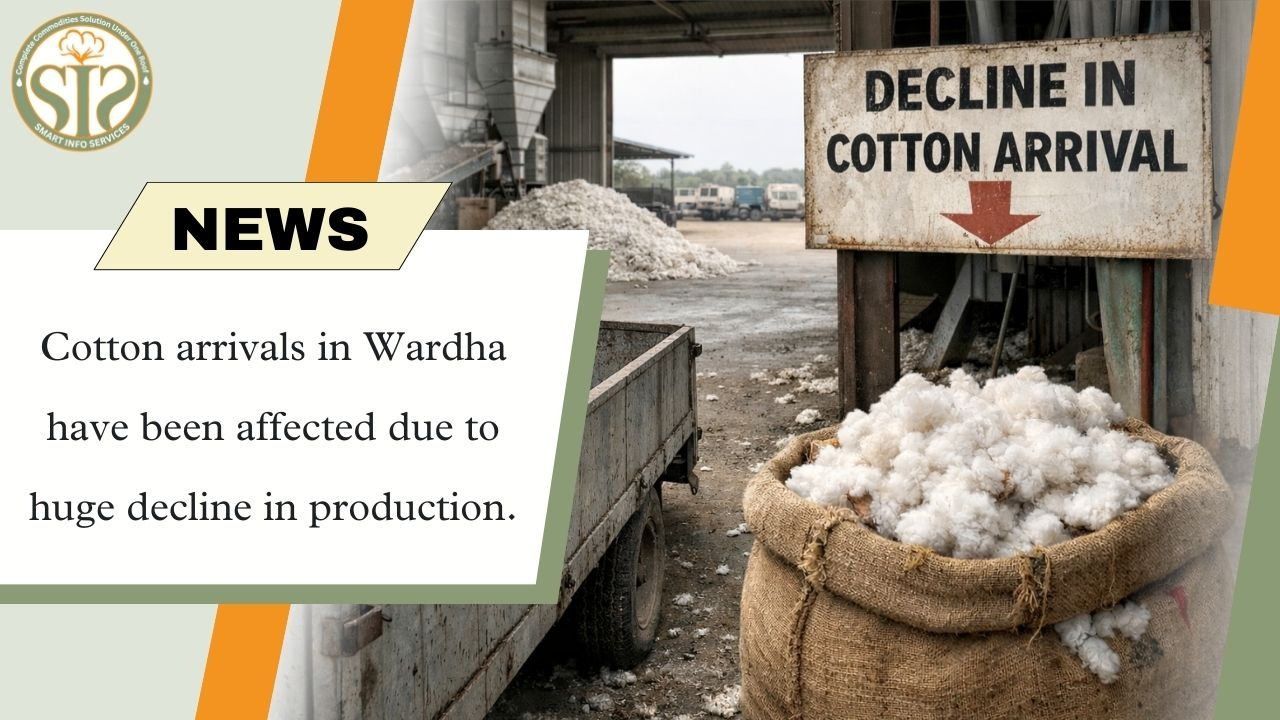
Maharashtra: Cotton production declines in Khandesh, 18 lakh bales of cotton will be produced.

Maharashtra: Sharp Decline in Khandesh Cotton Yield Alarms FarmersCotton production is low in Khandesh this year. The production of cotton bales continues, and it is expected that the ginning industry in Khandesh will produce about 1.8 million cotton bales (one bale is 170 kg) this season 2024/25 (by the end of September 2025).Every year during the cotton season, 2.2 to 2.3 million bales of cotton are produced in Khandesh. But in the last few years, there has been a steady decline in production. Cotton production is also expected to decrease due to reduced cotton cultivation in Jalgaon district and crop disease. Because the cotton processing industry in Khandesh operates at a rapid pace in the post-Diwali period. But this year this process is moving at a slow pace due to low supply of cotton.Continuous rains continued in October 2024 and even before that, affecting the cotton crop. Cotton production is decreasing. Producers and other organizations are not able to achieve the target of cotton production due to shortage of cottonThe arrival of cotton in Khandesh has been low from the beginning. Currently, 1,500 quintals of cotton are arriving in Khandesh every day. In the last season, an average of 18,000 quintals of cotton arrived per day in November and December. In the first fortnight of this month, the arrival of cotton has been continuously low.At present, not much purchase is being done from the villages as well. Because farmers no longer have much stock of cotton.Many people had cultivated cotton based on the availability of water and grew crops of gram, wheat, maize etc. In many villages, the cotton harvesting season has ended in January itself. Due to this, the situation regarding the arrival of cotton in the villages is not very positive. Now there will be no further increase in the arrival of cotton.The dry season cotton crop was harvested rapidly in December. But there too the production is low. The arrival of cotton was also good in December.Farmers also have very low stock of cotton at this time. Many people sold it within a few days of picking cotton.The pace of arrival in cotton mills was only for a few days. This year the arrival was very low.The stock with the farmers has reduced. Now there will not be much arrival. It seems that due to low production, the production of cotton bales will decrease in Khandesh this year 2024/25.read more :-Tami nadu : Nagapattinam cotton farmers worry over yield due to unseasonal rains

Tami nadu : Nagapattinam cotton farmers worry over yield due to unseasonal rains

Nagapattinam Cotton Farmers Hit by Unseasonal RainsNagapattinam and Karaikal districts have experienced unseasonal rain since last Friday through Monday, raising concerns among cotton farmers over potential yield loss as the crop enters the flowering stage.In Nagapattinam district, cotton is grown on approximately 2,700 hectares, with the majority of cultivation taking place in Tirumarugal block and some areas of Kilvelur block. P. Balasubramanian, Alathur Panchayat president in Tirumarugal, where cotton is cultivated on about 220 hectares, said farmers are facing severe challenges.“Due to unseasonal rains in the past two months, we have had to sow seeds three times. The cotton crop is currently in the flowering stage, but the rains have caused the flowers to wither, potentially affecting yields,” he said.He added that sowing one acre of cotton involves ₹3,000 in labour charges and ₹2,400 for seeds, not including additional expenses for fertilizers or sand. “We repeated this entire process three times over the past two months, and now even this crop is at risk,” he added.“In one acre, we typically get an average yield of 10 quintals,” he said. “But now, we’re looking at a loss of at least 200 kg per acre. If such rains persist, the situation will worsen, and we will suffer badly.”In Karaikal district, cotton is cultivated on over 2,500 acres, and similar issues have been reported. D.N. Suresh of the Kadaimadai Vivasayigal Sangam said, “For the past five years, farmers in Karaikal have been growing cotton, but each year brings new challenges. Last year too, unseasonal rains during this period caused damage. We no longer have faith in crop insurance as we rarely receive fair compensation. Many of us take loans to cultivate cotton. If these rains continue, it will be very difficult for us this year.”read more :-Rupee opens 6 paise higher at 85.58 against dollar

Related News

Youtube Videos

10 फ़रवरी 2025 का कपास बाज़ार😨 aaj ka kapas bajar bhav 😨cotton market rate today #kapas #cotton
10 फ़रवरी 2025 का कपास बाज़ार😨 aaj ka kapas bajar bhav 😨cott...
10/02/2025 सम्पूर्ण भारत की कपास की आवक || All India cotton arrival today #kapas #arrival #cotton
10/02/2025 सम्पूर्ण भारत की कपास की आवक || All India cotton...
इस सप्ताह कैसा रहा कपास बाजार का हाल 🤔? जानिए पूरी जानकारी Weekly cotton market update #smartinfo
इस सप्ताह कैसा रहा कपास बाजार का हाल 🤔? जानिए पूरी जानकारी...
Copyright© 2023 | Smart Info Service
Application Download