STAY UPDATED WITH COTTON UPDATES ON WHATSAPP AT AS LOW AS 6/- PER DAY
Start Your 7 Days Free Trial TodayThis evening, the rupee finished 4 paise worse versus the US dollar at 83.56At the close of trading, the BSE Sensex fell 27.43 points or 0.034% to close at 79,897.34. The NSE's 50-share index Nifty fell 8.50 points or 0.035% to close at 24,315.95.Read more :- Vietnam's Cotton Imports Surge to US$1.53 Billion in H1
Vietnam Imports $1.53 Billion in Cotton in H1Vietnam imported 766,000 tonnes of cotton worth US$1.53 billion in the first half of this year, marking a 21.6 per cent increase in volume and a 9 per cent rise in value compared to the same period last year, according to the General Statistics Office.The average import price during this period was $1,995.5 per tonne.Vietnam's cotton imports come from 11 main markets, including:- Brazil: $443 million (up 111 per cent),US: $400 million (down 18 per cent),Australia: $196 million (down 23 per cent),India: $85 million (up 116 per cent).Notably, cotton imports from Pakistan surged by 3,380 per cent to 5,186 tonnes in the first five months of this year, with revenue increasing from $0.2 million to $9.1 million.Conversely, imports from the Republic of Korea dropped by 72 per cent to 324 tonnes.The highest average price was for cotton imported from China at $3,832.3 per tonne, followed by the Republic of Korea at $2,179 per tonne, the US at $2,098 per tonne, and Australia at $2,092 per tonne. The lowest price was for cotton from Indonesia at $1,360 per tonne.Vietnam is the third-largest cotton importer globally, with an annual import volume of around 1.5 million tonnes, primarily serving its textile industry. Vietnam is also the sixth-largest textile producer and the third-largest garment producer in the world, after China and Bangladesh.According to the Vietnam Textile and Apparel Association, domestic cotton production meets only 1 per cent of the sector's demand, fiber 30 per cent, and fabric 20 per cent.The International Cotton Advisory Committee forecasts that global cotton prices will trend upward in 2024, driven by recovering demand and declining output.Read More :> Cotton Farmers Struggle with Labour Costs and Declining Profits
Maharashtra Sets Record for Sowing: Soybean, Maize, Cotton, and Tur Crops IncreaseThis year's Kharif season has seen unprecedented sowing of soybean, maize, cotton, and tur crops in Maharashtra. As of Wednesday, July 10, sowing has been completed on 11.638 million hectares, accounting for 81.94% of the average Kharif area.Marathwada leads the state in sowing activities. The Agriculture Department reports that the total average Kharif area in Maharashtra is 14.2 million hectares. By July 10, the Pune division has achieved the highest sowing, followed by the Chhatrapati Sambhajinagar and Latur divisions.In detail, the Konkan division has sown 96,870 hectares (23.42% of the average), while the Nashik division has sown 1,657,788 hectares (80.29% of the average). The Pune division has surpassed its average with 1,084,163 hectares, reaching 101.79%. The Kolhapur division has sown 539,103 hectares, achieving 74.03% of its average.Chhatrapati Sambhajinagar has sown 1,944,826 hectares, reaching 93.05% of the average. The Latur division has completed sowing on 2,546,683 hectares, achieving 92.04% of the average. In the Amravati division, 2,758,446 hectares have been sown, which is 87.32% of the average. The Nagpur division has sown 1,010,154 hectares, reaching 52.76% of the average.Maize sowing has reached 101% with 895,737 hectares, and tur sowing stands at 81% with 1,054,406 hectares. Urad dal sowing is at 82% with 305,069 hectares. Soybean sowing has achieved 108% with 4,487,844 hectares. Cotton sowing is at 90% with 3,768,214 hectares. Overall, grain sowing is at 47%, pulses at 75%, and oilseeds at 105%.Thanks to widespread good rainfall, record sowing has been achieved by July 10 in the Kharif season. With sowing continuing through August, it is expected that total Kharif sowing will exceed the average of 14.2 million hectares. Fertilizers and seeds are readily available across the state, according to Vinaykumar Awate, Director of Agriculture, Extension, and Development.READ MORE :> Textile Industry Sees Revival Amid Rising Domestic and Export Demand
In early trade, the rupee climbs 2 paise to 83.49 against the US dollar. This comes after the rupee stayed range-bound and settled 2 paise lower at 83.51 against the US dollar on Wednesday amid rising crude oil prices overseas and selling in domestic equities.Read More :> "Govt May Ease 45-Day Payment Requirement for MSMEs in Upcoming Budget"
The rupee ended the day down by 3 paise, closing at 83.52 against the US dollar.At the close of trading, the BSE Sensex fell 426.87 points or 0.53% to close at 80,351.64. It had touched a new high of 80,481.36 during the day. The NSE's 50-share index Nifty fell 108.75 points or 0.45% to close at 24,324.45. It also made a new all-time high of 24,443.60 during the day.readmore:-Cotton Farmers Struggle with Labour Costs and Declining Profits
"Govt May Ease 45-Day Payment Requirement for MSMEs in Upcoming Budget"The government is considering easing the requirement for large buyers to pay Micro, Small, and Medium Enterprises (MSMEs) within 45 days to prevent these buyers from seeking alternative suppliers, according to sources. The announcement could be made in the Budget presentation on July 23. This potential change is in response to suggestions made during pre-Budget consultations, aimed at amending Section 43B(h) of the Income Tax Act.The clause, introduced in the previous year’s Budget, mandates that if a large company fails to pay an MSME within 45 days, it cannot deduct that expense from its taxable income, potentially leading to higher taxes. While the provision was intended to ensure timely payments to MSMEs, there are concerns that large buyers might avoid doing business with MSMEs registered under Udyam, opting instead for non-registered MSMEs or larger firms.Sources indicate that MSMEs fear this provision may drive large corporations to shift their sourcing to bigger firms or compel vendors to forfeit their MSME registration to maintain business relations. In May, Finance Minister Nirmala Sitharaman acknowledged that any changes to this rule would be addressed in the full Budget in July under the new government, based on representations from MSMEs.The MSME sector is crucial to India’s economy, contributing 30% to the GDP and being the second-largest employer after agriculture. MSMEs also account for 45.56% of the country’s total exports.Read more :- Textile Industry Sees Revival Amid Rising Domestic and Export Demand
Growth in Domestic and Export Demand Drives the Textile Industry's RevivalThe textile industry is seeing a moderate revival due to rising domestic demand and a significant increase in cotton yarn exports driven by lower domestic cotton prices. Slight improvements in demand from the US and European markets have also contributed to this recovery.According to Niryat Portal data, exports of readymade garments, cotton yarn, and fabrics reached $17.9 billion from October 2023 to May 2024, up from $17.5 billion in the same period the previous year. Yarn exports alone grew by 51% in volume.Despite these positive signs, experts caution that the recovery is fragile and requires policy support. The demand remains below pre-Covid levels, and recent spikes in cotton prices have neutralized cost advantages for manufacturers.Bharat Boghra, Chairman of the Spinners Association (Gujarat) (SAG), noted the competitive edge of Indian cotton due to higher production and lower prices compared to the US and Brazil. However, he warned of potential challenges due to ongoing geopolitical crises and short order cycles.*Ramakrishnan M, Managing Director of Primus Partners, highlighted steady domestic demand bolstered by expanding e-commerce in tier 2 and 3 areas. However, he expressed concerns over rising production costs, global inflation, and muted consumer confidence impacting the industry's outlook.Bhavin Parikh, MD & CEO of Globe Textiles India, pointed to the China+1 policy and changing consumer behavior as factors aiding the industry's recovery. Still, the short order cycle reflects a lack of confidence in global economic growth.Textile Minister Giriraj Singh recently announced plans to include garments in the PLI Scheme for the Textile sector and revive the Scheme for Integrated Textile Parks (SITP), aiming for $50 billion in shipments this year.Read More :> Cotton Farmers Struggle with Labour Costs and Declining Profits
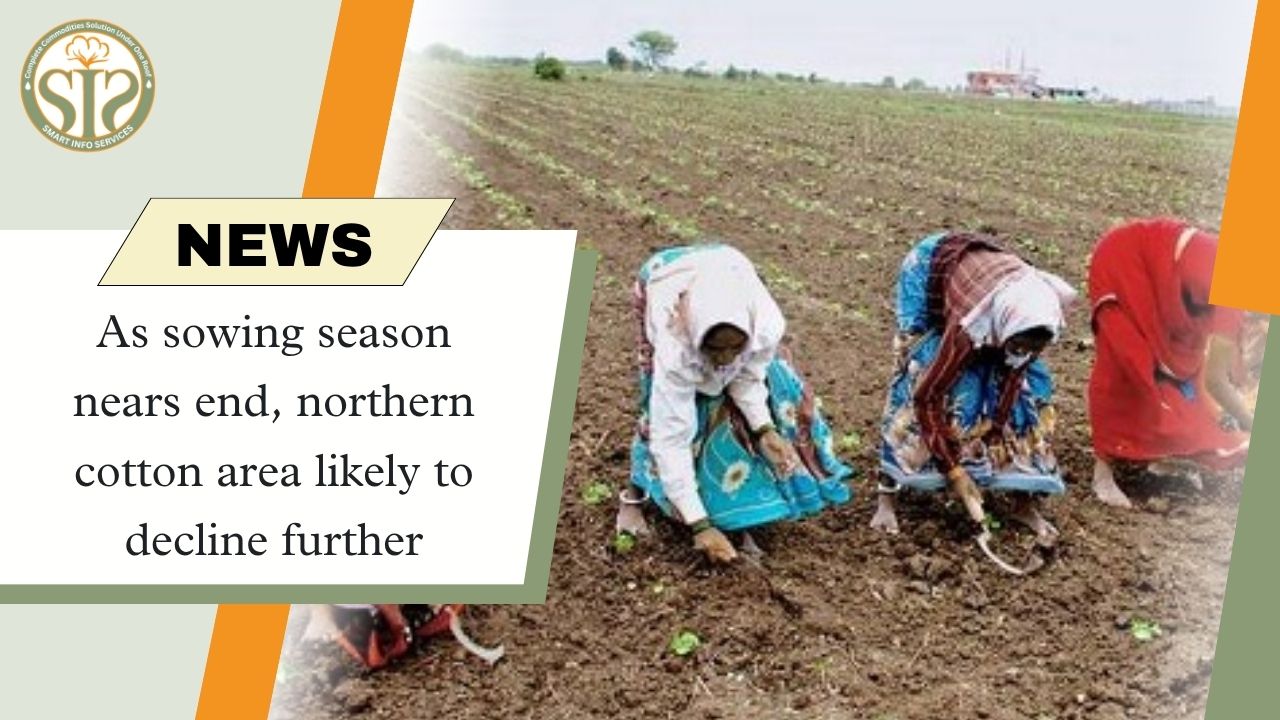
Cotton Growers Face Labor Expenses and Falling ProfitsCotton, once hailed as “White Gold” by farmers in Akola, has now become a crop of "compulsion." Farmers in Maharashtra are grappling with high production costs and labour concerns, finding cotton less profitable than it once was.Ganesh Nanote, a farmer from Akola who cultivates cotton on 15 of his 40-acre holding in the village of Nimbhara in Barsitakli taluka, describes the annual increase in production costs, particularly for labour, as making the crop almost non-viable. "But there is no other option – tur, urad, and other pulses have their own problems. Farmers take cotton out of compulsion and not profit anymore," he explains.This year, cotton traders nationwide fear a 10-15% decrease in planting area, driven by low prices and disappointing yields. The shift is especially evident in North India, where farmers are opting for paddy over cotton, despite a higher government-declared Minimum Support Price (MSP) of Rs 7,121/quintal. Bhagirath Choudhary, founder director of the South Asia Biotechnology Centre (SABC), attributes the shift largely to the Pink Bollworm infestation (PBW), a notorious pest affecting cotton crops. "The agriculture department needs to increase awareness among farmers on pest control," he adds.Pradeep Jain, founder president of the Khandesh Cotton Gin/Press Factory Owners and Traders Development Association, notes a 20% decline in cotton sowing areas in North Maharashtra. "Farmers did not get yield or price as per their expectation. Many have shifted to maize, pulses, and other crops," he says. Nationwide, he speculates a 10% decrease in cotton acreage for the upcoming season.Read More :> Textile Industry Seeks Robust Support for Spinning Sector in Union Budget 2024-25
The rupee gained 1 paisa today, ending at 83.49 against the US dollar.At the close of trading, the BSE Sensex rose 391.26 points or 0.49% to close at 80,351.64. It touched a new high of 80,397.17 during the day. The NSE's 50-share index Nifty rose 112.65 points or 0.46% to close at 24,433.20. It also made a new all-time high of 24,443.60 during trading.readmore:- Monsoon Reverses Deficit, Boosting Sowing Operations for Pulses and Oilseeds
Union Budget 2024–2025: Textile Industry Seeks Sturdy Support for Spinning SectorThe textile industry is eagerly anticipating significant support, particularly for the spinning sector, in the upcoming Union Budget for fiscal 2024-25, to be presented on July 23 by Finance Minister Nirmala Sitharaman.Industry stakeholders, including RK Vij from the Textile Association of India (TAI) and the Polyester Textile and Apparel Industry Association (PTAIA), are highlighting several key demands. These include ensuring a steady supply of raw materials such as cotton, polyester, and viscose at globally competitive prices and standards. Vij also advocates for increased duties on garment imports to boost domestic manufacturing competitiveness.Vij emphasizes the extension of the Remission of Duties and Taxes on Exported Products (RoDTEP) Scheme beyond its current deadline in September 2024. He raises concerns over the inverted duty structure of GST and urges streamlined tax rates across various textile products, suggesting higher taxes on downstream items.Rakesh Mehra, Chairman of the Confederation of Indian Textile Industry (CITI), echoes these sentiments. He calls for policies to ensure competitive raw material prices and proposes a Technology Upgradation Fund Scheme (TUFS) to stimulate investments in textile processing and value addition.Dr. SK Sundararaman, Chairman of The Southern India Mills’ Association (SIMA), stresses the need for fair trade policies and advocates for the availability of high-quality cotton at prices 10% lower than international markets. He calls for removing import duties on cotton to facilitate easier access to global supplies and enhance domestic cotton production.Sanjay Garg, President of the Northern India Textile Mills’ Association (NITMA), emphasizes the need for a minimum import price (MIP) on all fabric types to curb imports and prevent market manipulation. Garg also supports the removal of import duties on cotton to address cost discrepancies compared to global rates.Jaikrishna Pathak, President of The Bombay Yarn Merchants Association and Exchange, underscores the need to streamline the polyester textile value chain and reduce GST on raw materials to rectify the inverted duty structure.Collectively, these industry experts seek proactive measures from the government to support raw material availability, enhance competitiveness, and stimulate investment across various segments of the textile sector ahead of the upcoming budget presentation.Read More:> Monsoon Reverses Deficit, Boosting Sowing Operations for Pulses and Oilseeds
Monsoon Increases Oilseed and Pulse Sowing Operations and Reverses DeficitWith monsoon rains shifting from an 11% deficit on June 30 to a 2% surplus by July 8, sowing operations for Kharif (summer sown) crops have surged, pushing overall acreage 14% higher than the same period last year.Recent data from the agriculture ministry reveals that as of last Friday, total sown area reached 378 lakh hectares, up by 47 lakh hectares compared to the previous year. This significant increase is largely driven by a 50% rise in the acreage of pulses and oilseeds. In contrast, the area dedicated to water-intensive paddy has increased by only 19%.Despite a greater monsoon deficit in June this year (11%) compared to last year (9%), the acreage for Kharif crops was notably higher, with 59 lakh hectares (over 32%) more sown by June 28 this year compared to the same period in 2023. The total sown area as of June 28 was 240 lakh hectares, significantly up from 181 lakh hectares last year.“Due to insufficient rainfall in June, farmers opted for less water-consuming crops like pulses (arhar) and oilseeds (soybean) over water-intensive paddy, leading to increased acreage this June,” said an official.With a forecast of above-normal rainfall for July, further increases in sown area are anticipated. "Well-distributed rainfall from July to September should boost Kharif acreage beyond the normal (five-year average) for this season," the official added.READ MORE :> Aurangabad: ₹191 Crore Aid Announced for 6 Lakh Cotton Growers
In the opening session, the Rupee and the US dollar trade at 83.50. Domestic equity markets were trading higher in early trade, supporting the local unit. Benchmark Sensex rose 194.25 points or 0.24 per cent to 80,154.63 while broader Nifty was up 42.35 points or 0.17 per cent at 24,362.90. Read More :> Government Set to Revive Cotton Technology Mission with ₹500 Crore Allocation for Five-Year Plan
The rupee ended the day slightly down, closing at 83.50 against the US dollar, a decrease of 1 paisa.At the close of trading, the BSE Sensex fell 36.22 points or 0.05% to close at 79,960.38. The NSE's 50-share index Nifty fell marginally by 3.30 points or 0.014% to close at 24,320.55.read more:- Aurangabad: ₹191 Crore Aid Announced for 6 Lakh Cotton Growers
Rupee Gains 5 Pennies Against US Dollar to 83.44At the interbank foreign exchange market, the local unit opened at 83.45 and gained further to 83.44 against the greenback, registering a rise of 5 paise from its previous close.Read More :> Aurangabad: ₹191 Crore Aid Announced for 6 Lakh Cotton Growers
₹191 Crore in Aid Announced for 6 Lakh Cotton Growers in AurangabadChhatrapati Sambhajinagar District Farmers to Receive Government Compensation for Crop LossesIn Chhatrapati Sambhajinagar district, around 6 lakh farmers have faced significant losses in their cotton crops, which covered an area of 3.84 lakh hectares. The state government has announced a financial aid package of ₹191.50 crore to assist these farmers.For the past two years, cotton growers have suffered substantial losses due to plummeting cotton prices. In response, the state government committed to providing compensation of ₹5,000 per hectare to affected cotton farmers. This aid will soon be disbursed to the 6 lakh farmers in Chhatrapati Sambhajinagar who experienced these losses.In contrast to Chhatrapati Sambhajinagar, other districts in Marathwada have seen a significant decline in cotton production over the past decade. Farmers in these areas have increasingly shifted to soybean cultivation. However, farmers in Chhatrapati Sambhajinagar continue to cultivate cotton, often referred to as "white gold."During the last Kharif season, cotton was planted on approximately 80% of the cultivated land in the district, equating to about 3.84 lakh hectares. Over the past two years, cotton prices have dropped to ₹6,500 per quintal, and production has halved due to inadequate rainfall last year.Given these challenges, the state government has announced compensation of ₹5,000 per hectare for up to two hectares of land per farmer. As preparations for the upcoming Kharif season are underway, this announcement has brought much-needed relief and optimism to the farmers in the district.Read More :> Government Set to Revive Cotton Technology Mission with ₹500 Crore Allocation for Five-Year Plan
The rupee initially gained ground but ended the day nearly unchanged at 83.49 against the US dollar on Friday, with trading activity subdued.Sensex, Nifty end flat; Nifty Bank down nearly 1%Indian benchmark indices ended flat in the volatile session on July 5. At close, the Sensex was down 53.07 points or 0.07 percent at 79,996.60, and the Nifty was up 21.60 points or 0.09 percent at 24,323.80.read more:- Despite Government Efforts, Punjab Sees Record Low Cotton Cultivation
| title | Created At | Action |
|---|---|---|
| The rupee closed 4 paise lower at 83.56 against the US dollar this evening | 11-07-2024 23:43:14 | view |
| Vietnam's Cotton Imports Surge to US$1.53 Billion in H1 | 11-07-2024 18:53:55 | view |
| Record Sowing in Maharashtra: Soybean, Maize, Cotton, and Tur Crops Surge | 11-07-2024 18:53:07 | view |
| Rupee rises 2 paise to 83.49 against US dollar in early trade | 11-07-2024 17:17:12 | view |
| The rupee closed 3 paise lower at 83.52 against the US dollar this evening. | 10-07-2024 23:33:35 | view |
| "Govt May Ease 45-Day Payment Requirement for MSMEs in Upcoming Budget" | 10-07-2024 23:23:30 | view |
| Textile Industry Sees Revival Amid Rising Domestic and Export Demand | 10-07-2024 18:55:02 | view |
| Cotton Farmers Struggle with Labour Costs and Declining Profits | 10-07-2024 18:46:55 | view |
| The rupee strengthened by 1 paisa to close at 83.49 against the US dollar this evening. | 09-07-2024 23:52:05 | view |
| Textile Industry Seeks Robust Support for Spinning Sector in Union Budget 2024-25 | 09-07-2024 21:29:44 | view |
| Monsoon Reverses Deficit, Boosting Sowing Operations for Pulses and Oilseeds | 09-07-2024 18:26:35 | view |
| Rupee trades flat at 83.50 against US dollar in opening session | 09-07-2024 17:18:45 | view |
| The rupee closed 1 paisa lower at 83.50 against the US dollar this evening. | 09-07-2024 00:00:22 | view |
| Rupee Rises 5 Paise to 83.44 vs US Dollar | 08-07-2024 17:16:52 | view |
| Aurangabad: ₹191 Crore Aid Announced for 6 Lakh Cotton Growers | 06-07-2024 18:09:51 | view |
| This evening, the rupee closed at 83.49 against the dollar without any change. | 06-07-2024 00:45:18 | view |