Indian Textile Industry Welcomes ₹5,659-Crore Mission on Cotton to Boost Productivity and Global Competitiveness
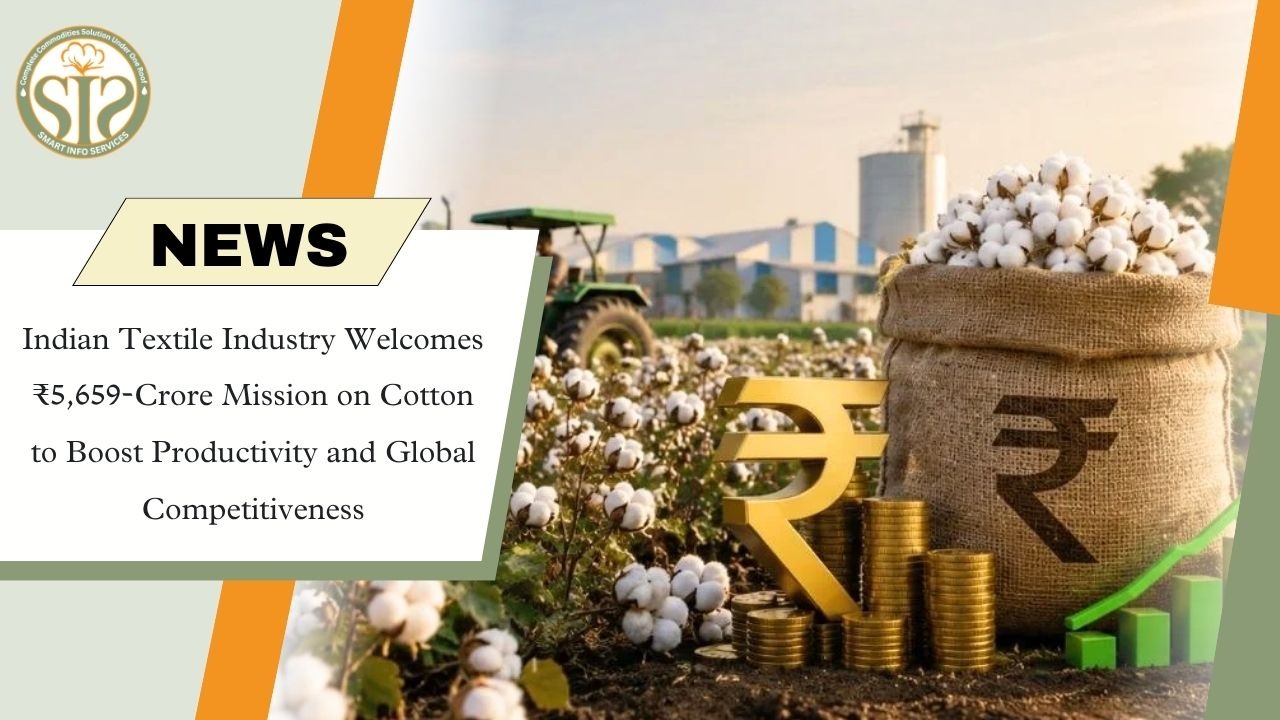
The Indian textile industry has welcomed the Union government’s approval of a five-year Mission on Cotton, aimed at boosting cotton productivity with an outlay of ₹5,659.22 crore. Industry stakeholders believe the initiative will strengthen cotton farming, improve productivity, and enhance the global competitiveness of India’s textile and apparel sector.
Confederation of Indian Textile Industry Chairman Ashwin Chandran said the Cabinet’s decision would provide a major impetus to the sector, especially at a time when India is looking to leverage opportunities arising from Free Trade Agreements (FTAs). He noted that the Mission would help address the long-standing imbalance in India’s cotton sector.
Although India is among the world’s largest cotton producers, its productivity levels remain comparatively low, affecting the country’s export competitiveness. Chandran said a recent delegation from the textile and apparel industry met Union Agriculture and Farmers’ Welfare Minister Shivraj Singh Chouhan to highlight challenges across the cotton value chain and seek government intervention.
Southern India Mills’ Association Chairman Durai Palanisamy recalled that the Technology Mission on Cotton (TMC), launched in 1999, had significantly transformed the sector. Cotton production increased from around 178 lakh bales to nearly 398 lakh bales by 2013-14, while the cultivation area expanded from 92 lakh hectares to 128 lakh hectares, accounting for nearly 36–38% of global cotton acreage.
However, following the closure of the TMC, cotton gradually lost policy focus, leading to a decline in productivity and production in recent years, with current output estimated at around 292 lakh bales.
Industry leaders expect the new Mission to ensure a steady supply of quality cotton to the textile sector and reduce dependence on imports of Extra Long Staple (ELS) cotton. They pointed out that India’s cotton productivity, estimated at 450–500 kg lint per hectare, remains lower than that of countries such as Brazil and China.
Meanwhile, the South India Hosiery Manufacturers Association has urged the Union government to withdraw import duty on cotton and take steps to stabilise yarn prices.