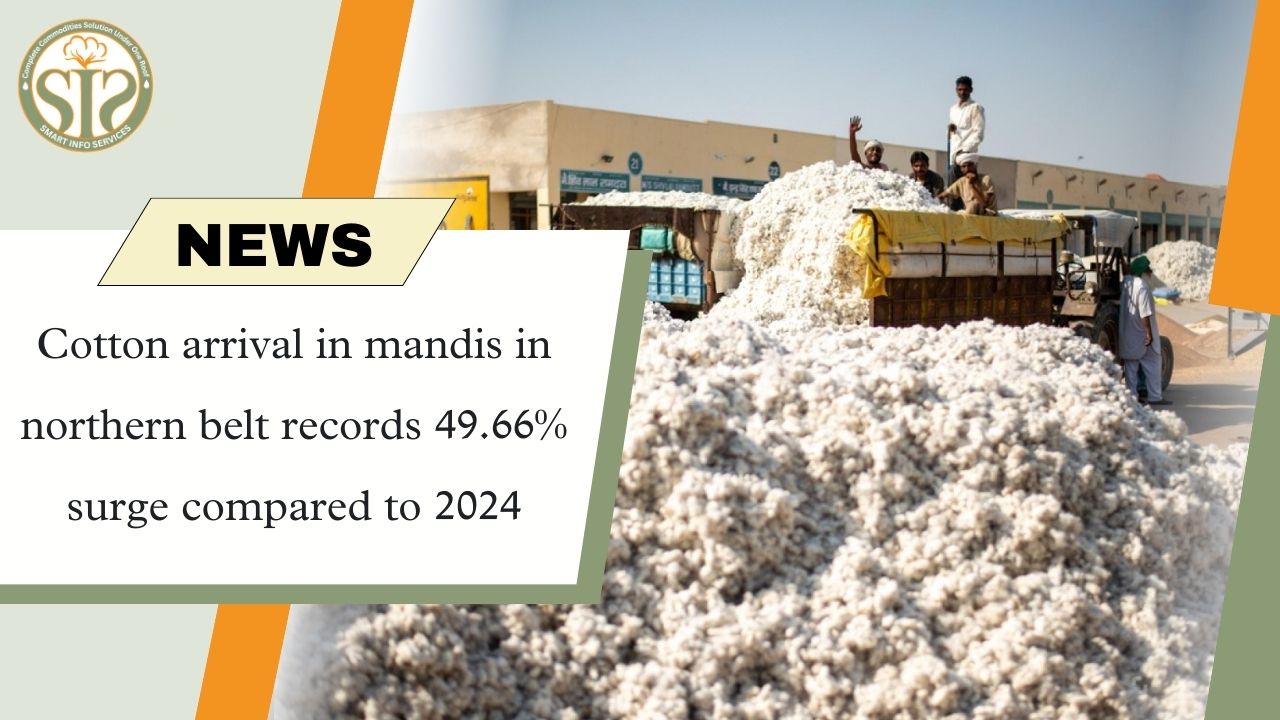
Cotton arrivals in the northern belt increased by 49.66%.
By yash chouhan 2025-12-11 19:05:00
Cotton arrival in mandis in northern belt records 49.66% surge compared to 2024
The northern cotton belt — comprising Punjab, Haryana and Rajasthan — has so far recorded a surge of 49.66 per cent in cotton balls’ arrival in mandis this season, and more arrivals are expected in the coming months with harvesting still on. The three states have so far received 13.32 lakh bales (one bale of ginned cotton — cotton separated from seed — weighs 170 kg) in their mandis compared to 8.90 lakh bales in the corresponding period in 2024.
This surge has been attributed to kapas (cotton balls) prices in mandis, selling well below the Minimum Support Price (MSP). With no significant price improvement anticipated, and the current presence of Cotton Corporation of India (CCI), which purchases on the MSP rate, in the market, farmers are choosing not to hold back their produce, and thus, pushing more crops to mandis faster than usual.
As cotton bulb picking starts in September and concludes by November, the major cotton arrival season in the northern region begins on October 1 — though some early crop reaches mandis even in September — and 50-70 per cent (in some cases even 90 per cent depending on the market rate in the given season) of the produce reaches mandis by December, and ends by September 30 the next year.
Also, the Cotton Corporation of India (CCI) has purchased 13,400 bales (67,000 quintals) this year. In the corresponding period last year, however, the CCI had not even entered the market because the prevailing rate was nearly equal to the MSP. Usually, the CCI enters the market when market prices fall below the MSP and buys cotton at the MSP that meets its parameters. CCI official said, farmers should not panic or rush to bring all their produce to the Mandis at once, as CCI will continue purchasing at the MSP in the coming monthe.
Punjab has 1.19 lakh hectares under cotton this year compared to around 1 lakh hectares in 2024, but heavy rainfall damaged around 10 to 15 per cent of the crop, reducing the productive area under cultivation to just above last year’s level (i.e. around 1 lakh hectares) and affecting quality too. Punjab is expected to harvest 1.5 lakh to 1.8 lakh bales this year, compared to last year’s 1.51 lakh bales (7.55 lakh quintals).
In Haryana, this year, the area under cotton cultivation stands at 3.80 lakh hectares compared to 4 lakh hectares last year. Thus far, 2.70 lakh bales (13.50 lakh quintals kapas, meaning unginned cotton) arrived in mandis across Haryana compared to 2.45 lakh bales (12.25 lakh quintals) by the corresponding period last year — an increase of about 0.25 lakh bales, or just over 10 per cent.
This year, the CCI has procured 65,000 bales (3.30 lakh quintals) in Haryana, slightly higher than last year’s 62,000 bales (3.10 lakh quintals).
Rajasthan has recorded arrivals of around 10 lakh bales so far, compared to more than 6 lakh bales in the same period last year — an increase of about 4.0 lakh bales, or around 66 per cent. The state’s cotton area this year is estimated to be 6.50 to 7 lakh hectares, while the yield remains average, around 8 to 10 quintals per hectare.
Together, Punjab, Haryana and Rajasthan had around 11.50 lakh hectares under cotton cultivation in 2025 compared to around 11 lakh hectares in 2024. In Punjab and Haryana, the cotton area continues to shrink year after year, while in Rajasthan the trend fluctuates with a slight decline one year and a modest rise the next. These states have also been battling repeated pink bollworm attacks in recent years, severely eroding farmers’ confidence. Punjab is said to be the worst affected, and experts point out that several years ago, the state had nearly 8 lakh hectares under cotton. They argue that if the Punjab government is serious about crop diversification and protecting the cotton belt, it must invite scientists from across India to investigate the root causes of persistent pest outbreaks and develop effective solutions.
Cotton prices remained strong and above MSP from 2021–22 to 2023–24, but fell sharply in 2024–25, although they stayed close to the MSP. Cotton fetched ₹13,000 to ₹14,000 per quintal in 2021, around ₹10,000 in 2022, ₹8,000 to ₹8,100 in 2023, and between ₹6,000 and ₹8,300 in 2024, with most of the crop selling at ₹7,400 to ₹7,500—almost equal to the MSP. Last year’s MSP was ₹7,121 per quintal for medium staple and ₹7,521 per quintal for long staple. This year’s cotton price is the lowest in the past five years.
Cotton Association of India (CAI) Chairman Atul Ganatra said based on inputs from states, the CAI projected that Punjab would harvest around 1.80 lakh bales (9 lakh quintals), Haryana 6.52 lakh bales (32.60 lakh quintals) and Rajasthan 18.80 lakh bales (94 lakh quintals).
To address these challenges, a five-year “Mission for Cotton Productivity” has been announced in the Union Budget 2025-26. The mission aims to enhance productivity and quality, promote innovation and strengthen the textile value chain through strategic interventions, research and extension activities across all cotton-growing states. It will focus on developing climate-smart, pest-resistant and high-yielding varieties, including Extra Long Staple (ELS) cotton, using advanced breeding and biotechnology tools.