STAY UPDATED WITH COTTON UPDATES ON WHATSAPP AT AS LOW AS 6/- PER DAY
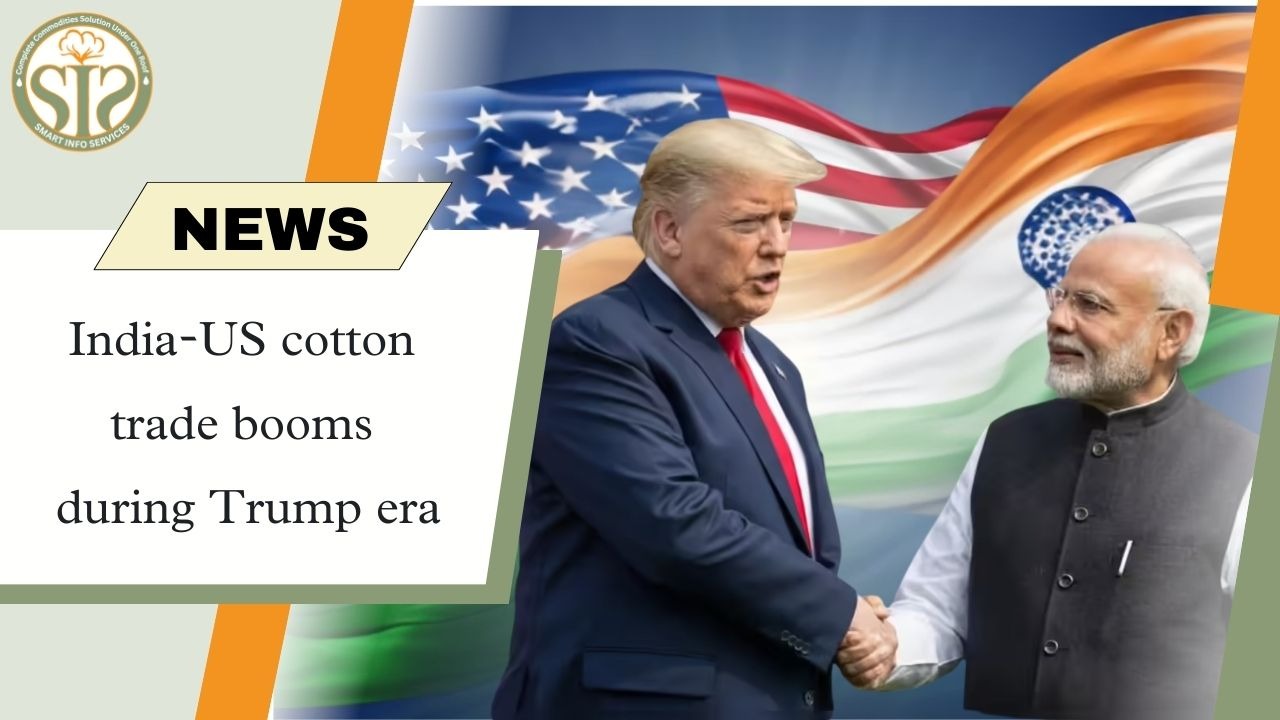
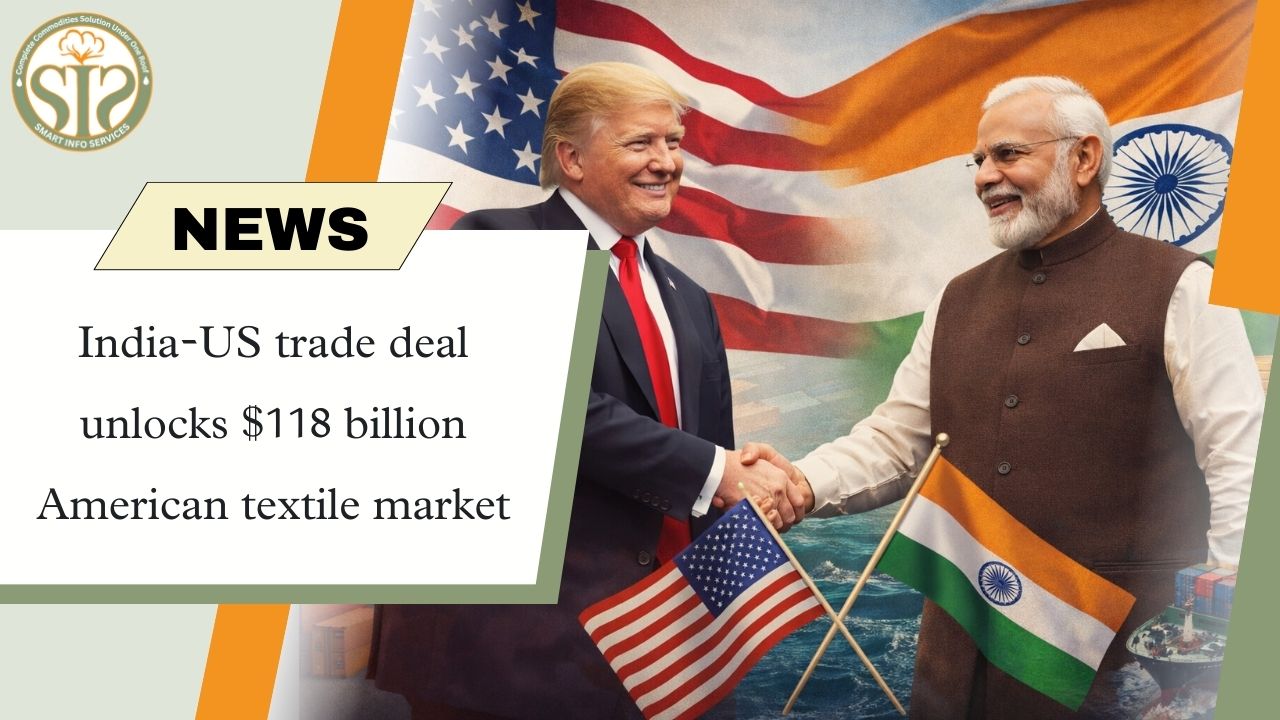
Start Your 7 Days Free Trial TodayIndian Yarn & Textile Exports at Risk from Asian RivalsVietnam is facing 46 per cent reciprocal tariffs, Bangladesh 37 per cent, and Cambodia 49 per cent, though they have received a breather for 90 days with a basic tariff of 10 per cent.Chennai : Bangladesh, Vietnam and Cambodia are in the process of either removing fully or charging minimal tariffs on US imports as part of their trade negotiations. This will make not just Indian textile and apparel exports to the US less competitive but shrink our cotton and yarn exports to these countries as well. Vietnam is facing 46 per cent reciprocal tariffs, Bangladesh 37 per cent, and Cambodia 49 per cent, though they have received a breather for 90 days with a basic tariff of 10 per cent.In order to offset the impact, Bangladesh has offered to increase US agricultural imports, including cotton. Similarly, Cambodia has announced a reduction in tariffs on 19 US product categories from the maximum 35 per cent to an applied 5-per cent rate. Vietnam too is ready to drop its duties on US imports. This will see the US exporting more cotton to these countries. The US is the third largest producer of cotton after China and India. According to Chandrima Chatterjee, secretary general of Confederation of Indian Textile Industry, import parity pricing of US cotton will be lower compared to India as India. In the recent past, Indian cotton has remained pricier compared to international cotton. Further, these countries will be under pressure to import more cotton from the US to ward off tariffs.India exports over $2 billion cotton and yarn to Bangladesh and a considerable portion of this is facing potential trade displacement. Similarly, the export of cotton and yarn to Vietnam and Cambodia also are sizeable. Further, in the absence of reciprocal tariffs, exports of apparels from these countries will become more competitive compared to Indian exports. Shrinkage of cotton and yarn exports along with apparels and textiles will be a double whammy for India. In 2024, India exported textile products worth $10.5 bn to the US. This mainly includes, apparels, home textiles and other textile products. India also imports cotton from the US and of the imports, Extra Long Staple cotton is not produced in India in sufficient quantities. The textile industry hopes that the Indian government too will negotiate with the US for a better deal.read more :-'There will be transition cost': Donald Trump holds ground on tariffs as US markets falter
The Indian rupee ended 20 paisa up on Friday at 86.05 to the dollar, while it opened at 86.25.At close, the Sensex was up 1,310.11 points or 1.77 percent at 75,157.26, and the Nifty was up 429.40 points or 1.92 percent at 22,828.55. About 3006 shares advanced, 807 shares declined, and 110 shares unchanged.Read More :-There will be transition cost': Donald Trump holds ground on tariffs as US markets falter
Trump Defends Tariffs Despite Market SlidePresident Donald Trump speaks at a cabinet meeting in the Cabinet Room of the White House, Thursday, April 10, 2025, in Washington. (AP)US President Donald Trump on Thursday said that his tariff policy would come with a "transition cost," as markets dropped again due to ongoing uncertainty around the trade conflict."There will be a transition cost, and transition problems, but in the end, it's going to be a beautiful thing," Trump said. The US president is aiming to change the global economy by encouraging manufacturers to operate from the United States.His comment came shortly after the White House said that tariffs on China would rise to 145 per cent on some products. This includes a previous 20 per cent tariff on those making the drug fentanyl.Despite the tensions, Trump said he still hopes to make an agreement with China. "I think we'll end up working something out that's very good for both countries. I look forward to it," he said.Markets continued to show signs of trouble on Friday, after Trump’s earlier announcement of a 10 per cent tariff on all countries except China.On Wednesday afternoon, Trump said that for 90 days, the US would apply a flat 10 per cent tariff on all countries except China, instead of setting different "reciprocal" tariffs for each country.Trump also paused a plan to impose tariffs as high as 50 per cent on countries he described as the "worst offenders." However, the trade dispute with China remains.Meanwhile, China has increased its retaliatory tariffs on American goods to 84 per cent .In a televised cabinet meeting, Trump said, "There would always be transition difficulty," but added that "it was the biggest day in history in markets."He said investors were pleased with how the US was managing its trade policy and that the country was "trying to get the world to treat us fairly."He also said, "everybody wants to come and make a deal" to lower tariffs.US commerce secretary Howard Lutnick, who was also at the meeting, said several countries were entering talks and bringing "offers they never would have" if not for Trump’s trade actions."We're getting the respect we deserve now," Lutnick said. "I think you're going to see historic deals one after the other."Moreover, Trump also said the US would "love to be able to work a deal (with China)" and added that he had "great respect for President Xi." He also said he thought they would "end up working something out that's very good for both countries."He repeated his claim that China had "taken advantage" and "ripped off" the US "more than anybody" for a long time.Meanwhile, China announced that it would reduce the number of American-made films in its cinemas. It also said that the trade dispute had lowered interest in Hollywood movies among Chinese audiences.Currently, China allows up to 34 US films each year. Local movies are becoming more popular.The European Union said it would pause its planned countermeasures against the US for 90 days. These were scheduled to start on April 15.On Wednesday, 26 out of 27 EU countries — all except Hungary — voted to apply tariffs in response to the US 20 per cent tariff.European Commission President Ursula von der Leyen said in a statement that the EU wanted "to give negotiations a chance."read more :-Rupee opens 44 paise higher at 86.25 against dollar
In relation to the US dollar, the rupee opens 44 paise higher at 86.25.The rupee opened at 86.25 against the US dollar after closing the previous session at 86.69.The rupee opened 44 paise up on April 11 against the US dollar following a selloff in the American market over the worsening tariff war with China amid a 90-day pause on reciprocal tariffs with other countries.read more :-India Ends Trans-Shipment Facility For Bangladesh To Export Goods To Other Countries
India Ends Bangladesh's Trans-Shipment Export RouteNew Delhi:The government has terminated the trans-shipment facility that allowed export cargo from Bangladesh to third countries using Indian land customs stations en route to ports and airports, according to a government circular.Indian exporters, mainly from the apparel sector, had asked the government to withdraw this facility to the neighbouring country.The facility enabled smooth trade flows for Bangladesh's exports to countries like Bhutan, Nepal, and Myanmar. It was provided by India to Bangladesh in June 2020."It has been decided to rescind... circular... dated June 29, 2020, as amended with immediate effect. Cargo already entered into India may be allowed to exit the Indian territory as per the procedure given in that circular," the Central Board of Indirect Taxes and Customs' circular, dated April 8, said.According to trade experts, the decision will help many Indian exporting sectors like apparel, footwear, and gems and jewellery.Bangladesh is a big competitor of India in the textile sector."Now we will have more air capacity for our cargo. In the past, exporters have complained about lesser space due to the transhipment facility given to Bangladesh," Federation of Indian Export Organisations (FIEO) Director General Ajay Sahai said.Apparel exporters' body AEPC had asked the government to suspend this order, which allowed trans-shipment of Bangladesh export cargo to third countries through the Delhi air cargo complex.AEPC chairman Sudhir Sekhri said 20-30 loaded trucks arrive in Delhi every day, which slows down the smooth movement of cargo, and airlines are taking undue advantage of this. This leads to an excessive increase in air freight rates, delay in handling and processing of export cargo, and severe congestion at the cargo terminal at Indira Gandhi International Airport in Delhi, resulting in exports of Indian apparel through the Delhi air cargo complex becoming uncompetitive."This will help in rationalization of freight rates resulting in less transportation cost to the Indian exporters besides decongesting the airports leading to the shorter transit time to ship the goods," AEPC secretary general Mithileshwar Thakur said.Think tank Global Trade Research Initiative (GTRI) founder Ajay Srivastava said the withdrawal of this facility is expected to disrupt Bangladesh's export and import logistics, which depend on Indian infrastructure for third-country trade."The previous mechanism offered a streamlined route through India, cutting transit time and cost. Now, without it, Bangladeshi exporters may face logistical delays, higher costs, and uncertainty. Additionally, Nepal and Bhutan, both landlocked nations, may raise concerns about restricted transit access to Bangladesh, especially as this move will hamper their trade with Bangladesh," Mr Srivastava said.He said Bangladesh's plans for creating a strategic base near the Chicken's Neck area with China's help may have prompted this action.India has always supported Bangladesh's cause, as it allowed one-way zero tariff access to Bangladesh goods (all except alcohol and cigarettes) to the vast Indian market for the last two decades.However, India-Bangladesh relations nosedived dramatically after the interim government headed by Muhammad Yunus failed to contain attacks on minorities, especially Hindus, in that country.read more :-White House Warns After Trump's 125% Tariffs On China
White House Responds to Trump’s 125% Tariffs on ChinaWashington:In a stunning turn of events, US President Donald Trump on Wednesday reversed his sweeping tariffs on most nations for at least 90 days. However, he ramped up pressure on China, on which the pause does not apply, further escalating a high-stakes confrontation between the world's two largest economies. Instead, Trump slapped a punishing 125 per cent tax on all Chinese goods, while China announced new tariffs of 84 per cent on all US imports, further escalating a high-stakes confrontation between the two largest economies of the world, and fuelling fresh market volatility. The two countries have traded tit-for-tat tariff hikes repeatedly over the past week. After making an example out of China, the White House sent a stark warning to trading partners-- "DO NOT RETALIATE AND YOU WILL BE REWARDED."Meanwhile, China refused to back down against America's aggression, and its 84 per cent tariffs on US imports came into effect at 12.01 pm on Thursday, according to the Chinese state news agency, Xinhua.Before levies came into force, Beijing's Commerce Minister had said the ‘reciprocal tariffs' by the US are “a serious infringement of the legitimate interests of all countries”.Per a Xinhua report, an official from the Ministry earlier said that no one would win in a trade war."I want to emphasize that there is no winner in a trade war, and that China does not want a trade war. But the Chinese government will by no means sit by when the legitimate rights and interests of its people are being hurt and deprived,” the official said on Wednesday.Trump's U TurnTrump's turnabout, which came less than 24 hours after steep new tariffs kicked in on most trading partners, followed the most intense episode of financial market volatility since the early days of the COVID-19 pandemic. The upheaval erased trillions of dollars from stock markets and led to an unsettling surge in U.S. government bond yields that appeared to catch Trump's attention."I thought that people were jumping a little bit out of line, they were getting yippy, you know," the American President told reporters after the announcement, referring to a golf term. Since returning to the White House in January, the Republican billionaire has repeatedly threatened an array of punitive measures on trading partners, only to revoke some of them at the last minute. The on-again, off-again approach has baffled world leaders and spooked business executives. Trump told reporters that he had been considering a pause for several days. On Monday, the White House denounced a report that the administration was considering such a move, calling it "fake news."Furthermore, the reversal of the country-specific tariffs is not absolute. A 10 per cent blanket duty on almost all US imports will remain in effect, the White House said. The announcement also does not appear to affect duties on autos, steel and aluminum that are already in place.The 90-day freeze also does not apply to duties paid by Canada and Mexico, because their goods are still subject to 25 per cent fentanyl-related tariffs if they do not comply with the US-Mexico-Canada trade agreement's rules of origin. Those duties remain in place for the moment, with an indefinite exemption for USMCA-compliant goods."Be Flexible'The day's events cast into stark relief the uncertainty surrounding Trump's policies and how he and his team create and implement them.US Treasury Secretary Scott Bessent asserted that the pullback had been the plan all along to bring countries to the bargaining table. Trump, though, later indicated that the near-panic in markets that had unfolded since his April 2 announcements had factored in to his thinking. Despite insisting for days that his policies would never change, he told reporters on Wednesday: "You have to be flexible."'China Unlikely To Change Strategy'Experts believe that while Trump's new strategy will come as a relief to many nations, Beijing is unlikely to change its strategy and back down. "China is unlikely to change its strategy: stand firm, absorb pressure, and let Trump overplay his hand. Beijing believes Trump sees concessions as a weakness, so giving ground only invites more pressure," Daniel Russel, vice president of international security and diplomacy at the Asia Society Policy Institute, told Reuters."Other countries will welcome the 90-day stay of execution — if it lasts — but the whiplash from constant zigzags creates more of the uncertainty that businesses and governments hate," he addedMeanwhile, Trump indicated a resolution with China was possible as well. But officials have said they will prioritize talks with other countries. "China wants to make a deal," Trump said. "They just don't know how quite to go about it."read more :-China Hikes Tariffs to 84%, Wall Street Futures Drop 2%
China raises tariffs on US imports to 84%, Wall Street Futures plunge nearly 2%China has again retaliated to US tariffs, and has increased its tariffs on imported American goods to 84 percent, effective April 10. China had earlier imposed 34 percent tariff on US imports.China added 12 US entities to export control list, and six firms to its unreliable list. Consequently, Wall Street Futures were trading sharply lower, with Dow Futures trading 1.7 percent lower, S&P 500 Futures trading 1.5 percent lower and Nasdaq Futures dropping 1.3 percent lower.European indices were lower between 3-4%. Tracking the sentiment, Nymex crude futures fell by more than 5-6% to slip to $56 per barrel. Earlier in the day, China's PBoC relaxed its control over offshore yuan, sending it down to record low against the dollar.US President Donald Trump had imposed a slew of reciprocal tariffs on a number of nations on April 2, with China being charged 34 percent. Beijing promptly hit back, imposing 34 percent tariff on US imports.The trade war intensified after Trump further hiked the tariff on Chinese imports to 104 percent. China has now again retaliated, hiking its tariffs on American imports to 84 percent.read more :-CCI Ltd Cotton Purchases - 2024/25 (Up to March 31)
DETAILS OF COTTON PURCHASES MADE BY M/S CCI LTD DURING SEASON 2024/25 (UPTO 31ST MARCH) AT A GLANCE1. Under msp purview m/s cci ltd. purchased total one crore bales cotton equivalent to 525 lakhs quintals of kapas.2. This quantum comes around 38% of total arrival of 263 lakh upto 31st march of & 34% of expected 294.25 lakh bales during whole sesson.3. Value wise an amount of rs.37450 crores dispersed amongst 21 lakhs farmers throughout the country towards kapas purchased.4. Total 508 procurement centers were established in various states to facilitate the purchase.5. Tamilnadu state stood on top giving a highest sale of 40 lakh bales to cci.read more :-Indian Rupee lower 24 Paisa, Ends at 86.69 per Dollar
Rupee lower by 24 Paisa, Ends at 86.69 per DollarThe Indian rupee on wednesday lower 24 paise to close at 86.69 per dollar, while it opened at 86.45in the morning.At close, the Sensex was up 592.93 points or 0.78 percent at 76,617.44, and the Nifty was up 166.65 points or 0.72 percent at 23,332.35. About 2755 shares advanced, 1049 shares declined, and 130 shares unchanged.
Telangana Tops National Cotton Procurement, Reports CentreHyderabad :Telangana has emerged as the top state in cotton procurement for 2024-25, according to data released by the Centre on Tuesday. The Union ministry of textiles, through its nodal agency the Cotton Corporation of India Ltd. (CCI), said that it had procured one crore bales of cotton, which is equivalent to 525 lakh quintals, under the Minimum Support Price (MSP) operations by March 31, 2025. This procurement accounts for 38 per cent of the total cotton arrivals (263 lakh bales) and 34 per cent of the estimated total cotton production (294.25 lakh bales) in the country, marking a significant effort to stabilise cotton prices and support farmers.Telangana led the country with the procurement of 40 lakh bales, followed by Maharashtra with 30 lakh bales and Gujarat with 14 lakh bales. Other states that saw substantial procurement include Karnataka (5 lakh bales), Madhya Pradesh (4 lakh bales), Andhra Pradesh (4 lakh bales), and Odisha (2 lakh bales). Northern states such as Haryana, Rajasthan, and Punjab together contributed 1.15 lakh bales to the total.In all, the CCI has disbursed `37,450 crore to approximately 21 lakh cotton farmers across all major cotton-producing states. In a media statement, the textiles ministry said, "This large-scale procurement reaffirms the government’s commitment to protecting farmers from market volatility through the MSP mechanism." To ensure smooth and transparent operations, the CCI established 508 procurement centres across the country. Technological innovations have also enhanced the procurement process such as farmers now benefit from on-the-spot Aadhaar authentication, real-time SMS payment alerts, and 100 per cent direct benefit transfers via the National Automated Clearing House (NACH). The "Cott-Ally" mobile app, launched in nine regional languages, allows farmers to track MSP rates, locate procurement centres, and monitor payment status. Additionally, all CCI-produced cotton bales are now traceable through QR codes enabled by blockchain technology, ensuring transparency and accountability throughout the supply chain.read more :-Rupee opens 21 paise down at 86.45 against dollar
In relation to the US dollar, the rupee opens 21 paise lower at 86.45.Indian rupee opened 21 paise lower at 86.45 per dollar on wednesday versus tuesday 's close of 86.24.read more :-Rupee lower 36 Paisa Against Dollar, Closes at 86.24
Indian Rupee lower 36 Paisa, Ends at 86.24 per DollarThe Indian rupee on tuesday lower 36 paise to close at 86.24 per dollar, while it opened at 85.88 in the morning.At close, the Sensex was up 1,089.18 points or 1.49 percent at 74,227.08, and the Nifty was up 374.25 points or 1.69 percent at 22,535.85. About 2968 shares advanced, 843 shares declined, and 115 shares unchanged.read more :- Cotton Crisis: The Dark Story of White Gold
Cotton Crisis: The Dark Truth Behind White GoldIndian Agriculture Crisis: Cotton is a major cash crop in India and is popular in the country. Cotton is also called white gold. Cotton is cultivated mainly in the states of Maharashtra, Gujarat, Telangana, Andhra Pradesh, Karnataka, Tamil Nadu, Punjab and Haryana. This crop is important for farmers as well as industry. The country's largest agro-based industry, yarn and textile production, is based on cotton. The livelihood of millions of people depends on this industry. As the area under cotton crops has decreased by more than 2 million hectares in the last five years, it is a matter of concern for farmers, research institutes, government and industry. The main reason for the reduction in area is loss-making cotton cultivation.Cotton cultivation has been running at a loss for the last several years due to low productivity, rising production costs and low prices. It would not be an exaggeration to say that this crop has lagged behind in terms of mechanization. Therefore, all the work from planting cotton to harvesting has to be done by laborers. There is a huge shortage of workers in the state and cotton growers are worried because they are not getting any workers despite paying high wages for picking cotton. In such a situation, the question arises that why should cotton be cultivated?This is also the result of the government's misguided policy from input to export in the last two and a half to three decades. The policy of the central government is that if cotton, oilseeds and pulses are produced in the country, then they should be imported as per the requirement. When the prices of cotton start increasing, the industrial sector also gives priority to import. But fulfilling the requirement by import has never been a good option, especially in today's changing global situation.The newly appointed director of CICR claimed that efforts will be made to provide advanced hybrid varieties at the departmental level to increase the productivity of cotton and cooperation will be taken from organizations across the country to control the pink caterpillar. He will definitely make efforts in this direction, but he will also have to find an answer to who stopped this organization from doing so in the last two and a half decades. CICR has repeatedly announced that it will identify the reasons for low productivity and develop action plans to increase productivity. But they have not been successful so far. The central and state governments have also failed repeatedly in this. There is also turmoil in the matter of cotton picking machines in the country.If cotton productivity is to be increased in the country and this crop has to become profitable for the producers, then extensive research has to be done on its varieties. Producers should get BT cotton directly. Adoption of advanced farming techniques in cotton cultivation has to be increased. Cotton cultivation has to be brought under irrigation. Producers have to effectively control pink caterpillar. All operations from planting of cotton to harvesting should be mechanized.Intensive cultivation of indigenous varieties of long-term crops has been found to increase productivity. In such a situation, intensive cultivation of indigenous varieties will have to be increased to 20 percent. Cotton prices in the country should be determined on the basis of the percentage of cotton present in it. The entire process of 'cotton to cloth' should take place in the same area where cotton is grown. Producers should have a share in the value addition of cotton. Such measures will make cotton cultivation more cost-effective and contribute to the development of the sector.read more :- Season-wise Statement of Total Domestic Cotton Production and Procurement by CCI Under MSP Provisions Over the Last Six Years
Domestic Cotton Output Falls, CCI Revives MSP Procurement in 2024-25 SeasonAfter a prolonged lull, the Cotton Corporation of India (CCI) has made a strong comeback in procuring cotton under the Minimum Support Price (MSP) mechanism in the 2024-25 season.As per official estimates, domestic cotton production is expected to decline to 294.25 lakh bales (170 kg each), compared to 325.22 lakh bales in the previous 2023-24 season. Despite the drop in output, CCI has procured 99.93 lakh bales as of March 28, 2025, reflecting a significant rise in procurement activity, with the share reaching 33.96%.This marks a notable shift after two consecutive seasons (2021-22 and 2022-23) when no MSP procurement was carried out, even though production remained relatively high at 311.17 lakh and 336.60 lakh bales, respectively.The last major procurement drive was seen in the 2020-21 season, when CCI purchased 99.33 lakh bales out of a total production of 352.48 lakh bales, accounting for 28.18% procurement. In 2019-20, CCI had procured 124.61 lakh bales, which was 19.62% of the total output of 365 lakh bales.With nearly 100 lakh bales procured so far, the 2024-25 season records the second-highest procurement in the last six years. This reflects CCI’s proactive approach to stabilise market prices and provide support to farmers amid declining production.Market experts believe that increased MSP procurement by CCI could help balance supply-demand dynamics and ensure better price realisation for cotton growers.Read More :- Rupee Opens 4 Paise Lower at 85.88 Against Dollar
Indian rupee opens 4 paise lower at 85.88 against US dollarThe Indian rupee opened 4 paise lower on April 8 at 85.88 against the US dollar, as compared to 85.84 against the greenback in the previous trading session.read more :-AUSTRALIAN COTTON SHIPPERS ASSOCIATION (ACSA) Delegation Visits CAI Headquarters
ACSA Delegation Visits CAI HQKey Insights from the Seminar :1. Annual Production: Australia produces approximately 5 million bales of cotton annually.2. Farming Community: The industry comprises around 1,500 cotton farmers.3. Landholding Size: Each farmer holds an average of 577 hectares.4. High Yield: Australian cotton achieves an average yield of 2,400 kg per hectare.5. Outturn: The kapas outturn ranges from 42% to 44%.6. Seed Size: Australian cotton seeds are smaller in size.7. Seed Distribution: Seeds are distributed by the government.8. Seed Provider: Only one company’s seeds are approved and used by farmers.9. Ginning Practice: Farmers do not sell kapas directly. Instead, they have it ginned at private ginning units by paying ginning and pressing charges, after which they sell the cotton lint and seed separately.10. Cotton Cake Usage: Primarily used in cattle farms and also exported to China.11. Primary Growing Region: Cotton in Australia is predominantly grown in Queensland.12. Fibre Quality : Staple Length: Averages 29 mm, ranging from 28.5 to 31 mm. Micronaire: Falls between 4.0 to 4.9.13. Yield Trade-off: Growing cotton with longer fibre and lower micronaire significantly reduces yield.read more :-Indian Rupee lower 10 Paisa, Ends at 85.84 per Dollar
| title | Created At | Action |
|---|---|---|
| Free US imports by Asian peers will hit Indian cotton, yarn, textiles and apparel exports | 12-04-2025 18:04:58 | view |
| Indian rupee ended higher at 86.05 per dollar on Friday | 11-04-2025 23:00:37 | view |
| 'There will be transition cost': Donald Trump holds ground on tariffs as US markets falter | 11-04-2025 20:26:00 | view |
| Rupee opens 44 paise higher at 86.25 against dollar | 11-04-2025 17:29:53 | view |
| India Ends Trans-Shipment Facility For Bangladesh To Export Goods To Other Countries | 10-04-2025 18:27:59 | view |
| White House Warns After Trump's 125% Tariffs On China | 10-04-2025 17:53:03 | view |
| China Hikes Tariffs to 84%, Wall Street Futures Drop 2% | 10-04-2025 00:56:37 | view |
| CCI Ltd Cotton Purchases - 2024/25 (Up to March 31) | 10-04-2025 00:01:17 | view |
| Indian Rupee lower 24 Paisa, Ends at 86.69 per Dollar | 09-04-2025 22:47:45 | view |
| Telangana tops in cotton procurement, says Centre | 09-04-2025 18:20:01 | view |
| Rupee opens 21 paise down at 86.45 against dollar | 09-04-2025 17:41:23 | view |
| Rupee lower 36 Paisa Against Dollar, Closes at 86.24 | 08-04-2025 22:49:51 | view |
| Cotton Crisis: The Dark Story of White Gold | 08-04-2025 18:48:29 | view |
| CCI Steps Up MSP Procurement as Cotton Output Declines in 2024-25 | 08-04-2025 18:21:53 | view |
| Rupee Opens 4 Paise Lower at 85.88 Against Dollar | 08-04-2025 17:11:31 | view |
| AUSTRALIAN COTTON SHIPPERS ASSOCIATION (ACSA) Delegation Visits CAI Headquarters | 08-04-2025 00:46:40 | view |