Filter

Recent News

Cotton yarn and product exports drive record cotton consumption in Vietnam

Cotton yarn and product exports drive record cotton consumption in VietnamRobust growth in Vietnam’s cotton yarn and product exports is projected to drive 2020-2021 cotton consumption to a record 7.3 million bales, 700,000 higher than the previous year’s downfall from COVID-19, according to the weekly report by the US Department of Agriculture (USDA).Yarn exports during 2020-2021 have exceeded the previous year’s record by more than 10 per cent through the first 11 months of the marketing year. Foreign demand has been primarily driven by China, with Vietnam’s cotton yarn exports to the country accounting for roughly 60 per cent of Vietnam’s total cotton lint consumption.China is the world’s largest cotton yarn importer and Vietnam’s largest customer with the geographic proximity and foreign investment by Chinese companies driving record exports. China’s August to June imports of Vietnamese cotton yarn were a record (for the period) and equal to roughly four million bales of cotton lint consumption.China’s robust demand is expected to persist with projected growth in China’s cotton fabric and product exports, in addition to greater domestic consumption of cotton products. The United States WRO (Withhold Release Order) on cotton lint from China’s Xinjiang region is further supporting current and future demand for Vietnam’s cotton yarn.Practically all cotton yarn spun in Vietnam is produced with cotton lint imported from outside of China. Garment and textile manufacturers in China seeking to circumvent the WRO are likely substituting imported cotton yarn for domestic with roughly two-thirds containing Xinjiang lint.Greater domestic consumption in Vietnam of cotton yarn is also driving cotton consumption higher. Significant foreign and domestic investment in Vietnam’s garment industry has driven greater demand for cotton knitted fabrics and thus domestic consumption of cotton yarn by knitters. According to Vietnam customs data, garment and textile exports in 2020-2021 are expected to recover from the previous year’s decline and rise to more than $30 billion; the garment industry is one of the country’s largest valued source for exports.Vietnam’s largest export market for cotton textiles and garments is the United States, which is also the world’s largest importer. US imports from Vietnam were a record in the first 11 months at more than $5 billion. Knitted cotton sweaters, pullovers, and other similar articles of clothing were the largest product category, accounting for roughly 30 per cent of the total value of US cotton product imports from Vietnam.This particular category has historically been dominated by China, however, two factors have driven Vietnam’s market share of US imports higher – the 2020 and 2021 WROs and ongoing tariffs specific to China. Both have lowered US imports of knitted cotton sweaters, pullovers, among others from China nearly 20 per cent thus far in 2020-2021 (August-June) despite US imports of this product category rising over 10 per cent on-year during the same period.Robust export prospects for both cotton yarn and products are expected to boost 2021-2022 cotton consumption even higher to 7.6 million bales, and further support Vietnam’s rise as a major global cotton importer as well as exporter and consumer of cotton yarn and products.

As cotton prices rule firm, CCI sees little scope for market intervention

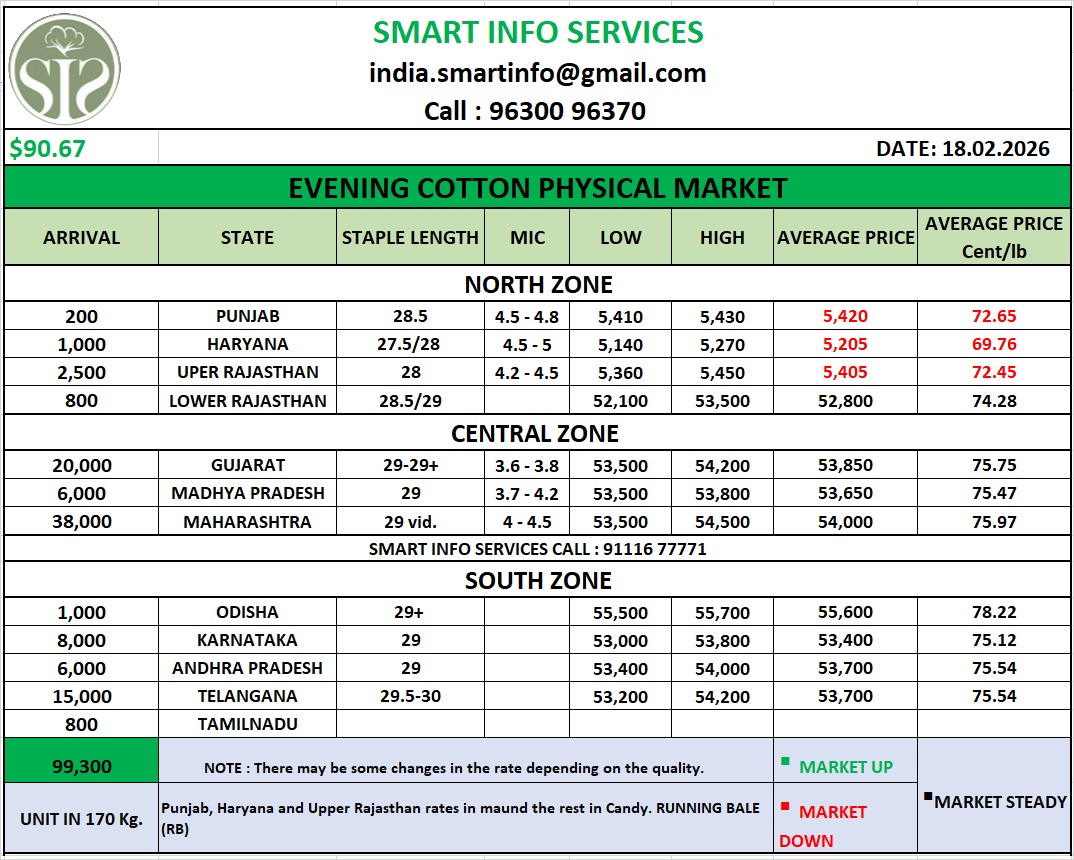
As cotton prices rule firm, CCI sees little scope for market interventionBut the state-run firm will be fully prepared for MSP operationsAs cotton prices continue to rule high, state-run Cotton Corporation of India Ltd (CCI) sees no scope for market intervention in the new season starting October. CCI, which made a record purchase of cotton at the minimum support price (MSP) during the 2020-21 season, expects its carry forward stocks for the next year to be in the range of 2-3 lakh bales.Ahead of the cotton harvest season starting mid-September, the raw cotton (kapas) prices are currently ruling high at over ₹7,000 per quintal. Also, cottonseed prices are hovering around ₹4,500-5,000 per quintal.“Everything is in a booming mode, and I think the CCI’s intervention may not be required as farmers are already getting 30 per cent more than the MSP rates. Next year, they may be fully satisfied with the market forces,” P K Agarwal, chairman and managing director, the CCI told Business Line.“However, as per our duty, CCI would be fully preparing for the MSP operations,” Agarwal said, adding that the intensity will certainly be lower. “In case our intervention is required, may be in the interior or far-flung places, where the competition is not there, we may have to help the farmers in those areas. In case MSP is not there, we may think of commercial operations,” Agarwal said.Further, Agarwal believes that the current high prices will not sustain for a longer period. “In every commodity, when the peak arrivals are there, the prices are bound to come down. It may come down by ₹500-700 but still be better than MSP,” he added.ProcurementCCI had purchased 92 lakh bales at MSP during the pandemic hit 2020-21 season, when there were no takers in the market, Agarwal said. “Farmers were protected through the MSP operations as they got an assured price,” he said. The opening stocks during October 2020 stood at 60 lakh bales. The Centre has fixed an MSP for medium staple cotton at ₹5,716 per quintal for 2021-22 season higher than the previous year’s ₹5515 per quintal. For the long-staple cotton, the MSP for 2021-22 has been fixed at ₹6025 per quintal over ₹5825.In 2021, CCI disposed of a record 140 lakh bales on good demand from the mills. It also exported about 1 lakh bales during 2020-21. “It was more than a good year. Because of the booming market and price improvement, the MSP losses have also come down substantially to around ₹17,000 crore” Agarwal said.The 2020-21 season started with around ₹40,000 per bale in October, higher than the corresponding previous year’s ₹36,000. “Now, the cotton prices are ruling between ₹53,000-55,000 range on good demand in the market as the mills have started operations, and their requirement has improved,” Agarwal said. Also, most mills have built up inventory and have covered stocks to meet their requirement for the next 2-3 months.InventoriesFurther, Agarwal said that CCI currently has stocks of around 8 lakh bales. “We wish to keep these stocks till September end to avoid any starvation like situation. We are selling about 1,000-2,000 bales daily and by mid-October we may be finishing our stocks,” he added. Agarwal expects CCI’s carry forward stocks for the next season to range between 2-3 lakh bales. The overall carry forward stocks for the country is expected to be 60-70 lakh bales.“The situation is very comfortable because, in the past there had been no occasion when the carry forward stocks were more than 40 lakh bales. This is because of the pandemic situation, India may end up with 60-70 lakh bales, which is almost two-month requirement. The position is not as worse as people are visualising it,” he added. By September end, the new crop will hit the market in North India, he said.

Palm oil falls over 2% on expectations of weak export demand

Palm oil falls over 2% on expectations of weak export demandMalaysian palm oil futures slumped as much as 2.8% on Wednesday, hitting a one-week low, amid anticipation of an increase in production and bleak demand outlook.The benchmark palm oil contract for November delivery on the Bursa Malaysia Derivatives Exchange slid 77 ringgit, or 1.75%, to 4,331 ringgit ($1,023.27) a tonne by the midday break, after rallying to a record high last week.The correction in prices was likely induced by expectations demand will fall by about 15% over August 1-20, said Marcello Cultrera, institutional sales manager and broker at Phillip Futures in Kuala Lumpur.Palm falls on August export plunge, profit-taking"Also, the Indian demand for August is fully covered while subscriptions for September-October have reached a standstill at current prices," he added.Export shipments during the first half of August had plunged between 15% and 24% from the previous month, cargo surveyors data showed on Monday.Indonesia, the world's largest palm exporter, had enjoyed greater demand than Malaysia over July and August, partly due to lower export taxes and higher discounts for its crude and refined palm oil.Cultrera said things will change in September as Indonesia is expected to raise its export duties for September to $166 from $93 in August.Top buyer India is also expected to raise their import tax structure for crude and refined palm oil from end-September as subscriptions for the Diwali festival are finalised, Cultrera added.Malaysia kept its September export tax for crude palm oil at 8%, but raised its reference price to 4,255.52 ringgit ($1,006.51) per tonne. The market is also hopeful for a rise in Malaysia's palm oil production amid the seasonal peak production season.The Southern Peninsula Palm Oil Millers' Association earlier this week forecast a 10.6% rise in August 1-15 production, according to traders.Dalian's most-active soyoil contract fell 2%, while its palm oil contract eased 3.8%. Soyoil prices on the Chicago Board of Trade were down 0.5%.Palm oil is affected by price movements in related oils as they compete for a share in the global vegetable oils market.  

Palm oil falls

Palm oil fallsMalaysian palm oil futures reversed early gains on Tuesday as profit-taking and a sharp decline in August exports pulled down prices from record highs scaled last week.The benchmark palm oil contract for November delivery on the Bursa Malaysia Derivatives Exchange closed down 84 ringgit, or 1.9%, at 4,363 ringgit ($1,029.98) a tonne, after rising 1.9% in intraday trade.Prices rose earlier on short-covering due to persistent talks of production losses in both Malaysia and Indonesia, and expectations of lower palm oil carryover stocks for the new season, said Anilkumar Bagani, research head of Mumbai-based vegetable oils broker Sunvin Group.Anticipation of Indonesia's crude palm oil (CPO) export duties for September rising to $166 per tonne from $93 in August also supported prices as it would benefit Malaysia's exports, Bagani said.Malaysia's palm oil exports during Aug. 1-15 fell between 15% and 24% from the same period in July, cargo surveyors said on Monday."Oil World is expecting crude palm oil prices to weaken by end-Dec 2021 and will continue to see more weakness in 1H22 with the assumption of no weather disruptions," UOB KayHian said in a note.Oil World Executive Director Thomas Mielke forecast Indonesia's free-on-board (FOB) CPO prices to fall to $1,000 a tonne by end-December, and range between $800 and $850 during the first half of next year, UOB said.This is due to expectations of stronger global edible oil supplies in 2021/22 after record high prices last year boosted plantings, and demand rationing due to high prices, UOB said.Mielke pegged world palm oil production to rise by 2.1 million tonnes in 2020/21, and by 3.8 million tonnes next season, but low opening stocks will offset production growth, according to UOB.Dalian's most-active soyoil contract gained 0.6%, while its palm oil contract rose 0.5%. Soyoil prices on the Chicago Board of Trade fell 0.6%.Palm oil is affected by price movements in related oils as they compete for a share in the global vegetable oils market.  

Soya firm as crop conditions in focus

Soya firm as crop conditions in focusChicago soybeans edged higher on Tuesday as lower-than-expected US crop ratings underscored mixed growing conditions, while the market awaited results from a Midwest field tour.The most-active  the Chicago Board of Trade was CBOT soybeans were up 0.3% at $13.72 a bushel.In a weekly report after Monday's market close, the US Department of Agriculture (USDA) rated 62% of US corn crop good to excellent, down 2 points from a week earlier, and soybeans 57% good to excellent, down 3 points. Traders on average had expected no change.The lower ratings tempered hopes for a boost to crops from rainfall forecast in the coming days."The market is considering downside but not any upside to yields," said Michael Magdovitz, commodity analyst with Rabobank. "The rains have come too little, too late."Initial results from this week's Pro Farmer Midwest Crop Tour projected lower corn yields and soybean pod counts than last year in South Dakota but higher levels in Ohio, supporting expectations of contrasting yields between western and eastern growing belts.Soybeans have also been supported by a run of sales to China.However, monthly US soybean crushing in July, according to National Oilseed Processors Association (NOPA) data released on Monday, was below trade estimates."Consumers are having to make pricing decisions at 50%-60% higher than last year. We're starting to see some demand rationing," Magdovitz said.  
Exporters to get new duty refund scheme this week

Exporters to get new duty refund scheme this weekThe government is set to notify the new duty refund scheme for exporters — Refund of Duties and Taxes on Exported Products (RoDTEP) — this week, with a final clearance from commerce and industry minister Piyush Goyal expected in a day or two.The scheme, meant to replace World Trade Organization (WTO) non-compliant incentives, was implemented in January but exporters have been waiting to get their dues for taxes paid by them for the last eight months. A notification will partially end the agonising wait, which has increased their fund requirement as the Centre has held back their claims.While commerce secretary B V R Subrahmanyam had said that the scheme will be implemented, some paperwork is yet to be completed after the commerce and finance ministries agreed to widen the scope of the scheme to cover all products, which also required higher budgetary allocation. The two ministries had earlier agreed to increase the allocation from the originally allocated Rs 13,000 crore to Rs 17,000 crore.Last week, the government had notified the Rebate of State and Central Taxes and Levies (RoSCTL) scheme, a similar mechanism, to allow textile exporters to get a rebate on central and state taxes till March 2024.According to industry estimates the government owes around Rs 8,000 crore to exporters in unpaid RoDTEP bills, with another Rs 3,500-4,000 crore arrears on account of RoSCTL. Further, around Rs 16,000 crore of payments from the now defunct Merchandise Exports from India Scheme (MEIS) are due for April-December 2020. So, exporters are demanding payments of close to Rs 28,000 crore just from these three schemes.Exporters have been complaining of the government sitting on tax refunds and arrears from earlier schemes such as Service Exports from India Scheme (SEIS) and MEIS that were abandoned after the US dragged India to the WTO, arguing that they were not compliant with global trade rules.Government sources said refunds could be handy at a time when costs such as those on fuel and freight have gone up due to global as well as domestic price dynamics.SiS Commited to update you on all textile related news real time.

Showing 4401 to 4411 of 4460 results
title Created At Action
Cotton yarn and product exports drive record cotton consumption in Vietnam 19-08-2021 00:41:14 view
As cotton prices rule firm, CCI sees little scope for market intervention 19-08-2021 00:33:06 view
Today evening, the rupee strengthened by 11 paise to close at Rs 74.24 against the dollar. 18-08-2021 23:13:43 view
Palm oil falls over 2% on expectations of weak export demand 18-08-2021 22:37:37 view
Palm oil may fall to 4,261 ringgit 18-08-2021 20:11:24 view
Rupee opens 5 paise stronger against dollar 18-08-2021 17:39:11 view
Oilseeds prices soften due to fall in foreign prices, fall in soybean, palmolein 18-08-2021 17:38:44 view
Palm oil falls 18-08-2021 17:38:11 view
Soya firm as crop conditions in focus 18-08-2021 17:37:00 view
Tanzania's cotton production & exports expected to rise 17-08-2021 23:44:34 view
Exporters to get new duty refund scheme this week 17-08-2021 00:40:52 view
Copyright© 2023 | Smart Info Service
Application Download