Recent News

Cotton sowing disrupted in Punjab due to two failed crop seasons

Cotton sowing disrupted in Punjab due to two failed crop seasonsTwo unsuccessful seasons in 2021 and 2022 have put cotton growers in jeopardy. Bad weather has also played its part, with cotton being sown on only 8% or about 20,000 hectares in South Malwa.As Punjab Agricultural University (PAU) advises, cotton sowing should be completed between April 15 and May 15 and with only 12 days left, farmers are racing against time to complete the sowing operations of the major kharif crop. Are.Agriculture experts and farmers said that after two consecutive crop failures, cotton growers are in a dilemma whether to invest in traditional cash crop cultivation or look for an alternative.Cotton-growing districts have recorded sowing in 20,000 hectares (50,000 acres) against a target of 3 lakh hectares for the 2023-24 kharif cycle, data collated by the state agriculture department on Wednesday said. Cotton was cultivated in about 2.47 lakh hectares in 2022-23.Considered to be the economic lifeline of the semi-arid districts of South Malwa region, the Punjab government also introduced a subsidy of 33 per cent on PAU approved seeds for the first time. Experts said that the main reason for crop failure in 2021 and 2022 season is due to use of rejected seeds by farmers and pest infestation.Dilbag Singh, Bathinda's chief agriculture officer, said the move was aimed at farmers buying only approved varieties.Statistics show that sowing has not picked up pace. Officials have cited poor weather conditions and delay in harvesting of wheat this year as the main reasons for delay in sowing of cotton crop.Fazilka has achieved maximum acreage with 8,000 hectares against this year's target of one lakh hectares.Chief Agriculture Officer (CAO) Jangir Singh expressed hope that sowing would pick up pace next week.“After the delay in harvesting wheat, farmers were busy clearing the fields for the next crop. With widespread rains in the region and forecast of rain for next 3-4 days, cotton growers are waiting for the weather to clear up to start sowing.In Bathinda, farmers have sown cotton on only 4,000 hectares, against the target of 80,000 hectares this year. In the last Kharif season, cotton was cultivated in about 70,000 hectares in the district.Sharanjit Singh, a resident of Maan Kheda village in Mansa, said farmers are in distress after two crops failed due to pest attacks in 2021 and 2022.“For the last several years, I was sowing cotton in 18 acres. But after suffering huge losses in the last two years, this time cotton has been sown in only 10 acres. I am planning to sow cereals like bajra or jowar on the rest of the land.Muktsar CAO Gurpreet Singh said the department expects the area under cotton to increase from 33,000 hectares to 50,000 hectares.“Farmers also suffered due to less availability of canal water in the last season. But this year, irrigation support is excellent and farmers will be encouraged to grow cotton again. Slow progress in sowing is due to unseasonal rains, but it will pick up soon.Low response to seed subsidyThe department's data shows that so far only 12,000 farmers have registered themselves to claim the 33% subsidy on seeds. The maximum 5,700 farmers are from Fazilka, followed by Bathinda (2,500), Mansa (2,400) and Muktsar (1,500). For the 2023 Kharif season, the central government has fixed the maximum retail price of Bt 2 cotton seeds at ₹853 per packet.Mansa's CAO Satpal Singh said that as per the state government's policy, each applicant can claim a subsidy of two packets per acre with an upper limit of 10 packets for 5 acres."A farmer will have to register on a web portal with the original bill and bank account details by May 15. Financial assistance will be credited to his account after physical verification of the fields," he added.Fazilka's Chief Agriculture Officer (CAO) Jangid Singh said, "Farmers are waiting for clear weather and this is also the reason for the slow registration to claim subsidy on seeds."GS Romana, PAU's principal agriculture economist, said farmers lack confidence after two bad seasons, but there is no option for them in this semi-arid region.


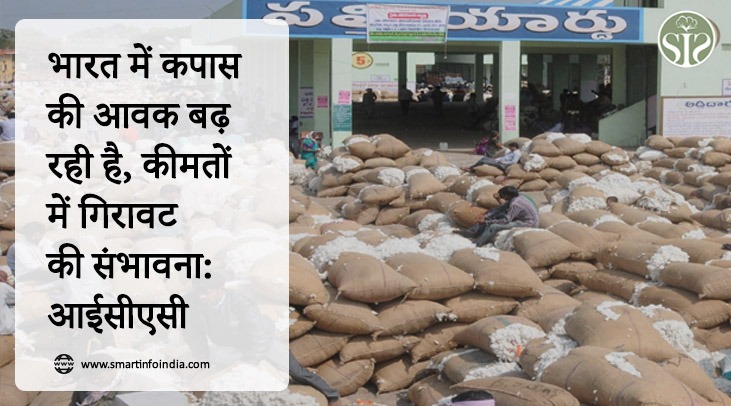
Cotton arrivals increasing in India, prices likely to fall: ICAC

Cotton arrivals increasing in India, prices likely to fall: ICACThe International Cotton Advisory Committee (ICAC) on Tuesday lowered its global price outlook for cotton in December 2022 compared to its projections.A month ago, ICAC data scientist Matthew Looney said Indian cotton supplies were well behind historical levels for that time of the season and suspected farmers were holding their cotton in the hope of better prices.Its effect was reflected in the prices of cotton in the domestic and international markets. The benchmark processed cotton of 29 mm length was trading at ₹68,500 per candy (of 356 kg) on December 2, 2022. However, as the arrivals started picking up, the prices started correcting and was last seen at ₹61,800 on Tuesday.ICE Cotton futures on December 2, 2022 quoted at 83.2 cents, while it is currently bidding at 81.34 cents.In its comments on whether Indian farmers have started offloading stocks, ICAC said, "Whether they have seen the recent slight stabilization in prices and decided to take advantage, or whether they want to sell cotton more The pace of cotton arrivals in India has picked up in the last month.Meanwhile, raw cotton continued to arrive in Gujarat markets. At the Rajkot APMC market in Saurashtra, arrivals were recorded at 110 tonnes, with prices ranging between ₹7,500-₹8,300 per quintal.👇🏻👇🏻👇🏻👇🏻https://smartinfoindia.com/hi/news-details-hindi/Volume-market-steady-cotton-amid-usman-naseem

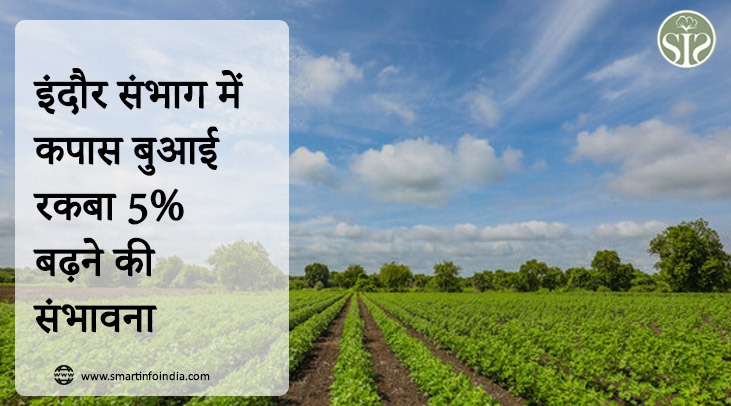
Cotton sowing area likely to increase by 5% in Indore division

Cotton sowing area likely to increase by 5% in Indore divisionThe area sown to cotton is expected to increase by about 5 per cent in Indore division this kharif season as farmers gear up in irrigated areas lured by better remuneration earned in the previous season.Cotton is a kharif or summer crop, sowing starts from mid-May in irrigated areas of Indore division while sowing starts in June in non-irrigated areas.Kailash Agarwal, a farmer and owner of a ginning unit in Khargone, said, “Farmers of Khargone, Barwani and Khandwa have started preparations for early sowing of cotton. The area under cotton cultivation is expected to increase this Kharif season as farmers have received good prices for their produce.According to farmers, traders and experts, the average sowing area under cotton in Indore division is over 5 lakh hectares, which is expected to increase by about 5 per cent this kharif season.According to farmers and traders, the average price of cotton seed in the markets of Madhya Pradesh in 2022-2023 season was around Rs 8000 per quintal, while in the previous season it was Rs 6000 to Rs 6200 per quintal.Khargone, Khandwa, Barwani, Manawar, Dhar, Ratlam and Dewas are the major cotton producing areas in Indore division.Kuber Singh, a farmer from Khargone, said, “We are hoping to start sowing by mid-May. I am planning to increase the area under cotton this time as the prices remained high throughout the season and got better returns.Experts said farmers in major cotton-growing areas could switch from soybean and corn to cotton.Alok Meena, Joint Director, Indore Agriculture Department, said, “Farmers in irrigated areas have started preparing the land for sowing cotton. Every year early sowing is done due to availability of irrigated land in some areas of Kargone, Khandwa and Burhanpur. This season, we are expecting an increase in the area under cotton and soybean in Indore division.”Soybean, cotton, maize and pulses are the main summer or kharif crops of Indore division.

pressure on cotton prices stable in the country

pressure on cotton prices stable in the country  The month of April has come to an end, but the cotton farmers are not getting the expected price level. The prices are constantly fluctuating. On the other hand, industries are now running at full capacity. The country's cotton consumption has also increased. But there is still pressure on cotton prices in the domestic market. Various estimates of cotton arrivals and production in the market are showing pressure on the market. At present, there is pressure on cotton prices in the country's market. Market flows were expected to taper off after mid-April. But the speed of arrival is constant.In the month of April, the arrival of cotton in the market was between one lakh 20 thousand to one lakh 40 thousand bales per day. The market is under pressure as inflows exceed estimates. The cotton import pressure has been on the market since February and it is still visible today.There are various discussions regarding the production of cotton in the country this year. According to farmers, there has been a huge decline in production this year. The Cotton Association of India also informed that the production of cotton has decreased this year as compared to last year.CAI estimates 303 lakh bales. The estimates of CAI and farmers are somewhat similar. But the Cotton Production and Utilization Committee (CCPC) said 337 lakh bales have been produced this year.Similarly, some multinational companies also said that this year's production is between 335 to 340 lakh bales. There seems to be a difference of opinion regarding the forecast of cotton production.On the other hand yarn mills are saying that there is no demand for yarn. Since there is no demand for textile, there is no demand for yarn from textile industries. As a result, the industry is saying that rates are under pressure. But at the moment it is clear that the industries in the country are running profitably.This was also confirmed by industry associations and some industries. But some experts say that farmers are trying to keep pressure on the price till the cotton reaches the market.At present, the average price of cotton is available in the country's market in the range of Rs 7700 to 8200. The minimum price starts from 7 thousand rupees. Fardarad cotton prices are even lower. The cost of long staple cotton is the highest.There is no pressure on cotton prices in the country. Hence, cotton market analysts predicted that the price may correct further if market penetration is limited.👇🏻👇🏻👇🏻👇🏻https://smartinfoindia.com/hi/news-details-hindi/Sensex-dollor-nifty-closed-market

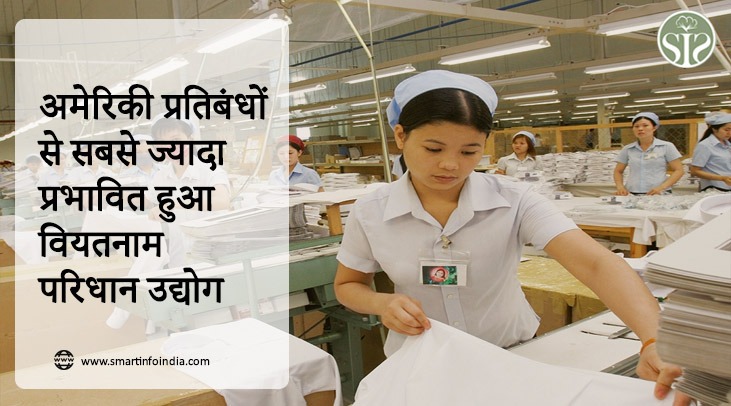
Vietnam apparel industry worst hit by US sanctions

Vietnam apparel industry worst hit by US sanctionsTighter US rules banning imports from China's Xinjiang are increasing pressure on Vietnam's apparel and footwear makers, which have lost nearly 90,000 jobs since October due to a slump in demand in the global manufacturing hub.Among apparel exporters, Vietnam has been among the worst hit by the Forced Labor Protection Act (UFLPA), a review of official US data showed. The law, in effect since June, requires companies to prove they are from Xinjiang. Do not use raw materials or components produced by forced labor.Many US importers are still optimistic, but their supply chains could still be disrupted as Vietnam's apparel makers rely on China for nearly half of their input materials. In total, customs checked nearly 3,600 shipments worth more than $1 billion from multiple countries to find they did not carry goods with inputs from forced labor in Xinjiang, the U.S. Customs data shown.According to the US Department of Commerce, this will affect US consumers, as Vietnam is their main source of cotton apparel. "Vietnam's heavy reliance on cotton textile material from China poses a significant risk to Xinjiang cotton, as the province produces more than 90% of China's cotton," said Sheng Lu, director of the Department of Fashion and Apparel Studies at the University of Delaware.He added that it is unlikely that Vietnam can substantially reduce this dependence, as many manufacturers there are owned by Chinese investors. A government official confirmed that some Vietnamese suppliers may find it difficult to comply with the new rules, either because they import cotton from Xinjiang or because they are unable to prove that they do not.In a survey last year, nearly 60% of US fashion industry managers said they were looking to countries outside Asia for their supplies as a response to forced labor legislation. Sheng Lu said it would be difficult for US firms to find alternative suppliers faster, so more scrutiny on Vietnamese cargoes could be expected. Western companies should "make a more significant effort to map their supply chains, trace where production occurs and perform due diligence at each stage".The country's exports fell by 11.9% and production by 2.3% in the first quarter. Nearly one out of every three pairs of shoes sold globally by Nike and Adidas and 26% and 17% of their clothing, respectively, are manufactured in Vietnam. However, according to its latest annual report updated to May 2022, Nike has significantly reduced its production of apparel and footwear, despite its main manufacturing center in Vietnam. It did not answer questions about the UFLPA. Adidas also did not comment on the UFLPA, but said shortlisting its Vietnamese suppliers would respect local law.👇🏻👇🏻👇🏻👇🏻https://smartinfoindia.com/hi/news-details-hindi/Market-pakistan-usman-naseem-cotton

Related News

Youtube Videos

रुई बाज़ार में गिरावट का रुख 😱 Cotton Market Rate Today | 23 Sep 2026
रुई बाज़ार में गिरावट का रुख 😱 Cotton Market Rate Today | 2...
आज के कपास के भाव 😱 गुजरात कपास बुवाई अपडेट 🔥Cotton Rate Today 22 Sep 2026
आज के कपास के भाव 😱 गुजरात कपास बुवाई अपडेट 🔥Cotton Rate T...
जानिए आज का कपास बाज़ार 😱 Cotton market rate today #kapas #cotton
जानिए आज का कपास बाज़ार 😱 Cotton market rate today #kapas #c...
Application Download
Whatsapp Contact