Recent News

Bangladesh Extends Curfew, Shuts Down RMG and Textile Mills Amid Unrest

Amid unrest, Bangladesh extends the curfew and closes the RMG and textile mills.Bangladesh’s readymade garment (RMG) factories and textile mills will remain closed as the government has extended the curfew indefinitely and announced a three-day general holiday starting Monday due to the deteriorating law and order situation, according to sector leaders.Production in most RMG factories in Narayanganj and a few units in Gazipur was already suspended on Sunday amid ongoing unrest. The government extended the curfew starting from 6:00 PM on Sunday and declared a three-day public holiday beginning Monday. This decision came after clashes in 14 districts resulted in at least 42 fatalities involving protesters, law enforcement, and ruling party-backed groups.Abdullah Hil Rakib, Vice-President of the Bangladesh Garment Manufacturers and Exporters Association, stated that factories would comply with the government’s announcement of general holidays. “However, we will seek a meeting with the government to request permission to operate the units during the curfew and holidays,” he added.Bangladesh Textile Mills Association (BTMA) Secretary General Zakir Hossain conveyed in a text message that all BTMA member mills would remain closed during the three-day holiday from August 5-7 due to the deteriorated law and order situation. Decisions on reopening the mills will depend on the overall situation and further government declarations.Factory owners in Narayanganj reported that workers began production on Sunday morning but were later incited by outsiders to leave. Consequently, workers from Eurotex Knitwear Limited and IFS Texwear Pvt Limited exited their workplaces and took to the streets. This led to protests in several factories in Narayanganj BSCIC and Fatullah, prompting other factory owners to declare a holiday to protect their establishments, said Fazle Shamim Ehsan, Senior Vice-President of the Bangladesh Knitwear Manufacturers and Exporters Association.In Gazipur, production in some factories ceased after 3:00 PM as workers left their jobs, according to Abdullah Hil Rakib. Additionally, an official from the BTMA reported that the Outpace Spinning mill in Gazipur was set on fire by outsiders on Sunday afternoon.Read More :>Ginning Units in Indore Region Face Challenges with High Mandi Tax

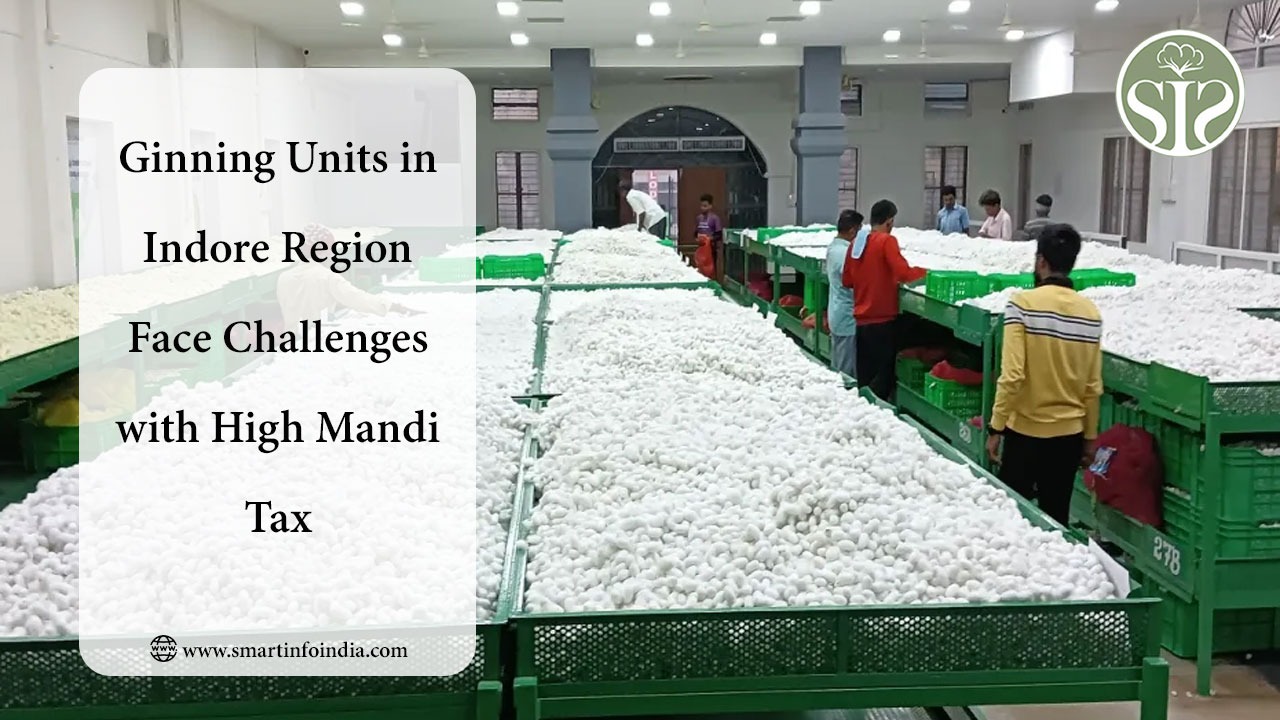
Ginning Units in Indore Region Face Challenges with High Mandi Tax

Indore Region Ginning Units Face Difficulties Due to High Mandi TaxAs the new cotton season approaches, beginning in the last week of September, ginning units in the Indore region are gearing up for operations. However, uncertainty over demand and uncompetitive pricing due to high mandi taxes has dampened industry sentiment.Madhya Pradesh hosts approximately 200 ginning units, with around half of them located in the Nimar region. Shrikrishan Agrawal, owner of a ginning unit in Bhikangaon village, Khargone district, remarked, “Preparations for the new season are underway, but capacity utilization may be impacted. Local units struggle to compete due to higher prices compared to other states.” Ginners argue that the mandi tax levied by the Madhya Pradesh government makes procuring raw cotton and selling finished lint cotton more expensive.Currently, the mandi tax in Madhya Pradesh stands at 1.20 percent. Ginners advocate for a reduction to 0.50 percent to level the playing field with other states. Kailash Agrawal, a cotton farmer and ginner from Khargone, highlighted the issue: “Selling cotton lint to other states is challenging because our prices are higher due to the mandi tax. This affects processing, leading ginning units to reduce operations.”The new cotton season is anticipated to start with arrivals in local markets by late September or October. In the Indore division, key cotton-growing areas include Khargone, Khandwa, Barwani, Manawar, Dhar, Ratlam, and Dewas.The Cotton Association of India, an apex trade body, estimates cotton pressing in Madhya Pradesh for the 2023-24 season at 18 lakh bales (1 bale equals 170 kg).Read More :>Rain Washouts Whitefly Threat in South Malwa; Agri Experts Warn Cotton Growers of Bollworm Attack

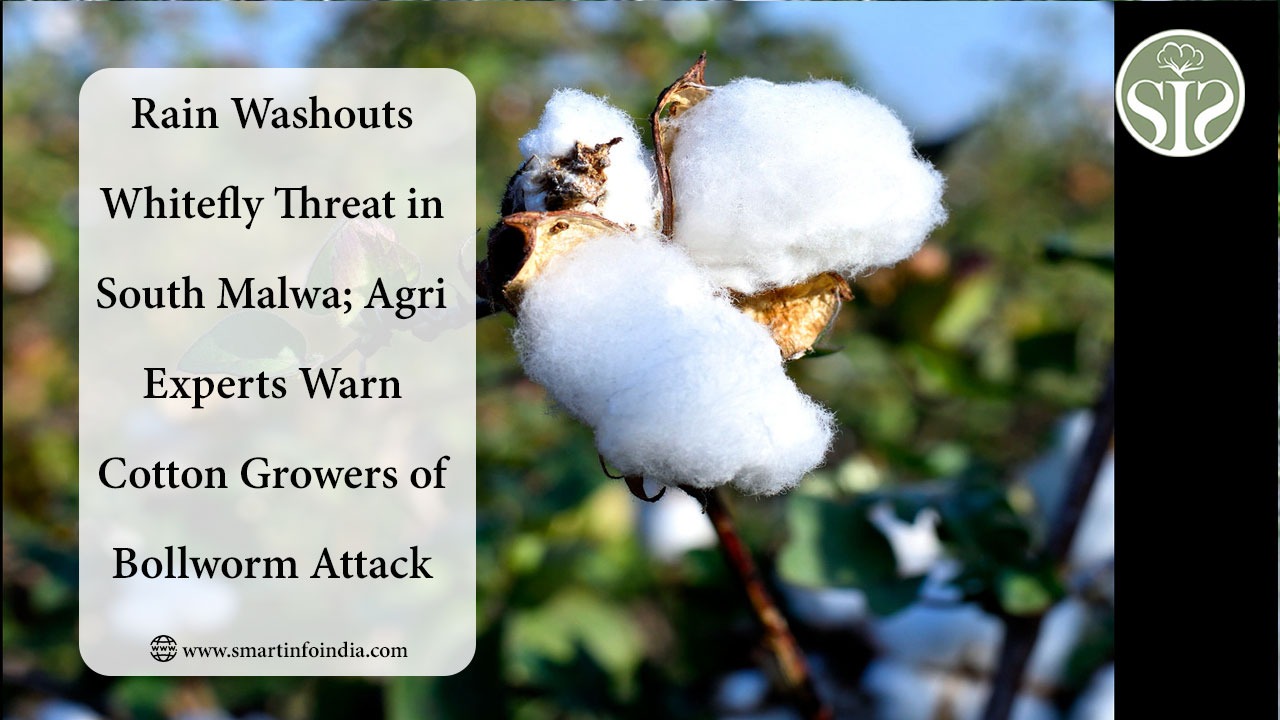
Rain Washouts Whitefly Threat in South Malwa; Agri Experts Warn Cotton Growers of Bollworm Attack

Experts in agriculture warn cotton growers of the threat posed by boltworm attacks in South Malwa due to rain washouts.Agricultural experts from the Punjab Agricultural University (PAU) and the state agriculture department have announced that recent showers will mitigate the threat of whitefly infestation on the cotton crop. The initial spell of rain on the first day of August ended a month-long dry spell in the kharif season, providing much-needed relief to farmers.According to the PAU’s observatory at the Bathinda-based regional research centre, 63.2 mm of rainfall was recorded on Thursday. This weather shift also caused a significant drop in temperature, with the maximum falling to 27.2 degrees Celsius, a decline of 10 degrees since July 31. The meteorological department predicts more rain later this week, which is seen as beneficial for both rice and cotton cultivation in this semi-arid region.PAU principal entomologist Vijay Kumar reported that field inputs from farm scientists at Krishi Vigyan Kendras (KVKs) indicate that the immediate threat of whitefly has been alleviated as the rain has washed away the adult pest population. However, Kumar emphasized the importance of continued vigilance, as future whitefly growth will depend on the upcoming climatic conditions.“This kharif season, the Malwa belt experienced scant rainfall. The dry and humid conditions over the past month were conducive to whitefly population growth, posing a significant threat to the cotton crop,” said Kumar. “As cotton reaches the flowering stage next week, farmers must stay alert to handle potential pink bollworm attacks.”Fazilka Chief Agriculture Officer (CAO) Sandeep Rinwa noted that while whitefly populations were detected in several villages, they remained below alarming levels and were managed with insecticides. “In the last week of June, pink bollworm was reported in a few areas, but it was controlled. Post-rainfall, farmers will add nutrients to their fields, promoting rapid plant growth and healthy crops,” Rinwa explained. Another survey will ensure that cotton sticks, often used as firewood and potential carriers of pink bollworm larvae, are removed from fields.Vinay Pathania, assistant professor (plant protection) at Bathinda KVK, confirmed that no pest infestations had exceeded the economic threshold limit (ETL) in the district. Extension teams have advised cotton-growers to continue monitoring their fields for any signs of pests.Rain Inundates Low-Lying AreasHeavy rain since Thursday morning has led to waterlogging in the low-lying areas of Bathinda and surrounding districts. In Bathinda’s Prajapat Colony, a house roof collapsed, damaging household items. Fortunately, the family was not home at the time. The Power House Road locality in Bathinda was severely affected, with water levels reaching up to 3 feet on the streets. Commercial and residential areas of Mall Road, Vir Colony, and Paramram Nagar also experienced significant waterlogging.Read More :>Whitefly attack looms large in cotton belt in Malwa area

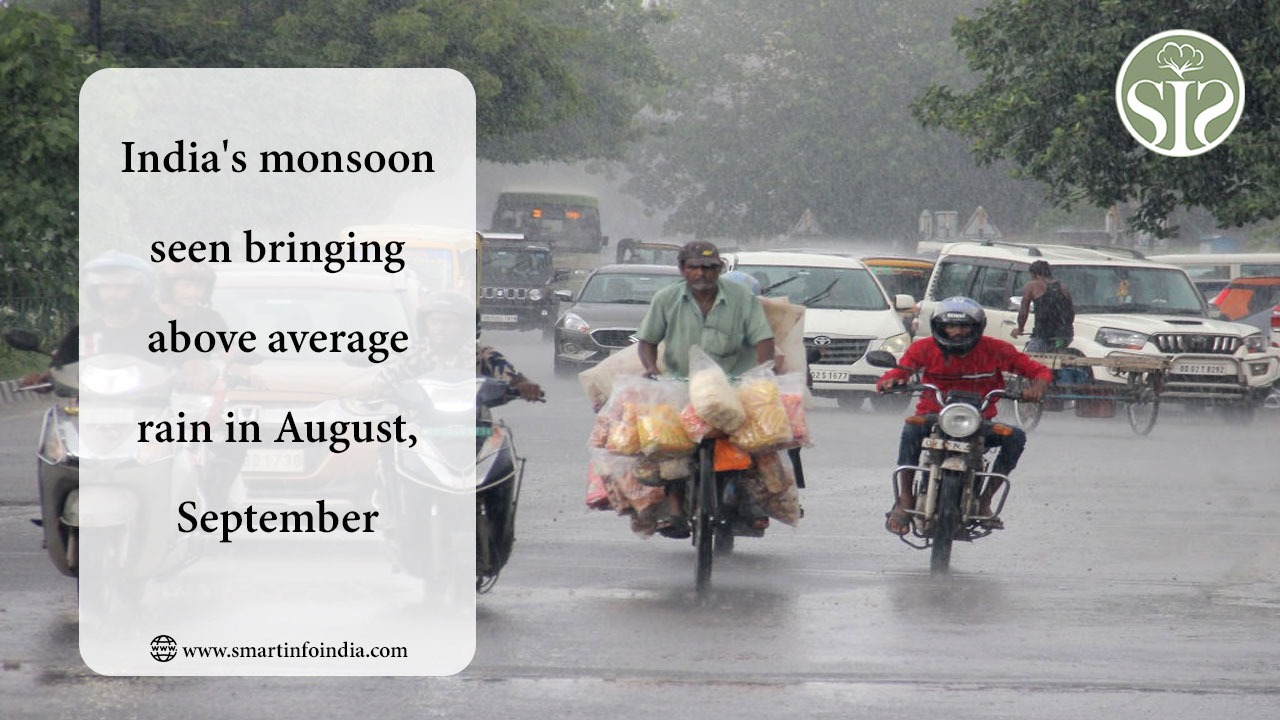
India's monsoon seen bringing above average rain in August, September

August and September had above-average rainfall due to India's monsoonIndia is set to receive monsoon rainfall that is above the average as a La Nina weather pattern forms in August and September, a top weather official said on Thursday, promising to boost farm output and growth in Asia's third-biggest economy.The lifeblood of a nearly $3.5-trillion economy, the annual monsoon brings almost 70% of the rain India needs to water farms and replenish reservoirs and aquifers.Without irrigation, nearly half the farmland in the world's second-biggest producer of rice, wheat and sugar depends on the rains that usually run from June to September.A La Nina weather pattern is likely to develop by the end of August or early September, bringing higher rainfall, said Mrutyunjay Mohapatra, director-general of the India Meteorological Department (IMD)."We are moving towards a La Nina weather condition and its impact is becoming visible," he told an online press conference. "La Nina will play a role in increased rainfall activity in September." In August, he added, India is likely to receive average rainfall, ranging between 94% and 106% of a figure weathermen describe as the long-period average.However, rainfall could be below average in August in a few areas in eastern, northeastern, central, and southern regions, he said.Areas growing cotton, soybean, pulses and sugarcane in the western state of Maharashtra and neighbouring Gujarat are likely to get less rainfall than average in August, he said.India received 9% more rainfall than average in July as the monsoon covered the entire country ahead of schedule.Torrential rain in the north killed at least 10 people, officials said on Thursday, after landslides following heavy rain killed at least 178 in the southern state of Kerala this week.Summer rains usually begin in the south around June 1 before spreading nationwide by July 8, allowing farmers to plant crops such as rice, cotton, soybeans and sugarcane.Farmers have expanded the area under most crops since July's abundant rainfall everywhere except in some eastern rice-growing states, a Mumbai-based dealer with a global trading house said."Eastern states desperately need good rains in the next few weeks, or their paddy output will decline," he said.The world's biggest exporter of rice, India put curbs on overseas shipments in 2023 to rein in domestic prices of the staple.Reda more :- Expanded Cotton Acreage in South May Compensate for Northern Decline

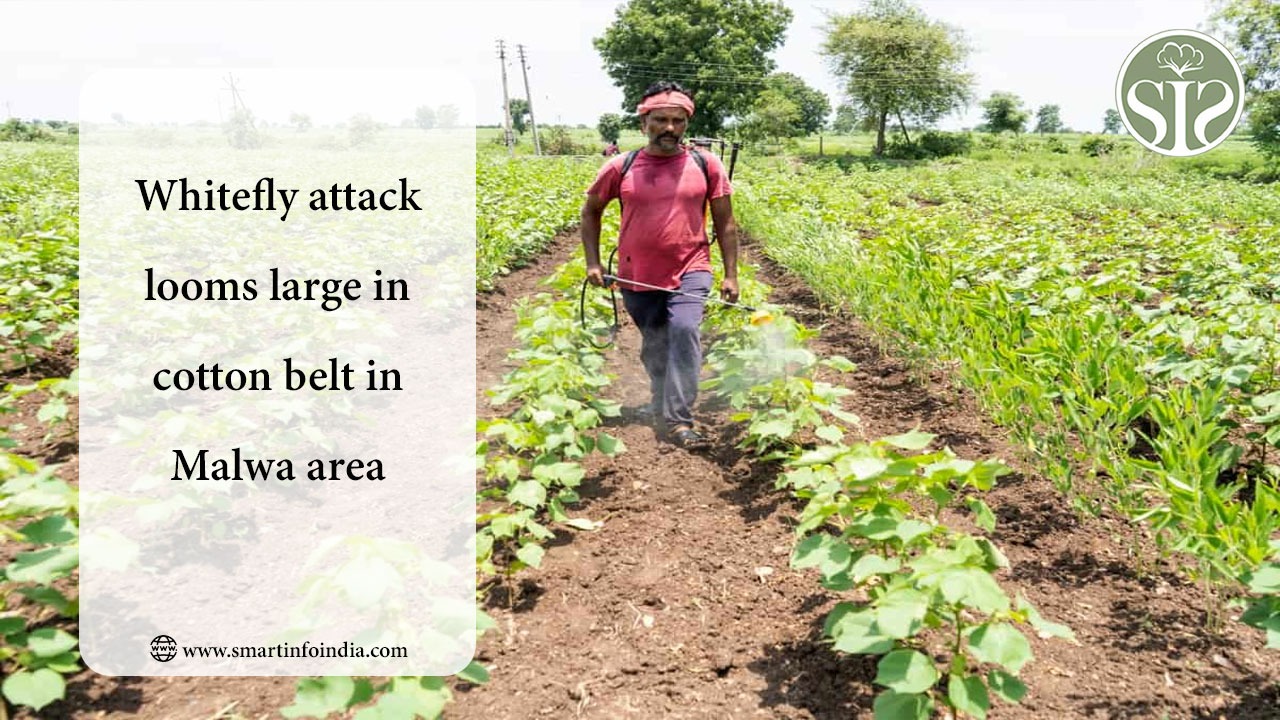
Whitefly attack looms large in cotton belt in Malwa area

In the cotton belt of the Malwa area, whitefly attacks are a major concern.After nine years, the fear of whitefly attacks on cotton crops is back to haunt farmers of the cotton belt in the Malwa area, as the presence of sulking pests has been reported in some parts of Mansa, Bathinda, and Fazilka districts.State Agriculture Department teams have visited various villages and held meetings with officials, asking the field officers to be vigilant. The teams have been directed to visit farmers in the fields to check the crop and recommend spray as per the situation.The department has also been making announcements in villages through gurdwara loudspeakers, urging farmers to spray their crops as recommended by experts as whitefly attacks were on the rise.Experts claimed hot and humid weather conditions were leading to pest infestations. They said against the state’s recommendations a large number of farmers grew moong crops during summer. They said it was another reason behind the pest infestation in the region.Farmers said the area under cotton had reduced drastically to an all-time low of about 97,000 hectares. They said the reason behind it was that farmers have shifted to paddy, pulses, and maize as successive governments have failed to contain pest attacks on cotton.Dejected by the whitefly attack on his cotton crop, Kulwinder Singh of Bhagi Bander village in the district reportedly destroyed his crop on two acres.In August–September 2015, nearly 60 per cent of the cotton crop sown on 4.21 hectares of land was damaged. Unable to bear the losses, some farmers ended their lives.Bathinda Chief Agriculture Officer (CAO) Jagseer Singh said, “Whitefly is quite rampant in the district, and it is due to the prolonged dry spell. Teams are visiting the fields and are recommending farmers spray the crop, which is quite effective in the early stages.”Read More :>Expanded Cotton Acreage in South May Compensate for Northern Decline

Related News

Youtube Videos

रुई बाज़ार में गिरावट का रुख 😱 Cotton market rate today #youtube
रुई बाज़ार में गिरावट का रुख 😱 Cotton market rate today #you...
जानिए आज का कपास बाज़ार 😱 Cotton market rate today #youtube
Ganesh Chaturthi Celebration at Our Office 🙏✨ | Ganpati Bappa Morya! #shorts
Ganesh Chaturthi Celebration at Our Office 🙏✨ | Ganpati Ba...
Application Download
Whatsapp Contact