Recent News

Cotton apparel exports for India, Vietnam increase as US, EU increase orders

India and Vietnam ship more cotton clothing as US and EU orders rise.In 2024, retailers in the United States and the European Union (EU) placed more orders for cotton clothing from Vietnam rather than Bangladesh and China. India also benefited during this time, growing by 20 per cent year over year from April to December of the current fiscal year.Last year, China’s market share in the US fell from 21.8 per cent to 20.8 per cent, a 1 per cent decrease from 2022. In the US, a one per cent market share is equivalent to over US $ 794 million (Rs. 6,900 crore) in sales, according to Prabhu Dhamodharan, Convenor of the Indian Texpreneurs Federation (ITF).Each competing country gained between 0.2 per cent and 0.6 per cent from this China Plus One move, which divided China’s lost share across other nations. According to him, India’s market share increased by 0.2 per cent, reaching 5.9 per cent at present.Data issued by the Ministry of Commerce & Industry indicates that exports of cotton yarn, textiles, made-ups, and handloom items from India increased by 11.98 per cent in December 2024 compared to December 2023, according to the Cotton Textiles Export Promotion Council (Texprocil).Indian cotton yarn, fabrics, makeup, and handloom goods saw a 2.82 per cent increase between April and December 2024. Over the first nine months of the current fiscal year, the apparel industry grew by 11.5 per cent.According to Dhamodharan, the US Government has imposed new tariffs on small packages coming from China. E-platform businesses will face difficulties as a result, which will reduce the competitiveness of small-parcel exports from China.He added that India is seeing a spike in enquiries and that apparel exporters are seeing an improvement in order visibility from the US, which will “open up big opportunities for India to bet on e-commerce fashion exports.”He said that Indian apparel exporters are seeing an increase in enquiries and improved order visibility as a result of brands launching new product categories that were not previously produced in India.However, Vietnam has started purchasing more cotton from the US than India. “Indian cotton costs more than those in the United States. Vietnam also purchases from West Africa and Brazil”, according to an insider.Vietnam is not purchasing since the price of the Intercontinental Exchange (ICE) is between 66 and 68 US cents per pound. Another industry expert added that limited amounts of yarn had been imported into India, but that it too does not apply customs duties.The current price of cotton benchmark futures is 67.4 US cents a pound, or US $ 534 (Rs. 46,375) a candy of 356 kg. Benchmark cotton Shankar-6 is sold in India for US $ 616.55 (Rs. 53,550) per candy.read more :-Sensex, Nifty End Lower Market Shows Mixed Advance-Decline Trend

Cotton Prices Rise as CCI Plans to Buy Over 100 Lakh Bales at MSP

As CCI prepares to purchase more than 100 lakh bales at MSP, cotton prices rise. Cottoncandy prices increased by 0.41% to settle at ₹54,370, supported by expectations of significant procurement by the Cotton Corporation of India (CCI), which is likely to buy over 100 lakh bales at the Minimum Support Price (MSP) this season. The Cotton Association of India (CAI) estimates a decline in India’s cotton output for the 2024-25 season to 301.75 lakh bales from 327.45 lakh bales in 2023-24 due to lower yields in Gujarat, Punjab, and Haryana. Despite the lower output, the quality of cotton remains strong. As of January 2025, total cotton supply is projected at 234.26 lakh bales, including 188.07 lakh bales from fresh pressings, 16 lakh bales from imports, and 30.19 lakh bales as opening stock. India's domestic consumption is retained at 315 lakh bales, while exports are projected to decline to 17 lakh bales from 28.36 lakh bales in 2023-24. Brazil's cotton production for 2024-25 is expected to rise by 1.6% to 3.76 million tons, with a 4.8% increase in the planting area, reflecting strong supply. The U.S. balance sheet shows minor changes, with domestic mill use reduced by 100,000 bales, while global cotton consumption sees marginal increases, driven by higher demand in Bangladesh, Pakistan, and Vietnam. Technically, the market is witnessing short covering, with open interest dropping by 1.94% to 253 contracts. Cottoncandy finds support at ₹54,260, with a break below potentially testing ₹54,160. On the upside, resistance is seen at ₹54,480, and a move above this level could push prices toward ₹54,600.read more :-India's T&A exports overtook total merchandise shipments in January

India's T&A exports overtook total merchandise shipments in January

In January, India's T&A exports surpassed all goods shipments.India's textile and apparel (T&A) exports outpaced total goods exports during January 2025. The country's T&A exports jumped 13.88 per cent to $3.402 billion, against total goods exports of $36.425 billion in the month. The exports of all goods eased by 2.41 per cent to $36.425 billion in the same month. Textile and apparel exports gained 8.30 percent, reaching $29.997 billion in the first ten months of the current fiscal 2024-25 (April-March), while the outbound shipment of all goods inched up by 1.39 per cent in the same period.Apparel exports, in particular, surged by 11.45 per cent to $1.606 billion in January. Textile exports also jumped by 16.14 per cent to $1.796 billion in the same month. This impressive growth in textile and apparel exports was probably helped by the continued weakness of the Indian rupee against the US dollar, benefitting Indian exporters in the global market.Textile exports grew by 8.30 per cent to $17.075 billion in the first ten months of FY25, compared to $16.114 billion in the same period of the previous year. Apparel exports rose by 11.56 per cent, reaching $12.922 billion, up from $11.583 billion in the corresponding period last fiscal. The share of T&A in India’s total merchandise exports increased to 8.36 per cent during April 2024-January 2025 and to 9.34 per cent in the latest reported month, according to the Ministry of Commerce and Trade.Within the textile sector, exports of cotton yarn, fabrics, made-ups, and handloom products increased modestly by 4.10 per cent, reaching $9.954 billion in the first ten months of this fiscal. Exports of man-made yarn, fabrics, and made-ups rose by 5.99 per cent to $4.036 billion, while carpet exports saw a significant increase of 11.47 per cent to $1,285.08 million.In January 2025, T&A exports totalled $3.402 billion. Textile exports rose by 16.14 per cent, reaching $1.796 billion, up from $1.546 billion in January 2024. Garment shipments grew by 11.45 per cent, totalling $1.606 billion, compared to $1.441 billion in January 2024. Under textiles, the export of cotton yarn, fabrics, made-ups, and handloom products grew by 16.41 per cent to $1,038.55 million, while man-made yarn, fabrics, and made-ups exports surged by 12.14 per cent to $425.82 million. Carpet exports also increased by 18.04 per cent to $135.58 million.Imports of raw cotton and waste climbed by 100.69 per cent to $1,040.41 million in April-January 2025, compared to $518.43 million in the same period of the last fiscal. Imports of textile yarn, fabrics, and made-ups increased by 7.74 per cent, rising from $2,081.22 million to $1,931.67 million. During January 2025, the import of raw cotton and waste surged by an astonishing 520.83 per cent, from $19.62 million to $121.72 million. Similarly, imports of textile yarn, fabrics, and made-ups rose by 28.83 per cent to $237.86 million in the latest month.In FY24, India’s textile and apparel exports amounted to $34.430 billion, a 3.24 per cent decline from $35.581 billion in FY23. Apparel exports dropped by 10.25 per cent, falling to $14.532 billion from $16.190 billion. Conversely, textile exports grew by 2.62 per cent, reaching $19.898 billion from $19.390 billion in FY23.India’s imports of raw cotton and waste were valued at $598.63 million in FY24, a 58.39 per cent decrease from $1,439.70 million in the previous fiscal. Imports of textile yarn, fabrics, and made-ups also declined by 12.98 per cent to $2,277.85 million, compared to $2,617.74 million in FY23.read more :-Indian rupee ended 2 paise lower at 86.94 per dollar on morning opening of 86.92.

EU & India launch 7 projects to boost textile & handicraft sector

India and the EU start seven projects to grow the textile and handicraft industries.Seven new projects were launched by the European Union (EU) and the Indian Ministry of Textiles to strengthen India's textile and handicraft industry on the sidelines of the ongoing Bharat Tex. Funded by the EU with a €9.5 million (~₹85.5 crore or ~$9.97 million) grant, these initiatives aim to foster inclusive growth, resource efficiency, and sustainability across the entire value chain in the Indian textile sector.The seven projects will be implemented across nine Indian states—Assam, Andhra Pradesh, Telangana, Uttarakhand, Uttar Pradesh, Odisha, Jharkhand, Bihar, and Haryana—benefitting 35,000 direct beneficiaries, including 15,000 MSMEs, 5,000 artisans, and 15,000 farmer-producers, over the next three to five years.These initiatives will focus on a range of products such as the production and promotion of natural dyes, bamboo crafts, handlooms, shawls, and traditional handicrafts and textiles, with the aim of enhancing production, branding, and market access.The projects will be implemented by Humana People to People India, Deutsche Welthungerhilfe EV, Stiftelsen Världsnaturfonden WWF, Professional Assistance for Development Action, Network for Enterprise Enhancement and Development Support, Foundation for MSME Clusters, and Intellecap Advisory Services Pvt Ltd.This project builds on the EU's ongoing collaboration with India on sustainability and the circular economy, aligning with the ‘Sustainable Bharat Mission for Textiles’ by the Ministry of Textiles. The funding, part of the EU's Global Gateway Strategy, complements the ongoing EU-India Resource Efficiency and Circular Economy Initiative, co-funded by the German Federal Ministry (BMUV). This initiative is being executed jointly with the Ministry of Environment, Forest, and Climate Change, Government of India, and implemented by GIZ.The projects have been designed to preserve India's cultural heritage in textiles while promoting economic self-sufficiency through enhanced innovation, competitiveness, and market linkages.The Textiles Toolkit, developed in collaboration with GIZ, was also launched to promote circular economy and resource efficiency in the sector.Speaking on the occasion of the launch, the Minister Counsellor and Head of Cooperation of the EU Delegation to India, Franck Viault said, “While fast fashion dominates global trends, both the EU and India have been making serious effort to make the textile industry more sustainable. India's rich textile heritage is internationally acclaimed, particularly in Europe. By merging tradition with innovation and technology, India's textile sector can leapfrog into a sustainable future. As a key partner, the EU is committed to supporting India's circular economy agenda, sharing best practices, and promoting environmentally sustainable practices in this vital sector.”read more :-The Indian rupee on Monday low 18 paise to close at 86.87 per dollar, while it opened at 86.69 in the morning.
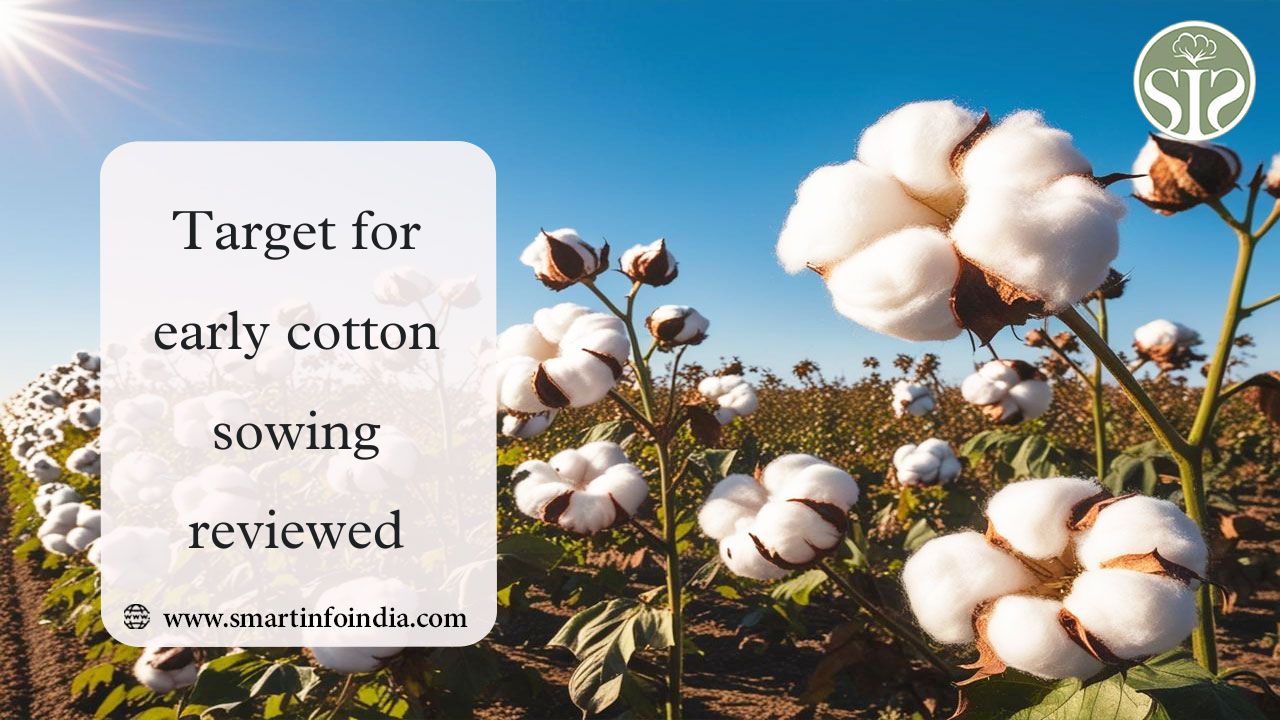
Target for early cotton sowing reviewed

Review of the early cotton sowing targetPunjab Agriculture Secretary Iftikhar Ali Sahu chaired a high-level meeting in Multan to review the strategy for early cotton sowing.He stated that achieving the cotton cultivation target was a challenging task, with six divisions in Punjab identified as suitable for early sowing. The province has set a target of 1 million acres for early cotton sowing, scheduled between February 15 and March 31. To support farmers, the government has announced a financial assistance package of Rs. 25,000 per acre. Sahu instructed officials to remain active in the field and ensure effective implementation of the plan, highlighting that early cotton sowing has yielded better results amid climate changes.To ensure success, divisional, district, and tehsil-level cotton management committees have been formed, while strict monitoring is in place to guarantee the availability of quality agricultural inputs in markets.he meeting was attended by Special Secretary Agriculture South Punjab Sarfaraz Hussain Magasi, Additional Secretary Agriculture Task Force Punjab Rana Shabbir Ahmed Khan, Vice Chancellor Prof.Dr. Ishtiaq Ahmed Rajwana, Director Generals of Agriculture Abdul Hameed, Naveed Asmat Kahloon, Dr. Amir Rasool, Dr. Sajid Ur Rehman, Abdul Qayyum, consultant Dr. Muhammad Anjum Ali, Dr. Asif Ali, Pakistan Kissan Ittehad President Khalid Khokhar, and Dr. Muhammad Iqbal Bandesha, along with other officials and stakeholders.Later, the Secretary Agriculture Punjab visited the under-construction Model Agriculture Mall in Multan to inspect its progress. Expressing satisfaction with the pace of work, he stressed that construction must strictly follow the approved design. He directed the Buildings Department to ensure its timely completion. Officials briefed him that 80% of the project has been completed. Sahu stated that the area surrounding the mall will serve as a practical model of modern agricultural technology.read more :-Take up issue of resumption of cotton procurement with Centre: Maha CM

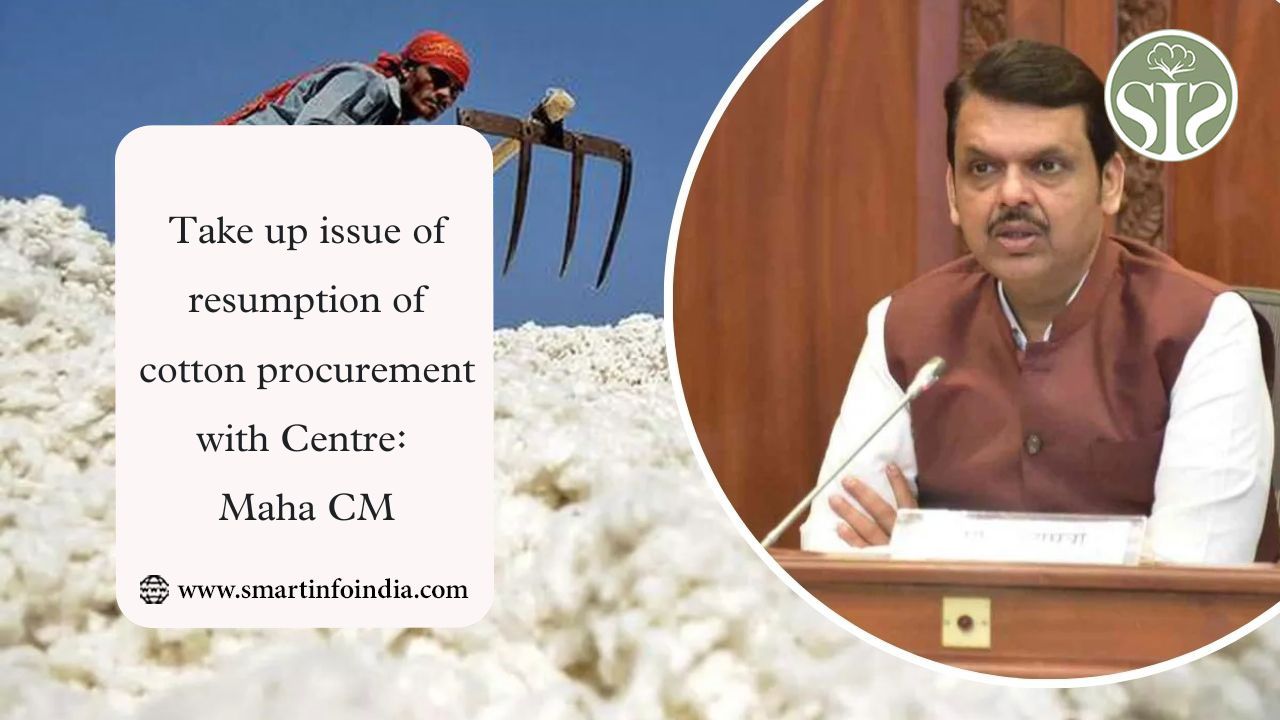
Take up issue of resumption of cotton procurement with Centre: Maha CM

Discuss with the Center: Maha CM the matter of resuming cotton procurement.Jalgaon, Feb 16 (UNI) Maharashtra Chief Minister Devendra Fadnavis assured on Sunday that he will hold talks with the central minister to resume procurement of cotton from farmers in the district, which was stopped by the Cotton Corporation of India Limited (CCI).Speaking at the farmers' meeting organised on occasion of the Amrit Mahotsav (75 years) of The Shendurni Secondary Cooperative Society, the Amrit Granth publication and the foundation laying ceremony of the new building here, he said that the state government will ensure that the produce of farmers does not remain at home under any circumstances.The state government will provide all necessary cooperation to change the picture of this area, he asserted.The Chief Minister expressed that the state government has accorded priority to solve the problems of farmers such as electricity and water.Farmers who have paid for solar pumps will be given connections within next 15 days and every farmer will be given connections within two months, he assured.The work of solar feeders is going on rapidly to provide daytime electricity to farmers by 2026, he added.Fadnavis inaugurated the sewage project and road work under the Urban Upliftment Scheme of Shendurni Nagar Panchayat.read more :-The Indian rupee on Monday increase 14 paise to open at 86.69 per dollar, while it closed at 86.83 in the friday.

Related News

Youtube Videos

कपास बाज़ार साप्ताहिक रिपोर्ट 🔥 | तेजी या मंदी? | CCI Update | Cotton Market  Update
कपास बाज़ार साप्ताहिक रिपोर्ट 🔥 | तेजी या मंदी? | CCI Updat...
रुई बाजार में आज का पूरा माहौल 🔥Cotton Market Today | 11 सितंबर 2026 #smartinfo
रुई बाजार में आज का पूरा माहौल 🔥Cotton Market Today | 11 सि...
कपास बाजार में आज तेज़ी का रुख 😱Cotton market rate today #youtube
कपास बाजार में आज तेज़ी का रुख 😱Cotton market rate today #yo...
Application Download
Whatsapp Contact