Recent News

Asia-Pacific Cotton Yarn Market Consumption Growth Trend, By 2035

Growth Trend in the Asia-Pacific Cotton Yarn Market Consumption by 2035Projected to Reach US$72.7 Billion Over the next ten years, the Asia-Pacific region is projected to continue its upward trend in cotton yarn consumption, driven by the growing demand for cotton yarn, says a report by IndexBox. The market is expected to continue on its current trajectory, growing at an estimated compound annual growth rate (CAGR) of +0.5 percent between 2024 and 2035, and reach a market size of 19 million tons by the end of 2035. In value terms, the market is expected to grow at an estimated compound annual growth rate (CAGR) of +1.3 percent between 2024 and 2035, and reach a market size of US$72.7 billion (at nominal wholesale prices) by the end of 2035.Consumption of cotton yarn in Asia-Pacific stabilized last year at 18 million tons expected in 2024. In 2024, the Asia-Pacific cotton yarn market was valued at US$62.8 billion, almost the same as last year.The three largest consuming countries in 2024—China (7.4 million tons), India (4.7 million tons) and Pakistan (3.4 million tons)—accounted for 88 percent of total consumption.Among the major consuming countries, India achieved the most notable rate of consumption growth (compound annual growth rate of +8.5 percent) from 2013 to 2024, while consumption in other leading countries grew at more moderate rates.China (US$30.4B) led the market alone in terms of value, with India in second place (US$15.2B) followed by Pakistan. The average annual growth rate of value in China from 2013 to 2024 was -3.8 percent. The average annual rates in the other countries were as follows: Pakistan (+3.1 percent annually) and India (+8.0 percent annually).India achieved the highest rate of consumption growth among the major consumer countries between 2013 and 2024 (a compound annual growth rate of +7.4 percent), while the other leaders' consumption grew at more moderate rates.Cotton yarn production remained largely unchanged from the previous year, with 18 million tons produced in Asia-Pacific in 2024. Projected export values for cotton yarn production in 2024 were US$61.7 billion.The three countries with the highest production in 2024—China (6.2 million tons), India (5.8 million tons), and Pakistan (3.7 million tons)—accounted for 87 percent of total production. Bangladesh, South Korea, Vietnam, and Indonesia followed slightly behind, contributing an additional 11 percent.China was the largest importer of cotton yarn in 2024, accounting for 59 percent of all imports with 1.5 million tons. South Korea (176K tons) and Bangladesh (531K tons), which accounted for 28 percent of total imports, followed closely behind. Vietnam remained far behind at the top with 84K tons.With a 52 percent share in total imports, China (US$3.5B) is the largest market in the Asia-Pacific region for imported cotton yarn. Bangladesh (US$1.6B) was second (US$1.6B), accounting for 23 percent of total imports. South Korea was second with an 8.1 percent share.With nearly 37 percent and 34 percent share in total exports, respectively, India (1 million tons) and Vietnam (1 million tons) were the top exporters of cotton yarn in 2024. China was second with 287K tonnes or 10 percent of total shipments (in physical terms), followed by Pakistan with 9.3 percent. These leaders were far ahead of Malaysia (89K tonnes), Indonesia (70K tonnes) and Taiwan (Chinese) (64K tonnes).In 2024, the three nations with the largest export value – China (US$1.1 billion), Vietnam (US$2.8 billion) and India (US$3.4 billion) – accounted for 83 percent of all exports. With a combined 15 percent share, Pakistan, Malaysia, Indonesia and Taiwan (Chinese) trailed slightly behind.read more :-Indian Rupee higher 9 Paisa, Ends at 87.27 per Dollar

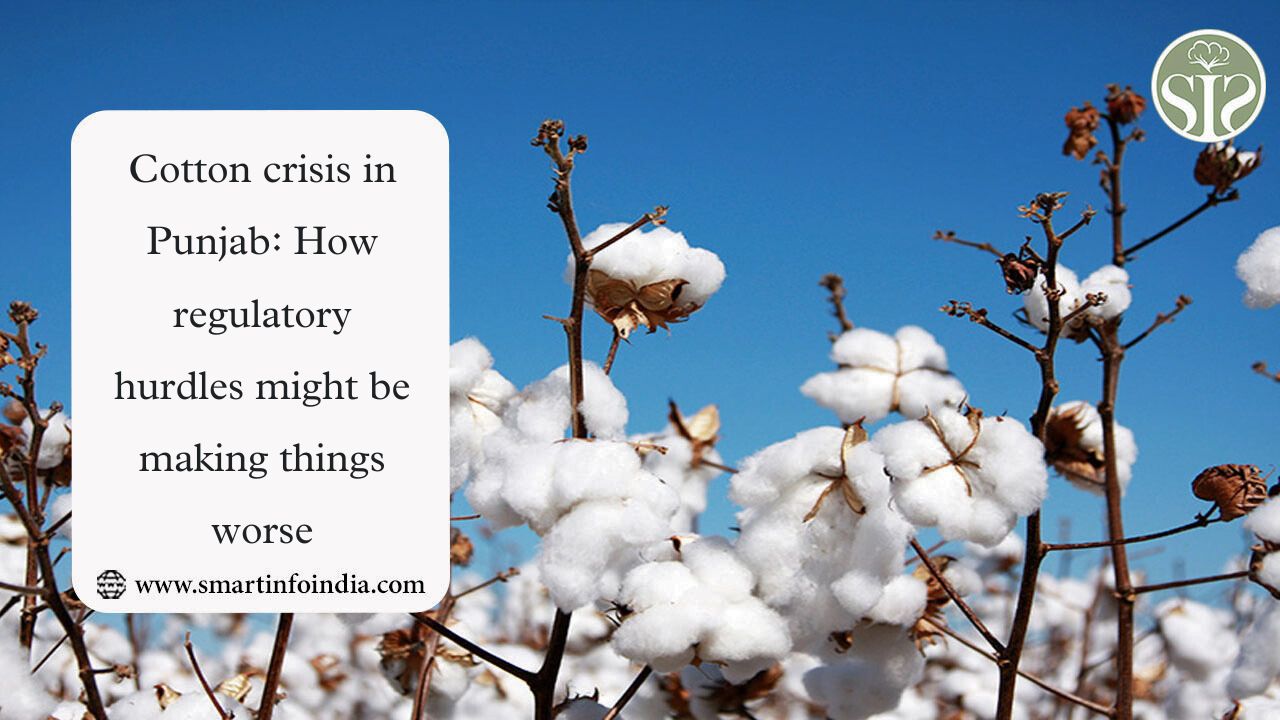
Cotton crisis in Punjab: How regulatory hurdles might be making things worse

Punjab's cotton crisis: How potential regulatory obstacles could be exacerbating the situationIn recent years, whiteflies and pink bollworms have wreaked havoc on the cotton crop in North India. Cotton yields are down, as is the area under cotton cultivation — the crop was cultivated in only one lakh hectares in Punjab in 2024, down from nearly eight lakh hectares three decades back. The drop in acreage has in turn harmed the ginning industry — only 22 ginning units remain operational in Punjab today, down from 422 in 2004.Ahead of the cotton sowing season, farmers are thus calling for the swift approval of Bollgard-3, a new pest-resistant genetically-modified (GM) cotton variety developed by Monsanto. Can this be a game-changer? The short answer is that it can be. But Indians won’t have access to it any time soon.Bollgard-3, a Bt cotton varietyBollgard-3 was developed by Monsanto more than a decade ago, and shows remarkable resistance to pests. It contains three Bt proteins Cry1Ac, Cry2Ab and Vip3A that cause insect death by disrupting their normal gut function. This in turn allows for the growth of a healthier cotton crop, and increases yield.Bacillus thuringiensis (Bt) is a soil-dwelling bacterium with potent insecticidal properties. In the past few decades, researchers have successfully inserted certain genes from Bt in various crops, like cotton, providing these with insect-repellent properties.Bollgard-1 was a Monsanto-developed Bt cotton introduced in India in 2002, followed by Bollgard-2 in 2006. The latter remains prevalent today. And although these do have some pest-repellent properties, they are not effective against the whitefly and the pink bollworm, which arrived in Punjab in 2015-16 and 2018-19 respectively.This is why farmers are demanding the introduction of Bollgard-3, which is particularly effective against lepidopteran pests like pink bollworm.BG-2RRF, a more likely optionHowever, Bollgard-3 is not available in India at the moment, although it is being used in other cotton-growing countries around the world. What is the closer to being available is the Bollgard-2 Roundup Ready Flex (BG-2RRF) herbicide tolerant variety, although even this is pending final regulatory approval.Dr Y G Prasad, director at ICAR’s Central Institute for Cotton Research in Nagpur, said: “Both government and private trials for BG-2RRF were conducted in India in 2012-13… But the application for commercial use is still pending with the government.”Prasad said that BG-2RRF is an advanced seed technology that makes the cotton crop more tolerant to herbicides. This allows for farmers to better control weeds without harming the cotton plant, ultimately leading to better yields.“However, the approval of the technology has been significantly delayed due to regulatory hurdles, which have hindered the introduction of next-generation seed technologies,” Bhagirath said.This is why Bhagwan Bansal, president of the Punjab Ginners’ Association, said that without high-yielding, pest-resistant varieties like Bollgard-3, the future of Punjab’s cotton industry remains uncertain. Many countries in the world are already adopting these (and even more advanced technologies) and reaping the rewards.Atul Ganatra, president of the Cotton Association of India (CAI), said that Brazil is using Bollgard-5, a variety which protects against multiple pests, weeds, and insects. This has led to the South American country achieving astronomical yields of 2400 kg per hectare, compared to only 450 kg in India.read more :-Rupee Holds Steady at 87.36 vs Dollar

NBRI develops GM cotton resistant to pink bollworm

GM cotton resistant to pink bollworm is developed by NBRI.Lucknow: In a ground-breaking advancement for agriculture, scientists at the CSIR-NBRI in Lucknow claim to have developed the world's first genetically modified (GM) cotton that is totally resistant to the Pink Bollworm (PBW), a devastating pest affecting cotton crop in India, Africa and Asia."Since the implementation of GM cotton in India in 2002, varieties such as Bollgard 1 and Bollgard 2, developed jointly with Monsanto of St. Louis, US, have effectively controlled certain bollworm species. However, these varieties have not maintained robust defence against the PBW, known locally in India as Gulabi Sundi," said NBRI director Ajit Kumar Shasany.He explained that the PBW developed resistance to the proteins utilised in these technologies, intensifying the threat. Consequently, cotton yields diminished substantially in India.Addressing this crucial challenge, CSIR-NBRI's researchers, led by chief scientist Dr PK Singh, whose expertise spans nearly 30 years in crop protection, engineered a novel insecticidal gene. This indigenous gene, distinctively effective against PBW, demonstrated superior resistance compared to Bollgard 2 cotton."Comprehensive laboratory trials at NBRI have demonstrated that the new GM cotton exhibits exceptional tolerance to PBW while providing protection against other pests like the cotton leafworm and the fall armyworm," he said.He said recognising the potential of this pioneering technology, Nagpur-based agri-biotech company M/s Ankur Seeds Pvt. Ltd has proposed a partnership with NBRI.Ankur Seeds will collaborate on safety studies following regulatory guidelines and generate extensive multi-location data from field trials with NBRI technology.Upon confirmation of the technology's safety, the seeds will be licensed to seed companies for further variety and hybrid development, facilitating widespread commercialisation."By safeguarding cotton from the threat of Pink Bollworm, CSIR-NBRI's innovation protects the livelihoods of millions of farmers while establishing a new benchmark for pest resistance globally," he added.read more :-Rupee opens 16 paise up at 87.34 against US dollar

India can be the world leader in textiles. Here’s how

India might lead the world in textile production. Here's howIf India is to become a developed country by 2047, it must prioritise job creation. The textile and apparel industry is the second-largest employer in India after agriculture, providing direct employment to 45 million people. The sector is expected to grow at an annual growth rate of 10 per cent and become a USD 250 billion market by 2030, adding millions more jobs. If our exports grow from the current USD 45 billion to the targeted USD 100 billion, and if the economy grows at 6-7 per cent annually, the textile industry can add one million jobs every year from now to 2030 - 10 per cent of the country's need.The government is thinking ahead in supporting the industry. It has approved various schemes with an outlay of several thousand crores that stimulate the sector – such as the Pradhan Mantri Mega Integrated Textile Region and Apparel (PM MITRA) Parks, the Production Linked Incentive (PLI) scheme and the Remission of State and Central Taxes and Duties (RoSCTL) scheme.The USD 100 billion Indian textile market presents a huge domestic opportunity. An emerging middle class is driving demand and this trend is further amplified by Gen Z. The mainstreaming of e-commerce and the emergence of instant commerce have made apparel and fashion easier for people to access. While there is a lull during a crisis like Covid or a recession, Indians continue to have a healthy consumption appetite.With so much work to do, how can we ensure labour efficiency and thus create more jobs and increase market share? India suffers a 15-20 per cent cost loss compared to competing countries like Bangladesh and Vietnam. A major reason for this is low efficiency in the labour-intensive apparel manufacturing process. How can we address this?read more :-Indian Rupee lower 19 Paisa, Ends at 87.50 per Dollar
Related News

Youtube Videos

कपास बाज़ार साप्ताहिक रिपोर्ट 🔥 | तेजी या मंदी? | CCI Update | Cotton Market  Update
कपास बाज़ार साप्ताहिक रिपोर्ट 🔥 | तेजी या मंदी? | CCI Updat...
रुई बाजार में आज का पूरा माहौल 🔥Cotton Market Today | 11 सितंबर 2026 #smartinfo
रुई बाजार में आज का पूरा माहौल 🔥Cotton Market Today | 11 सि...
कपास बाजार में आज तेज़ी का रुख 😱Cotton market rate today #youtube
कपास बाजार में आज तेज़ी का रुख 😱Cotton market rate today #yo...
Application Download
Whatsapp Contact