STAY UPDATED WITH COTTON UPDATES ON WHATSAPP AT AS LOW AS 6/- PER DAY
Start Your 7 Days Free Trial TodayCotton farmers were asked to opt for bed planting.CHANDIGARH: This cotton sowing season is prompting the people of Punjab to go for bed planting for the state's farmers. Besides promising proper, the method requires less water for germination and keeping weeds at bay. It is expected that more number of progressive farmers have switched to technology in this season.As recommended by Punjab Agricultural University (PAU), sowing of bed plantation can be done by tractor driven tractor using bed planter with row to row distance of 67.5 cm and plant to plant distance of 60 cm. Farmers can give water to the crops in furrows and in the rainy season, the excess water also drains out through these furrows.Agriculture director Gurvinder Singh said that bed planting cotton was a better method and farmers had shown interest in it this season. The department has held demonstrations for the farmers in various districts.“Farmers in the state were motivated to switch to cotton from paddy to save groundwater. More farmers will opt for bed planting once they realize that it comes with benefits. The crop is easier to pick and they get better returns," said Dr Jaswinder Singh Brar, Plant Protection Officer.
Business activities have improved in the cotton marketLAHORE: The local cotton market remained stable on Wednesday with a marginal improvement in trading volume.Cotton analyst Naseem Usman told that the price of cotton in Sindh is between Rs 17,000 to Rs 20,000 per head. The cost of cotton in Punjab ranges from Rs 18,000 to Rs 21,000 per head.The rate of footi in Sindh ranges from Rs 5,500 to Rs 8,300 per 40 kg. The rate of footi in Punjab ranges from Rs 6,000 to Rs 8,500 per 40 kg.About 300 bales of Shahdad Pur were sold at Rs.15,500 per head, 600 bales of Tando Adam, 200 bales of Kotri Kabir and 200 bales of Rani Pur at Rs.18,000 per head.The spot rate remained unchanged at Rs 20,000 per head. Polyester fiber was available at Rs 375 per kg.
Rupee weakens by 17 paise against US dollarThis evening, the rupee closed at a level of 82.38 against the dollar with a weakness of 17 paise.Sensex dropped 372 pointsToday the stock market closed with a fall.Today, where the Sensex closed at a level of 61560.64 points with a fall of 371.83 points.On the other hand, the Nifty closed at a level of 18181.80 points with a fall of 104.70 points.
Punjab state government has extended the deadline of 33% subsidy on cotton seeds till MayPunjab state government has extended the deadline of 33% subsidy on cotton seeds till May 31, more than 50,000 farmers have already registered for the subsidy. Delayed harvesting of wheat has affected sowing of kharif crop, with only 44 per cent of the target being met so far. The high number of subsidy registrations has been taken as a positive sign that farmers are looking to grow cotton instead of crops that have failed in the past two years.The state government has extended the date to apply for 33 per cent subsidy on cotton seeds till May 31. Delay in harvesting of wheat has also affected the sowing of major kharif crop. Sowing has been done so far 44% of the target of 3 lakh hectares for Kharif season 2023-24 has been completed on 1.30 lakh hectares More than 50,000 farmers have registered themselves for subsidy on cotton seeds so far.Last year the area under cotton crop was 2.47 lakh hectares“With average rates of raw cotton being much higher than the MSP in the last two seasons, farmers are reposing faith in the state government's preparedness for the cash crop. Initially, it was feared that many cotton growers may shift to paddy wherever irrigation facilities are available, but trends in subsidy registration and sowing area reflect farmers' interest in the cotton crop," the state said. said an official of the agriculture department.According to official information, maximum 19,109 applications have come for Fazilka subsidy till May 15. The district is also a leader in cotton sowing with about 74,000 hectares covered under the crop. Against 96,000 hectares under cotton in 2022-23, officials had set a target to sow cotton on 1.05 lakh hectares this year, Fazilka chief agriculture officer Jangid Singh said, adding that the district has already achieved 70% of the target. “Canal based irrigation support has been audited at a satisfactory level and the target will be achieved in seven to 10 days.In Bathinda, the second largest cotton producing district, around 13,000 farmers have applied for the subsidy. This year, against the target of 80 thousand hectares, sowing has been done in 20 thousand hectares. And officials said it would pick up the pace in the next few days.Muktsar chief agriculture officer Gurpreet Singh said the subsidy introduced in the first instance would motivate Punjab farmers to use only approved varieties of cotton. “In the last two kharif seasons, Punjab saw a sharp decline in cotton production Went. Pest attacks observed in districts of cotton growing state and use of rejected varieties reportedmajor reason behind failed crop,” he said.Mansa, another major cotton-growing district, has received 10,000 applications for the subsidy till date. Cotton has been sown in 19,000 hectares. Satpal Singh, chief agricultural officer of Mansa, said the recommended time for sowing cotton is between On 15th April and 15th May, the crop gets attacked by pests. But farmers had to delay sowing due to inclement conditions on several days in the last month.”After an intensive campaign by extension teams of the state agriculture department, farmers have reposed confidence in traditional cash crop cultivation. We have seen an impressive registration to avail the subsidy and a sharp jump in sowing is expected in the coming days.”
China has ordered 5 thousand tonnes of cotton yarnAHMEDABAD: Lower production of cotton crops in China's Xinjiang province this year has resulted in the country ordering nearly 5,000 tonnes of cotton yarn from India in the last fortnight. The province produces more than 70% of China's total cotton production.The latest orders are going to help the Gujarat based. The spinning mills undergoing idling are on a large scale as most of the orders will be fulfilled by the state's spinning mills in the next two months.Indian cotton prices have remained higher than international prices for almost a year, and hence, exports of cotton yarn have dropped. China's Xinjiang state is estimated to produce about 10-15% less this year at 27.5 million bales.Spinners' Association Gujarat (SAG) vice-president Jayesh Patel said, "Xinjiang cotton production is estimated to be much lower this year. As per our estimate, China has placed orders for around 250 containers of 20 tonnes each. Most orders are 20-count." And for 32- count cotton yarn. A major part of this will be supplied to Gujarat-based spinning mills." He said cotton prices have come down to Rs 59,000 per candy (356 kg) in Gujarat and Rs 58,000 in Maharashtra. Rupees.According to industry estimates, India's cotton production this year will be around 34 million bales (170 kg each). "As arrivals are slow and farmers' holding capacity is better, arrivals of stocks will continue till the end of the season in September," said Patel. Cotton prices are expected to reach Rs 55,000 per candy level, and yarn prices once 245 per kg from the current level of Rs 255 per kg, we will see more export demand as our prices will be in line with international prices,” said Patel.Rahul Shah, Co-Chairman, GCCI Textile Taskforce.“With the forecast of lower cotton crop, cotton yarn demand from China has increased in the last two weeks. For India, getting significant orders from China is a good sign. Till two years ago, the demand from China was around 40% of our total exports, which has now come down to around 15%.
Rupee depreciates 10 paise to open at 82.30 against US dollarThe Indian rupee opened 10 paise lower against the US dollar on Wednesday as the dollar index remained at a five-week high. The local currency opened at 82.30 as compared to its previous close of 82.20 per dollar.Sensex down 61,832 points, Nifty in red at 18,257Indian shares fell on Wednesday as investors booked profits after a 5% gain in the benchmark Nifty 50 so far in fiscal 2024, while the U.S....
Sluggish trading activity in the cotton marketLAHORE: The local cotton market remained stable on Tuesday with a slight improvement in trading volume.Cotton analyst Naseem Usman told that the price of cotton in Sindh is between Rs 17,000 to Rs 20,000 per head. The cost of cotton in Punjab ranges from Rs 18,000 to Rs 21,000 per head.The rate of footi in Sindh ranges from Rs 5,500 to Rs 8,300 per 40 kg. The rate of footi in Punjab ranges from Rs 6,000 to Rs 8,500 per 40 kg.About 150 bales of Lodharan were sold at Rs 20,000 per head.The spot rate remained unchanged at Rs 20,000 per head. Polyester fiber was available at Rs 375 per kg.
MCX Cotton Candy Prices Slip 2% in a Week Amid Weak Demand SignalsCotton candy prices on the Multi Commodity Exchange (MCX) declined by around 2.05% over the past week, reflecting sluggish demand and growing concerns over a potential global economic slowdown.Mixed Market Trends Across IndiaThe cotton market is currently witnessing mixed trends across different regions. While cotton sowing is progressing well in North India with expectations of increased acreage, demand conditions in South India remain weak. The yarn market is facing reduced demand from the weaving industry, leading to a decline in cotton yarn prices.Supply-Side Pressures and Lower Crop EstimatesOn the supply front, Cotton Association of India (CAI) has revised downward its cotton production estimates for the 2022–23 season. The decline is attributed to lower output in key states such as Maharashtra, Telangana, Tamil Nadu, and Odisha.This reduction in domestic production is expected to bring cotton stocks down to their lowest level in over three decades, tightening supply in the local market.Global Outlook Remains BalancedGlobally, cotton supply for the 2023–24 season is projected to be higher than last year despite a slight dip in production. Consumption is expected to recover, while ending stocks may decline marginally.However, reduced harvesting areas in countries like China, India, Turkey, and Australia may offset gains from increased production in the United States and West Africa.Market Outlook and Technical LevelsCurrently, the domestic cotton market is under pressure due to weak demand, even as global consumption shows signs of recovery. Lower production and shrinking stocks in India point toward a tighter supply scenario ahead.From a technical perspective, MCX cotton prices are consolidating, with key support levels near ₹60,800 and ₹60,280. Resistance is expected around ₹61,820, with a potential upside target of ₹62,600.
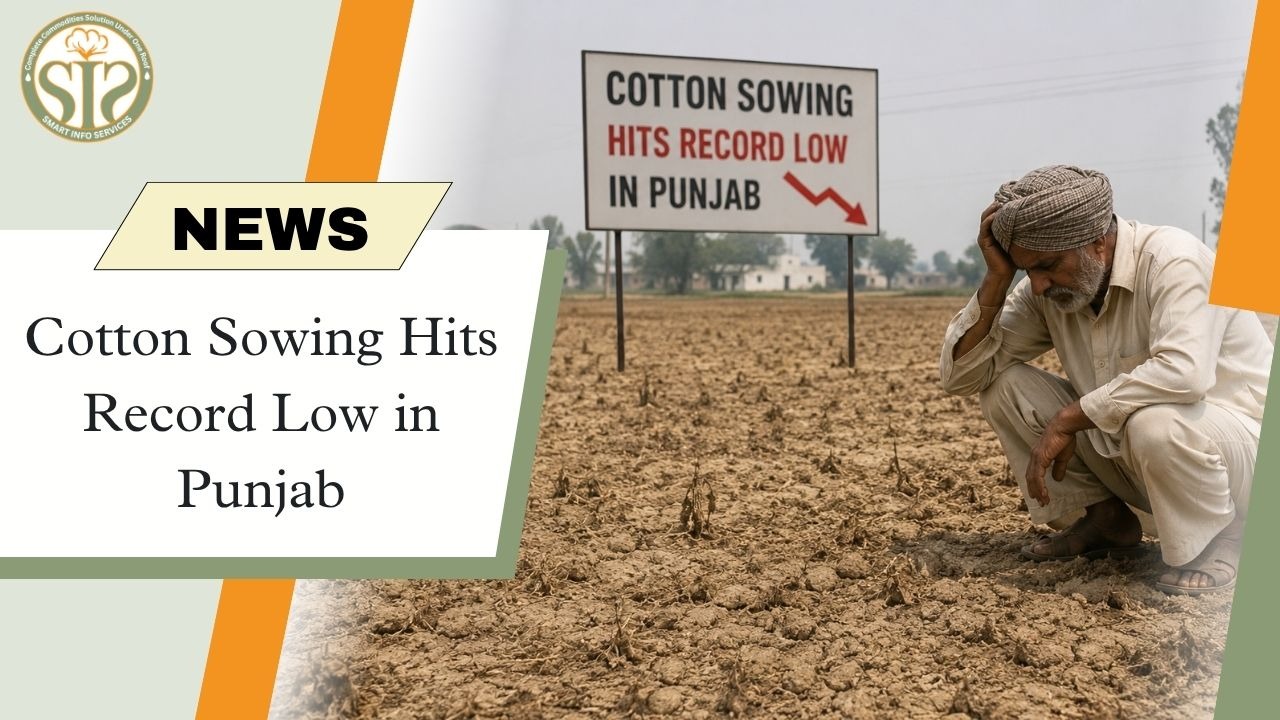
Cotton sowing time is running out in PunjabBathinda: The mercury has started rising with the mercury rising above 40 degree Celsius making the weather hot and humid. The ideal time for cotton sowing is fast approaching but less than half of the target area has been recorded in Punjab. According to the State Agriculture Department, cotton has been sown in 1.21 lakh hectares till May 15 against the target of three lakh hectares.The crop was grown on 2.48 lakh hectares in the previous year and the state government had set a target of a 20% increase in the current season. To attract farmers to cotton by pulling them from the watershed to paddy, the state government also offered 33 per cent subsidy on Bollgard-II (BG-II) seeds. However, according to the sowing trend.The optimum time for cotton sowing is considered when the temperature hovers between 30°-35°C, which normally lasts till May 15. Under such temperature, germination and growth of plants is expected in line and it gets first irrigation after about one month. But with the rise in temperature and the conditions getting hotter and moist, the chances of germination becoming erratic or the plant getting burnt in the scorching heat are high. The number of plants, which is usually 1,80,000-2,00,000 inches at sowing stage, decreases under normal conditions and as the insects grow, the crop becomes more vulnerable to insect attack under moist conditions. Pests Due to two consecutive crop losses (if not failures). The attack and excessive rains have eroded the confidence of the farmers and they are turning to paddy for assured returns. The cotton crop in 2021 was damaged due to pink bollworm and in 2022 it was white fly and pink bollworm to some extent apart from excessive rains at the most inopportune times. The cotton crop had actually started going down after 2015 when the whitefly attack took placeFor the first time about 60% crop damage was reported. Thereafter it moved downwards and reached the lowest level of 2.48 lakh hectares in 2022 sowing season. Even though cotton touched Rs 10,000 per quintal and is stable at Rs 8,000 per quintal, which is much higher than the MSP, for much of 2020 and 2021, and yet in 2022, the damage done by the pest The producer failed to revive the trust.
Rupee strengthens 8 paise against US dollarThe rupee strengthened by 8 paise to close at Rs 82.21 against the dollar this evening.Sensex breaks 413 pointsToday the stock market closed with a fall.Today, where the Sensex closed at a level of 61932.47 points with a fall of 413.24 points.On the other hand, the Nifty closed at a level of 18286.50 points with a decline of 112.30 points.
Why is El Nino a concern for Indian monsoon rainfall?The India Meteorological Office has predicted normal monsoon rainfall in 2023. However, there is a 90% chance of an El Niño weather pattern developing during the June-September monsoon season, increasing the likelihood of below-normal rainfall.In the past, India has experienced below-average rainfall during most El Niño years, sometimes causing severe droughts that destroy crops and force authorities to limit exports of certain food grains.What is El Nino? How does it affect the monsoon of India?El Niño is a meteorological phenomenon that occurs when ocean temperatures in the central and eastern Pacific Ocean exceed normal. The warming causes changes in atmospheric patterns, leading to a weakening of the monsoon circulation over the Indian subcontinent. As a result, the Indian monsoon becomes weaker and less reliable during El Nino years.How close is the relationship between El Nino and monsoon rains?The relationship between El Niño and Indian monsoon rainfall is significant, despite occasional instances when India receives normal or above-normal rainfall during El Niño years. In the past seven decades, El Nino weather patterns occurred 15 times, with India receiving normal or above-normal rainfall six times. However, an opposite trend has emerged in the last four El Nino years, with India experiencing persistent drought conditions and rainfall falling below 90% of the long-term average.El Niño events are classified as weak, moderate, or strong according to the magnitude of the temperature increase above normal.In 2009, a weak El Niño led to a significant deficit in India's rainfall, which fell 78.2% below normal, the lowest recorded in 37 years. In contrast, in 1997, a strong El Niño occurred, yet India received 102% of its normal rainfall. Weather models are suggesting that the 2023 El Niño could be stronger.Why is monsoon important?The monsoon is crucial to India, providing about 70% of the annual rainfall and affecting major crops such as rice, wheat, sugarcane, soybeans and groundnuts. Agriculture accounts for about 19% of India's $3 trillion economy and employs more than half of its 1.4 billion population.The impact of the monsoon extends beyond agriculture, affecting the wider economy. Adequate rainfall boosts overall economic growth, helping to control food price inflation, which has risen recently, and increased lending rates.An increase in agricultural production could also ease export restrictions on sugar, wheat and rice. In contrast, a drought requires importing food and maintaining export restrictions. In 2009, bad rains forced India to import sugar, pushing global prices to record highs.How does monsoon affect inflation and central bank policy?Food accounts for nearly half of India's consumer price index, which the central bank closely monitors when deciding on monetary policy. India received normal or above-normal rainfall for four straight years, yet prices of cereals, dairy products and pulses have jumped in recent months and forced the Reserve Bank of India to sharply hike lending rates .
Cotton farmers in Maharashtra will take out a rally demanding a subsidy of Rs 5,000 per quintalIn a press release, agriculture activist Kishor Tiwari said cotton has been cultivated on a record 10.2 million hectares this year as the price of the key textile ingredient reached Rs 14,000 per quintal last year.Cotton farmers will take out a rally in Maharashtra's Yavatmal district on May 18 to demand a subsidy of Rs 5,000 per quintal and financial assistance for crop growers who have suffered losses due to "excessive" rains, an agriculture activist said on Monday.In a press release, agriculture activist Kishor Tiwari said cotton has been cultivated on a record 10.2 million hectares this year as the price of the key textile ingredient reached Rs 14,000 per quintal last year.However, prices have come down to Rs 7,500 per quintal, forcing many debt-ridden cotton farmers to end their lives. He said 40 per cent of the cotton crop was damaged this year due to "excessive" rains.Tiwari claimed that 3,300 cotton farmers have committed suicide in Maharashtra this season.👇🏻👇🏻👇🏻👇🏻https://smartinfoindia.com/newsdetails/2356
LAHORE: The local cotton market remained stable on Monday with low trading volume.Cotton analyst Naseem Usman said that the rate of cotton in Sindh is Rs 17,000 to Rs 20,000 per head.Cotton rates in Punjab range from Rs 18,000 to Rs 21,000 per head.The rate of footi in Sindh ranges from Rs 5,500 to Rs 8,300 per 40 kg. The rate of footi in Punjab ranges from Rs 6,000 to Rs 8,500 per 40 kg.About 400 bales of Sadiqabad were sold at Rs 21,500 per head.The spot rate remained unchanged at Rs 20,000 per head. Polyester fiber was available at Rs 375 per kg.
Rupee gains 7 paise at 82.23 against US dollarThe Indian rupee opened higher by 7 paise against the US dollar on Tuesday due to a fall in the dollar index and narrowing of India's trade deficit. The rupee opened at 82.23 against the US dollar as against its previous close of 82.30.Sensex breaks 131 points, Nifty below 18400Domestic stocks opened flat on Tuesday amid improving global cues and key fourth quarter earnings data were due today. The S&P BSE benchmark Sensex opened 4.65 points or 0.1 per cent lower at 62,341.06, while the broader NSE Nifty 50 advanced 5 points or 0.03 per cent to 18,403.90.
This evening, the rupee closed at a level of 82.30 rupees with a weakness of 13 paise against the dollar.Sensex rises again, rises 318 pointsToday, where the Sensex closed at a level of 62345.71 points with a gain of about 317.81 points. On the other hand, the Nifty closed at a level of 18398.80 points with a gain of 84.00 points.
Farmers travel to other states for indigenous cotton seedsCotton Market Update Supply of indigenously improved, indigenous hybrids in Khandesh is constrained every year. Due to this, the farmers have to go around Madhya Pradesh, Gujarat for this seed.The concerned companies send their seeds to Madhya Pradesh and Gujarat on time and in large quantities as they get good prices. This seed yields 8 to 10 quintals of cotton per acre. Farmers have experience that big harvest is also good.A company supplies its indigenous cotton seeds to Khandesh. But this supply ends at the end of June. Also, in Jalgaon district, at least one to one and a half lakh packets of this seed are needed, but only 25 to 30 thousand packets come in two phases.In that too these packets are first given to the preferred group. By then the right time for cotton cultivation is over. Due to this, the farmers of Madhya Pradesh and Gujarat are going to their familiar agricultural center managers, cotton growers, relatives to buy the seeds of this company by paying a fixed price and taking a receipt.A maximum of two to three packets are being given to a farmer in Madhya Pradesh, Gujarat. Because the seller and the administration fear that if a farmer is given as many packets as he needs, there will be shortage of the respective seeds. Due to this, the farmers of Khandesh are being given the necessary seeds for cultivation in two to three acres.Time and travel cost increasedFarmers of Muktainagar, Raver, Yawal, Chopra, Shirpur, Dhule, Taloda, Akkalkuwa, Shahada, Navapur of Nandurbar in Khandesh are buying more cotton seeds from abroad.There the respective seeds are available for 950 to 1000 rupees. In this, the farmers have to bear the trouble of commuting and visiting the agricultural centers. It costs more time and money.👇🏻👇🏻👇🏻👇🏻https://smartinfoindia.com/newsdetails/2343
| title | Created At | Action |
|---|---|---|
| Cotton farmers were asked to opt for bed planting. | 18-05-2023 18:30:15 | view |
| Business activities have improved in the cotton market. | 18-05-2023 17:53:36 | view |
| Rupee weakens by 17 paise against US dollar | 17-05-2023 23:50:17 | view |

| Punjab state government has extended the deadline of 33% subsidy on cotton seeds till May | 17-05-2023 23:20:27 | view |
| China has ordered 5 thousand tonnes of cotton yarn | 17-05-2023 22:59:02 | view |
| Rupee depreciates 10 paise to open at 82.30 against US dollar | 17-05-2023 22:35:51 | view |

| Sluggish trading activity in the cotton market | 17-05-2023 22:07:02 | view |
| MCX Cotton Prices Fall 2% on Weak Demand | 17-05-2023 00:12:33 | view |
| Cotton sowing time is running out in Punjab | 16-05-2023 23:48:31 | view |
| Rupee strengthens 8 paise against US dollar | 16-05-2023 23:32:39 | view |

| Why is El Nino a concern for Indian monsoon rainfall? | 16-05-2023 23:02:38 | view |
| Cotton farmers in Maharashtra will take out a rally demanding a subsidy of Rs 5,000 per quintal | 16-05-2023 18:57:31 | view |
| LAHORE: The local cotton market remained stable on Monday with low trading volume. | 16-05-2023 18:28:57 | view |
| Rupee gains 7 paise at 82.23 against US dollar | 16-05-2023 18:09:45 | view |

| This evening, the rupee closed at a level of 82.30 rupees with a weakness of 13 paise against the dollar. | 16-05-2023 01:01:24 | view |
| Farmers travel to other states for indigenous cotton seeds | 15-05-2023 19:49:27 | view |