Filter

Recent News

Weekly Summary Report : Cotton Bales Sold by Cotton Corporation of India (CCI)

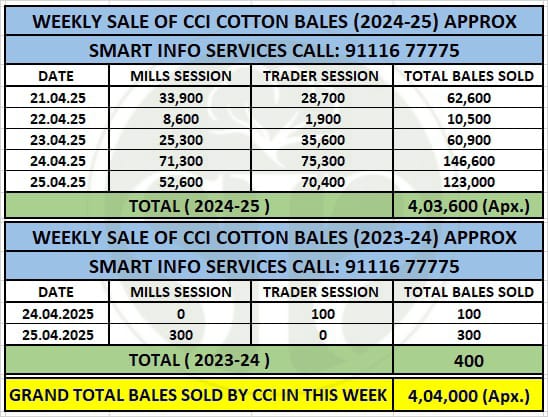
Weekly Summary Report: Cotton Bales Sold by Cotton Corporation of India (CCI)Cotton Corporation of India (CCI) conducted online bidding for cotton bales throughout the week, with the daily sales summary being as follows:21st April 2025: CCI sold a total of 62,600 bales (2024-25 season), comprising 33,900 bales in Mills session and 28,700 bales in Traders session.22nd April 2025: Total sales stood at 10,500 bales (2024-25 season), comprising 8,600 bales in Mills session and 1,900 bales in Traders session.23rd April 2025: Total 60,900 bales (2024-25 season) were sold, which included 25,300 bales in Mills session and 35,600 bales in Traders session.24th April 2025: Highest sales of the week recorded, with 1,46,700 bales sold - which included 1,46,600 bales (2024-25 season) and 100 bales (2023-24 season). Mills session sales stood at 71,300 bales (2024-25) while Traders session sold 75,300 bales (2024-25) and 100 bales (2023-24).25th April 2025: The week concluded with sales of 1,23,300 bales - 1,23,000 bales (2024-25 season) and 300 bales (2023-24 season). Mills session sales were 52,900 bales (including 300 bales from 2023-24), while Traders session recorded 70,400 bales (2024-25).Weekly Total:During the full week, CCI sold around 4,04,000 cotton bales, successfully using its online bidding platform to streamline sales and facilitate smooth trade operations.Stay tuned with SiS for real-time updates on the textile industry.read more :-Ambitious cotton scheme: 2.2 million hectares in Kharif season

Ambitious cotton scheme: 2.2 million hectares in Kharif season

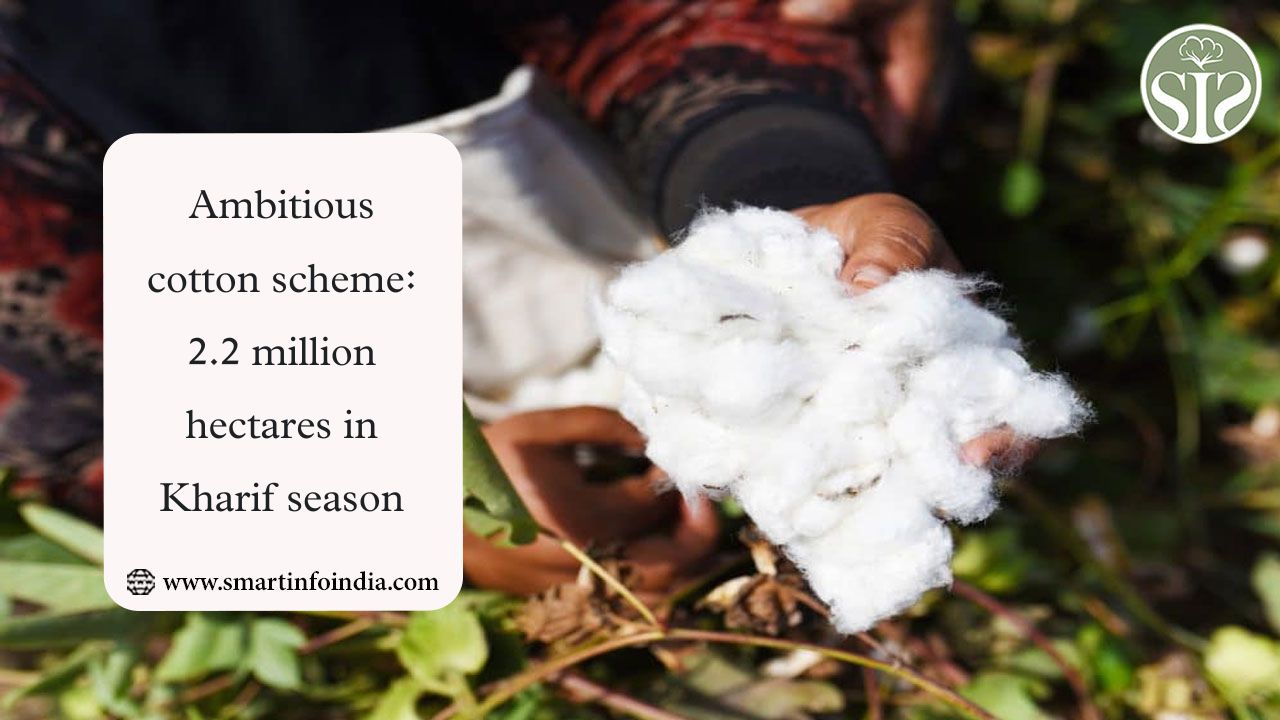
Ambitious 2.2M Hectare Cotton Plan for Kharif SeasonThe government has set an ambitious target of cultivating cotton on 2.2 million hectares of land during the current Kharif season (2025-26). The initiative aims to meet local demand, as well as contribute to the growth and progress of farming communities across the country.According to an official of the Ministry of National Food Security and Research, the target for cotton production has been set at 10.18 million bales, with a focus on ensuring the availability of certified high-yielding seeds and providing adequate supply of agricultural inputs in key sowing areas.Key points of the scheme:Improved seeds and technology: Farmers will be supported with high-quality seeds, pest-resistant varieties, and modern irrigation techniques.Digital monitoring: Satellite-based monitoring will track crop conditions to provide timely advice.Training and awareness: Farmers will be made aware through training and field demonstrations in local languages.Beneficiary States: Priority has been given to cotton producing states like Maharashtra, Gujarat, Telangana, Andhra Pradesh, Madhya Pradesh and Punjab.Agriculture Ministry's vision:"Our aim is not only to increase production but also to improve quality, stabilize prices and boost exports. Mandi reforms and the e-NAM platform are being expanded to give farmers direct access to markets," the agriculture minister said.Challenges:While the scheme is ambitious, challenges like climate change, pest control, and farmers' technical understanding have to be addressed. The government says a multi-pronged strategy has been prepared to address these issues.read more :-Tech adoption can raise cotton productivity, says SABC study

Tech adoption can raise cotton productivity, says SABC study

Tech Boosts Cotton Yields: SABC StudyTechnological interventions such as drip irrigation, fertigation and integrated pest management can enhance cotton productivity, showed a study by South Asia Biotechnology Centre.SABC had conducted the high-tech regenerative cotton demonstration during the Kharif 2024 season at its North India High-Tech R&D Station at Gindran village, Sirsa district of Haryana. The demonstration has provided compelling evidence that technological interventions can significantly enhance cotton productivity, resource efficiency and sustainability.The adoption of drip fertigation systems ensures higher germination rates and optimal plant stand, contributing to better crop establishment and yield potential, while farmers utilising micro-irrigation techniques such as drip systems can achieve up to 60 per cent savings in irrigation water, compared to the conventional cotton farming, said Bhagirath Chaudhary, Founder Director, SABC.Nutrient uptake efficiencyAlso the drip fertigation leads to significant improvements in nutrient uptake efficiency, with 54 per cent for nitrogenous fertilizers, 33 per centfor phosphoric fertilizers, and 79 per cent for sulphur fertilizers, ensuring better croр nutrition and reduced input wastage, Chaudhary said.Further the integration of drip fertigation with advanced agronomic practices demonstrated substantial yield advantages, he said. As against the highest yield of 8-9 quintal per acre in Haryana last year, the average yields in the demonstration unit were significantly higher at 13 quintal per acre, Chaudhary said.SABC has recommended that the drip fertigation should be widely promoted as a standard agronomic practice to improve water and nutrient efficiency in cotton farming. It has also suggested that the integrated pest management (IPM), including mating disruption technology (PBKnot) and pheromone traps for monitoring, should be scaled up to reduce pesticide usage, minimise pest incidence, and ensure environmental protection.The adoption of water storage tanks and solar-powered irrigation systems alongside drip fertigation can play a crucial role in climate change mitigation and sustainable water management. The success of these technology-driven demonstrations serves as a pathway for increased adoption across the cotton-growing belt, offering a ray of hope for farmers, ginners, spinners and textile industry of North India.By embracing precision agriculture, resource-efficient practices, and modern pest management strategies, the North cotton growing zone can revitalise cotton cultivation, enhance productivity, and ensure long-term sustainability for both farmers and the industry. In summary, the successful demonstration of these innovative technologies can become a ray of hope for farmers and cotton value chain partners of the North cotton growing region which results in the increase of area, productivity and production of cotton through technology adoption.”read more :-Rupee lower 25 Paisa Against Dollar, Closes at 85.44

Donald Trump tariff news live updates: US says India could be first country to sign trade deal with Washington

India May Be First to Sign US Trade Deal, Says WashingtonAccording to the New York Post, US Treasury Secretary Scott Bessant has said that he expects India to be the first to sign a bilateral trade deal to avoid President Donald Trump's reciprocal tariffs. The 26 per cent 'reciprocal' tariff on Indian exports to the US is currently on hold for 90 days, which is set to expire on July 8. However, like other countries, India is subject to a 10 per cent tariff under the current policy.According to the New York Post, Bessant told a roundtable of about a dozen reporters on Wednesday that trade talks with India are "very close" to reaching a successful conclusion because the world's most populous country does not have "that many tariffs"."India also has lower non-tariff trade barriers, obviously, there's no currency manipulation, very few government subsidies, so it's very easy to deal with Indians," Bessant said at a DC event organised on the sidelines of the annual meetings of the World Bank and the International Monetary Fund.President Trump has demanded that other countries eliminate their tariff and non-tariff barriers on US goods, as well as close the US trade deficit, the New York Post said.Earlier on Tuesday in Jaipur, US Vice President JD Vance urged India to eliminate non-tariff barriers, give greater access to its markets and buy more US energy and military hardware, as he laid out a sweeping roadmap for deeper ties between the two countries for a "prosperous and peaceful" 21st century.read more :-Indian Rupee higher 32 Paisa, Ends at 85.27 per Dollar

Cotton Productivity: An autonomous organisation is needed for cotton productivity estimation; Experts in the field of cotton research and productivity enhancement are in demand

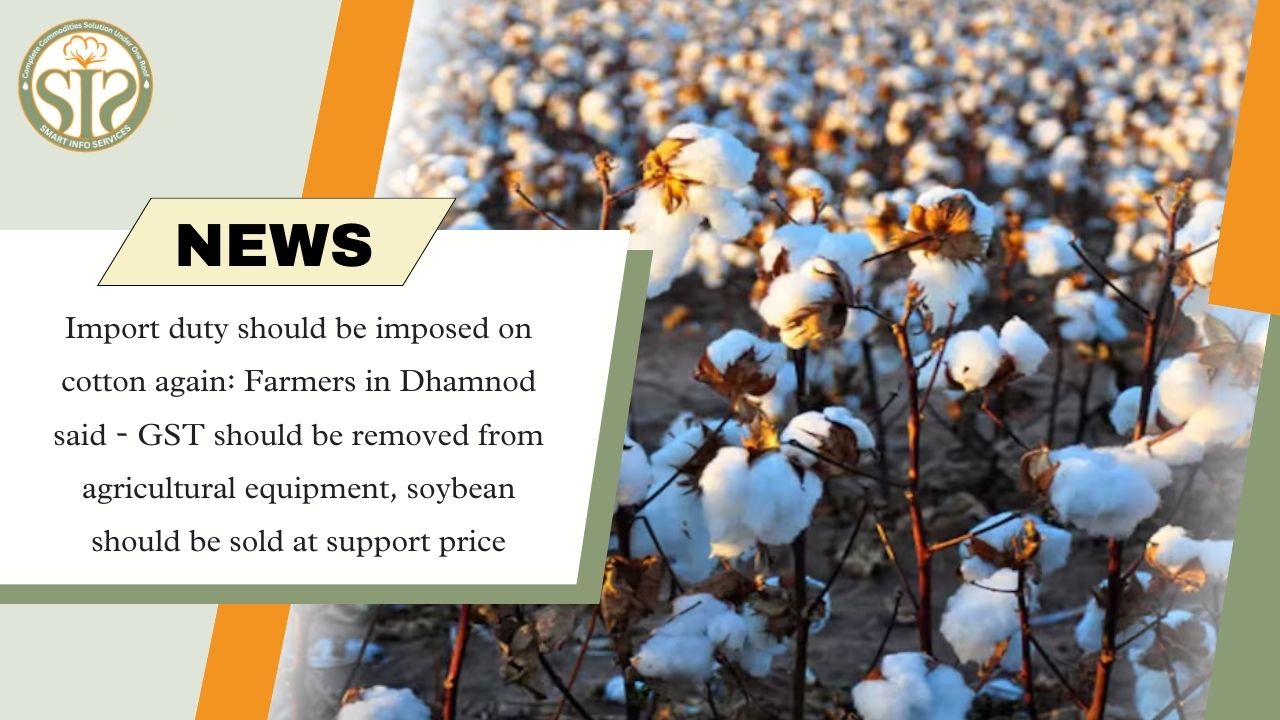
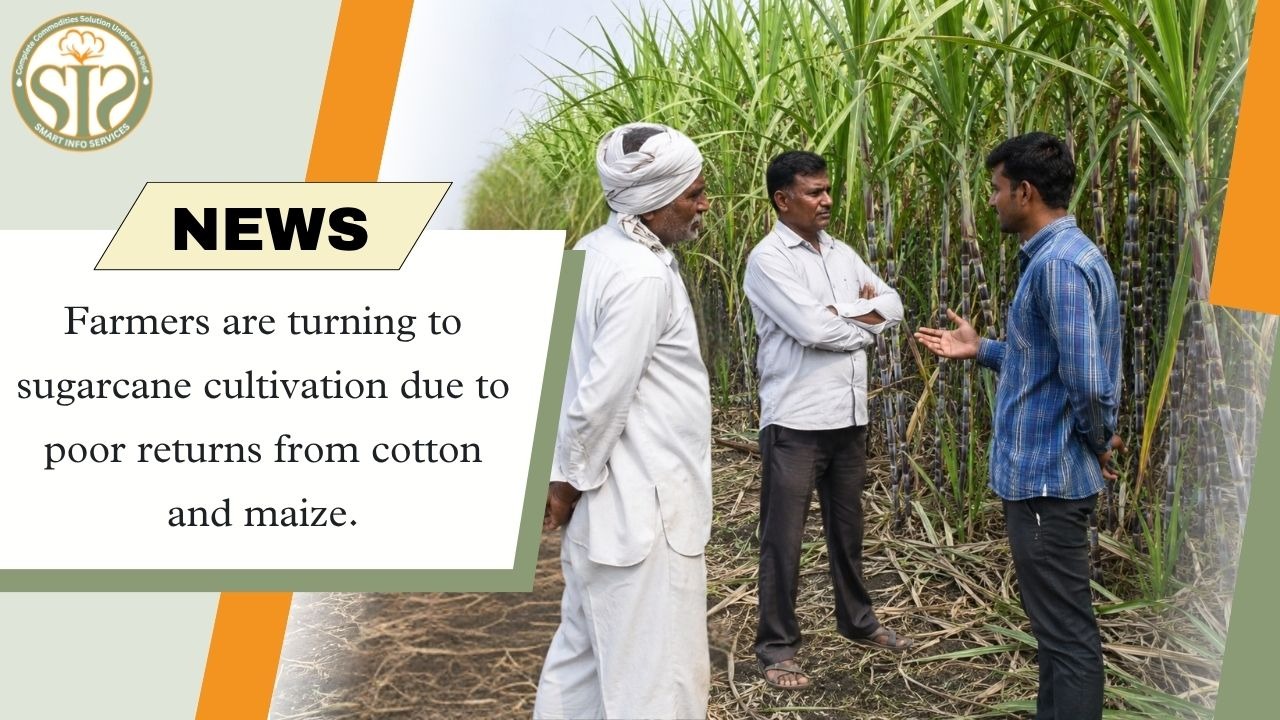
Establishing an Autonomous Body for Cotton Productivity Estimation and ResearchThe policy of increasing productivity at the beginning of the season and then gradually reducing it is implemented through domestic entities to put pressure on imports. This is the reason why cotton gets a low price during the season. Now there is a demand to reduce the import duty on imports to zero. Looking at this overall situation, experts in the field are demanding that the government set up an autonomous organisation to estimate cotton productivity.Domestic cotton productivity is low. It has been observed that pests and diseases are spreading as a result of climate change, which is also affecting productivity. The area under cotton cultivation in Punjab and Haryana has declined significantly in the last few years, as the pink bollworm infestation has gone out of control in both these states. In Maharashtra too, farmers are preferring maize crop over cotton, while in Gujarat farmers have given preference to groundnut.It is feared that the cotton acreage will decrease in both these states in the upcoming Kharif season. This is why we had to import twice the amount of cotton bales this year compared to last year. Last year 1.5 million bales were imported, and this year 3 million bales have been imported. While all this is happening, there is also talk that farmers are not getting the expected price. This is because the trade lobby has estimated higher productivity at the beginning of the season.Accordingly, cotton prices remain under pressure. Experts in the sector also said that after this, pressure is exerted to increase imports by claiming a decrease in productivity. The game being played is that if imports increase, prices will again come under pressure. That is why experts say that there should be a government system to estimate the productivity and production of cotton. It was also said that this will control the large fluctuations in the productivity declared at the commercial level and help farmers get good profits....It is supply and demand320 lakh bales demanded291 lakh bales produced3.3 million bales importedThere used to be a Cotton Advisory Board at the government level. Now it has been renamed as COCPC (Cotton Production and Consumption). It has four members: Union Agriculture Ministry, Cotton Association of India, Indian Spinning Mills Association and Cotton Corporation of India. Their meetings are held and productivity is estimated. So it is wrong to say that there is no such committee.read more :-Rupee Falls 15 Paisa, Closes at 85.42 Against US Dollar

End of US-China trade war? Trump now says tariffs on China will be 'significantly reduced'

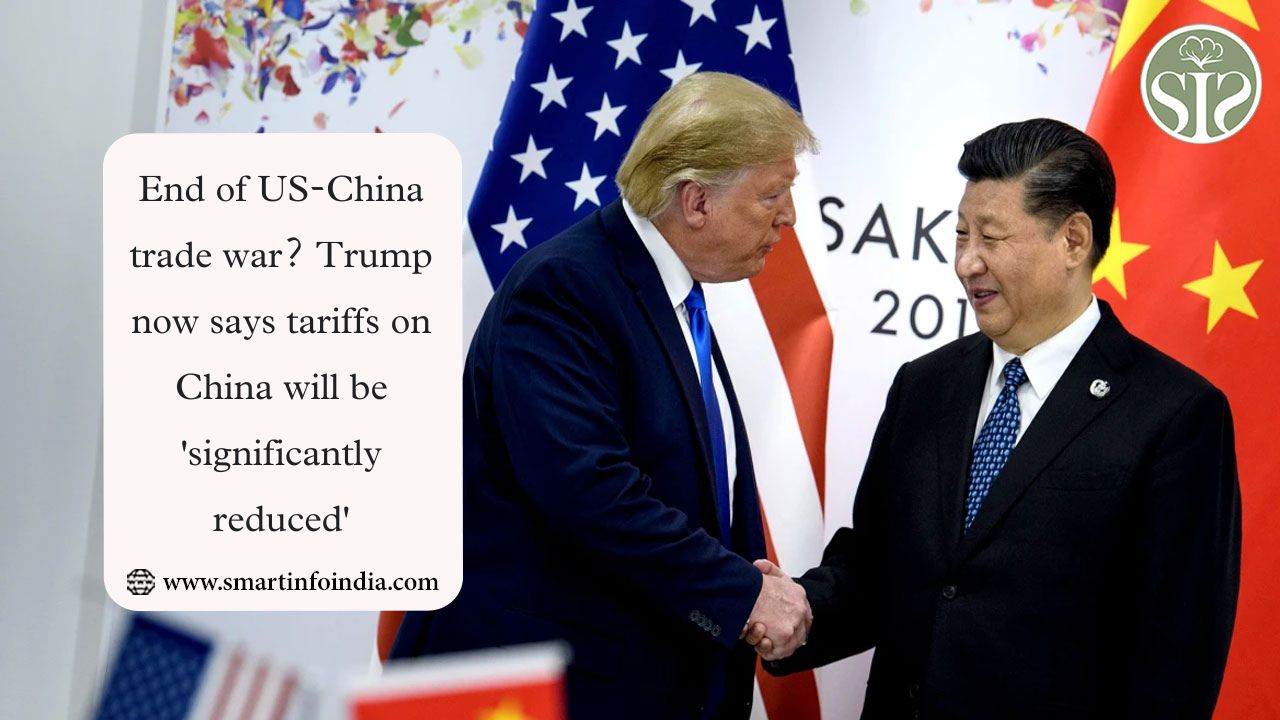
Trump Hints at Big China Tariff ReductionsUS President Donald Trump has suggested that the historically high tariffs he has imposed on Chinese imports will not last long. Speaking from the Oval Office on Tuesday, Trump told reporters that the 145% tariff rate will eventually be "significantly reduced", although he maintained a confident tone about the US bargaining position."145% is very high, and it won't be that high," Trump said. "No, it won't be anywhere near that high. It will be significantly reduced. But it won't be zero - it used to be zero. We were just ruined. China was cheating us.""We're going to be very nice, they're going to be very nice, and we'll see what happens. But eventually," he said, "they're going to have to make a deal because otherwise they won't be able to make a deal in the United States."President Trump says tariffs with China will be significantly reduced |Trump's change in tone came shortly after Treasury Secretary Scott Bessant warned behind closed doors that the ongoing US-China trade impasse could not be sustained. "Nobody thinks the current situation is sustainable," Bessant reportedly told investors at a JPMorgan Chase forum in Washington.The current tariff scenario sees multiple rounds of hikes, with Chinese imports now subject to tariffs totaling 145%. In response, China has imposed retaliatory tariffs of 125% on US exports.Electronics such as smartphones and semiconductors remain exempt, while a 20% "blanket" tariff linked to concerns over fentanyl remains in place.Formal negotiations between Washington and Beijing have not begun. However, White House press secretary Caroline Levitt said more than 100 countries have expressed interest in the new trade arrangement following Trump's recent announcement of global tariffs - though China is not yet among them.Despite the absence of talks with Beijing, Levitt said the administration is "setting the stage" for a future deal with China and is "doing very well" on trade overall.Market reactions indicate cautious optimism. US stock indexes rose more than 2% after Bessant's comments, indicating that investors may be betting on a future easing of tensions - even if the road to any agreement is long.read more :-Rupee Opens 9 Paise Lower at 85.27 Against US Dollar

Copyright© 2023 | Smart Info Service
Application Download