Recent News

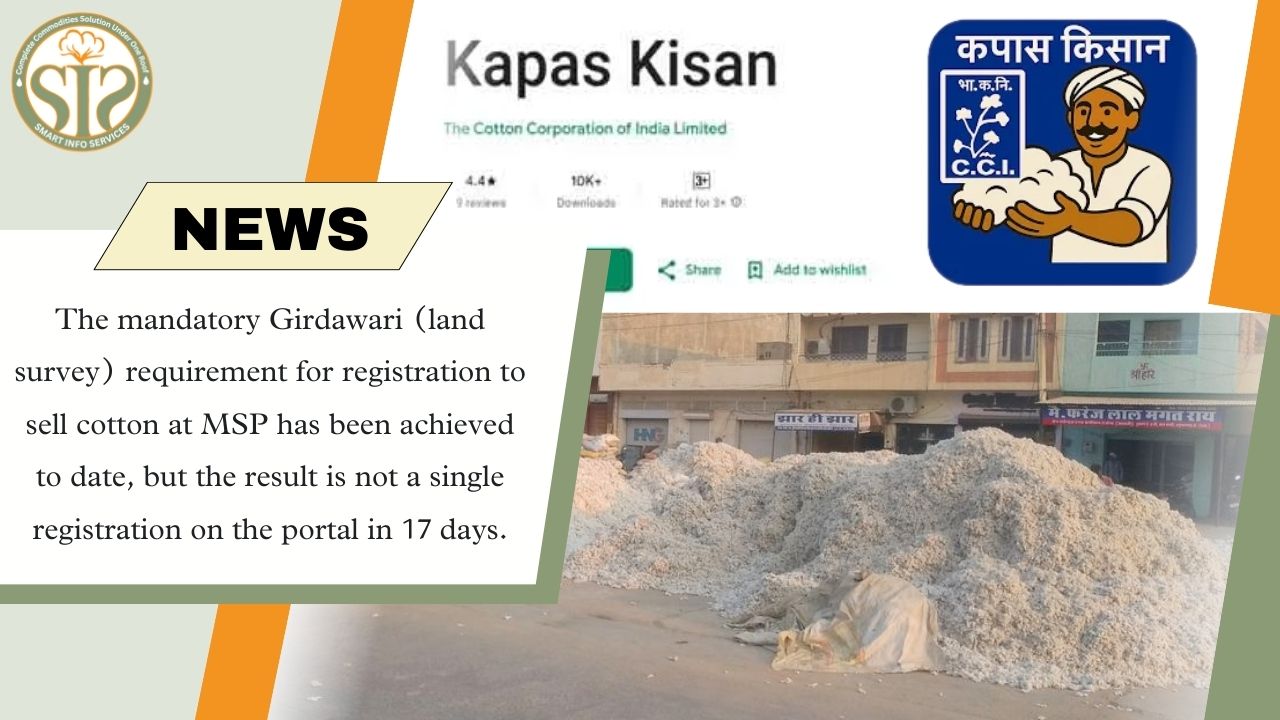
Girdawari mandatory: Zero registration on MSP portal in 17 days

The mandatory Girdawari (land survey) requirement for registration to sell cotton at MSP has been achieved to date, but the result is not a single registration on the portal in 17 days.Piles of cotton piled up on the bales at Hanumangarh Junction Mandi. | Hanumangarh: For the first time, the CCI has implemented online registration for cotton purchases at the Minimum Support Price (MSP). The 'Kapas Kisan' app has been launched for this purpose on September 1st.After the Girdawari (land survey) is 100% complete, the report will be certified and uploaded. Only then will farmers be able to obtain the Girdawari report from the Patwari or online. The complete Girdawari is unlikely to be completed before October 15th. Consequently, government cotton procurement will also be delayed. The Agricultural Marketing Department has written to the CCI requesting the removal of the Girdawari requirement at the time of registration. Despite this, the CCI has not issued any orders in this regard. The FCI also purchases wheat at the support price based on online registration, but a survey is not required during registration.When farmers bring their produce to the market, the survey is conducted and the purchase is made.However, the CCI has made it mandatory to upload the survey report at the time of registration. Consequently, registration will be delayed, and procurement will not begin on time. This will result in significant losses for farmers. This year, cotton has been sown on approximately 180,000 hectares in the district. The sown area is approximately 61,000 hectares more than last year. The crop is in good condition so far. Consequently, production is expected to be good. Cotton will arrive in the markets in October.If procurement at the support price does not begin on time, farmers will face difficulties. This time, the Cotton Corporation of India (CCI) will procure at nine centers in the district. The CCI has written to the secretaries of the Agricultural Produce Market Committees of Hanumangarh Town, Junction, Goluwala, Pilibanga, Rawatsar, Bhadra, Nohar, Tibbi, and Sangaria, urging them to educate farmers about registering. However, due to the mandatory uploading of a Girdawari report, farmers are unable to register. CCI officials claim that online registration has been initiated for the convenience of farmers. After registration, farmers will be able to bring their produce to the market according to their slots. The Girdawari requirement is to harass farmers. The government does not want to purchase agricultural commodities at the support price. The government makes new rules every day, but does not consider the interests of farmers. Therefore, various obstacles are imposed. First, online registration was made mandatory for purchasing cotton. Now, Girdawari is being imposed. Farmers will not tolerate this.Surendra Sharma, farmer leader, Hanumangarh Deputy Director, said, "A letter has been written to the General Manager to remove the requirement of Girdawari (land survey) during registration. Girdawari is mandatory during registration on the Cotton App. Due to this, not a single registration has been made. A letter has been written to the General Manager of CCI to remove the requirement of Girdawari during registration." DL Kalwa, Deputy Director, Agricultural Marketing Department, Hanumangarh. The Central Government has increased the MSP of cotton by Rs. 589 per quintal, benefiting farmers. This time, the Central Government has increased the MSP of cotton by Rs. 589 per quintal. This time, the support price for medium-staple cotton has been set at Rs. 7710 per quintal, and the MSP for long-staple cotton has been set at Rs. 8110 per quintal. In recent years, Hanumangarh district has produced common staple cotton, between medium and long. When arrivals begin in the markets, the CCI determines the price by checking the length. Purchases are then made at that rate. Last year, the price of medium staple cotton was fixed at Rs 7121 per quintal and that of long staple at Rs 7521 per quintal. Due to low production last year, procurement could not be done at the support price.Traders only purchased the produce through open auction. The average market price during the season was Rs 6500 to 7000 per quintal. Guidelines from higher level, Girdawari is necessary for registration. Cotton producing farmers can register online on the Kapas Kisan App to sell their produce. Girdawari is necessary at the time of registration. Registration and procurement guidelines for cotton procurement are decided at higher level. Kewalkrishna Sharma, Quality Inspector, CCI

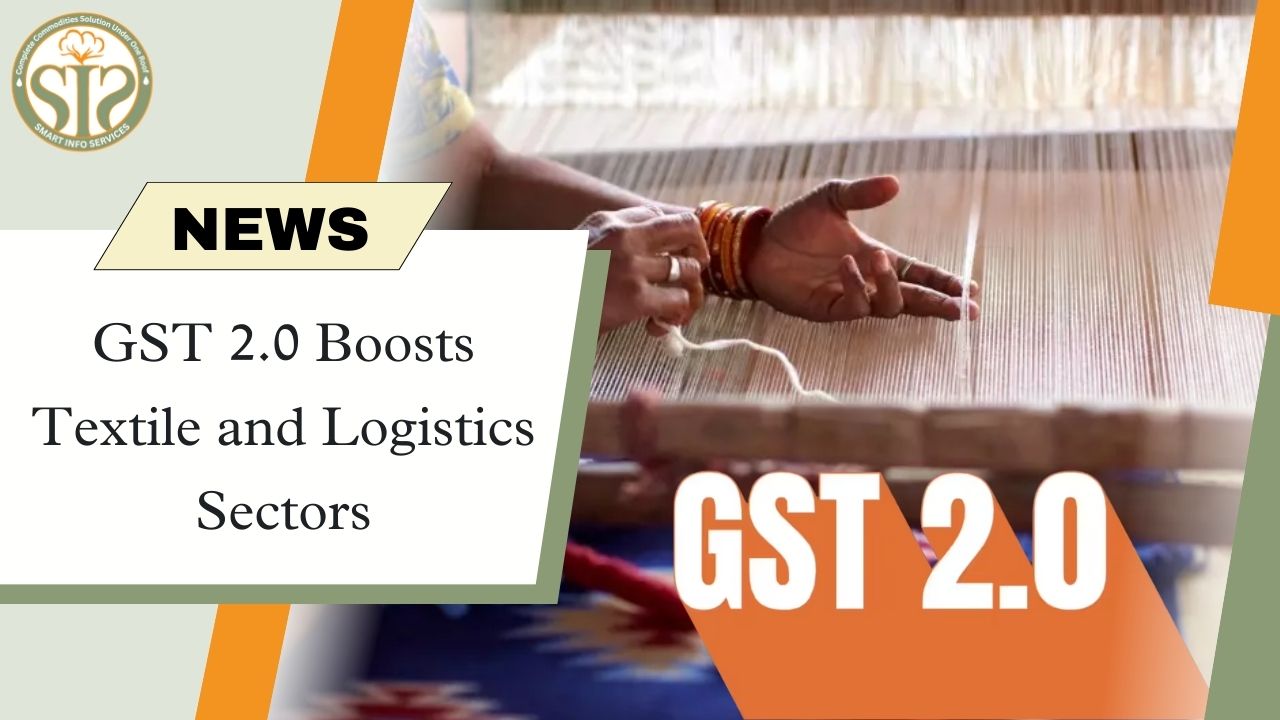
"GST 2.0: New impetus for textiles and logistics"

GST 2.0 Boosts Textile and Logistics SectorsNew Delhi : According to an official statement issued on Thursday, the rationalization of the Goods and Services Tax (GST) under GST 2.0 is a significant reform aimed at addressing structural anomalies, reducing costs, and boosting demand in the textile and logistics industries. Both of these are crucial for domestic growth, employment, and export competitiveness.By uniforming tax rates across the value chain, the GST reform ensures affordability for consumers, sustains employment in labor-intensive sectors, and enhances India's ability to compete globally. The statement states that in the textile sector, this rationalization strengthens the entire value chain—from fiber to apparel—by reducing distortions, improving apparel affordability, reviving retail demand, and boosting export competitiveness.The reduction in GST will make apparel more affordable for middle- and lower-income families, boosting domestic demand and having a significant impact in smaller towns and rural areas.The GST on readymade garments up to ₹2,500 is now 5%, making apparel more affordable and boosting domestic demand.Reducing the GST on man-made fibers and yarns from 12% and 18% to 5% removes the inverted duty structure and strengthens small and medium enterprises, while reducing the GST on carpets and other textile floor coverings from 12% to 5% will enhance global competitiveness, the statement said.Similarly, reducing the GST on commercial goods vehicles from 28% to 18% will reduce logistics costs and boost exports.GST reforms also extend to the transportation sector, which plays a key role in reducing logistics costs and promoting industrial growth. Trucks and delivery vans, which carry approximately 65-70% of India's freight traffic, benefit significantly from the tax rationalization. Cheaper freight transportation – Lower costs per tonne-km benefit the transportation of textiles, FMCG, and e-commerce deliveries.The cascading effect of lower logistics costs helps mitigate overall price pressures and reduce inflation. Furthermore, lower logistics costs make the Indian textile industry more competitive abroad.Rationalizing GST in the textile and logistics sectors is a decisive step towards strengthening India's manufacturing base, improving affordability, and boosting exports. By reducing structural imbalances and easing cost pressures, these reforms benefit consumers, small businesses, and exporters alike. The statement further stated that these reforms reinforce the vision of a globally competitive India, driven by resilient supply chains and a thriving textile sector.read more :- Tamil nadu : Mini textile park inaugurated in Karur

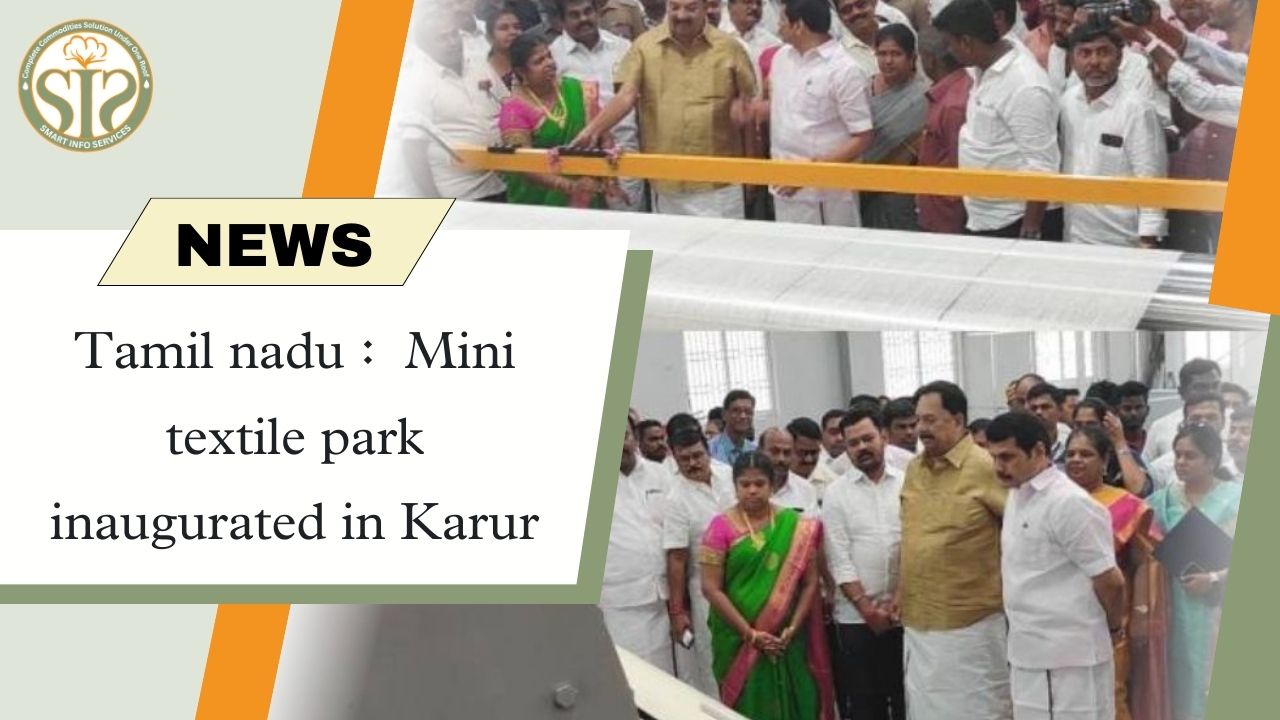
Tamil nadu : Mini textile park inaugurated in Karur

Tamil Nadu: Karur gets new textile parkMinister for Textiles and Handlooms R. Gandhi on Thursday inaugurated a mini textile park at Kodangipatti on Thursday.It has been set up under the Tamil Nadu Mini Textile Park Scheme. Under the scheme, the State government will bear 50% of the expenditure on establishing common facilities, infrastructure, and factory buildings. The maximum grant will be ₹2.5 crore for each park. A sum of ₹11.87 crore had been spent on establishing the park. Of the expenditure, the State government had extended ₹2.5 crore as grant. Oasis Texpark Private Ltd. has spent the remaining amount.Minister for Textiles and Handlooms R. Gandhi on Thursday inaugurated a mini textile park at Kodangipatti on Thursday.It has been set up under the Tamil Nadu Mini Textile Park Scheme. Under the scheme, the State government will bear 50% of the expenditure on establishing common facilities, infrastructure, and factory buildings. The maximum grant will be ₹2.5 crore for each park. A sum of ₹11.87 crore had been spent on establishing the park. Of the expenditure, the State government had extended ₹2.5 crore as grant. Oasis Texpark Private Ltd. has spent the remaining amount.A press release said that three companies would function in the textile park. About 400 persons would get employment.Mr. Gandhi said that approval had been given to nine mini textile parks in Karur district. Of them, two parks had started functioning. Other parks were under construction.Earlier, Mr. Gandhi and Mr. Senthilbalaji inaugurated a quilt machine erected at an estimate of ₹35 lakh at Thiyagi Kumaran Handloom Weavers Cooperative Society here.read more :- Rupee open Falls 09 Paise to 88.22/USD

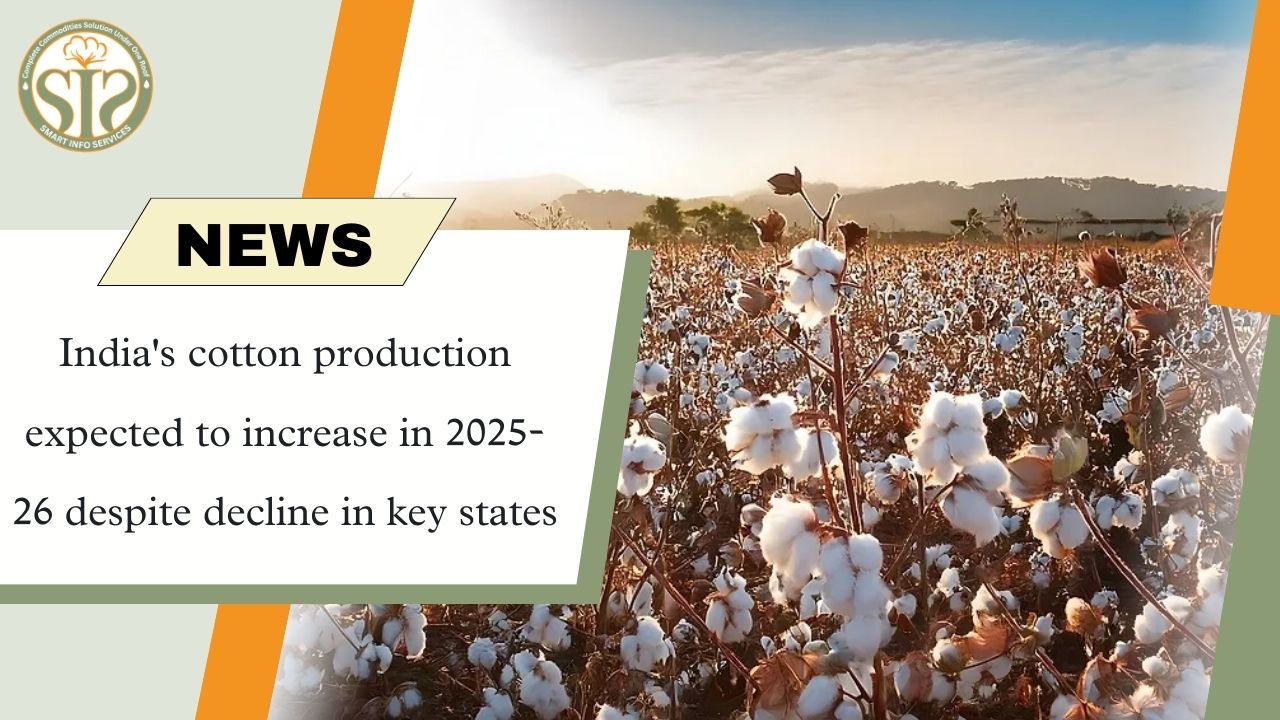
India's cotton production expected to increase in 2025-26

India's cotton production expected to increase in 2025-26 despite decline in key statesIndia's cotton production is projected to be higher than last year in the 2025-26 season, starting in October. However, crop acreage has declined in key states like Maharashtra and Gujarat, and heavy rains in August have damaged standing crops in some areas.Key State-wise Situation* Gujarat: Acreage decreased from 23.66 lakh hectares to 20.82 lakh hectares (12% decline).* Maharashtra: Acreage decreased from 40.81 lakh hectares to 38.44 lakh hectares.* Telangana: Acreage increased from 18.11 lakh hectares to 18.51 lakh hectares.* Karnataka: Acreage increased from 7.79 lakh hectares to 8.08 lakh hectares.* Andhra Pradesh: A slight decrease, from 4.13 lakh hectares to 3.77 lakh hectares.Production EstimatesAccording to trade associations, India's cotton production in 2025-26 could reach 32.5–34 million bales (each weighing 170 kg), up from 31.2 million bales in the current season.* Karnataka: Increase from 2.4 to 3 million bales (25% increase).* Andhra Pradesh: Increase from 1.25 to 1.7 million bales.* Telangana: Increase from 5.0 to 5.3–5.5 million bales.Total production in South India could reach 10.5 million bales, up from last year's 8.8 million bales, and offset the shortfall in other regions.Market ImpactCotton arrivals are expected to reach 30–35,000 bales per day by Dussehra, significantly higher than the current 10,000 bales. However, prices are under pressure due to increased production and imports.The government has removed the 11% import duty until the end of the year to support the textile industry. Due to this, imports have reached a record 4.1 million bales in 2024-25 (up from 1.5 million bales last year). Imports are expected to exceed 2 million bales in October-December alone.Raw cotton prices are trading below the MSP (₹5,500–7,000 per quintal). Recent rains in northern states have also affected fiber quality.CCI's RoleThe Cotton Corporation of India (CCI) has prepared for large-scale procurement at MSP. Operations will begin from October 1st through 550 centers in North India. CCI, which purchased 10 million bales last year, has a stock of 1.2 million bales this time.Global OutlookThe USDA estimates that India's production will increase, while imports will decrease to 3.58 million bales and exports will increase to 1.664 million bales.According to the ICAC, global production will decline from 25.9 million tons to 25.5 million tons. Production has been affected due to weather and pests in America, Pakistan and Sudan.read more:-  INR Drops 17 Paise, Closes at 88.13 per Dollar

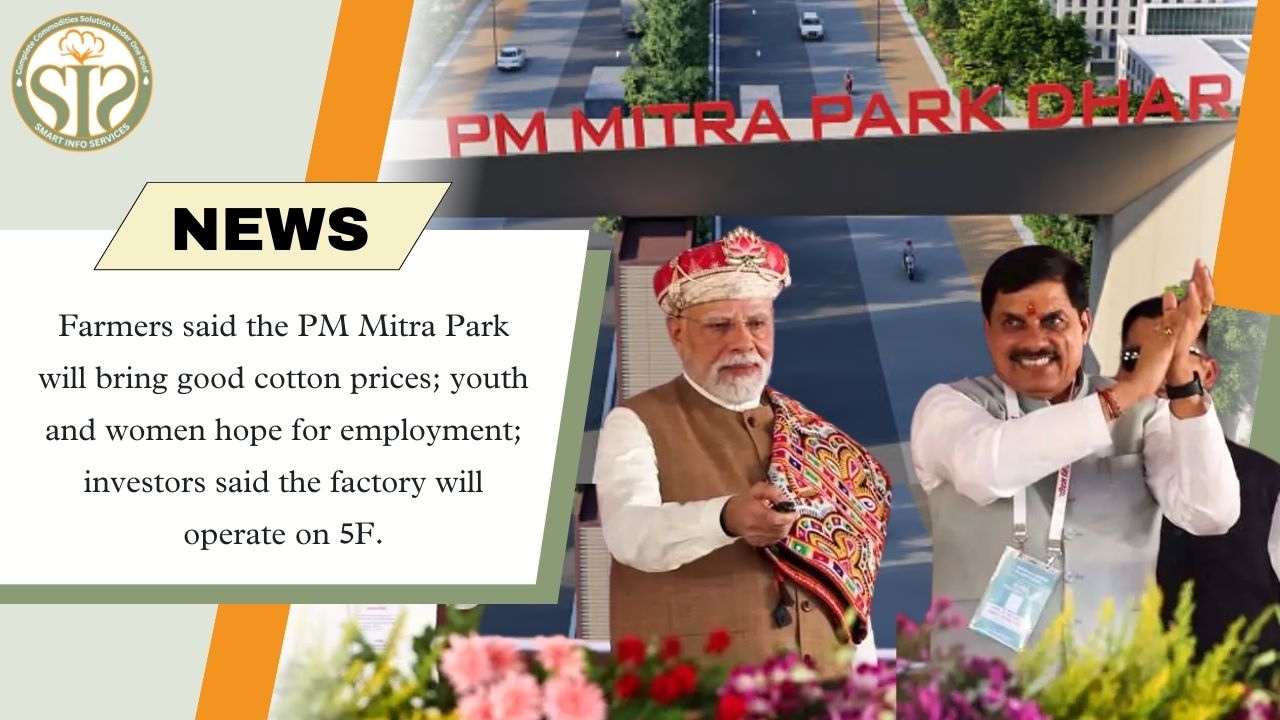
PM Mitra Park: Better prices for farmers, employment for youth, investment on 5F model

Farmers said the PM Mitra Park will bring good cotton prices; youth and women hope for employment; investors said the factory will operate on 5F.Prime Minister Narendra Modi laid the foundation stone for the country's largest PM Mitra Park, to be built on approximately 2,158 acres of land in Bhainsala, Dhar, on Wednesday. Production in textile-related industries is expected to begin in this park within two years.Cotton farmers and textile entrepreneurs in Malwa-Nimar have high hopes for this park. Youth across the region are also excited about the potential for employment. Dainik Bhaskar spoke with farmers, youth, women, and industrialists and workers about the project. Find out who has what expectations...First, find out...what farmers expect.Manna Lal Bhuria, a cotton farmer from Chayan village, says, "We grow a large quantity of cotton. Currently, our cotton is small. We believe that cotton will be purchased at good prices in the village itself."Narsingh Bhabar, a farmer from Gandhwani, said, "Setting up factories here will provide employment. Children don't have any work right now, but once this work starts, they will. Women will get good work. We grow cotton, which currently sells for 60-70 rupees a kilo. We believe that once the factories open, our cotton will be bought for at least 100 rupees a kilo."What Women, Youth, and Workers SaidPooja, a couple from Dotriya village, said, "Our wages will increase with the establishment of factories here. We will benefit greatly." Local youth Shobharam Vaskel said, "We are still hoping for government jobs. But even if we don't, we will find jobs here in this park. We won't have to go out looking for jobs."Now read what the industrialists investing in the park said... A zipper industry manufacturing chains for pants and bags will spend 2.70 crore rupees. Aditya Jat, manager of the company that came to PM Mitra Park to obtain an LOI for a zipper manufacturing company, said, "Our company, Chaudhary Infra Project, is based in Badnawar.Our company is going to invest 2 crore 70 lakh rupees here. We have been allotted 10 thousand square feet of land. Our company will manufacture chains for pants, bags, and raincoats. The chain used for designing clothes is called a zipper. Our company will work here to manufacture zippers (chains).An Indore company will work on the park's 5F theme. Sanjay Agarwal, a textile industrialist from Indore, one of the industrialists allotted land in PM Mitra Park, said, "Our company works in the textile sector.We have committed to investing 4 crore 72 lakh rupees here under the name NASA Fiber to Fashion." We have filed a project for dyeing, knitting, and garmenting here. Our company will work on the 5F theme of PM Mitra Park.------------------ These are the 5Fs- ---------* FARM - Cotton-producing farmers will be able to bring cotton directly from their fields and sell it to companies .* Fiber - Cotton will be ginned, i.e., cleaned, and made into yarn .* Factory - Cotton will be spun, woven, and separated from the cotton.* Fashion: Clothing designing, garmenting, etc. will be done, such as buttoning .* Foreign: After packaging the finished garments in the factory, they will be exported directly from here to foreign countries.Industrialist said, "If cotton is purchased at competitive rates, farmers will benefit." Lakshmi Narayan Gupta, Director of TDN Fibers Limited, Kukshi, said, "Our business is cotton fibers. We believe we will receive some more concessions. We are also participating in the park." We are planning production here as well.Setting up plants here will benefit local residents. Cotton farmers will see increased profits. When traders purchase cotton from an average farmer at competitive rates, he will receive more money and his income will increase.read more :- Rupee opens 16 paise down at 87.96

Brazilian cotton prices near decline (2024-25)

Brazilian cotton prices fall as 2024-25 harvest nears completion Cotton prices in Brazil moved down in early September due to the progress of harvesting and processing activities of the 2024-25 season, which boosted the availability of batches and encouraged sellers to be more flexible about quotations. Decreases in dollar values abroad also reinforced the downward trend in the domestic market, as per the Centre for Advanced Studies on Applied Economics (CEPEA).Due to constant price drops, many sellers stayed away from closing trades in the spot market, preferring to accomplish term contracts, which were closed at more attractive values compared to current ones. Purchasers, in turn, were closing only a few deals.The CEPEA/ESALQ Index (payment in 8 days) decreased 6.05 per cent between August 29 and September 15, closing at BRL 3.6703 (~$0.69) per pound on September 15. On September 12, it closed at BRL 3.6590 per pound, the lowest value since early July 2023, in nominal terms (BRL 3.7047 per pound), CEPEA said in its latest fortnightly report on the Brazilian cotton market.According to data from Brazilian Cotton Growers Association (ABRAPA), 90.83 per cent of 2024-25 crops had been harvested and 30.65 per cent had been processed until September 4.International Cotton Advisory Committee (ICAC) estimates the global area at 30.8 million hectares in 2025-26, for a decrease of 0.76 per cent compared to the previous crop. Productivity is expected to move up 1.4 per cent to 829.18 kilos per hectare, resulting in production at 25.55 million tons, up 0.63 per cent year-on-year. World consumption is likely to reach 25.519 million tons.In Brazil, production may increase 7.19 per cent to the record of 3.92 million tons in 2025-26, sustained by the higher area. Domestic consumption is likely to reach 752 thousand tons, up 0.27 per cent compared to the season before, the highest since 2014-15 (801 thousand tons).read more :- Rupee higher 02 Paise Against USD, Closes at 87.80
Rohtak: Hub of grain-cotton trade, new hub of MSME

MSME for Bharat: A hub for grain and cotton trade, strong connectivity has transformed Rohtak into a hub of industrial activity.Micro, Small, and Medium Enterprises (MSMEs) are considered the backbone of growth in the Indian economy. This sector not only employs millions of people but also plays a major role in fostering innovation and accelerating local and regional development. Amar Ujala is organizing the "MSME for Bharat Conclave" to discuss these opportunities and challenges.MSME for Bharat Conclave InformationThe MSME for Bharat Conclave in Rohtak will be held on September 18th from 11 a.m. to 2 p.m. The venue is Radhakrishnan Auditorium, Maharishi Dayanand University. Several prominent figures from the industry, trade, and development sectors will attend the event. The chief guest will be Mr. Rajesh Nagar, Minister of Food and Supplies, Government of Haryana.Objective of the ConclaveExperts will share their views on key topics such as digital transformation, easy access to finance, supply chain modernization, export expansion, skill development, and policy reforms. Additionally, new funding options, modern branding and marketing techniques, and practical uses of Artificial Intelligence (AI) will be highlighted.The conclave will specifically emphasize promoting women's participation, connecting MSMEs to international markets, and providing global recognition to local products through the One District One Product (ODOP) scheme.Experts believe that such events will prove crucial in connecting the MSME sector with new technology and financial opportunities, preparing them for global competition, and shaping future strategies. This conclave will be a unique opportunity for entrepreneurs across the country, including Rohtak, where industry and business leaders will share their experiences and suggestions.Let's learn about the importance of the MSME sector in Rohtak, Haryana, to the national economy.The Specialty of Rohtak's Light IndustryRohtak in Haryana is known as a major grain and cotton trading center. Light industries are also active here, strengthening the local economy.The city is located on the main Delhi-Ferozepur railway line, making it a vital link in the trade map of North India. Rohtak is also a major hub on the regional road network, offering easy access to Delhi, Bhiwani, Panipat, and other cities.Due to its strong position on both trade and transportation fronts, Rohtak continues to be a hub of industrial and economic activity.Industry ChallengesIndustries here face several challenges. Increasing traffic and expensive logistics put pressure on infrastructure, while the grain and cotton trade remains volatile due to seasonality. Small and medium-sized enterprises face a lack of capital and affordable credit. Furthermore, competition from larger industrial hubs and a reliance on traditional technology are slowing the growth of local industries.read more:-   Cotton production to rise despite lower acreage and more rainfall

Related News

Youtube Videos

जानिए आज का कपास बाज़ार? 😱 कपास, बीज, यार्न बाज़ार | Cotton Market Rate Today
जानिए आज का कपास बाज़ार? 😱 कपास, बीज, यार्न बाज़ार | Cotton...
कैसा रहा आज का कपास बाजार? 😱 Cotton Market Rate Today 29 Oct 2026
कैसा रहा आज का कपास बाजार? 😱 Cotton Market Rate Today 29 Oc...
जानिए आज का कपास बाज़ार! 😱 कॉटन + सीड + खल पूरा अपडेट | Cotton Market Rate 28 Oct 2026
जानिए आज का कपास बाज़ार! 😱 कॉटन + सीड + खल पूरा अपडेट | Cot...
Application Download
Whatsapp Contact