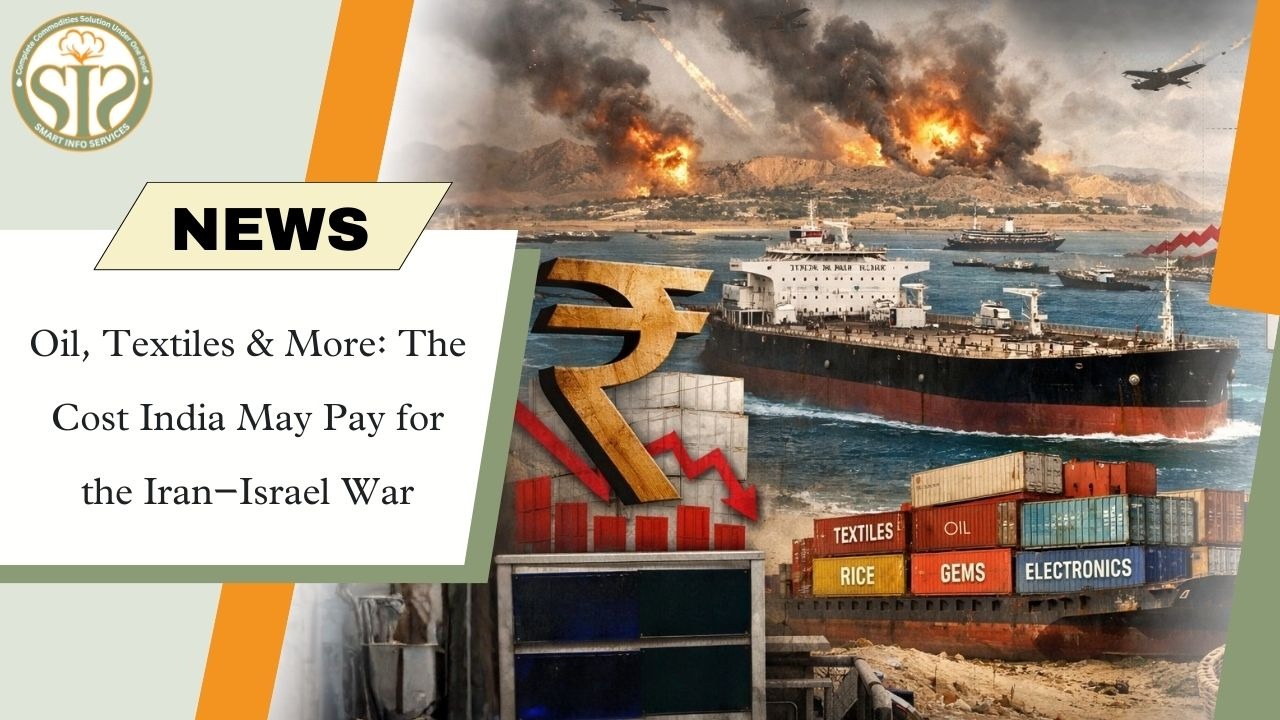
Iran-Israel war: The price may prove costly for India
By yash chouhan 2026-03-02 16:02:34
Oil, Textiles & More: The Cost India May Pay for the Iran–Israel War
The escalating conflict between Israel and Iran is beginning to impact India’s economy, with rising household prices and growing pressure on exporters. Disruptions in shipping lanes and air routes across West Asia are pushing up logistics costs, delaying deliveries, and unsettling commodity markets.
Prices of staples such as pulses and onions have started climbing as supply chains face uncertainty. Exporters of rice, textiles, gems, electronics, and IT services are also reporting higher freight rates and longer transit times.
In 2025, India exported goods worth $1.2 billion to Iran, including rice ($747 million), bananas ($61 million), and tea ($51 million). Imports from Iran comprised petroleum coke ($135.7 million), apples ($71.5 million), and dates ($33.3 million).
Textile exports hit by shipping delays :-
India’s garment and textile sector is among the first to feel the heat, as vessels avoid the Strait of Hormuz — a key route for trade between Asia and the West. Ships headed to Europe and the US may now take the longer route around the Cape of Good Hope, extending delivery times by up to 25 days.
“We will face delays in shipments going to Europe and the USA as the shipping routes would now avoid the Gulf region,” said Vijay Agarwal, chairman of the Cotton Textiles Export Promotion Council. “It’s going to hurt us as we are in the fashion business, which is very time-sensitive.”
In Tiruppur, which accounts for over 40% of India’s knitted garment exports, manufacturers fear missed deadlines and tighter cash flows. “Some April orders have been shipped, while others are still being produced. Any delay has financial implications,” said Raja M. Shanmugham, former president of the Tiruppur Exporters’ Association.
“Even Dubai is an important transit hub,” added K. M. Subramaniam, current president of the association. “If airspace there closes, exports could be severely disrupted.”
Oil shock raises fiscal concerns :-
Crude oil prices surged after US–Israeli strikes killed Iran’s Supreme Leader, with Brent crude hitting $82.37 per barrel on Monday — the highest since January 2025. Nearly 20% of global oil trade and 40% of India’s crude imports move through the Strait of Hormuz.
“For India, each $1 increase in crude adds roughly $2 billion to the annual import bill,” said JM Financial in a note. Sustained high oil prices could raise petrol, diesel, and LPG costs, strain public finances, and widen the fiscal deficit.
HDFC Bank warned that higher oil prices may also weaken the rupee and expand the current account deficit. India’s strategic oil reserves cover around 74 days of demand, but analysts caution that if tensions persist, Brent could rise to between $90 and $110 per barrel.
Broader impact :-
The Iran–Israel conflict underscores India’s vulnerability to instability in West Asia — a region critical for both energy and exports. From household groceries to high-value shipments, the economic shock could deepen if the crisis escalates further.