India-EU FTA to boost textile exports and employment
By yash chouhan 2026-01-28 18:33:53
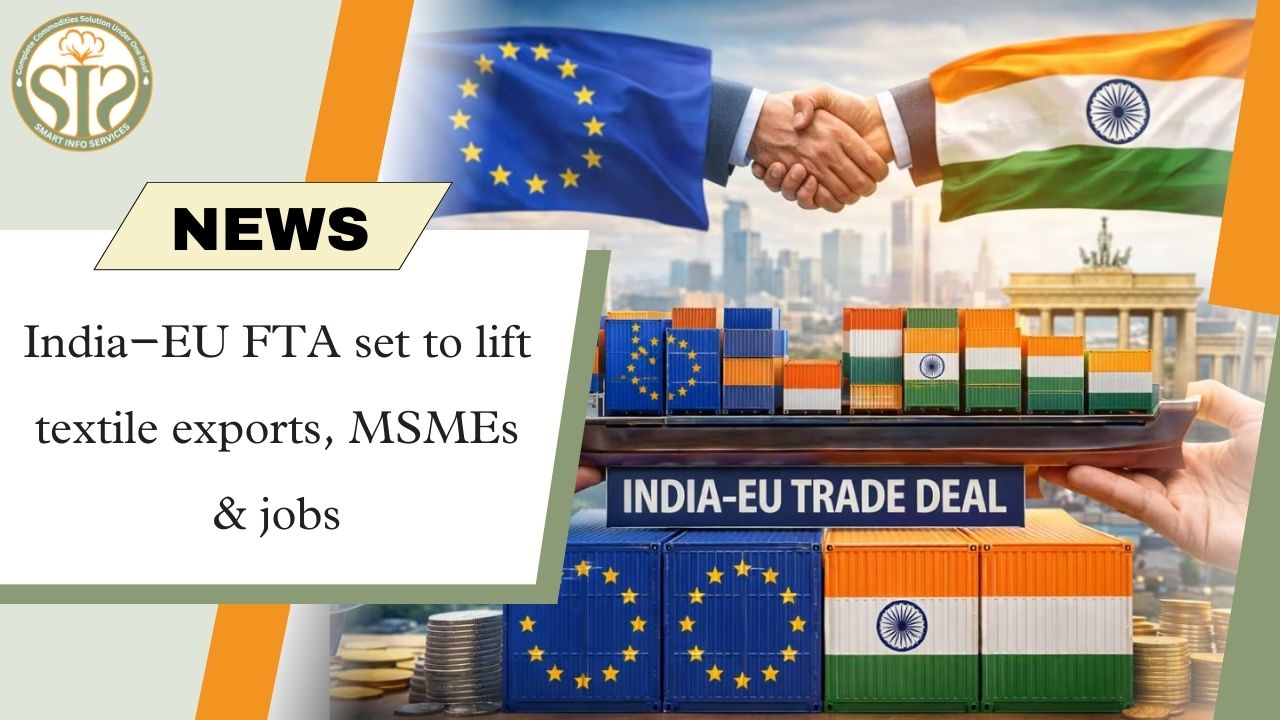
India–EU FTA set to lift textile exports, MSMEs & jobs
The newly signed India–European Union (EU) Free Trade Agreement (FTA) will provide zero-duty access for textiles and clothing across all tariff lines, eliminating duties of up to 12 per cent. Once the agreement enters into force, it will open the EU’s import market, valued at ₹22.9 lakh crore (~$263.5 billion), to Indian exporters.
Building on India’s current ₹3.19 lakh crore ($36.7 billion) in global textile and apparel exports, including ₹62.7 thousand crore ($7.2 billion) to the EU, such access would significantly expand opportunities, particularly in yarn, cotton yarn, man-made fibre apparel, ready-made garments, men’s and women’s clothing and home textiles. This would enable MSMEs to scale, generate employment, and reinforce India’s positioning as a reliable, sustainable, and high-value sourcing partner.
The FTA corrects a long-standing tariff disadvantage faced by Indian exporters vis-à-vis competitors such as Bangladesh, Pakistan and Turkiye, the Ministry of Textiles said in a release.
The EU is India’s second-largest export destination for textiles and apparel, after the US. The EU’s total global imports of textiles and apparel stood at $263.5 billion in 2024, while India’s textile exports to the EU have also shown positive growth in last 5 years.
India’s textile exports to the EU are diversified across multiple value-added and labour-intensive segments. Ready-Made Garments (RMG) form the largest component, (~60 per cent) of exports followed by cotton textiles (17 per cent), man-made fibre and MMF textiles (12 per cent). Handicrafts (4 per cent), carpets (4 per cent), jute products (1.5 per cent), woollen (0.6 per cent), handloom (0.6 per cent) and silk products (0.2 per cent), form an important part of India’s textile exports to the EU, underscoring the labour-intensive sectors of textiles, apparel and handicrafts, artisanal and MSME-driven character of India’s textile trade with the European market.
The textile sector employs around 45 million people directly in India. Improved access to the EU market is expected to boost production, capacity utilisation and employment across labour-intensive MSME clusters. The FTA will also encourage investment, technology transfer, and sustainability-linked up-gradation, particularly in MMF, technical textiles and green manufacturing aligned with EU standards.
The India–EU FTA is expected to significantly strengthen the textile sector ecosystem by enhancing market access, improving competitiveness and supporting employment across key clusters.
Beyond tariff reduction, the India–EU FTA provides comprehensive measures to address non-tariff barriers through strengthened regulatory cooperation, customs facilitation, transparency and predictable trade rules.
Together with India’s FTAs with the UK and EFTA, the India–EU FTA opens up the European market for Indian businesses, exporters and entrepreneurs and is expected to further strengthen and accelerate the export diversification efforts of the Ministry of Textiles, the release added.