High-income, smaller markets are key to modern fiber exports.
By yash chouhan 2025-12-19 19:44:48
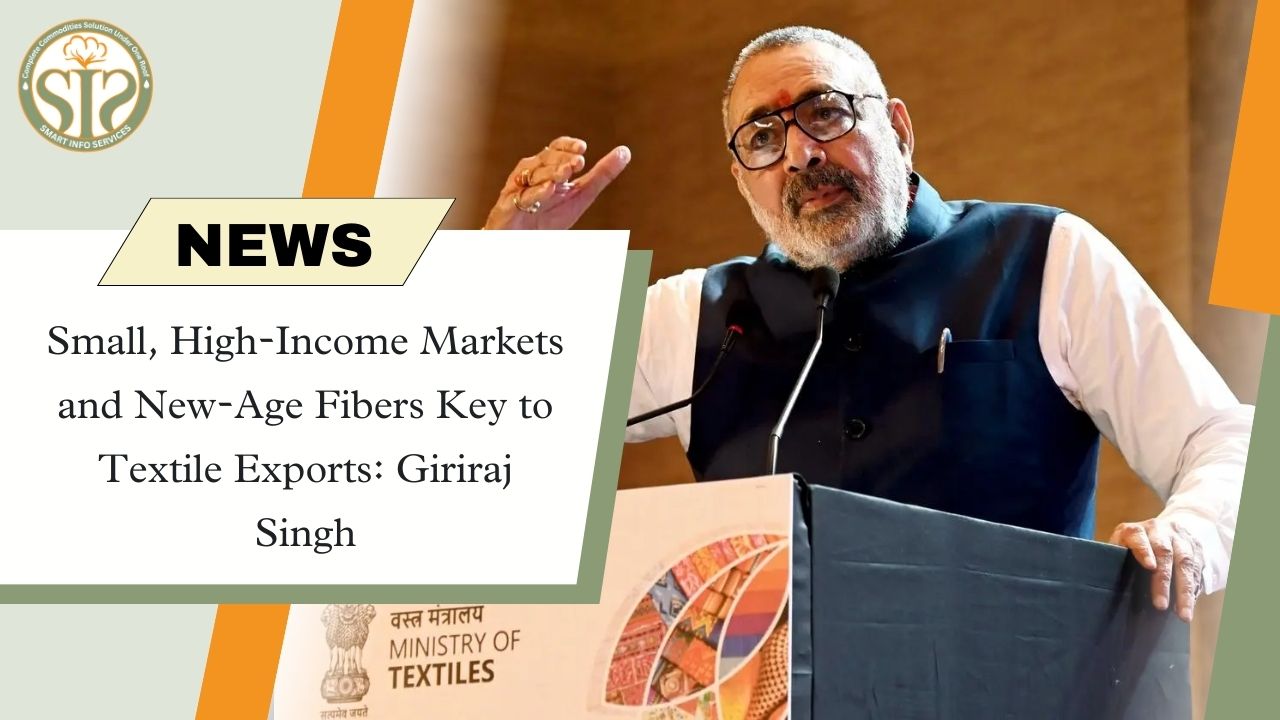
Small, High-Income Markets and New-Age Fibers Key to Textile Exports: Giriraj Singh
Textiles Minister Giriraj Singh said India aims to increase its textile and apparel exports from approximately $40 billion to $100 billion in the next five years by targeting small, high-income markets, launching a ₹5,000 crore cotton productivity mission, adopting high-density planting, and promoting new-age fibers like milkweed, ramie, and flax.
He told ET that the government is also now focusing on domestic manufacturing of textile machinery currently imported from China, Germany, and Japan, while employment in the sector is expected to increase from the current 45 million to 80 million by 2031.
"We are focusing on smaller countries with high per capita income and are also working on a warehouse hub and spoke model for small apparel manufacturers to boost exports," Singh said.
He added that India's 15 Free Trade Agreement (FTA) partners offer a $198 billion textile market, while the country's exports to these markets currently stand at only $11.5 billion. India's domestic textile market is currently valued at $180 billion and is projected to reach $350 billion in the next five years.
"To meet the growing demand, the target is to produce 25 million tonnes of fiber in the future," the minister said. He emphasized that the government aims to increase exports of technical textiles from approximately $4 billion to $10 billion by 2030 under the Production Linked Incentive (PLI) scheme. The PLI scheme for man-made fiber (MMF) apparel, MMF fabrics, and technical textiles products has helped attract an estimated investment of ₹31,270 crore from 91 beneficiary companies. Exports worth ₹733 crore and a turnover of ₹7,290 crore have been achieved by the end of September. The action plan is crucial because India is the world's sixth-largest exporter of textiles, accounting for nearly 5% of global trade.
Amidst the 50% tariffs imposed by the US, India is working on dedicated outreach programs in 40 countries, including the UK, UAE, Russia, Japan, and South Korea, to boost textile exports. He said, "These markets were selected before the tariffs were implemented (in August), and exports to 39 of these selected countries have increased in the last few months."
Collectively, these 40 countries represent over $590 billion in textile and apparel imports, offering India significant opportunities to expand its market share.
Singh added that the challenge lies in meeting domestic demand. "The first goal is to meet the demand of the domestic market and then focus on exports. The use of AI-based inspection has reduced the production of defective garments by 80%, which will ensure quality and facilitate exports to quality-conscious economies like Korea and Japan."