Coimbatore mills produce less, waste cotton prices rise
By yash chouhan 2025-11-20 18:54:12
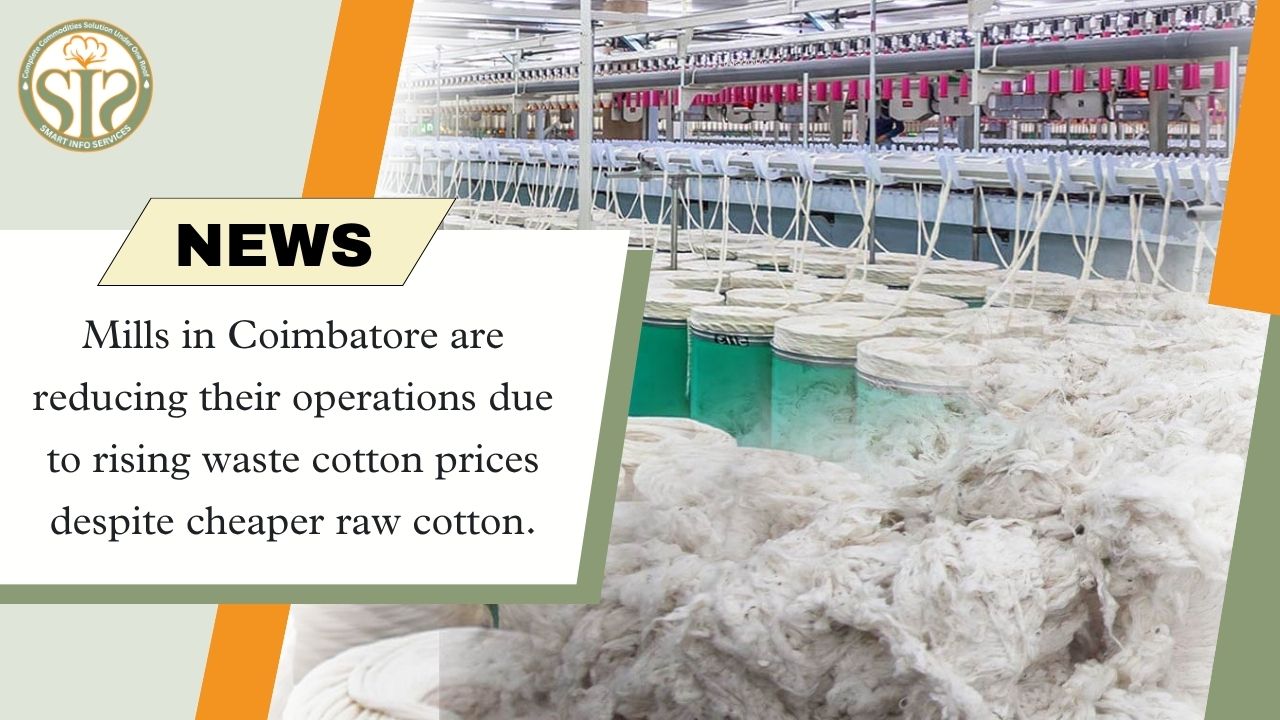
Mills in Coimbatore are reducing their operations due to rising waste cotton prices despite cheaper raw cotton.
Coimbatore: With the price of waste cotton rising, most open-end (OE) mill operators have stopped purchasing it from spinning mills since the second week of November.
Mill operators who convert raw fiber into yarn say that recycling waste cotton is no longer economically viable because spinning mills are unnecessarily raising prices.
Waste cotton is leftover fiber and scrap from the textile industry. It can be recycled to make new yarn, insulation, cleaning cloth, and more.
One candy weighs approximately 356 kg.
J Balaji, who runs an OE mill in Periyanaickenpalayam, Coimbatore, said, "We buy waste cotton from spinning mills and make yarn from two-count to 30-count. We then supply the yarn to handlooms and powerlooms. Although cotton prices have come down after government intervention, spinning mills have, within a short period of time, increased the price of waste cotton like comber noil cotton from Rs. 100 to Rs. 108 per kg and the price of FS cotton from Rs. 85 to Rs. 92. Due to the increase in waste cotton prices, we are finding it difficult to meet the production cost of existing orders. Like me, many OE mill operators have stopped buying waste cotton from spinning mills since November 10."
(Yarn count is a numerical system that measures the fineness or coarseness of a yarn by combining its length and weight. Comber noil cotton is a byproduct of the ring spun yarn spinning process. It is created when cotton is combed in a comber machine.)
Balaji also said that he has reduced his unit's operations to 2-3 days a week. He said, "I have enough raw material to run the mill for less than 10 days. Similarly, most OE mills have reduced their operations since the second week of November." "As new cotton started arriving in the market, the price fell to Rs 4,000 to Rs 6,000 per candy, forcing spinning mills across the country to reduce their yarn prices by Rs 8 to Rs 10 per kilogram since October," said M Jayabal, president of the Recycle Textile Federation. "However, in the last two months, the price of waste cotton has been increased indiscriminately. OE mills cannot increase their yarn prices to match the increased price of waste cotton." He further said, "Over the past four months, production of 30-count weaving yarn has declined due to a lack of sufficient orders, leading to a buildup of OE yarn and textile materials. Spinning mills fear that if they reduce the price of 20-count yarn used for 'kada' (sheeting) fabric, the prices of all karas already sold, currently in stock, and those on power-looms will fall. This fear is further exacerbated by the fact that North Indian kada traders have been slow to return payments after Diwali and are hesitant to make new purchases."
He added, "In this situation, we have decided to purchase waste cotton at last month's prices. If prices do not decrease, mills will operate on their existing stock of waste cotton to avoid losses."
In Tamil Nadu, out of the 8.5 lakh rotor capacity of OE mills, 3.5 lakh rotors produce grey yarn. The remaining 500,000 rotors produce a variety of yarns ranging from 2 to 40 counts, including bleached, colored, melange, cotton-polyester, viscose-cotton, and viscose-polyester, available in over 45 colors. These mills primarily supply 10/20/25/30 count gray yarns to power looms in Tiruppur, Coimbatore, Erode, Salem, Karur, Madurai, and Virudhunagar districts.