Filter

Recent News

Modi government made cooking oil cheaper by cutting import duty

Modi government made cooking oil cheaper by cutting import dutyGiving some relief to the common people from inflation, the government has decided to reduce the import duty on soya oil and sunflower oil from 15% to 7.5%. Earlier, the government had also cut import duty on crude palm oil.Overall, the effective duty has been reduced by 8.25% inclusive of all taxes. The overall fee has come down from 38.50 per cent to 30.25 per cent. Agricultural Cess and Social Welfare Cess are also included in the total fee.The reduction in import duty will directly benefit the kitchen budget of the common people, although this reduction in import duty is only till 30 September. At present, the government imports 15 million tonnes of edible oil annually, valued at around Rs 70,000 crore. While the country's annual consumption is 25 million tonnes of edible oil. Palm oil in India is imported from both Malaysia and Indonesia. India imported 7.2 million tonnes of palm oil from Malaysia and Indonesia last year. Palm oil accounts for about 55 per cent of the total imports. 34 lakh tonnes of soybean oil was imported from Brazil and Argentina and 2.5 million tonnes of sunflower oil was imported from Russia and Ukraine.Earlier, the Modi government had approved the plan of Palm Oil Mission in the cabinet meeting held on Wednesday. To increase the availability of edible oils, the government announced a Palm Oil Mission (National Edible Oil Mission-Oil Palm- NMEO-OP) worth Rs 11,040 crore. The government has taken this step to make India self-reliant in the matter of edible oils. This mission of the government will reduce the dependence on import of palm oil and will also pave the way for increasing the income of the farmers. At the same time, the oil industry will also benefit.It was also decided in the cabinet meeting that if the market fluctuates and the price of the farmer's crop falls, then the difference amount will be paid by the central government to the farmers through DBT. The amount which was given earlier in agricultural material has also been increased. In order to enable people to set up industries in the North-East region, it was decided to provide an assistance of Rs.5 crore to the industry.
US not looking for a new trade agreement, says Union minister Piyush Goyal

US not looking for a new trade agreement, says Union minister Piyush GoyalUnion Commerce and Industry Minister Piyush Goyal on Thursday said that the possibility of a trade agreement between India and the United States is not being considered at the moment, reported Smart info services.In such a trade deal, partners cut down on tariff-related hurdles on a specific number of goods in order to boost trading.“The US, as of now, has kind of indicated that they are not looking for new trade agreements, but we will look at working with them on market access issues on both sides,” Goyal said during an event with exporters.The minister added that even the resolution of the problems related to a trade pact would boost outbound trade to the United States.Goyal noted that matters such as non-tariff barriers, reaching mutually recognised agreements and aligning on better quality of international standards would lead to a spike in trade between the United States and India.Goyal also specified the Centre’s priority list of countries with which it was going to forge a free trade agreement.“Australia is first on the list, United Kingdom, then the United Arab Emirates, and if the UAE happens, the pact with GCC [Gulf Cooperation Council] will also be expedited,” he said. “We have already started the dialogue with the UAE and one more country from the Middle East.”So far, Australia has shown the “highest level of engagement”, Goyal said, according to Business Standard, adding that the country has displayed a lot of interest in early harvest agreement. This early harvest deal is considered a precursor to a free trade deal.He also noted that discussions with the United Kingdom was “progressing well”.The minister also said that discussions with the Canadian government had been impacted due to the Covid-19 crisis. Goyal added that the talks were likely to resume after the elections in Canada.“We also have to open our markets to others if we are wanting a larger pie in their markets,” he said, according to The Hindu. “Therefore, my appeal to all of you is to also identify areas where we have confidence that we can withstand competition.”SiS Commited to update you on all textile related news real time.RegardsTeam SisAny query plz call 9111977771https://wa.me/919111977775

Cotton yarn and product exports drive record cotton consumption in Vietnam

Cotton yarn and product exports drive record cotton consumption in VietnamRobust growth in Vietnam’s cotton yarn and product exports is projected to drive 2020-2021 cotton consumption to a record 7.3 million bales, 700,000 higher than the previous year’s downfall from COVID-19, according to the weekly report by the US Department of Agriculture (USDA).Yarn exports during 2020-2021 have exceeded the previous year’s record by more than 10 per cent through the first 11 months of the marketing year. Foreign demand has been primarily driven by China, with Vietnam’s cotton yarn exports to the country accounting for roughly 60 per cent of Vietnam’s total cotton lint consumption.China is the world’s largest cotton yarn importer and Vietnam’s largest customer with the geographic proximity and foreign investment by Chinese companies driving record exports. China’s August to June imports of Vietnamese cotton yarn were a record (for the period) and equal to roughly four million bales of cotton lint consumption.China’s robust demand is expected to persist with projected growth in China’s cotton fabric and product exports, in addition to greater domestic consumption of cotton products. The United States WRO (Withhold Release Order) on cotton lint from China’s Xinjiang region is further supporting current and future demand for Vietnam’s cotton yarn.Practically all cotton yarn spun in Vietnam is produced with cotton lint imported from outside of China. Garment and textile manufacturers in China seeking to circumvent the WRO are likely substituting imported cotton yarn for domestic with roughly two-thirds containing Xinjiang lint.Greater domestic consumption in Vietnam of cotton yarn is also driving cotton consumption higher. Significant foreign and domestic investment in Vietnam’s garment industry has driven greater demand for cotton knitted fabrics and thus domestic consumption of cotton yarn by knitters. According to Vietnam customs data, garment and textile exports in 2020-2021 are expected to recover from the previous year’s decline and rise to more than $30 billion; the garment industry is one of the country’s largest valued source for exports.Vietnam’s largest export market for cotton textiles and garments is the United States, which is also the world’s largest importer. US imports from Vietnam were a record in the first 11 months at more than $5 billion. Knitted cotton sweaters, pullovers, and other similar articles of clothing were the largest product category, accounting for roughly 30 per cent of the total value of US cotton product imports from Vietnam.This particular category has historically been dominated by China, however, two factors have driven Vietnam’s market share of US imports higher – the 2020 and 2021 WROs and ongoing tariffs specific to China. Both have lowered US imports of knitted cotton sweaters, pullovers, among others from China nearly 20 per cent thus far in 2020-2021 (August-June) despite US imports of this product category rising over 10 per cent on-year during the same period.Robust export prospects for both cotton yarn and products are expected to boost 2021-2022 cotton consumption even higher to 7.6 million bales, and further support Vietnam’s rise as a major global cotton importer as well as exporter and consumer of cotton yarn and products.

As cotton prices rule firm, CCI sees little scope for market intervention

As cotton prices rule firm, CCI sees little scope for market interventionBut the state-run firm will be fully prepared for MSP operationsAs cotton prices continue to rule high, state-run Cotton Corporation of India Ltd (CCI) sees no scope for market intervention in the new season starting October. CCI, which made a record purchase of cotton at the minimum support price (MSP) during the 2020-21 season, expects its carry forward stocks for the next year to be in the range of 2-3 lakh bales.Ahead of the cotton harvest season starting mid-September, the raw cotton (kapas) prices are currently ruling high at over ₹7,000 per quintal. Also, cottonseed prices are hovering around ₹4,500-5,000 per quintal.“Everything is in a booming mode, and I think the CCI’s intervention may not be required as farmers are already getting 30 per cent more than the MSP rates. Next year, they may be fully satisfied with the market forces,” P K Agarwal, chairman and managing director, the CCI told Business Line.“However, as per our duty, CCI would be fully preparing for the MSP operations,” Agarwal said, adding that the intensity will certainly be lower. “In case our intervention is required, may be in the interior or far-flung places, where the competition is not there, we may have to help the farmers in those areas. In case MSP is not there, we may think of commercial operations,” Agarwal said.Further, Agarwal believes that the current high prices will not sustain for a longer period. “In every commodity, when the peak arrivals are there, the prices are bound to come down. It may come down by ₹500-700 but still be better than MSP,” he added.ProcurementCCI had purchased 92 lakh bales at MSP during the pandemic hit 2020-21 season, when there were no takers in the market, Agarwal said. “Farmers were protected through the MSP operations as they got an assured price,” he said. The opening stocks during October 2020 stood at 60 lakh bales. The Centre has fixed an MSP for medium staple cotton at ₹5,716 per quintal for 2021-22 season higher than the previous year’s ₹5515 per quintal. For the long-staple cotton, the MSP for 2021-22 has been fixed at ₹6025 per quintal over ₹5825.In 2021, CCI disposed of a record 140 lakh bales on good demand from the mills. It also exported about 1 lakh bales during 2020-21. “It was more than a good year. Because of the booming market and price improvement, the MSP losses have also come down substantially to around ₹17,000 crore” Agarwal said.The 2020-21 season started with around ₹40,000 per bale in October, higher than the corresponding previous year’s ₹36,000. “Now, the cotton prices are ruling between ₹53,000-55,000 range on good demand in the market as the mills have started operations, and their requirement has improved,” Agarwal said. Also, most mills have built up inventory and have covered stocks to meet their requirement for the next 2-3 months.InventoriesFurther, Agarwal said that CCI currently has stocks of around 8 lakh bales. “We wish to keep these stocks till September end to avoid any starvation like situation. We are selling about 1,000-2,000 bales daily and by mid-October we may be finishing our stocks,” he added. Agarwal expects CCI’s carry forward stocks for the next season to range between 2-3 lakh bales. The overall carry forward stocks for the country is expected to be 60-70 lakh bales.“The situation is very comfortable because, in the past there had been no occasion when the carry forward stocks were more than 40 lakh bales. This is because of the pandemic situation, India may end up with 60-70 lakh bales, which is almost two-month requirement. The position is not as worse as people are visualising it,” he added. By September end, the new crop will hit the market in North India, he said.

Related News

Youtube Videos

ऐसा रहा आज कपास बाज़ार 😱 राजस्थान कपास बुआई | Cotton Market 22 July
ऐसा रहा आज कपास बाज़ार 😱 राजस्थान कपास बुआई | Cotton Market...
कपास बाज़ार में आज क्या हुआ? 😱 Cotton Market Rate 21 July 2026
कपास बाज़ार में आज क्या हुआ? 😱 Cotton Market Rate 21 July 2...
कैसा रहा आज का कपास बाज़ार? 😱 Cotton Market Rate Today | 20 July 2026
कैसा रहा आज का कपास बाज़ार? 😱 Cotton Market Rate Today | 20...
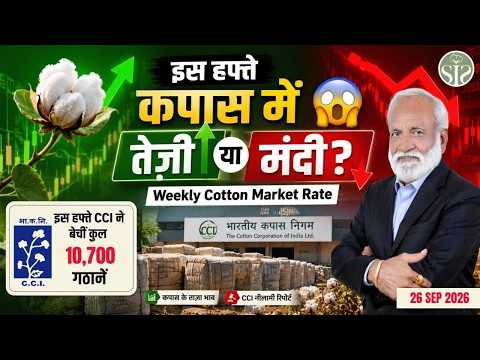
इस हफ्ते कपास में तेज़ी या मंदी? 😱 CCI ने बेचीं 3.18 लाख गांठें | Weekly Cotton Market
इस हफ्ते कपास में तेज़ी या मंदी? 😱 CCI ने बेचीं 3.18 लाख गा...
Cotton rate today: आज के कपास के भाव 🤔 #kapas  #youtube
Cotton rate today: आज के कपास के भाव 🤔 #kapas #youtube
रुई बाज़ार में आज तेज़ी का रुख 😱 CCI ने बेचीं 40,000+ गठानें #kapas
रुई बाज़ार में आज तेज़ी का रुख 😱 CCI ने बेचीं 40,000+ गठानें...
ऐसा रहा आज कपास बाज़ार 😱  राजस्थान कपास बुआई | Cotton Market 15 July
ऐसा रहा आज कपास बाज़ार 😱 राजस्थान कपास बुआई | Cotton Marke...
कपास की कीमतों में उछाल 😱 Cotton market rate today #kapasnabhav
कपास की कीमतों में उछाल 😱 Cotton market rate today #kapasna...
CCI Update: आज कितनी रुई गठानें बिकीं? 😱 Cotton market price today
CCI Update: आज कितनी रुई गठानें बिकीं? 😱 Cotton market pric...
साप्ताहिक कपास बाजार में तेज़ी 😱 Weekly cotton market review #kapas
साप्ताहिक कपास बाजार में तेज़ी 😱 Weekly cotton market review...
जानिए आज का कपास बाज़ार 😱 Cotton market rate today #kapas
कपास की कीमतों में उछाल 😱 Cotton market rate today #kapas
रुई बाज़ार में आज तेज़ी का रुख 😱 CCI ने बेचीं  70,000+ गठानें  #kapas
रुई बाज़ार में आज तेज़ी का रुख 😱 CCI ने बेचीं 70,000+ गठानें...
कैसा रहा आज का कपास बाज़ार? 😱 | Cotton Market Rate Today | 06 July 2026
कैसा रहा आज का कपास बाज़ार? 😱 | Cotton Market Rate Today |...
CCI ने अब तक कितनी कपास गांठें बेचीं? 😱 | Statewise Bales Sold Report  #youtube
CCI ने अब तक कितनी कपास गांठें बेचीं? 😱 | Statewise Bales S...
Application Download
Whatsapp Contact