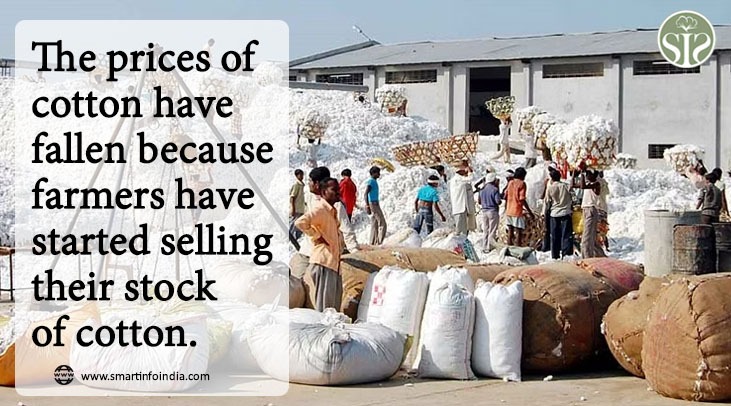
Cotton prices fall as farmers start selling stocked cotton
Cotton prices fall as farmers start selling stocked cottonMay arrivals at nine-year high; Daily arrivals above 1 lakh balesCotton prices have declined by nearly nine per cent in the past two weeks as growers have started bringing back their produce held over the past few months to Agricultural Produce Marketing Committee (APMC) yards.“Farmers in various states have changed their mind and want to sell their stocked cotton (seed cotton). Cotton arrivals are at a new high in May and are expected to continue till the end of June.“The daily arrival of cotton has increased to one lakh bales (170 kg each) in the last few days. The demand for yarn is negligible and its exports have been affected by the bearish trend. Fabric demand is also sluggish,” said Ramanuja Das Bubb, who sources cotton from Raichur, Karnataka, for spinning mills, multinationals and exporters.Panic?Cotton arrivals so far this month are at a nine-year high of 1,82,572.67 tonnes (10.73 lakh bales), according to data from Agmarknet, a unit of the agriculture ministry. In 2014, when India produced a record high crop of 398 lakh bales, arrivals during the same period were 2,36,800.48 tonnes (13.93 lakh bales)."The daily arrival of cotton last week was 90,000-110,000 bales per day, taking the total arrival to 7 lakh bales," Popat said.“Panic has spread in the market. There is no demand for yarn or cloth. No one is buying cotton either. Production seems high,” said Sachin Jhanwar, a yarn processor.Indian Texpreneurs Federation (ITF) convenor Prabhu Dhamodharan said, "Cotton prices are softening in line with the same trend, due to continued sluggish demand across the value chain."expect moreProcessed cotton (lint) is currently priced at Rs 56,900 per candy (356 kg) as compared to Rs 62,200 two weeks back. On the Multi Commodity Exchange, the June cotton contract is currently trading at ₹58,120 per candy.Cotton prices at Rajkot APMC are trading at Rs 7,175 per quintal, down from Rs 7,950 two weeks back. On the Intercontinental Exchange (ICE), New York, cotton July contracts were trading at 84.27 US cents per pound (₹56,625 a candy).Cotton growers had held on to their produce this year and stored it in backyards and on rooftops in anticipation of a rise in prices. Even when the prices were at Rs 8,000 per quintal against the minimum support price of Rs 6,080, they were not ready to sell as they got more than Rs 10,000 in the previous season.Growers in Karnataka and Maharashtra held back their produce for the first time, apart from farmers in Gujarat, who usually hold back their produce for the short arrival season that begins in April."Cotton prices in India have come down to Rs 57,000, while in China it is Rs 67,000," Jhanwar said.difficult to predict“There is some parity in prices for exports. It will now accelerate. So far 11.50 lakh bales of cotton have been exported and from this season till September, exports are expected to fall to a 19-year low of 23 lakh bales.“Since last week, the ICE market is consolidating despite the fall in Indian cotton prices on a daily basis. Bearish trend remains on MCX as well.Jhanwar said, “If the situation has to be changed, we will have to try to increase the export to 30-35 lakh bales.”“Across the value chain, textile companies are operating at low capacity utilization levels. Thereafter, cotton prices will align with real demand factors such as apparel exports," Dhamodharan said.“Given the current arrival trends, it is difficult to judge the crop based only on arrivals in APMC yards and cotton held back by farmers in Maharashtra and Gujarat,” Das Bub said.He said this would also make it difficult to estimate the quantity of cotton coming in as ginners and traders have a huge stock of 30-35 lakh bales.MNCs manufacture goodsThe Committee on Cotton Production and Consumption, a body of all stakeholders, has estimated the current season (October 2022-September 2023) at 327.23 lakh bales, but a section of the trade pegs it at over 340 lakh bales. Is. However, the Cotton Association of India, a body of traders, pegged it at less than 300 lakh bales in its latest estimate done this month.Jhanwar said many had stock of cotton and yarn which was more than a year old. “Since last year, I have a good amount of yarn and one lakh bales of cotton,” he said.Das Bub and Popat said that at present multinational trading companies are buying cotton. “Spinning mills have cotton stock for 45 days. Cash-rich mills have a stock of 70-90 days.“Situation looks favorable for these trading firms who had sold in the futures market and are now covering the stock. The fall in prices is also helping them.sowing can increase"In the next three months, we can see some volumesCotton is being imported from Australia, Brazil and the US," said Das Bub.Jhanwar said, "This week the market movements will be important and then the focus will be on the US."Despite falling prices, cotton sowing will increase this year, although millers are likely to see a reduction in production in the coming months, Das Boob said.👇🏻👇🏻👇🏻👇🏻https://smartinfoindia.com/newsdetails/2438