Recent News

Cotton gains momentum as Haryana records lowest cotton yield in two decades

Cotton gains momentum as Haryana records lowest cotton yield in two decadesCotton yesterday closed 1.93% higher at 57100 as Haryana records lowest cotton yield in two decades in 2022-23 even as the state has almost completely converted to genetically modified Bt cotton, which is being sold in North Was introduced in India as an insect-repellent. Yield enhancing variety in 2005-06. According to survey data from the China Cotton Storage Information Center, China's total cotton planting area fell by 10.3% over the previous year. The survey data shows that the country's total cotton planting area till May was 41.40 million mu, which is equivalent to 2.77 million hectares. Acreage fell 8.0% to 36.16 million, equivalent to 2.42 million hectares, in the northwestern Xinjiang region, China's main cotton-producing region.In the global 2023/24 cotton balance sheet, higher opening stocks and production exceed consumption growth, and ending stocks are estimated at 92.8 million, 515,000 bales higher than in May. World cotton production this month is estimated at 1.0 million bales higher as larger crops in the United States and Pakistan offset a shortfall of 500,000 bales for China. Consumption is higher at 765,000 bales, with increases in Vietnam, Pakistan, Bangladesh, Indonesia and Turkey. World trade is also projected to increase to 900,000 bales due to increased US exports and Chinese imports.Technically market is under short covering as market has seen -1.5% fall in open interest and it closed at 329 while prices are up 1080, now cotton is taking support at 56540 and below this A test of 55970 level can be seen, and resistance is now likely to be seen at 57540, on the upside the price could test 57970.

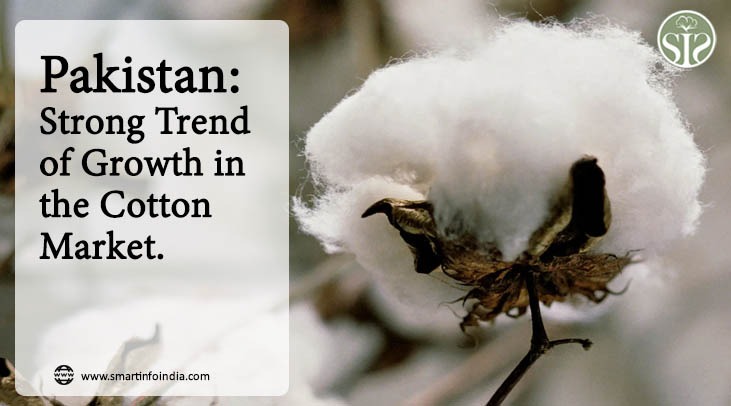
Pakistan: Cotton market: spot price declines by Rs 1000 per maund

Pakistan: Cotton market: spot price declines by Rs 1000 per maundLAHORE: The spot rate committee of the Karachi Cotton Association (KCA) on Monday reduced the spot rate by Rs 1,000 per head and closed it at Rs 16,500 per head.The local cotton market remained stable and the trading volume was satisfactory. Cotton analyst Naseem Usman said that the rate of new cotton crop in Sindh is between Rs 16,300 to Rs 16,500 per head. The rate of footi in Sindh is between Rs 6,700 to Rs 72,00 per 40 kg. The rate of cotton in Punjab ranges from Rs 17,000 to Rs 17,200 per mane and cotton between Rs 7,500 to Rs 8,500 per 40 kg.About 4,200 bales of Tando Adam were sold at Rs.16,400 to Rs.16,700 per head, 2200 bales of Sanghar at Rs.16,200 to Rs.16,500 per head, 1200 bales of Shah Pur Chakar, 1800 bales of Mir Pur Khas at Rs.16,500 per head. 16,500 to Rs 16,600 per head, 1600 bales of Shahdadpur were sold for Rs 16,400 to 16,600 per head, 800 bales of Hyderabad were sold for Rs 16,300 to 16,500 per head, 800 bales of Khando, 800 bales of Tando Muhammad were sold. 16,400 per head, 400 bales of Rajanpur were sold at 16,850 per head, 600 bales of Chichavatni were sold at 17,000 per head and 800 bales of Burewala were sold at 17,200 to 17,300 per head Sold at rate.The spot rate committee of the Karachi Cotton Association reduced the spot rate by Rs 1,000 per head and closed it at Rs 16,500 per head. Polyester fiber was available at Rs 355 per kg.

Welspun India to see 2-fold growth in domestic business by 2026

Welspun India to see 2-fold growth in domestic business by 2026A global leader in home textiles and part of the $2.3 billion Welspun Group, is expecting its home textile business to double from around Rs 650 crore last year to around Rs 2,200 crore by 2026 due to increased demand in India . markets and a better performing economy.The company which currently claims to produce one in five towels in the United States and also holds a major market in Europe, saw a decline in demand last year due to economic issues in these regions. During the last financial year, the company's income fell by nearly 12 per cent to Rs 8,215 crore in 2021-22 from Rs 9,377 crore. The company now aims to increase India's share in the topline from around 8 per cent to around 12-15 per cent by 2026.“Last year, the whole world was going through upheavals. In commodities, cotton prices soared by more than 100 percent, and there was also a container crisis and freight disruption. Now, the overall recovery is happening and it started in the fourth quarter of the last financial year. Q1 and Q2 will be slightly better this year. If we talk about the US economy, it has grown by 2 per cent and inflation is at 5 per cent, which is the lowest in the last 22 months. Certainly, we are seeing that everything is getting easier,'' said Deepali Goenka, CEO & MD, Welspun India.However, the Indian market is turning out to be a bright spot for the company at the moment. The company registered a growth of nearly 30 per cent in the domestic market last year with a turnover of around Rs 550 crore in home textiles, while its flooring business clocked a turnover of Rs 100 crore, taking the total domestic sales to around Rs 650 crore. “Definitely, India will continue to grow. Our emerging businesses are also doing well in India. We expect the India business to reach around Rs 2,200 crore by 2026, while our domestic business is going to exceed last year's around Rs 650 crore,' Goenka said. Apart from India, the regions where the company is betting big are Australia, South East Asia and West Asia.The growth in the Indian market will be driven by the company's strategy of 'Welspun from every home to every heart'. Currently, 31 per cent of the global share of home textiles is coming from the US, 34 per cent from Europe and 35 per cent from the rest of the world. The global home textile market size is expected to grow from around $49 billion now to $60 billion by 2025. The Indian home textile market is now worth around $7 billion. It is expected to reach $10 billion in the next four years. Home textiles has a mix of products and it will all depend on the growth in demand in the Indian market,” he said.

Declining exports: Ministry of Commerce will meet exporters today

Declining exports: Ministry of Commerce will meet exporters todayAn official said the commerce ministry has convened a meeting of exporters on Monday to take stock of the situation as outbound exports have been coming down for the past four months. Exporters are expected to highlight issues such as providing more support to participate in global exhibitions and fairs; expediting negotiations to conclude free trade agreements with the UK, Canada, Israel and the GCC (Gulf Cooperation Council); and allowing industry to double cut the salaries of professionals to retain talent in India.According to the ministry data, exports declined 10.3 per cent year-on-year for the fourth consecutive month to USD 34.98 billion in May, while the trade deficit widened to a five-month high of USD 22.12 billion.Cumulatively, exports declined by 11.41 per cent to US$ 69.72 billion during April-May in the current fiscal, while imports declined by 10.24 per cent to US$ 107 billion.Sluggish demand in key markets, high inflation in advanced economies and the Russia-Ukraine war are taking a toll on the country's exports.Apparel Export Promotion Council (AEPC) chairman Naren Goenka said more support measures from the government such as participation in global exhibitions would help boost exports.FIEO Director General Ajay Sahay said that the RoDTEP (Remission of Duties and Taxes on Exported Products) scheme will also help boost exports by providing benefits to advance authorisation, special economic zones and export-oriented units.When asked about ways to boost shipments, Sanjay Budhia, Chairman - CII National Committee on Exim and MD - Patton Group, said that in view of the global recessionary trend, a strategic approach is needed to encourage exports. Needed."Resolving the specific issues faced by exporters, especially related to non-tariff barriers affecting supplies in critical markets, should be the primary focus," Budhia said. The pandemic has led to a rethink of strategies for sourcing, diversification of supply routes and manufacturing.He said promoting technology upgradation and innovation in manufacturing processes would also help improve the quality and competitiveness of Indian products, leading to higher exports.Budhia also said that the focus should be on skill development initiatives to enhance the capabilities of the workforce, especially in sectors with export potential."Support should be provided to encourage research and development for modernization of manufacturing processes, skill development, promotion of sustainable practices and enhancing the competitiveness of sectors such as pharmaceuticals, chemicals, textiles and auto and auto components," he added.He said that the focus should also be on boosting quality standards and streamlining regulatory procedures, this could also help India increase its exports in the agriculture and food processing sectors.India is already an agricultural powerhouse with a wide variety of food products, and this should be reflected in its exports.He suggested that India should also set up a trade promotion body with dedicated offices abroad to provide branding and promotional activities as well as marketing services to Indian exporters.He said, this body will help in the areas of trade facilitation, capacity building and awareness generation and help in achieving the desired target of USD 2 trillion by 2030 and making India a global economic superpower.In addition, he suggested facilitation centers for free trade agreements as they would become one-stop points of information on all FTAs by India and would aim to reach exporters to developing markets in FTA-partner countries.Budhia said, “These centers will facilitate better understanding of the provisions of FTAs in goods, services and investment and can help Indian industry to make better use of existing FTAs and benefit from preferential liberalization through capacity building programmes.” Are." ,He said investment in expansion of cold chain network could open up export opportunities for sectors like agriculture, horticulture and pharmaceuticals.The official said representatives of export bodies including Federation of Indian Export Organizations (FIEO), Apparel Export Promotion Council and Leather Export Council are likely to attend the meeting.

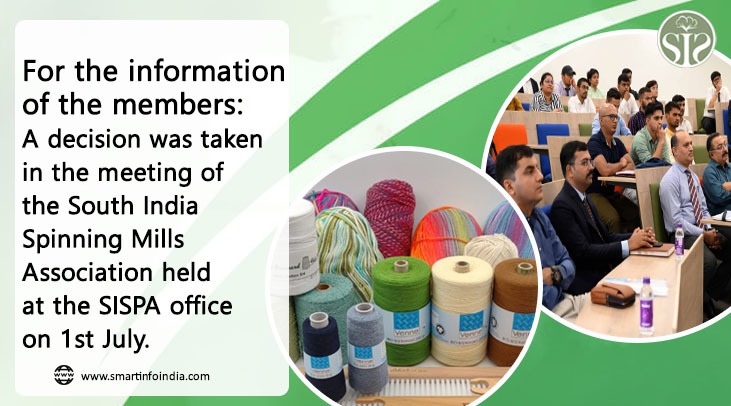
For the kind information of members:

For the kind information of members: A meeting of all Spinning Mills Associations of South India held on 1st July at the SISPA office it is decided to:1) Approach IBA by Friday and seek a moratorium on the Term Loan Repayments including the Covid Loans so as to survive the present crisis. (as advised by the Textiles & Finance Ministries and also RBI, when they were approached recently with such a request).2) Request to convert Covid loans from short term to longer term repayment period as these repayment installments are adversely impacting the cashflows in the current crisis scenario.3) Convey to the central & state governments to not give any further incentives to create any new spinning capacity as there is already an excess capacity which is the cause for the current crisis.4) Encourage One India One Policy for textile with respect to Power Tariff and Investment Subsidies to have a level playing field for all states.5) Not increase electricity MD charges any further and also relax the minimum billing rules to allow slowing of productions as it is a necessity due to the poor demand. planning to meet the Hon’ble chief minister & Electricity Minister of Gotn by 2nd week of July & explain to them 6) Discuss to collectively take a decision to curtail productions to match the demand at a healthy levels and also inform the press & media elaborately including by an advertisement if required.It is therefore decided to conduct one more round of consultation meetings this time including the Northern India Mills Associations on coming Tuesday at 4 pm and then give a final shape to the collective action plan to be represented by a suitable delegation.
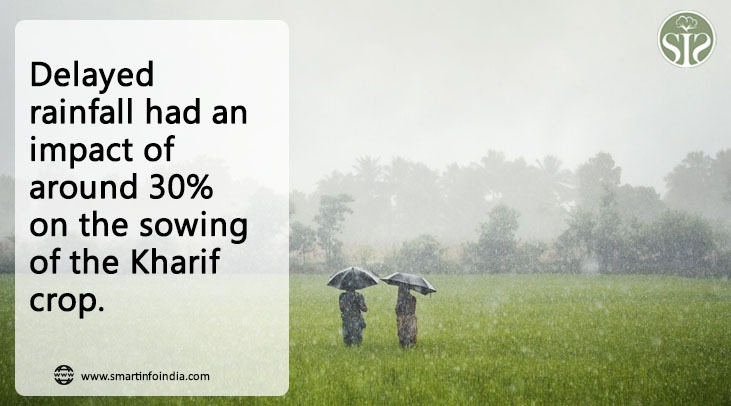
Delayed rains impact kharif sowing operations by about 30%

Delayed rains impact kharif sowing operations by about 30%Farmers pin hopes on rain forecast from July 4; only two districts have over 50% of extent covered against normalThe sustained delay in proper onset and spread of monsoon rain has hit sowing and transplantation operations of the Vanakalam (kharif) crop season by nearly 30% as the State’s average rainfall deficit continues to be very high at 52% and with the district-wise average deficit going up to 78%.According to the Agriculture department authorities, Vanakalam crops have been cultivated on 14.86 lakh acres as of June 28 against 20.82 lakh acres of extent covered by the same date last year — about 28.6% less this year compared to last year.Director (Research) of Prof. Jayashankar Telangana State Agricultural University P.Raghurami Reddy stated that the farming community need not worry about running out of time for sowing operations as many crops could be sown till July 15, and cotton, the major crop for the season, till July 20.However, worries of the farming community are on the rise with the increasing possibility of harvesting short-duration crops such as soybean, green gram and black gram running into the peak monsoon period owing to the delay in sowing operations. They are of the view that delayed sowing also impacts the yield adversely.st year. | Photo Credit: G.N.RaoThe sustained delay in proper onset and spread of monsoon rain has hit sowing and transplantation operations of the Vanakalam (kharif) crop season by nearly 30% as the State’s average rainfall deficit continues to be very high at 52% and with the district-wise average deficit going up to 78%.According to the Agriculture department authorities, Vanakalam crops have been cultivated on 14.86 lakh acres as of June 28 against 20.82 lakh acres of extent covered by the same date last year — about 28.6% less this year compared to last year.Director (Research) of Prof. Jayashankar Telangana State Agricultural University P.Raghurami Reddy stated that the farming community need not worry about running out of time for sowing operations as many crops could be sown till July 15, and cotton, the major crop for the season, till July 20.However, worries of the farming community are on the rise with the increasing possibility of harvesting short-duration crops such as soybean, green gram and black gram running into the peak monsoon period owing to the delay in sowing operations. They are of the view that delayed sowing also impacts the yield adversely.“We can harvest short-duration crops such as green gram, black gram and soybean before September-end, before heavy rains that occur towards the end of the south-west monsoon period, if we sow the seed by the end of June second/ third week,” explains A.Sharnappa, a farmer in Narayankhed mandal of Sangareddy district who cultivates short-duration pulses for the past four decades.Delay in tonset of rains has also impacted the raising of paddy nurseries hampering the State government’s plans to advance the Yasangi (rabi) crop season with early harvesting of Vanakalam crops, particularly paddy, short-duration pulses, maize, and others to prevent the damage of Yasangi crops in unseasonal rains.Agriculture department authorities explained that sowing operations have progressed beyond 50% of the normal extent for the period only in Adilabad (60%) and Kumaram Bheem Asifabad (57.35%) till June 28. In the remaining 30 rural districts, the maximum extent covered against the normal is only 20% each in Narayanpet and Warangal districts, and in others, it ranges from 0.91% to 19.4% of the normal.

Related News

Youtube Videos

रुई के भाव में लगातार गिरावट 😱 क्या आगे भी रहेगी मंदी? | Cotton Market
रुई के भाव में लगातार गिरावट 😱 क्या आगे भी रहेगी मंदी? | Co...
रुई बाज़ार में गिरावट का सिलसिला जारी 😱🔥Cotton market rate today #youtube
रुई बाज़ार में गिरावट का सिलसिला जारी 😱🔥Cotton market rate...
रुई बाज़ार में गिरावट का रुख 😱 Cotton market rate today #youtube
रुई बाज़ार में गिरावट का रुख 😱 Cotton market rate today #you...
Application Download
Whatsapp Contact