Recent News

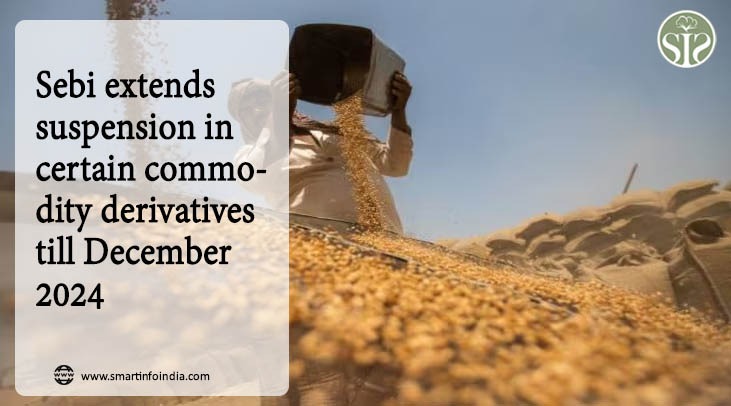
Sebi extends suspension in certain commodity derivatives till December 2024

Sebi extends suspension in certain commodity derivatives till December 2024The market regulator has extended the suspension in trading in certain commodity derivatives till December 2024.The Securities and Exchange Board of India (Sebi) on December 19, 2021 had issued directions to stock exchanges having commodity derivatives segment to suspend trading in derivative contracts in the commodities--paddy, wheat, chana, mustard seeds and its derivatives, soya bean and its derivatives, crude palm oil and moong—for a year.This was done on inflation concerns, around the time of a few state elections. That November wholesale inflation had spiked to 14.23 percent.  The index had remained in double digits for eight consecutive months beginning in April, mainly because of surging prices of food items.Thereafter, the suspension was extended for one more year, beyond December 2022, to December 2023.A latest press release from Sebi on the extension of the suspension said, “In continuation of the said directions, the suspension in trading in the above contracts has been extended for one more year beyond December 20, 2023 i.e. till December 20, 2024.”In 2022, a team of researchers from IIM Udaipur, Jindal School of Government and Public Policy and Universidad Carlos III de Madrid had written that banning derivatives in the segment is futile.They wrote, “ there is no evidence that derivatives trading led to higher prices or that the suspension had any effect in bringing down price variability. Rather, the decline in price levels was observed across all oils, irrespective of their derivatives trading status.  Price surges are typically rooted in the underlying demand and supply factors, as observed in earlier studies.”The researchers added, “The Report of the Expert Committee on Integration of Commodity Spot and Derivatives Markets (2018) also argued that outright bans erode the confidence of participants in the domestic derivatives markets. Evidence from past suspensions shows that once a contract is banned or suspended, it is difficult to bring back trading activity to even the pre-ban levels once the ban is revoked. Market participants have an easy choice to hedge their risks on international exchanges, where no such regulatory uncertainty exists.”

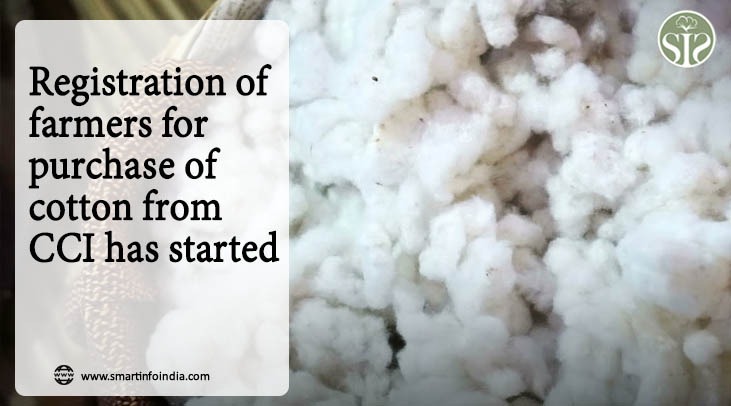
CCI Begins Cotton Farmer Registration in Vidarbha

The Cotton Corporation of India (CCI) has begun registering farmers for cotton procurement for the current season across Vidarbha.Registration is being conducted at 33 procurement centres spread across eight districts—Akola, Amravati, Buldana, Chandrapur, Nagpur, Wardha, Washim, and Yavatmal. Farmers can enroll at these centres to sell their produce under the government procurement system.For this season, CCI has announced a guaranteed Minimum Support Price (MSP) of ₹7,020 per quintal for long staple cotton and ₹6,620 per quintal for medium staple cotton.District-wise, the procurement centres include seven in Akola, two in Amravati, five in Buldana, three in Chandrapur, two in Nagpur, six in Wardha, two in Washim, and six in Yavatmal. These centres operate under the Akola divisional office, while arrangements for other cotton-growing districts are being managed by the Aurangabad division.Actual procurement is expected to begin only after Diwali this year. Due to delayed rains, sowing was pushed back, and the cotton season has not yet fully commenced. Currently, picking is limited to areas where sowing took place earlier, around May or June.Market prices remain subdued, with new cotton trading between ₹6,500 and ₹6,700 per quintal, while old stock is fetching around ₹7,200. Farmers are closely monitoring price trends, as their selling decisions will depend on how rates behave once arrivals increase.In recent years, government procurement had slowed due to favourable open market prices. However, if market rates remain low this season, a shift back towards CCI procurement is likely.

Tamil Nadu government approves six mini textile parks

Tamil Nadu government approves six mini textile parksThe Tamil Nadu government has so far approved setting up of six mini textile parks in the State and eight more are awaiting approval.Textile Commissioner, Tamil Nadu government, M. Vallalar, told The Hindu that there are at least 100 expression of interest received for the scheme. “We have given life to the scheme that was dormant since 2015. It will start gaining momentum now,” he said.The scheme offers 50 % or ₹2.5 crores subsidy to develop common facilities in a mini textile park. The park can come up on minimum two acres and with just three units. The stakeholders should identify land, form a special purpose vehicle, and submit a detailed project report. Across the State, about 20 DPRs have been received for the scheme. “There are eight project from in and around Madurai. In Coimbatore, the slowdown has affected the textile industry and hence the response is gradually picking up,” he said.Coimbatore District Collector Kranthi Kumar Pati held a meeting with industry representatives here on Wednesday, October 26, to explain details of the scheme. Officials, who were part of the meeting, said the scheme earlier mandated requirement of 10 acres and 10 industries. This has been reduced now. Textile spinning mills will require more space and hence, the scheme will benefit those in the post-spinning operations, such as weaving, garmenting or finishing. If the park is set up in backward blocks of the district, the units can avail of capital subsidy from the MSME Department. Some of the weaving units in Annur area have evinced interest, they added.

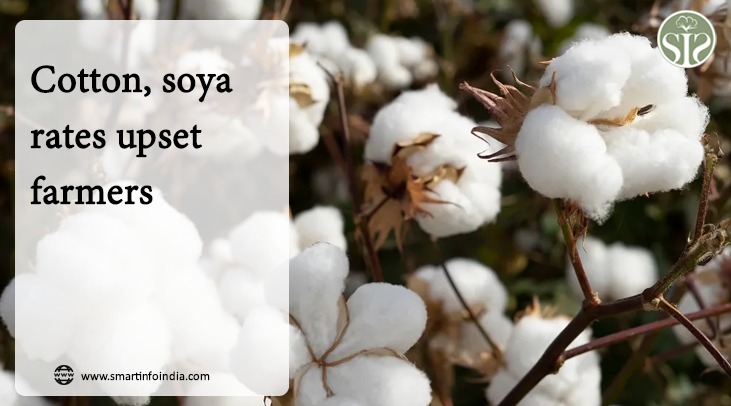
Cotton, soya rates upset farmers

Cotton, soya rates upset farmersNagpur: The Dussehra ‘muhurat’ deal for cotton — a symbolic gesture to mark the beginning of the buying season — has come as a dissappointment for farmers. The opening rate offered to growers is between Rs 6,800 and Rs 7,000 a quintal, which is slightly below minimum support price (MSP) of Rs 7020 fixed for long staple cotton.Cotton is the main crop for farmers in most parts of Vidarbha with soyabean being the second most popular one.Soyabean is fetching up to Rs 4800 a quintal — barely above the MSP of Rs 4600. The rate is still better than what farmers received last year. However, large tracts of farmlands are affected by the yellow mosaic virus this year, thus bringing down the yield.Dussehra marks the beginning of harvest/selling for farmers. While cotton bales start reaching the market around this time, soyabean comes a little early. No doubt, the current rates have proved a dampener for growers ahead of the Diwali season.On Wednesday, Shetkari Swabhiman Paksha leader from Buldhana, Ravikant Tupkar, announced his plan to tour all districts of Vidarbha and Marathwada to mobilise farmers for a massive protest. “The rally would end at Shegaon in Buldhana on November 20. If the demands are not met by then, a massive agitation will be held across the state,” he said.Tupkar wants the state to announce loan waiver for farmers. As per his own calculations, cotton must get at least Rs 12,000 a quintal and soyabean Rs 10,000 for the farmers to make profits.Vijay Jawandhia, a veteran farm activist from Wardha, said cotton has fetched around Rs 6,800 while soyabean is getting Rs 4800. However, the yield this year is abysmally low due to yellow mosaic virus attack. There are reports of per acre harvest coming down to barely two quintals. Cotton harvest is also expected to be below expectation, Jawandhia said.Traders says the actual picture will be clear as the buying season proceeds. A trader at the Hinganghat market yard of Wardha district said cotton arrival is very less at present. “There are reports of some non-irrigated fields giving poor yield of cotton. By the time rates improve, a large number of farmers may end up selling their produce,” said the trader.Piyush Bothra, a dealer in farm inputs in Maregaon in Yavatmal, said farmers are talking about pests other than pink bollworm which causes significant damage to the cotton crop.Manish Jadhav, a farmer from Yavatmal, said traders buying cotton directly from the field are offering as low as Rs 6500 a quintal. Some soyabean farmers may not get more than a quintal per acre.

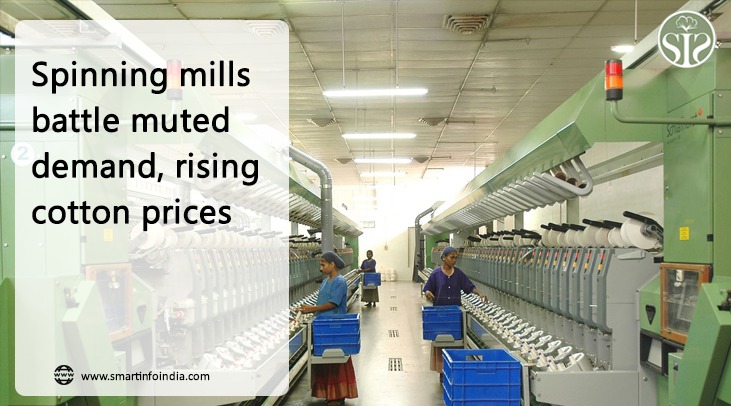
Spinning mills battle muted demand, rising cotton prices

Spinning mills battle muted demand, rising cotton pricesAhmedabad: Spinning mills in Gujarat find themselves in the eye of a storm, grappling with surging costs and a shrinking appetite for their products, be it on home turf or in foreign markets. Though cotton prices have eased slightly, they are still perched higher than their international counterparts.To put it in rupees and candy (356 kg) terms, cotton futures hover between Rs 53,000 and Rs 54,000.This price rift is not just denting the competitiveness of local yarn producers, it is also applying a vice-like grip on their financial stability.Saurin Parikh, the president of the Spinners’ Association of Gujarat (SAG), sheds light on the situation: “The relatively higher cost of cotton in India compared to other countries is increasing the overall expense of yarn production. As a result, Indian yarn manufacturers face reduced competitiveness in the international market. Furthermore, the ongoing economic downturn in Europe and the US has led to a significant drop in apparel demand due to restrained spending. So, the demand for yarn has failed to rebound. In times of low demand, manufacturers cannot afford to raise prices.”Even the domestic demand has recently suffered due to reduced discretionary spending, said industry players. Sanjay Jain, chairman of the national textiles committee of the Indian Chamber of Commerce (ICC), said, “The festive season has not brought the expected relief to spinning mills, as demand remains sluggish. Manufacturers are receiving fewer orders from finished fabric producers. The demand scenario is the worst over the past two decades, with the industry facing a sustained slowdown. Lifestyle alterations and a change in priorities when it comes to purchases are also reasons for the recent decline in discretionary spending.”The waning demand has also affected the liquidity of the yarn makers. Additionally, SAG’s estimates suggest that the cotton inventory in manufacturing units has been considerably reduced. Parikh revealed inventory days for cotton stock have been reduced from 60 days to just 12 days.source : The times of India

Related News

Youtube Videos

रुई के भाव में लगातार गिरावट 😱 क्या आगे भी रहेगी मंदी? | Cotton Market
रुई के भाव में लगातार गिरावट 😱 क्या आगे भी रहेगी मंदी? | Co...
रुई बाज़ार में गिरावट का सिलसिला जारी 😱🔥Cotton market rate today #youtube
रुई बाज़ार में गिरावट का सिलसिला जारी 😱🔥Cotton market rate...
रुई बाज़ार में गिरावट का रुख 😱 Cotton market rate today #youtube
रुई बाज़ार में गिरावट का रुख 😱 Cotton market rate today #you...
Application Download
Whatsapp Contact