Increase in labour cost in Bangladesh could help Indian garment exporters, say expert
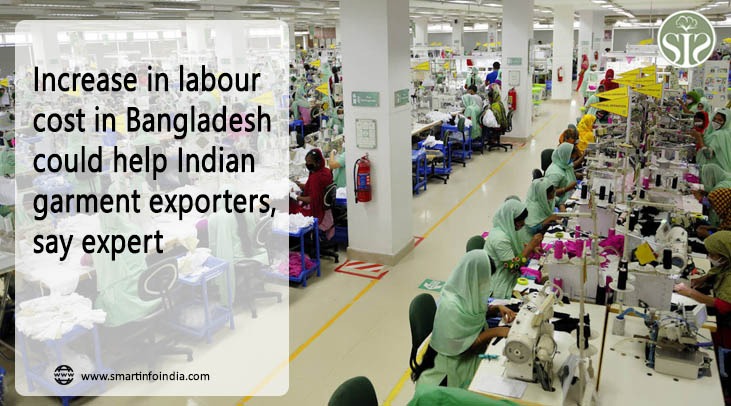
Increase in labour cost in Bangladesh could help Indian garment exporters, say expertWill Indian garment export demand see an upswing due to labour issues in Bangladesh, which has an edge over India in the sector globally? Things look bright but challenges remain.Bangladesh has built a ‘solid’ garment industry in the last one decade. It has an edge over India in the global readymade garments market, which is valued around $1,110 billion in 2023. India’s exports of readymade garments (RMG) including cotton accessories stood at $16 billion in FY23. In comparison, Bangladesh’s RMG exports last fiscal was more $47 billion, according to data on the web.David Birnbaum, Strategic Planner for the Global Garment Export Industry, says garment industries in Bangladesh are in trouble as tens of thousands of workers have taken to the street seeking higher wages. With minimum wage of $75 per month, workers there are demanding now minimum wages of $208. However, the industry has offered $113 on a take-it-or-leave-it-basis, he said.“We are looking at an existential problem. Frankly, a rise to $113 is not enough. Indeed, it is still below wages in neighbouring India and Pakistan,” he said. India’s wages in the garment sector is $168, while it is $142 in Pakistan, he added.Bangladesh’s garment industry is certainly in a state of decline, but so too are Pakistan and Cambodia and the other cheap commodity garment exporters, he told businessline.“India’s advantage is that it is not Bangladesh. India’s strategy is not to become the next Bangladesh but rather the next India. You have special nets and and facilities that customers want and need. Develop those. For instance, India has great fashion and colour sense. You can produce great quality. You can maintain design integrity. However, these are of no value if you plan to be the next Bangladesh,” he said.The Indian garment export demand may see an upswing due to high labour costs in Bangladesh, which is a major competitor, said P Sundararajan, CMD, SP Apparels Ltd, based in Avinashi in Coimbatore, and a large garment exporter.Bangladesh is consuming a wage hike of 35 per cent to 40 per cent. The high inflation there could create an opportunity for India’s apparel players. The situation in Bangladesh presents a significant opportunity for the Indian garment industry to capture a larger share of the global market, he told analysts while discussing the company’s September quarter financial results.Moreover, recent developments in Bangladesh, such as increase in labour costs and worker unrest impacting the industry, have led many retailers to shift their focus away from Bangladesh, he said.Scale & Competitiveness“Indian apparel companies needs to build scale and competitiveness in every aspect of manufacturing, very importantly integration. Even after the recent wage increase, if we account for the efficiency and low attrition rate at Bangladesh, they will continue to maintain their competitiveness. We can definitely compete by focusing on continuous improvement in process and products,” he said.N Chandran, Chairman of the Tiruppur-based Eastman Exports, said, “there will be no immediate benefits, but we hold a positive outlook for the long term. We will have to monitor events in Bangladesh, including the consideration of duty-free access to the US. The consideration of duty-free access to the US is in the wake of Bangladesh seeking this benefit from the US for its exports.”“Even after the recent wage increase, if we account for the efficiency and low attrition rate at Bangladesh, they will continue to maintain their competitiveness. We can definitely compete by focusing on continuous improvement in process and products,” said Prabhu Dhamodharan, Convenor, Indian Texpreneurs Federation, Coimbatore.. “We need to build scale and competitiveness in every aspect of manufacturing, very importantly integration,” he added.