Recent News

Textile Associations Urge Intervention On CCI Cotton Trading Policies

Textile Associations Urge Intervention On CCI Cotton Trading PoliciesThe Confederation of Indian Textile Industry (CITI) has sought government intervention to tackle the challenges confronting the trading policies of the Cotton Corporation of India (CCI).CITI, and allied textile associations, jointly presented a memorandum to Piyush Goyal, Minister of Textiles, to address concerns related to CCI’s Minimum Support Price (MSP) cotton procurement practices, proposing revisions to ensure price stability and a seamless supply to downstream sectors.The textile industry emphasises that current practices favour multinational cotton traders, leading to speculation in cotton prices that adversely affect yarn prices and exports of cotton-based textile and clothing products.Given the financial strain on the Micro, Small, and Medium Enterprise (MSME) spinning segment, the memorandum calls upon Piyush Goyal to implement several measures, including initiating CCI cotton sales to registered textile/spinning mills from February/March.It advocates retaining MSP-procured cotton as a buffer stock, releasing it based on international price differentials to ensure price stability. Monthly price announcements, factoring in MSP procured price, carrying charges, and other incidental charges, are also proposed.Further recommendations include extending a uniform free period of 60 days for all actual users, collecting a one-time Earnest Money Deposit (EMD) of 10 per cent for advance booking, providing a key loan facility by storing pre-booked cotton at individual mill premises for day-to-day use against payment, selling cotton in multiples of 130 to 150 bales (one truckload) on par with MCX to benefit small spinning mills, and establishing a Sub-Committee to monitor CCI's trade practices and prices, taking corrective measures when necessary.Emphasising the mutual benefits for CCI, the Government, and the user industry, the joint memorandum underscores the adoption of these policies to ensure stability in cotton prices, safeguard the interests of MSMEs, and foster the long-term growth of the Indian cotton textiles and clothing industry.

As cotton prices rule steady, spinners and traders stock up

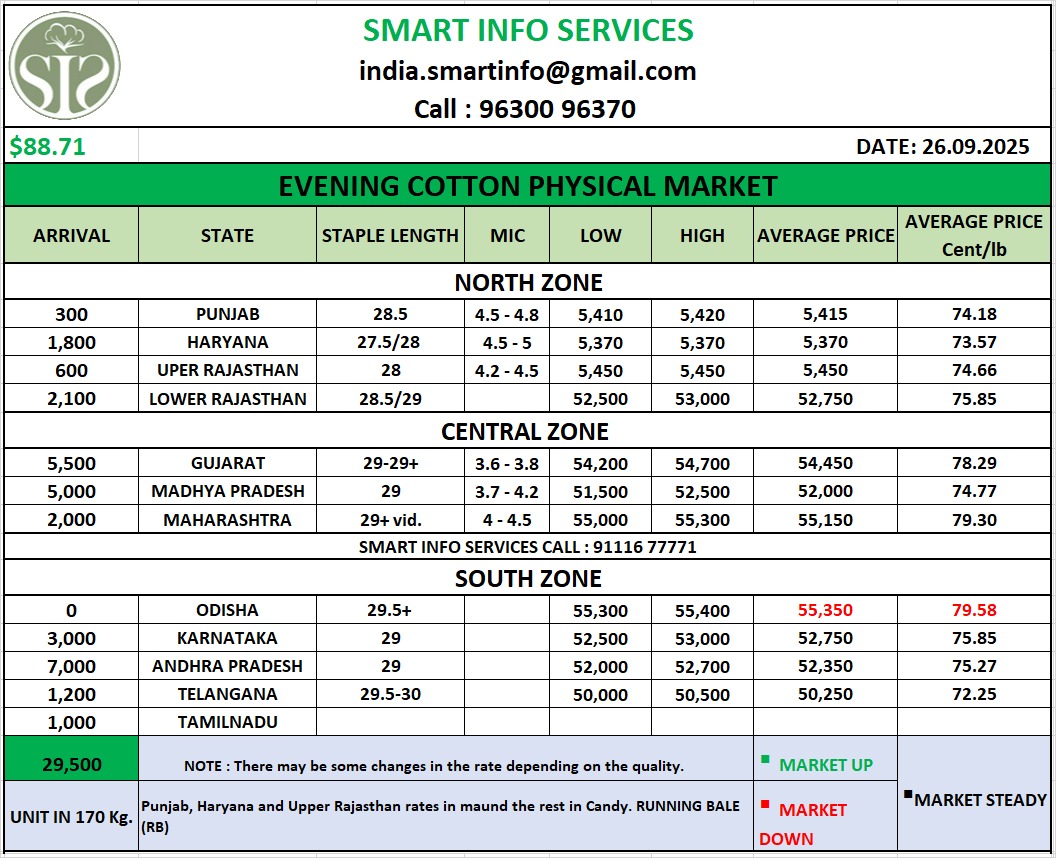
As cotton prices rule steady, spinners and traders stock up Industry sees the market having bottomed out at ₹55,000 per candyCotton prices are ruling steady over the past month helping in demand improving from spinning mills, traders and multinational trading houses as the general consensus is that the market may not drop any more from here.“It is unlikely that there will be any sharp fall in prices from here. It is one reason why mills are buying. Also, prices on InterContinental Exchange have increased by 4 cents in the past couple of sessions encouraging international trading houses to buy,” said a trading source without wishing to identify. “The cotton market has been steady over the past month at ₹54,100 and ₹55,500 for 29 mm and 30 mm cotton, respectively. The demand has been steady from mills and exporters are buying small quantities,” said Ramanuj Das Boob, a sourcing agent for multinationals based in Raichur, Karnataka.Lack of liquidity“Cotton prices seem to have bottomed out. The difference of 2-3 cents between domestic and global prices is attracting multinational trading houses,” said Anand Popat, a Rajkot-based cotton, yarn and cotton waste trader.However, Prabhu Dhamodharan, Convenor, Indian Texpreneurs Federation (ITF), said though current prices are reasonable, the lack of liquidity in the market has reduced the purchasing power in the trade for cotton.Currently, March futures on ICE are ruling at 82.81 US cents a pound (₹54,425 a candy of 356 kg). For cash, the natural fibre is quoted at 80.26 cents (₹52,750 a candy) on the exchange. Demand for qualityIn the domestic market, Shankar-6, the benchmark export variety, was quoted at ₹55,300 a candy. In Gujarat’s Rajkot agricultural produce marketing committee yard, kapas (unprocessed cotton) ruled at ₹6,885 a quintal against the minimum support price of ₹6,620. “As traders perceive that this is the minimum price one can expect, they are stocking up on quality material. Given the variations in quality, there will always be demand for quality cotton at this level, This is the best time to procure,” said Das Boob.“The Cotton Corporation of India (CCI) has procured some 20 lakh bales (of 170 kg) till now. It could have procured 40-50 lakh bales in a month from now. Others could hold 15-20 lakh bales. This could push up prices,” said Popat.Retail buyers cautiousThe trading source said CCI procurement was surprising and it could decide the market movement later in the season. Popat agreed with the view that CCI could be crucial in how prices rule later this season. Das Boob said CCI procurement may top 30 lakh bales.“Imported synthetic dyed fabrics imports are grabbing the market share of cotton fabrics. Sluggish domestic demand at the retail end has turned buyers cautious. It has resulted in manufacturers witnessing the demand fluctuating,” said Dhamodharan.The Raichur-based sourcing agent said this is the best time to procure the quality fibre. “We feel quality cotton will maintain this price level and in the near future, depending on yarn demand, may rise once arrivals decline,” he said.  The ITF Convenor said though the overall cotton utilisation has improved compared with the previous two quarters, the textile sector continues to operate at lower levels as the visibility of strong orders was lacking.Red Sea crisis not big“Yarn exports have stabilised with challenges in pricing, leading to margin pressure for mills. Apparel exports recovery is uneven across products and still we are behind our historic volumes,” he said. All these factors were leading to a cautious approach among spinners towards buying cotton and mills are buying based on their own order visibility, said Dhamodharan.The Raichur-based sourcing agent said mills are covering at a slow speed due to low yarn demand.  “Most of the reputed mills are covering cotton at this level to maintain the quality requirements.“The market movement mainly depends on yarn offtake and demand in the local market and exports. Average grade quality cotton is also available with shorter length with prices ruling at ₹50,000-53,000 a candy. Prices of these may also improve and there is ample availability,” said Das Boob. Though the Red Sea crisis has resulted in freight charges surging, it has not emerged as a big issue for yarn exporters, said Popat. The current trend is despite fears of a lower cotton crop this year. The Ministry of Agriculture, in its first advanced estimate, pegged the output at 316.6 lakh bales, 5.9 per cent lower from 336.6 lakh bales a year ago. A section of the trade says production could be below 300 lakh bales, while some peg it at a little over 320 lakh bales

Why is the price of Chinese cotton rising from December?

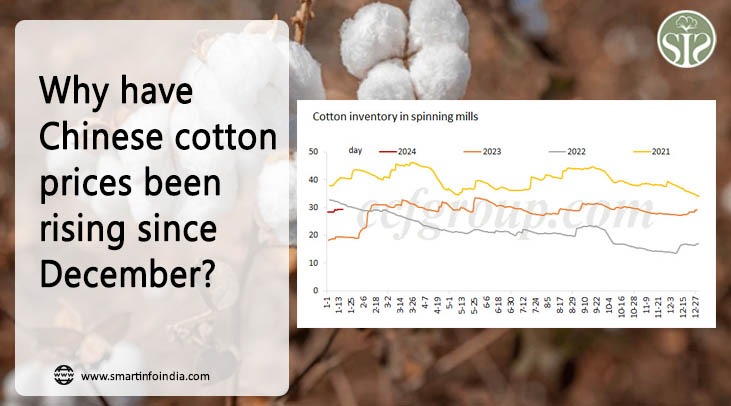
Why is the price of Chinese cotton rising from December?Since the beginning of December 2023, ZCE cotton futures have continued to rise, with the key contract rising from a low of 14,740yuan/mt to a high of 15,860yuan/mt on the morning of January 18, up more than 1,000yuan/mt. There is an increase. From a Mt fundamentals perspective, the sustained price increase during this period is primarily driven by good demand from downstream sectors. After cotton prices bottomed out in late November, the downstream textile industry experienced a sharp reduction in cotton yarn inventories due to pre-holiday replenishment demand, pressured demand and delayed demand from October and November. This event alleviates the cotton yarn trader's concerns about inventory, and the entire industry chain returns to smooth operations. Strong downstream demand supports the upward trend in cotton prices.Due to the performance of downstream textile mills, cotton yarn inventories have declined sharply since the beginning of December and have reached a relatively low level. However, cotton yarn sales have slowed recently due to the approaching spring festival. However, the basic situation of low inventory pressure in spinning mills and no significant inventory pressure has been established for cotton yarn traders. Therefore, textile mills are still in demand to buy cotton at favorable prices after a rapid decline in cotton thread inventory. The order position for textile factories remains better than expected, with some large-scale textile enterprises receiving orders by February or March, while smaller enterprises have a relatively poor order position. Overall, home textile orders remain strong. Considering the recent boom in tourism in Harbin, residents' willingness to travel remains stronger than during the epidemic period.From the latest market retail data, Chinese domestic sales demand in 2023 is also satisfactory, especially in November and December when the year-on-year growth rate of clothing retail sales continued to expand, reaching 11% for the full year. wentOverall, unless downstream demand declines significantly, the upward driving force in cotton prices will remain. However, the performance of downstream end-market demand after the Spring Festival needs to be verified. If end-market demand is weak, inventory pressures may reappear for cotton yarn traders, which may put pressure on cotton prices. Conversely, if end-market demand remains strong and hedging pressure gradually eases, cotton will be a strong driving force for price growth.Source: CCF

38 lakh cotton bales came to Gujarat’s market yards till Jan 15

38 lakh cotton bales came to Gujarat’s market yards till Jan 15The textile industry in Gujarat is optimistic as the arrival of cotton at market yards has been strong this season. According to data from the GujCot Association, the state has seen around 38 lakh bales (170kg each) from Oct 1 to Jan 15.The state is seeing about 45,000 bales arrive every day despite cotton prices being significantly lower than last year. Across India, cotton arrivals reached 1.35 crore bales till Jan 15. GujCot Association secretary Ajay Shah said, “By our estimates, Gujarat will have around 85 lakh bales for pressing in the cotton season of 2023-24 (Oct 2023 to Sept 2024). This year, arrivals have been stronger with a daily average of 45,000 bales in Gujarat. Last year, farmers were not selling the crop in volume, so arrivals were low. This year prices have decreased but farmers are selling cotton.”According to GujCot data, good quality raw cotton is priced at around Rs 1,450 per 20kg while low quality cotton is priced at around Rs 1,250 per 20kg. Processed cotton prices have remained at around Rs 55,000 a candy (356kg) for about a month, which has brought stability to the textile industry.Cotton prices had reached Rs 1.10 lakh per candy due to low supply in May 2022 and this affected the textile industry badly. Since Dec, cotton yarn export orders have also increased, according to the Spinners Association Gujarat. (SAG).source: Times of India



Related News

Youtube Videos

रुई के भाव में लगातार गिरावट 😱 क्या आगे भी रहेगी मंदी? | Cotton Market
रुई के भाव में लगातार गिरावट 😱 क्या आगे भी रहेगी मंदी? | Co...
रुई बाज़ार में गिरावट का सिलसिला जारी 😱🔥Cotton market rate today #youtube
रुई बाज़ार में गिरावट का सिलसिला जारी 😱🔥Cotton market rate...
रुई बाज़ार में गिरावट का रुख 😱 Cotton market rate today #youtube
रुई बाज़ार में गिरावट का रुख 😱 Cotton market rate today #you...
Application Download
Whatsapp Contact