Recent News

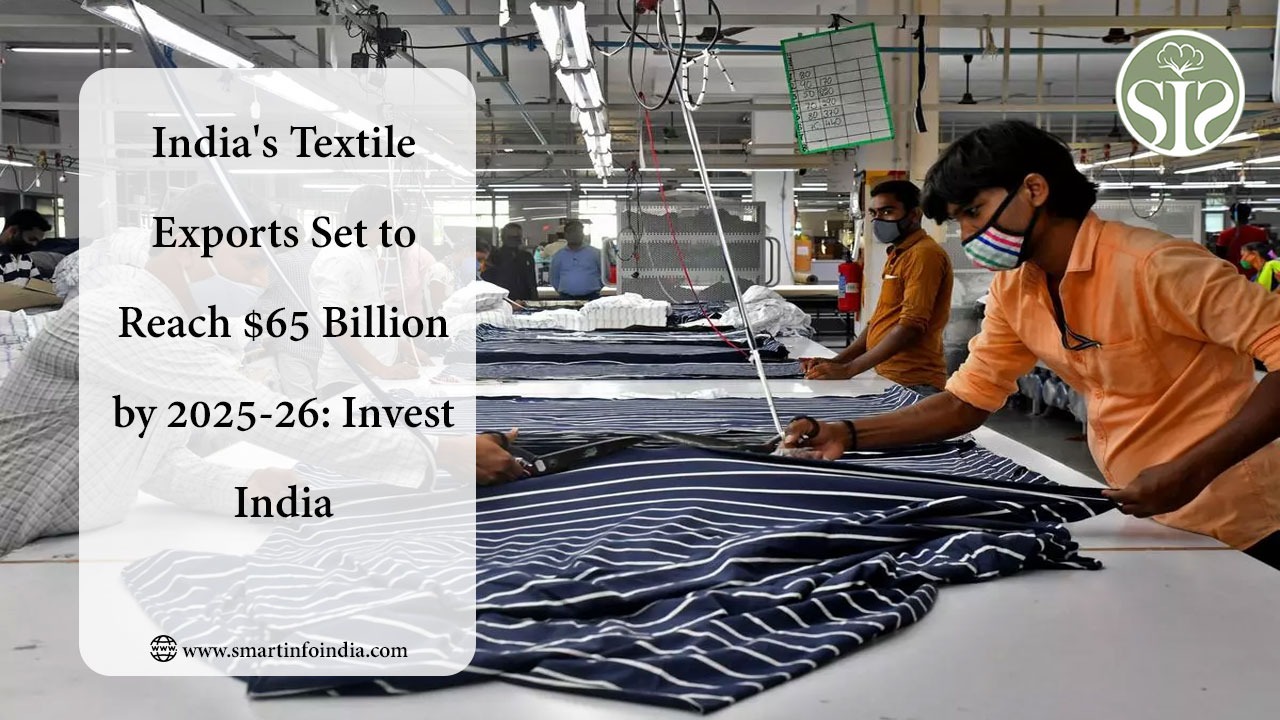
India's Textile Exports Set to Reach $65 Billion by 2025-26: Invest India

Invest India Projects That India's Textile Exports Will Hit $65 Billion by 2025–2026India’s textile industry is poised for significant growth, with exports projected to hit $65 billion by the financial year 2025-26, according to a report by Invest India. This optimistic forecast underscores the robust expansion of the sector, driven by strong demand in both domestic and international markets.In 2022, the Indian textile and apparel market was valued at approximately $165 billion, with the domestic segment contributing $125 billion and exports accounting for $40 billion. The industry is expected to continue its upward trajectory, with projections indicating a compound annual growth rate (CAGR) of 10 percent. By 2030, the total production value for textiles in India—encompassing both domestic consumption and exports—is expected to reach $350 billion.Invest India attributes this rapid expansion to the visionary "fibre-to-fashion" approach championed by Prime Minister Modi. This initiative is not only propelling India’s textile industry onto the global stage but is also enhancing the technological capabilities and competitiveness of domestic players. "PM Modi's bold fibre-to-fashion vision is guiding the textile industry to become a driving force in the global market while bringing competence and technology to local players," Invest India stated in a post on the social media platform X.The growth of India's textile sector is also expected to create significant employment opportunities and contribute to the overall economic development of the country. As the industry continues to evolve, it will likely attract increased investment in innovation, sustainable practices, and advanced manufacturing technologies, further solidifying India's position as a global leader in textiles.read more :- Possibility of pressure on cotton prices, despite decline in area and productivity

Possibility of pressure on cotton prices, despite decline in area and productivity

Pressure on cotton prices could exist even while production and area are declining.Nagpur: Due to continuous rains, the area under cultivation is decreasing and the increasing incidence of pests and diseases is likely to lead to a decline in the productivity of cotton. Despite this, senior agricultural expert Vijay Javandiha says that there is pressure on the prices of cotton in the US market, due to which the prices of cotton in the Indian market are also expected to remain around Rs 6,500 per quintal.According to Javandiha, currently the price of 'Outlook-A' in the US cotton market is 78.60 cents per pound of cotton (2.2 pounds = 1 kg). About 35 kg of cotton and 64 kg of sardki are obtained from one quintal of cotton. If 79 cents per pound of cotton and Rs 30 per kg of sardki are calculated, then the price of 35 kg of cotton is Rs 5,110 and the price of 64 kg of sardki is Rs 1,920.Thus, the total income of cotton and sarkki is Rs 7,030, from which Rs 6,500 remains after deducting the processing cost of Rs 500. Therefore, cotton prices are likely to remain in the range of Rs 6,500. However, the central government has announced a guaranteed price of Rs 7,500 per quintal for cotton for this season.Given the slowdown in the global market, farmers may get Rs 1,000 less than the guaranteed price, which will require the government to buy cotton at the guaranteed price. Javandhiya has also raised the question that in such a situation, how can the target of doubling the income of farmers be achieved. read more :- Cotton Procurement in Haryana to Begin on October 1 Amid Record CCI Sales This Week

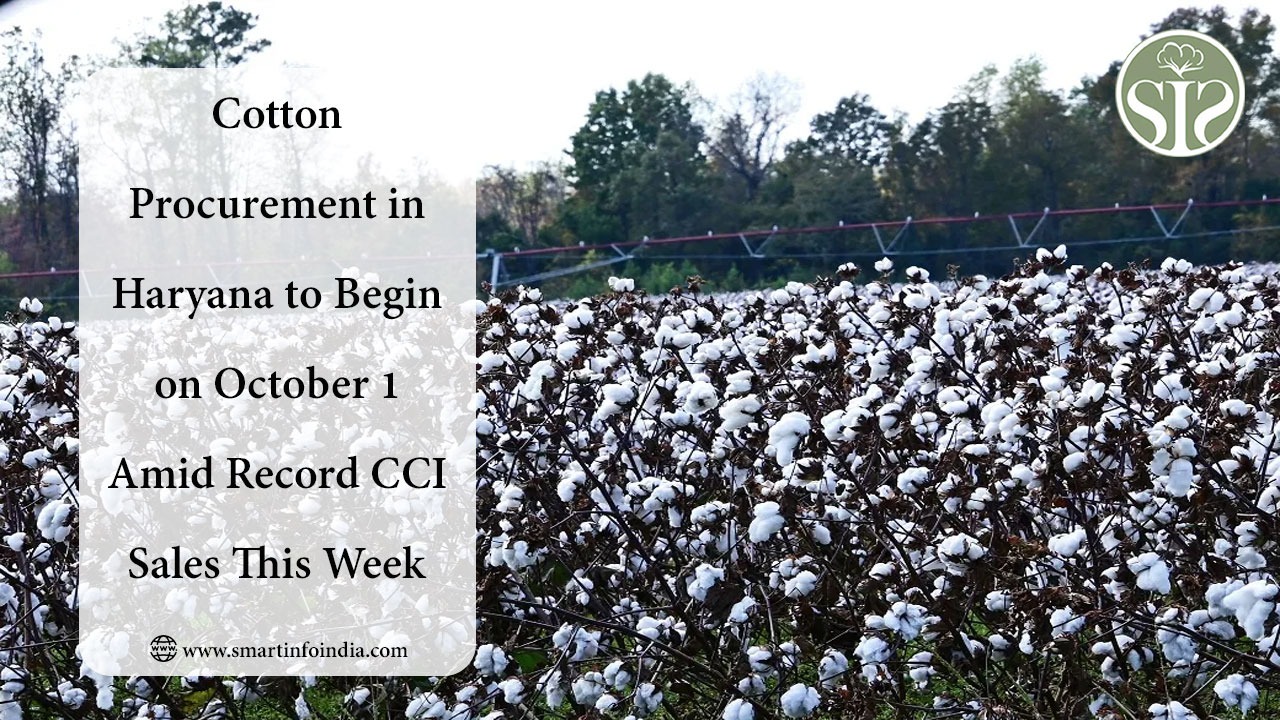
Cotton Procurement in Haryana to Begin on October 1 Amid Record CCI Sales This Week

Haryana's October 1st Cotton Procurement Will Start Despite This Week's Record CCI SalesCotton procurement for the Kharif Marketing Season 2024-25 in Haryana is set to commence on October 1, 2024. The procurement will be carried out at the Minimum Support Price (MSP) through the Cotton Corporation of India (CCI), following the guidelines of the Government of India. This comes in a week where CCI recorded exceptionally high sales, signaling strong market activity just ahead of the new procurement season.A review meeting, chaired by the Additional Chief Secretary of the Agriculture and Farmers Welfare Department, Raja Sekhar Vundru, was held to finalize the preparations for the upcoming procurement. Dr. Vundru emphasized the need to extend full support to the Cotton Corporation of India during the process. He assured that both the CCI and the Haryana Government are fully prepared to ensure that farmers can sell their crops without any issues.20 Mandis and Procurement Centers Established for CottonThe meeting also outlined that Haryana produces two varieties of cotton: Medium Long Staple (26.5-27.0 mm) and Long Staple (27.5-28.5 mm), both of which will be procured. To streamline this process, 20 mandis and procurement centers have been established across the state. These centers are located in the following districts: Siwani, Dhigawa, and Bhiwani (Bhiwani District); Charkhi Dadri (Charkhi Dadri District); Bhattu, Bhuna, and Fatehabad (Fatehabad District); Adampur, Barwala, Hansi, Hisar, and Uklana (Hisar District); Uchana (Jind District); Kalayat (Kaithal District); Narnaul (Mahendragarh District); Meham (Rohtak District); and Ellenabad, Kalanwali, and Sirsa (Sirsa District).Procurement of Other Crops at MSPThe meeting also addressed the procurement of other crops at MSP. The Haryana Government has designated HAFED as the primary agency responsible for procuring soybean, maize, and sorghum, with 100% of these crops being managed by HAFED. For other crops, procurement will be conducted in a 60:40 ratio between HAFED and other designated agencies.Key officials, including the Director of the Agriculture Department, Sh. Rajnarayan Kaushik, and the Director of the Food, Civil Supplies, and Consumer Affairs Department, Sh. Mukul Kumar, attended the meeting, along with other officers. Representatives from the Cotton Corporation of India also participated via video conferencing.read more :- Uneven Monsoon Disrupts Kharif Crops and Agricultural Production

Uzbekistan and Poland Explore Textile Sector Cooperation

Poland and Uzbekistan Examine Cooperation in the Textile SectorUzbekistan recently engaged in discussions with Poland to enhance textile exports to the country and explore the integration of modern Polish technologies into Uzbek industries.A delegation from Uzbekistan, comprising representatives from the Ministry of Investments, Industry, and Trade along with textile company officials, visited Poland to strengthen economic ties between the two nations.During their visit, the delegation toured the GD Poland International wholesale trade complex near Warsaw, where they met with Felix Wang, the complex's president, and Janusz Piechocinski, president of the Poland-Asia Chamber of Commerce. Both parties agreed to open a store for Uzbek textiles and footwear within the complex, offering special discounts and rental benefits to the Uzbek side.The delegation also visited the Union of Polish Weavers and several major companies, including yarn manufacturer Legs, Przedsiebiorstwa Produkcyjno Handlowo Uslugowego (PPHU), and Jola Styl, as reported by Uzbek media.In a joint business forum, discussions centered on the potential relocation of Bangladesh’s Rusinagency and Ukraine’s Arlen Textile Group to Uzbekistan, along with the implementation of innovative technologies to modernize Uzbekistan’s light industry.Uzbek textile enterprises such as Uztex Group, Aisha Home Textile, Korajon Textile, and Parvoz Humo Ravnaq Trans signed agreements with Poland-based companies Rusinagency, Arlen Textile Group, Legs, PPHU, Jola Styl, SWP, Ptak, and Colorinvest for the supply of yarn, gauze, knitwear, underwear, and home textiles to Poland.read more :- Textile and Chemical Exports to Bangladesh Resume After Brief Halt

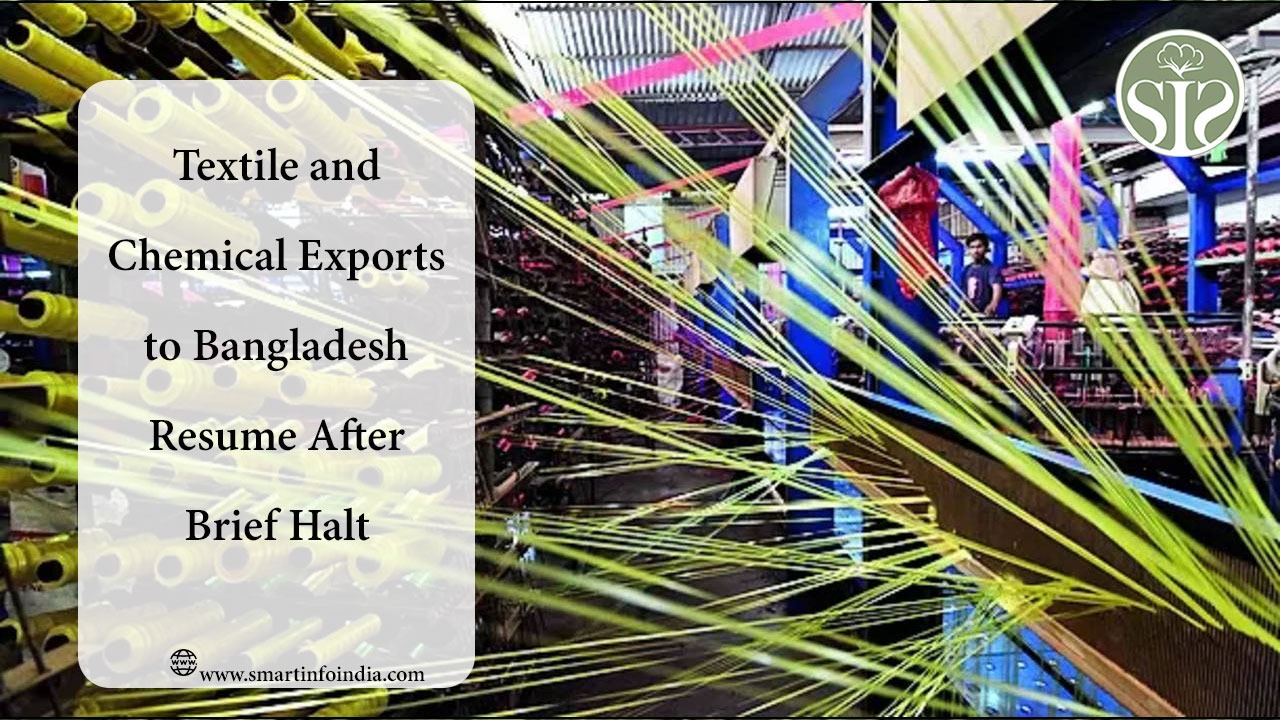
Textile and Chemical Exports to Bangladesh Resume After Brief Halt

After a brief pause, Bangladesh resumes exporting chemicals and textiles.Ahmedabad: With the political situation in Bangladesh stabilizing, exports of textiles and chemicals from Gujarat are beginning to return to normal, industry experts report. Fresh orders for cotton yarns and dye chemicals have started flowing in from Bangladesh, a key export market for Gujarat’s textile and chemical industries.According to industry sources, while payment issues have improved over the past week, exporters remain cautious in their business dealings.For India’s spinning sector, Bangladesh is the largest export market, accounting for 428 million kg of cotton yarn in 2023-24, which made up 35% of India’s total yarn exports.In the dyes sector, Gujarat exports over 3,500 tonnes of reactive dyes to Bangladesh each month. Given that garment manufacturing is a critical component of Bangladesh’s economy, the country cannot afford to lose these imports.Bharat Chhajer, former chairman of the Powerloom Development and Export Promotion Council (PDEXCIL), noted, “The textile industry in Bangladesh has resumed operations, and the situation is becoming stable. Exports had been halted due to the violence in Bangladesh, with cotton yarn containers held up at various Indian ports.”Exporters are closely monitoring the situation in Bangladesh and taking necessary precautions to ensure safe business transactions.Jayesh Patel, senior vice-president of the Spinners’ Association Gujarat (SAG), commented, “Exports to Bangladesh have resumed, and inquiries are picking up, but the overall costs are still not aligning with manufacturing costs.”The textile and chemical industries in Gujarat had been facing challenges since the Covid-19 pandemic. Although both sectors have seen a revival in the current financial year, the political unrest in Bangladesh had raised concerns.Manish Kiri, managing director of a chemical company, explained, “Gujarat’s dyestuff manufacturers supply 3,500 to 4,000 tonnes of dyes, primarily reactive dyes, to Bangladesh every month, representing nearly 15% of the state’s dye exports.”Approximately 150 businesses in Ahmedabad are involved in exporting reactive dyes to Bangladesh.“We’ve observed that the business environment is stabilizing sooner than anticipated. Payment situations have improved, and new inquiries and orders are beginning to come in,” Kiri added.read more :- Farmers in Punjab disillusioned with cotton, interest increased towards paddy cultivation, area reduced by three times

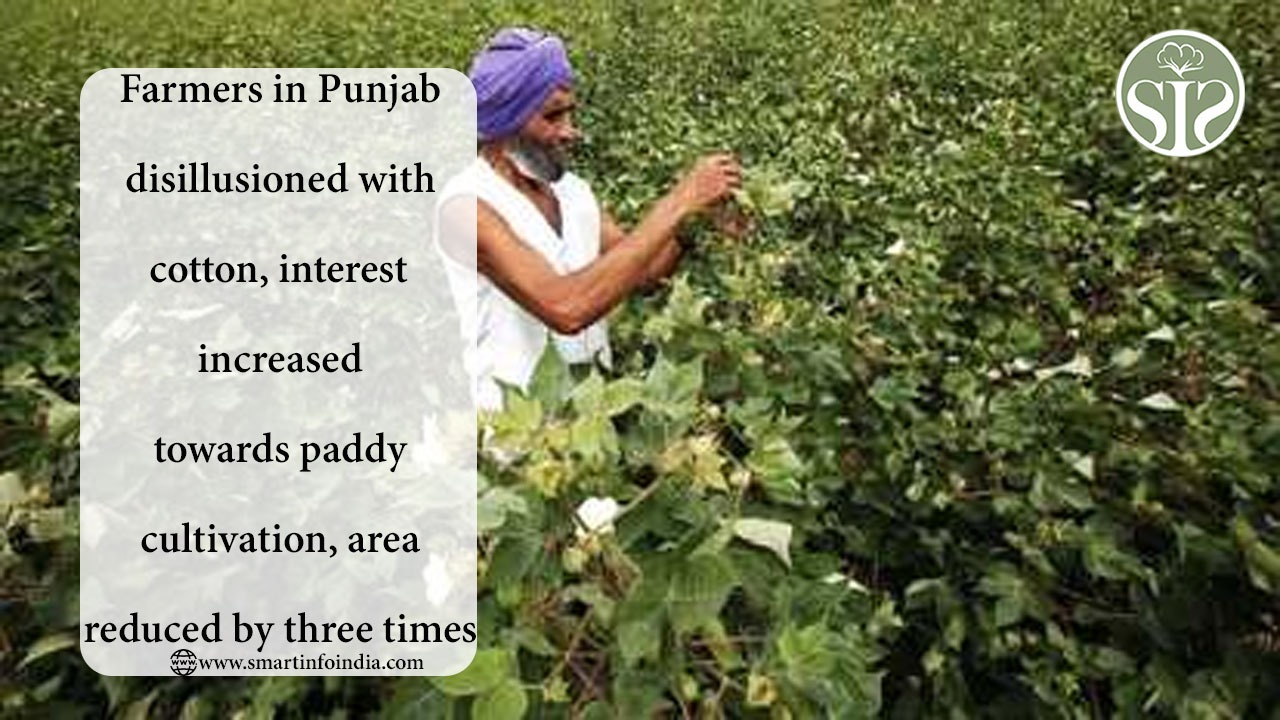
Farmers in Punjab disillusioned with cotton, interest increased towards paddy cultivation, area reduced by three times

Punjabi farmers lost faith in cotton, became more interested in paddy farming, and saw a threefold decrease in areaIn the current season, the area of cotton crop, which gives the highest income to the farmers, has come down to only 94,000 hectares in Punjab. In 2019, this area was 3.35 lakh hectares. In the last three to four years, farmers got bumper yield of cotton, and in 2022, the price of cotton went above Rs 10,000 per quintal. But this time the reason for the huge decline in the area of cotton was pests like bollworm and whitefly. In 2023, due to the outbreak of pink caterpillar, farmers could not even get half the production, and for many farmers it became difficult to even recover the cost.Increased interest in paddy cultivationThe reduction in cotton acreage has raised concerns among agriculture department officials that if appropriate steps are not taken in this direction, farmers may completely abandon cotton cultivation in the coming times and get attracted towards paddy. Paddy cultivation requires more water, which can lead to increased exploitation of groundwater level, which can create a serious crisis for the environment.Farmers destroying cotton cropIn many villages of Mansa, Bathinda and Fazilka districts, farmers have destroyed cotton crop and started sowing PR 126 paddy variety, which gets ripe in 110 days. An official of the state agriculture department said that the cost of pesticides to farmers to deal with pests like bollworm and whitefly increases, making cotton cultivation economically unviable. Although the income in cotton crop is high, paddy cultivation gives a fixed income.Need for better seedsPAU Vice Chancellor Dr SS Gosal said that to increase cotton acreage and ensure good harvest for farmers, they need better seeds. This is necessary to keep farmers away from paddy cultivation in cotton growing areas of south and west Punjab. According to KP Singh, Principal Special Principal Secretary, Agriculture Department, the Union Ministry of Agriculture and Farmers Welfare has been apprised of the situation, and the Punjab government is creating awareness among farmers to focus on low water consuming farming.Read more :- Minister S. Savitha Says Andhra Pradesh Government to Introduce Enhanced Textile Policy Soon

Related News

Youtube Videos

जानिए आज का कपास बाज़ार 😱 Cotton market rate today #youtube
Ganesh Chaturthi Celebration at Our Office 🙏✨ | Ganpati Bappa Morya! #shorts
Ganesh Chaturthi Celebration at Our Office 🙏✨ | Ganpati Ba...
कपास बाज़ार साप्ताहिक रिपोर्ट 🔥 | तेजी या मंदी? | CCI Update | Cotton Market  Update
कपास बाज़ार साप्ताहिक रिपोर्ट 🔥 | तेजी या मंदी? | CCI Updat...
Application Download
Whatsapp Contact