


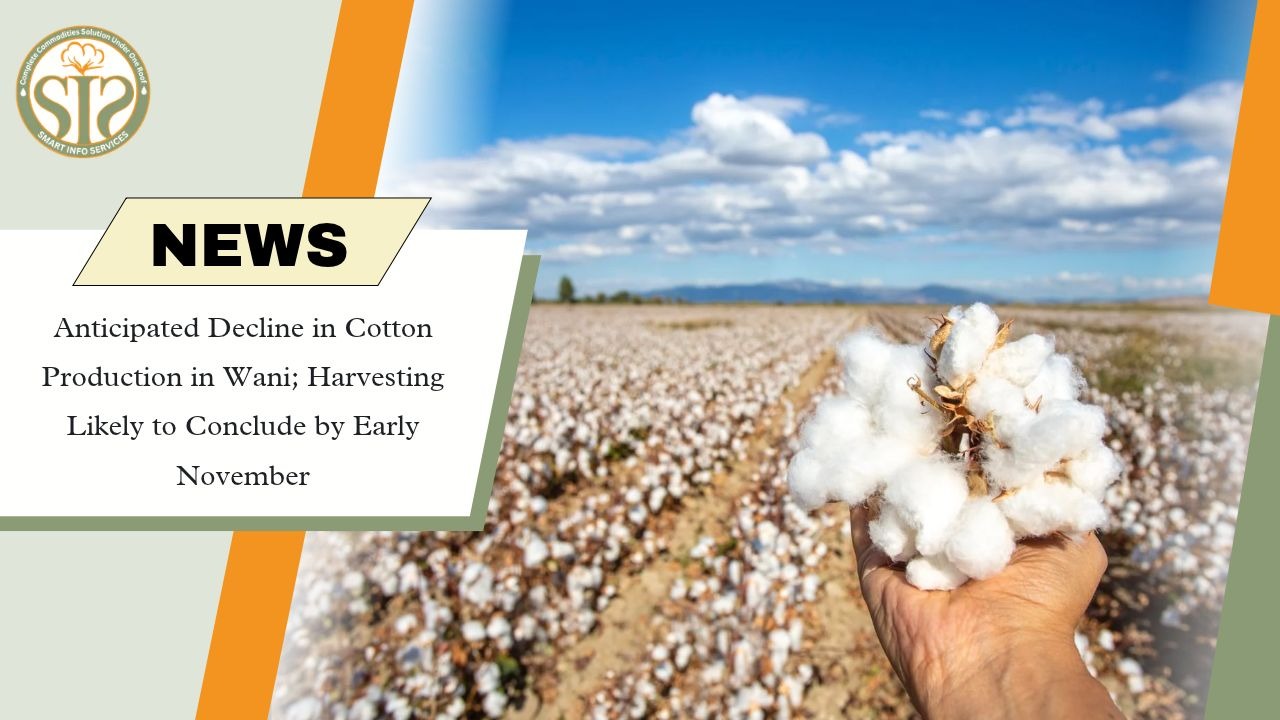
Anticipated Decline in Cotton Production in Wani; Harvesting Likely to Conclude by Early November
Wani (Maharashtra): Cotton crops in the Wani taluka of Maharashtra have been adversely affected by unfavorable weather conditions this year. A lack of rainfall during critical growth stages, combined with disease outbreaks in irrigated areas, has raised concerns about a decline in production. This is also expected to impact the duration of the cotton-picking season; while harvesting typically continues through December and January, it is now likely to conclude as early as the beginning of November. Lower yields and rising cultivation costs have further compounded the concerns of farmers.
Cotton Sown Across 42,768 Hectares in Wani Taluka
For a large number of farmers in Wani taluka, livelihoods depend on cotton cultivation. In the current Kharif season, cotton has been sown across an area of 42,768 hectares. Many farmers completed their sowing as early as June. Initially, good germination led farmers to expect a strong harvest; however, a lack of sufficient rainfall after July hindered plant growth. This has negatively affected the flowering and boll-formation stages, likely weakening the crop's overall yield potential.
Rainfall Deficit Causes Losses in Unirrigated Areas
The erratic nature of this year’s monsoon has hit unirrigated areas the hardest. Insufficient rainfall following July led to a depletion of soil moisture. The resulting water stress stunted the growth of cotton plants and reduced the number of bolls. In several areas, plants have even begun to wither and dry up. Consequently, farmers who rely solely on rainfall may face a significant drop in production.
Disease Outbreaks in Irrigated Areas
Even in areas with irrigation facilities, farmers have found little relief. Fluctuating weather patterns and irregular rainfall have triggered issues such as 'laliya' (reddening of leaves) and wilt (wilting of plants) in the cotton crop. These issues have affected plant growth and the formation of cotton bolls. To save their crops, farmers repeatedly applied pesticides and other agrochemicals, yet the expected improvement did not materialize.
Rising cultivation costs add to farmers' hardships
In cotton farming, farmers have incurred significant expenses on seeds, fertilizers, pesticides, application labor, and general crop care. A lack of rainfall and the prevalence of diseases necessitated additional pesticide applications, further driving up production costs. Meanwhile, the failure of the plants to develop the expected number of cotton bolls points to a likely decline in yield. Consequently, even if market prices are favorable, the low output may make it difficult for farmers to recover their cultivation costs.
Cotton picking season may conclude by early November
Typically, the cotton picking season in Wani Taluka extends through December and January. However, due to the poor condition of the crop and the low number of bolls this year, the picking season is expected to end as early as the beginning of November. If this occurs, the duration over which farmers harvest their cotton will be shorter than in a typical year. Low yields, escalating production costs, and an prematurely truncated picking season have created a significant economic challenge for the cotton farmers of Wani.
read more :- Indian Rupee higher 26 Paise to Close at 94.95 Against US Dollar.