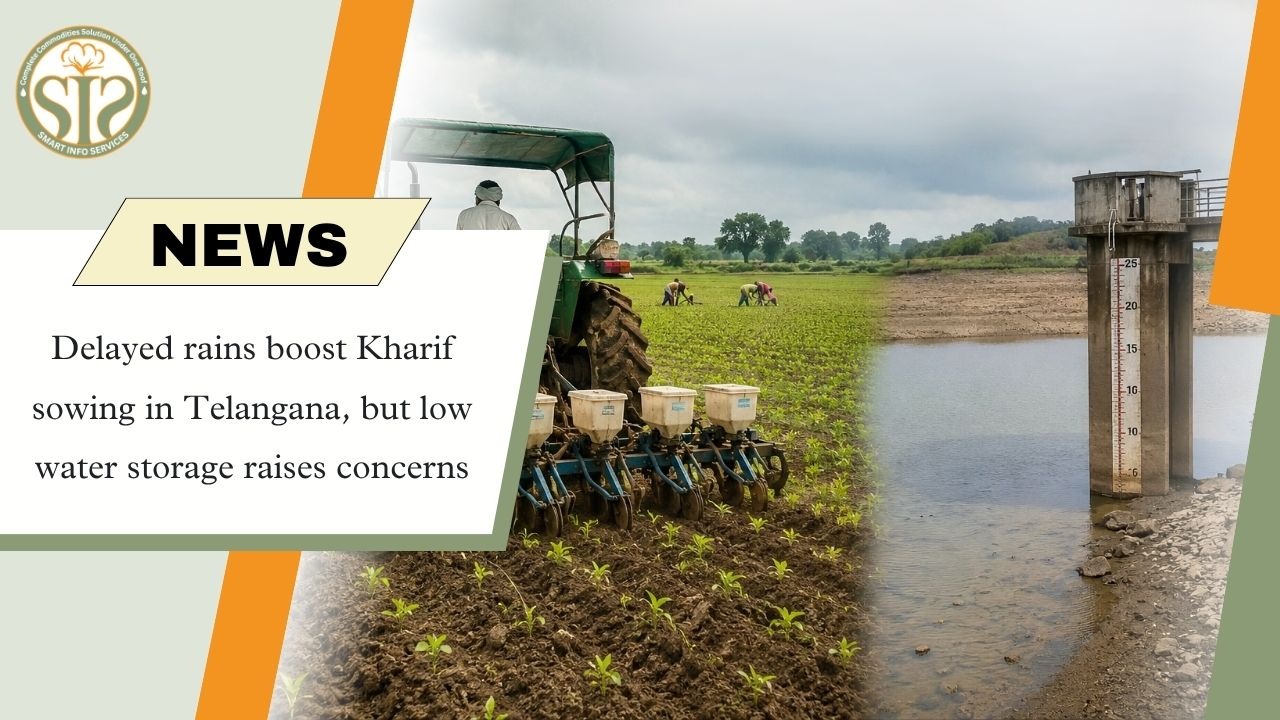
Delayed rains boost Kharif sowing in Telangana, but low water storage raises concerns
Hyderabad: Sowing activity for the Kharif (Vanakalam) season in Telangana has picked up significantly following increased monsoon activity. By August 5, sowing had been completed across 96.74 lakh acres, representing approximately 73 percent of the normal Kharif acreage of 132.38 lakh acres. However, water storage levels in major reservoirs—significantly lower than last year—remain a cause for concern regarding irrigation availability and crop productivity.
As of July 22, sowing had covered only 68.43 lakh acres (51.69 percent) of the state's area. The intensification of the monsoon during the second half of July, coupled with heavy rains in Maharashtra, Karnataka, and Chhattisgarh, increased water inflows into the Krishna and Godavari river basins, enabling farmers to accelerate sowing operations.
Farmers who had previously deferred sowing due to irrigation uncertainties resumed field operations rapidly following the recent rains. A notable increase has been recorded in the sowing of rain-fed crops, including cotton, maize, sorghum (jowar), pearl millet (bajra), finger millet (ragi), pulses, groundnut, and soybean. Meanwhile, paddy nurseries are being prepared in irrigated areas.
Despite this, water availability remains a concern. As of August 5, major reservoirs in the state held 438.90 TMC (thousand million cubic) feet of water, compared to 725.36 TMC during the same period last year. Although water storage has improved from the 321.24 TMC recorded two weeks ago, the significant deficit compared to the previous year is raising concerns about future irrigation availability.
Crop-wise data also presents a mixed picture. Paddy sowing has reached 26.16 lakh acres, against a normal acreage of 65.96 lakh acres. During the same period last year, paddy sowing covered 28.74 lakh acres. In contrast, cotton sowing has reached 46.80 lakh acres—nearly matching the normal acreage of 47.41 lakh acres and exceeding the previous year's 43.56 lakh acres. Meanwhile, pulse sowing has also increased to 5.48 lakh acres compared to the previous year.
According to agricultural scientists at Professor Jayashankar Telangana State Agricultural University, many farmers have prioritized alternative crops over paddy this year. However, if there is insufficient rainfall in the coming weeks and reservoir water levels do not rise as expected, the productivity and yield of Kharif crops could be affected.
read more :- India Cotton Market Recovers in July